ITIFSTER COPY
R CAC.–
4t
INTERNATIONAL COMMISSION ON IRRIGATION AND
DRAINAGE
COMMISSION INTERNATIONALE DES IRRIGATIONS ET
DU DRAINAGE
METH CONGR
FAS R. 10CINQUIEME CONGRES
QUESTION 16EFFECTS OF IRRIGATION METHODS AND SYSTEM MANAGEMENT ON WATER APPLICATION EFFICIENCY*
CLAUDE H. PAIRt
SUMMARY
Efficient use of water in irrigated agriculture is as important in areas of plentiful water supply as it is in water-short areas. Much of the water delivered to the farm for irrigation is lost while applying it to the land because of the system management practices followed.
Field-water application efficiency is the precentage of water delivered to a field that is stored in the soil within the root zone of the growing crop. Factors affecting field-water application efficiency in irrigation are climate, soil, crop, water supply, topography, method of irrigation, irrigation system design, and irrigation system operation. Water is applied to the land by four general methods: flooding, furrows, sprinkler, and subirrigation. Each of these methods has charactersitic water losses, but all losses can be classified under evaporation, deep percolation, or runoff.
Water-application efficiency studies have been conducted at a number of locations in the United States. This paper summarizes a study conducted near Boise, Idaho to compare the field-water appli• cation efficiencies of the furrow, border, contour border, and sprinkler methods of irrigation of crops in a grain-legume rotation on 3 to 5 per cent slopes.
The contour border method of irrigation gave the highest water • Les effete de nitthodes d'administration Wan systeme d'irrigation sur Pefficaciti•
de l'application des eaux.
Contribution from the Northwest Branch, Soil and Water Conservation Research Division, Agricultural Research Service, USDA, in cooperation with
the Idaho Agricultural Experiment Station.
application efficiency for the greater depth of soil moisture, repIate∎
ment each irrigation, whereas the, sprinkler method gave the highest efficiency for shallow depths of soil moisture replacement.
The water application efficiency obtained in the Boise study 'ad higher than those measured on farmer , irrrigated fields with similar soils,, slopes, and crops. This was because more control equipment, more • labor, and better land preparation were used' in 'the detailed study.
Maximum water application efficiency requires good water con-trol equipment, proper land preparation, correct irrigation system designs, and proper management of the irrigation system.
RESUME
L'ernploi efficace des eaux dans les terrains irrigues est tout aussi important dans les re gions oil it y a une abondance d'eau que dans les endroits oh it y a un manque d'eau. Une grande partie des eaux livrees a la ferme pour l'irrigation est perdue en l'appliquant a la terre a cause des procadas employ6s dans l'administration du systeme.
•
L'efficacite d'irrigation, c'est le pourcentage des' eau"( iivrees-•4 tin terrain qui est accumule dans le sol a l'interieur de . la
WC
sits racines de la culture croissante. Les considerations qui. touebent l l'efficacite de l'application des eaux, refficacite d'irrigation, sont le climat, le sol, la culture, Ia piovision d'eau, la topograpNe, la mathode d'irrigation, le dessin du systeme d'irrigation et l'aperatiott. maniement du systeme d'irrigation.•;- On fait l'application des eaux au terrain au moyeir de.#4lisitie
mathodes generales: inondation, sillons, arrosage et irrigation souter-raine. Chacune de ces methodes a ses pertes d'eau caractiiriSfiques 7, mais tootes ces pertes sont les rêsultats d'evaporation.
On a fait des recherches au sujet de l'efficacite -de l'irrigatiori dabs plusieurs endroits aux Etats-Unis. Ce memoire est maresumé d'une ètude faite pros de Boise, Idaho, pour comparer, 1'efficac0 '4es-methocles d'irrigation au moyen du sillon, de la plate-bande, do plate- . batide ‘cOntoure et d'arrosage. On a pratique l'assolemea. giaitt7 14gotne stir des pontes de 3 a 5 pourcent. _ -, _.
La methode d'irrigation par plate-bande canto/Ili a- Ten& Ig plug gratrde .efficatitê trirrigation_en tant.qm la plus grande prohndeur 4u-xeuiPlacement-cle_la_moiture dusoLgour cJiaqu,e appJicatiw . tandis gue_l'arrosage a rendu la plus grande efficaeite poor le .remplaseolenti de moiture du sol moins profond. .
contrOle, plus main-oeuvre et une meilleure preparation du tarrain utilises dans l'etude detainee.
Le maximum d'efficacite de l'application des eaux exige un bon equipement de contreole, des dessins exacts du systeme d'irrigation, et l'administration convenable du systerne d'irrigation.
.mmol••nnn
INTRODUCTION
When good water is plentiful and low in cost, it is taken for granted and very few people Are concerned about its use. But with an increasing demand for specialized crop production in arid areas and for agricultural products in countries experiencing a food short-age, and with increasing industry to support an ever-growing population, water supplies will need to be stretched. There are two principal ways to increase the available' supplies : (1) the reclamation of saline waters and (2) more efficient use of the water now available.
Efficient use of water in agriculture is as important in areas of plentiful water supply as it is in the water-short areas. Proper utilization of irrigation water on farms results in maximum returns from the fertilizers applied, a reduction in labor and water costs, and reduced areas of waterlogged lands and drainage problems. Since 46 per cent of an water used in the United States is used for irrigated agriculture(s), any improvement in irrigation efficiency will have the effect, of stretching the available water supplies.
DEFINITION OF TERMS
The term "irrigation efficiency" is defined by Israelsenn as "the ratio of the water consumed by the .crops of an irrigation farm or project to the water diverted frOm a river or other natural water source into the farm or project canal or canals."
Irrigation efficiency is a composite term covering many of the water losses in irrigation that can be defined separately if desired. Among these are water conveyance efficiency, farm water application efficiency, field water application efficiency and water distribution efficiency. These efficiency terms were defined to permit evaluation of the various components of an irrigation project. The prime objective of these definitions is the promotion of better . utilization of our water supplies.
that the area considered is a field instead of a farm. Distribution, efficiency is an index of the uniformity of water application over an irrigated field.
FACTORS AFFECTING EFFICIENCY
Factors affecting irrigation water application efficiency at any one site or field are climate, soil, crop, water supply, topography, method of irrigation, labor, irrigation system design, and irrigation system 6 pe rati on .
CLIMATE
•
The climate affects the losses by evaporation befOre thewater. enters the soil. Frost and Schwalen(4) after 700 sprinkler
tists,
State that "Losses increase with temperature, wind movement,twist-ing pressure
and degree of breaking of spray, and decrease .w#h: increasein
humidity, and nozzle diameter." Blaney andMaekelet
state that "evaporation increases under conditions of low humidity. It increases with high temperatures and decreases with low temper-atures. Wind increases ,'evaporation from small water surfaCesby
replacing moist air over the water with drier air moving in from a: distance. 'Linsley, Kohler and Paulhus(') sum up the climatic factors affecting evaporation in this manner
:
."It
can be stated, however, that the rate of evaporation is influenced by solar radiation, air, temperature, vapor pressure; wind, and possibly atmospheric pressure."SOILS
Very
few soils are uniform. Intake rates,
may be very, slow.for
many fine textured soils but .very fast for somesands;
'The
available water storage capacity also varies from very high ter'
,
low for the same range of soils. Soils with slow intake rates and high water storage capacities require longer irrigation water applica-tions. As a result; irrigation of these soils issubject to greater losses
by evaporation for all methods of irrigation and by runoff at the endsfutrows and borders. High intake rate toils may result in /arse deep:percolation losses unless the system is correctly designed.,.
All
these lOiseswill
reduce the field water application efficiency. ,CROPS
Some irrigated crops have a shallow root zone ; othees have
a
4gep:•mot
zone. The first,case will require frequent, shallow'irriga-Lions, are generally less efficient than less freqUent,i'deeti irrigations,
kN
itleStiOVES
WOer. sppply may
be,more than adequate.ConsequendsC
*iych water-. is wasted, The author has observed that
in areas wing
-a deficient w-ater supply, irrig-ators -are usu-ally more efficient th-an in those areas having a surplus water supply.
TOPOGRAPHY
The topography has a definite effect on the efficiency of irriga-.tion. Level or nearly level fields are easier to irrigate and usually
more efficient water application results. Irregular topography is
more difficult to surface irrigate and the potential water losses from deep percolation and runoff are greater because of uneven water :distribution.
IRRIGATION METHOD
The method of irrigation affects the efficiency of water applica-tion. In obtaining a uniform irrigation with furrow and border irrigation methods, some deep percolation and some runoff losses often result. Sprinkler irrigation has evaporation losses together with deep percolation losses due to uneven water distribution pattern. Basin and contour border irrigation often do not have any runoff
losses but may have losses from deep percolation.
LABOR
The labor supply and its cost have a very definite effect on the efficiency of irrigation. With adequate labor, the loss of runoff water from furrows and borders can be reduced by decreasing streams size as the soil intake rate decreases. Irrigation sets can be changed when necessary, thereby reducing deep percolation losses in all methods of irrigation. •
IRRIGATION SYSTEM DESIGN
Without the proper irrigation system design, efficient water application is not possible. Too long runs in furrow, border, or contour border irrigation will result inedeep percolation losses if an adequate irrigation is applied to all areas in the field. Runoff and deep percolation losses or a combination of these two losses can occur from improper design of sprinkler systems.
IRRIGATION SYSTEM OPERATION
EFFICIENCY STUDIES
Numerous irrigation efficiency studies have been conducted at various locations in the United States. Some of the more recent studies have been conducted in Idaho, Nebraska0 and Utah(s). Similar methods were used for collecting the data used to calculate the individual irrigation efficiency. The amount of water delivered to, and the runoff from the same area were measured for each irrigation. The amount of water stored in the soil during each irri-gation was determined by soil sampling before and after the water was applied. The water application efficiency was the percentage of the water applied that was stored in the root zone of the soil.
At Boise, Idaho, a study was conducted to compare the efficiency of water-application of the sprinkler, downslope furrow, downslope border, and contour border methods of irrigation.
This study was conducted on lands in the Black Canyon Irri-gation District, near Caldwell, Idaho. The dominant soil is the Chilcott series. Associated with it in a complex of small spots are the Sebree and Vickery series. The Chilcott soil series was formed from a thin layer of loess overlying unconsolidated or very poorly-conso-lidated fluviatile, fan, or lacustrine sediments of the Idaho, Payette, or other closely related formation of Pliocene, early Pleistocene, or older age. The soil has a silt loam surface with silty clay loam subsoil. Slopes vary from 3 to 5 per cent. There is a lime hardpan underlying the area at a l'5 to 3'0 feet in depth.
This area, which had never been irrigated before, was cleared of sagebrush and native grasses and then prepared for cropping. Fields were laid out and sprinkler and downslope furrow irrigation systems were installed in 1949. In the spring of 1953 downslope and contour border systems were installed on fields formerly furrow irrigated.
The sprinkler system consisted of a pump, Motor, 6-inch main pipeline and a lateral made up of 4-inch and 3-inch aluminium tubing. Sprinklers were spaced 40 feet apart on the lateral and the lateral was moved 60 feet on the main pipeline. The water applied to the field by sprinklers was measured by a water meter placed in the lateral sprinkler line.
Water was applied to the downslope furrow field throiigh gated pipe. Furrows were spaced 2 feet apart. The gated pipe was connected to a turnout structure, which received water delivered through a concrete pipeline from the measuring structure.
The downslope border and contour border fields were also irrigated using gated pipe. Border ridges were spaced 14 feet apart for both methods. The contour borders had a slope in the direction fo flow of 01 foot per hundred feet.
The amount of water applied to the downslope furrow, Own-slope border, and contour border fields was measured, using 90* V notch weirs and water stage recorders at the head of each field. The runoff from each of these fields and from the sprinkled area was measured using the same type of measuring equipment.
The cropping pattern followed on these fields was the grain-legume rotation used by most farmers in the area. The same tillage and fertilizer practices were applied to all fields.
The amount of water (d) stored in the root zone of the crop was calculated from data obtained by soil sampling the irrigated areas before and after each irrigation. The soil-samples were taken In 1-foot increments to the Caliche hard pan layer underlying the fields. Samples were taken from 17 locations in the sprinkled field, . 12 locations in the downslope border field, and 6 or more locations
in the contour border and downslope furrow fields. Each soil sample was weighed, dried in an electric oven at 105°C.. weighed again and the percentage of moisture (P„) computed on a dry- weight basis(Y). The following formula was used to calculate the depth of water in each soil sample :
P 1
A – 00
IAwhere d is the depth of water in the soil sample in inches, P, is thOr percentage of moisture on a dry weight basis, A, is the volume weight of the soil in grams per cubic centimetre, and D is the depth • of the soil sample in inches.
'The amount of water retained in the soil from an irrigation is -.;
determined by subtracting the amount stored in the soil before irri-gation from that stored in the soil after irriirri-gation. This amount was corrected for the crop consumptive use for the period between soil sampling dates.
The amount of water consumptively used between the bgore and after irrigation soil-sampling periods was determined by compu-ting the daily rate of crop use for the before irrigation period and „projecting this rate for the number of days between the soil samplings
'before and after the irrigation water was applied.
- The amount of water retained in the soil from an irrigation was calculated by use of the following equation:
(cu) ... (2)
where d, is the amount of water retained from an irrigation in inches,
da is the depth of water in the soil profile after -irrigation, 4, is the
-depth of water in the soil profile before irrigation, n is the number of days between soil samplings, and cu is the daily consumptive use for f. the period preceding the application of irrigation water.
AS ,-.N071.1elkOn
oow
lv
coonmt.smtmmielvr-,971 7.1 0
mo.mo.mert-i
a,
7:$
at at
U
ec42tg,'
"a CBS $1
1c 0 2g
os d6D`n ›Leg
RU2A
fi
R 5 8 a.E
0—,--NCAMN ••eraNMN,-.ke) CO
N
(1) 1"
0
2,E°4?,
awlm V71"fl rrN:-wImminv--0
2 gt
-d i t v2 o2 t
---6000
mr4--Tmco-o,p.,,00mn,am
9Tinmch000
r-71".-7'Twt.-"V 4:1
NNNNNN,i 5:17
•
n,1
c7,0odp**.
004Dchot%.&64 vi
tri
N
00
C3.•
ts
ts
tgl •
rVcr
g
4in7,9099T
ora-caotoo 7co06000,9904'Prfi N1.4
Notnenw,mm '7,1/40. 00007hoi►tt-i4
4"
00 411
ViI1V1
of water applied to the field co.rreqted for the rainfall-03.M gapcuried
between soil sampling periog g;-,:-. t
X 0 - ,' •
• l
The rainfall occurrent bisgeen t
hee before an4_ffftei isrlgation
soil sampling dges was Meavul-4.,hy a standard WeaPe:r pbregiu rain
gauge. The prepipitation-obtaineld:was added to the irrliatiderith.
.
Field application ekier4y, was calculated by; :,,-thui ft:Wowing
:
• ,...
.
.
equation:
i
, '
• I • =.i
d-
A,
Effe zd-=—
8
Inn
UU ..!
(3)
doaT
where Efiad
is the fteld-w4er-appiiigatioli efficiency in,perce.ato‘is the
amount of water ti6taindaln"ilie Vot zone OT thesiiiffrtita'at
irri-gation in inches
d,,is ihe depth of watei• applied tO the field in inches,
and
ris the rainfall that occurred between soil sampling periods.
A summary ofi the data obtained fbr each method of .writer
application for
theigiption season is shown in Table I. Also
shown is the yq.r. consumpt,i407,A at measured fietackillAtkipling
pn each field•an4 the yield of the alfalfa miler!' With hard fescue gnus
crop.
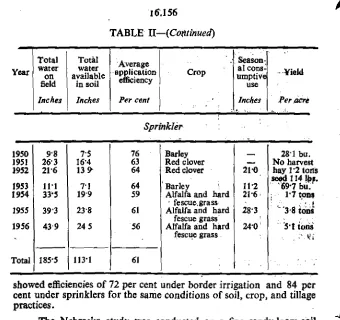
A summary of the data obtained for each method 9f wetter
application for each i rigation season is shown in Table II, together
with totals of Ntater pied;.-water .stored Mid overall.?
cation efficiency) to
use `'s calrolltdea
sampling and crap yie s for each crop is4thown.
A summa i ‘or -th-e-dittibbtAined
1'4all irrigations shows th#
for the downsloOe fgrrbw..method, the mean. sail ;moisture.. gpragef jt
theroot zone ideritthi arid','field-Winter application•effieiefiey - for 33
irrigations was 3 .3 inches and 36 per cent, respectively. For-the
downslope border . method, --the.. mean w4ter ,stared and field-water
application efficient' for ,24 irrigations was13 tinChy (aul,43nercOnt.
The contour borikletiniethna'ghoWe4,.rot 22 irrigattons::amoiverage of
3.5 inches of wider stored in the soil per irrigatiOn with a field-w4ter
application efficienoy Of-62-per-cent,-- Under--the-sprinkler-method: of
irrigation for 41 irrigations with an average of 21 inches of water
stored per irrigatiog, the
N4 Vyi
ltpr.
Application, effi-zigney, 4v,..aa..6l per
cent.
•
•
'
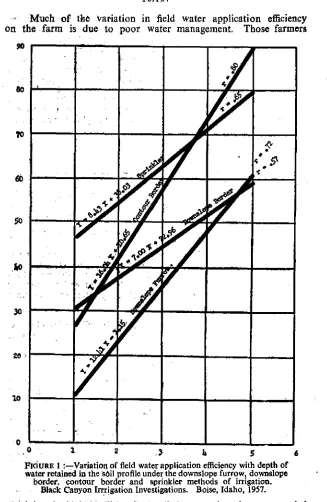
The indiv*1,01_40.1d-water AppWtiori efficiencies were „aaalyied
to obtain the vaiiationlin efficiency with depth of water retained in
the soil profile. Tile iregeseion-7eqqation .!and correlation:co.efficient
were determined far eacli'Methtichfif PitifeTt hbVis the
result% of this analysiS. Field water application efficiency increased
with the greater .amount of water stored in fife- oll-TOTOTTnZlhods
of irrigation. Thee sprinkler method of irritation gave the highest
efficiency for shalick irrigations and the cont air border method gave
the highest efficiency
11.1'7i6ilier ivater ap8licati6rig."
TABLE -II
Summary of irrigation and -related data by years for four methods of water application 1950,56 ,
yrim. Totalwater on field
Total water available
in soil
Average' application
efficiency Crop
Season-a/ cons-umptive use
, Yield
. ....
Inches Inches Per cent Inches Per acre
•
Downslope furrows i ii
-1952 101/ 34. 5 34 Red clover 23 .0 hay 1 .4 tpns
se0 167 lbs.
1953 13. 1 5. 3 40 Barley ' 10. 9 60.4 bu.
1954 .63 .4 25 . 5 40 Alfalfa and hard
fescue grass 25-4 1 . 9 tons • 1955 88 . 6 25 • 1 28 Alfalfa and hard
fescue grass' 28. 3 3'9 i Tls1/4
1956 56. 4 26. 4 47 Alfalfa and hard
fescue grass 25-0. 4. 8 }ons
Total 3227 116. 8 36
Down.slope borders
1953
1954 48115-2- . , 21 .96-8 45.45 BarleyAlfalfa and hard fescue grass
- 11-4
21 6 66 . 6 bu.l • fr tons
-1955 36 • I 24/ 44 Alfalfa and hard
fescue grass 27.5 • 3'8 tons
1956 691 28. 1 40 Alfalfa and hard 25 . 7 41 tons
fescue grass 1
.. . J
• 1
dotal 189.4 81 .0 43
Contour borders
1.4
1954 35. 7 24'5. 69 Alfalfa and hard
fescue grass 25.5 1 . 1-tons', .. , , 1 i 1935 . , 49'6 ' 221 44 Alfalfa and hard
fescue grass 27. 1 q44 tons
1956 37. 1 29. 6 80 Alfalfa and hard
fescue grass 272 4.3 tolls
.. _
rote 122.4 . 76'1
•
TABLE 11—(Continued)
Year Total water on
Total water available
Average aPPlicatim
, . Crop
. Season-. aI
cons-umptiv -'llield
field in soil efficiency use
Inches Inches Per cent Inches Per acre
Sprinkler
1950 9'8 7-5 76 Barley 2S'1 bu.
195! 26' 3 16'4 63 Red clover No harvest
1952 21'6 139• 64 Red clover hay 1 .2 tons
seed 1141p.
1953 11'1 64 Barley 111 '69.7 bu.
1954 33. 5 19 . 9 59 Alfalfa and hard
fescue, grass
21'6 1'7 tans
1955 39'3 23'8 61 Alfalfa and hard
fescue grass
28'3 "3'8 tons
1956 43 . 9 24 5 56 Alfalfa and hard
fescue grass
24'0 5't tons Vi
Total 185-5 113'1 61
showed efficiencies of 72 per cent under border irrigation and 84 per cent under sprinklers for the same conditions of soil, crop, and tillage practices.
The Nebraska study was conducted on a fine • sandy loam soil with a I per cent slope. The Idaho study reported here was condo' ted on a silt loam surface soil having a clay loam subsoil with
a
3 to5 per cent surface slope. The basic intake rate for the Nebraika soil was reported to be 0.5 to 0.6 inch per hour, while the Idaho soil has a 0.12 to 013 inch per hour rate. "Basic intake rate" is the rate at which water will enter the soil after a period of several hours, when the change in rate becomes very slow(3). The laboratory-
determi-nations of moisture capacities at one-third atmosphere tension (field capacity) and at 15 atmosphere (wilting point) were 18•2" and 9'5 per cent for the Nebraska soils. The Idaho soils showed 23 and 12 per cent. The equipment used to apply water in these comparisons of field water application efficiency was comparable. An examination of the reasons for a difference in water application efficiencies pointed to two factors—the slope and the basic intake rate of the soil.
Much of the variation in field water application efficiency on the farm is due to poor water management. Those farmers
90
2e
1.0
0
0 1 2 .3 h 5 6
FIGURE 1 :—Variation of field water application efficiency with depth of water retained in the soil profile under the downslope furrow, downslope
border, contour border and sprinkler methods of irrigation. Black Canyon Irrrigation Investigations. Boise, Idaho, 1957.
reducing runoff. They used the water saved to irrigate more fiirrows and borders. The most efficient farm irrigator checked the depth of water penetration with a soil auger, probe, or shovel at various parts of the field to determine when an adequate, uniform irrigation had been obtained. If deep percolation losses were discovered at the top of the field the farmer increased the furrow or border stream on the next irrigation to reduce the time for getting the water through the furrow or border. This reduced deep percolation at the upper end of the field by making the time for water intake on each part of the furrow or border, more nearly the same. More attention to water management was obvious where the most efficient field water application efficiencies were being obtained..
CONLUSIONS
. A study of field water application efficiency on a shallow soil having a surface slope of 3 to 5 per cent showed an efficiency' of 36
pef, cent for 35 irrigations by downslope furrows, 43 per cent for 24 irrigations by downslope borders, 62 per cent for 22 irrigations by contour borders, and 61 per cent for 41 irrigations by sprinklers.
A study of the field water application efficiencies in relation to the depth of water replaced in the soil in the crop root zone showed lower efficiencies for small amounts of soil moisture replacements and higher efficiencies for the larger soil moisture replacements regardless of the method of irrigation. The sprinkler method was the most effici-ent method for a 1-inch soil moisture replacemeffici-ent and the contour border was 'most efficient for a 4-inch or greater soil moisture replacement. . _
A comparison of the furrow' and border efficiencies obtained in the Idaho study and in a Nebraska study showed that for border and sprinkler methods of irrigation the more favorable irrigation con-ditions of high intake rate, deep soil, and level topography gave higher field water application efficiencies.
The Idaho field water application efficiency studies gave much more efficient water application than was measured on farmer-irrigated similar soils and slopes. The explanation for this is that more water control equipment, more labor, better land preparation for irriga-tion and better water management practices were used by research workers. When the cost or scracity of water makes it more economical for the farmer to invest in good water control equipment, proper land preparation, proper irrigation system design and adequate labor,- then by using proper water management practices the water application efficiency will increase. Ultimately the time may come when only two methods of irrigation will be used. These will be some forms of basin and sprinkler irrigation, because it is possible to get more efficient water application with these methods as shown in the Idaho, Nebraska and other studies.
0
REFERENCES
Blaney, Harry F. and Muckel, Dean C., "Evaporation from water surfaces in California," State of Colifornia Department of Water Resources, Division of Resources Planning, Bulletin No. 73, 1959.
Bonar, James Albert, "A rapid method for determining the moisture content of soils," Texas Experiment Station Research Report No. 9, 1949.
(5) Cfiddle, Wayne D.; Davis, Sterling ; Pair, Claude H.; and Shockley, Dell G., "Methods for evaluating irrigation systems," Agricultural Handbook No. 82, U.S.D.A. 1956.
Frost, K. R. and Schwalen, H. C., "Sprinkler evaporation losses," Agricultural Engineering, V. 36, n8, p. 526-528, 1955.
(9) Israelsen, Orson W., "Irrigation principles and practices, second edition," John Wiley and Sons, 1950.
(5) Israelsen, 0. W., Criddle, W. D., Fuhriman, D. K., and Hansen, V. E., "Water application efficiencies in irrigation," Utah State Agricultural College Experiment Station Bulletin 311, 1944. Linsley, Ray K., Kuhler. Max A., and Paulhus, .1, L. H., "Hydrology for engineers," McGraw ,Hill Book Company, Inc., 1958.
(9) Select Committee on National Water resources, United States Senate, 86th Congress: Water resource activities in the United States. Committee Print No. 3, 1900.
(9) Somerhalder, B. R., "Cc mparing efficiencies in irrigation water
application," AgrizuItural Engineering, V. 39, n 3, p. 156-159,
' 1958. •
(1)
(2)
(4) 5