Stimulating student note-taking
and review: the effect of active
learning with rapid feedback
Duncan Grant is a tutor at the University of Bolton working mainly with Masters
dissertation students in the University’s partner institutions in Africa and Asia and
teaching MBA financial management. He is a chartered accountant and management
consultant who has been a senior manager in large and small businesses in UK and
overseas and is also a psychology graduate and a qualified educator with extensive
experience in professional, technical and management development and training.
Chris Grant teaches business and management and is a member of the Senior
As part of a study skills workshop, first year undergraduate students participated in
an active learning exercise on remembering; this involved watching a video and later
being tested on how much they could recall. The students watching the video were
divided into three groups with different approaches to note-taking and subsequent
review; afterwards the test results were fed back to the class. Subsequently, a
survey was carried out of the students’ approach to note-taking and review, both
before and after the workshop. The results during the classes clearly demonstrated
to the students the learning benefits both of taking notes and of subsequently
reviewing them and the questionnaire results confirm that students’ behaviours
in this area were positively impacted by the workshop. Additionally, a number of
barriers to effective note taking were identified which can be addressed in the
future.
Keywords: active learning, note-taking, notetaking, remembering, study skills.
Introduction
It has long been known that learning from lectures is made more effective when students take notes and subsequently review those notes (see, for instance, Fisher & Harris, 1973; Einstein et al, 1985). In developing “Learning Skills” workshops for first year
undergraduates, the taking and use of notes was therefore an important element. This paper describes the approach taken to encouraging students to take and review notes and then discusses the subsequent effect on their note-taking behaviour. It must however
be pointed out that this was not planned as a research study but rather the study was developed during the course of six workshops, which were delivered over two weeks.
Background
Learning Skills Workshop
Live Events Management is a two-year Foundation Degree (FdA) course offered by Backstage Academy, a partner institution of the University of Bolton which is the degree awarding body. Foundation Degrees are described by the UK higher education regulator, the QAA (The Quality Assurance Agency for Higher Education) as follows: “Foundation Degrees integrate academic and work-based learning through close collaboration between employers and programme providers. They build upon a long history of design and delivery of vocational qualifications in higher education, and are intended to equip learners with the skills and knowledge relevant to their employment, so satisfying the needs of employees and employers.” (QAA, 2010:4). The same QAA document goes on to stress the importance of balancing intellectual and practical skills.
The Live Events Management course very much embodies these principles; it is a hands-on, two-year, practical course for people who wish to work on technical, creative and organisational aspects of live events such as concerts,
festivals, product launches and other corporate events. Aspects covered include sound, lighting, staging, live visuals, design and planning. Alongside the FdA qualification, students also obtain technical certificates needed for employment in the industry in areas such as safety, rigging, first aid, working at heights and working with electricity (Backstage Academy, 2014).
A one day “Learning Skills” workshop was developed for delivery to all first year FdA students; it formed part of an intensive introduction to the course and took place during the initial ten days of the students’ first term. Topics related to note-taking and remembering in the workshop included benefits of note-taking, techniques, organising information, remembering and forgetting together with several exercises.
The FdA course is very practically orientated and the workshop was designed to fit in with that approach by showing the students, through their own results, the benefits of note-taking and
review. An exercise was therefore developed involving students watching a video in the morning and then being tested on their
recall at the end of the day. A range of modes of note-taking and review was incorporated by dividing the students into three groups each of which would adopt a different approach to taking notes and subsequent review of them.
There were 96 students in the cohort, divided into study groups of 16, each group participating in the workshop on a specific day; approximately 90% of eligible students attended a workshop. The initial intention was simply that the efficacy of both note-taking and subsequent review would be made apparent because the students who did more note-taking and review would perform better in the test and, on the first day, the results were collected in orally. However, on reflection this was not optimally effective so, for subsequent days, students marked their own work and handed it in and the lecturer was then able briefly to summarise the day’s results. Whilst
previous results were analysed and presented to students graphically (see Findings section below) after their own results. Each subsequent day’s results were added to the presentation so that, by the final workshop, students had not only their own results but also those of the majority of the cohort.
The results obtained during the workshop, as discussed below, strongly indicated the positive effects, both of taking notes and of subsequently reviewing them, on recall. The pedagogical aim of the workshop though was to
impact positively on students’ study behaviour and it was therefore also decided to investigate whether a positive classroom demonstration had led to changes in their approach to note-taking. This meant that there were two research objectives:
• To test whether note-taking and review affected subsequent recall.
• To assess whether students’ approach to note-taking and review were changed by the workshop and this particular exercise.
Remembering and forgetting
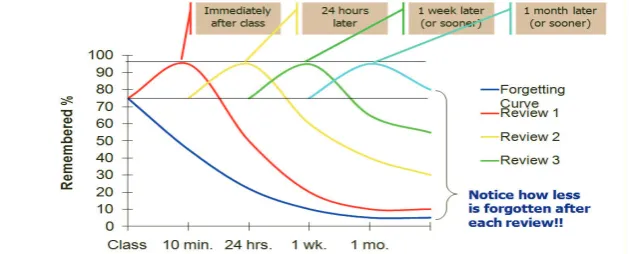
In one of the earliest studies in the field of experimental psychology, Ebbinghaus (1885) investigated memory and forgetting. He observed that the ability to recall learned information (groups of syllables) decreased over time in a consistent manner and his results can be clearly seen in what is now called the Ebbinghaus Forgetting Curve. This showed that, of information that can be recalled immediately, over half is forgotten in less than an hour and by two days 75% can no longer be recalled:
Ebbinghaus also studied the effect of repeating the learning over time and found that it did assist recall considerably if the material was studied again and that the amount of time needed to consolidate learning fell with each successive
repetition.
These two findings form the basis of the view (University of Waterloo, ND; trainingindustry, ND) that revisiting learned material is a very effective way of
overcoming Ebbinghaus’s curve. The following graph is one of many illustrating this point that can be found in study skills books and on university and other internet study sites:
Figure 1: Based on data from Ebbinghaus (1885)
Active Learning
The value of the learner actually “doing” rather than passively absorbing is one of the oldest concepts in pedagogy, having been identified at least two and a half thousand years ago:
“One must learn by doing the thing, for though you think you know it - you have no certainty until you try.” (Sophocles, 5th c BCE)
“I hear and I forget. I see and I remember. I do and I understand.” (Confucius, 5th/6th c BCE)
More recently, Adler (1982:50) expressed the same sentiment: “All genuine learning is active, not passive. It is a process of discovery in which the student is the main agent, not the teacher.” And in 1987 (3) Chickering and Gamson, in their manifesto “Seven Principles For Good Practice in Undergraduate Education” identified encouraging active learning as one of those key principles and went on to say: “Learning is not a spectator sport. Students do not learn much just by sitting in classes listening to teachers, memorizing prepackaged assignments, and spitting out answers.” However, the concept was really popularised and the term ‘active learning’ introduced with the creation of the Association for the Study of Higher Education (ASHE) and the publication in 1991 of the first ASHE report by Bonwell & Eison where it was defined with great simplicity as: “anything that involves students in doing things and thinking about the things they are doing” (2). The aim is also summarised in the subtitle of their paper (a phrase they have repeatedly used since): Creating Excitement in the Classroom.
In the following years, active learning became an increasingly
important component of Higher Education teaching and, in their 2002 investigation of how time was spent in classes in a US public university, Lammers & Murphy found that approximately 15% of class time was engaged in active learning. This approach is very much that adopted by Backstage Academy (nd: online) as expressed in its prospectus: “We place great emphasis on practical learning”.
The issues both of remembering and active learning can be seen to affect the way in which student classroom learning is mediated by the way students record and review what they have been taught.
Note-taking and remembering
It has been experimentally demonstrated many times that note-taking enhances learning. Fisher & Harris (1973) compared recall of lecture content after three weeks depending on both note-taking and subsequent review. They found that taking notes and reviewing them produced the highest level of recall, whereas not taking any notes and reviewing the lecture “mentally” was the least effective. Subsequently it has been shown that note-taking has a benefit not only on the quantity of recall but on its quality as well: Einstein et al (1985) compared the recall of note takers and non-note takers and found that non-note takers recalled more of the high-importance propositions whereas non-note takers recalled high- and low-importance propositions equally. In other words, taking notes assists information processing leading particularly to recall of important information.
The efficacy of note-taking and review can now be considered settled and it is notable that there is little if any contemporary research
on this. By 1979, in their review of research on the subject, Carrier & Titus concluded that there were two principal active areas of research: the first considered the various methods of note-taking and their relative benefits and the second was more concerned with the mechanisms by which note-taking has its impact on learning which they express as “investigators disagree as to which property of notetaking best accounts for its utility” (1979:299).
In a subsequent meta-analysis (Henk & Stahl, 1984), the
medium for review than in the real world where, even in the absence of their own notes, students will still have other sources for revision such as lecture handouts, slide packs, other VLE material, text books, revision guides, internet sites and so on.
As a result of all the above work, the subject is addressed in many publications aimed at students; for instance, Kesselman-Turkel & Peterson (2003:3) say that “the very act of note-taking helps you remember ideas you’re taking down” and many universities have learning skills sites which also promote the taking of notes (the University of Bolton and, in addition, Leeds, St Andrews & Cornell to name only three out of many). In fact, universities invest heavily in a wide range of learning skills support; whilst it is difficult to find financial information on the amounts invested, the level of commitment can be illustrated by the staffing of such centres; for instance, the University of Essex Skills Centre has 17 academic staff as well as administrators (University of Essex, ND).
Research on the subject has very much moved on in the last 30 years to special cases (such as those with learning needs – outwith the scope of this paper) and to the methods employed in note-taking, especially in the light of electronic means that are now available. In particular, there is a strong body of work suggesting that the use of laptops (and, by inference, more recent technology such as tablets and smartphones) during lectures impacts negatively on learning. An early, and still influential, paper on this subject reported on research done at Cornell, a university well known for its widely-used ‘Cornell Notes’ approach to note-taking, by
Hembrook & Gay (2003). Groups attended the same lecture, one using laptops (the ‘open’ group) and the other not (the ‘closed’ group). They were subsequently tested using both multiple choice (recognition) and free form (recall) questions. The closed group performed significantly better on both recall and recognition. The result is explained by the level of distraction available with a laptop (now, with the rise of social media, much greater than it was in 2003) even if the distraction related to lecture content (looking up specific points mentioned by the speaker for example). Although Hembrook and Gay did not specifically record whether the laptops were being used for note taking it is possible that the lower degree of encoding required in transcribing material through a keyboard may also have adversely affected learning.
Sana, Weston and Cepeda (2012) took this further and looked at the impact of laptop use not only on the student’s own learning but also on that of their neighbours and found that students who were in view of peers who were using laptops performed less well than those who did not have a view of a screen. Concentrating again in the impact on note takers themselves, Mueller & Oppenheimer (2014), echoing both the findings
of Einstein et al (1985) and Hembrook & Gay (2003), found that students who took notes on paper performed better on conceptual questions than those who used laptops, and concluded that “laptop note takers’ tendency to transcribe lectures verbatim rather than processing information and reframing it in their own words is detrimental to learning.” (1)
All of this weight of evidence has led to a move by many academics
to ban laptops in class. As Dartmouth computing Professor Dan Rockmore (2014) puts it: “The act of typing effectively turns the note-taker into a transcription zombie, while the imperfect recordings of the pencil-pusher reflect and excite a process of integration, creating more textured and effective modes of recall.” If this is so, it would accord with the encoding thesis as the scope for encoding when typing is rather less than that available to the paper note taker who can more readily annotate, link and illustrate during the process of taking down what is heard.
Methodology
Remembering test
Students were shown a video that was brief, lasting just over 4 minutes, but interesting and informative in a relevant subject area which was intended to engage their interest. In the video Todd Ricci (EventElevator, 2013), the lighting director for Bruce Springsteen’s touring show, discusses some of the equipment he uses and the reasons for choices he made.
There were 96 students in the cohort, divided into study groups of 16, each group participating in the workshop on a specific day; numbers actually attending on any given day varied between 12 and 16.
Each day’s class was divided into three groups of approximately equal size, based on which of the three sides of the room (the seating being an open rectangle) they were sitting on; two of the groups were told to take notes (on paper) while the video was played and the other was told not to make any notes. After the video had been viewed, the notes from one group were collected in and the group which had retained their notes were asked to review those notes.
The groups were identified as A (no notes), B (notes but no further review) and C (notes and review). To avoid any bias from where students chose to sit (for example it was observed that the first students to arrive tended to select the seats facing the lecturer), the group allocations were changed from day to day so that each position had an approximately equal chance of being in A, B or C.
Those in Group C were prompted to review their notes again several times during the rest of the day.
At the start the design was purely a pedagogical one and it was only intended that the data collected should be shown to the students to demonstrate the point being made. During the course of the workshops it became apparent that there might be something interesting in that data and therefore more effort was taken both on eliminating bias and on the feedback of the results (both of that group and of previous groups) at the end of the exercise.
At the end of the day a 10 question recall test was administered and self-marked by the students.
The differences between the three groups were analysed using a 1-tailed t-test. A 1-tailed test was deemed appropriate due to the very low possibility (both from previous evidence and inductively) that taking no notes (or not reviewing notes) would result in better recall.
Survey of note-taking
behaviour
Approximately one month after the last workshop all 96 students in the cohort were emailed and asked to complete an online questionnaire if they had attended a workshop. In addition to
background and demographic information, the questionnaire asked respondents to describe their note-taking behaviour both before and after the workshop, on 4 or 5 point Likert scales, in terms of:
• The frequency with which they normally took notes - questions 1 (before) & 4 (after)
• The extent / level of detail in their notes- questions 2 & 5
• The degree to which they subsequently reviewed their notes - questions 3 & 6
In addition, a diagnostic question was asked to those who took few notes, seeking to understand their reasons for this and students were also asked their preferred medium for note-taking.
Points were allocated to
questionnaire answers relative to the desirability of the approach (from 1, least, to 4 or 5, most, depending on the number of options presented) across all three dimensions (frequency of note-taking, extent of notes taken and level of subsequent review).
Descriptive statistics of numbers of students who had improved on each aspect were produced and the differences between ‘before’ and ‘after’ scores were tested for significance using 1-tailed t-tests (1-tailed being deemed appropriate as there was no reason to expect that the workshops would have had a negative effect on behaviour).
Limitations of the methodology It must be recognised that there are several limitations in the methodology, in particular:
• It was developed during the course of the workshops so there were no a priori objectives and each day was not absolutely identical to the previous ones;
Findings and discussion of results
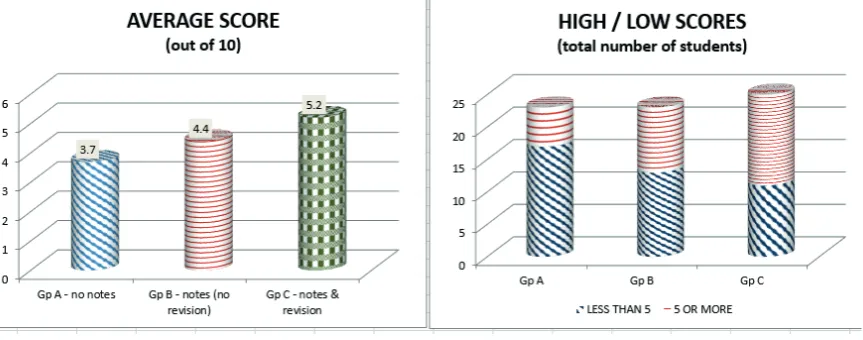
It can be seen that the results are very much in line with the expectations based both on theory and on previous research.
The use of the high-low scores graph was intended to bring the findings home more dramatically as it shows that whereas well over half (56%) of those who took and reviewed notes achieved an above average score, barely a quarter (26%) of those who took no notes did so or, to put it another way, members of the ‘note and review’ group were more than twice as likely to obtain a high score (at least half marks) as those in the ‘no notes’ group.
Statistical analysis
The analysis, using a 1-tailed t-test, showed that taking and reviewing notes was better than not taking any notes at the 99% confidence level, and taking and reviewing
notes was better than simply taking the notes at the 95% confidence level. However just taking notes alone did not improve performance over the no notes group by a statistically significant degree (the difference fell just above the 90% confidence level).
This demonstrates that the
significance to recall of taking notes lies to a great extent in its being an essential enabler to subsequent review and that simply taking notes, whilst beneficial, is not sufficient on its own to ensure improved performance.
It should however be noted that (a) as commented above this applies more in the experimental setting where students’ notes are the only means of revision available and (b) the findings do not the support the null hypothesis (that note taking alone has no effect).
Discussion
It is worth remembering that the students were assigned to groups randomly and that the scores should therefore reflect purely their actions during the exercise and not any inherent differences between or preferences of the members of each group.
It is the experimenter’s observation that those students who did
not, as their preferred approach, take notes during the rest of the workshop tended to be those who appeared least interested or engaged in the process. (This is, of course, a generalisation and there were students who, while very engaged, did not take notes; in at least one case, the student concerned was dyslexic.)
It could therefore be inferred from this that if the experiment were to be repeated with participants choosing their own approach, the In addition to announcing the day’s results, those for the previous groups were shown to the students after the test, in graphical form (for ease of understanding); the examples below show the results for all five days.
demonstrate the specific impact of the video exercise;
• The ‘before’ survey results were based on recollection after the event rather than
being the views at the time and were based on participants’ subjective views rather than impartial observation.
gap would be greater and that this would represent the ‘real-life’ situation.
The material recalled was purely factual and required little analysis,
therefore the impact of note-taking and review is really only being measured in terms of simple recall rather than understanding. The period after which recall was
tested is also fairly short – about 4 hours - so says little about longer term learning.
Survey of note-taking behaviour
Overall note-taking approach
Points were allocated to
questionnaire answers relative to the desirability of the note-taking approach (from 1, least, to 4 or 5, most, depending on the number of options presented) across all three dimensions (frequency of note-taking, extent of notes taken and level of subsequent review). On this basis, 7 of the 9 respondents increased their score and the mean increase was 25%. Of the 7, 2 improved on all 3 dimensions and 4 on 2 dimensions. The results of each dimension are considered below.
Frequency of note-taking
Participants were asked which of the following statements best described the frequency with which they took notes:
1. I rarely or never took/take notes
2. I occasionally took/take notes
3. I usually took/take notes
4. I always took/take notes A majority of students (6/9) reported that, before the
workshop, they usually took notes whilst one said notes were taken occasionally and the remaining two rarely if ever took notes.
Afterwards, 5 students reported that they took notes more often than before, including 3 who said they now always took notes (none having previously done so). Two students also commented that some lecturers discouraged
students from taking notes during classes (as it was seen as a distraction from learning) with one going on to add: ”my recall is less in these lectures”. The mean points score increased by 0.7 (from 2.4 to 3.1) after the workshop which is significant at the 95% confidence level using both 1- and 2-tailed t-tests.
Extent of note-taking
Participants were next asked which of the statements below best described the extent of the notes they took:
1. I hardly wrote/write anything down
2. I just noted occasional things that were/are interesting
3. My notes were/are quite brief
4. My notes were/are focussed on the most important points
5. My notes were/are usually very comprehensive
Before the workshop only 3/9 students claimed to take notes which were comprehensive or focussed on the important points; but afterwards the number doubled, with 2 taking comprehensive notes and 4 at least capturing the most important points. Overall 6 students
improved the extent of their note-taking (and one was already on the maximum level so did not have scope to improve within the terms of the questionnaire – so 75% of students who were able to improve did so). However, somewhat
surprisingly, one student actually reported that they were taking less comprehensive notes after the workshop. It is difficult to interpret a single score and it may well be that this anomaly is due to nothing more than careless completion of the questionnaire; nevertheless, it is possible that other factors not directly connected to the workshop (such as the change in the type of learning they were now experiencing compared to school or college) may have negatively affected this student’s note-taking behaviour.
Overall the mean points score for respondents increased by 0.6 (from 3.0 to 3.6) and the improvement is significant at the 95% confidence level using both 1- and 2-tailed t-tests.
Review of notes
Finally, respondents were asked about whether they subsequently reviewed notes they had taken:
1. I rarely or never reviewed/ review my notes and/or I didn’t take notes
2. I reviewed/review my notes when I needed to look something up or for a test
3. I reviewed/review my notes after class
4. I reviewed/review my notes after class and several times after that
notes) or only used their notes to study for a test (5/9). Afterwards 4/9 had increased their review frequency: 3/9 said they reviewed their notes after the class and one, who had previously not taken notes, now used those notes prior to tests. Overall, mean scores increased by 0.6 (from 1.6 to 2.2); this is significant at the 95% confidence level using 1- or 2-tailed t-test.
Reasons for not taking notes
Students were also given the opportunity to select from a list of reasons why they did not take notes. Although the question was explicitly aimed at those who took few if any notes, it was in fact answered by a majority of students (5/9) indicating that many of those who do take notes still have issues.
The two who initially took few if any notes both answered that they were unable to write fast enough and it is interesting to note that both of these (but only one of the other 6 who stated their preferred method) used laptops for note-taking. Although ‘writing’ was not intended in the question to mean specifically using pen and paper, it is possible that respondents interpreted it this way so it may be that they used laptops because they found the physical process of writing on paper difficult. Even if this is so, it does not appear that using a laptop has solved the problem for them.
In addition to the comments above on some lecturers discouraging note-taking, other issues identified were: missing things while writing (4/5), the view that handouts / slides are sufficient (2/5) and not knowing what to write (1/5). Two students also reported that they suffered from a diagnosed learning need.
DISCUSSION AND CONCLUSIONS
Efficacy of note-taking and
review in supporting learning
Although this has long been established (Fisher & Harris, 1973) it is nevertheless a positive outcome that the results of the remembering test did, in fact, conform to both theory and previous experimentation.
Impact on note-taking
behaviour
Participants’ approaches to both the taking and the subsequent review of lecture notes improved significantly following and, by inference, as a consequence of the workshop. Universities and other institutions invest substantially in teaching skills - as opposed to specific academic subjects – (University of Essex, ND), including not only study skills, as in this case, but also specific technical skills (e.g. use of Microsoft Office products or SPSS) and other skills needed for their particular area of study (such as Research Skills) and these results do indicate that such investment can be worthwhile in terms of positively affecting behaviour.
Active learning and feedback
The exercise contained both active learning (participation in an experiment on note-taking) and prompt feedback (of the results within the current class and, from day 3, of those of previous classes). Unfortunately, the number of respondents on each day precludes any attempt to identify the impact of different factors (e.g the potential impact of more data being fed back with each subsequent workshop.)
The video exercise addressed taking notes and reviewing
them but did not address the actual nature, quality or comprehensiveness of the notes taken. If active learning is more effective (Bonwell & Eison, 1991), it would be reasonable to expect that the aspects addressed by the activity (propensity to take notes and to review them) would be impacted more than would the extent of those notes, as this was not addressed in the activity. In fact, there was a somewhat greater impact on the frequency of note-taking but no difference between the impact on comprehensiveness of notes taken and that on
subsequent review. This, though, does not necessarily imply that the exercise played no part in the improved overall approach to taking and reviewing notes. The three aspects were all explained to participants as being inextricably linked in supporting effective learning and it is therefore a tenable hypothesis that the effect of the active learning exercise was on the whole of note-taking.
of the workshop that addressed note-taking and remembering. The limitations of this brief study do not permit any of these to be determined but they will be referred to below under ‘future directions’.
Nevertheless, the effectiveness of the active learning approach can be a useful guide to the design of course delivery. There may well, of course, be other reasons for including such activities: they serve to, in Bonwell & Eison’s phrase (1991), Create Excitement in the Classroom (by breaking up the day, adding variety, stimulating active engagement and so generally increasing student interest). But this study reinforces the view that, in a real world classroom environment, they can also directly
contribute to positive learning outcomes.
Future directions
A study planned and designed in advance, ideally using control groups and with a larger population, could give a better insight into the impact of the factors identified. However, it must be noted that there are ethical issues in giving some students a sub-optimal learning experience purely to facilitate research. Even simply repeating this study on subsequent cohorts would give a larger dataset that could potentially identify a statistically significant difference in recall between the ’no notes’ and ‘notes but no revision’ groups.
Remembering is a simple subject
to be studied in this way because it can readily be tested in a short period of time which means both that it can fit in with the limited time available and that more or less immediate feedback can be provided. Ways of applying this approach to other aspects (such as comprehension or planning and to technical skills) could be investigated.
Finally, turning to the enhancement of future workshops, the main area of focus arising from the study would be in investigating and offering more solutions to enable students to overcome the barriers to note-taking that were identified.
References
Adler, M (1982). The Paideia Proposal: An Educational Manifesto. New York: Simon & Schuster. Backstage Academy (ND) http://www.backstage-academy.co.uk/ [accessed 1/10/2014]
Bonwell, CC, & Eison, JA (1991). Active learning: Creating excitement in the classroom (ASHE–ERIC Higher Education Rep. No. 1). Washington, DC: The George Washington University, School of Education and Human Development.
Brigham Young University (2014) Lest they forget http://www.byui.edu/learning-and-teaching/articles-and-videos/ articles-and-videos/lest-they-forget [accessed: 23/2/2015]
Carrier, C &Titus, A (1979)The effects of note-taking: A review of studies, Contemporary Educational Psychology, 4 (1979), pp. 299–314
Chickering, A & Gamson, Z (1987), Seven Principles For Good Practice in Undergraduate Education, http:// www.lonestar.edu/multimedia/SevenPrinciples.pdf [accessed 12/2/2015]
Cornell University (2001) The Cornell Note-taking System http://lsc.cornell.edu/ [accessed 23/2/2015]
Ebbinghaus, H (1885, Tr Ruger, H & Bussenius, C, 1913) Memory: A Contribution to Experimental Psychology http://nwkpsych.rutgers.edu/~jose/courses/578_mem_learn/2012/readings/Ebbinghaus_1885.pdf [accessed 11/1/2015]
Einstein, G, Morris, J & Smith, S (1985) Note-taking, individual differences, and memory for lecture information. Journal of Educational Psychology, Vol 77(5), Oct 1985, 522-532.
EventElevator (2013), Lighting Director Todd Ricci about his work for Bruce Springsteen and the E Street Band, https://www.youtube.com/watch?v=UZep8AKhJFQ [accessed 6/10/2014]
Fisher, J & Harris, M (1973). Effect of note taking and review on recall. Journal of Educational Psychology, Vol 65(3), Dec 1973, 321-325
Hembrook, H & Gay, G (2003) The Laptop and the Lecture, Journal of Computing in Higher Education Fall 2003, Vol. 15(1),
Henk, W & Stahl, N (1985) A Meta-Analysis of the Effect of Notetaking on Learning from Lectures, Paper Presented at the 1985 Annual Meeting of the National Reading Conference
Journal of Educational Psychology, Vol 77(5), Oct 1985, 522-532
Kesselman-Turkel, J & Peterson, F (2003) Note-taking made easy, Madison, WI, University of Wisconsin Press Learning Environments Journal of Computing in Higher Education
Lammers, W & Murphy, J (2002) A profile of teaching techniques used in the university classroom: A descriptive profile of a US public university, London & Thousand Oaks, The Institute for Learning and Teaching in Higher Education and SAGE Publications
Mueller, PA & Oppenheimer, DM (2014), The Pen Is Mightier Than the Keyboard: Advantages of Longhand Over Laptop Note Taking Psychological Science OnlineFirst, http://pss.sagepub.com/content/ early/2014/04/22/0956797614524581.abstract [Accessed 2/4/2015]
Rickards & Freidman (1978) The encoding versus the external storage hypothesis in note taking Contemporary Educational Psychology Volume 3, Issue 2, April 1978, Pages 136–143
Rockmore, D (2014) The case for banning laptops in the classroom http://www.newyorker.com/tech/elements/ the-case-for-banning-laptops-in-the-classroom
Sana, F, Weston, T, and Cepeda, N (2013) Laptop multitasking hinders classroom learning for both users and nearby peers, Computers & Education Volume 62, March 2013, Pages 24–31
University of Bolton (2004), Study Skills http://www.bolton.ac.uk/library/LibraryPublications/StudySkills/ notetaking.pdf [accessed: 23/2/2015]
University of Essex (ND) University Skills Centre – People http://www.essex.ac.uk/skillscentre/staff/default.aspx [accessed 19/3/2015]
University of Leeds (ND) Skills Library http://library.leeds.ac.uk/skills-students [accessed 3/10/2014] University of St Andrews (ND) Taking and making notes https://www.st-andrews.ac.uk/students/academic/ advice/academicstudyskillsmathssupport/notes/ [accessed 3/10/2014]