The Thirty-First AAAI Conference on Innovative Applications of Artificial Intelligence (IAAI-19)
Grading Uncompilable Programs
Rohit Takhar, Varun Aggarwal
{rohit.takhar, varun}@aspiringminds.comAspiring Minds
Abstract
Evaluators wish to test candidates on their ability to pro-pose thecorrectalgorithmic approach to solve programming problems. Recently, several automated systems for grading programs have been proposed, but none of them address compilable codes. We present the first approach to grade un-compilable codes and provide semantic feedback on them us-ing machine learnus-ing. We propose two methods that allow us to derive informative semantic features from programs. One of this approach makes the program compilable by correct-ing errors, while the other relaxes syntax/grammar rules to help parse uncompilable codes. We compare the relative ef-ficacy of these approaches towards grading. We finally com-bine them to build an algorithm which rivals the accuracy of experts in grading programs. Additionally, we show that the models learned for compilable codes can be reused for un-compilable codes. We present case studies, where companies are able to hire more efficiently by deploying our technology.
1
Introduction
Evaluators often wish to test students and jobseekers on their ability to propose thecorrectlogic, aka algorithmic ap-proach, to solve a given programming problem. Evaluators care most about this skill rather than the ability to follow and reproduce the syntax of a language. Syntax can be learnt quickly for a new language. Thus, candidates are often asked to write the program in a language of their choice or even as a pseudo-code. Evaluators then examine the code and dis-cuss to see if the stated algorithm (not the exact program) is correct and efficient.
Several automated systems for testing coding skills and pro-viding feedback have been developed in the last decade. The traditional method for evaluation of the code uses test cases, which neither provides a good judgment to the eval-uator nor proper actionable feedback to the candidate. Re-cently, several new methods of grading and feedback that use techniques such as machine learning and program anal-ysis have been developed. In (Srikant and Aggarwal 2014), the authors present a system which provides a grade on the logical correctness of a program according to a rubric. It uses machine learning and control structure and data de-pendency features. In (Singh, Gulwani, and Solar-Lezama
Copyright © 2019, Association for the Advancement of Artificial Intelligence (www.aaai.org). All rights reserved.
2013; Head et al. 2017), the system automatically provides feedback on student programs by finding fixes. There are also tools (Le Goues et al. 2012; Long and Rinard 2016; Mechtaev, Yi, and Roychoudhury 2016) that fix logical bugs automatically in softwares.
None of these approaches handles codes that do not com-pile.1 They require a compilable code to be able to grade
them or provide feedback. Generally, codes that do not com-pile constitute34%of the total submitted codes in MOOCs (Bhatia and Singh 2016) and46%in applicant pool for cod-ing jobs (our study). Candidates miss out on good grades or jobs, even when they write uncompilable codes with correct or near correct logic (see examples in Table5). They are un-able to get any feedback on their codes either. Evaluators miss on identifying or hiring potentially good recruits. We present the first approach to grade uncompilable codes and providesemanticfeedback on them. By semantic feed-back, we imply feedback on the logic/algorithm of the code and not feedback on how to make the code compilable. Our feedback comprises whether the code has the algorithmic structures to solve a given programming problem, for in-stance, does it have the required control structures or data operations (refer to Table 4 for rubric definition). We in-tend to discover theintentof the coder — capture what she wished to imply had the code compiled. We do this by vari-ous ways — imposing less stringent grammar/rules than the compiler, skipping non-understandable parts and by fixing compilation errors. These methods allow us to derive rich semantic features from uncompilable codes. We then build machine learning (ML) based grading models using these features. Also, we investigate the possibility of reusing of available ML models developed using labelled compilable codes. We suggest methods to re-use these models with lim-ited sample of labelled uncompilable codes.
Using our method, we find that 15.5% of uncompilable codes submitted by students seeking job with a China in-ternet company had near correct logic, while21.9%had the right control structures. In particular, the paper makes the following contributions:
• We present the first approach to grade and provide
seman-1
tic feedback on codes that do not compile. This is a first step to decouple the skill to propose the right algorithm for a programming problem vs. writing syntactically cor-rect code.
• We present different novel methods to derive semantic features from codes that do not compile and compare their efficacy.
• We present methods to reuse machine learning based grading models built for compilable codes.
The paper is organized as follows — In Section2, we discuss the machine learning approach to grade programs. In Section
3and Section4, we present the techniques to extract features from uncompilable programs and machine learning models. In Section5, we discuss the details of our experiments and results. Section6discusses the deployment of our system in a high stakes assessment. Section7concludes the paper and discusses future work.
2
Grading programs using machine learning
In this section, we discuss the machine learning based ap-proach proposed in (Srikant and Aggarwal 2014) to grade programs. It uses a set of features which are derived from abstract representations of a given program. These features capture the semantic relationships present in the program. The counts and relations of the following properties of a program are extracted — the keywords, the expressions, the control structures and the expression dependencies. The dif-ferent features extracted from a program are as following:• Keywords:Examples include counts of all keywords, to-kens, operators etc. such as the number of times a ‘*’ op-erator appears or loop and conditional tokens such as ‘for’ and ‘if’ appear.
• Expressions: Expressions such as y = x%2 are ab-stracted to a notation such asv : 2 :: op : % :: c :‘2’, which denotes an expression having two variables, one modulus operator and the constant ‘2’. The number of oc-currences of such abstract expressions are counted.
• Expression Dependency:A data dependency is captured when the variable in one expression is used in another expression.2 For example, the expressionx < y, which
contains a relational operator (<) and two variables, is dependent on the expressiony+ +, which contains a post increment operator (++) and one variable. This is denoted using the notationv : 1 :: op : + + (←)v : 2 :: op :
relation. The occurrences of each dependency match-ing such abstractions is counted. This is repeated for each unique pair of dependencies that appears in a response.
• Control Context: Separate counts are maintained for each of the three properties described above according to the control-context (loops and conditional statements) in which they appear. For example, an expression whose ab-stract notation matchesv: 2 ::op: % ::c:‘2’ is counted separately if it appears within anif statementas opposed
2
For a given variable, only expressions in its scope block are considered.
to a loop like aforor awhileas opposed to anif statement
within afor.
These features are transformed into a set of features that maintain their structural relation with the labels across pro-gramming tasks (Srikant and Aggarwal 2014). Using these transformed features a task-independent supervised model is learned across programming tasks. This model is used to predict grades for a new code. We require the Abstract Syn-tax Tree (AST) and the Symbol Table (ST) to generate these features. The code needs to compile for this. In the next sec-tion, we describe how we generate features for uncompilable code.
3
Extracting features from uncompilable
codes
We wish to find theintentof the programmers even though they haven’t followed the grammar/syntax rules of the pro-gramming language.3 One may extrapolate, add or
mod-ify code, to make the program syntactically correct and anticipate the programmer’s intention. Another option is
ignore rules, that the code doesn’t follow, interpret non-understandable snippets or skip them. We try both these methods.
Correcting the program: We use two methods to make the code compilable. The first is a rule based system, where common errors are fixed by say, inserting a semicolon, balancing parentheses, declaring undeclared variables, or adding areturnstatement. We do multiple passes of these fixes, one at a time, until the code compiles.
In the second method, we predict the correct line at the posi-tion of compilaposi-tion error based on previous keywords. We learn n-gram models on good codes for a particular pro-gram to make the prediction.4Generally, if the predicted line makes the program compilable, the statement is accepted. In our approach, we do not accept all such edits. We find the difference between the generated statement and the origi-nal one. We only use the generated statement for differences such as insertion of a data type, a variable name, etc. and not where new logical units, such as operators, expressions or control structures are introduced. We wish to grade the program only based on the logical units written by the pro-grammer, and not introduce new ones.
We first run the rule-based system to fix the general er-rors. For codes that are still uncompilable, we run the n-gram based token prediction approach to remove complex errors. We run the updated programs again through the rule based system to correct any declaration/definition errors in-troduced by the n-gram approach.5 We call this combined
approach as the MC (Make Compilable) method. On aver-age, it makes48%codes in our Chinese data set compilable.
Relaxing the compilation rules: We require the AST and
3This is akin to the task of finding user intent in natural
lan-guage understanding systems. 4
We also tried an LSTM based RNN model, but it did not pro-vide any better performance than n-gram on our data set. The ap-proach is described in detail in (Bhatia and Singh 2016).
5
Uncompilable Codes (UC)
Make Compilable (MC)
Method
Rule Relaxation (RR)
Method
Combination of MC and RR
Learn model on labelled UC codes
Reuse CC model
Apply correction
Final model to grade UC codes
• Keywords • Expressions • Expression Dependency • Control Context
AST and ST
Derive Features
Figure 1: The flow to grade uncompilable programs with various possible alternatives at each step.
ST to extract our features. A typical compiler consists of several steps — tokenization, parsing based on a grammar, type checking, linking and optimization (Appel 1997). We loosen the rules in the various compilation steps to generate the AST and ST for an uncompilable program. We intend to:
(a) Capture the bulk of the correct statements
(b) Accept/reinterpret uncompilable statements by rule re-laxation
(c) Skip those that are not parseable
The tokenization step doesn’t generally lead to an error. Non-meaningful tokens get identified as potentially vari-able/function names, to be disambiguated later. For instance, an undeclared variable, or a variable with an operation not matching its data type, are accepted at this stage. A spelling error in a token, sayrturninrturnf lag is wrongly iden-tified as a class identifier, whose definition will be expected to be linked in later steps.
In the parsing step, errors happen when the code violates the grammar rules. We skip such statements. For instance, the statement,int[]arr=new int[];gets skipped. We build an
Imperfect AST in the parsing steps — it captures the good part of the code, while uncompiling pieces are skipped. On average very few tokens are skipped, around6.2%for our sample.
The type checking/linking steps generate errors in case op-erations/declarations of variables do not match; for missing declarations/definitions of variables, functions and so on. We ignore wrong declarations and assume missing decla-rations. This constitutes our relaxation of the rules. In the previous examples — the operation is accepted even if the data type doesn’t match, so is usage of undeclared variables andrturnis considered as a class. We create anImperfect STfor the program. We call this the RR (relax rules) method. Each of these approaches have their relative advantages. The first is better at inferring the intent of the coder by correcting the non-understandable statements. However, it fails when it cannot correct — 52% times for our sample. The second
approach skips or even misconstrues what it cannot under-stand. However, it parses95%of the codes.
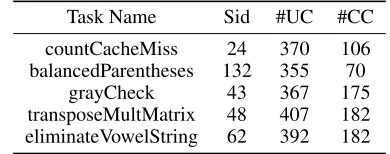
Table 1: Sample size for different programming tasks
Task Name Sid #UC #CC
countCacheMiss 24 370 106 balancedParentheses 132 355 70
grayCheck 43 367 175 transposeMultMatrix 48 407 182 eliminateVowelString 62 392 182
4
Machine Learning Models
Figure 1 shows the final flow for our algorithm. We start with a set of labelled uncompilable (UC) codes. We generate fea-tures from these codes based on one of the following: MC method, RR method or a combination of both. The combina-tion method is motivated and described in detail in Seccombina-tion5. We then develop a machine learning model using these fea-tures.6In the first case, we perform supervised learning
us-ing the UC codes to predict the expert grades (labels). In the second, we reuse models already trained on labelled com-pilable codes (CC). We report in the next section, that the models (trained on CC) do not perform well in themselves. However, certain corrections to them make them as good as those trained on the labelled UC code sample.
We developed machine learning models based on the re-sponses collected on the programming tasks listed in Table
1. We report results forLASSO(α = 1) (Tibshirani 1994) we variedλfrom0 to4.7 The model which gave the best
6
The modelling techniques are described in detail in the next section.
7
We used linear regression, linear regression withL1
regular-ization (LASSO), linear regression withL2regularization (Ridge
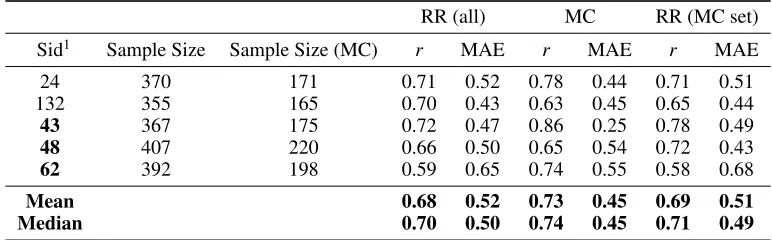
Table 2: Accuracy of models built using the RR and MC approach to grade uncompilable codes. Metrics:rand MAE.
RR (all) MC RR (MC set)
Sid1 Sample Size Sample Size (MC) r MAE r MAE r MAE
24 370 171 0.71 0.52 0.78 0.44 0.71 0.51
132 355 165 0.70 0.43 0.63 0.45 0.65 0.44
43 367 175 0.72 0.47 0.86 0.25 0.78 0.49
48 407 220 0.66 0.50 0.65 0.54 0.72 0.43
62 392 198 0.59 0.65 0.74 0.55 0.58 0.68
Mean 0.68 0.52 0.73 0.45 0.69 0.51
Median 0.70 0.50 0.74 0.45 0.71 0.49
1Some data from SIDs in bold was used for training purposes. In this table we only report
results for test data on all SIDs.
cross-validation (three-fold) correlation was selected. We develop generalized task-independent models (detailed in (Singh, Srikant, and Aggarwal 2016)). Thus, we trained on data from three tasks (Sid43,48,62), and tested on data from all five tasks. For the tasks used in training, we split the response set into a 70-30 train-test set. For the other two tasks, all responses were used in the test set. The per-formance of the model on the unseen problem set helped demonstrate how well the models generalized to program-ming tasks whose sample was not used in training.
We report the Pearson correlation coefficient (r) and MAE
(P|ypred−y|
n ) as evaluation metrics to judge the
perfor-mance of our models.
Now, we describe our experiments, which compare the effi-cacy of various approaches based on choices made at differ-ent steps.
5
Experiments and Results
Our experiments were designed to address the following questions:
• Which among MC and RR approaches are more accurate in predicting the grade for uncompilable codes?
• How accurately can we grade uncompilable codes? How does it compare to the accuracy of expert grades and au-tomatic grading of compilable codes?
• Can we re-use models trained for compilable codes for uncompilable codes?
We conducted our experiments on five programming tasks. The tasks were chosen such that the algorithms to solve these tasks had varying complexities. A subset of programs writ-ten by candidates for these tasks were graded by experts. The set included both compilable and uncompilable codes. We built separate ML models for the compilable and uncom-pilable codes to predict expert grades. For the uncomuncom-pilable
what was seen in (Singh, Srikant, and Aggarwal 2016), linear mod-els worked the best among all these techniques, indicating linearity in the inherent structure of this problem space. We report results only for LASSO in this work which outperformed all other tech-niques.
codes, we built models using each of the RR and MC ap-proach and compared their accuracy. We further investigated if the models for CC could be reused for predicting grades for UC. We now discuss further details.
Data
The experiments were run on a set of programming tasks hosted onAutomata, our automated programming evaluation platform (Aspiring Minds 2012). Respondents, who were college seniors majoring in computer science, took a 90
minute assessment in a proctored environment wherein they attempted two programming tasks. For our experiments, we considered five tasks and programs written in Java (see Table
1). The topics covered by these programming tasks spanned iterative/ recursive algorithms, trees and graphs and other algorithms like the shortest job first, etc. We used on an av-erage,143compilable and378uncompilable responses per task to build and test our models. In total,2606codes were used in our experiments.
Two professional software engineers with4-7 years’ expe-rience each shared the task of grading the responses. The experts followed the rubric defined in to grade codes on a scale of 1-5 (described in (Srikant and Aggarwal 2014)). Before beginning the grading exercise, they underwent a one-week workshop wherein they learned how to interpret the rubric and participated in mock grading exercises. The experts were given special instructions to grade the codes only based on the intended logic of the coder and not to pe-nalise based on the quantum or type of compilation errors. The correlation between the grades of the two experts was on an average0.72across the programming tasks in the data set.
Results
To answer the first question, we trained models on the un-compiling codes using each of the RR and MC approach. The MC approach couldn’t correct all the codes. For an ap-ple to apap-ple comparison, we also present RR results for the subset of codes corrected by the MC approach. These re-sults are provided in Table2. MC is able to only grade48%
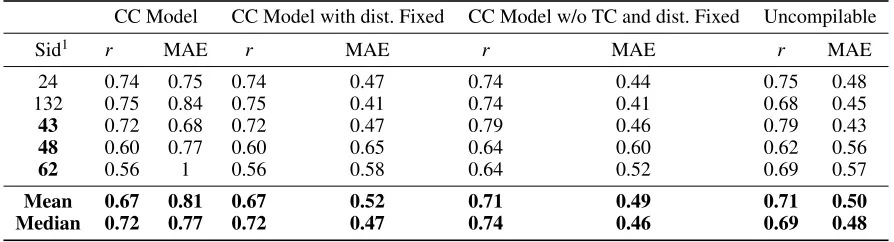
Table 3: Accuracy of models built using a sample of compilable and uncompilable codes to grade uncompilable codes. Metrics:rand MAE.
CC Model CC Model with dist. Fixed CC Model w/o TC and dist. Fixed Uncompilable
Sid1 r MAE r MAE r MAE r MAE
24 0.74 0.75 0.74 0.47 0.74 0.44 0.75 0.48
132 0.75 0.84 0.75 0.41 0.74 0.41 0.68 0.45
43 0.72 0.68 0.72 0.47 0.79 0.46 0.79 0.43
48 0.60 0.77 0.60 0.65 0.64 0.60 0.62 0.56
62 0.56 1 0.56 0.58 0.64 0.52 0.69 0.57
Mean 0.67 0.81 0.67 0.52 0.71 0.49 0.71 0.50
Median 0.72 0.77 0.72 0.47 0.74 0.46 0.69 0.48
1Some data from SIDs in bold was used for training purposes. In this table we only report results for test data
on all SIDs.
(median)rfor MC is0.73(0.74), and it is0.69(0.71) for RR (on MC set). AlsoM C is better for 3 out of5 tasks, worse for one and similar for another.
We find that the approach to correct codes is better than re-laxing grammar. This implies that our code correcting algo-rithm does extrapolate the user’sintent. However, it is unable to do so for52%codes. We combine both the approaches to take each one’s advantage. Here, we useM Capproach for the correctable codes and RRfor the rest. We henceforth call this theRRM C approach. We use this for all further analysis.
Our second question is regarding the accuracy of our mod-els. As reported before, the correlation between expert rat-ings is0.72. We findRRM Cmodels have a mean correla-tion of0.71(Refer second last column of Table3). Only for one task, the correlation is fairly low at0.62. This shows that our approach can at most times provide human-competitive results.
Second, we also built models using compilable codes to pre-dict their labels. We find that the accuracy of these models is much higher (on average,0.85as compared to0.71for UC). This is because we have a fairly informative feature, number of test-cases (TC) passed, for CC. This feature alone pro-vides a correlation of0.73on average with expert ratings. Without this feature, the average correlation for CC falls to
0.70, comparable to0.71of UC. We do not have the benefit of the test case feature for uncompilable codes.8Even when
we correct the codes, we do not semantically correct them to result in an informative TC feature.
Lastly, we wanted to analyse whether we could reuse the models trained on compilable codes (CC models) for un-compilable codes. Here, we use RRM C approach to de-rive features and use the machine learning model learned on compilable codes. This way we do not require additional la-belled UC for building a model. The first column in Table3
shows the results of using the model trained on compilable codes directly. We find that that though the correlation is a little poorer (0.67 compared to0.71), the MAE is
signifi-8
The value of the TC feature is0for codes that we are unable to make compilable. We use the number of test cases passed by the compilable program for codes corrected by the MC approach.
cantly higher (0.81compared to0.50).
To improve the model, we used two insights. First, we drop TC as a feature in training our models on CC. As discussed above, the feature isn’t predictive of grades for UC in the same way it is for compilable codes. Second, a compara-ble correlation and high MAE signals a systematic error. To test this hypothesis, we simply modify the distribution of the model output to match with that of the uncompilable code ratings (on the train set, explained in more detailed later). The results in Table3show that by fixing the distribution, there is a dramatic improvement in the MAE — it comes down to 0.52, comparable to 0.50 of model learnt on un-compilable codes. On removing the test case feature, we get a further improvement. The meanrbecomes0.71and MAE
0.49, almost same as models learned on uncompilable codes.
Distribution correction (DC): The grades predicted by CC models are transformed such that their distribution match the expert grade distribution of the UC. We do an equipercentile transformation on the train set of the UC.9One may note that
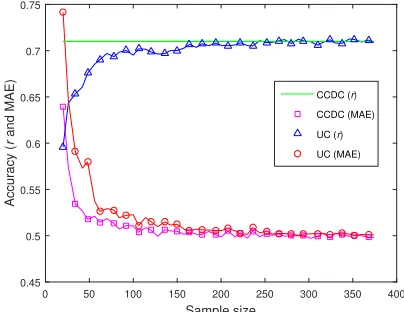
this actually requires expert grades on the UC. Our hypoth-esis was that distribution matching would require a much smaller sample of labelled codes as compared to building a fresh model. To confirm this, we do a simulation: we boot-strap different sample sizes of labelled uncompilable codes and test the mean r/MAE for the distribution correction ap-proach (CCDC) vs. building fresh models (UC). The results are shown in Figure2.
We find that the MAE for the DC approach as a function of the sample size reduces much faster as compared to training fresh models. The DC approach has the rightrthroughout. To attain stability within1%of MAE andr of the asymp-totic accuracy, we require around 140 samples for the DC approach and 220samples for building fresh models. This mean a reduction of about33%in labelling effort. This be-comes significantly large for creating models for multiple programming languages and for multiple raters. For10
lan-9
guages and3raters, it would lead to rating2400additional codes.
Sample size
0 50 100 150 200 250 300 350 400
Accuracy (
r
and MAE)
0.45 0.5 0.55 0.6 0.65 0.7 0.75
CCDC (r)
CCDC (MAE)
UC (r)
UC (MAE)
Figure 2: Accuracy of models built on a sample of compil-able codes with distribution correction (CCDC) and uncom-pilable codes (UC). The x-axis denotes the sample size used and y-axis denotes accuracy in terms ofrand MAE.
6
Development and Deployment
Our current system grades uncompilable programs written in C, C++ and Java. Our test delivery platform, scoring and feedback engine were developed in Python. It took us close to 15 months in designing and deploying the system in pro-duction for all the three languages. We can easily add new programming problems for the existing languages in the sys-tem. To scale the system to a new language, we need to de-velop the feature extractioncomponent and train new ma-chine learning models for it. With two developers, it takes around two months to add a new language to the system.Case Studies
We deployed the RRMC model in the scoring engine of
Automata, our online programming evaluation platform. A multinational technology company in China with more than
50,000 employees used this product for their 2017-2018
campus hiring cycle for entry level software engineers. The company wished to find candidates who can think of correct algorithmic approach to solve a given programming prob-lem. In the Automata report, we provide scores on Program-ming Ability (PA), ProgramProgram-ming Practices (PP), Time Com-plexity (TC) and a total score. Earlier, uncompilable codes had a−1score on Programming Ability. With incorporation of the new models, now uncompilable codes got a PA score based on our standard rubric. The total score is a combina-tion of PA, PP and TC scores. A penalty for non-compilacombina-tion was introduced in it. This helped score a compilable code higher than uncompilable codes, if they had the same score on all metrics.
All candidates first took the test. The company shortlisted candidates with a PA score of 3 or above for interviews. All interviewers were provided with the candidate report,
which provided various test scores, the candidate programs and whether the programs were compilable or not. The in-terviewers were instructed to do an independent evaluation of the coding skills of the candidates. They asked candidates to work out the algorithmic solution for two programming problems during the interview. Based on how the candidate solves these problems, the final hiring decision was made. The recruiters made the decision by their own evaluation, to-gether with transparent input on compile/non-compile from test.
A total of29,600candidates took the test. Out of these54%
had a compilable code,24%had a blank code and22%had an uncompilable code. The PA score for candidates with compilable and uncompilable codes is shown in Table4. The company used a cut-off of3or above on the PA score to in-terview candidates. We find that a total of2457additional candidates were selected for interview (an addition of26%
candidates). After the independent evaluation of interview-ers,565selected candidates had uncompiling codes (an ad-dition of19%hired candidates). The company was able to hire much more efficiently. Also, many worthy candidates who would have got missed out by traditional program grad-ing systems were hired.
In another study, a large IT services company in India used the system for hiring software engineers from campus. The company hires tens of thousands of software engineers ev-ery year and cite inability to fulfill all open positions as a major challenge. Using our tool, the company was able to improve shortlisting and selection rate by30%-40%. They used an independent programming interview round to make hiring decisions. The increase in hiring rate led to big sav-ings in sourcing cost, business cost of unfilled positions and greatly reduced time to hire.
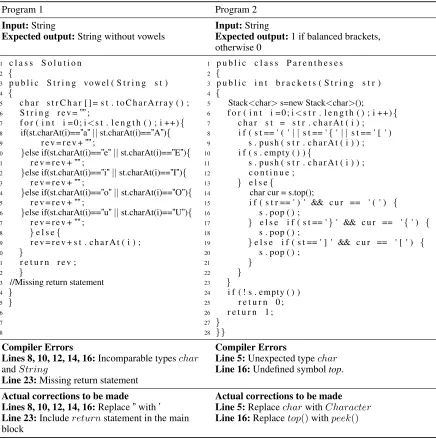
We eyeballed some of the uncompilable codes of hired can-didates in these studies. We show couple of examples in Ta-ble5. One observes that the codes’ logic is correct, but they do not compile due to incorrect declaration or use of data types. Another error is wrong placement of return with respect to parentheses. We find that candidates with near-correct codes (semantically) makes compilation errors due to lack of knowledge of using the language. They also some-times are unable to debug simply silly errors. One reason for this could be that compiler generated error messages aren’t instructive enough to correct the errors (see ‘Compiler Er-rors’ in example). For instance, in (Becker et al. 2018), au-thors report that64%students find multiple compiler error messages confusing and hard to debug.
7
Conclusion
Table 4: Distribution of PA scores for candidates with compilable and uncompilable programs. The table also includes the number of candidates selected for interview and the number of candidates who were hired.
Rubric Definition Compilable Uncompilable
1 Code unrelated to given task 3361 1979
2 Appropriate keywords and tokens are present 3264 2125 3 Right control structure exists with missing data dependency 2547 1440
4 Correct with inadvertent errors 2955 1017
5 Completely correct 3828
-≥3 Selected for interview 9330 2457
- Hired 2986 565
Table 5: Examples of candidate submissions with uncompiling codes who got hired.
Program 1 Program 2
Input:String
Expected output:String without vowels
Input:String
Expected output:1 if balanced brackets, otherwise 0
1 c l a s s S o l u t i o n
2 {
3 p u b l i c S t r i n g v o w e l ( S t r i n g s t )
4 {
5 c h a r s t r C h a r [ ] = s t . t o C h a r A r r a y ( ) ;
6 S t r i n g r e v =””;
7 f o r ( i n t i = 0 ; i<s t . l e n g t h ( ) ; i ++){ 8 if(st.charAt(i)==”a”||st.charAt(i)==”A”){ 9 r e v = r e v +””;
10 }else if(st.charAt(i)==”e”||st.charAt(i)==”E”){ 11 r e v = r e v +””;
12 }else if(st.charAt(i)==”i”||st.charAt(i)==”I”){ 13 r e v = r e v +””;
14 }else if(st.charAt(i)==”o”||st.charAt(i)==”O”){ 15 r e v = r e v +””;
16 }else if(st.charAt(i)==”u”||st.charAt(i)==”U”){ 17 r e v = r e v +””;
18 }e l s e{
19 r e v = r e v + s t . c h a r A t ( i ) ;
20 }
21 r e t u r n r e v ;
22 }
23 //Missing return statement
24 } 25 } 26
27
28
1 p u b l i c c l a s s P a r e n t h e s e s
2 {
3 p u b l i c i n t b r a c k e t s ( S t r i n g s t r )
4 {
5 Stack<char>s=new Stack<char>();
6 f o r ( i n t i = 0 ; i<s t r . l e n g t h ( ) ; i ++){ 7 c h a r s t = s t r . c h a r A t ( i ) ;
8 i f ( s t == ' ( '| |s t == '{'| |s t == ' [ ' ) 9 s . p u s h ( s t r . c h a r A t ( i ) ) ;
10 i f ( s . empty ( ) ){
11 s . p u s h ( s t r . c h a r A t ( i ) ) ;
12 c o n t i n u e ;
13 } e l s e{
14 char cur = s.top();
15 i f ( s t r == ' ) ' && c u r == ' ( ' ) {
16 s . pop ( ) ;
17 } e l s e i f ( s t == '}' && c u r == '{' ) {
18 s . pop ( ) ;
19 }e l s e i f ( s t == ' ] ' && c u r == ' [ ' ) {
20 s . pop ( ) ;
21 }
22 }
23 }
24 i f ( ! s . empty ( ) )
25 r e t u r n 0 ;
26 r e t u r n 1 ;
27 }
28 }}
Compiler Errors
Lines 8, 10, 12, 14, 16:Incomparable typeschar andString
Line 23:Missing return statement
Compiler Errors
Line 5:Unexpected typechar
Line 16:Undefined symboltop.
Actual corrections to be made Lines 8, 10, 12, 14, 16:Replace”with’
Line 23:Includereturnstatement in the main block
Actual corrections to be made Line 5:ReplacecharwithCharacter
coder’sintent, while the second is able to parse a much larger number of programs. We combine both these methods in our final algorithm.
We grade uncompilable codes according to a rubric based on features derived from the ST and AST. We perform super-vised learning on a sample of expert graded codes. We find that our machine learning models for uncompilable codes ri-val the internal consistency of experts. We further find that the models developed for compilable codes can be reused for uncompilable codes after normalization. This reduces the need of new labelled data on uncompilable codes.
To the best of our knowledge, this is the first work which at-tempts to separately treat the skill to propose the right algo-rithmic approach for a problem vs. being able to write syn-tactically correct code. This enables companies and evalua-tors to identify good coders even if their submitted programs do not compile. We identified19%such coders in the case study with a company. The approach also enables coders to get semantic feedback on uncompiling codes.
In future, the holy grail is how we can further relax the need for writing a code following syntax and grammar rules — be able to grade pseudo-code or that written in natural lan-guage. This constitutes a specialized problem in the domain of natural language understanding. Our immediate area of interest is to investigate how to provide more fine-grained feedback for uncompilable codes.
References
Appel, A. W. 1997. Modern Compiler Implementation in
ML: Basic Techniques. New York, NY, USA: Cambridge
University Press.
Aspiring Minds. 2012. Automata. Accessed: 2018-09-02.
Becker, B. A.; Murray, C.; Tao, T.; Song, C.; McCartney, R.; and Sanders, K. 2018. Fix the first, ignore the rest: Dealing with multiple compiler error messages. InProceedings of the 49th ACM Technical Symposium on Computer Science
Education, SIGCSE ’18, 634–639. New York, NY, USA:
ACM.
Bhatia, S., and Singh, R. 2016. Automated correction for syntax errors in programming assignments using recurrent neural networks.
Braun H. I., H. P. W. 1982. Observed-score testing equating: A mathematical analysis of some ets equating procedures.
Holland, Paul W.; Rubin, Donald B. (eds.) Test Equating. New York: Academic Press, 1982, p9-49267–288.
Gupta, R.; Pal, S.; Kanade, A.; and Shevade, S. K. 2017. Deepfix: Fixing common C language errors by deep learn-ing. InProceedings of the Thirty-First AAAI Conference on Artificial Intelligence, February 4-9, 2017, San Francisco, California, USA., 1345–1351.
Head, A.; Glassman, E.; Soares, G.; Suzuki, R.; Figueredo, L.; D’Antoni, L.; and Hartmann, B. 2017. Writing reusable code feedback at scale with mixed-initiative program syn-thesis. In Proceedings of the Fourth (2017) ACM
Confer-ence on Learning @ Scale, L@S ’17, 89–98. New York,
NY, USA: ACM.
Kolen M. J., B. R. L. 1995. Test Equating, Scaling, and Linking. New York: Springer-Verlag.
Le Goues, C.; Nguyen, T.; Forrest, S.; and Weimer, W. 2012. Genprog: A generic method for automatic software repair.
IEEE Trans. Software Eng.38(1):54–72.
Long, F., and Rinard, M. 2016. Automatic patch generation by learning correct code. InProceedings of the 43rd Annual ACM SIGPLAN-SIGACT Symposium on Principles of Pro-gramming Languages, POPL ’16, 298–312. New York, NY, USA: ACM.
Mechtaev, S.; Yi, J.; and Roychoudhury, A. 2016. An-gelix: Scalable multiline program patch synthesis via sym-bolic analysis. InProceedings of the 38th International Con-ference on Software Engineering, ICSE ’16, 691–701. New York, NY, USA: ACM.
Singh, R.; Gulwani, S.; and Solar-Lezama, A. 2013. Au-tomated feedback generation for introductory programming assignments. In Proceedings of the 34th ACM SIGPLAN Conference on Programming Language Design and Imple-mentation, PLDI ’13, 15–26. New York, NY, USA: ACM. Singh, G.; Srikant, S.; and Aggarwal, V. 2016. Question independent grading using machine learning: The case of computer program grading. In Proceedings of the 22Nd ACM SIGKDD International Conference on Knowledge Discovery and Data Mining, KDD ’16, 263–272. New York, NY, USA: ACM.
Srikant, S., and Aggarwal, V. 2014. A system to grade com-puter programming skills using machine learning. In Pro-ceedings of the 20th ACM SIGKDD International Confer-ence on Knowledge Discovery and Data Mining, KDD ’14, 1887–1896. New York, NY, USA: ACM.
Tibshirani, R. 1994. Regression shrinkage and selection via the lasso. Journal of the Royal Statistical Society, Series B