RESEARCH REPOSITORY
This is the author’s final version of the work, as accepted for publication
following peer review but without the publisher’s layout or pagination.
The definitive version is available at:
https://doi.org/10.1109/PESGM.2014.6939812
Abeygunawardana, A., Arefi, A. and Ledwich, G. (2014) An efficient forward-backward
algorithm to MSDEPP including batteries and voltage control devices. In: IEEE PES
General Meeting | Conference & Exposition 2014, 27 - 31 July 2014, National Harbor, MD
http://researchrepository.murdoch.edu.au/id/eprint/40227/
Copyright: © 2014 IEEE
An Efficient Forward-backward Algorithm to MSDEPP
Including Batteries and Voltage Control Devices
Anula Abeygunawardana, Ali Arefi,
Member, IEEE,
Gerard Ledwich,
Senior Member, IEEE
Electrical Engineering and Computer Science School Queensland University of Technology
Brisbane, Australia
Abstract— Electric distribution networks are now in the era of transition from passive to active distribution networks with the integration of energy storage devices. Optimal usage of batteries and voltage control devices along with other upgrades in network needs a distribution expansion planning (DEP) considering inter-temporal dependencies of stages. This paper presents an efficient approach for solving multi-stage distribution expansion planning problems (MSDEPP) based on a forward-backward approach considering energy storage devices such as batteries and voltage control devices such as voltage regulators and capacitors. The proposed algorithm is compared with three other techniques including full dynamic, forward fill-in, backward pull-out from the point of view of their precision and their computational efficiency. The simulation results for the IEEE 13 bus network show the proposed pseudo-dynamic forward-backward approach presents good efficiency in precision and time of optimization.
Index Terms— Energy storage, Capacitor, Distribution expansion planning, Multi-stage planning, Pseudo-dynamic approach.
INTRODUCTION
Long-term distribution expansion planning problems (DEPPs) are complex combinatorial problems due to the large number of variables involved. Further, as DEPPs are non-linear “NP-hard” problems, computational time generally increases exponentially with the number of variables. Therefore, exact mathematical methods can only be applied to solve DEPPs for small scale systems. For this reason, many authors have applied heuristic methods to solve large scale DEPPs. Even with heuristics, computing good solutions to large scale DEPPs remains a time consuming operation. One of the main factors that increase computational time of DEPPs, beside the large dimension of the networks is time dynamic nature of the problem. Due to this reason, researchers have used diverse approaches to simplify the dynamic nature of the DEPPs.
Most of early studies on DEP considered the study period as a single stage by ignoring the inter-temporal dependences and the dynamic nature of DEPPs [1, 2]. This approach is known as horizon planning and it finds the optimal state of the
network for a future fixed year. Since timing of decisions is not a decision variable in horizon planning, it may not be appropriate for long term planning considering economic aspect. Because it does not take into account the time value of the money and the optimal sizes of network expansion equipment for different load levels. In order to achieve a more precise and optimal modeling of DEPP, a dynamic planning approach that minimizes the overall present value of several planning periods should be used. However, exact dynamic planning is very complex, involves a very large number of variables and requires enormous computational effort to obtain the optimal solution. Therefore, exact dynamic planning works only for small DEPPs. A number of studies propose multi-stage distribution expansion planning (MSDEP) models based on exact dynamic planning approach for small networks [1, 3]. Due to the curse of dimensionality in applying exact dynamic approach for multistage planning of real-size networks, a number of algorithms based on pseudo-dynamic theory have been proposed in the literature. Pseudo-dynamic algorithms decompose multi-stage planning problems into a sequence of single-stage problems and each sub problem is solved independently and coordinated through different strategies.
A. Forward fill-in planning
The most commonly used pseudo- dynamic approaches for DEP are the forward fill-in and backward pull-out approaches. In the forward fill-in approach, the static expansion planning problems are solved sequentially for all time stages starting from the first one, considering in the next time stage the equipment installed in the past. Forward fill-in is simple but it works best for very short-range planning and in cases where there are only one or a few load growth locations [4]. A few studies have used the forward fill-in approach for DEP mainly due to its simplicity [5, 6].
B. Backward pull-out planning
In the backward pull-out approach, first the optimal set of investments are determined for the last stage (say stage T) of the planning period by considering the demand in the last stage and the network configuration at the beginning of planning period. Then the planning exercise proceeds
This work is part of project supported by Queensland Government via the National and International Research Alliances Program (NIRAP) and Ergon Energy corp.
backwards in time analyzing stage T-1, then stage T-2, and so forth, to stage 1, using only the elements determined in the first step. Backward pull-out works best for multi-year planning situations [4] mainly because it takes into account demand growth for the whole planning period This approach has been used by a number of studies [3, 7-10].
C. Forward-backward approach
Although the backward pull-out approach gives reasonable solutions for long-term DEPPs, this approach decides the optimal set of investments for the horizon year demand level and finds the timing of these investments backwards. Since the backward pull-out approach optimizes the network for last time stage, it effectively does no splitting of the time stages. In the other hand, the forward fill-in approach does full-splitting of the problem into time stages and it does not take future load growth into account. Since most distribution equipment is available only in discrete sizes and there is usually a large economy of scale, investments decisions for each time stage should be made by considering future load growth. For the same reason, the optimal size of network expansion equipment for one particular demand level may not be optimal for another demand level. Therefore, both forward and backward planning can be combined to obtain the better results for DEPPs as a combined approach can take into account, future load growth, the discrete nature and economy of scale of distribution equipment, and the time value of money.
Few studies have used forward-backward approach [4, 5, 11]. Nara et al used a recursive forward-backward approach for multi-stage distribution expansion planning (MSDEP) using the branch and bound method [4]. In this approach, forward fill-in approach is initiated from the first time stage and proceeded to the second stage and then backward is tried. If a better expansion plan cannot be obtained from backward path, the forward path proceeds to the next time stage and the procedure goes on. When the backward path succeeds a new better expansion plan is obtained, a new forward path planning is started from the first stage to the time stage where the backward planning started and this new plan is compared with the backward plan to find the better plan. This procedure is done recursively until finding the best solution. Unlike in [4], [11] starts backward pull-out planning from the last time stage and proceeds to the first time stage. Then forward fill-in planning is carried out form the first time stage to the next using the expansion plan obtained for the first stage from the backward planning and this forward planning is continued until the last time stage. The total cost of the backward and forward paths are then compared and if the difference in cost between two plans is below a value predetermined by the planner the optimization stops, otherwise backward planning is redone from the last time stage using the expansion plan of the last stage obtained from forward planning. This procedure continues until convergence. The forward-backward approach used by [5] for multi-year active distribution network planning is different to the above two approaches. All possible forward backward multi-planning scenarios are compared to find the best expansion plan. Possible multi-year planning scenarios includes forward fill-in from the first year to the final year, backward pull-out from the last year to the first year, and
from each intermediate year backward pull-out planning until the first year and forward fill-in planning to the last year.
This paper presents an efficient forward-backward approach for MSDEPP including energy storage sizing and placement, capacitor and voltage regulator placement, transformer and line upgrade. The results are compared in terms of precision and computational efficiency for IEEE 13 bus system.
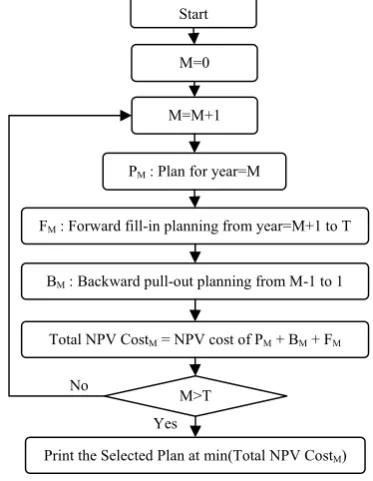
THE PROPOSED FORWARD-BACKWARD TO MSDEPP The flowchart of proposed forward-backward approach is shown in Fig.1.
Figure 1. The flowchart of proposed forward-backward approach
The objective of MSDEPP is to design a distribution system that can economically supply the load over the planning stages. Therefore, the objective function to be minimized is as:
3 ,
4 , ,
05 . 1 95 . 0
:
NPV) Salvage NPV
Operation NPV
on Installati Variable
NPV on Installati Fix ( min
,
Numbers Regulator
trippling and
doubling conductor
of
TypedTransformer BatteryCapacitorSize
Discretize
B 1 i I I
N 1 i V
to Subject
Function Objective
Max i i
i
(1)
Where NPV is net present value; Fix Installation NPV is fix NPV cost of equipment installation; Variable Installation NPV is variable NPV cost of equipment installation; Operation NPV is operation NPV cost of equipment + energy and power loss; Salvage NPV is salvage NPV cost of variable Installation NPV; Vi is the magnitude of voltage at bus i;
Start
M=M+1
FM : Forward fill-in planning from year=M+1 to T
BM : Backward pull-out planning from M-1 to 1
Total NPV CostM = NPV cost of PM + BM + FM
Print the Selected Plan at min(Total NPV CostM)
M>T M=0
PM : Plan for year=M
No
i
I is the magnitude of current at branch i; Ii,Max is the current rating of branch i; B is number of branches and N is number of buses.
The MSDEPP in modern power systems is a large-scale, mixed-integer, and non-linear problem and exact mathematical methods can hardly be applied to solve it. Heuristic approaches are most commonly used to solve MSDEP problems. Due to the nature of Particle Swarm Optimization (PSO) as an optimization tool proven to be capable of handling highly non-linear and mixed integer problems, PSO has been widely applied to solve DEPPs [10, 12-15]. However, in some cases, premature convergence and poor fine-turning of the final solution can occur in PSO. Therefore, in this study, we use a modified version of PSO (MPSO) by combining the strengths of PSO and GA to increase the diversity of variables and thereby to escape from local minima. Our hybrid algorithm combines standard PSO particle update rules with idea of mutation from GA as in [16]. In addition, the constriction factor approach for PSO is applied in this algorithm because it has better performance compared to the inertia weight approach [17].
The decision variables in each particle of MPSO to MSDEP of active distribution networks include the size, location and size batteries, capacitors, conductors and voltage regulators as presented in Fig. 2.
Figure 2. Particle structure in MPSO
In the initialization process, a population of particles is randomly generated. Each particle represents a candidate solution for expansion planning. The fitness calculation involves two steps in our problem. First we calculate the total capital and operating cost for each given particle, then we carry out AC load flow based on the bus-injection to branch-current (BIBC) matrix[18] for the network configuration given by the particle to check if all constraints are met. If a constraint is violated we penalized the particle by adding a high cost value to the objective. In addition, the load flow gives all necessary information for calculating the total loss for each particle. The required transformer upgrades for both distribution transformers and sub-transmission transformer are calculated for each corresponding particle after finding the loading of transformer by including the new voltage regulators, capacitors, batteries, and line upgrades given in the particle . The estimated objective function value or fitness value of each particle is used to locate the individual best particle and global best particle. Then we proceed to the next iteration, where a new population is generated by updating the velocity of each particle based on the best solution seen so far by that particle and on the global best particle. This procedure is continued until convergence.
SIMULATION RESULTS
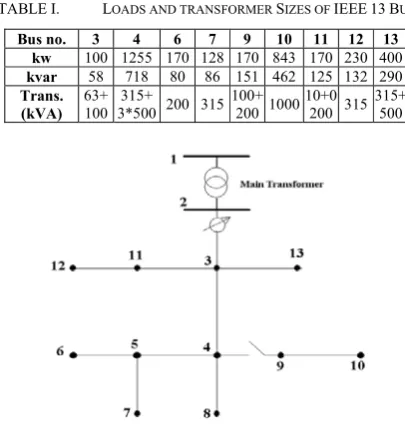
In order to compare the different approaches of solving the MSDEPP, they are applied to the IEEE 13 bus network which is a 4.16 kV radial distribution network including one voltage regulator, 13 nodes (9 load nodes), and two capacitor banks in buses 10 and 6 whose capacities are 600 and 100 kvar, respectively as shown in Fig. 3 [6]. The test system consists of both overhead and underground cables. The load characteristics and sizes of distribution transforms obtained from initial network design are given in Table I.
TABLE I. LOADS AND TRANSFORMER SIZES OF IEEE13BUS
Bus no. 3 4 6 7 9 10 11 12 13 kw 100 1255 170 128 170 843 170 230 400 kvar 58 718 80 86 151 462 125 132 290 Trans.
(kVA) 63+
100 3*500315+ 200 315 100+ 200 1000 10+0 200 315315+500
Figure 3. IEEE 13 bus test System
The cost parameters of the candidate equipment are shown in Table II. Note that in this case study, storage units and capacitors are used for both peak clipping and voltage control. The analysis here assumes a load growth of 7% per each time stage and discount rate of 5%. The MPSO parameters used in the simulation are particle population = 50, maximum iterations = 100, ψmax = 4.05, K = 0.99 and the mutation
probability = 80%. The mutation operator is applied to 10% of particle population.
We develop the network expansion plans using four different approaches and expansion plans obtained from different approaches are compared from the point of view of their precision and their computational efficiency. The four different cases considered in the study are:
A. Dynamic planning case (at-once planning): B. Planning case with forward fill-in approach C. Planning case with backward pull-out approach D. Planning with proposed forward-backward approach
In case A, we consider all time stages together and optimal expansion plan is outlined for whole planning period by minimizing overall present value of all planning periods. Network expansion plans are developed for these four scenarios for two different planning horizons, 3 and 5 years.
… … …
Voltage regulators
(loc
atio
n)
C
ap
acito
rs
(s
iz
e &
location) Batterie
s
(s
iz
e &
location) Line upgra
Therefore, altogether we developed eight network expansion plans to examine the effectiveness of different pseudo-dynamic planning approaches in terms of their precision and their computational efficiency. The MPSO technique described above was used to develop these eight MSDEPs.
TABLE II. COST PARAMETERS OF CANDIDATE EQUIPMENT
Candidate equipment type cost (k$) Fix Inst. Variable inst. cost (k$) Life time (yr) OH
conductors
Pluto 75 91 k$/ km
40
Saturn 98 k$/km
UG cables Al Triplex Cu 1 core 100 511 k$/km 525 k$/km
Overhead trans.
25kVA
75
30
40
63kVA 31
100kVA 35 200kVA 42
315kVA 50
500kVA 65
Pad mounted substation
315kVA
125
63
40
500kVA 77
750kVA 98
1000kVA 119
1500kVA 140
Sub Trans. 5000kVA 350 550 40
Regulator 25 - 40
Capacitor 3 0.025/kVAR 20
Battery storage 0.7 1/kWh 7
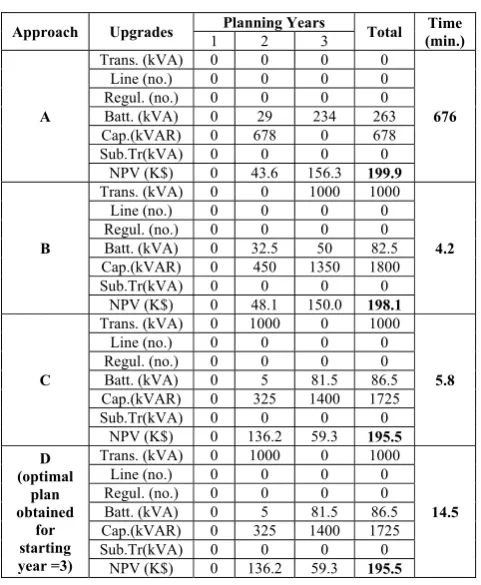
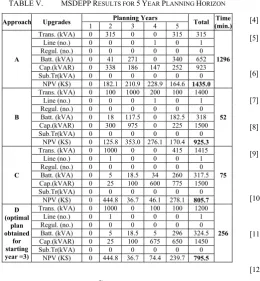
The choice of approach for solving multi-stage dynamic DEPPs mainly depends on the precision of the approach and its computational efficiency. Table III gives the comparison of computational time and total NPV cost of expansion plans for the different cases for two different planning horizons (3 and 5 years). Although we expect that the dynamic planning procedure can lead to the better optimal solution, our results show that in both 3 and 5 year planning case, the total NPV cost of expansion plan obtained from this case is higher than that of other cases. This is because in case A, the optimization algorithm may trap in local optima due to the problem complexity and size. Furthermore, the computational time of case A is a multiple of that of other cases for both 3 and 5 years planning horizons.
TABLE III. COMPARISON OF DIFFERENT APPROACHES OF MSDEPP
3 year planning horizon 5 year planning horizon Approach (min) time NPV (k$) Total (min) time NPV (k$) Total A 676 199.9 1296 1435.0 B 4.2 198.1 52 925.3
C 5.8 195.5 75 805.7
D 14.5 195.5 256 795.5
Tables IV and V present the optimal network expansion plans for planning horizon of 3 years and 5 years respectively for all four approaches considered. As shown in Table IV, existing network equipment can supply the load growth in first year without violating any constraints. Therefore there is no difference in optimal expansion plans obtained from forward fill-in approach that starts from the first year and forward-backward planning that starts from the 2nd year. Hence, in
applying forward-backward approach for 3 year planning horizon case we effectively need to compare the optimal plans obtained from case B and case C. As expected backward pull-out approach gives lower cost expansion plans than that obtained using forward fill-in approach.
A 7% annual growth in load demand for 3 years would overload the distribution transformers located in bus 10 and 12 in year 2, and transformers located in bus 4 in year 3 respectively. Therefore, in 3 year optimal expansion plan (in the backward pull-out approach) we expect that new transformers would be added in these three buses. However, as can be seen from Table IV, in the lowest cost plan obtained from backward pull-out approach, only one new distribution transformer of capacity 1000 kVA is added at bus 10. It would be economical to install battery storage units and capacitors in year 2 and 3 to defer the transformer upgrades at bus 4 and 12. The results show that these battery storage units and capacitors not only defer the transformer investments but also help to keep voltages at load buses and line current within acceptable limits.
TABLE IV. MSDEPPRESULTS FOR 3YEAR PLANNING HORIZON
Approach Upgrades 1 2 3 Planning Years Total (min.) Time
A
Trans. (kVA) 0 0 0 0
676
Line (no.) 0 0 0 0
Regul. (no.) 0 0 0 0 Batt. (kVA) 0 29 234 263 Cap.(kVAR) 0 678 0 678
Sub.Tr(kVA) 0 0 0 0
NPV (K$) 0 43.6 156.3 199.9
B
Trans. (kVA) 0 0 1000 1000
4.2
Line (no.) 0 0 0 0
Regul. (no.) 0 0 0 0 Batt. (kVA) 0 32.5 50 82.5 Cap.(kVAR) 0 450 1350 1800
Sub.Tr(kVA) 0 0 0 0
NPV (K$) 0 48.1 150.0 198.1
C
Trans. (kVA) 0 1000 0 1000
5.8
Line (no.) 0 0 0 0
Regul. (no.) 0 0 0 0 Batt. (kVA) 0 5 81.5 86.5 Cap.(kVAR) 0 325 1400 1725
Sub.Tr(kVA) 0 0 0 0
NPV (K$) 0 136.2 59.3 195.5 D
(optimal plan obtained
for starting year =3)
Trans. (kVA) 0 1000 0 1000
14.5
Line (no.) 0 0 0 0
Regul. (no.) 0 0 0 0 Batt. (kVA) 0 5 81.5 86.5 Cap.(kVAR) 0 325 1400 1725
Sub.Tr(kVA) 0 0 0 0
NPV (K$) 0 136.2 59.3 195.5
In addition, there will be one line upgrade to keep line currents within their maximum allowable limits. As in the 3 year planning case, battery storage and capacitors not only defer transformer upgrades but also keep load voltages within limits. It should be noted here that, in both 3 and 5 year planning horizon, no any voltage regulator is selected. This is because existing voltage regulator can provide the voltage support for a five year load growth as lines are not very long in this 13 bus test system.
TABLE V. MSDEPPRESULTS FOR 5YEAR PLANNING HORIZON
Approach Upgrades 1 2 3 4 5 Planning Years Total (min.)Time
A
Trans. (kVA) 0 315 0 0 315 315
1296
Line (no.) 0 0 0 1 0 1 Regul. (no.) 0 0 0 0 0 0 Batt. (kVA) 0 41 271 0 340 652 Cap.(kVAR) 0 338 186 147 252 923 Sub.Tr(kVA) 0 0 0 0 0 0
NPV (K$) 0 182.1 210.9 228.9 164.6 1435.0
B
Trans. (kVA) 0 100 1000 200 100 1400
52
Line (no.) 0 0 0 1 0 1 Regul. (no.) 0 0 0 0 0 0 Batt. (kVA) 0 18 117.5 0 182.5 318 Cap.(kVAR) 0 300 975 0 225 1500 Sub.Tr(kVA) 0 0 0 0 0 0
NPV (K$) 0 125.8 353.0 276.1 170.4 925.3
C
Trans. (kVA) 0 1000 0 0 415 1415
75
Line (no.) 0 1 0 0 0 1 Regul. (no.) 0 0 0 0 0 0 Batt. (kVA) 0 5 18.5 34 260 317.5 Cap.(kVAR) 0 25 100 600 775 1500 Sub.Tr(kVA) 0 0 0 0 0 0
NPV (K$) 0 444.8 36.7 46.1 278.1 805.7 D
(optimal plan obtained
for starting year =3)
Trans. (kVA) 0 1000 0 100 100 1200
256
Line (no.) 0 1 0 0 0 1 Regul. (no.) 0 0 0 0 0 0 Batt. (kVA) 0 5 18.5 5 296 324.5 Cap.(kVAR) 0 25 100 675 650 1450 Sub.Tr(kVA) 0 0 0 0 0 0
NPV (K$) 0 444.8 36.7 74.4 239.7 795.5
CONCLUSION
This study proposes an effective forward-backward approach to solve MSDEPP and compares different approaches in terms of their computational efficiency and precision. The different approaches including proposed algorithm (Case D) are applied to obtain the expansion plans for MSDEP of IEEE 13 bus test system. It is observed that pseudo-dynamic approaches are more effective in solving MSDEPP compared to full dynamic planning because they are computationally efficient and give acceptable results. Since the proposed forward-backward approach develops series of expansion plans staring from every year of planning horizon, this approach would give better results than that obtained by other cases. The simulation results show that using batteries and capacitors can defer the installation of transformer and line upgrades and presents more cost effective planning for distribution networks.
ACKNOWLEDGEMENT
The authors would like to acknowledge and thank the Queensland Government of Australia and Ergon Energy Corporation Ltd. for their financial support via the National
and International Research Alliances Program (NIRAP). REFERENCES
[1] Z. Krishans, V. Neimane, and G. Andersson, "Dynamic model for planning of reinforcement investments in distribution networks," presented at the Power systems computation Conference (PSCC’99), Trondheim, Norway, 1999.
[2] T. H. Fawzi, K. F. Ali, and S. M. El-Sobki, "A New Planning Model for Distribution Systems," Power Apparatus and Systems,
IEEE Transactions on, vol. PAS-102, pp. 3010-3017, 1983.
[3] S. Krajcar, M. Skok, and D. Skrlec, "Long-term Multi-stage planning of open loop distribution networks under uncertainty," presented at the 15th Power Susystems Computational Conference (PSCC 2005), Liege, Belgium.
[4] H. L. Willis, Power Distribution Planning Reference Book: Taylor & Francis, 2004.
[5] C. L. T. Borges and V. F. Martins, "Multistage expansion planning for active distribution networks under demand and Distributed Generation uncertainties," International Journal of Electrical Power & Energy Systems, vol. 36, pp. 107-116, 3// 2012.
[6] IEEE PES Distribution System Analysis Subcommittee, IEEE PES
Distribution test Feeders. Available:
http://ewh.ieee.org/soc/pes/dsacom/testfeeders
[7] G. J. Berg and T. A. M. Sharaf, "Dynamic transmission planning under uncertainty," Electric Power Systems Research, vol. 8, pp. 131-136, 3// 1985.
[8] I. J. Ramirez-Rosado and T. Gonen, "Pseudodynamic planning for expansion of power distribution systems," Power Systems, IEEE Transactions on, vol. 6, pp. 245-254, 1991.
[9] D. I. Sun, D. R. Farris, P. J. Cote, R. R. Shoults, and M. S. Chen, "Optimal Distribution Substation and Primary Feeder Planning VIA the Fixed Charge Network Formulation," Power Apparatus
and Systems, IEEE Transactions on, vol. PAS-101, pp. 602-609,
1982.
[10] I. Popovic, d. Popovic, and V. Kerleta, "Risk management based procedure for multi-stage expansion planning of distribution networks under uncertainty," presented at the 19th International Conference on Electricity Distribution, Vienna, 2007.
[11] G. Celli, S. Mocci, F. Pilo, D. Bertini, and R. Cicoria, "Multi-Year Optimal Planning of Active Distribution Networks," presented at the 19th International Conference on Electricity Distribution, Vienna, 2007.
[12] M. C. d. Rocha and J. T. Saraiva, "A multiyear dynamic transmission expansion planning model using a discrete based EPSO approach," Electric Power Systems Research, vol. 93, pp. 83-92, 2012.
[13] M. Sedghi, M. Aliakbar-Golkar, and M. R. Haghifam, "Distribution network expansion considering distributed generation and storage units using modified PSO algorithm," International Journal of Electrical Power & Energy Systems, vol. 52, pp. 221-230, 2013.
[14] I. Ziari, G. Ledwich, A. Ghosh, and G. Platt, "Optimal distribution network reinforcement considering load growth, line loss, and reliability," Power Systems, IEEE Transactions on, vol. 28, pp. 587-597, 2013.
[15] I. Ziari, G. Ledwich, A. Ghosh, and G. Platt, "Integrated Distribution Systems Planning to Improve Reliability Under Load Growth," Power Delivery, IEEE Transactions on, vol. 27, pp. 757-765, 2012.
[16] Y. del Valle, G. K. Venayagamoorthy, S. Mohagheghi, J. C. Hernandez, and R. G. Harley, "Particle Swarm Optimization: Basic Concepts, Variants and Applications in Power Systems,"
Evolutionary Computation, IEEE Transactions on, vol. 12, pp.
171-195, 2008.
[17] R. C. Eberhart and Y. Shi, "Comparing inertia weights and constriction factors in particle swarm optimization," in
Evolutionary Computation, 2000. Proceedings of the 2000 Congress on, 2000, pp. 84-88 vol.1.