*Corresponding author: Koffi Sagna ISSN: 0976-3031
Research Article
STUDY AND DESIGN OF AN IMPROVED CLAY CONICAL STOVE
Komi Apélété Amou., Koffi Sagna*., Kokou N’witcha., Tchamou Saa and Kossi Napo
Department, Sciences Faculty, University of Lomé, Lomé, Togo
DOI: http://dx.doi.org/10.24327/ijrsr.2018.0912.2958
ARTICLE INFO ABSTRACT
The use of fossil and nuclear energy is at the root of global warming and the risks associated with nuclear accidents. This is why many researchers and scientists have started looking for ways and means to significantly reduce the use of these forms of energy. Thus renewable sources including solar, biomass etc ... have reduced the use of fossil sources. But in many cities, the use of wood for fuel and charcoal is behind the advance of the desert and deforestation. One way to significantly reduce the use of wood and the preservation of flora the use of improved stoves. These homes reduce the consumption of wood and charcoal in households. In Togo, the conical hearth is one of the best that saves coal more than 30% [1] compared to the “Malgache” stoves. In this work, we introduced clay into the UB conical focus to further improve its performance. The results of the study are interesting and allow us to conclude that the introduction of clay has saved coal at 28% compared to the original conical focus given the properties of the clay. Thus the extension of this new home in Togo and the sub-region will contribute to the reduction of greenhouse gases, reduce deforestation and reduce the progress of the desert in the world.
INTRODUCTION
A cooker stove is a system in which fuel is burned to cook food. It represents a technology that is as old as the discovery of fire and the civilization of man. The earliest known foci date from about 400,000 BC (China) to 500,000 BC (Europe) [2]. The man (Homo erectus, Paleolithic inferior) lived mainly in caves and made fire in a circle of stones. In this ice age, the fire was most likely used for heating purposes. The use of fire for the preparation and preservation of food is only really known in the Middle Palaeolithic, about 100,000 BC [2]. Most people in developing countries use wood or charcoal as fuel for cooking. These types of fuels are burned in homes. The fires used in our countries are of different kinds. The used cooker stove is based on several criteria such as: customary considerations; the environment in which it is used. In fact, the rural population prefers to use wood burning fireplaces than charcoal cookers because of the availability of this type of fuel in these areas, whereas in urban areas it is rather preferred to use charcoal cookers do not smoke too much when used; the amount of meals to be cooked also determines the size of the fireplace to be used. It should be noted that the consumption of wood and charcoal damages the environment due to deforestation and deforestation [3, 4]. Many huge quantity of trees are cut each year for obtaining firewood and its transformation into charcoal. Awareness of this growing consumption has led to
major projects to improve traditional cookers stove that are too greedy in wood and charcoal. We then tend gradually to households qualified as improved because of their better performance. The introduction of improved stoves has been done in two waves:
The first projects are carried out in India and Indonesia in the 1950s. In Africa, in the Sahel, they start after the great drought of the end of 1970. In Central America, it is after the earthquake in Guatemala in 1976. At these first waves, more or less at the initiative of Westerners, correspond massive cook stove with fireplace, two or three pans or pots. They are usually complicated, expensive or difficult to obtain compared to traditional local households [3]. The models of the second wave (1980 - 1990) are better studied and will adapt to the problems of wood consumption, the needs of users, producers and markets. This approach, better adapted to local conditions (materials, technical construction, etc.), is marked by a clear participation of specialists and grassroots organizations. The main types distributed then are the earthen fireplaces for a saucepan, without chimney, manufactured by the users (self-construction), and the ceramic or metal fireplaces manufactured by craftsmen and diffused by the traditional markets and the projects (commercialization). Current efforts are aimed to liberalize the design and distribution of households while adapting them to the local circumstances of the regions and
Available Online at http://www.recentscientific.com
International Journal of
Recent Scientific
Research
International Journal of Recent Scientific Research
Vol. 9, Issue, 12(B), pp. 29909-29915, December, 2018
Copyright © Komi A. Amou et al, 2018, this is an open-access article distributed under the terms of the Creative Commons Attribution License, which permits unrestricted use, distribution and reproduction in any medium, provided the original work is properly cited.
DOI: 10.24327/IJRSR
CODEN: IJRSFP (USA)
Article History:
Received 06th September, 2018
Received in revised form 14th October, 2018
Accepted 23rd November, 2018 Published online 28th December, 2018
Key Words:
countries of the South [5].This is how several types of fireplaces have been developed in several countries with different performances. In this article, it will improve the performance of the UB conical focus, which has already proved to be efficient compared to the other foci available in the sub region by introducing clay inside it[6, 7].
MATERIALS AND METHOD
Manufacture of the clay conical hearth: Fireplace design
Ceramic heart design
To design the ceramic core, we used mainly: clay and a mold.
Clay preparation
The clay used is white kaolinite collected from the University of Lomé. The preparation of the clay was done in three steps: break the clay into small pieces see in powder; add water and knead it.
Transformation of clayinto powder
The collected clay is initially in large pieces. It must therefore turn the clay into powder in order to make it more plastic when adding water. To do this, we used a stone[1, 8].
Water addition and mixing
Once the clay is crushed, the water is added by knea
plasticity paste suitable for our application is obtained. In our case the moisture content is 11.66% on the wet basis. This rate is calculated by the following formula:
Rate = (Mass of the wet clay-Mass of the dry clay) / (mass of the wet clay) * 100
The kneading is normally done using a rotating machine to obtain a uniform mixture but in our case, it was done by hand.
Figure 1 clay preparation steps: a) clay directly harvested at the site, b) crushed clay, c) clay become pulp.
Presentation of the mold
After preparation of the clay, we go to the molding using a mold. The mold used in our case is made from a sheet of 2mm thick and consists of three parts:
The outer wall, having the shape of the conical focus, the lower and upper diameters of the combustion chamber are increased by 4cm compared to the original;
An internal cone which has the same dimensions as the combustion chamber of the original conical hearth to give the conical shape to the clay paste to be introduced betwee outer wall and the inner cone;
A cylinder, which is introduced into the lower part of the mold to form the air intake cylinder.
of the South [5].This is how several types of fireplaces have been developed in several countries with different performances. In this article, it will improve the performance of the UB conical focus, which has already proved e other foci available in the
sub-Fireplace design
To design the ceramic core, we used mainly: clay and a mold.
The clay used is white kaolinite collected from the University of Lomé. The preparation of the clay was done in three steps: break the clay into small pieces see in powder; add water and
collected clay is initially in large pieces. It must therefore turn the clay into powder in order to make it more plastic when adding water. To do this, we used a stone[1, 8].
Once the clay is crushed, the water is added by kneading until a plasticity paste suitable for our application is obtained. In our case the moisture content is 11.66% on the wet basis. This rate
Mass of the dry clay) / (mass of
The kneading is normally done using a rotating machine to obtain a uniform mixture but in our case, it was done by hand.
clay preparation steps: a) clay directly harvested at the site, b) crushed
After preparation of the clay, we go to the molding using a mold. The mold used in our case is made from a sheet of 2mm
The outer wall, having the shape of the conical focus, the lower diameters of the combustion chamber are increased
An internal cone which has the same dimensions as the combustion chamber of the original conical hearth to give the conical shape to the clay paste to be introduced between the
A cylinder, which is introduced into the lower part of the mold
Figure 2 components of the mold
Molding
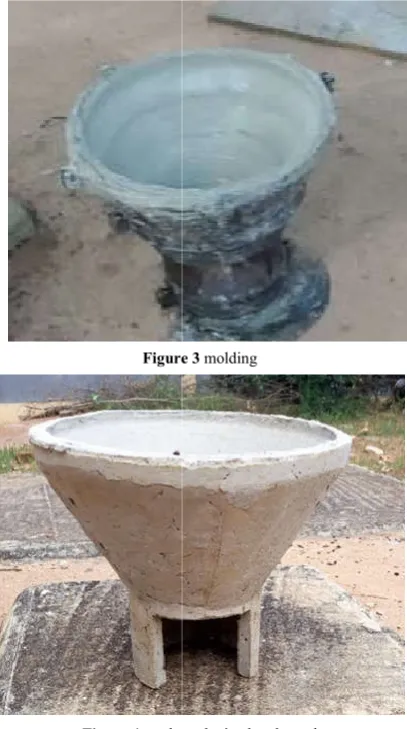
The previously prepared clay paste is introduced into the mold. Using the inner cone of the mold and a little water, we give it the conical shape. After this step, the product goes on drying, about 15 days in the shade sheltered from the wind and to avoid cracks. Once dry, compact and hard, we disassemble the mold to extract it [9,10,11,12].
Figure 3
Figure 4 product obtained at the end
Baking
Once the product is well dried, it goes to the stage of cooking which consists of subjecting it to a high temperature in an oven. The role of cooking is to increase the
rock. The cooking can be done either in an oven. In our case, we could not do cooking for lack of a suitable oven.
Metalfireplace design
The metal part of the fireplace is designed based on a 2mm sheet. It has exactly the same
hearth but of larger dimensions to contain clay and insulation. components of the mold
The previously prepared clay paste is introduced into the mold. inner cone of the mold and a little water, we give it the conical shape. After this step, the product goes on drying, about 15 days in the shade sheltered from the wind and to avoid cracks. Once dry, compact and hard, we disassemble the mold
Figure 3 molding
product obtained at the end
Once the product is well dried, it goes to the stage of cooking which consists of subjecting it to a high temperature in an oven. The role of cooking is to increase the hardness of the clay like a rock. The cooking can be done either in an oven. In our case, we could not do cooking for lack of a suitable oven.
International Journal of Recent Scientific Research Vol. 9, Issue, 12(B), pp. 29909-29915, December, 2018
Table II 1 Dimensions of Oversized Metal Fireplace
Designations Measures (cm)
Upper diameter of the combustion chamber 38 Lower diameter of the combustion chamber 20 Depth of the combustion chamber 19 Height of the upper cylinder 2 Height of the air inlet cylinder 12 Dimensions of the air inlet opening 10 x10
Figure 5 Oversized Metal Fireplace
Insertion of the ceramic core in the metal fireplace
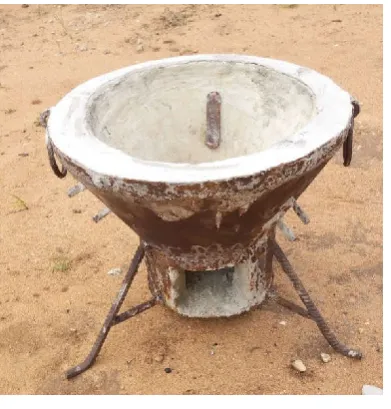
At this stage, it is about assembling the clay and the metal. Both parts are separated by the insulation. Insulation is a mixture of cement, ash and sand. Its role is to limit the loss of heat and also to bind the clay to the metal[13, 14, 15]. During assembly, the mixture of the insulation is made fluid so that its insertion is possible.
At the end of the assembly, one thus obtains the improved hearth "conical with ceramic"(figure 6) that we will test with the focus "conical UB" in the following paragraphs.
Figure 6 "conical with ceramic" hearth
MATERIALS USED AND TEST CONDITIONS
Marmites and fuel
In Togo, frequently used pots are aluminum pans. For this purpose we have obtained two pans of the same size on the
local Togolese market for testing. The fuel used is charcoal commonly used by households and coming from the same place. The moisture test of this charcoal on a wet basis is about 10%.
Measuring devices
The realization of the tests carried out required a number of measuring devices:
A thermometer for measuring temperatures,
A scale for weighing,
A hygrometer for humidity measurements,
An anemometer for measuring the wind speed,
A watch for the time.
Table II 2 Measuring equipment used and their main characteristics
Devices Characteristics Digital probe
thermometer
Checktemp: -30oC to 120oC Accuracy: 0.1oC
Precision Digital Scale Worn: 30kg Accuracy: 0.1g
Anemometer Kestrel 400, 0<V<40m/s Precision: 0.1m/s Hygrometer Kestrel 400,
Food prepared during the controlled kitchen test
Controlled Cooking Tests (CBT) concerned the preparation of white rice with short cooking time and bean preparation with long cooking time. In order to carry out the tests, 10 kg of rice and 10 kg of beans were bought from the market place.
Test conditions
The tests took place under a bait in the premises of the Solar Energy Laboratory. This bait is virtually identical to local cuisines. The fireplaces are laid directly on the ground and in the open air as the Togolese population usually does. The tests took place in October 2018, under a climate with high humidity (80% relative humidity of the air).
We decided to start simultaneously the tests on two homes in order to be in the same test conditions to make a real comparison of the performance of the homes at the end.
Tests performed
To evaluate the characteristics of the newly designed fireplace, performance tests were necessary. The way of performing the tests has a significant influence on the results. To avoid having very different results from one tester to another on the same household, it is advisable to use a test protocol studied and validated by experts in the field. To this end, we used the protocol of the Global Alliance for Clean Cook stoves Foundation, a protocol that is regularly updated to reflect the new requirements[16].
The process includes
The Water Boiling Test (TEE)
The Test of Controlled Kitchen (TCC)
And the Kitchen Performance Test (TPC).
Test conditions
During the tests carried out, the following equipment and elements are taken
The pot: the aluminum pans
The amount of water: 3.5 L for the TEE
Amount of coal: 300g for TEE and 500g for CBT
The amount of food
The wind direction
Our objective being to compare the performance of the new "conical with ceramic" fireplace model with respect to the original UB conical hearth, the TEE and the TCC have been realized on both types of hearths.
In order to have meaningful results, we performed four water boil tests and six controlled kitchen tests, three of which were for cooking rice and three for cooking beans.
The TEE (Water Boiling Test) or WBT (Watter Boiling Test) is a Sahelian methodology developed by the CILSS (Permanent Interstate Committee for Drought Control in the Sahel) in 1986 [15] is a simple simulation and short procedures normally followed during cooking meals. It aims to measure the efficiency with which a household uses fuel to heat water in a kettle and measure the amount of emissions produced during cooking [16]. The measurement of emissions requiring complex equipment is not taken into account during our test. The test is done in three successive stages: the high power phase with cold start; the high power phase with warm start; and the simmering phase.
This is to begin the test when the hearth is at room temperature with a pre-weighed batch of fuel to boil a measured amount of water into a standard pot.
The high-power phase with warm start is conducted after the first phase while the fireplace is still hot. The tester also uses a pre-weighed batch of fuel to boil a measured amount of water in a standard pot. Repetition of the high power test with a hot focus can identify differences in performance between a home when it is cold and when it is hot. This is particularly important for fireplaces with a high thermal mass, since these cook stove can be kept warm in practice. [1]
The simmering phase reveals the amount of fuel required to simmer a measured amount of water at a temperature just below the boiling point for 45 minutes. This step simulates the slow cooking of legumes or common pulses almost everywhere in the world. [1]
The burning rate is the measure of the average amount, in grams, of charcoal burned per minute during the test.
VC = (average burned fuel mass) / (test time)
Power is a measure of how fast the fuel is burned, in Watts (joules per second). It is influenced by both the focus (size of the fuel inlet / combustion chamber) and the mode of use (fuel supply frequency). Overall, it is a usable measure of home heat production, and an indicator of how consistently the operator has operated the fireplace in different tests. A high or low value is not necessarily desirable, but is rather an indicator of the size of the home.
The boiling time is the time in minutes that the water goes from its initial temperature to the local boiling temperature. It is
determined by making the difference between the final time and the initial time.
Teb= tf - ti
Average of the mass of charcoal consumed to boil 1 liter of water with a temperature gradient of 75oC. It is equal to the amount of dry-equivalent fuel used, divided by the number of liters of water remaining at the end of the test. It is expressed in g / l. This parameter is very important for comparing two homes during simmering.
CS = *
With Mcu: mass of the dry-equivalent charcoal used;
Mer: remaining mass of water;
Tini: initial water temperature.
Thermal efficiency is the measure of the proportion of heat produced by the fuel that is transmitted directly to the water in the kettle. It is equal to the ratio between the quantity of energy supplied to the water of the kettle and the quantity of energy produced during the combustion of the fuel. It is expressed as a percentage:
ET = *100
With Efe: energy supplied to the water expressed in kJ,
calculated as follows
Efe = 4,18 * Meini * (Teb - Tini) + 2257 * (Meini -Mefin)
Meini: initial mass of water
Mefin: final water body
Teb: boiling temperature of water
Tini: initial water temperature
Ecc: energy released during the combustion of charcoal
expressed in kJ
Ecc = Mcc * PCI
PCI, the lower calorific value of charcoal
Note: It is important to know that the protocol has an Excel sheet that allows us to calculate the previously listed parameters. And that this sheet takes into account several parameters in the calculations of which we have not spoken here especially the effect of fuel moisture on performance. Indeed, since the fuel contains a quantity of water, a portion of the energy released during combustion will be used to evaporate it. So to determine the amount of fuel actually consumed (dry equivalent), the fuel needed to evaporate this water should be taken into account.
This test, conducted under real-life conditions, is designed to compare the performance of a fireplace intended to replace an existing fireplace mode. It consists of cooking a standard dish, representative of local culinary traditions. The main objectives of the TCC are:
Compare the fuel consumed and the time needed to cook a meal on different homes;
International Journal of Recent Scientific Research Vol. 9, Issue, 12(B), pp. 29909-29915, December, 2018
of homes, a series of three tests was conducted for cooking each type of meal.
All the ingredients needed to prepare each meal are weighed. For both outbreaks, one kilogram of rice or beans was used for each test.
Since the final weight must vary, only the energy needed to cook each kilogram of food should be evaluated in order to calculate the relative gain of the household. This is the final weight of all cooked foods; it is simply calculated by subtracting the weight of the empty pan from the weight of the pan and food once cooking is complete. Specific fuel consumption is the main indicator of household performance for CBT. It indicates the amount of fuel needed to cook a given amount of food. It is calculated as a simple ratio of fuel to food:
CS = *1000
With
CS: the specific fuel consumption expressed in g / kg; M_cu: mass of the fuel used expressed in g;
M_ac: mass of cooked food expressed in g
It is also an important indicator of performance of the test focus. This is calculated as a simple clock difference:
TC = tf - ti
With TC: total cooking time expressed in min; ti: time of the beginning of cooking;
tf: end of cooking time.
RESULTS AND DISCUSSIONS
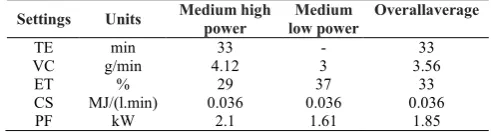
In the previous section, we talked about two tests done to determine the characteristics of the hearths: the Water Boiling Test (TEE) and the Cooked Kitchen Test (CBT). In this section, we will present and analyze the results obtained following these tests. Tables III-1 to III-5 present the values of the TEE characteristic parameters such as boiling time (TE), burning rate (VC), thermal efficiency (ET), specific consumption (SC) and the firepower (PF) of the two different stoves.
Table III 2 Summary of TEE results on the original conical focus
Settings Units Medium high
power
Medium low power
Overallaverage
TE min 33 - 33
VC g/min 4.12 3 3.56
ET % 29 37 33
CS MJ/(l.min) 0.036 0.036 0.036
PF kW 2.1 1.61 1.85
Table III-3 TEE results on the conic health with ceramic Settings Units Test-1 Test-2 Test-3 Test-4 Average DS CoV
High power tests with cold start
TE min 41 36 37 38 38 2.1 5.4%
VC g/min 3 3 3 3 3 0.1 4.6%
ET % 33 35 32 33 33.23 1.21% 3.6% CS (MJ/min.L) 0.027 0.028 0.030 0.028 0.028 0.052 6.9% PF kW 1.55 1.6 1.72 1.57 1.61 0.074 4.6%
High power tests with warm start
TE min 39 34 32 31 34 3.4 9.97%
VC g/min 3 3 4 4 3.5 0.36 15.02
ET % 34 36 33 33 34 1.58% 4.63%
CS (MJ/min.L) 0.027 0.028 0.034 0.033 0.030 0.020 7% PF kW 1.57 1.62 1.93 1.91 1.75 0.19 10.9%
Low power tests : simmering
VC g/min 3 2 3 3 3 0.27 10.23
ET % 40 41 40 46 41.8 3.12 7.46
CS (MJ/min.L) 0.029 0.023 0.031 0.032 0.029 0.00 14.03
Table III 4 Summary of results of TEE on conical healths with ceramic
Settings Units Medium high power
Medium low
power Overall Average
TE min 36 - 36
VC g/min 3.25 3 3.12
ET % 33.65 41.8 37.7
CS (MJ/min.L) 0.029 0.029 0.029
PF kW 1.68 1.33 1.51
The following table shows the performance difference of the conical hearth with ceramic compared to the simple original conical hearth [7].
Table III 5 Difference between the performances of two hearths
Settings Units Original conicalhearth
Conicalhearth with ceramic
Difference between hearth 2
and the hearth 1
TE min 33 36 8.3%
VC g/min 3.56 3.12 -12%
ET % 33 37.7 12.47%
CS (MJ/min.L) 0.036 0.029 -19.4%
PF kW 1.85 1.51 -18%
The results presented in Tables III-1 to III-5 show that:
The boiling time of the "conical with ceramic" hearth is slightly higher than that of the "original conical" hearth with a difference of 8.3%. This means that the "conical with ceramic" hearth is slower than the "original conical" hearth because of the inertia of the clay used. Indeed, during startup, the ceramic is heated before transmitting heat to the pot, the cost that it puts to heat will lengthen the boiling time;
The combustion rate of the original conical hearth is greater than that of the ceramic conical hearth with a difference of 12%. This difference is due to the configuration of the two types of cook stoves with a wider air intake for the "original conic", which has the disadvantage of consuming quickly its fuel as also showed in [17];
The thermal efficiency of the "conical with ceramic" is greater than that of the "original conic". The difference is 12.47%. That is, the "conical with ceramic" hearth loses less heat than the "original conic";
The specific consumption of the "original conical" hearth is higher than that of the "conical with ceramic" hearth with a difference of 19%. Which means that the "conical with ceramic" hearth consumes less fuel than the "original conic". A
Table III 1 TEE Results on the Original Conical Focus
Settings Units Test-1 Test-2 Test-3 Test-4 Average DS CoV
High power tests with cold start
TE min 35 34 37 34 35 1.6 4.5%
VC g/min 4 4 4 4 4 0.2 4.4%
ET % 28 31 27 28 28.5 1.7 6.3%
CS (MJ/min.L) 0.036 0.032 0.036 0.036 0.034 0.026 5.2
PF kW 2.05 1.87 1.98 2.06 1.99 0.09 4.4%
High power tests with warm start
TE min 33 29 34 26 31 4 12.9%
VC g/min 4 4 4 5 4.25 0.7 15.02%
ET % 30 33 27 28 29.5 2.49% 8.45%
CS (MJ/min.L) 0.035 0.036 0.037 0.046 0.038 0.017 5.86
PF kW 1.98 2.1 2.1 2.7 2.2 3.3 15%
Low power tests: simmering
VC g/min 3 3 3 3 3 0.1 2.78%
ET % 40 42 34 32 37 3.12 7.46%
CS (MJ/min.L) 0.037 0.036 0.035 0.035 0.036 0.00 2.89%
series of three controlled kitchen tests for two types of meals (rice and beans) commonly cooked in Togolese households was conducted. The results of the characteristic parameters of each household for each type of meal are recorded in Tables III-6 to III-11.The tests carried out for the preparation of rice provided the results presented in Tables III-6 to III-8.
Table III 6 TCC-rice results on the original conical focus
Settings Units Test-1
Test-2
Test-3 Average
Standard deviation
CS (g/kg) 68 67 63 66 2
TC min 44 34 37 38 5
Table III 7 Results of TCC-rice on conical hearth with ceramic
Settings Units Test-1 Test-2 Test-3 Average Standard deviation
CS (g/kg) 65 62 63 64 4
TC min 50 46 48 48 2
Table III 8 Comparison of the performances of the TCC-rice
of the conical focus with ceramic compared to the original conical focus.
Settings Units Difference
in % T-test
95% confidence
CS (g/kg) -5% -1.74 Non
TC min 20% 3.04 Oui
Table III 9 CBT-bean results on the original conical focus
Settings Units Test-1 Test-2 Test-3 Average Standard deviation
CS (g/kg) 115 128 130 124 8
TC min 114 94 91 100 13
Table III-10 TCC-bean results on conical hearth with ceramic
Settings Units
Test-1 Test-2 Test-3 Average
Standard deviation
CS (g/kg) 99 97 100 99 1
TC min 128 118 120 122 5
Table III-11 Comparison of the performances of the
TCC-beans of the conical focus with ceramic compared to the original conical focus.
Settings Units Difference in % T-test 95% confidence
CS (g/kg) -26% -5.55 Oui
TC min 18% 2.85 Oui
The analysis of the results of the TCCs is a comparison of the values of the characteristic parameters of the two studied foci: On the specific consumption: the "conical with ceramics" hearth realizes a saving compared to the "original conical" hearth of 5% for cooking rice and 26% for cooking beans. The low economy achieved when cooking rice is due to the short cooking time, which does not allow ceramic to restore the stored heat. On the other hand, the cooking of the bean provides a great saving due to its longer cooking time, the ceramic acts as a heat loss limiter compared to the "original conical" hearth and has had the necessary time to restore the heat stored. So the "conical with ceramic" hearth is better suited for the preparation of long-term meals
On the cooking time: the "original conical" hearth has a shorter cooking time than the "original conical" hearth, a difference of about 20% for both cooked meals. This difference is due to the air inlet of the "conical with ceramic" hearth which is smaller than that of the "original conic"; and the thermal properties of
the ceramic used, indeed the composition of the clay has not been studied. Although the cooking time is longer for the conical ceramic stove, the amount of charcoal saved is about 28%. These figures indicate the high performance of the conical clay hearth. Improving the air intake opening will increase cooking speed and firepower while saving coal. These and other studies will further enhance this work.
CONCLUSION
At the end of our study on improving the UB conical focus, by introducing clay into its combustion chamber, we can remark that the results obtained are very encouraging. For both the hot and cold boiling test, the cone-shaped hearth has made enormous savings of coal compared to the original hearth. When beans are cooked, the saving is greater or 26% despite a longer cooking time. In the future, it will be a question of making the ceramic heart in the best conditions with different types of clay and baked. Also, the mixture of the clay with different proportions of the mica, a rock with refractory properties will be studied which will make it possible to obtain more interesting results. The study will also focus on determining the ideal opening for a perfect air inlet into the combustion chamber as well as the width of the holes to obtain a very economical ideal fireplace.
Bibliographie
1. W. G. Lawrence, Ceramic Science for the Potter, Chilton Book Company, 1972, p. 33. Traduction libre. 2. REDD+ Togo. Etude approfondie sur la dynamique de
l’utilisation du bois-énergie au Togo. Version consolidée. 2017
3. Sharma, S.K. (1993) - Improved Solid Biomass Burning Cookstoves: A Development Manual -Bangkok, Thailand, FAO-RWEDPA, Field Document No.44, p. 4,5.
4. Beatrix WesthoffDorsiGermann « Foyers en Images : Une documentation sur les foyers améliorés et traditionnels en Afrique, Asie et Amérique Latine » livre écrit en collaboration avec la Commission des Communautés Européennes Bruxelles et SfE (SozietätfürEntwicklungsplanungGmbH Frankfurt am Main),1995. [WESTHOFF Beatrix, GERMANN Dorsi. Foyers en Images des éditeurs. Edition française, Frankfurt am Main 1995, ISBN 3-86099-135-3]
5. État des lieux sur l’utilisation des foyers améliore au Burkina. Rapport du projet Energie propre ou domestique de Women Environnemental Programme. Octobre 2013.
6. AKOUEHOU, S. Gaston, et al., 2012. Foyers améliorés recommandés pour des usages domestiques au Bénin de bois au Bénin. Fiche technique N° 6181 du 19 juillet 2012, 3ème trimestre 2012, Bibliothèque National (BN) du Bénin ISBN : 978-99919-70-12-7.11p.
7. Bolivia Inti – Sud Soleil. Tests d’ébullition d’eau : tests comparatifs de 10 modèles de cuiseurs à bois de types « rocket stove ». Essais réalisés selon le protocole des tests d’ébullition d’eau.2013.
International Journal of Recent Scientific Research Vol. 9, Issue, 12(B), pp. 29909-29915, December, 2018
9. L’argile, c'est sain et malin. MONDADORI MAGAZINES. France, 92543 Montrouge Cedex, Juillet 2011.
10. http://www.virtualmuseum.ca/sgc-cms/expositions exhibitions/regina/francais
11. l’argile, c'est sain et malin. MONDADORI MAGAZINES. France, 92543 Montrouge Cedex, Juillet 2011.
12. HERNOT, François. L’argile, son utilisation à l’officine. Thèse de doctorat en pharmacie. Université angers, 2016, 127p.
13. M. Segad, B. Jonsson, T. Åkesson, B. Cabane :Ca/Na montmorillonite: structure, forces and swelling properties, Langmuir 26.8, 2010, pages 5782-5790. 14. J. Hower, T. C. Mowatt, The mineralogy of illites and
mixed-layer illite/montmorillonites. American Mineralogist, vol. 51, no 5-6, 1900.
15. Kaouther Ben Azouz. Relation entre propriétés rhéologiques et structure microscopique de dispersions de particules d’argile dans des dispersions de polymères. Autre. Université de Haute Alsace -Mulhouse, 2010. Français. <NNT : 2010MULH3194>. <tel-00673467> 16. William FOTSEU, Joel BLIN, Lassana SANA, Sayon
SIDIBE. « Caractérisation et amélioration d’un foyer a cuisson de «dolo» équipe d’un bruleur à huile végétale (jatropha) », ReseachGate. CIFEM2-2012-274. 2012.7p. 17. Rapport des tests de foyers pour E+CARBONE.
Laboratoire sur l’Energie solaire de l’université de Lomé. 2010.
How to cite this article:
Komi A. Amou et al.2018, Study and Design of An Improved Clay Conical Stove. Int J Recent Sci Res. 9(12), pp.29909-29915. DOI: http://dx.doi.org/10.24327/ijrsr.2018.0912.2958