A b s t r a c t. The type of tillage in arable soils affects porosity of the soil and in consequence the hydraulic conductivity. The accessibility and mobility of organic carbon in arable soils can differ depending on the type of tillage. The highest differences between conventional or conservation tillage are found in the top-soil layer of the A horizon in pore size distribution and organic mat-ter content. Total porosity and pore continuity influence the hy-draulic conductivity and also the exchange processes in structured soil. Percolation of soil can provide not only information on hy-draulic conductivity of structured soil but also about the accessi-bility of fixed organic matter. The aim of this study was to find out how the type of the soil tillage influences the hydraulic conducti-vity and accessibility of organic carbon in the topsoil.
Soil samples from the topsoil layer under conventional and conservation tillage were percolated with distilled water and pyro-phosphate solution. The differences in hydraulic conductivity bet-ween samples resulted in various amount of the organic carbon leached out. Organic carbon content (Corg), bulk density (dB) and tensile strength (Ts) of soil aggregates after percolation have changed in comparison with the non-percolated soil and show in which aggregate fraction the organic carbon was easily available for leaching out. The highest Corgreduction was found in smaller aggregates in comparison with larger aggregates, which resulted in the tensile strength of macroaggregates being very little affected by percolation.
K e y w o r d s: percolation process, carbon distribution, aggregates strength
INTRODUCTION
Organic matter, its forms, distribution, and accessibility are very variable in structured soils and depend on other soil propertiesegporosity, pore continuity, water relations. Soil pores and organic matter are often considered together while different forms of organic matter play an important role in
the formation of pores as well as in stabilization of the structure when soils are exposed to different stresses (Kay and Van den Bygaart, 2002).
In aggregated soils the movement of water is controlled by the presence of inter-aggregate pores where water flows faster than in intra-aggregate and mostly finer pores (Horn, 1990). The differences in hydraulic properties between the bulk soil and single aggregates results in a dominant flow in interaggregate pores which furthermore reduces the possibi-lity of obtaining an equilibrated pore water pressure profile (Horn and Baumgartl, 2000). Pore continuity in macropores and a more tortuous pore system in single aggregates induce preferential flow especially near saturation (Beven and Ger-mann, 1982). Youngs and Leeds-Harrison (1990) suggested that pore water pressure gradients cause water to flow prefe-rentially in macropores with little flow within aggregates when both the macropores and micropores are saturated, which can be also derived from the Hagen Poiseuille Law. When saturated macropores surround unsaturated aggrega-tes, solutes are transported by diffusion into the aggregates depending on the concentration gradient. If macropores in-side the aggregates are filled with air they become isolated, severely reducing the possibility for redistribution of water and solutes in soil. Slower flow of soil solution gives more opportunities for chemical reactions within the entire micro-scopic pore structure owing to the relative importance of molecular diffusion compared with that of convection (Kutilek and Nielsen, 1994). Hartmann et al.(1998) have studied the influence of soil structure on cation exchange processes and found that the amount of exchangeable ca-tions of water saturated structured soil samples is smaller compared with a homogenized sample of the same material. Hantschel et al. (1988) explained that the extract of
Changes in soil organic matter, bulk density and tensile strength of aggregates
after percolation in soils after conservation and conventional tillage
E. Urbanek*
and R. Horn
Institute for Plant Nutrition and Soil Science, Christian-Albrechts University, Hermann-Rodewald 2, D-24118 Kiel, Germany
Received February 13, 2006; accepted February 27, 2006
© 2006 Institute of Agrophysics, Polish Academy of Sciences
*Corresponding author’s e-mail: [email protected]
A
A
Agggrrroooppphhyhyysssiiicccsss
w w
homogenized soil contains more alkaline cations than the percolation soil extracts due to a larger accessible soil sur-face area of a homogenized sample and the differences are more pronounced with more intense aggregation and in-creasing amount of acids in the soil (Gradlet al., 1987). In coarser pores the exchange processes are faster due to con-vective and diffusive ion transport, in fine intra-aggregate pore system the processes are slower while only diffusion allows the exchange processes (Becher, 1991). Higher tor-tuosity of the intra-aggregate pores decreases the accessi-bility of the intra-aggregate surfaces (Horn, 1987). Horn and Taubner (1989) found that the potassium release related to unit mass per unit time is smaller in bigger aggregates due to longer flow paths and smaller aggregate surface.
Organic matter in soils includes different organic com-pounds from easily-mineralizable plant residuals to more complex products from biotic and abiotic transformation processes or microbial biomass (Stevenson, 1994; Rethe-meyer, 2004). The distribution of organic carbon in structu-red soil affects its availability for microorganisms and also for leaching into deeper horizons. The availability of or-ganic carbon measured by respiration was found to correlate with water-extracted organic carbon (Burford and Bremner, 1975; Davidsonet al., 1987). Water and Na-pyrophosphate solution are often used for extraction of humic substances in soil (Swift, 1996), but mostly for homogenized material. The percolation of structured soils with water and pyrophos-phate solution results in the extraction of only the easily-accessible organic matter. Davidsonet al. (1987) stated that water-extracted organic carbon is ‘almost certainly availa-ble’, and is the immediate substrate for microorganisms. However, Beauchampet al.(1989) suggested that a signi-ficant proportion of water-extracted C was not available to denitrifying microorganisms. Zsolnay and Steindl (1991) found that 85% of water-extracted organic C was biodegra-dable. The processes of percolation which simulated the leaching of organic carbon from upper horizons to the sub-soil conducted byegHartmannet al.(1998) have shown that the hydraulic conductivity and percolation time is primarily responsible for the accessibility of exchange surfaces. Per-colation time for constant volumes increases with decrea-sing hydraulic conductivity and cause that also diffusion next to the fast exchange processes and mass flow determine the amount of exchanged cations.
Structured soils are characteristic for their heteroge-neity in porosity and organic matter distribution. Because soil management may influence the pore system it has been reported that cultivation may change organic matter distri-bution and its accessibility. Some authors reported that the change from conventional to conservation tillage can result in accumulation of organic carbon in the topsoil together with a decrease of total porosity (Tebrügge and Düring, 1999; Yang and Kay, 2001).
The objectives of this study are to find out how far the conventional or conservation tillage influence the accessi-bility of organic carbon in structured undisturbed soil sam-ples during percolation with water and pyrophosphate solu-tion; to analyse the loss of organic carbon during the perco-lation processes affected by the distribution of organic carbon in aggregates from different size classes as well as in single aggregates and to quantify the effect of the altered organic carbon content due to percolation processes on the bulk density and tensile strength of single aggregates.
MATERIAL AND METHODS
Soil material
Soil samples were collected in autumn 2002 from the experimental field of Rotthalmünster/Southern Germany from a silty loam Luvisol and Anthrosol at two sites with different cultivation systems and vegetation; soil with maize monoculture since 1979 with conventional tillage and soil with wheat monoculture since 1969 where soil tillage was changed into conservation system in 1998 (Table 1). The soil samples were taken at four different soil depths as un-disturbed samples with 100 cm3cylinders.
Determination of pore size distribution in soil
In order to determine the distribution of pore sizes among conventional and conservation tilled soil and different soil horizons the samples were saturated and then adjusted to different matric suction (Fig. 1). The pore size distribution was determined according to Sekera and Boodt (Scheffer and Schachtschabel, 2002) (Table 2).
Percolation with water and pyrophosphate solution
Vegetation/
Soil type Tillage Horizon
Depth (cm)
Grain size distribution (%) Corg N
C/N pHKCl
Sand Silt Clay (g kg-1)
Maize (since 1979), Hortic Anthrosol
CT Ap1 3-7 10 68 22 13.2 1.49 8.9 6.4
11-5 10 68 22 13.4 1.51 8.9 6.4
Ap2 31-35 10 69 21 12.1 1.37 8.9 6.2
SwM 39-43 7 72 21 4.5 0.72 6.2 6.0
Wheat (since 1969), Haplic Luvisol
CnT since 1998
Ap1 3-7 9 68 23 13.9 1.46 9.5 6.4
11-5 9 68 23 12.3 1.35 9.1 6.4
rAp 31-35 9 65 26 7.2 0.88 8.1 6.3
Bt 39-43 7 65 28 3.8 0.50 7.7 6.2
T a b l e 1.Basic properties of the analyzed soils under conventional (CT) and conservation (CnT) tillage
pF
1 2 3 4 5 6 7
0 10 20 30 40 50
conventional tillage
1 2 3 4 5 6 7
3-7cm 11-15cm 31-35cm 39-43cm conservation
tillage
pF
Fig. 1.Water retention curves of soil from different depths; a – conventional tillage (maize) and b – conservation tillage (wheat).
a b
Tilage system
Sample No.
Percolated volume
(dm3)
Carbon lost
(g)
CT
I II III IV V
0.213 0.873 1.049 1.460 2.861
0.016 0.029 0.043 0.045 0.054
CnT
I II III IV V
0.416 0.389 0.601 0.295 2.194
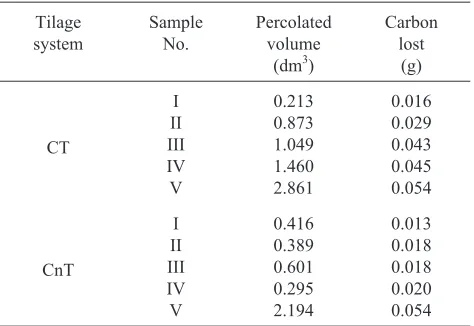
0.013 0.018 0.018 0.020 0.054 T a b l e 2.Volume of percolated solution and organic carbon lost in soil samples from 3-7 cm depth under maize (CT) and wheat vegetation (CnT)
separating funnel plexiglas cylinder with soil sample plexiglass cylinder with percolation solution atmospheric pressure
vacuum system pipe for saturation
Fig. 2.Schema of percolation system under saturated conditions.
Water
content
(%
,gg
-1 )
The percolation was conducted under a pressure of 20 hPa and each eluat was analyzed for dissolved organic carbon content with the Dima-TOC 100 (Dimatec).
Determination of the organic carbon distribution of air-dry aggregates after percolation
After the finished percolation soil was removed from the cylinders and aggregates were separated by manually breaking the soil along the zones of weakness. The single ag-gregates were peeled in the soil aggregate erosion chamber (SAE) and the material from the exterior, transitional and interior region of the aggregates were collected for further analyses of organic carbon content. The organic carbon con-tent (Corg) was measured on the milled material from aggre-gates of different size or concentric layers using a conti-nuous flow mass spectrophotometer consisting of an ANCA SL sample converter attached to a 20-20 IRMS, Europa Scientific, Crewe, UK.
In order to find out the effect of percolation on soil ag-gregates the soil samples without percolation (control) were separated in the same way as percolated samples (numbers I-V represents percolated samples with increasing amounts of lost organic carbon according to Table 2).
Determination of bulk density and tensile strength of aggregates after percolation
The bulk density of air-dried soil aggregates was deter-mined by coating the single aggregates with paraffin and measuring their volume in distilled water.
Tensile strength of single aggregates was measured by crushing tests using a loading frame Instron 5569, software, Merlin. The minimal force applied on an aggregate which caused the breakage was taken as the crushing force. The test on irregularly-shaped aggregates was standardized by pla-cing the samples in their most stable positions. For calcula-tion of aggregate tensile strength, the following equacalcula-tions were used (Dexter and Kroesbergen, 1985):
T F
d
s
a
=0 567. 2 ( 1)
Ts–tensile strength of the aggregate,F– the applied force at failure,da– equivalent diameter of an irregular aggregate defined by:
d m
d
a
B
=é ëê
ù ûú
6 13
P (2)
m– the mass of the aggregate anddBits bulk density. The equation gives the equivalent diameter of a sphere having the same mass and density as the test aggregates.
Calculation and statistical analyses
The calculation of the results follows the assumptions that soil samples from the same horizon and vegetation are replicates and that non-percolated soil material is taken as a reference for samples after percolation. Pore size distribu-tions were calculated for five replicadistribu-tions from each ho-rizon. The percolation process was conducted also on five replications but the differences in hydraulic conductivity due to the previous percolation had to be calculated sepa-rately. The statistical calculation of the data was based on the arithmetic means and standard error of the mean (+/-) consi-dering the management system, soil depth and size of ag-gregates. For the comparisons, confidence tests for organic carbon content, bulk density and tensile strength of ag-gregates were done using one-way (no blocking) ANOVA statistical analyses with Tukey’s multivariate test at the significance level of 95%.
RESULTS
General description of analyzed soils
The texture of both soil types Anthrosol and Luvisol is silty loam with about 70% silt, 20% clay and 10% sand with the clay enrichment in the Bt horizon of the Luvisol. The pH values are slightly acidic (pH~6). The organic carbon, nitrogen content as well as C/N ratio have higher values in the Ap horizons and decrease in subsoil with an increase of organic carbon in conservative tilled wheat soil at the depth of 3-7 cm (Table 1).
Water retention curves (Fig. 1) as well as the derived pore size distribution (Table 3) from both soils under con-ventional (maize) and conservative (wheat) tillage show large differences. The Ap horizon with maize vegetation shows about 10% higher values of total porosity than the soil from following horizons in contrast to small differences between the three horizons in the haplic Luvisol with wheat.
Together with higher total porosity, the percentage of macropores in both Ap horizons is much higher and finer pores lower in comparison with the subsoil horizons. In wheat soil the differences in pore size between soil horizons is not as high as in maize soil, but at a depth 3-7 cm the percentage of macro- and mesopores is higher and fine pores – lower than in deeper horizons. At 11-15 and 31-35 cm depth, the lowest total porosity with low content of macro-and mesopores was found.
Organic carbon content in percolated solution
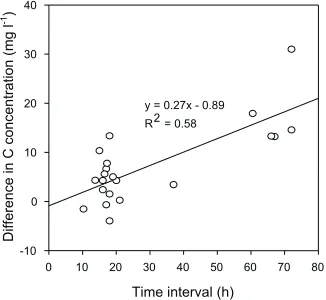
Interruption of the percolation process caused an increase of carbon concentration at the beginning of the next percolating interval and decreases again when the process is continued. The duration of the interruption has also an effect on the concentration of organic carbon (Fig. 4); the longer the interruption time, the greater is the increase in con-centration.
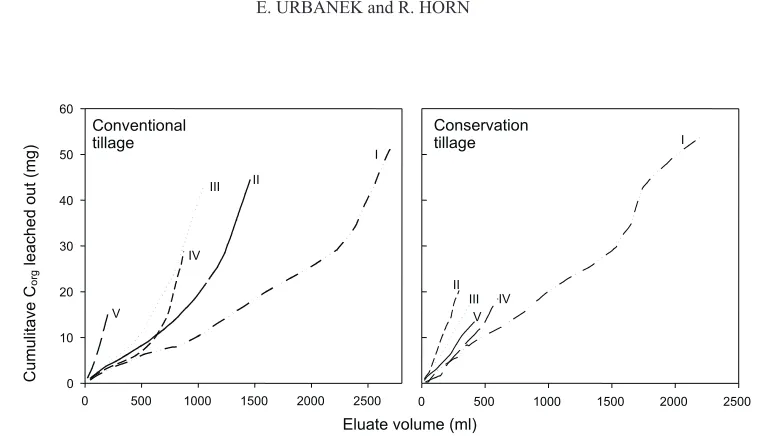
Considering the equal duration of the percolation process for all samples the amount of the total percolated water and pyrophosphate solution was relatively higher in maize than in wheat soil which also reflected in lower cumulative mass of organic carbon leached out from the soil (Fig. 5). Similar but less pronounced was the variation found between replicates: each soil sample presented an individual amount of percolated solution and mass of lost organic Tillage
system Horizon
Depth (cm)
Bulk density (g cm-3)
Total porosity
(%)
Pore size distribution (%, vol.)
Macropores Mesopores Micropores
mean SE* >50mm 50-10mm 10-0.2mm <0.2mm
CT
Ap1 3-7 1.30 0.04 50.5 11.7 4.1 20.0 14.7
11-5 1.39 0.05 47.1 7.4 3.4 19.8 16.4
Ap2 31-35 1.57 0.04 40.4 6.5 2.5 11.5 19.9
Sw-M 39-43 1.50 0.06 42.9 8.2 2.8 18.7 13.3
CnT
Ap1 3-7 1.40 0.09 46.7 10.0 3.2 16.3 17.2
11-5 1.51 0.04 42.7 6.2 3.2 14.9 18.4
rAp 31-35 1.53 0.09 42.0 8.5 2.6 10.7 20.3
Bt 39-43 1.46 0.06 44.5 9.6 2.6 10.5 21.8
*SE – standard error.
T a b l e 3.Bulk density, total porosity and pore size distribution determined from the water retention curves
Percolation time (h)
0 100 200 300 400 500 600 700 800 900 1000 1100 1200
C-concentration
in
eluat
e
(mg
l
-1)
0 10 20 30 40 50 60 70
H2O Na2H2P2O7 H2O
Fig. 3.An example of changes in carbon concentration in the eluate during percolation process with several interruption periods.
Time interval (h)
0 10 20 30 40 50 60 70 80
Difference
in
C
concent
ration
(mg
l
-1)
-10 0 10 20 30 40
y = 0.27x - 0.89
R2= 0.58
carbon. In soil from conservation tillage (wheat) four samples have shown similar amount of percolated solution and organic carbon lost with an exception of one sample. In soil samples from conventional tillage even that the volume of percolated solution in each replicate was different the total amount of lost organic carbon was similar. Figure 6 which presents the relation between the concentration of organic carbon in the solution and the hydraulic con-ductivity shows that a retarded flux results in more organic carbon which can be leached out from the soil as compared with a faster flow.
Changes in organic carbon distribution after percolation
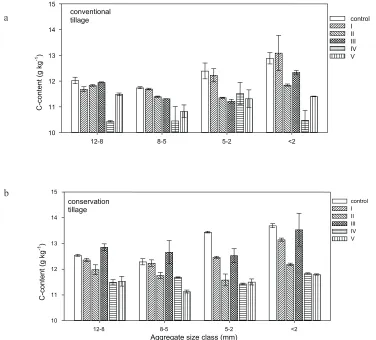
Percolation of soil with water and pyrophosphate solution caused some of organic matter to be leached out (Table 4). Comparison of the distribution of Corgin control soil with soil after percolation showed a reduction of organic carbon content in the latter, especially in aggregates from those samples where more volume of eluate was percolated (Fig. 7).
In the control samples the organic carbon content was higher in smaller aggregates; a similar tendency was found only in a few samples after percolation with very small amounts of organic carbon leached out. In contrast, in those samples in which higher amounts of Corg were lost, the difference in Corgcontent between aggregates from different size classes was very slight.
Percolation of soil from conventional tillage (maize) resulted in very slight decrease of Corgin aggregates from 12-8 mm size class (Fig. 7), but a greater decrease in smaller aggregates. The greatest differences were found in the aggregates <2 mm, where control and I aggregates show
significantly higher values than IV and V. In soil aggregates from conservation tillage (wheat) all size classes the content of organic carbon decreased after percolation except with the III soil sample.
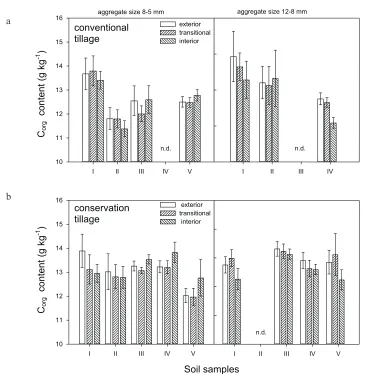
The analyses of organic carbon content in different aggregate layers showed very high variability between the exterior, transitional and the interior regions but the dif-ferences are insignificant (Fig. 8). In some samples a higher content of organic carbon in the interior region can be seen, but in other samples the tendency is opposite. In addition higher variations among aggregate regions expose the aggregates from the maize soil in contrast to the wheat soil where the values are more similar.
Eluate volume (ml) 0 500 1000 1500 2000 2500
Cumul
itave
Corg
leache
d
out
(m
g)
0 10 20 30 40 50 60
Conventional tillage
0 500 1000 1500 2000 2500
Conservation tillage I
II III
IV
V
I
II III IV
V
Fig. 5. Cumulative total organic carbon measured in the percolation solution during the complete percolation process in soils under conventional (a) and conservation (b) tillage for I-V soil samples.
Hydraulic conductivity (cm h-1)
0.00 0.05 0.10 0.15 0.20 0.25
C
c
oncentra
tion
(mg
l
-1)
0 20 40 60 80 100
Fig. 6.Relationship between carbon concentration in eluate and hydraulic conductivity.
Tillage system Sample No. Carbon lost (mg)
Bulk density (g cm-3) Tensile strength (kPa)
12-8 mm 8-5 mm 12-8 mm 8-5 mm
mean SE mean SE mean SE mean SE
CT control I II III IV V 0.000 0.016 0.029 0.043 0.045 0.054 1.55 1.71 1.71 1.67 1.88 1.63 0.01 0.03 0.01 0.02 0.11 0.04 1.57 1.84 1.72 1.96 1.86 1.81 0.02 0.04 0.02 0.12 0.15 0.07 170 126 123 83 111 63 10c* 8cb 13ab 13b 16a 6a 120 189 129 87 116 90 15ab 26b 15ab 15a 21ab 31a CnT control I II III IV V 0.000 0.013 0.018 0.018 0.020 0.054 1.72 1.76 1.74 1.84 1.80 1.79 0.06 0.02 0.02 0.05 0.03 0.04 1.71 1.86 1.74 1.80 1.78 1.92 0.03 0.04 0.01 0.02 0.04 0.06 170 229 234 188 181 173 15a 23a 34a 22a 9a 9a 241 166 195 140 178 176 22b 25ab 24ab 10a 21ab 17ab
*a, b, c – significant differences between samples (p=0.05).
T a b l e 4.Bulk density and tensile strength of soil aggregates without (control) and after percolation process (I-V) with different amount of carbon lost
12-8 8-5 5-2 <2
C-conte n t (g k g -1) 10 11 12 13 14 15 control I II III IV V conventional tillage
Aggregate size class (mm)
12-8 8-5 5-2 <2
C-content (g k g -1 ) 10 11 12 13 14 15 control I II III IV V conservation tillage
Fig. 7.Content of organic carbon (C-content) in soil aggregates from not percolated soil (control) and percolated soil with different amount of lost organic carbon; a – conventional tillage, b – conservation tillage.
a
Changes in mechanical properties after percolation processes
The measurements of the mechanical properties of soil aggregates after percolation showed an increase of aggrega-te density from conventional tilled soil and insignificant changes in aggregates from conservation tilled soil (Table 4). The tensile strength of aggregates show no significant differences between two size classes; only the control of conservation tillage soil is significantly higher in 8-5 mm than the aggregates from 12-8 mm. Comparison of the tensile strength (Ts) of control soil aggregates with those after percolation showed that with increasing loss of carbon the Ts decreases in conventional tilled soil (not always statistically significant). In aggregates from conservation tillage the loss of organic carbon does not significantly change theTsof 12-8 mm aggregates and in aggregates from 8-5 mm the difference is significant only between aggre-gates from control and III samples.
DISCUSSION
The movement of water and soil solution in soils depends especially on the amount of the macropores (Beven and Germann, 1982; SchjØnning and Rasmussen, 1989) and their continuity (Beven and Germann, 1982; White, 1985; Ballet al., 1988). Changes of soil tillage system from con-ventional to conservation or no-tillage system usually re-sults in reduced porosity of topsoil (Roseberg and McCoy, 1992; Bhattacharyyaet al., 2006) and affects the hydraulic conductivity and storage of water.
In analysed soils from different soil tillage systems, there were also some differences in topsoil porosity which in-fluenced the progress of percolation. Higher total porosity of conventional tilled soil with high percentage of coarse po res resulted in higher hydraulic conductivity in comparison with the less porous soil from conservation tillage. Due to lower hydraulic conductivity and smaller amount of macropores
I II III IV V
Corg
content
(g
kg
-1 )
10 11 12 13 14 15 16
exterior transitional interior
I II III IV
aggregate size 12-8 mm aggregate size 8-5 mm
Soil samples
I II III IV V
Corg
content
(g
k
g
-1 )
10 11 12 13 14 15 16
exterior transitional
interior
I II III IV V
conventional tillage
conservation tillage
n.d. n.d.
n.d.
Fig. 8.Content of organic carbon (Corgcontent) in different parts (exterior, transitional and interior) of soil aggregates in percolated soil with different amounts of lost organic carbon; a – conventional tillage, b – conservation tillage, n.d. – identify not determined.
a
the percolation process was much slower and less organic matter was leached off.
Percolation experiments on structured soils may give not only important information about the transport processes in soil but also on elements distribution and their accessi-bility by analyses of eluate. Taubner (1993) and Hartmann (1999) found differences between eluate from percolation of structured soil and extraction of homogenised material. Taubner (1993) conducted percolation experiments on soil samples with different soil structure and found that the dif-ferences in solution composition between the intraaggregate pore system and the bulk soil (mostly interaggregate) pore system were higher in stronger structured subangular blocks and in blocks than those with the weaker aggregated prisms. In addition Hartmannet al. (1998) found that the amount of available cations in structured soils is much lower than in homogenised material. Youngs and Leeds-Harrison (1990) described that when saturated macropores surround unsatu-rated aggregates, solutes will be transported by diffusion into the aggregates depending on the concentration gradient. When the movement of the soil solution is stopped the exchange between fine and coarse pores takes place and causes an increase of organic carbon concentration in the solution.
The analyses of the eluate from percolated soil samples have shown similar tendency. Slower percolation resulted in higher concentration of organic carbon in the solution and the interruption of the process for several hours caused an increase of carbon concentration. Although, even that lower hydraulic conductivity induced higher exchange processes and C concentrations, the total amount of carbon loss was higher in those soil samples where more pyrophosphate solution was percolated.
All studies on percolation focus on the analyses of the extracted solution, but the examination of the remaining soil material may give additional information about accessibility and distribution of organic carbon in different sizes of aggregates as well as within single aggregates. Comparison of organic carbon content between non-percolated and percolated samples can explain in which places the organic matter was more-easily accessible and where it was better protected against leaching.
However, it has to be taken into consideration that the differences in carbon content in different aggregate sizes could also be due to spatial variation in soil samples. Small change in organic carbon content in larger aggregates suggests that in these pores the organic carbon was better protected than in small aggregates. The strong decrease of carbon content was found in aggregates <2 mm where probably most of fresh organic matter not associated with a mineral phase was accumulated. The close association of organic carbon with the mineral particles and aggregates, supposed to provide physical protection for organic matter and has been reported as one of the main mechanisms of carbon sequestration in soils (Oadeset al., 1988).
Examination of single aggregates and the distribution of organic carbon in the external, transitional and the internal regions has shown very high variation within aggregates but no significant trend. This suggests that during the per-colation the exchange processes in some compartments were stronger than in other ones, but cannot be separated into the exterior and the interior aggregate regions.
Removal of soil organic matter by percolation affected the density and tensile strength of aggregates. Aggregate density increased after percolation which was probably caused not only by organic matter loss but also by the redistribution of clay and silt particles and consolidation of particles. Slight changes in tensile strength of macro-aggregates after percolation confirm the small effect of Corg leaching from large aggregates, but also suggest that the tensile strength of air dry aggregates does not depend on the content of organic matter in the aggregates.
CONCLUSIONS
1. The chemical composition of percolated soil solutions gives information about hydraulic properties of structured soils and also helps to characterize the accessibility and distribution of organic matter.
2. The changes in organic carbon concentration in percolated solution from soil samples from conventional and conservation tillage suggest that in conventionally-tilled soil where more coarse pores are present the acces-sibility of organic carbon for microorganisms and leaching into deeper horizons is higher than in conservation-tilled soil. The lower amounts of percolate volume also resulted in less organic carbon removed from the soil.
3. The analyses of the organic carbon distribution in soil aggregates after the process of percolation suggest that the organic carbon associated with macroaggregates is better protected against mineralization and leaching than organic carbon not associated with the mineral phase or present in small aggregates.
4. Slight changes in tensile strength of macroaggregates after percolation confirm the small effect of Corgleaching
from large aggregates, and also suggest that the tensile strength of air-dry aggregates does not depend on the con-tent of organic matter in the aggregates.
REFERENCES
Ball B.C., O’Sullivan F., and Hunter R., 1988.Gas diffusion, fluid flow and derived pore contiuity indices in relation to vehicle traffic and tillage. J. Soil Sci., 39, 327-339. Beauchamp E., Trevors J.T., and Paul J.W., 1989. Carbon
sources for bacterial denitrification. Adv. Soil Sci., 10, 113-142.
Beven K.J. and Germann P., 1982.Macropores and water flow in soils. Water Resour. Res., 18, 1311-1325.
Bhattacharyya R., Prakash V., Kundu S., and Gupta H.S., 2006.Effect of tillage and crop rotations on pore size distri-bution and soil hydraulic conductivity in sandy clay loam soil of the Indian Himalayas. Soil Till. Res., 86, 129-140.
Burford J.R. and Bremner J.M., 1975.Relationships between the denitrification capacities of soils and total, water-soluble and readily decomposable soil organic matter. Soil Biol. Biochem., 7, 389-394.
Davidson E.A., Galloway L.F., and Strand M.K., 1987.
Assessing available carbon: comparison of techniques across selected forest soils. Communications in Soil Science and Plant Analysis, 18, 45-64.
Dexter A.R. and Kroesbergen B., 1985. Methodology for determination of tensile strength of soil aggregates. J. Agric. Eng. Res., 31, 139-147.
Gradl J., Hantschel R., Kaupenjohann M., Horn R., and Zech W., 1987.Vergleich von Perkolations- und Gleichgewichts-bodenlösungen an ausgewählten Standorten. Mitteilungen der Deutschen Bodenkundlichen Gesellschaft, 53, 387-393.
Hantschel R., Kaupenjohann M., Horn R., Gradl J., and Zech W., 1988. Ecologically important differences between equilibrium and percolation soil extracts, Bavaria. Geoderma, 43, 213-227.
Hartmann A., Greasle W., and Horn R., 1998.Cation exchange processes in structured soils at various hydraulic properties. Soil Till. Res., 47, 67-72.
Horn R., 1987.Die Bedeutung der Aggregierung für die Nährstoff-sorption in Böden. Z. Pflanzenern. u. Bodenkunde, 150, 13-16.
Horn R., 1990.Aggregate characterization as compared to soil bulk properties. Soil Till. Res., 17, 265-289.
Horn R. and Baumgartl T., 2000.Dynamic properties of soils. In: Handbook of Soil Science (Ed. M.E. Sumner). CRC Press, Boca Raton.
Horn R. and Taubner H., 1989.Effect of aggregation on po-tassium flux in a saturated soil. J. Soil Sci. Plant Nutr., 152, 99-104.
Kay B.D. and Van den Bygaart A.J., 2002.Conservation tillage and depth stratification of porosity and soil organic matter. Soil Till. Res., 66, 107-118.
Kutilek M. and Nielsen D., 1994.Soil Hydrology. Catena Verlag, Cremlingen-Destedt.
Oades J.M., Waters A.G., Vassallo A.M., Wilson M.A., and Jones G.P., 1988. Influence of management on the com-position of organic matter in a red-brown earth as shown by 13C nuclear magnetic resonance. Aust. J. Agric. Res., 26, 289-299.
Rethemeyer J., 2004.Organic carbon transformation in agricultu-ral soils: Radiocarbon analysis of organic matter fractions and biomarker compounds. Ph.D. Thesis, Christian-Albrechts University, Kiel.
Roseberg R.J. and McCoy E.L., 1992.Tillage and traffic changes in macroporosity and macropore continuity: an ability assessment. Soil Sci. Soc. Am. J., 56, 1261-1267.
Scheffer F. and Schachtschabel P., 2002. Lehrbuch der Bodenkunde. Spektrum Akademischer Verlag, Heidel-berg- Berlin.
SchjØnning P. and Rasmussen K.J., 1989.Long-term reduced cultivation. I. Soil strength and stability. Soil Till. Res., 15, 79-90.
Stevenson F.J., 1994.Humus Chemistry: Genesis, Composition, Reactions. J. Wiley&Sons, New York.
Swift R.S., 1996.Organic matter characterization. In: Methods of Soil Analysis. Part 3. Chemical Methods (Ed. D. L. Sparks). Soil Science Society of America, Madison, Wisconsin, USA.
Taubner H., 1993. Element flux in different structured soils affected by acid rain input - comparing properties of bulks soil and aggregates (in German). Ph.D. Thesis, Christian-Albrechts University, Kiel.
Tebrügge F. and Düring R.A., 1999.Reducing tillage intensity -a review of results from -a long-term study in Germ-any. Soil Till. Res., 53, 12-28.
White R.E., 1985.The influence of macropres on the transport of dissloven and suspenden matter trhough soil. Adv. Soil Sci., 3, 94-120.
Yang X.M. and Kay B.D., 2001.Rotation and tillage effects on soil organic carbon sequestration in a Typic Hapludalf in southern Ontario. Soil Till. Res., 59, 107-114.
Youngs E.G. and Leeds-Harrison P.B., 1990. Aspects of transport processes in aggregated soils. J. Soil Sci., 41, 665-675.