UNIVERSITY OF BOLTON
Course: Masters in Business Administration (Part
Time)
Year: Year 3 Semester 1
Module: Research Methods MBA 4060 Part One
Student ID: 1010004
Tutor: Peter Moran
Word Count: 862
INTRODUCTION
Community based offender management services are currently primarily provided
nationally by 35 Probation Trusts of which Greater Manchester Probation Trust
(GMPT) is one. The aims of GMPT are to protect the public by rehabilitating and
punishing offenders. This is achieved by ensuring that they repay the local
community for the harm that they have done and understand the impact of their actions on victims as indicated within GMPT‟s 2012/13 Business Plan.
GMPT is divided into ten local delivery units (LDUs), geographically based and
aligned to police divisional areas and Local Authority boundaries. Within each of the
LDUs there are a number of operational teams who are responsible for frontline
work, supported by administrative staff. The teams are defined by the risk level that
the offender presents – either the risk of re-offending or the level of harm that they
pose to the public. This risk level determines the grade of staff responsible for
managing the offenders either qualified Probation Officers or Probation Service
Officers who are responsible for lower risk cases.
The author has senior management responsibility for one of the ten LDUs, namely
Bolton and has held this position for almost four years. This responsibility includes
operational, strategic and performance management for the 87 staff and the
allocation and monitoring of a £2.9 million delegated budget. People management
and effective leadership are key elements of this role, the significance of these
aspects are demonstrated in this next section of this paper.
STRATEGIC SIGNIFICANCE AND AREA UNDER INVESTIGATION
The author writes at a timely stage in the evolution of what has been a public sector
service for over 100 years. The Trust awaits the outcome of the Coalition Government‟s review of probation services, “Punishment and Reform: Effective Probation Services” March 2012 and their vision for the management of offenders in
the community. The response to the consultation is expected to be published in
Autumn 2012. It is envisaged that this review will provide clarity to which services will
remain within the public sector and which will be open to competition in a wider
commercial market.
However it could be argued that the direct of travel for Probation Trusts is clear. The
and public sectors. It is also indicated that there will be a distinct „purchaser- provider split‟ and that it is envisaged that Probation Trusts will be responsible for
commissioning the majority of offender management services which thus far have
been delivered within the public sector by such Trusts. Whilst there is an indication
that Probation Trusts may be allowed to choose to compete for the delivery of such
services, they will be required to become separate entities, independent of those
Probation Trusts which are responsible for the commissioning. (Ministry of Justice
2012: 8) The publication of the outcome of the consultation is merely expected to
provide clarity regarding the timescales for the uncoupling of the current public
sector offender management arrangements and how this will be phased in.
With 80% of GMPT‟s annual budget aligned to staffing costs (GMPT 2012/13
Business Plan), the impact of the changes will be significant on personnel and
require whole service re-design by the organization. A key challenge for GMPT
senior management will be how to both communicate and engage staff and middle
managers in the impact of these changes, in addition to enhancing the commercial
capabilities and awareness of public sector staff so that they can compete effectively
in an open market alongside the private sector. This will need to be undertaken alongside the probation officer union‟s rhetoric which classifies these changes as the “government‟s ideological crusade to reduce the size of the state and cut public services to vulnerable communities” NAPO Branch Circular 50/2012.
Schein (2004:32) suggests that culture can be considered as a group‟s defence
mechanism against change. With many probation staff considering their work as a
vocation and having worked extensively, or in many instances exclusively, within the
public sector it is arguably not to be unexpected that the union have taken such a stance in relation to the Government‟s proposed changes.
Providing leadership and engaging staff within the Bolton LDU in a meaningful discussion regarding these fundamental changes is a key element of the author‟s
role as Assistant Chief Executive. The proposed changes are transformational and
are on a scale not previously experienced within the criminal justice sector. The
Chief Executive has billed the task facing GMPT as one of “Achieving Radical Reform” (GMPT August 2012). The author however suggests that this ambition
cannot fully be achieved without a cultural transition and an appreciation of the
RESEARCH QUESTION AND OBJECTIVES
How can cultural transition within the Bolton Local Delivery Unit of GMPT be
facilitated to enable the organization to flourish in the contemporary environment?
1. To identify shifting environmental demands and constraints placed upon GMPT.
2. To critically evaluate potential cultural barriers in shifting to a more responsive
approach to environmental changes within the Bolton Local Delivery Unit.
3. To proffer recommendations intended to assist with cultural transition.
BIBLIOGRAPHY
GMPT 2012/13 Business Plan (Unpublished)
GMPT August 2012 Achieving Radical Reform, Senior Management Paper (Unpublished)
NAPO Branch Circular 50/2012 A Future That Works
Punishment and Reform: Effective Probation Services (March 2012) Ministry of Justice
UNIVERSITY OF BOLTON
Course: Masters in Business Administration (Part
Time)
Year: Year 3 Semester 1
Module: Research Methods MBA 4060 Part Two
Student ID: 1010004
Tutor: Peter Moran
Word Count: 4634
Research Question and Objectives
How can cultural transition within the Wigan Local Delivery Unit of GMPT be
facilitated to enable the organization to flourish in the contemporary environment?
4. To identify shifting environmental demands and constraints placed upon GMPT.
5. To critically evaluate potential cultural barriers in shifting to a more responsive
approach to environmental changes within the Wigan Local Delivery Unit.
6. To proffer recommendations intended to assist with cultural transition.
Introduction
The author will provide a review of the academic literature within this section,
considering the impact of environmental change on culture within organisations and
the resultant barriers to change. At the conclusion a synthesis of the key elements
will be illustrated within a conceptual framework before moving on to address the
research philosophy, strategy and methodology.
Literature Review
Pettinger (2000:186) asserts that organisational culture is the combination of how
activities are undertaken and standards and values are adopted within an
organisation. Newstrom (2007:90) builds upon this stating that it includes the
assumptions, beliefs, values and norms that are subscribed to by the employees of a
particular organisation, either as a deliberate, conscious creation or a culture that
has evolved over time. The statement offered by Pettinger (2000:187) albeit simple,
is perhaps the most encapsulating way of defining organisational culture. He states that it is “the way in which things are done here”. It is worth noting the point made by
Thompson and McHugh (2002:200) however who emphasises that culture is
continually being recreated by all within an organisation rather than being a static
entity.
It is suggested by Pettinger (2000:188) that there are eleven pressures on
1) Linkage between the desired culture and the structures and systems within an organisation
2) Management and supervisory style
3) Qualities and expertise of staff and the extent that this divides their loyalties
4) Extent to which the expectations and aspirations of staff are realistic and are able to be met by the organisation.
5) Technology and the extent that it impacts on the ways that work is carried out
6) Working customs, traditions and practices including unionisation and other means of representation and the attitudes and approaches by both organisation and staff towards each other
7) Extent to which employment is threatened or uncertain
8) Internal approaches and attitudes to legal and ethical issues
9) Pride and commitment within the organisation, its work and its reputation
10) Communication methods and the nature of language used
11) Physical and psychological distance between departments and its hierarchies
Figure 1: Pressures on Organisational Culture (Pettinger R 2000:188)
His assertions resonate with a number of points made by other authors regarding
organisational culture, for instance Schein (2004:14) refers to the importance of structural stability; Newstrom (2007:92) the importance of top management‟s style;
Dobson 1989 (cited in Brooks 1999:240) the importance of effective communication
methods; Deal and Kennedy 1988 (cited in Capon 2000:364) the importance of
security of employment during the transition.
Brooks and Bate 1994 cited in Brooks (1999:243) would however highlight that there are gaps within Pettinger‟s proposal. Whilst they share a view that an aware of the
future structure and its requirements is needed to facilitate change, Brooks and Bate
indicate that there needs to be a trigger for this change for it to be successfully
also indicate, as they maintain that if there is a high level of threat to an organisation
by the external environment, then cultural change is more likely to be successful.
Brooks (1999:229) suggests that individual staff members that operate within an
organisational culture differ and are not a homogeneous group. Given this, it is quite
likely that a culture may have two or more sub cultures. This view is furthered by
Thompson and McHugh (2002: 207) who assert that the corporate, management led
culture cannot fully eliminate the informal sub groups and their norms that exist
within organisations.
Thompson and McHugh (2002:205) cite the Rosenthal et al 1997 supermarket case
study which shows that where there is sustained and systematic exposure to
communications regarding change, there is an impact on the attitudes of staff. Within
this study however the researchers acknowledged that staff took the opportunity to “bring management into line with what they have been told about how customers and employees should be treated” and as such that staff have a role in cultural change
rather than it being solely management led.
A contrary view is put forward by Cummings and Huse 1989 (cited in Brooks
1999:241) who purport that cultural change is likely to occur if there is a clear top
down approach by senior management, commitment and a clear strategic vision.
They also suggest that symbolic leadership is important and recognise that visioning
with staff along with behaviours and language are important elements towards
achieving the desired change. These views build upon those put forward by Peters
1978 cited in Capon (2000:164) who considered that culture within an organisation
could be influenced by how senior management spent their time, communicated key
messages and use meetings with staff as they have a key role in setting the vision
and culture that the organisation is striving to adopt
Schein (1985) does not share the view of the significance of a management led
approach to achieving cultural change, arguing instead that it is essential that the
existing culture is understood before it can be changed. If the view of Needle
that culture is dynamic and that the behaviour and feelings of staff will alter the
culture of an organisation over a period of time.
Pettigrew 1990 cited in (Brooks 1999:241) maintains the view that there are seven
key reasons why culture is difficult to change. Firstly that culture is present at a
number of levels within an organisation and that it is pervasive in that it is in all
elements of organisational activity. He suggests that it has historical roots over a
number of years and that much of the culture operates at a subconscious level, thus
the combination of these elements mean that it is difficult to change. This is
compounded he argues, as some within an organisation will have a vested interest in
the prevailing culture remaining and that this is also closely intertwined with the
overall structure and systems. The final difficulty he claims is that there is often more
than one culture within organisations and that sub cultures and their associated
norms and behaviours complicate the process of cultural change. It is however worth noting that Pettigrew‟s paper and findings draw upon empirical research undertaken
Development of a Conceptual Framework
The author‟s research regarding organisational cultural transition within the Wigan
Local Delivery Unit of Greater Manchester Probation Trust requires some focus on
the impact of the external operating environment. This is firstly to successfully
identify the shifting environmental demands and constraints (Objective One) but also
in recognition of the points made by Deal and Kennedy 1988 (cited in Capon
2000:364) referred to above, regarding the impact of threat to an organisation of
cultural change. Probation Services are currently at a critical juncture in their 100 year history as they await the outcome of the Government‟s consultation on the future of Probation Services, “Punishment and Reform: Effective Probation Services”
(March 2012). It is envisaged that this review will indicate which services will remain
within the public sector and which will be open to competition in a wider commercial
market.
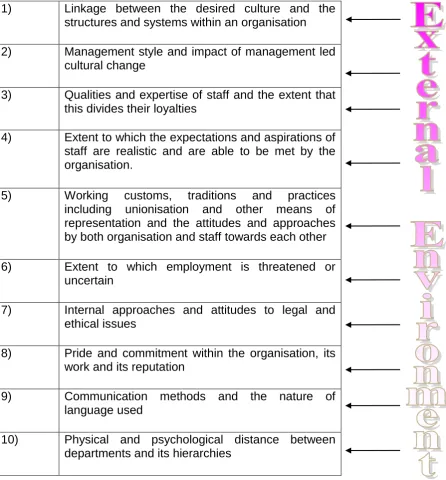
Pettinger (2000:188) identifies eleven aspects that have an impact upon
organisational culture as shown in Figure 1. Consideration of these points would
assist in the evaluation of the potential cultural barriers to change within the area of study by the author (Objective Two). However it is maintained that Pettinger‟s
assertion that the use of technology and its influence on work carried out is not significantly relevant to the author‟s area of research and thus it is not included within
the conceptual framework. GMPT is a people focused, public sector organisation
rather than industry. Whilst it is acknowledged that technology is part of almost all organisations, in the author‟s view it is not relevant to this research. It is maintained
by the author that the other points that Pettinger outlines have greater significance
and are worthy of investigative study. A consideration of the expectations of staff to
the review of the Probation Service and the extent to which these are realistic and
how the presence or otherwise of the Probation Qualification for the two grades of
practice staff impacts differently are just two examples of the direct relevance of Pettinger‟s assertions to GMPT.
Whilst Pettinger (2000:188) includes reference to management style within his key
points, the impact of management on organisational culture has been expanded
above literature review. Given this, the author has widened the management focus of
the conceptual framework to include a consideration of whether cultural change within GMPT is management led and staff‟s views regarding the impact of this.
The assessment of the above points based upon a review of the organisational
culture literature has led the author to develop the conceptual framework below in
Figure 2: Conceptual Framework 1) Linkage between the desired culture and the
structures and systems within an organisation
2) Management style and impact of management led cultural change
3) Qualities and expertise of staff and the extent that this divides their loyalties
4) Extent to which the expectations and aspirations of staff are realistic and are able to be met by the organisation.
5) Working customs, traditions and practices including unionisation and other means of representation and the attitudes and approaches by both organisation and staff towards each other
6) Extent to which employment is threatened or uncertain
7) Internal approaches and attitudes to legal and ethical issues
8) Pride and commitment within the organisation, its work and its reputation
9) Communication methods and the nature of language used
Research Philosophy
Ontology considers the nature of reality and the assumptions that researchers make
about the way that the world operates and thus the impact of these assumption on
their studies (Saunders, Lewis and Thornhill 2012:130). Collis and Hussey (2003)
represent the ontological positions as a continuum, illustrating the position of
positivism, realism and interpretivism.
Positivism
Those that adopt a positivist approach to research, operate on the basis that they
can have complete control over the variables and importantly, the effect of these
upon other variables, thus allowing cause and effect relationships to be established.
(Brewerton and Millward 2004:11). Such an approach infers that reality exists „out there‟ independent of the research or the views and beliefs of the researcher and
that any study is undertaken in a value free way resulting in value free data without
the potential for researcher bias. (Chia 2002:7)
Easterby- Smith, Thorpe and Lowe (2003:28) maintain that fundamental to positivism
is the belief that any measure of the social world should be undertaken using
objective methods that can be replicated. As indicated by Saunders et al ( 2012:137)
rich insights will be missed if the complexity of the social world is considered solely
as a series of laws and cause and effect generalisations
Interpretivism
Those that critique the positivist approach would advocate that the researcher needs
to be able to understand the differences between humans in our role as social actors
and that it is necessary to understand the world from their point of view.
Interpretivists would also maintain that organisations and business situations are
complex entities with a unique set of circumstances at any given time. Given this,
assuming law like generalisations they suggest is flawed (Saunders et al 2012: 137).
As indicated by Brewerton and Millward (2004:11), the assumption adopted by the
interpretivist approach is that reality is a social construct and as such, is not
something that can be fully worked out or explained in terms of universal laws; rather
it is a series of interpretations, often unique to a particular situation or group of
people attach to their experiences and what they are thinking or feeling about a
given situation.(Easterby- Smith et al, 2003 :30)
Realism
Realism represents the mid-point on the ontological continuum, taking elements of
both positivism and interpretivism which are at opposite ends of this continuum
(Collis and Hussey 2003). Those adapting a realist position Chia (2002:10) suggests,
see areas of research such as the culture or strategy within an organisation as
existing independently and as such can be systematically analysed and compared,
building knowledge through the development of theory, adding to what is already known. Realist‟s however recognise that people cannot be studied and understood in
the same way as natural sciences and as such recognise the implications of this in a
similar way to interpretivists.(Bryman 2001:13)
Author’s Research Philosophy
The key objectives of the research undertaken by the author are to identify and
understand the impact of environmental demands and constraints upon GMPT from
the view of employees within the Wigan Local Delivery Unit and to evaluate the
cultural barriers to becoming more responsive within the contemporary operating environment. These objectives lend themselves to establishing meaning and staffs‟
interpretation of the current environment in which the Probation Trust is operating.
However some of the environmental factors have a concrete external reality such as
the extensive cuts to the Trust budget, the opening up of the operating environment
to competition by the voluntary and private sector as outlined in Punishment and
Reform: Effective Probation Services (March 2012) Ministry of Justice.
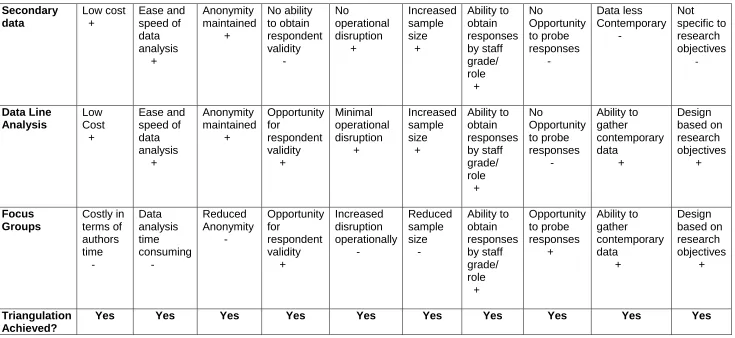
The author has adopted a realist research philosophy, utilising both qualatitive and
quantative research methods. The findings of such methods triangulate and balance
out the strengths and weaknesses of the individual methods as evidenced by Table
four below. Such a philosophy was adopted due to the need to understand the
operating environment from the view of the staff and middle managers in Wigan. As
indicated above, Saunders et al (2012:137) maintain assuming law like
generalisations to a unique and complex business situation would fail to provide
be balanced in the author‟s view with the external reality of the environmental factors
and changes to the Probation Trust.
Research Strategy
From the many research strategies available the author has chosen to undertake a
case study strategy as the basis of her research. Einsenhardt and Graebner 2007
cited in Saunders et al (2012:179) suggest that a case study strategy is the most
relevant strategy if the researcher is aiming to gain a rich understanding of the context of the research. Given that the author‟s research objectives focus on a single
geographical delivery unit within Greater Manchester Probation Trust and are
seeking to establish how cultural transition can be achieved within the unit, such a
strategy meets these aims. This view is reinforced by Johnson (2002:51) who maintains that case study strategies are useful where the intention is “to understand a specific situation.” It is also worth noting the point made by Newstrom (2007:90) who states that “any attempt to measure organizational culture can only be an
imperfect assessment. Such measurements capture only a snapshot of the culture at a single point in time”. As a case study strategy sets out to consider a snapshot of an organisation such a strategy would seem to be ideal in meeting the author‟s aims of
this reseach.
Secondary Data
There are a range of formats of secondary data e.g documentary, surveys,
government publications, newspaper reports etc and may be either raw or compiled
data (Saunders et al 2012:307)
The GMPT “Your Voice” staff survey was utilised by the author. This encompassed
quantitative data as closed questions were asked and respondents required to
indicate their views on a scale. Elements of the survey provided qualitative data as
respondents were asked to indicate why they had chosen a particular score on the
scale.
The survey was conducted in April and December 2012 in all ten geographical LDUs
but staff were required to indicate their grade and LDU base so that grade and
geographically based findings could be collated. The author of this research was
also provided with access to the raw data which assisted in mitigating one of the key
disadvantages of utilising secondary data, the reliance on third party analysis and
knowledge of the sample.
A key benefit of using the two “Your Voice” surveys as a research method has been the ability to enhance the scope and relevance of the author‟s research beyond a
single snapshot, to findings that have some longevity. There are however a range of
strengths and weaknesses associated with utilising secondary data as a research
method. These are summarised in table one below.
Generic Contextual
Strengths Low Cost
Ease and speed of data analysis
Anonymity maintained
Re-analysis of data provides opportunity for fresh interpretation
Ability to utilise contemporary data
Data provides trend
information and longevity to findings (April and December 2012 data collection)
No operational disruption
Data based on same sample as author‟s research
High sample size within secondary data (n= 77% of N)
Access to raw data available to the author
Weaknesses No ability to obtain respondent validity
No face to face interaction with research sample
Data is less contemporary than primary research methods
Table One : Comparison of generic and contextual strengths and weaknesses of secondary data
Data Line Analysis
A key benefit of data line analysis as presented by Douglas (1995:55) is the facility to
quickly establish the main themes within the area of study. The approach involves
the researcher producing a list of perceived central themes or areas of importance
within the research and asking the respondents to rank them in order of importance.
In Douglas (1995) initial research he used fifty five statements for ranking this could
be considered excessive and also has significant implications for data analysis.
Qualatitive data collection can be built into this method by incorporating the option
for respondents to add additional statements to blank cards.
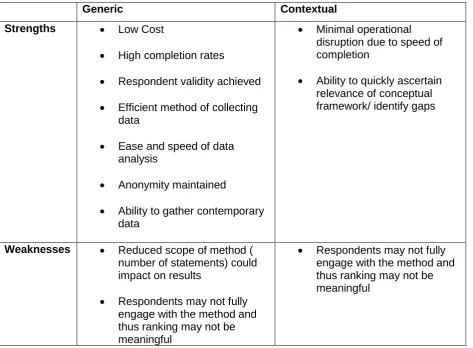
There are a number of strengths and weaknesses of using data line analysis as a research method, some of which are contextual to the author‟s research. These are
summarised in Table Two below.
Generic Contextual
Strengths Low Cost
High completion rates
Respondent validity achieved
Efficient method of collecting data
Ease and speed of data analysis
Anonymity maintained
Ability to gather contemporary data
Minimal operational disruption due to speed of completion
Ability to quickly ascertain relevance of conceptual framework/ identify gaps
Weaknesses Reduced scope of method ( number of statements) could impact on results
Respondents may not fully engage with the method and thus ranking may not be meaningful
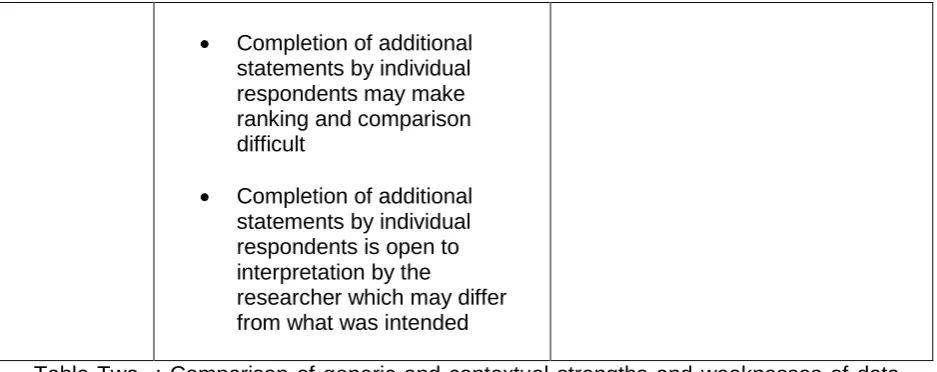
Completion of additional statements by individual respondents may make ranking and comparison difficult
Completion of additional statements by individual respondents is open to interpretation by the
researcher which may differ from what was intended
Table Two : Comparison of generic and contextual strengths and weaknesses of data line analysis
The author chose to utilise this method due to its ability to quickly establish respondents‟ views regarding the environmental demands and constraints placed on
GMPT (Objective One) and the potential cultural barriers in responding to these
changes within Wigan LDU (Objective Two). Initially this method was piloted with
the GMPT staff forum which is mixed grade. Whilst this forum is Greater Manchester wide, and therefore not contextually relevant to the author‟s research in Wigan it is
comprised of colleagues in other geographical LDUs who are facing similar
environmental challenges and political change. This allowed the researcher the
opportunity to test out the relevance of the initial statements and to collate additional
information from the optional, additional statements added by the pilot respondents.
This method was undertaken in Wigan ahead of the focus groups in order to
establish initial themes which could then be explored in greater depth in the focus
groups where qualatitive data was obtained.
Focus Groups
Focus groups provide a researcher with a reasonably small number of respondents,
brought together at the same time to discuss a particular topic, linked to the researcher‟s research objectives. A number of pre-prepared open questions are
utilised by the researcher but as Johnson 2002:99 states this method has the benefit
of being flexible in terms of the order of the questions, adding probing questions
along with responding to non verbal cues by the respondents. Additionally as Gliner
and Morgan (2000:341) indicates, focus groups have the potential to stimulate
respondents thinking and elicit their ideas and thoughts regarding the research area.
Johnson 2002:120 emphasises the benefits of capturing some of the “quotable quotes” and that such responses should be included as they assist in illustrating a
key point or theme. The potential for researcher bias however is also highlighted and
it is suggested that this can be balanced by ensuring that several quotes are used as
part of the findings to demonstrate the variety of responses offered by subjects in
relation to a particular theme or issue.
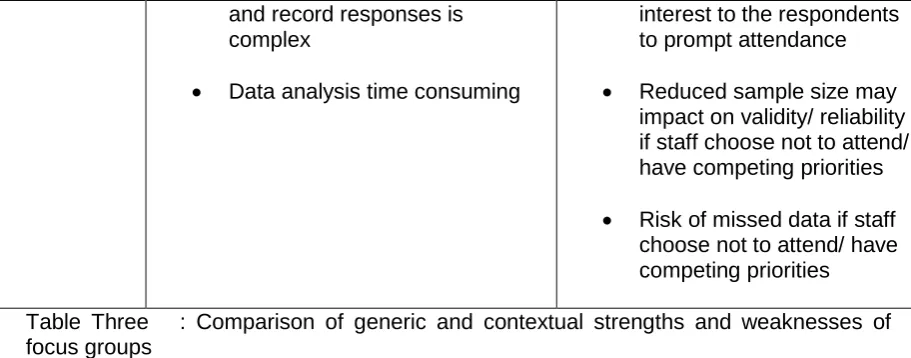
There are however, a number of advantages and disadvantages of focus groups as
a research method. These are summarised in Table Three below.
Generic Contextual
Strengths Low Cost
Increased sample size
Speed of completion
Opportunity for respondent validity
Opportunity to probe responses
Opportunity to identify non verbal cues
Ability to record the session with respondents permission
Ability to gather contemporary data
Minimal operational disruption due to speed of completion
Ability to obtain responses by staff grade/ role
Weaknesses Anonymity of respondents reduced
Potential for respondents answers/ participation to be influenced by others in the group
Ability to facilitate focus group
Potential for hierarchical deferral due to authors senior role within the organisation (mitigated by author having responsibility in a different geographical LDU)
and record responses is complex
Data analysis time consuming
interest to the respondents to prompt attendance
Reduced sample size may impact on validity/ reliability if staff choose not to attend/ have competing priorities
Risk of missed data if staff choose not to attend/ have competing priorities
Table Three : Comparison of generic and contextual strengths and weaknesses of focus groups
The author of this research chose to undertake focus groups as the final method in
the research as this enabled exploration of any remaining gaps in the conceptual
framework in further depth. It also provided the opportunity to obtain further
respondent validity and qualitative feedback to the ranking from the data line
analysis.
As the author holds the position of Assistant Chief Executive within the same
organisation as the research has been undertaken, there was an awareness of the
potential for hierarchical deferral by respondents by utilising focus groups as a
research method. The author has attempted to minimise this in two ways; firstly not
conducting the research the Local Delivery Unit for which she is responsible for
people and performance management; secondly by ensuring that all participants are
aware that their responses will remain anonymous within the research.
Sample Size
There are a total of 60 (N=60) staff based in Wigan Local Delivery Unit (LDU). The
intention of the author has been to maximise the potential sample size within the
research methods adopted so that that the sample is as representative as possible
but manageable within the time constraints placed upon the author. Given that the
research objectives relate to the cultural barriers to shifting to a more responsive
approach to environmental change and identifying the constraints to achieving this,
the author was of the view that the sample size needed to be as near to N =n as
The author has been able to utilise secondary data from the staff “Your Voice”
Survey which was undertaken in April 2012 and repeated in December 2012 along
with the raw data behind the analysis provided by Greater Manchester Probation Trust‟s Research department. This survey asks all GMPT employees to complete an
anonymous questionnaire incorporating questions where respondents are asked to
indicate their view on a scale of 1 to 5. There is also an option to add comments so
that qualatitive data is also captured. The response rate to this survey by Wigan
staff was 77% (n= 46) which was 30% higher than the Trust average. Whilst the
focus of this research is solely on the Wigan LDU and has internal validity only, it is
useful to compare the Wigan responses to peers within other geographical LDUs.
The second method adopted by the author was data line analysis. In order to
improve the response rate and thus increase the sample size, pre- set staff team
meetings were utilised to undertake this. The author utilised the first part of these
meetings without the team manager being present to explain the focus of the
research and to ask staff to rank the statements in order of importance. By
undertaking this method in pre-set meeting time with the permission of the team
manager the author was able to capture the responses of all staff in work on that
day.
The third method that the author utilised was focus groups that were grade specific. From the raw data provided for the “Your Voice” secondary data source the author
was aware that despite a 77% response rate, there had been no responses by
Probation Service Officers (PSOs) who are the unqualified practice staff grade within
the Probation Trust. In order to ensure that the sample was representative and
captured PSOs within the research the author provided additional opportunities for
PSO focus groups to be held and prioritised this particular focus group over and
above the other grades of staff in terms of author flexibility for facilitating it.
Triangulation
Table Four on the next page demonstrates that methodological triangulation has
been achieved. The strengths and weaknesses of each individual method has been
compared to demonstrate that the research findings are enhanced as a result of
Table Four: Review of research methods to demonstrate methodological triangulation Secondary data Low cost + Ease and speed of data analysis + Anonymity maintained + No ability to obtain respondent validity - No operational disruption + Increased sample size + Ability to obtain responses by staff grade/ role + No Opportunity to probe responses - Data less Contemporary - Not specific to research objectives -Data Line Analysis Low Cost + Ease and speed of data analysis + Anonymity maintained + Opportunity for respondent validity + Minimal operational disruption + Increased sample size + Ability to obtain responses by staff grade/ role + No Opportunity to probe responses - Ability to gather contemporary data + Design based on research objectives + Focus Groups Costly in terms of authors time - Data analysis time consuming - Reduced Anonymity - Opportunity for respondent validity + Increased disruption operationally - Reduced sample size - Ability to obtain responses by staff grade/ role + Opportunity to probe responses + Ability to gather contemporary data + Design based on research objectives + Triangulation Achieved?
Bibliography
Brewerton P and Millward L (2004) Organizational Research Methods Sage, London
Brooks I (1999) Organisational Behaviour: Individuals, Groups and the Organisation Financial Times Management, London
Bryman A. (2001) Social Research Methods, New York: Oxford University Press
Capon C (2000) Understanding Organisational Context Prentice Hall, Essex
Chia R (2002) “The production of Management Knowledge: Philosophical Underpinnings of Research Design” In Partington D (ed) Essential Skills for Management Research Sage, London
Collis J and Hussey R (2003) Business Research A Practical Guide for Undergraduate and Postgraduate Students 2nd Edition Macmillan, Basingstoke
Douglas D (1995) The Management of Human Resources in the SME, proceedings of the Small Business and Enterprise Development Conference, University of Leeds, 5-6 th April, 55-56
Easterby-Smith M, Thorpe R and Lowe A (2003) Management Research 2nd Ed Sage , London
Gliner, J and Morgan G (2000) Research Methods in Applied Settings: An Integrated Approach to Design and Analysis Lawrence Erlbaum Associates, London
Johnson G (2002) Research Methods for Public Administrators Quorum Books, London
Needle D (2001) Organizational Aspects of Business In Salaman G (Ed) Understanding Business: Organisations Open University Press, London
Newstrom J (2007) Organizational behaviour: Human Behaviour at Work 12th Edition McGraw- Hill, New York
Pettinger R (2000) Mastering Organisational Behaviour Macmillan, Hampshire
Punishment and Reform: Effective Probation Services (March 2012) Ministry of Justice
Saunders M, Lewis P and Thornhill A ( 2012) Research Methods for Business Students 6th Edition Pearson, Essex
Schein, E.H. (2004) Organizational Culture and Leadership, San Francisco, Jossey-Bass\John Wiley.