Published online 2016 November 30. Review Article
Study of Comparison Among Information Processing Theory,
Interference Model of Test Anxiety and Beck’s Cognitive Theory of
Depression with Regard to Their Relationship with Academic
Achievement
Fayegh Yousefi,
1,2,*Marof Redzuan,
3and Rumaya Bte Juhari
3 1Social Determinants of Health Research Center, Kurdistan University of Medical Sciences, Sanandaj, Iran 2Faculty of Medicine, Kurdistan University of Medical Sciences, Sanandaj, Iran3Faculty of Human Ecology, University Putra Malaysia Serdang 43400, Malaysia Faculty of Human Ecology, University Putra Malaysia Serdang 43400, Malaysia
*Corresponding author: Fayegh Yousefi, Social Determinants of Health Research Center, Kurdistan University of Medical Sciences, Sanandaj, Iran. E-mail: [email protected]
Received2016 August 30;Revised2016 September 11;Accepted2016 October 16.
Abstract
Objective:In this paper, the Interference model of test anxiety by Eysenck (1972), Beck’s cognitive theory of depression (1967) and information processing theory by Atkinson and Schifrin (1968) were assumed to develop the theoretical framework.
Methods:Here, the above theories are discussed in relation to the present paper. Their application and implications and academic achievement are also considered.
Results:Academic achievement was treated as a dependent variable. Depression and test-anxiety were considered as independent variables, this is because the researcher wanted to investigate whether variables, such as depression, test-anxiety, and memory have the potential to affect students’ academic achievement. The paper highlights the relationships between depression, test-anxiety, memory, and academic achievement. It has been postulated that depression and test-anxiety despair short–term memory, and short-term memory cannot transfer information to long short-term-memory. Thus, these processes are linked to low academic achievement. In other words, when depression and test-anxiety prevent the transfer of information from short-term memory to long-term memory, then students cannot memorize their lesson or recall it.
Conclusions:Although much work has been done on academic achievement, yet there are not enough studies carried out on the relationship among test-anxiety, depression, memory and academic achievement. Thus, more studies are needed to ascertain the effects of depression and test anxiety on academic achievement through memory. The focus of the present paper was to examine the relationship between the above-mentioned variables and theories.
Keywords:Information Processing Theory, Interference Model of Test Anxiety, Beck’s Cognitive Theory of Depression and Academic Achievement
1. Introduction
In this paper, three basic theories were used, namely the interference model of test anxiety by Eysenck (1972), Beck’s cognitive theory of depression (1977), and Informa-tion processing theory by Atkinson and Schifrin (1968) and they were adopted for developing the conceptual frame-work (1-3). In this section, the above theories were dis-cussed in relation to their application in the present study. Meanwhile, the research theoretical framework is pre-sented in order to support the present work. The three the-ories are related to academic achievement.
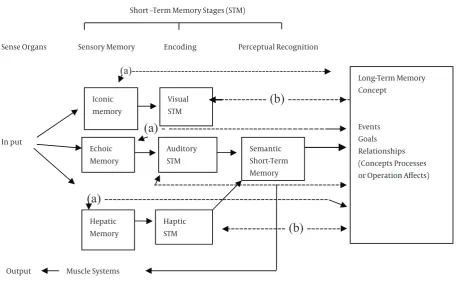
According to Thomas (2005), human processing sys-tem consists of 4 principal elements, including eyes, ears, taste buds, and pressure and pain nerves in the skin. These principal elements receive impressions from the environ-ment, stored by short-term memory in a short period of
time, while long-term memory stores large amounts of in-formation. Finally, muscle systems, energized by nerve im-pulses perform all the motor acts, which people carry out, such as reading speaking, running, assembling machines, and the rest (4). The systems involve functions or processes within each element and the interactions among these el-ements (seeFigure 1).
There are 2 main reasons that indicate the mentioned theories are linked together. Firstly, according to Eysenck (2001), Eggen and Kauchok (2004), and Raulin, and Ktkin (2003), depression and test-anxiety are closely related to memory, because students with high depression and test anxiety are unable to concentrate (5-7). For example, Beck (1967) and Halgin Krauss, and Bourene (2005) pointed out that depression symptoms, which affect low academic achievement could lack concentration and attention (8,9).
Short –Term Memory Stages (STM)
Sense Organs Sensory Memory Encoding Perceptual Recognition
(a)---
--- (b) ---
(a) -
---In put(a)
--- (b) ---
Output Muscle Systems
Long-Term Memory Concept
Events Goals Relationships (Concepts Processes or Operation Affects) Iconic
memory
Visual STM
Semantic Short-Term Memory Auditory
STM Echoic
Memory
Haptic STM Hepatic
Memory
Figure 1.One Classical Version of the Human Information -Processing System (4)
For instance, students, who suffer from depression usually could not pay attention to their study, and thus, it could lead to low academic achievement. Meanwhile, Winter and Bowers (2007), Moritz, Kloss, Jahn, Schick and Hand (2003), Lemstra, Neudorf, Aecy, Kunst, Warren and Bennett (2008), and Chapel Blanding and Silverstein (2005) showed that symptoms of depression, such as inability in concentra-tion and attenconcentra-tion, are closely related to memory perfor-mance and academic achievement (10-13). In addition, based on the present study, among 21 items of BDI, the highest rate of depression items with triple choice among high school students were “dislike of self” with 23.3%, “self-accusation” with 23.3%, and “sadness” with 14.5 %. However, the lowest scored depression items among respondents were “suicidal ideation” with 2.8%, “pessimism and change in body image” with 4%, respectively.
As mentioned earlier, two items, namely “dislike of self” and “self-accusation” and also “sadness” were high-lighted among the other items in BDI, this is closely sup-ported by Beck’s cognitive theory of depression. Beck (1967) indicated that dislike of self and self-accusation lead to symptoms of depression, such as sadness and unhap-piness (8). Also, low academic achievement and dropout among high school students create dislike of self, self-accusation and sadness meaning that they thought
worth-lessness because of failure in exam and academic achieve-ment (14). Therefore, it is linked to information processing theory and also to interference model of test anxiety pro-posed by Eysenck (2001); these three theories have focused on memory and academic achievement, meaning that dis-ruption in attention and concentration leads to dysfunc-tion of memory and leads to low academic achievement (5).
Strauss, Lahey, and Jacobsen (1982) in their study, pointed out that, Beck cognitive theory of depression sup-ports the relationship between depression and academic achievement. They showed that depression interferes with academic success, such as indolence, short attention, pre-occupation toward their problems, and poor school per-formance. Thus, depression decreases academic achieve-ment (15). A study by Salami (2008) also indicated that de-pression is related to academic achievement and memory, where impairment of attention and concentration lead to low academic achievement. As mentioned earlier, depres-sion influences memory, and information processing the-ory clearly explains how depression and test anxiety could impair memory capacity (16).
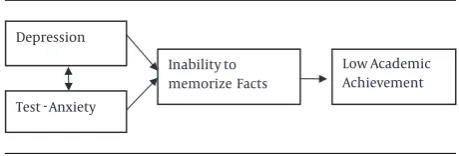
depres-sion and test-anxiety could not memorize their lesson and recall it (4). Obviously, based on Beck’s cognitive the-ory of depression and interference model of test anxiety by Eysenck, the symptoms of depression and test-anxiety, such as low self esteem, low self-worth, feeling lack of con-trol, negative emotion, anxiety, loss of motivation, anger and negative thoughts, inability in attention, and concen-tration are related to each other, and they are all associated with weak memory performance (8). Moreover, weakened memory is related to academic failure (17). In short, all dis-cussed theories are related to each other, and thus they need to be considered, particularly, in designing the theo-retical and conceptual framework in this study (seeFigure 2).
Depression
Test - Anxiety
Inability to memorize Facts
Low Academic Achievement
Figure 2.The Theoretical Framework
2.1. Relationship Between Depression, Test-Anxiety, Memory and Academic Achievement
Depression is one of the major mental disorders, which have a wide range of symptoms affecting somatic, cogni-tive, affeccogni-tive, and social processes. The array of conse-quences of depression include low academic achievement, poor peer relations, behavioral problems, conflict with parents and authority figure, and low self-esteem (12).
Another issue, presented here, is test-anxiety. Accord-ing to Zeidner (1998), test anxiety is a multidimensional sign that could be described as “a group of phenomeno-logical, physiophenomeno-logical, and behavioral reactions to appear with possible negative consequences or failure on an exam or similar evaluative situation (18). Test-anxiety and depres-sion are also related to memory. Memory is the process by which information is retained for later use (19). Also, based on the information processing model, memory is a storage system that records information from the senses for up to three seconds (4).
As mentioned earlier, depression, test-anxiety, and memory are inter-related and together they may influence academic achievement. According to Pine et al. (2004), Park, Goodyer and Teasdale (2002), and Mowla et al. (2007), depression influences memory. Based on Beck’s cogni-tive theory of depression (1967), negacogni-tive view about self, future and the world leads to low self-esteem, hopeless-ness and the belief that the world is unfair (20-22). Also,
Beck (1974) and Halgin et al. (2005) showed that negative thoughts lead to depression and effect memory and aca-demic achievement because students with depression can-not do their homework and school activities. It has been noted that the symptoms of depression impair concentra-tion and attenconcentra-tion. Therefore, they damage memory. Fi-nally, this leads to low academic achievement (9,17). Fur-thermore, Keogh et al. (2003) reported that worrying im-pairs performance by reducing attainable working mem-ory, which is related to academic achievement (23).
As mentioned above, the major problems of respon-dents toward exams were worrying and body trembles at the time of exam. These were confirmed by Stober (2004), who indicated that the main components of test-anxiety are worrying about the consequences of failure, and then the perception of autonomic reactions evoked by the test situation, meaning that when students are worried about their test, at the same time their autonomic system will be stimulated and cause depression, and test-anxiety leads to the inability to memorize facts and thus low academic achievement. Signs of test-anxiety include faster heart beats, agitation, glands perspiring and palpitation. Also, those symptoms disrupt attention and concentration and finally lead to low academic achievement among students (24). In addition, test-anxiety decreases academic perfor-mance (24). Eysenck (2001) found that limitation in work-ing memory is the cause of cognitive impairment of highly test-anxious individuals. Students with high test anxiety encountered task-irrelevant thoughts, such as worries and anxiety about self-evaluative aspects of failure, which en-gage working memory. Test-anxiety also disturbs the recall of prior learning and thus reduces academic performance (5). Based on Eysenck’s interference model of test anxi-ety, high test anxiety is closely related to memory and aca-demic achievement. Eysenck (2001) found that high test-anxiety creates irrelevant thoughts, thus impacts on mem-ory and attention span, and leads to decreasing amount of recall (5).
2.2. Depression, Test-Anxiety, Memory and Academic Achieve-ment
In addition, Chapell at al. (2005) carried out a study on 5551 undergraduate and graduate students in Penn-sylvania and Illinois. They found that there was a sig-nificant relationship between academic achievement and levels of test-anxiety among students. For instance, stu-dents with low test-anxiety had higher academic achieve-ment than students with moderate and higher test-anxiety. Similarly, students with moderate test-anxiety had higher academic achievement than students with higher test-anxiety (13). Also, based on the findings of the study by Chapell et al. (2005), test-anxiety among female students was more than that of male students (13). According to Eysenck’s interference model of test anxiety, high test anx-iety is closely related to memory and academic achieve-ment. Eysenck (2001) found that high test anxiety creates irrelevant thoughts, it also effects memory and attention span, and then leads to reduced ability to recall (5). To il-lustrate this process with an example, when an adolescent focuses seriously (anxiety) on outcome or results of a test that they has taken, this might affect their memory, and as a result they would fail the test due to disturbed mem-ory. In this case, they focus more on negative consequences of failure, and this will affect their concentration, atten-tion and then, memory, therefore this would lead to low academic achievement. Eysenck (2001) showed that test anxiety has an impact on memory, which leads to low aca-demic achievement. He concluded that test anxiety is re-lated to less efficient performance because of a vulnera-bility to distraction and interference (5). Also, test anxi-ety creates the students’ physiological, cognitive and be-havioral responses, and these have symptoms, such as pal-pitations, sweating, fear, apprehension, negative thoughts and feelings about the failure of the test (26,27). However, Alting and Markam (1993) showed that students with test-anxiety were not only generally more emotionally sensi-tive to distraction, but also to anxious mood (28). As noted, this theory is closely related to Beck’s cognitive theory of depression, where depression and test-anxiety effect atten-tion and concentraatten-tion (8).
Another factor affecting academic achievement is de-pression. According to Chen and Li (2000), adolescents with depression were vulnerable to educational under-achievement (29). Based on the resource allocation model of the effect of depressed mood on cognition, students with symptoms of depression are predisposed to focus their attention on interfering, irrelevant thought, leav-ing little sustained attention available for cognitive tasks, which leads to low academic achievement (30).
Also, Needham (2006) reported that many of the homework depended on the ability to sustain attention and concentration (31). Depression disrupts concentration and attention in schools and most likely undermines
aca-demic performance. He indicates that depressed mood is related to academic under-achievement (30). In addi-tion, Rockhill et al. (2008) in their study with 521 middle schools in the USA, found that depression has an impact on academic achievement among respondents because it disrupts attention and concentration, and thus students cannot memorize the information and recall it (31). Frojd et al. (2008) in their research about the relationship be-tween different levels of depression and academic achieve-ment among 2516 students aged 13 to 17 years old in Fin-land found that depression is related to academic achieve-ment. Depression was significantly correlated with aca-demic achievement among high school students in this study (14).
Studies by Frojd et al. (2008) and Needham (2006) are similar because both of them focused on the rela-tionship between depression symptoms and low academic achievement (14, 30). For instance, Frojd et al. (2006) indicated that depression in high school students has a tendency to impact academic achievement and outcomes. They pointed out that depression caused impaired ability to concentrate, loss of interest, poor initiative, psychomo-tor retardation, and low self-esteem. These symptoms de-crease students’ academic achievement (14). Also, Need-ham (2006) found that depression effects concentration and student’s academic performance, which leads to aca-demic under-achievement. In addition, he pointed out that depression symptoms in adolescents are positively as-sociated with failure to complete high school and failure to enter college among high school students (30).
Studies, by Hallfors et al. (2005) in the USA, and Rockville (2005) in his national survey on drug use and health in research Triangle Park, North Carolina have been carried out about depression and its relationship with aca-demic achievement. All of these studies indicated that de-pression symptoms undermine academic performance (31,
32).
es-teem, low self concept, anxiety, phobias, withdrawal, dis-turbed sleep, and appetitive indecisiveness are closely re-lated to memory performance and academic achievement (10-13).
Strauss et al. (1982) in their article entitled “the rela-tionship of three measures of child depression with aca-demic underachievement” pointed out that cognitive the-ory could support the relationship between depression and academic achievement. They showed that depression interferes with academic success, such as indolence, short attention, preoccupation, and poor school performance. Thus, depression decreases the academic achievement (15). A study by Salami (2008) also indicated that depression is related to academic achievement and memory, where it impairs attention and concentration that lead to academic failure (16). Frojd et al. (2008) reported that depression im-pairs cognitive functioning and blocks cognitive sources. This is in accordance with Beck’s cognitive theory of de-pression, in which cognitive functioning, attention and concentration are impaired, and short-term memory can-not transfer information to long–term memory, thus stu-dents cannot memorize their lesson and recall it (14).
On the other hand, based on Eysenck’s interference model of test anxiety, high test anxiety leads to cogni-tive impairment. This results in lower performance scores on attention and memory, and decreases the academic achievement (1). In addition, Macleod and Donnellan (1993) pointed out that more than 20 experimental studies showed that test-anxiety was linked to academic achieve-ment and also cognitive tasks (34).
Another point to note is that depression and anxiety af-fects memory. To elaborate this process, information pro-cessing theory is employed to explain the effect of depres-sion and test-anxiety on memory. According to this the-ory, when concentration and attention are impaired, short-term memory could not transfer information to long-short-term memory (3).
According to the Information Processing Theory, mem-ory is a mediating variable (Atkinson and Schifrin, 1968). Concentration and attention are required in order to trans-fer information from short-term memory to long-term memory (35,36). However, if depression and test-anxiety upset attention and concentration, the process of transfer-ring information will be disrupted (4). The disruption of memory could lead to low academic achievement. Thus, in this process, memory is the mediating variable between in-dependent variables (depression and test anxiety) and de-pendent variable (academic achievement). In addition, ac-cording to Eysenck (1992), limitation in working memory is a cause of cognitive impairment of highly test-anxious individuals. In other words, test-anxiety affects attention and concentration, and then, it leads to impairment of
memory. In fact, students with high test anxiety have en-countered task-irrelevant thoughts, such as worries and anxiety about self-evaluative aspects of failure, which en-gages working memory (37). According to this interference model, test anxiety disturbs the recollection of prior learn-ing and thus, reduces academic performance (1).
Also, According to Martin (2008), information process-ing theory describes how the memory system works and how it is related to learning and academic achievement. He indicated that many students have significant problems on interference in transformation of information from short-term memory to long-term memory. This means that some factors, such as depression and test anxiety disrupt the process of learning (36). In addition, according to in-formation processing theory, memory and learning are linked together in three stages, which are sensory memory, short-term memory, and long-term-memory and new in-formation and learning happen in these stages before be-ing stored (35).
Therefore, depression and anxiety prevent the trans-fer of information from short-term memory to long-term memory and disrupt in the process. In other words, for transfer of information from short-term memory to long-term memory, students must focus attention and concen-tration on their study. At this stage, depression and test-anxiety disrupt this process, and in this condition, mem-ory is impaired due to inability to memorize and recall the information (6,7).
As a result, according to information processing the-ory, firstly, information is not transferred from short-term memory to long term memory. Second, students with high depression and test- anxiety cannot memorize and recol-lect their lessons (4). Obviously, based on Beck’s cogni-tive theory of depression and Interference model of test anxiety by Eysenck, the symptoms of depression and test-anxiety, such as low self-esteem, low self–worth, feeling lack of control, negative emotion, anxiety, loss of motiva-tion, anger and negative thoughts, inability in attention and concentration are related to each other (1,2). Also, they are associated with weak memory performance and the weakened memory is related to academic achievement (1,
2). In short, all theories discussed are related to each other, and thus they need to be considered in designing the the-oretical and conceptual framework of this study.
However, all of them pointed out that psychological disturbances have impacts on memory. These findings are in line with the Information Processing Theory (4,43). As mentioned earlier, depression and test-anxiety effect attention and concentration, and lead to impairment of memory performance. In addition, Torzandjani (2006) re-ported that subscales of WMS, such as mind control, visual memory, and learning of association in depressed people, are different from normal groups, i.e. depression has im-pacts on subscales of WMS (44). Furthermore, Vasa et al. (2007) indicated that gender, age, and family social class were not related to either visual or verbal memory (42). In addition, they found that there was a significant differ-ence in visual memory between juvenile and without cur-rent test-anxiety groups (F (1, 50) = 510.24, P≤5.02), with lower memory scores observed among adolescents with test-anxiety versus those without test-anxiety (M = 58.51 and M = 9.68), respectively (42).
An de Decker et al. (2003) pointed out that depres-sion has a considerable relationship with memory deficits. They indicated that depression, anxiety, worry, hopeless-ness, and subjective stress, are significantly related to the retrieval of specific memories (40). Pine et al. (2004) in their study with 152 respondents (ages 9 to 19) in the USA indicated that there was a significant relationship between memory performance and academic achievement. Also, they showed that there was a close relationship (F (2,351) = 3.3, P < 0.05) between memory performance and major depression (20). Furthermore, Park et al. (2002) in their study with 75 adolescents in the UK, found that depression had an impact on memory among adolescents (21).
Mowla et al. (2007) reported that memory perfor-mance, which was assessed by Wechsler Memory Scale, is related to depression among respondents in Shiraz, Iran. Individuals with depression had lower scores on the Wech-sler Memory Scale than the control group (22).
Although, the above-mentioned studies were carried out among different cultures and samples, they were sup-ported by the information processing theory (21, 22). It has been hypothesized that psychological disorders, such as depression and test-anxiety, weaken the attention and concentration of the students and they effect memory and eventually decrease the academic performance of students (21,22).
Age Diseth (2007) in his study with 206 undergraduate psychology students in Norway, indicated that several fac-tors, such as anxiety, depression and memory, are related to academic achievement (45).
Also, Annett et al. (2007) with 939 children aged 6 to 12 years old without neuropsychological problems from the USA found that memory was closely related to academic achievement (46).
Wilding et al. (2007) in their study with 90 undergrad-uate students from the UK found that there were signif-icant correlations between working memory and second year examination performance among respondents (47). Kamali, Birdshot, and Ebrahimi (2006) pointed out that cognitive performance, especially learning and academic achievement, was investigated by subscales of WMS (48). Moreover, Airaksinen et al. (2006) reported that depres-sion heavily impacts memory performance among respon-dents (49).
As mentioned earlier, depression and anxiety prevent the transfer of information from short-term memory to long-term memory. In other words, for transformation of information from short-term memory to long-term mem-ory, students must focus attention and concentration. At this stage, depression and test-anxiety disrupt the pro-cess, and therefore, memory is impaired due to inability to memorize and recall the information (6,7).
References
1. Beck AT. Treatment of depression with cognitive therapy and amitriptyline.Arch Gen Psychiatry. 1985;42(2):142. doi: 10.1001/arch-psyc.1985.01790250036005.
2. Stöber J, Esser KB. Test anxiety and metamemory: general prefer-ence for external over internal information storage.Pers Individ Dif. 2001;30(5):775–81. doi:10.1016/s0191-8869(00)00069-6.
3. Atkinson R, Shiffrin R. In: The psychology of learning and motivation: Advances in research and theory. Spence K, Spence J, editors. 2. New York: Academic Press; 1968. Human memory: A proposed system and its control processes. Proposed system and its control processes. 4. Thomas RM. Comparing theories of child development. California:
Thomson and Wad worth; 2005.
5. Eysenck MW. Principles of cognitive psychology. Hove, East Sussex: Psychology Press; 2001.
6. Eggen P, Kauchak D. Educational psychology. USA: Prentice Hall Press; 2004.
7. Raulin L. Ktkin Abnormal psychology. New York: Aldyn and Bacon press; 2003.
8. Beck AT. Depression: Clinical experimental and theoretical aspects. New York: Harper & Row; 1967.
9. Halgin RP, Krauss W, Bourene S. Abnormality psychology clinical per-spective on psychological disorder. Boston: Mc Grew; 2005. 10. Winter MG, Bowers CD. Peer relationships and academic
achieve-ment as interacting predictors of depressive symptoms during mid-dle childhood.Canada J Behav Sci.2007;39(3):220–34.
11. Moritz S, Kloss M, Jahn H, Schick M, Hand I. Impact of comor-bid depressive symptoms on nonverbal memory and visuospatial performance in obsessive-compulsive disorder.Cogn Neuropsychia-try. 2003;8(4):261–72. doi: 10.1080/135468000344000020. [PubMed: 16571565].
12. Lemstra M, Neudorf C, D’Arcy C, Kunst A, Warren LM, Bennett NR. A sys-tematic review of depressed mood and anxiety by SES in youth aged 10-15 years.Can J Public Health.2008;99(2):125–9. [PubMed:18457287]. 13. Chapell MS, Blanding ZB, Silverstein ME, Takahashi M, Newman B, Gubi A, et al. Test anxiety and academic performance in undergrad-uate and gradundergrad-uate students.J Educ Psychol. 2005;97(2):268–74. doi: 10.1037/0022-0663.97.2.268.
mid-dle adolescent boys and girls. J Adolesc. 2008;31(4):485–98. doi: 10.1016/j.adolescence.2007.08.006. [PubMed:17949806].
15. Strauss CC, Lahey BB, Jacobsen RH. The relationship of three measures of childhood depression to academic underachievement.J Appl Dev Psychol.1982;3(4):375–80. doi:10.1016/0193-3973(82)90009-0. 16. Salami SO. Psychopathology and academic performance among
Nige-rian high school adolescents: The moderator effects of study behav-ior, self-efficacy and motivation.J Soc Sci.2008;16(2):155–62. 17. Beck AT, Rial WY, Rickels K. Short form of depression inventory:
cross-validation.Psychol Rep.1974;34(3):1184–6. [PubMed:4424377]. 18. Zeidner M. Test-anxiety: The state of the art. New York: Plenum Press;
1998.
19. Kassin S. Essentials of psychology. USA: Prentice Hall; 2004. 20. Pine DS, Lissek S, Klein RG, Mannuzza S, Moulton J3, Guardino M, et
al. Face-memory and emotion: associations with major depression in children and adolescents.J Child Psychol Psychiatry. 2004;45(7):1199– 208. doi:10.1111/j.1469-7610.2004.00311.x. [PubMed:15335340]. 21. Park RJ, Goodyer IM, Teasdale JD. Categoric overgeneral
autobio-graphical memory in adolescents with major depressive disorder. Psychol Med.2002;32(2):267–76. [PubMed:11866322].
22. Mowla A, Ashkani H, Ghanizadeh A, Dehbozorgi GR, Sabayan B, Chohedri AH. Do memory complaints represent impaired mem-ory performance in patients with major depressive disorder? De-press Anxiety. 2008;25(10):E92–6. doi: 10.1002/da.20343. [PubMed: 17592609].
23. Keogh E, Bond FW, French CC, Richards A, Davis RE. Test anxiety, susceptibility to distraction and examination performance.Anxiety Stress Coping.2004;17(3):241–52. doi:10.1080/10615300410001703472. 24. Stöber J. Dimensions of test anxiety: Relations to ways of
cop-ing with pre-exam anxiety and uncertainty.Anxiety Stress Coping. 2004;17(3):213–26. doi:10.1080/10615800412331292615.
25. Peelo M, Wareham T. Failing students in higher education. Philadel-phia: Sreh and Open University Press; 2002.
26. Hill KT, Wigfield A. Test anxiety: A major educational problem and what can be done about it.Elem Sch J.1984;85:105_26.
27. Sena JD, Lowe PA, Lee SW. Significant predictors of test anxiety among students with and without learning disabilities. J Learn Disabil. 2007;40(4):360–76. doi: 10.1177/00222194070400040601. [PubMed: 17713134].
28. Alting T, Markham R. Test Anxiety and Distractibility.J Res Pers. 1993;27(2):134–7. doi:10.1006/jrpe.1993.1009.
29. Chen X, LI B. Depression mood in Chinese children: Develop-ment significance for social and school adjustDevelop-ment.Int J Behav Dev. 2000;97(2):268–78.
30. Needham BL. Gender differences in the consequences of depressive symptomatology for educational attainment, social support, and health risk behavior during the transition from adolescence to young adulthood. University of Texas; 2006.
31. Rockhill CM, Vander Stoep A, McCauley E, Katon WJ. Social com-petence and social support as mediators between comorbid depressive and conduct problems and functional outcomes in middle school children. J Adolesc. 2009;32(3):535–53. doi: 10.1016/j.adolescence.2008.06.011. [PubMed:18694594].
32. Hallfors DD, Waller MW, Bauer D, Ford CA, Halpern CT. Which comes first in adolescence–sex and drugs or depression? Am J Prev Med.2005;29(3):163–70. doi:10.1016/j.amepre.2005.06.002. [PubMed:
16168864].
33. Beck AT, Steer RA, Carbin MG. Psychometric properties of the beck de-pression inventory: Twenty-five years of evaluation.Clin Psychol Rev. 1988;8(1):77–100. doi:10.1016/0272-7358(88)90050-5.
34. MacLeod C, Donnellan AM. Individual differences in anxiety and the restriction of working memory capacity.Pers Individ Dif. 1993;15(2):163–73. doi:10.1016/0191-8869(93)90023-v.
35. Huitt W. The information processing approach to cognition. Edu-cational psychology Interactive Valdosta, GA: Interactive: Valdosta State University; Available from:http://chiron.valdosta.edu/whuitt/ col/cogsys/infoproc.html.
36. Martin R. How we learn: Our memory system. State schools for severely handicapped. Jefferson city: Missouri department of elemen-tary and secondary education; .
37. Eysenck MW, Calvo MG. Anxiety and performance: The pro-cessing efficiency theory. Cogn Emot. 1992;6(6):409–34. doi: 10.1080/02699939208409696.
38. Fossati P, Coyette F, Ergis AM, Allilaire JF. Influence of age and exec-utive functioning on verbal memory of inpatients with depression.J Affect Disord.2002;68(2-3):261–71. [PubMed:12063154].
39. Rohling ML, Scogin F. Automatic and effortful memory processes in depressed persons.J Gerontol.1993;48(2):P87–95. [PubMed:8473702]. 40. de Decker A, Hermans D, Raes F, Eelen P. Autobiographical mem-ory specificity and trauma in inpatient adolescents.J Clin Child Adolesc Psychol. 2003;32(1):22–31. doi:10.1207/S15374424JCCP3201_03. [PubMed:12573929].
41. Afshar H. Compression of Memory in depressed, Alzheimer and nor-mal groups [In Persian]. Iran: University of Medical science and health services; 2004.
42. Vasa RA, Roberson-Nay R, Klein RG, Mannuzza S, Moulton J3, Guardino M, et al. Memory deficits in children with and at risk for anxiety disorders.Depress Anxiety. 2007;24(2):85–94. doi: 10.1002/da.20193. [PubMed:16850413].
43. Baddeley AD. Working memory. Oxford, England: Clarendon Press; 2003.
44. Torzandjani H. Memory based on logic with mood among depressed people. Iran: University of Nayshapoor; 2006.
45. Diseth A. Approaches to learning, course experience and examina-tion grade students: testing of mediator effects and construct valid-ity.Soc Res High Educ.2007;32:373–88.
46. Annett RD, Bender BG, Gordon M, Childhood Asthma Management Program Research G. Relating children’s attentional capabilities to intelligence, memory, and academic achievement: a test of construct specificity in children with asthma.Child Neuropsychol.2007;13(1):64– 85. doi:10.1080/09297040600770779. [PubMed:17364564]. 47. Wilding J, Andrews B, Hejdenberg J. Relations between life
diffi-culties, measures of working memory operation, and examination performance in a student sample.Memory. 2007;15(1):57–62. doi: 10.1080/09658210601106447. [PubMed:17479924].
48. Kamali Z, Eghtesadi S, Birashak B, Afkham Ebrahimi A, Poorvali K. Iron impact on cognitive performance among female with iron and blood deficit [In Persian].J Iran Univ Med Sci.2006;13:161–8.