*Corresponding author: Andrew Chubykalo ISSN: 0976-3031
Research Article
MAXWELL’S ERROR AND ITS CONSEQUENCES FOR PHYSICS
Andrew Chubykalo
1, Augusto Espinoza
1,Victor Kuligin
2and Maria Korneva
21
Unidad Académica de Física, Universidad Autónoma de Zacatecas, Zacatecas, México
2Department of Electronics, Voronezh State University, Russia
DOI: http://dx.doi.org/10.24327/ijrsr.2019.1002.3198
ARTICLE INFO ABSTRACT
The analysis of errors in the theories of modern physics led us to an important conclusion. There are initial errors, which then “generate” a spectrum of sec-ondary errors (erroneous consequences). We found an error made by Maxwell in the mathematical formulation of Faraday studies. In summarizing the experiments, Faraday Maxwell “lost” instantaneous action at a distance. The paper presents a proof and considers some consequences for physical theories. For example, we must consider the charge fields and the fields of electromagnetic waves as independent fields having different (mutually exclusive) properties.
INTRODUCTION
While reading general courses and special courses, we constantly encountered “inconsistencies” in physical theories. To lecture, you need to know more and deeper than given in the textbooks. We are constantly faced with contradictions in theories and obvious errors. The desire to give students a clear, consistent presentation of the material led to the need to analyze the problems of physics. Gradually,we got a picture of “breeding” errors.
Any competent physicist knows well the principle of Occam: "Do not multiply entities beyond necessity." But in the Middle Ages, another philosopher Duns Scott lived, who formulated a no less interesting rule: “Correct assumptions make the right conclusions. False assertions may result in both erroneous and correct conclusions.” It follows from this rule that, at a certain stage of its development, even a theory with errors in its foundation can “predict” the correct results. Only much later comes the crisis, the theory becomes a dogma, which is then reformed or replaced by a new theory.
The same with the “confirmation” of the theory by experiment. In nature, there is no “pure” experiment. Any experiment is “loaded with theory,” as philosophers say. Any experiment requires a theoretical explanation, interpretation. And here are the fit for the “right point of view”. This is clearly visible on the hypotheses of researchers. Each of them builds a hypothesis
to eliminate contradictions in standard theories, but so as to “fit into the experiments.”
They often talk about the “triumph of science”, pointing to the success of industrial production. This is not entirely true. People have a plan: to make a certain product by the deadline. The discrepancy between the theory and the result is justified by many reasons (unrecorded conditions, manufacturing errors, measurement errors, etc.). A plan is a plan. It rarely explores the true causes of the discrepancy between theory and practice. Researchers uselessly spend a lot of effort to correct the consequences (secondary errors). But this is “Sisyphean toil”. As long as the original prejudice lives, it will constantly replicate new and new errors. An example is the “crisis of physics” at the turn of the XIX - XX centuries. The “crisis of physics”, which dates back to the turn of the nineteenth and twentieth centuries, appeared much earlier. This crisis has arisen because of several initial admissions somewhere in the XIX century. Over a hundred and fifty years, the uncorrected errors have become prejudices. We can name at least three such chronic, 150-year-old errors in physics and mathematics.
In this paper, we show one “mistake” made by Maxwell. This error “predicted” the existence of electromagnetic waves, but “threw out” from physics “instantaneous action at a distance. Instant action was the foundation of Newtonian mechanics, the foundation of the theory of gravity. Theory and mechanics had a solid experimental evidence and more than two hundred years
Available Online at http://www.recentscientific.com
International Journal of
Recent Scientific
Research
International Journal of Recent Scientific Research
Vol. 10, Issue, 02(G), pp. 31139-31146, February, 2019
Copyright © Andrew Chubykalo et al, 2019, this is an open-access article distributed under the terms of the Creative Commons Attribution License, which permits unrestricted use, distribution and reproduction in any medium, provided the original work is properly cited.
DOI: 10.24327/IJRSR
CODEN: IJRSFP (USA)
Article History:
Received 12th November, 2018
Received in revised form 23rd December, 2018
Accepted 7th January, 2019
Published online 28th February, 2019
Key Words:
of practical application. The elimination of instantaneous action gave rise to difficulties and subsequent errors in theories. If you track this chain, we get:
The first mistake: Identification of charge fields and fields of electromagnetic waves. The ban on instant action at a distance. Incorrect description of electrodynamics phenomena.
The second error (consequence). Incorrect philosophical interpretation of causality and interaction. The appearance of an erroneous (inane) concept of the “speed of propagation of interactions.”
The third mistake: Incorrect explanation of the essence of the Lorentz transformation, etc.
“Birth” of Maxwell's equations
“When I began to delve into the study of the works of Faraday, wrote Maxwell [1], I noticed that the method of his understanding is also mathematical, although not presented in the conventional form of mathematical symbols. I also found that themethod can be expressed in the usual mathematical form and thus can be compared with the methods of recognized mathematicians.”
So, both Ampere and Faraday believed that each electric current is surrounded by a magnetic field. Maxwell decides to write this thesis in the form of an equation:
rotH = j . (2.1)
Here is the vector of the magnetic field strength, is the density vector of the electric current, in which Maxwell turns on the “bias current” that has not yet been observed by anyone. Maxwell sees that the law of conservation of charge does not follow from equation (2.1). He went through the options for a long time, until he introduced the “displacement current” (the derivative of the electric field strength).
rot = + ,
rot = − ,
div = , div = 0 .
(2.2)
It can be assumed that Maxwell had doubts. The electric and magnetic fields in equations (2.2) are retarded. This contradicted Coulomb’s law, the explanation of which was based on instantaneous action at a distance, and the existing the Newton’s law of the universalgravity.It seemed strange to Maxwell’s contemporaries. But gradually they got used to it, and instant action at a distance became an “outcast” in physical theories.
Charge Potential
Physicists sometimes “stew in their own juice,” forgetting that many questions have already been solved analytically by mathematicians and, if there are theories with similar mathematical formalism, then they are tested experimentally. We will take advantage of this. Classical mechanics (and its section - Analytical mechanics) is actually a branch of mathematics and developed by the works of mathematicians and physicists: Poisson, Lagrange, Laplace, Green,
Ostrogradsky, Hamilton, Gauss, Neumann, Helmholtz, Kirchhoff, and others. By the time Maxwell formulated his equations, the foundations of analytical mechanics were already quite well developed. Why did Maxwell not use its results? No one will know.
Let us try to Eliminate this Disadvantage. Let us be Consistent and first Perform the Routine part
We note the analogy between the quasistatic phenomena of electrodynamics and the Newtonian law of the universal gravity. Speaking about the quasistatic phenomena of electrodynamics, we can draw a direct and deep analogy with the theory of the theory, since the potentials of these fields are described by the Poisson equation.
Resting charged body creates an electrostatic field around itself (proportional to the charge), which has energy and strength properties. This is a figurative physical model (as a reflection of a fragment of reality), allowing us to give speculative representation (based on analogy) and draw a picture of physical phenomena and processes of interaction.
The field potential is the energy characteristic of the field of a resting charge at some point in space. It is numerically equal to the work that we must do in order to move the trial (unit, positive, point) charge from infinity to a given point of space.
The electric field strength of a stationary charge at some point in space is the force characteristic of the field. It is numerically equal to the force that will act on the trial (unit, positive, point) charge resting at a given point in space in the observer’s frame of reference.
Italicized, as will be shown, is a very important point. The absence of the word “resting” in the definition led to contradictions in the explanation of magnetic phenomena, which allowed relativists to conclude that classical theories are unable to explain magnetic phenomena and declare the “fallacy” of classical ideas.
The motion of a charged particle can be represented as a sum of translational and rotational. During translational motion, the body moves in such a way that all points of the body moving along a curve line at each moment have the same velocity vector (depending in general on time). During rotational motion, the center of mass of the body rests, and the body rotates around an axis passing through the center of mass.
In physics, there is a law of charge conservation. The point charge does not “creep away” in space, therefore ivv = 0, where v is the velocity of the point charge. In addition, if a point charge rotates around its axis, around it there is no movement of the scalar potential and, accordingly, a magnetic field (translational movement of the point charge).
Faraday, Maxwell and Analytical Mechanics
Considering conditionally the potential as a kind of “environment” we can use the results of continuum mechanics [2].
The first. We can use the scalar potential continuity equation:
+ div = 0 . (4.1)
This is the famous equation. Next, we can introduce the vector potential . Let:
A = v ⁄ , (4.2)
then we can write a new form of the continuity equation that binds the vector and scalar potentials:
1
+ div = 0 . (4.3)
Recall that for a point charge all points of the potential always have the same speed due to the translational nature of the motion of the scalar potential.
The second. We can use the conservation equation for vector tubes and their intensities. For some arbitrary vector a, this equation has the form [2]:
⁄ + div + rot[ × ] = 0 . (4.4 )
If we replace vector with the electric field vector = −grad , then we can write:
grad ⁄ + ∆ + rot[grad × ] = grad ⁄ + rot( ) = 0 . (4.4 )
The final form of the resulting equation is:
rotH = E+ j , (4.4 )
where
H =1rotA; E = −grad ; j = v. (4.4)
Third. When moving the scalar potential of the charge field with respect to the stationary observer, the observer will find an “additive” to the field strength. This additive is a third-party EMF and, corresponding to it, the intensity of an external field is equal to:
.= − ⁄ . (4.5) It is third-party because it cannot be replaced by the potential gradient of the electrostatic field, i.e. it does not have electrostatic origin. The third-party EMF is the result of the movement of the scalar potential field relative to the resting trial charge in the reference frame of the observer.Therefore, it is now possible to write another identity:
rot( + .) = − . (4.6)
One can verify its validity by substituting the corresponding scalar and vector potentials.
So, using only mathematics, we obtained a system of equations of quasistatic electrodynamics. Here it is:
rot = + ,
rot( + .) = − ,
div = , div = 0 ,
(4.7)
где = −grad , .= − ⁄ , = rot .
It is easy to point out the differences between the system of equations (4.7) and Maxwell's equations (2.2).
It would seem that the difference is small, but it is only “it would seem.” In fact, the nature of the functional dependence of solutions has radically changed. Instead of potentials describing instantaneous action at a distance, Maxwell’s equations began to describe fields of retarded potentials!
We have no reason to believe that Maxwell’s lagging potentials appeared naturally. Ampere, Faraday and other scientists could experimentally study only quasistatic, not wave phenomena. Only much later, Hertz, knowing about the wave nature of solutions of Maxwell's equations, gave a qualitative experimental confirmation of the existence of such waves.
So, Maxwell made a “fatal” mistake by writing down the bias current incorrectly. He introduced not only the term = − ( grad ⁄ ), but also the term .= − ( ⁄ ), which logically should not have been included in the equations. But it was a “brilliant mistake.” Maxwell, without knowing it, “opened the way” to new scientific and technical areas, and, above all, radio engineering, radar, etc. It was a huge step forward.
At the Same Time, this Mistake Dealt a Blow to the Materialistic Worldview and Physics
charge fields and electromagnetic waves were identified, despite the difference in properties;
classical theories (mechanics, Newtonian theory of aggression, etc.) became the subject ridicule.
Thus was born in classical electrodynamics prejudice or dogma.
Fields of Charges and Fields of Electromagnetic waves
Did we do the right thing, considering the mathematical approach more justified than Maxwell’s analysis? Have we done right, accusing Maxwell of an unintentional error? We have one advantage over Maxwell: we have more complete theoretical and experimental information. Let us compare some properties of the charge fields and properties of the fields of electromagnetic waves. To do this, their main properties are summarized inTable 1.
Table 1
Quasistatic charge fields Wave fields
1.
The charge fields and are always “attached” to the charge and the current and cannot exist without charge.
After radiation, the wave propagates (fields and ) and is no longer dependent on the radiation source.
2.
The magnetic field of the charge depends on the speed of movement of the charge. If the charge is at rest, the magnetic field is zero.
The magnetic field of the wave is always hard connected to the electric field . These fields cannot exist separately.
inertial properties, i.e. there is an electromagnetic mass (rest mass), momentum and kinetic energy. Electromagnetic mass has all the properties of a conventional (mechanical) inertial mass [3].
electromagnetic wave cannot be correlated with the density of an inertial mass. The rest mass density of an electromagnetic wave is always zero [3].
4.
The speed of movement of the charge fields is always equal to the speed of the charge and can be zero.
The speed of movement of an electromagnetic wave in free space is constant and is always equal to .
5.
The relationship between the electromagnetic mass, the electromagnetic momentum and kinetic energy of the charge fields is described by the Umov law and the Lenz law [3].
Relationship between energy density and momentum density in electromagnetic the wave is determined by the Poynting conservation law.
Already given is sufficient to establish that the charge fields and the fields of electromagnetic waves are fundamentally different fields, i.e. fields that are different (mutually exclusive) properties and, accordingly, a different physical nature. For this reason, the fields must be described by independent groups of equations.
Is there a limiting Transition from Retarded Potentials to Quasi-Static Potentials?
Based on the results of Table 1, it can be said that the transition from wave fields (retarded potentials) to quasistatic charge fields (instantaneous action) within Maxwell’s equations do not exist. Properties of these fields are incompatible. Let us check this conclusion.
Modern textbooks state that equations for describing quasi-static phenomena can be easily obtained, for example, if the speed of light rushes to infinity, since the “lag” in this case disappears. At the limiting transition, the solution of the wave equation for the fields should go to the solution of the Poisson equation for the same fields.
Alas! This is a chronic prejudice. Let us check this point.
Consistently eliminating or from Maxwell’s equations, we write down separate equations for these vectors:
rot rot + 1 = − ; div = ;
rot rot + 1 = rot ; div = 0.
(6.1)
To these equations, for analysis, we must add the Lorentz force describing the interaction of charges:
= + × = + × . (6.2)
Now let us recall how the speed of light is determined in the equations of electrodynamics:
= ( ∙ ) ⁄ . (6.3) So, in order to turn the speed of light to infinity, we have to either aim zero or aim zero.
Let us test both options.
1) → 0 .
We immediately come across a “nuisance”:
lim
→ div = lim→ (6.4)
does not exist!
Coulomb’s law is also violated:
= (6.5)
(the interaction forces between the charges become infinite!), etc.
2) → 0 .
And here we get an awkward system of equations:
rot rot = 0; div = ⁄ ; rot rot = rot ;
= . (6.6)
Here the displacement currents are absent, and the interaction of charges is reduced to electrostatic interaction. The interaction through the magnetic field “disappears”. In other words, in both cases we do not get a system of quasistatic equations and a correct description of the interactions of the charges. These are some “scanty bits” of quasistatic equations. So, the limiting transition from wave fields to quasistatic charge fields is fundamentally impossible. These fields must be described by independent equations.
How could “wave Processes” Penetrate into Quasistatic Equations?
Now, following Maxwell and taking into account the results obtained by us, we will answer the question: where could the wave processes in Maxwell equations come from? Let us return to the equations of quasistatics (4.7):
rot = + ; rot( + .) = − ;
div = ; div = 0;
= −grad , .= − ⁄ , = rot .
(7.1)
In order for equations (4.7) to begin to contain not only instantaneous fields, but also fields of retarded potentials, we introduce additional new fields, including them in (7.1).
Let the new additional fields ∗ and ∗ be created by some vector potential ∗, which describes a transverse electromagnetic wave (div ∗= 0). We add to the old electric field of charge = −grad a new field ∗= − ∗⁄ , and to the induction of the magnetic field of the charge = rot
an additional induction of the magnetic field ∗= rot ∗. So:
′= −grad − ∗⁄ ;
.= − ⁄ ; ′= rot + rot ∗;
= . (7.2)
Substitute expressions (7.2) into the system of quasistatic equations (4.7):
rot ′=
′
,
div ′= 0,
rot ′+
. = −
′
,
div ′= .
(7.2 )
The first group is a group of quasistatic equations known to us:
rot = + ; rot( + .) = − ;
= ; div = 0 .
(7.3)
The second group consists of two homogeneous equations:
rot rot ∗= 1 ∗
= 0; div ∗= 0 . (7.4)
We see that the wave equation describing transverse electromagnetic waves is not contains the sources field on the right side. This is not a “slip”, but evidence of the incompleteness of Maxwell’s equations and Faraday’s experiments. Faraday and other researchers studied quasistatic fields. Their experiments could not “detect” the electromagnetic wave and its sources due to the smallness of the effect of emission of electromagnetic waves and the imperfection of devices. Much later, the existence of electromagnetic waves (retarded potentials) was experimentally confirmed from the qualitative side by Hertz.
Quantitative measurements for the purpose of detailed verification of Maxwell's equations have not been carried out to date. It seemed to everyone that the Maxwell equations were correct and did not need special experimental verification.
An analysis of the Maxwell equations in the Lorentz gauge showed [3], [4] that charged particles do not directly emit electromagnetic waves during acceleration. Waves are emitted by specific currents [4]. Even now, scientists do not have a complete description of the radiation processes (the problem of calibrations) and the reactions of this radiation to charges (“self-acceleration” of the charge).
The crisis in Physics and the Error of Maxwell
In the late XIX - early XX centuries. in connection with new discoveries. There were two schools of physicists: “mechanical” and “critical.”
The adherents of the “mechanical school” adhered to the materialist view of the meaning and purpose of the knowledge of nature. In defending mechanism, they believed that they also advocated materialism. The rejection of mechanics, as the basis of theoretical physics, seemed to them a rejection of the materialistic view of the essence and purpose of knowledge.
Representatives of the “critical school” denied the principles of mechanics, not so much because the limitations of these principles were increasingly revealed, but rather because confidence in the objectivity of theoretical knowledge was associated with the recognition of their objectivity and firmness. In the “critical school”, the real natural science problem from the very beginning was shifted to the field of revision of the materialist, in essence, Newtonian mechanics.
Let us explain: what is the fundamental difference between these schools? It is reflected in the principles of knowledge laid down and proclaimed by the “critical school” (Poincaré, Mach, Duhem, Ostwald, etc.). Here are some “delimitation points”:– denial by representatives of the “critical school” of the accumulative nature of knowledge (each new theory rejects its predecessor; theories die when their apologists die, etc.);
– violation of the laws of logic (logically contradictory “wave-particle duality”, logical contradictions in the SRT – “paradoxes” , etc.)– denial of the variety of forms of cause-effect relationships (reduction of causality only to a sequence of interrelated events, etc.).
In fact, the “critical school” was a form of subjective idealism (positivism). Materialism is one and only. Special “materialisms” (separately for classical theories, separately for relativistic theories, separately for quantum ones) do not exist. Therefore, if we recognize classical theories as materialistic theories (Newton’s mechanics, for example), then quantum theories and relativistic theories must be recognized as subjective-idealistic.
This is where Maxwell's error played a role. Here is what Professor O. D. Khvolson wrote at the end of the 19th century in his “Course of Physics” [5] (§4. Actio in distans):
The term "actio in distans", i.e. “Action at a distance” denotes one of the most harmful teachings that ever dominated physics and hindered its development: this is a teaching that allowed the possibility of the direct action of something (A) on something else (B), which is located the great distance that contact between A and B cannot take place... The pupil of Newton, Cotes, in the preface to the second edition of “Principia”, which Newton did not read before it was printed, for the first time clearly expressed the idea of “actio in distans”, that the bodies are mutually attracted. On the one hand, the conviction that the view expressed in the preface to his book is favored by Newton, on the other hand, the tremendous development of celestial mechanics, entirely based on the law of the world as a fact, and not needing any of its explanations, forced scientists to forget about the purely descriptive nature of this law and to see in it the complete expression of a really occurring physical phenomenon.
... The idea of action in the distance, which prevailed in the last century, received a new food, even stronger, when, at the end of the century, from Coulomb’s experiments, it turned out that both magnetic and electrical interactions can be reduced to the interactions of particular hypothetical substances (two electricity and two magnetism), walking directly into the distance and according to the laws, quite analogous to Newton’s law. ... In the first half of this century (XIX century – our commentary) actio in distans sovereignly dominated science.... Nowadays, the conviction that actio in distans should not be allowed to become by any area of physical phenomena. But how to expel it from the doctrine of the world gravitation?
You see, thanks to Maxwell’s mistake, “instantaneous action at a distance” turned out to be driven out of electrodynamics. It remains to expel him from the mechanics of Newton and the theory of gravity.
Interaction and Instantaneous Action at a Distance
Imagine that a shred of matter has been torn from your shirt. You must somehow mend the hole. This can be done by inserting and sewing a torn piece. But you can clumsily tighten the edges of the hole “on the live thread.” Similarly, in physics. Maxwell’s error “snatched” instantaneous action at a distance from the explanation of a number of physical phenomena. This had a negative impact on the change in the content of concepts in physical theories and on the numerous postulates in the theories.
The postulate plays a “strange” role, the role of dogma. It is similar to a road sign (like "brick"). You must obey this sign and have no right to “look in” for it and look for an answer to the questions: why is it “impossible” and what is next for it? If you break, you expect “sanctions”. There are many such prohibitions, for example, “there are no absolutely rigid bodies in nature” or “it is impossible to move with superlight speed”, etc.
The “loss” of instantaneous action at a distance led to incorrect explanations and distortion of the content of some terms. We will consider as an example the definition of the fundamental concept of "interaction" in physics. We quote Great Soviet Encyclopedia [7]:
Interaction in physics (Int.) – the effect of bodies or particles on each other, leading to a change in their state movement. In Newtonian mechanics, the mutual action of bodies on each other is quantitativelycharacterized by force. A more general characteristic of Int. is potential energy. Initially, in physics, the idea was established thatInt.between bodies can be carried out directly through empty space, which does not take any part in the transfer of Int. while Int. moves instantly ... This was the so-called. the concept of long-range action.
Note that the interaction is not characterized by "potential energy". It has two sides, two facets: mutual power influence and energy (interaction energy, which depends on the relative distance and relative speed [4]). We continue:
... It wasprovedthat the Int. electrically charged bodies arenot carried out instantaneouslyand the movement of one charged particle leads to a change in the forces acting on other particles, not at the same moment, but only later end time. ... Accordingly, there is a “middleman” carrying out Int.. between charged particles. This intermediary was called the electromagnetic field. ... A new concept has emerged – a concept short-range action, which then was extended to any other Int.
In [7] it is written: “it was proved”. In fact, there are no empirical data, and the theoretical background is based on Maxwell’s equations, in which we saw an error. See what Laplace wrote about this. In Newton's theory of gravity, the speed of gravity is not included in any formula, being considered infinitely large. In his famous “Statement of the System of the World” in 1797, Laplace wrote: “The speed of propagation of gravity, which I calculated by analyzing the motion of the moon, its so-called secular acceleration, is at least 50 million times the speed of light!” Exceeds by 50 × 10 (!), if such a speed is generally available. No accurate data refuting instantaneous action at a distance does not exist. Moreover, it allows to solve the problem of electromagnetic
mass (electromagnetic mass has all the properties of the usual inertial mass) and the problem of interaction of charges. Not reasons to refuse instant action at a distance in the right to exist.
Identification of interaction with a material object, energy or information isphilosophical ignorance, there is a lack of understanding of the essence of the defined concept. You see, how many absurdities can follow from the incorrect definition given by scientists! And those who rejected instant action at a distance as “non-physical” are to blame. Here and “darn holes” in the theory.
Now it is our turn to define the concept of “physical interaction”. For any interaction (mutual action of objects) are necessary:
two objects that have a common property for the occurrence of interaction;
the contact between them is direct or indirect;
mutual action (simultaneous influence) of objects on each other.
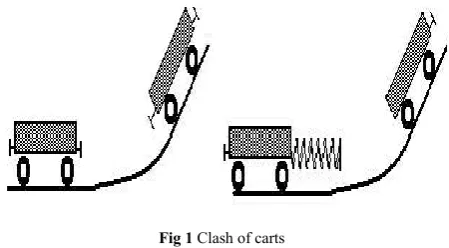
It is useful to consider a physical model of interaction at a distance. Imagine that a platform comes down from a hill, and after acceleration it hits another one standing in its way. Such a collision refers to a “point” contact type. The same type of interaction takes place between the balls in the above example. Now we put an elastic spring between the carts. If the spring has a mass, then when a moving carriage hits the spring along the spring, a compression wave will propagate. The speed of this wave will depend on the stiffness and mass of the spring.
Fig 1 Clash of carts
Suppose now that the mass of the spring is zero. In the limit, the wave propagation velocity from a moving carriage to a stationary one and back will be infinite (instantaneous action at a distance). The impact of the carts will no longer be a “point” because the carts will divided by spring. However, the interaction will retain its contact character. We called such interaction the contact interaction of the point type.
Now we can consider the case of the interaction of electric or gravitational charges. There are two possible explanations. The electromagnetic mass of the resting charge is determined by the formula:
=
2 . (9.1)
of this field is the lines of force, which have elastic properties. They determine the contact nature of the interaction. Thus, instantaneous action at a distance does not contradict the principle causality and has its counterpart interaction of the contact type.
So physical interaction is not a body or information, etc. Interaction is a contact type process. It is usually accompanied by the exchange of energy and momentum between two objects of interaction and the change of their states. The contact nature of the interaction rejects intermediaries. Any complex causal chain can be decomposed into a sequence of contact-type interactions. Instant action at a distance (respectively, the laws of Coulomb, Ampere, the law of universal gravitation of Newton and others) does not contradict the principle of causality [8].
Once again it should be repeated. Interaction is a contact type process. The concept of the “speed of propagation of interactions” is an empty, empty concept. The return to the physics of instant action at a distance entails the need to revise some physical theories and the need for new, correct explanations of physical phenomena.
Step Forward to solve problems
Consider what problems have already been solved, relying on the instantaneous range. Consider briefly some results:
The most important step is the strict solution of the electromagnetic mass problem [3], [4]. In these papers, energy conservation laws were formulated.
Umov’s energy conservation law: It was proved that when a charge field moves, a flow of energy arises that has a convective character. This stream carries the energy of the charge field at the speed of the charge.
The law of conservation Lenz: (balance of kinetic energy). This law states that when the charge is accelerated (decelerated) by external forces, an opposing the electric field, which, acting on the charge, tends to keep its speed unchanged. The work done by this field changes the kinetic energy of the particle (the energy of the magnetic field).
The conservation laws show that the electromagnetic mass of a charged particle has all the standard properties of an ordinary inertial mass. It should be noted that these laws are independent of Pointing’s conservation law.
The Establishment of the Classical Nature of the Field Interaction of Charges with each other can be Considered the second Important step. It is Important to note the Following:
The interaction of charges does not depend on the choice of the reference system by the observer, nor on the number of observers.
The interaction of charges is invariant with respect to the Galilean transformation.
The laws of conservation of energy, momentum, angular momentum of the system of interacting charges, the magnitude of the work done by the charges are also invariant with respect to the Galilean transformation. They are essential. The interaction of charges fits perfectly into the framework of classical analytical mechanics.
The third Important step was the Separation of Equations for an Independent Description of the Charge fields and the fields of Electromagnetic waves. This has Important Implications:
The Lorentz transformation is valid only for electromagnetic waves. Therefore, we need a new interpretation of the Lorentz transformation, which was proposed in [4]. The “paradoxes” of special relativity (logical contradictions) disappear as part of a new explanation of phenomena.
There is no contradiction between the Lorentz transformation and the Galilean transformation, since the Lorentz transformation is invariant with respect to the Galilean transformation [4]. It depends on the speed of the relative motion of inertial systems, which, as is well known, is the Galilean transformation invariant.
The fourth result is the determination of the erroneousness of “gauge invariance”. Instant action at a distance is not removable from either electrodynamics or the theory of gravity. We will not show the fallacy of evidence for gauge invariance. Formally, the proof looks right. However, it has the following assumptions that are illegal:
The proof (explicitly or hidden) is based on the uniqueness of the solution of the Cauchy problem for Maxwell's equations. Therefore, when replacing fields with electromagnetic potentials, we must formulate and transform the corresponding initial conditions for potentials and fields. This is not done.
As was shown, instantaneous action at a distance in electrodynamics cannot be eliminated. Therefore, any potential must be represented as a sum of functionally different parts (instantaneous potential plus retarded (anticipating) potential, etc.). In the "evidence" functional separation of potentials is absent.
Note that in the famous Landau and Lifshitz textbook [9] you will not find any mention of the Coulomb gauge, although it is implicitly widely used by them. Apparently the authors understood or felt the dubiousness of the “gauge invariance” procedure and tried avoid mentioning it. But they have a correct and important remark about gradient invariance.
One could continue this list further. One thing is clear: the restoration of rights in instantaneous physics at a distance will inevitably lead to a revision of a number of scientific theories and, above all, the theories of the micro world (QED, the theory of elementary particles, the theory of the atomic nucleus, etc.), as well as STR and GTR Difference of charge fields and electromagnetic fields waves call into question the “wave-particle dualism” hypothesis. The essence of physical phenomena turns out to be more complex and diverse than the existing explanations.
CONCLUSION
From this follows an important conclusion about the urgent need for constant verification and re-testing of the theoretical foundations of physics and fundamental experiments. The re-examination of experiments is the conduct of well-known fundamental experiments at a higher scientific and technical level in order to confirm or deny them more precisely and in depth.
References
1. Masxwell J 1885 Adynamical theory of the electromagnetic field Phil. Trans. Roy. Soc.London,155, 459, See also Masxwell J 1991 A treatise on electricity and magnetismVol. II(London)
2. Landau L and Lifshitz E 1986 Fluid Mechanics (2nd ed. Pergamon Press)
3. V.A. Kuligin, G.A. Kuligina, M.V. Korneva 1996 The Electromagnetic Mass of a Charged Particle Apeiron3 (1) 7
4. Chubykalo A and Kuligin V 2018 Unknown electrodynamicsBoson Journal of Modern Physics4(2) 384
5. Khvolson O (Хвольсон О) 1897 Course of Physics, Volume 1, favorites (Mechanical Constitutions and Measurements) (The edition of K.L. Ricker) 1-36 (in Russian); Chwolson O (French translation of Kurs fiziki by E. Davaux, Paris : A. Hermann) 1906-1928 (in French)
6. Poincaré H 1906 “Sur la dynamique de l’électron.” Ren. Circ. Mat. Palermo21, 129-175.
7. Great Soviet Encyclopedia 2011 (Translation from Russian into English University Library of Nijmegen) 8. Jefimenko O 2000 Causality, Electromagnetic Induction
and Gravitation, 2nd ed., (Electret Scientific, Star City) 9. Landau L and Lifshitz E 2010 The Classical Theory of
Fields(2nd ed., Pergamon Press)
How to cite this article:
Andrew Chubykalo et al.,2019, Maxwell’s Error and its Consequences for Physics. Int J Recent Sci Res. 10(02), pp.31139-31146. DOI: http://dx.doi.org/10.24327/ijrsr.2019.1002.3198