Vol.4 (2014) No. 4
ISSN: 2088-5334
Waste Utilization as Fine Coconut Fiber for Core and Wood Waste
Bayur to The Face Layer of The Physical and Mechanical Properties
of Particle Board Produced
Sahadi Didi Ismanto
#, Aisman, Supardi
##
Faculty of Agricultural Technology, Andalas University, Padang, Indonesia
E-mail: [email protected]
Abstract— This study aims to determine the effect of wood particle bayur comparison to the outer layer of coconut husk particle
board smooth the physical and mechanical properties of the resulting particle board . The design used was completely randomized design ( CRD ) with 5 treatments with 3 replications for each treatment used is the use of wood particles bayur as the outer layer of particle board and refined coconut fiber as a core that is 80 % : 20 % , 70 % : 30 % , 60 % : 40 % , 50 % : 50 % , 40 % : 60 % observational data physical and mechanical properties were analyzed using analysis of variance if significantly different then performed with a further test of Duncan's New Multiple Range Test ( DMNRT ) at the 5% significance level . Observations made on the physical properties of particle board include : water content , water absorption and thickness expansion. The mechanical properties of particle board : strength broken , the pressure parallel and bonding strength. Based on the research that has been carried out showed that the utilization of wood waste bayur as the outer layer of particle board on a percentage varying significantly different effect on strength broken , water content , water absorption , expansion of thick , strength pressure bonding parallel to the internal surface . The results show the percentage of particle board with wood bayur with delicate coconut husk ( 40:60 ) is the best board with a water content of 6.11% , water absorption 20.56 % 10.93 % thicker expansion, density of 0.84 % , bonding strength of 56.90 kg / cm 2 pressure and parallel fiber determination 146.65 kg /cm 2.
Keywords— Wood Bayur, Waste coconut fiber, core, particle board.
INTRODUCTION
Indonesia is a major coconut producing countries in the world . In 2000 , the total area of coconut plantations in Indonesia reached 3.76 million hectares with a total production estimated at 14 billion coconuts are mostly (95 %) is a people's plantations . Coconut has a value and important role in terms of economic and socio- cultural aspects besides coconuts too much dikosumsi humans ( Anonymous , 2012a )
By Anonymous (2012b), coconut coir is a byproduct of the industrial processing of copra . Utilization of coconut fiber as raw material industry to become a commodity trading led to work opportunities in the form of existence of coco traders and transport service business . According Suryadi ( 2010) , currently coconut husk is used for the manufacture of brooms , mats , ropes and tools other households . Coconut coir is also a raw material for various industrial products such as carpets , upholstery vehicle , mattresses , hardboard and besides coconut fiber is also used for the manufacture of particle board
According to Rizal (2002 ), the coconut husk is one berlignoselulosa materials are easily available , and resistant
to water and mechanical treatments such as rubbing . Coco containing lignin was 33.06 % and 38.91 % alpha cellulose and lignin containing coconut hybrids by 33.35 % and 36.68 % alpha cellulose. According Suryadi (2010) , coconut fiber have also been developed for the manufacture of particle board , but there are still obstacles such as fiber size and surface rough particle board produced rata.Untuk not overcome this one way that can be done is to coat the outer layer of the board coco particles with particle-shaped wooden bayur ketaman with 10 mesh size sieve mesh accommodated 20. The function of the outer layer of particle board is to improve the surface so that the finer the particle board surface so that when it is coated with mica mica will stick with evenly and not easily dislodged, otherwise it is expected to further improve the physical and mechanical strength of the particle board.
purpose of use, well-shaped construction timber, lumber and wood industry fuel.
The number of wood processing in West Sumatra can be estimated much wood waste generated in the form of small pieces , slashes , sawdust , and so the results ketaman potential still to be exploited . Alternatives include the use of waste wood for particle board and the outer coating on the particle board particle board three layered particle board on the inner lining is made of other materials such as from coconut husk.
According to Kasim (1991) , the wood is composed of a small portion of nitrogen, 50 % carbon, 6 % hydrogen and 44 % oxygen. Therefore, only a slight difference between the various types of wood in terms of its basic components . The content is the most important wood cellulose , hemicellulose , lignin , extractives and ash wood.
Preliminary research has attempted to make particle board using a three-layer coconut coir ratio 90 % 10 % smooth wood bayur ketaman results with good results but the amount of wood particles bayur can not cover the entire surface of the particle board , while the ratio of 80 % using refined coconut coir and 20 % wood particles bayur can cover the surface of the particle board perfectly.
The use of wood particles bayur not expected to be too low in order to cover the surface of the board so it is perfectly smooth and has a high strength to meet the Indonesian National Standard . Based on this comparison should look smooth with coco wood particles bayur optimum on the manufacture of particle boards from coconut fiber with wood particles bayur on the outer layer.
According Subiyanto (2003) , concentration of good adhesive used to glue the levels of 20 % where the levels are varied adhesive is 10 % and 15 % by using coconut powder as raw material . But after the pre- research by Suryadi (2010) , using the raw material of wood particles surian floured gergajia then obtained the optimal amount of adhesive is 22 % because the 20 % is the percentage of particles that are separated in this study
The purpose of this study was to determine the percentage of the use of wood particles bayur for the outer layer and smooth coconut fiber as a core of the best in the manufacture of particle board three layers of smooth coconut fiber.
MATERIALSANDMETHODS
Materials used in this study consists of coconut fiber waste obtained from PT.Alam Mandiri Persada Korong Tanjung Aur Pekandangan the District VI Lingkung Nagari Padang Pariaman and then separated coconut fiber rough and smooth, for particles of waste wood furniture industry bayur business Human Settlements, Pagang (Siteba) Padang.
The tools used are 10 mesh sifter , measuring cups , pH meters , glass cup , ruler , machete , sacks , big bucket , stirrer , scales , cutlery , ovens , appliance mold (31 × 31 × 1) cm2 , tool pengempa pengempa hot and cold and cut saws and testers physical and mechanical properties of particle board.
A. Research Methods
In this study design used was a completely randomized design (CRD) with 5 (five) treated with 3 (three) replications. Treatment is the percentage ratio of coconut husk fine
particles with bayur wood particles to the outer layer of the three layer particle board.
A = 80 % fine coconut fiber and 20 % wood particles bayur B = 70 % fine coconut fiber and 30 % wood particles bayur C = 60 % fine coconut fiber and 40 % wood particles bayur D = 50 % fine coconut fiber and 50 % wood particles bayur E = 40 % fine coconut fiber and 60 % wood particles bayur
The data obtained were analyzed statistically by F test if the results are significantly different then a further test is performed using Duncan 's New Multiple RangeTest (DNMRT) at the 5% significance level.
B. Implementation Research
Preparation of Refined Coconut Fiber and Particle Wood Bayur. Coconut coir fiber extracted from coconut husk waste treatment plant of Sicincin cleaned and cut into pieces with a length of ± 5cm . Then dried in sunlight until the moisture content of ± 10 % . As for wood particle boards bayur a smooth shaved results are taken from the business furniture industry , owned Anasrul at Padang drying is done with sunlight until the moisture content of ± 10 %
C. Calculation of Materials
Calculation of material in the manufacture of particle board do this is as follows :
a. The size of the board to be made is ( 31 × 31 × 1 cm ) b . Density of 0.8 g/cm3 board expected
c . Weight of the particle board is calculated by weigth
Density = --- volume
Weight = Volume x Density board board expected = 961 cm3 x 0.8 g/cm3
= 768.8 / per sheet
d . Levels of adhesives used for the core layer is 18 % and for the outer layer is 18 % of the dry weight of the board.
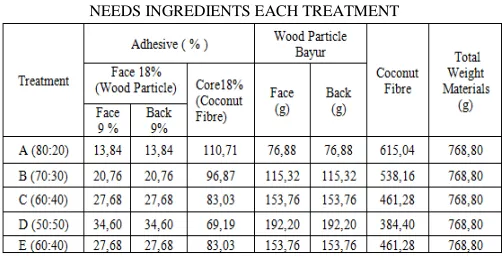
TABLE I
NEEDS INGREDIENTS EACH TREATMENT
D. Preparation of Particle Board
Manufacture of particle board based on the three-layer Haygreen and Bowyer (1982 ) were modified as follows 1) Weighing ingredients according to treatment
each material used 9 % for each material layer and 9 % for the bottom layer so the average of all the materials used for the outer layer which is equal to 18 %
3) Pouring the mixture into cetakanyang sized ( 31 x 31 × 1 cm ) located above the aluminum plate where the surface layer ( outer ) is bayur wood particles and lapisantengah is coconut fiber .
4) Flattening board candidates .
5) Compression with cold to form a sheet of felt boards for ± 15 minutes with a thickness of approximately 2 cm 6) Closure prospective board with another aluminum plate . 7) Then do compression with size ( 31 × 31 × 1 cm )
temperature of 150 ˚ C , a pressure of 300 kg/cm2 for 15 minutes .
8)
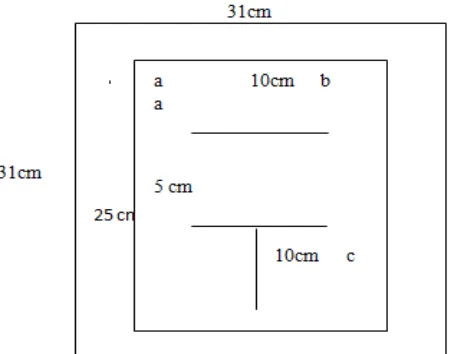
Expenditure board of forged instrument .Fig. 1 Patterns of test sampling for physical and mechanical properties of particleboard produced based on SNI 03-2105-2006
Description:
a : Sample test of strength broken
b : Sample density test, water absorption and thickness expansion
c : Sample test pressure equal strength d : internal test example bonding e : Sample test water content
E. Water Content
Water Content Refined Coconut Fiber and Bayur Wood (Sudarmadji et al, 1984)
A total of 1 g of material was weighed and dried used oven at 1030C for 3 hours and cooled in a desiccator and then weighed and dried again until the process constan. With heavy water content can be determined by the formula:
Water content = (A-B) / B x 100% (1)
where:
A = initial weight (g)
B = final weight (g)
F. Density (SNI 03-2105-2006)
Sample measuring 10 x 10 x thick. Tests done at the time of sample air dry. Last measured weight, length, width and thickness test sample density is calculated using the formula:
P = B / V (2)
where: P = density (g / cm 3) B = Weight (g) V = Volume (cm3)
G. Observation Physical Properties of Particle Board Water Content (SNI 03-03-2105-2006)
Sample size of 5 x 5 x thick with heavy weighted (A) and then put into the oven with a temperature of 103 0C for 24 hours, then re-weighed to a constant weight (B). Water content dehitung with formula.
Water content = (A-B) / B x 100% (3)
where:
KA = moisture content (%) A = initial weight (g) B = oven dry weight (g)
H. Water Absorption (SNI 03-2105-2006)
Sample used measuring 10 x10 x thick. This test is to measure the weight gain after immersion in water for 24 hours and compared with the weight before deep water. Water absorption was calculated by the formula:
Water absorption == (Bb-Ba) / Ba x 100% (4)
where:
Ba = initial weight before soaking (g) B = weight after immersion (g)
I. Expansion of Thick
Expansion of a benchmark against thick end use when worn on the moisture conditions different (Prayitno and Darmoko.1994). Examples of test used a 10 x 10 x thickness cm3. Sample immersed in water at room temperature for 24 hours. Furthermore, again measured by means such as measuring the thickness of a thick pre-soaked. Expansionof thick can be calculated by the formula:
Expansion of thick = (Tb-Ta) / Ta x 100% (5)
where:
Ta = thickness before soaking (cm) Tb = thickness after immersion (cm)
J. Observation Mechanical Properties This breaks Board 1) Modulus of Repture (SNI 03-2105 - 2006): Sample Test used size 5 × 25 × thick. Testing is done by using a test with a buffer distance of 15 cm pressurized sample perpendicular to the sample surface until broken or damaged. Strength fracture calculated by the formula:
3. P. L
Where:
MOR = Tenacity fracture (kg / cm2) P = Load break (kg)
L = Width (cm)
b = Width of specimen (cm) h = Thickness of test sample (cm)
K. Internal Bonding (SNI 03-2105-2006)
Internal bonding strength is a value that indicates the amount of the bonds between the particles so that particle board retaining kesatuanya as a particle board. Examples of test used 5 x 5 x thick then glued on a wood sample size (10 cm x 7 cm x 5 cm) by using pereket pox and left to dry for 24 hours. Test by pulling the two plates of the iron, which is one up and one down until the bond despite the magnitude of the internal bonding strength can be calculated by using the formula:
IB = P / pL (7)
IB = Iternal Bonding (kg/cm2) P = Maximum Load (kg) p = length of sample (cm) L = Width of specimen (cm)
RESULTS AND DISCUSSION
A. Water Content
Water content showed the water content in a state of equilibrium with the surrounding environment (Massijaya et al., 1999). Based on the analysis of variance showed that the percentage difference does not affect the use of real wood bayur against moisture content of particle board. Average water content in each treatment is shown in Table 2. The entire document should be in Times New Roman or Times font. Type 3 fonts must not be used. Other font types may be used if needed for special purposes. Recommended font sizes are shown in Table II.
TABLE II
AVERAGE WATER CONTENT (%)AT DIFFERENT LEVELS OF PARTICLE
BOARD PERCENTAGE SMOOTH WITH COCONUT FIBER WOOD (%)
Coconut Fiber Fine Treatment: Bayur Wood Water Content (%) A (refined coconut fiber 80: 20 bayur Wood) 9.79 a B (refined coconut fiber 70: 30 bayur Wood) 9.75 b C (refined coconut fiber 60: 40 bayur Wood) 8.70 c d D (refined coconut fiber 50: 50 bayur Wood) 8.17 d E (refined coconut fiber 40: 60 bayur Wood) 6.11 e The Diversity Coefficient: 9.20%
The numbers in the same column followed by the same lowercase different not significant at 5% level according to the Multiple Duncan' new Ranger Test
Water content ranged board made 6.11% to 9.79% with a 9.20% coefficient of variability. Thus the moisture content of particle board made with varying degrees of mixing delicate coconut fiber with wood bayur SNI 03-2105-2006 standards which require a maximum water content of 14% particle board. In Table 2 it can be seen that the mixing timber bayur that the higher yield of particle board with a lower water content, this is because the moisture content of wood bayur smaller than coco smooth. Haygreen and Bowyer (1989), said that the higher the moisture content of the raw material, the higher the moisture content of the particle board.
Overall less than the water content of the raw material. This might be due to the cavities in particle boards get smaller due to the inclusion of the adhesive into the pores of the particles, as well as the provision of heat during compression so that the particle board produced less higroskopi. Wood that has been subjected to temperatures above 1000C with a long period of time becomes less hygroscopic (Haygreen and Bowyer,1989), the average water content of the resulting particle board has a moisture content that is.
B. Water Absorption
Water absorption is the board's ability to absorb water after immersion for 24 hours (Massijaya et al, 1999). Results of analysis of variance showed that the difference in percentage of particles to the outer layer of wood bayur, significantly against water absorption, the average water absorption in each treatment can be seen in Table 3.
TABLE III
AVERAGE WATER ABSORPTION (%)PARTICLE BOARD VARIOUS LEVELS
PERCENTAGE OF WOOD PARTICLES BAYUR FOR OUTER LAYER SMOOTH
WITH COCONUT FIBER
Treatment (coconut fiber : bayur wood) Thickness (%) A (refined coconut fiber 80 : 20 bayur wood) 17.17 a B (refined coconut fiber 70 : 30 bayur Wood) 16. 24 b C (refined coconut fiber 60 : 40 bayur Wood) 15.11 c D (refined coconut fiber 50t: 50 Wood bayur) 14.28 d E (refined coconut fiber 40 : 60 Wood bayur) 10.39 e The diversity coefficient = 9.70%
The numbers in the same column followed by the same lowercase different not significant at 5% level according to the Multiple Duncan' new Ranger Test
Expansion thick obtained ranged between 17.17% - 10.39% with 9.70% coefficient of variance standard ISO 03-2105 - 2006 for the value of the expansionis not required thick particle board as included in the U-type boards (particle board using adhesive polyvinyl acetate).
C. Density
Density is defined as the period of unity volume or weight (Haygreen and Bowyer, 1989). Results of analysis of variance showed that consentration polyvinyl acetate adhesives provide a significantly different effect against density particle board. To see the effect of the polyvinyl acetate adhesive cosentration to density particle board then conducted a further test of Duncan's New Multiple Range Test (DMNRT) at the 5% significance level average density particle board in each treatment is shown in Table 5. No more than 3 levels of headings should be used.
TABLE V.
AVERAGE DENSITY (G/CM3)PARTICLE BOARD IN VARIOUS PERCENTAGE
USE COCONUT FIBER FINE WITH BAYUR WOOD (%)
Treatment (Smooth Coconut Fiber: Wood Bayur) Density (g/cm3)
The numbers in the same column followed by the same lowercase different not significant at 5% level according to the Multiple Duncan'new Ranger Test
Value density particle board ranged from 0.51 g/cm3 to 0.84 g/cm3 with a coefficient of variance of 6.44%. Density particle board produced meet the standards required SNI 03-2105-2006. Density values ranged from 0.84 g/cm3 to 0.51g/cm3. Meanwhile, according to FAO (Department of Forestry, 2000), this includes particle board medium density because its value is between 0.51 g/cm3 to 0.84 g/cm3.
Density is one of the factors that affect the mechanical properties of particle board. According Maloney (1977) cit Novizar (1988), with a density increasing board will result in an increase in the properties of particle board, so in general it can be said that the higher density particle board produced the strength is also higher.
D. Internal Bonding Strength
Internal bonding strength is a value indicating the amount of the bonds between the particles so that the particles maintain the integrity of the board as a particle board (Prayitno and Darmoko, 1994). Results of analysis of variance showed that the scales kosenterasi polyvinyl acetate adhesives provide a significantly different effect to the internal bonding strength of particle board.
To see the effect of the concentration of polyvinyl acetate adhesive to the internal bonding strength of particle board, then do a further test of Duncan's New Multiple Range Test (DNMRT) significance level 5% on average of the internal bonding strength of particle board in each treatment is show in Table 6.
TABLE VI.
PASTE AVERAGE STRENGTH INTERNAL BONDING (KG/CM2)PARTICLE
BOARD TO STRENGTH ADHESIVE POLYVINYL ACETATE (%) Treatment (Coconut Fiber: Wood Bayur) Internal Bonding
Strength (kg /cm2)
A (Refined Coconut Fiber 80:20 bayur Wood) 20.44 a B (Refined Coconut Fiber 70: 30 Bayur Wood) 24.23 b C (Refined Coconut Fiber 60: 40 Bayur Wood) 35.72 cd D (Refine Coconut Fiber 50: 50 Bayur Wood) 43.09 d E (Refine Coconut Fiber 40: 60 Bayur Wood) 56.90 e The diversity coefficient = 10.76%
The numbers in the same column followed by the same lowercase different not significant at 5% level according to the Multiple Duncan'new Ranger Test
In Table 6 it can be seen that the internal bonding strength of particle board tends to increase along with the increase in the concentration of polyvinyl acetate adhesive. With increasing concentration of the adhesive, resulting in a more solid board so that the adhesion between the wood particles will be larger than the lower levels of gluten. This is in accordance with the opinion Haygreen and Bowyer (1989), that the internal bonding strength will be more perfect with increasing the amount of adhesive used in the manufacture of particle board. Internal bonding strength values obtained ranged between 20.44 kg/cm2 - up to 56.90 kgf/cm2 with a coefficient of variability 10.76%. Internal bonding strength values are the result of particle board meets persaratan standat SNI 03-2015 - 2006 for particle board mempersaratkan least 1.5 kg/cm2 (particle board type 18).
E. Modulus of Repture
Strength showed broken wood in load bearing strength (Massijaya et al., 1999). Results Analysis of variance showed that the difference in the percentage of use of wood particles bayur provide a significantly different effect the strength broken particle board. To see the effect of the use of wood particles bayur percentage of the strength broken particle board, then do a further test Duncan's new Multiple Range Test (DNMRT) At the 5% significance level Average strength broken particle board in each treatment is shown in Table 7.
TABLE VII
FRACTURE AVERAGE STRENGTH (KG /CM3)PARTICLE BOARD VARIOUS
WOOD PARTICLE USAGE PERCENTAGE RATE BAYUR WITH
COCONUT FIBER (%)
Treatment (Coconut Fiber: Wood Bayur) Broken Strength (kg /cm2) A (refined coconut fiber 80: 20 Bayur Wood) 106.48 a B (refined coconut fiber 70: 30 Bayur Wood) 140.65 b C (refined coconut fiber 60 : 40 Bayur Wood) 165.90 cd D (refined coconut fiber 50 : 50 Bayur Wood) 215.95 d E (refined coconut fiber 40 : 60 Bayur Wood) 303.73 e The diversity coefficient = 9.20%
The numbers in the same column followed by the same lowercase different not significant at 5% level according to the Multiple Duncan'new Ranger Test
In Table 7, shows that the higher percentage of wood particles broken bayur the determination of particle board increased. Value determination fracture ranged from 106.48 kg /cm3 to 303.73 kg /cm3 with a coefficient of determination value diversity 9.20% broken particle board produced is compliant with ISO standards 03-2105-2006 because a large value of 82 kg /cm3
Strength values are also influenced by the value of fracture density. Haygreen and Bowyer (1989) explains that the higher density particle board penyusunanya, the higher the persistence properties of the resulting fracture of the board besides the particle size also affects the value of strength broken a particle board. According Haygreen and Bowyer (1989), for which both particles ranged from 12.7 mm-15, 4 mm thick with particles between 0.25 mm - 0,28mm particle length and thickness of the smaller will produce particle board broke with strength values higher.
Parallel Pressure Surface Strength
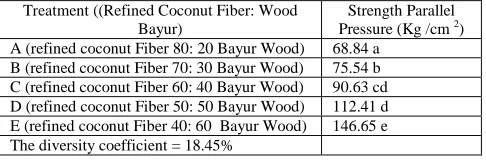
Based on the analysis of variance showed that the difference in the percentage of usage of wood particles bayur significant effect parallel surface pressure strength of particle board surface. Average strength equal pressure on each surface treatment can be seen in Table 8.
TABLE VIII
STRENGTH PRESS AVERAGE PARALLEL SURFACE (KG/CM2) PERCENTAGE LEVEL OF PARTICLE BOARD VARIOUS USES OF
WOOD PARTICLES FINE BAYUR WITH COCONUT FIBER (%) Treatment ((Refined Coconut Fiber: Wood
Bayur)
Strength Parallel Pressure (Kg /cm 2)
The numbers in the same column followed by the same lowercase different not significant at 5% level according to the Multiple Duncan'new Ranger Test
Strength values parallel to the surface pressure of particle board obtained ranged between 68,84kg/cm 2 until 146,65kg/cm2 with a 18.45% coefficient of variability Indonesian standards do not require the value of persistence press parallel surfaces. The higher use of wood particles bayur then press the firmness values parallel the surface tends to rise. Firmness press is a force parallel to the surface of the particle board to deny a burden.
CONCLUSIONS
Based on the research that has been done can be concluded as follows: Utilization of wood particles bayur as the outer layer of the three layer particle board at different percentages of different-significant effect on water content, water absorption, expansion of thick, density, strength fractures, internal bonding, surface strength parallel pressure.
Particle board with a percentage of refine coconut fiber : bayur wood particles (40: 60) is the best particle board where the water content of 6.11% water absorption 20, 56%. Expansion of thick 10.93%. Density of 0.84%; 303.76 kg/cm2 broken strength, strength internal bonding 56.90 kg/cm2 kg/cm2 parallel to the surface of 146.65 kg/cm2.
Triple particle board with wood particles bayur the outer layer with a smooth coconut fiber on the inner lining has met the standard of SNI 03-2105-2006.
The numbers of observations of physical and mechanical properties of particle board seen that the water content, and strength broken, parallel pressure, and internal bonding strength of SNI 03-2105-2006 standards for particle board, while for water absorption and thickness expansion board particles are not required.
V.SUGESTION
Based on the research that has been conducted hasi it can be some suggestions as follows: Strength broken boards to get smaller particles it is advisable to reduce the concentration of wear particles of wood adhesives and more subtle.
Using Bayur wood particle board with a good percentage of the coconut husk is (40% to 60%) because it is optimal. To continue this research by adding an optimal adhesive for outer layer and for the addition of a helper like paraffin.
ACKNOWLEDGMENTS
Thanks to Supardi who helped research and to the leadership of the Faculty of Agriculture Technology, Andalas University Indonesia has provided funds so that research can be done.
REFERENCES
[1] Anonymous, 2012a, http, / Wiki Pedia, December 21, 2012 org / wiki /Bayur
[2] Anonymous, 2012b, http/www/jakarta.go.id/jakvI/ encyclo-pedia/detai/128Industri, Coir Fiber Coconut Posted on 09 February 2012.
[3] Forestry Derpertemen 1990. Atlas of Wood. Volume Three Wood Bayur. 2004
[4] Dumanauw, J, K. , 1994. Knowing to Wood. The Fifth Prints. Kanisius. Yokyakarta.
[5] Djalal, M. 1986. Technology Wood Panels. Faculty of Agriculture, Andalas. Padang.
[6] Haygreen, J. G.dan Bowyer. J.L. , 1989. Forestry Products and Wood Science. An Introduction. Translated by Sutjipto A, Hadikusumo. Gajah Mada University Process. Yogyakarta p. 275-284.
[7] Kasim A. 1991. Employment Student Handbook (BKPM) subjects teknoogi Forest Products. UNAND. Padang.
[8] Kollman, Franz, F. P, AEW Edward W. Kuenzi, and Alfrad J.Stamn.,1997. Principles of Wood Science and Tecknology. Volume II. Wood-Based Materials. Springer Verlag Berlin Heidenberg. New York.
[9] Massijaja, M.Y,. Hadi, Y.S, Tambunan, B,. Bakar, ES and Sunarmi, I. 1999. Study Making Particle Board of Wood And Plastic Waste Polystyrene. Results of Forest Products Technology Journal 12 (2). This 31-43.
[10] Novizar.1988. Effect of Adhesives and Giving Levels Of Skin Stem Sifaf of Wood Particle Board Tusam (Pinus Merkusi Jung et de vries) [thesis]. Faperta UNAND. Padang. Page 23.
[11] Prayitno. TA, and Darmoko 1994 Carateristic Particle Board From Oil Palm Tree. News 2 Research center (3) This 217-219.
[12] Rizal, S. 2002. Evaluation of Industrial Waste Treatment Skin Oil to Produce Call in West Sumatra (Thesis) Post Graduate Andalas Padang.
[13] Indonesian National Standard 2006 Particle Board (SNI 03-2105-2006) National Standards Council.
[14] Suryadi, 2010. Influence of Particle Usage Percentage Surian Wood Particle Board For Outer Layer of Coconut Fiber To The Physical Properties and Mechanical. Thesis Faculty of Agricultural Technology.