International Journal of Engineering
J o u r n a l H o m e p a g e : w w w . i j e . i rParameter Estimation of Loranz Chaotic Dynamic System Using Bees Algorithm
R. Gholipoura, A. Khosravi a, H. Mojallali* b
a Faculty of Electrical and Computer Engineering, Babol University of Technology, P.O. Box 47135-484, Babol, Iran b Electrical Enbineering Department, Faculty of Engineering, University of Guilan, P.O. Box 3756, Rasht, Iran
P A P E R I N F O
Paper history: Received 10 August 2012
Accepted in revised form 13 December 2012
Keywords: Loranz Chaotic System Parameter Estimation Bees Algorithm Mean Squared Errors
A B S T R A C T
An important problem in nonlinear science is estimation of unknown parameters in Loranz chaotic system. Clearly, the parameter estimation for chaotic systems is a multidimensional continuous optimization problem, where the optimization goal is to minimize mean squared errors (MSEs) between real and estimated responses for a number of given samples. The Bees algorithm (BA) is a new member of meta-heuristics. BA tries to model natural behavior of honey bees in food foraging. This paper focuses on using the BA to solve this problem. Simulation resultsdemonstrate the merit, effectiveness and robustness of BA.
doi:10.5829/idosi.ije.2013.26.03c.05
1. INTRODUCTION1
The synchronization and control of chaotic systems have been investigated intensely in various fields in recent years [1-3]. Many of the proposed approaches only work under the assumption that the parameters of chaotic systems are known in advance. In the real world, the parameters may be difficult to determine owing to the complexity of chaotic systems. Therefore, parameter estimation for chaotic systems has become a hot topic in the past decade [4-8].
The least-squares method is a basic technique often used for parameters estimation. It has been successfully used to estimate the parameters in both static and dynamic systems [9]. But, the least-squares method is only suitable for the model structure of systems having linear parameters. Once the form of model structure is not linear in the parameters, this approach may be invalid. Heuristic algorithms, especially with stochastic search techniques seem to be a more promising approach and provide a powerful means to solve this problem. They seem to be a promising alternative to traditional techniques, since: 1) the objective function's gradient is not required, 2) they are not sensitive to starting point, and 3) they usually do not get stuck into so called local optima.
*Corresponding Author Email: [email protected] (H. Mojallali)
A relatively new branch of nature-inspired algorithms which are called as swarm intelligence is focused on insect behavior in order to develop some effective meta-heuristics which can mimic insect’s problem solving abilities. Interaction between insects contributes to the collective intelligence of the social insect colonies. These communication systems between insects have been adapted to scientific problems for optimization. One example of such interactive behavior is the waggle dance of bees during the food procurement. By performing this dance, successful foragers share the information about the direction and distance to patches of flower and the amount of nectar within this flower with their hive mates. This is a successful mechanism which foragers can recruit other bees in their colony to productive locations to collect various resources. Bee colony can quickly and precisely adjust its searching pattern in time and space according to changing nectar sources.
The information exchange among individual insects is the most important part of the collective knowledge. Communication among bees about the quality of food sources is being achieved in the dancing area by performing waggle dance. The previous studies on dancing behavior of bees show that while performing the waggle dance, the direction of bees indicates the direction of the food source in relation to the Sun, the intensity of the waggles indicates how far away it is and the duration of the dance indicates the amount of nectar
R. Gholipour et al. /IJE TRANSACTIONS C: Aspects Vol. 26, No. 3, (March 2013) 257-262 258
on related food source. Waggle dancing bees that have been in the hive for an extended time adjust the angles of their dances to accommodate the changing direction of the sun. Therefore, bees that follow the waggle run of the dance are still correctly led to the food source even though its angle relative to the sun has changed. So collective intelligence of bees is based on the synergistic
information exchange during waggle dance.
Observations and studies on honey bee behaviors resulted in a new generation of optimization algorithms [10]. Such an algorithm which is known as Bees Algorithm (BA) is used in this paper in order to estimate the Loranz chaotic system parameters.
The remainder of this paper is organized as follows. The parameter estimation is formulated as a multi-dimensional optimization problem in Section 2. In section 3, Bees Algorithm is described. Simulation results are presented in section 4. Finally, conclusion is reported in Section 5.
2. NONLINEAR SYSTEM ESTIMATION
If we do not have a priori knowledge about the real system, then structure identification becomes a difficult problem and we have to select the structure by trial and error. Fortunately, we know a great deal about the structures of most engineering systems and industrial processes; usually it is possible to derive a specific class of models that can best describe the real system. As a result, the system identification problem is usually reduced to that of parameter estimation.
In order to explore the problem of parameter estimation in this paper, the following n-dimensional nonlinear system is considered:
0 ( , , )
X&=F X X q (1)
where X =[ ,x x1 2,...,xn]T ÎRn is the state vector, X0
denotes the initial state, q=[ ,q q1 2,...,qn]T ÎRm is the unknown parameters vector and F R: n´Rm ®Rn is a given nonlinear vector function. In order to estimate the unknown parameters in Equation (1), an estimated model is defined below:
0 ˆ ( ˆ, , )ˆ
X& =F X X q (2)
where Xˆ =[ ,x xˆ ˆ1 2,...,xˆn]TÎRn and ˆ [ , ,..., ]ˆ ˆ1 2 ˆ
T m
n
q q q= q ÎR are
the estimated state vector and the estimated parameter vector, respectively.
Since heuristic algorithms depend only on the objective function to guide the search, it must be defined before these algorithms are initialized. In this paper, the mean squared errors (MSEs) between real and estimated responses for a number of given samples are considered as fitness of estimated model parameters. Hence, the objective function is chosen as follows:
[
]
22
1 1
1 1 ˆ
( ) ( )
N N
k K
MSE e X k X k
N = N =
= å = å - (3)
where N is the sampling number and X k( )and X kˆ ( )
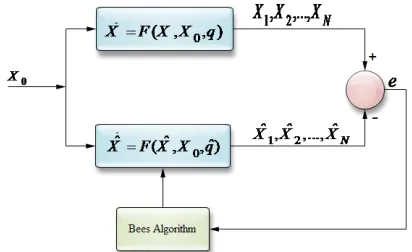
are real and estimated values at time k , respectively. The contribution of this paper is to apply the Bees Algorithm to minimizing the MSE value such that the actual nonlinear system parameters are accurately estimated. Figure 1 presents a block diagram of nonlinear system parameter estimation. Considering Figure 1, the initial state is given to both the real system and the estimated model. Then, outputs from the real system and its estimated model are input to the optimization algorithm, where the objective function (MSE ) will be calculated.
Owing to the unstable dynamic behavior of chaotic systems, the parameters are not easy to obtain. In addition, there are often multiple variables in the problem and multiple local optima in the landscape of
MSE , so traditional optimization methods can easily be trapped in local optima and it is difficult to achieve the global optimal parameters. Here, the Bees Algorithm method will be adopted to overcome these drawbacks.
3. BEES ALGORITHM
3. 1. Bees in Nature A colony of honey bees can extend itself over long distances (more than 10 km) and in multiple directions simultaneously to exploit a large number of food sources [11, 12]. A colony prospers by deploying its foragers to good fields. In principle, flower patches with plentiful amounts of nectar or pollen that can be collected with less effort should be visited by more bees, whereas patches with less nectar or pollen should receive fewer bees [13, 14]. The foraging process begins in a colony by scout bees being sent to search for promising flower patches. Scout bees move randomly from one patch to another. During the
harvesting season, a colony continues its exploration, keeping a percentage of the population as scout bees [11]. When they return to the hive, those scout bees that found a patch which is rated above a certain quality threshold (measured as a combination of some constituents, such as sugar content) deposit their nectar or pollen and go to the “dance floor” to perform a dance known as the “waggle dance” [11]. This mysterious dance is essential for colony communication, and contains three pieces of information regarding a flower patch: the direction in which it will be found, its distance from the hive and its quality rating (or fitness) [11, 14]. This information helps the colony to send its bees to flower patches precisely, without using guides or maps. Each individual’s knowledge of the outside environment is gleaned solely from the waggle dance. This dance enables the colony to evaluate the relative merit of different patches according to both the quality of the food they provide and the amount of energy needed to harvest it [13]. After waggle dancing on the dance floor, the dancer (i.e. the scout bee) goes back to the flower patch with follower bees that were waiting inside the hive. More follower bees are sent to more promising patches. This allows the colony to gather food quickly and efficiently. While harvesting from a patch, the bees monitor its food level. This is necessary to decide upon the next waggle dance when they return to the hive [14]. If the patch is still good enough as a food source, then it will be advertised in the waggle dance and more bees will be recruited to that source.
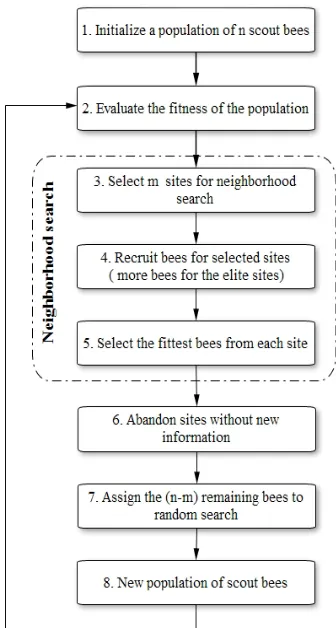
3. 2. The Basic Bees Algorithm This section summarizes the main steps of the Bees Algorithm. Figure 2 shows the pseudo code for the algorithm in its simplest form. As detailed in some articles [15, 16], the algorithm requires a number of parameters to be set, namely: number of scout bees (n), number of sites selected for exploitation out of n visited sites (m), number of top-rated (elite) sites among the m selected sites (e), number of bees recruited for the best e sites (nep), number of bees recruited for the other (m e- ) selected sites (nsp), initial size of each patch (a patch is a region in search space that includes a visited site and its neighborhood) and stopping criterion.
The algorithm starts with the n scout bees being placed randomly in the search space. The fitnesses of the sites visited by the scout bees are evaluated in step 2. In step 3, the m sites with the highest fitnesses are designated “selected sites” and chosen for neighborhood search. In steps 4 and 5, the algorithm conducts searches in the neighborhood of the selected sites, assigning more bees to the best e sites. Selection of the best sites can be made directly according to the fitnesses associated with them. Alternatively, fitness values can be used to determine the probability of sites being
selected. Searches in the neighborhood of the best e
sites which represent the most promising solutions are made more detailed by recruiting more bees for them than for the other selected sites. Together with scouting, this differential recruitment is a key operation of the Bees Algorithm. In step 5, for each patch, only the one bee that has found the site with the highest fitness (the “fittest” bee) will be selected to form part of the next bee population. In steps 6-8, the remaining bees in the population are assigned randomly around the search space scouting for new potential solutions. These steps are repeated until a stopping criterion is met. At the end of each iteration, the colony will have two parts to its new population – representatives from each selected patch and other scout bees assigned to conduct random searches.
4. SIMULATION RESULTS
A chaotic system is a nonlinear deterministic system and its prominent characteristic is the sensitive dependence on initial conditions. Due to the complexity and unpredictable behavior of chaotic systems it is difficult to determine parameters of these systems.
R. Gholipour et al. /IJE TRANSACTIONS C: Aspects Vol. 26, No. 3, (March 2013) 257-262 260
So, a Loranz system which is a known chaotic system is considered to show the performance of the Bees algorithm in parameter estimation of chaotic nonlinear systems. The mathematical description of the Loranz system is as follows:
1 1 2 1
2 2 1 2 1 3
3 1 2 3 3
( )
x q x x x q x x x x x x x q x
=
-= -
-= +
ì ï í ïî
&
& &
(4)
where q1=10, q2=28, and q3=2.6667 are the original parameters. The searching ranges are set as follows:
1
5£q £15, 20£q2£30, and 0£q3£5. In the Loranz system (Equation 4), three-dimensional parameters are unknown and need to be estimated.
According to Equation (3), in this case, the objective function is chosen as:
2
1 1
1
2 2
2 2 3 3
1 ˆ
[ ( ) ( )]
ˆ ˆ
[ ( ) ( )] [ ( ) ( )] [
] N
K
MSE X k X k
N
X k X k X k X k
=
å +
=
-- +
-(5)
where N is the sampling number and X k( )and X kˆ ( ) are real and estimated values at time k , respectively.
The parameters of the Bees Algorithm are set as shown in Table 1. The sampling time and sampling number (N ) in this simulation are 0.01 and 1000,
respectively.
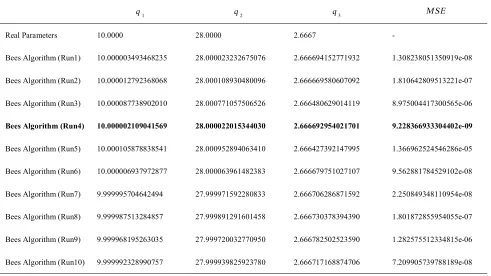
Table 2lists estimated parameters obtained by BA, when algorithm is implemented 10 times independently. From Table 2, it can be seen that all of the estimated parameters obtained by BA are very close to the true values in all experiments. It can be seen from Table 2 that experiment 4 is able to generate better solutions than other runs for parameter estimation of Loranz system. Figures 3-9 show results obtained by this run.
Figures 3–5depict the great success of optimization process by using Bees algorithm for the identified parameters q1, q2, and q3, respectively.
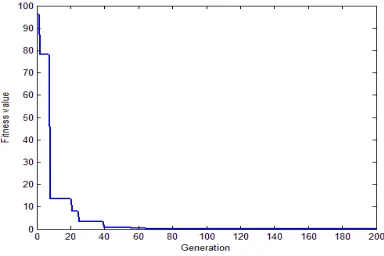
Moreover, the convergence of the optimal MSE at each generation is plotted in Figure 6. It confirms the superiority of Bees Algorithm in terms of convergence speed without the premature convergence problem.
Figures 7-9 show the observed time response of the model with estimated parameters. The synchronization of the model response with that of the actual system is clearly evident.
TABLE 1. Bees Algorithm parameters
n m e nep nsp ngh Maximum generation
100 15 5 30 20 0.01 200
TABLE 2. Estimated parameters obtained using Bees Algorithm
1
q q2 q3 MSE
Real Parameters 10.0000 28.0000 2.6667 -
Bees Algorithm (Run1) 10.000003493468235 28.000023232675076 2.666694152771932 1.308238051350919e-08
Bees Algorithm (Run2) 10.000012792368068 28.000108930480096 2.666669580607092 1.810642809513221e-07
Bees Algorithm (Run3) 10.000087738902010 28.000771057506526 2.666480629014119 8.975004417300565e-06
Bees Algorithm (Run4) 10.000002109041569 28.000022015344030 2.666692954021701 9.228366933304402e-09
Bees Algorithm (Run5) 10.000105878838541 28.000952894063410 2.666427392147995 1.366962524546286e-05
Bees Algorithm (Run6) 10.000006937972877 28.000063961482383 2.666679751027107 9.562881784529102e-08
Bees Algorithm (Run7) 9.999995704642494 27.999971592280833 2.666706286871592 2.250849348110954e-08
Bees Algorithm (Run8) 9.999987513284857 27.999891291601458 2.666730378394390 1.801872855954055e-07
Bees Algorithm (Run9) 9.999968195263035 27.999720032770950 2.666782502523590 1.282575512334815e-06
Figure 3. The convergence process of q1 of Loranz system
Figure 4. The convergence process of q2 of Loranz system
Figure 5. The convergence process of q3 of Loranz system
Figure 6. The convergence process of fitness value
Figure 7. Actual and estimated responses of X1 in Equation (4)
Figure 8. Actual and estimated responses of X2 in Equation
(4)
Figure 9. Actual and estimated responses of X3 in Equation (4)
5. CONCLUDING REMARKS
R. Gholipour et al. /IJE TRANSACTIONS C: Aspects Vol. 26, No. 3, (March 2013) 257-262 262
6. REFERENCES
1. Lu, Z., Shieh, L. S. and Chen, G. R., "On robust control of uncertain chaotic systems: a sliding-mode synthesis via chaotic optimization", Chaos, Solitons & Fractals, Vol. 18, No. 4, (2003), 819-827.
2. Yang, S. and Duan, C., "Generalized synchronization in chaotic systems", Chaos, Solitons & Fractals, Vol. 9, No. 10, (1998), 1703-1707.
3. Elabbasy, E., Agiza, H. and El-Dessoky, M., "Global synchronization criterion and adaptive synchronization for new chaotic system", Chaos, Solitons & Fractals, Vol. 23, No. 4, (2005), 1299-1309.
4. Saha, P., Banerjee, S. and Roy Chowdhury, A., "Chaos, signal communication and parameter estimation", Physics Letters A, Vol. 326, No. 1, (2004), 133-139.
5. Alvarez, G., Montoya, F., Romera, M. and Pastor, G., "Cryptanalysis of an ergodic chaotic cipher", Physics Letters A, Vol. 311, No. 2, (2003), 172-179.
6. Wu, X., Hu, H. and Zhang, B., "Parameter estimation only from the symbolic sequences generated by chaos system", Chaos, Solitons & Fractals, Vol. 22, No. 2, (2004), 359-366.
7. Xu, D. and Lu, F., "An approach of parameter estimation for non-synchronous systems", Chaos, Solitons & Fractals, Vol. 25, No. 2, (2005), 361-366.
8. Gu, M., Kalaba, R. E. and Taylor, G. A., "Obtaining initial parameter estimates for chaotic dynamical systems using linear associative memories", Applied Mathematics and Computation, Vol. 76, No. 2, (1996), 143-159.
9. Astrom, K. J. and Wittenmark, B., "Adaptive control", Addison-Wesley Longman Publishing Co., Inc., (1994).
10. Ozbakir, L., Baykasoglu, A. and Tapkan, P., "Bees algorithm for generalized assignment problem", Applied Mathematics and Computation, Vol. 215, No. 11, (2010), 3782-3795.
11. Von Frisch, K., "Bees: their vision, chemical senses, and language", Cornell University Press, N.Y., Ithaca, (1950). 12. Seeley, T. D., "The wisdom of the hive: the social physiology of
honey bee colonies", Harvard University Press, (1995). 13. Bonabeau, E., Dorigo, M. and Theraulaz, G., "Swarm
intelligence: from natural to artificial systems", Oxford University Press, USA, (1999).
14. Camazine, S., Deneubourg, J. L., Franks, N. R., Sneyd, J., Theraula, G., and Bonabeau, E., "Self-organization in biological systems", Princeton University Press, (2003).
15. Pham, D., Ghanbarzadeh, A., Koc, E., Otri, S., Rahim, S., and Zaidi, M., "The bees algorithm–a novel tool for complex optimisation problems", in Proceedings of IPROMS 2006 conference, (2006), 454-461.
16. Pham, D., Ghanbarzadeh, A., Koc, E., Otri, S., Rahim, S., and Zaidi, M., "The bees algorithm. Technical note", Manufacturing Engineering Centre, Cardiff University, UK, (2005).
Parameter Estimation of Loranz Chaotic Dynamic System Using Bees Algorithm
R. Gholipoura, A. Khosravi a, H. Mojallali b
a Faculty of Electrical and Computer Engineering, Babol University of Technology, P.O. Box 47135-484, Babol, Iran b Electrical Engineering Department, Faculty of Engineering, University of Guilan, P.O. Box 3756, Rasht, Iran
P A P E R I N F O
Paper history: Received 10 August 2012
Accepted in revised form 13 December 2012
Keywords: Loranz Chaotic System Parameter Estimation Bees Algorithm Mean Squared Errors
هﺪﯿﮑﭼ
ﺮﯿﻏ ﻢﻠﻋ رد ﻢﻬﻣ ﻪﻠﺌﺴﻣ ﮏﯾ ﺖﺳا ﺰﻧرﻮﻟ ﯽﺑﻮﺷآ ﻢﺘﺴﯿﺳ رد ﻪﺘﺧﺎﻨﺷﺎﻧ يﺎﻫﺮﺘﻣارﺎﭘ ﻦﯿﻤﺨﺗ ،ﯽﻄﺧ
.
ياﺮﺑ ﺮﺘﻣارﺎﭘ ﻦﯿﻤﺨﺗ
ﻢﺘﺴﯿﺳ ﻪﻠﺌﺴﻣﮏﯾﯽﺑﻮﺷآيﺎﻫ ي
ﻪﺘﺳﻮﯿﭘيزﺎﺳﻪﻨﯿﻬﺑ ﯾﺪﻌﺑﺪﻨﭼي
ﻬﺑفﺪﻫﻪﮐﺖﺴ ،يزﺎﺳﻪﻨﯿ
ندﺮﮐﻪﻨﯿﻤﮐ تﺎﻌﺑﺮﻣﻦﯿﮕﻧﺎﯿﻣ
ﺦﺳﺎﭘﻦﯿﺑيﺎﻄﺧ ﻬﻧﻮﻤﻧزاداﺪﻌﺗﮏﯾياﺮﺑﯽﻨﯿﻤﺨﺗوﯽﻌﻗاويﺎﻫ
ﺖﺳاهﺪﺷهداديﺎﻬ
.
ﺪﯾﺪﺟﻮﻀﻋﮏﯾﻞﺴﻋرﻮﺒﻧزﻢﺘﯾرﻮﮕﻟا
ﻢﺘﯾرﻮﮕﻟازا يﺎﻫ اﺮﻓ ﯾرﺎﮑﺘﺑا ﺖﺴ
.
رد ﯽﻌﺳرﻮﺒﻧزﻢﺘﯾرﻮﮕﻟا ﻧدﺮﮐلﺪﻣﺮﺑ
ﺎﻫرﻮﺒﻧزﯽﻌﯿﺒﻃرﺎﺘﻓﺮ ﻞﺴﻋي
اﺬﻏيﻮﺠﺘﺴﺟرد ﺖﺳ
.
ﯽﻣﺰﮐﺮﻤﺗﻪﻠﺌﺴﻣﻦﯾاﻞﺣياﺮﺑرﻮﺒﻧزﻢﺘﯾرﻮﮕﻟازاهدﺎﻔﺘﺳايورﻪﻟﺎﻘﻣﻦﯾا ﺪﻧ
.
وﯽﯾارﺎﮐ،ﯽﮕﺘﺴﯾﺎﺷيزﺎﺳﻪﯿﺒﺷﺞﯾﺎﺘﻧ ﺖﺑﻼﺻ
ﯽﻣنﺎﺸﻧاررﻮﺒﻧزﻢﺘﯾرﻮﮕﻟا ﺪﻫد
.