VOLUME NO.6(2016),ISSUE NO.11(
NOVEMBER
) ISSN2231-5756A Monthly Double-Blind Peer Reviewed (Refereed/Juried) Open Access International e-Journal - Included in the International Serial Directories
Indexed & Listed at:
Ulrich's Periodicals Directory ©, ProQuest, U.S.A., EBSCO Publishing, U.S.A., Cabell’s Directories of Publishing Opportunities, U.S.A., Google Scholar, Open J-Gage, India [link of the same is duly available at Inflibnet of University Grants Commission (U.G.C.)],
Index Copernicus Publishers Panel, Poland with IC Value of 5.09 & number of libraries all around the world.
Circulated all over the world & Google has verified that scholars of more than 5000 Cities in 187 countries/territories are visiting our journal on regular basis.
VOLUME NO.6(2016),ISSUE NO.11(
NOVEMBER
) ISSN2231-5756INTERNATIONAL JOURNAL OF RESEARCH IN COMMERCE, IT & MANAGEMENT
CONTENTS
Sr.
No.
TITLE & NAME OF THE AUTHOR (S)
Page
No.
1
.
PREPARATION AND ANALYSIS OF VALUE ADDED STATEMENT OF VISAKHAPATNAM PORT TRUST
ARUNA POLISETTY & SHEELA.P
1
2
.
A STUDY ON CONSUMER PREFERENCE TOWARDS SAKTHI MILK WITH SPECIAL REFERENCE TO
COIMBATORE CITY
M. DEVARAJAN & S. KIRTHIKA
8
3
.
EMPOWERING HEALTH SECTOR THROUGH DIGITAL INDIA INITIATIVES
CHINNASAMY. V
10
4
.
COACHING: TRY FEEDFORWARD INSTEAD FEEDBACK FOR LEADERSHIP PERFORMANCE
C. NIKHILA REDDY, JYOTI ADHIKARI & DR. RAVINDER KAUR
14
5
.
ROLE OF LOGISTICS IN BUILDING CUSTOMER SATISFACTION
DR. S. SUDHA
17
6
.
INFORMATION TECHNOLOGY ENABLED SERVICES IN PROMOTING SERVICES MARKETING
GUDDATI ARCHANA
20
7
.
INTEGRATED MARKETING COMMUNICATION IN HEALTHCARE & BRAND BUILDING
K. SRIKANTH & DR. SAPNA SINGH
22
8
.
A REVIEW OF LITERATURE ON EMOTIONAL STABILITY AND WORK LIFE BALANCE OF EMPLOYEES OF
TEXTILE INDUSTRY IN MADHYA PRADESH
NEHA SOMANI & DR. SANDEEP MALU
26
9
.
A STUDY ON CUSTOMER SATISFACTION ON INTERNET BANKING SERVICES: AN EVALUATION
DR. J. RAMOLA PREMALATHA & V. BHARATHKUMAR
29
10
.
THE ROLE OF FOREIGN DIRECT INVESTMENT IN THE IRAQI ECONOMY
HIKMAT SALMAN KHUDHAIR
33
11
.
FOOD SECURITY IN IGAD COUNTRIES: UNFINISHED AGENDA OR UNATTAINABLE GOAL?
MELAKE TEWOLDE
39
12
.
CASH CONVERSION CYCLE AND FIRM PROFITABILITY IN CEMENT MANUFACTURING SECTOR IN
TELANGANA STATE-INDIA
P LAKSHMI NARASA REDDY
47
13
.
THEORIES AND PRACTICES OF CORPORATE GOVERNANCE
SREEJA NAIR
50
14
.
PROBLEMS ASSOCIATED WITH STUDENTS’ PERSISTENCE IN BUSINESS APPRENTICESHIP TRAINING
CENTRES (BATCs): IMPLICATIONS FOR VOCATIONAL TRADE DEVELOPMENT IN KADUNA STATE,
NIGERIA
IBRAHIM SHITTU KAILANI
53
15
.
THE CAUSES OF PRIMARY AGRICULTURAL CREDIT SOCIETIES’ OVERDUES IN ANDHRA PRADESH: A
STUDY OF WEST GODAVARI DISTRICT
DR. K. SUDHAKARA RAO
63
16
.
U-COMMERCE OPPORTUNITIES & CHALLENGES
SREEJA.E.S
68
17
.
ORGANIZATION AND MANAGEMENT OF OLD AGE HOMES IN INDIA, WITH SPECIAL REFERENCE TO
MYSURU CITY IN KARNATAKA
DIVYA M & VIDYA D AVADHANI
71
18
.
A STUDY ON CONSUMER’S PERCEPTION ON MOBILE BANKING IN INDIA
AMALKUMAR.P
76
19
.
A CASE STUDY REGARDING NOT USING CREDIT CARD BY PEOPLE OF TINSUKIA DISTRICT
DR. NARENDRA KUMAR
79
20
.
IMPACT OF MGNREGA ON RURAL WOMEN: A STUDY OF MANDI DISTRICT OF HIMACHAL PRADESH
KHEM RAJ
85
VOLUME NO.6(2016),ISSUE NO.11(
NOVEMBER
) ISSN2231-5756INTERNATIONAL JOURNAL OF RESEARCH IN COMMERCE, IT & MANAGEMENT
CHIEF PATRON
PROF. K. K. AGGARWAL
Chairman, Malaviya National Institute of Technology, Jaipur
(An institute of National Importance & fully funded by Ministry of Human Resource Development, Government of India)
Chancellor, K. R. Mangalam University, Gurgaon
Chancellor, Lingaya’s University, Faridabad
Founder Vice-Chancellor (1998-2008), Guru Gobind Singh Indraprastha University, Delhi
Ex. Pro Vice-Chancellor, Guru Jambheshwar University, Hisar
FOUNDER PATRON
LATE SH. RAM BHAJAN AGGARWAL
Former State Minister for Home & Tourism, Government of Haryana
Former Vice-President, Dadri Education Society, Charkhi Dadri
Former President, Chinar Syntex Ltd. (Textile Mills), Bhiwani
FORMER CO-ORDINATOR
DR. S. GARG
Faculty, Shree Ram Institute of Business & Management, Urjani
ADVISORS
PROF. M. S. SENAM RAJU
Director A. C. D., School of Management Studies, I.G.N.O.U., New Delhi
PROF. M. N. SHARMA
Chairman, M.B.A., Haryana College of Technology & Management, Kaithal
PROF. S. L. MAHANDRU
Principal (Retd.), Maharaja Agrasen College, Jagadhri
EDITOR
PROF. R. K. SHARMA
Professor, Bharti Vidyapeeth University Institute of Management & Research, New Delhi
CO-EDITOR
DR. BHAVET
Faculty, Shree Ram Institute of Engineering & Technology, Urjani
EDITORIAL ADVISORY BOARD
DR. RAJESH MODI
Faculty, Yanbu Industrial College, Kingdom of Saudi Arabia
PROF. SANJIV MITTAL
University School of Management Studies, Guru Gobind Singh I. P. University, Delhi
PROF. ANIL K. SAINI
Chairperson (CRC), Guru Gobind Singh I. P. University, Delhi
DR. SAMBHAVNA
VOLUME NO.6(2016),ISSUE NO.11(
NOVEMBER
) ISSN2231-5756INTERNATIONAL JOURNAL OF RESEARCH IN COMMERCE, IT & MANAGEMENT
DR. MOHENDER KUMAR GUPTA
Associate Professor, P. J. L. N. Government College, Faridabad
DR. SHIVAKUMAR DEENE
Asst. Professor, Dept. of Commerce, School of Business Studies, Central University of Karnataka, Gulbarga
ASSOCIATE EDITORS
PROF. NAWAB ALI KHAN
Department of Commerce, Aligarh Muslim University, Aligarh, U.P.
PROF. ABHAY BANSAL
Head, Department of I.T., Amity School of Engineering & Technology, Amity University, Noida
PROF. A. SURYANARAYANA
Department of Business Management, Osmania University, Hyderabad
PROF. V. SELVAM
SSL, VIT University, Vellore
DR. PARDEEP AHLAWAT
Associate Professor, Institute of Management Studies & Research, Maharshi Dayanand University, Rohtak
DR. S. TABASSUM SULTANA
Associate Professor, Department of Business Management, Matrusri Institute of P.G. Studies, Hyderabad
SURJEET SINGH
Asst. Professor, Department of Computer Science, G. M. N. (P.G.) College, Ambala Cantt.
FORMER TECHNICAL ADVISOR
AMITA
Faculty, Government M. S., Mohali
FINANCIAL ADVISORS
DICKIN GOYAL
Advocate & Tax Adviser, Panchkula
NEENA
Investment Consultant, Chambaghat, Solan, Himachal Pradesh
LEGAL ADVISORS
JITENDER S. CHAHAL
Advocate, Punjab & Haryana High Court, Chandigarh U.T.
CHANDER BHUSHAN SHARMA
Advocate & Consultant, District Courts, Yamunanagar at Jagadhri
SUPERINTENDENT
VOLUME NO.6(2016),ISSUE NO.11(
NOVEMBER
) ISSN2231-5756INTERNATIONAL JOURNAL OF RESEARCH IN COMMERCE, IT & MANAGEMENT
CALL FOR MANUSCRIPTS
We invite unpublished novel, original, empirical and high quality research work pertaining to the recent developments & practices in the areas of Com-puter Science & Applications; Commerce; Business; Finance; Marketing; Human Resource Management; General Management; Banking; Economics; Tourism Administration & Management; Education; Law; Library & Information Science; Defence & Strategic Studies; Electronic Science; Corporate Gov-ernance; Industrial Relations; and emerging paradigms in allied subjects like Accounting; Accounting Information Systems; Accounting Theory & Practice; Auditing; Behavioral Accounting; Behavioral Economics; Corporate Finance; Cost Accounting; Econometrics; Economic Development; Economic History; Financial Institutions & Markets; Financial Services; Fiscal Policy; Government & Non Profit Accounting; Industrial Organization; International Economics & Trade; International Finance; Macro Economics; Micro Economics; Rural Economics; Co-operation; Demography: Development Planning; Development Studies; Applied Economics; Development Economics; Business Economics; Monetary Policy; Public Policy Economics; Real Estate; Regional Economics; Political Science; Continuing Education; Labour Welfare; Philosophy; Psychology; Sociology; Tax Accounting; Advertising & Promotion Management; Management Information Systems (MIS); Business Law; Public Responsibility & Ethics; Communication; Direct Marketing; E-Commerce; Global Business; Health Care Administration; Labour Relations & Human Resource Management; Marketing Research; Marketing Theory & Applications; Non-Profit Or-ganizations; Office Administration/Management; Operations Research/Statistics; Organizational Behavior & Theory; Organizational Development; Pro-duction/Operations; International Relations; Human Rights & Duties; Public Administration; Population Studies; Purchasing/Materials Management; Re-tailing; Sales/Selling; Services; Small Business Entrepreneurship; Strategic Management Policy; Technology/Innovation; Tourism & Hospitality; Transpor-tation Distribution; Algorithms; Artificial Intelligence; Compilers & Translation; Computer Aided Design (CAD); Computer Aided Manufacturing; Computer Graphics; Computer Organization & Architecture; Database Structures & Systems; Discrete Structures; Internet; Management Information Systems; Mod-eling & Simulation; Neural Systems/Neural Networks; Numerical Analysis/Scientific Computing; Object Oriented Programming; Operating Systems; Pro-gramming Languages; Robotics; Symbolic & Formal Logic; Web Design and emerging paradigms in allied subjects.
Anybody can submit the soft copy of unpublished novel; original; empirical and high quality research work/manuscript anytime in M.S. Word format after preparing the same as per our GUIDELINES FOR SUBMISSION; at our email address i.e. [email protected] or online by clicking the link online submission as given on our website (FOR ONLINE SUBMISSION, CLICK HERE).
GUIDELINES FOR SUBMISSION OF MANUSCRIPT
1. COVERING LETTER FOR SUBMISSION:
DATED: _____________
THE EDITOR
IJRCM
Subject: SUBMISSION OF MANUSCRIPT IN THE AREA OF .
(e.g. Finance/Mkt./HRM/General Mgt./Engineering/Economics/Computer/IT/ Education/Psychology/Law/Math/other, please specify)
DEAR SIR/MADAM
Please find my submission of manuscript titled ‘___________________________________________’ for likely publication in one of your journals.
I hereby affirm that the contents of this manuscript are original. Furthermore, it has neither been published anywhere in any language fully or partly, nor it is under review for publication elsewhere.
I affirm that all the co-authors of this manuscript have seen the submitted version of the manuscript and have agreed to inclusion of their names as co-authors.
Also, if my/our manuscript is accepted, I agree to comply with the formalities as given on the website of the journal. The Journal has discretion to publish our contribution in any of its journals.
NAME OF CORRESPONDING AUTHOR :
Designation/Post* :
Institution/College/University with full address & Pin Code :
Residential address with Pin Code :
Mobile Number (s) with country ISD code :
Is WhatsApp or Viber active on your above noted Mobile Number (Yes/No) :
Landline Number (s) with country ISD code :
E-mail Address :
Alternate E-mail Address :
Nationality :
* i.e. Alumnus (Male Alumni), Alumna (Female Alumni), Student, Research Scholar (M. Phil), Research Scholar (Ph. D.), JRF, Research Assistant, Assistant Lecturer, Lecturer, Senior Lecturer, Junior Assistant Professor, Assistant Professor, Senior Assistant Professor, Co-ordinator, Reader, Associate Profes-sor, ProfesProfes-sor, Head, Vice-Principal, Dy. Director, Principal, Director, Dean, President, Vice Chancellor, Industry Designation etc. The qualification of
VOLUME NO.6(2016),ISSUE NO.11(
NOVEMBER
) ISSN2231-5756INTERNATIONAL JOURNAL OF RESEARCH IN COMMERCE, IT & MANAGEMENT
NOTES:a) The whole manuscript has to be in ONE MS WORD FILE only, which will start from the covering letter, inside the manuscript. pdf.
version is liable to be rejected without any consideration.
b) The sender is required to mention the following in the SUBJECT COLUMN of the mail:
New Manuscript for Review in the area of (e.g. Finance/Marketing/HRM/General Mgt./Engineering/Economics/Computer/IT/ Education/Psychology/Law/Math/other, please specify)
c) There is no need to give any text in the body of the mail, except the cases where the author wishes to give any specific message w.r.t. to the manuscript.
d) The total size of the file containing the manuscript is expected to be below 1000 KB.
e) Only the Abstract will not be considered for review and the author is required to submit the complete manuscript in the first instance.
f) The journal gives acknowledgement w.r.t. the receipt of every email within twenty-four hours and in case of non-receipt of acknowledgment from the journal, w.r.t. the submission of the manuscript, within two days of its submission, the corresponding author is required to demand for the same by sending a separate mail to the journal.
g) The author (s) name or details should not appear anywhere on the body of the manuscript, except on the covering letter and the cover page of the manuscript, in the manner as mentioned in the guidelines.
2. MANUSCRIPT TITLE: The title of the paper should be typed in bold letters, centeredand fully capitalised.
3. AUTHOR NAME (S) & AFFILIATIONS: Author (s) name, designation, affiliation (s), address, mobile/landline number (s), and email/al-ternate email address should be given underneath the title.
4. ACKNOWLEDGMENTS: Acknowledgements can be given to reviewers, guides, funding institutions, etc., if any.
5. ABSTRACT: Abstract should be in fully Italic printing, ranging between 150 to 300 words. The abstract must be informative and eluci-dating the background, aims, methods, results & conclusion in a SINGLE PARA. Abbreviations must be mentioned in full.
6. KEYWORDS: Abstract must be followed by a list of keywords, subject to the maximum of five. These should be arranged in alphabetic order separated by commas and full stop at the end. All words of the keywords, including the first one should be in small letters, except special words e.g. name of the Countries, abbreviations etc.
7. JEL CODE: Provide the appropriate Journal of Economic Literature Classification System code (s). JEL codes are available at www.aea-web.org/econlit/jelCodes.php. However, mentioning of JEL Code is not mandatory.
8. MANUSCRIPT: Manuscript must be in BRITISH ENGLISH prepared on a standard A4 size PORTRAIT SETTING PAPER. It should be free from any errors i.e. grammatical, spelling or punctuation. It must be thoroughly edited at your end.
9. HEADINGS: All the headings must be bold-faced, aligned left and fully capitalised. Leave a blank line before each heading.
10. SUB-HEADINGS: All the sub-headings must be bold-faced, aligned left and fully capitalised.
11. MAIN TEXT:
THE MAIN TEXT SHOULD FOLLOW THE FOLLOWING SEQUENCE:
INTRODUCTION
REVIEW OF LITERATURE
NEED/IMPORTANCE OF THE STUDY
STATEMENT OF THE PROBLEM
OBJECTIVES
HYPOTHESIS (ES)
RESEARCH METHODOLOGY
RESULTS & DISCUSSION
FINDINGS
RECOMMENDATIONS/SUGGESTIONS
CONCLUSIONS
LIMITATIONS
SCOPE FOR FURTHER RESEARCH
REFERENCES
APPENDIX/ANNEXURE
VOLUME NO.6(2016),ISSUE NO.11(
NOVEMBER
) ISSN2231-5756INTERNATIONAL JOURNAL OF RESEARCH IN COMMERCE, IT & MANAGEMENT
12. FIGURES & TABLES: These should be simple, crystal CLEAR, centered, separately numbered & self-explained, and the titles must beabove the table/figure. Sources of data should be mentioned below the table/figure. It should be ensured that the tables/figures are referred to from the main text.
13. EQUATIONS/FORMULAE: These should be consecutively numbered in parenthesis, left aligned with equation/formulae number placed at the right. The equation editor provided with standard versions of Microsoft Word may be utilised. If any other equation editor is utilised, author must confirm that these equations may be viewed and edited in versions of Microsoft Office that does not have the editor.
14. ACRONYMS: These should not be used in the abstract. The use of acronyms is elsewhere is acceptable. Acronyms should be defined on its first use in each section e.g. Reserve Bank of India (RBI). Acronyms should be redefined on first use in subsequent sections.
15. REFERENCES: The list of all references should be alphabetically arranged. The author (s) should mention only the actually utilised references in the preparation of manuscript and they may follow Harvard Style of Referencing. Also check to ensure that everything that you are including in the reference section is duly cited in the paper. The author (s) are supposed to follow the references as per the following:
•
All works cited in the text (including sources for tables and figures) should be listed alphabetically.•
Use (ed.) for one editor, and (ed.s) for multiple editors.•
When listing two or more works by one author, use --- (20xx), such as after Kohl (1997), use --- (2001), etc., in chronologically ascending order.•
Indicate (opening and closing) page numbers for articles in journals and for chapters in books.•
The title of books and journals should be in italic printing. Double quotation marks are used for titles of journal articles, book chapters, dissertations, reports, working papers, unpublished material, etc.•
For titles in a language other than English, provide an English translation in parenthesis.•
Headers, footers, endnotes and footnotes should not be used in the document. However, you can mention short notes to elucidate some specific point, which may be placed in number orders before the references.PLEASE USE THE FOLLOWING FOR STYLE AND PUNCTUATION IN REFERENCES:
BOOKS
•
Bowersox, Donald J., Closs, David J., (1996), "Logistical Management." Tata McGraw, Hill, New Delhi.•
Hunker, H.L. and A.J. Wright (1963), "Factors of Industrial Location in Ohio" Ohio State University, Nigeria. CONTRIBUTIONS TO BOOKS•
Sharma T., Kwatra, G. (2008) Effectiveness of Social Advertising: A Study of Selected Campaigns, Corporate Social Responsibility, Edited by David Crowther & Nicholas Capaldi, Ashgate Research Companion to Corporate Social Responsibility, Chapter 15, pp 287-303.JOURNAL AND OTHER ARTICLES
•
Schemenner, R.W., Huber, J.C. and Cook, R.L. (1987), "Geographic Differences and the Location of New Manufacturing Facilities," Jour-nal of Urban Economics, Vol. 21, No. 1, pp. 83-104.CONFERENCE PAPERS
•
Garg, Sambhav (2011): "Business Ethics" Paper presented at the Annual International Conference for the All India Management Asso-ciation, New Delhi, India, 19–23UNPUBLISHED DISSERTATIONS
•
Kumar S. (2011): "Customer Value: A Comparative Study of Rural and Urban Customers," Thesis, Kurukshetra University, Kurukshetra. ONLINE RESOURCES•
Always indicate the date that the source was accessed, as online resources are frequently updated or removed. WEBSITESVOLUME NO.6(2016),ISSUE NO.11(
NOVEMBER
) ISSN2231-5756INTERNATIONAL JOURNAL OF RESEARCH IN COMMERCE, IT & MANAGEMENT
CASH CONVERSION CYCLE AND FIRM PROFITABILITY IN CEMENT MANUFACTURING SECTOR IN
TELANGANA STATE-INDIA
P LAKSHMI NARASA REDDY
ASST. PROFESSOR
ANNAMACHARYA INSTITUTE OF TECHNOLOGY & SCIENCES
VENKATAPURAM
ABSTRACT
Firm’s liquidity position is disclosed by the combination of current assets and current liabilities. Hence every company needs to maintain good amount of net current assets to meet its payments on time. The company liquidity position determines its ability to survive in the short term and of late many businesses have had critical financial problems regardless of posting profits in many cases. Manufacturing companies must have more current assets in the form of inventory which is considered as most valuable liquid asset in the firm. The purpose of this study is to establish the relationship between company’s liquidity, measured by the length of the cash conversion cycle, and its profitability, measured by return on investment. Using a correlation and regression test, the study used data from a sample of five cement manufacturing companies at Telangana from 2011 to 2015. The study finds that there is a positive relationship between the cash conversion cycle and the com-pany’s return on investment and return on equity, and it provides evidence that the cash conversion cycle, a measure of business liquidity which has an impact on a firm’s performance.
KEYWORDS
cash conversion cycle, return on investment, return on equity, profitability.
INTRODUCTION
orking capital may be regarded as the lifeblood of business. Working capital is of major importance to internal and external analysis of business because of its close relationship with the current day-to-day operations of a business. Every business needs funds for two purposes. Long term funds are required to create production facilities through purchase of fixed assets such as plants, machineries, lands, buildings & etc. Short term funds are required for the purchase of raw materials, payment of wages, and other day-to-day expenses. It is nothing but the difference between current assets and current liabilities. In this competitive word all companies goal is to obtain more profits and finally, to maximize shareholders’ wealth, so any decision about working capital has potential impact on company's profitability. One of the influential factors in working capital management is shortening the cash con-version cycle (CCC). It can help the protection of liquidity power of firms. Therefore, the purpose of this study is to investigate impact of cash conversion cycle on profitability of TELANGANA cement manufacturing sector in India
DEFINITION OF VARIABLES
Profitability is taken as dependent variable, whereas liquidity is taken as independent variable in the present study. The variable includes:
Inventory collection period (ICP)
It is a measure of how long a company ties its funds in the form of inventory or stock.
Receivable collection Period (RCP)
This variable measures how much time a firm takes to collect funds from its trade debtors.
Payment Deferral Period (PDP)
It measures the length of time in days the company defers payments to its suppliers and other creditors
Cash Conversion Cycle (CCC)
This liquidity variable states that how much time a firm will take to convert a raw material in to finished good and to make a sale and receive cash.
Current Ratio (CR) Quick Ratio (QR)
These two ratios asses the composition of current assets as a proportion of current liabilities.
Assets Turnover Ratio (ASTO)
This variable shows the level of business performance as measured by the Revenue generated from the total capital employed in the business.
Net Profit Margin (NPM)
This indicates the business “Operating Profit before Interest tax (PBIT) as a percentage of total revenue generated over a financial period.
Return on Equity (ROE)
This represents the profits attributable to equity shareholders of a company for a particular financial year.
Return on Investment (ROI)
This indicates one of the best measures of company performance in terms of profitability.
LITERATURE REVIEW
Earlier literature has explored different variables representing liquidity and its effect on profitability and examined the relationship of Accounts payable manage-ment, Accounts receivables managemanage-ment, inventory management and cash conversion cycle management with profitability managemanage-ment, providing with different results as per how the length of cash conversion cycle has been affecting profitability using different proxies for profitability.
Richards & Laughlin (1980) presented the idea of cash conversion cycle as a tool for measuring the liquidity management and performance of a company. Gentry et al. (1990) suggested that cash conversion cycle affects the market value of a firm. Lamberson (1991) suggested, during expansion in economics, liquidity in-creases to some extent by working capital management but there is no noticeable change seen during economic slowdown. Schilling (1996) proved that the increase in cash conversion cycle increases the minimum liquidity requirements of the business organizations and similarly decrease in cash conversion cycle decreases the minimum liquidity requirements of the business organizations.
Schilling (1996) stated that the optimal level liquidity position is obtained at minimized level of liquidity therefore the deployment of available resources in working capital in a way to attain and maintain optimal level of liquidity is mandatory, the study further set up the association of cash conversion cycle with the required minimal level of liquidity in a way that if at times cash conversion cycle increases the minimal level required for liquidity gets to upper levels; and if the cash conversion cycle decreases the minimal level required for liquidity moves down to lower levels. Shin & Soenen (1998) found significant impact of efficient cash cycle conversion management on profitability and liquidity of companies.
Lyroudi & Lazaridis (2000) argues that the company’s profitability depend son working capital management. Lyroudi and Lazaridis (2000) provided some evidence that cash conversion cycle significantly affects the liquidity of the company. Filbeck & Krueger (2003) investigated that there are some other factors that affect the working capital management like interest rate; if the interest rate rises it will make longer the cash cycle period. Deloof (2003) stated that for better performance the time duration for collection of receivable should be kept short. Nobanee et al. (2004) suggested that for better performance of company inventory must be converted into cash as early as possible. Eljelly (2004) found significantly inverse association and linkage between the profitability and the liquidity represented by
VOLUME NO.6(2016),ISSUE NO.11(
NOVEMBER
) ISSN2231-5756INTERNATIONAL JOURNAL OF RESEARCH IN COMMERCE, IT & MANAGEMENT
the cash conversion cycle. Padachi (2006) found that if the firm is invested higher in the inventories then the optimum level will diminish and profit will go down. Teruel & Solano (2007) explained that company’s profitability would be increased by reducing days in receivables, days in inventories and length of cash cycle. Hutchison et al. (2007) Observed significant association of cash conversion cycle with the return on investments of the companies.
STATEMENT OF THE PROBLEM
Many Researchers have found that cash conversion cycle has plays vital role in the success of any manufacturing Organizations. The business has to monitor the Management of cash conversion cycle constantly to maximize the profits. Thus keeping the importance of cash conversion cycle in view, the Present student has been carried out.
OBJECTIVE OF THE STUDY
To find out relationship between cash conversion cycle and Profitability of Cement Manufacturing Sector of Telangana State.
METHODOLOGY
The present study has conducted among five cement manufacturing companies in TELANGANA state. The companies have taken for the study purpose are: ACC cement ltd, Ambuja cements ltd, JK cements ltd, NCL Industries ltd and Decan cements ltd The data of five years {from 2011-2015} which is required for the analysis part was collected from the money control.com. The analysis part has carried out with the help of the following variables; cash conversion cycle, current ratio, quick ratio, return on investment return on equity and assets turnover ratio. Apart from these ratios, the study also used statistical tools like descriptive statistics, correlation analysis and regression statistics were used to derive results
.
FINDINGS AND ANALYSIS OF RESULTS
The relationship between cash conversion cycle and profitability is presented in the following section. First descriptive analysis is presented to check the association between liquidity variables and profitability. Further, regression analysis is used to see the effect of liquidity on profitability of the cement manufacturing sector in Talengana State.
DESCRIPTIVE STATISTICS
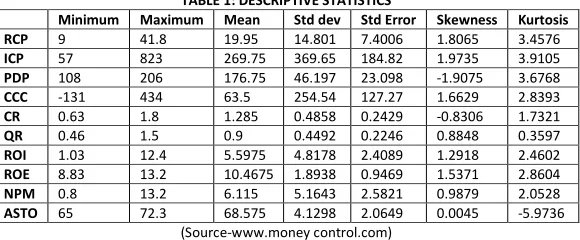
The bellow table shows the detailed descriptive statistics of variables of liquidity and profitability of Talengana cement manufacturing companies from 2011 to 2015. Return on investment, which is key among the profitability dependent variables ranges from 1.03 to 12.04 with a mean value of 5.59 and a standard deviation of 4.81. Another main explanatory variable is the cash conversion cycle with mean value of 63.5 and standard deviation of 254.54. Quick ratio is the second explanatory variable with a mean value of 0.09 and standard deviation of 0.45. receivables collection period is the another explanatory variable with a mean value of 19.5 and a standard deviation of 14.80. Inventory conversion period shows a mean value of 269.75 and a standard deviation of 369.65 and payment deferral period shows mean value of 176.75 and a standard deviation of 46.19.
TABLE 1: DESCRIPTIVE STATISTICS
Minimum Maximum Mean Std dev Std Error Skewness Kurtosis
RCP 9 41.8 19.95 14.801 7.4006 1.8065 3.4576
ICP 57 823 269.75 369.65 184.82 1.9735 3.9105
PDP 108 206 176.75 46.197 23.098 -1.9075 3.6768
CCC -131 434 63.5 254.54 127.27 1.6629 2.8393
CR 0.63 1.8 1.285 0.4858 0.2429 -0.8306 1.7321
QR 0.46 1.5 0.9 0.4492 0.2246 0.8848 0.3597
ROI 1.03 12.4 5.5975 4.8178 2.4089 1.2918 2.4602
ROE 8.83 13.2 10.4675 1.8938 0.9469 1.5371 2.8604
NPM 0.8 13.2 6.115 5.1643 2.5821 0.9879 2.0528
ASTO 65 72.3 68.575 4.1298 2.0649 0.0045 -5.9736
(Source-www.money control.com)
CORRELATION ANALYSIS
A correlation matrix of all the variables presented in the above table, which is included 25 observations. The table shows that Return on Investment is slightly positively associated with receivables collection period, but negatively associated with inventory conversion period, payables deferral period, cash conversion cycle, current ration, and quick ration.
The data reflects significant negative correlations between all liquidity variables and profitability variables. The table shows that negative correlation between Return on investment (-0.75) and inventory conversion period (-20), cash conversion cycle (-0.30), current ratio (-0.89), quick ratio (-0.79).
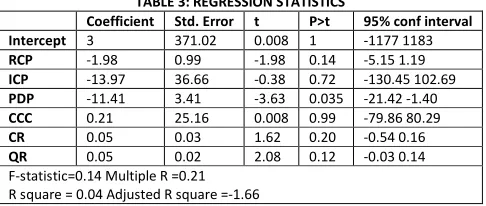
The relationship between Return on investment and cash conversion cycle was further tested using regression model where cash conversion cycle was used as an independent variable and return on investment as a dependent variable in the table 3 which shows the regression statistics.
The R and the R-square given in the table 3 are coefficient correlation, and coefficient of determination respectively. The value of R shown in the table 3 suggest that 0.21 correlation exists between dependent (Return on Investment) and liquidity independent variables (receivables collection period, inventory conversion period, payables deferral period, cash conversion cycle, current ratio and quick ratio) and the value of R square is 0.04 which shows that 4% variation in return on investment is a result the independent variables. The value of adjusted R-square which is 1.66 or 166% also shows the explanatory power of these variables in determining the return on investment after taking residual and error items.
The result from the correlation analysis in table 2 and the regression analysis in table 3 suggest that there is a relationship between return on investment and cash conversion cycle and other liquidity measures, confirming that an entities liquidity situation impacts on its profitability.
TABLE 2: PEARSON CORRELATION BETWEEN VARIABLES OF FIVE CEMENT MANUFACTURING COMPANIES
RCP ICP PDP CCC CR QR ROI ROE NPM ASTO
RCP 1
ICP -0.20501
PDP 0.441145 0.401633
CCC -0.30073 0.964524 0.151572
CR -0.89573 0.207566 -0.30411 0.273782
QR -0.73328 0.149026 -0.48087 0.281342 0.913135
ROI -0.75329 -0.21496 -0.90252 0.004893 0.683665 0.769272
ROE -0.67773 -0.27941 -0.95746 -0.04561 0.552304 0.651673 0.984601
NPM -0.81725 -0.12691 -0.73274 0.046781 0.861957 0.915388 0.947 0.87699
VOLUME NO.6(2016),ISSUE NO.11(
NOVEMBER
) ISSN2231-5756INTERNATIONAL JOURNAL OF RESEARCH IN COMMERCE, IT & MANAGEMENT
TABLE 3: REGRESSION STATISTICS
Coefficient Std. Error t P>t 95% conf interval
Intercept 3 371.02 0.008 1 -1177 1183
RCP -1.98 0.99 -1.98 0.14 -5.15 1.19
ICP -13.97 36.66 -0.38 0.72 -130.45 102.69
PDP -11.41 3.41 -3.63 0.035 -21.42 -1.40
CCC 0.21 25.16 0.008 0.99 -79.86 80.29
CR 0.05 0.03 1.62 0.20 -0.54 0.16
QR 0.05 0.02 2.08 0.12 -0.03 0.14
F-statistic=0.14 Multiple R =0.21 R square = 0.04 Adjusted R square =-1.66
CONCLUSION
This paper analyzed the effect of cash conversion cycle on profitability in five cement manufacturing companies at Telangana state between 2011 to 2015. Results revealed that there is positive relationship between return on equity and cash conversion cycle. Further Cash conversion cycle also had positive impact on Return on asset. Therefore, the effect of cash conversion cycle on total profitability as whole contains significant value.
REFERENCES
1. A Case Study of Selected Listed Manufacturing Companies in Sri Lanka; (JUICE Jaffna University International Conference)
2. Ahmet, G. (2012). Effects of working capital management on firm’s performance. International Journal of economics and Financial issues, 2, (4), 2012, 488-495.
3. Byson Beracah Majanga (2015) cash conversion cycle and firm profitability in Malawi Manufacturing sector.
4. Enayati S. (2004) Investigating & Explaining the Working Capital Management of Listed Company in Tehran Stock Exchange, Master Degree Dissertation, Shahid Beheshti University, Tehran, Iran.
5. Jannesari S. A. The impact of working capital management on profitability of small and medium enterprises. Journal of Audit. 2012.
6. Majeed, S., Makki, Msaleem, S.,&Aziz, T(2013). The Relationship of cash conversion cycle and profitability of firms: An empirical investigation of Pakistani firms. Journal of Emerging issues in Economics, Finance and banking.
7. P. lakshmi Narasa Reddy (2012) Working Capital Structure and Liquidity Analysis: An Empirical Research on Andhra Pradesh Pharmaceutical Industry-Journal of Exclusive Management Science –December 2012-Vol 1 Issue 11 - ISSN 2277 – 5684
VOLUME NO.6(2016),ISSUE NO.11(
NOVEMBER
) ISSN2231-5756INTERNATIONAL JOURNAL OF RESEARCH IN COMMERCE, IT & MANAGEMENT
REQUEST FOR FEEDBACK
Dear Readers
At the very outset, International Journal of Research in Commerce, IT & Management (IJRCM) acknowledges
& appreciates your efforts in showing interest in our present issue under your kind perusal.
I would like to request you to supply your critical comments and suggestions about the material published
in this issue, as well as on the journal as a whole, on our e-mail
for further
improve-ments in the interest of research.
If you have any queries, please feel free to contact us on our e-mail
.
I am sure that your feedback and deliberations would make future issues better – a result of our joint effort.
Looking forward to an appropriate consideration.
With sincere regards
Thanking you profoundly
Academically yours
Sd/-
Co-ordinator
DISCLAIMER
VOLUME NO.6(2016),ISSUE NO.11(
NOVEMBER
) ISSN2231-5756