A structural model for evaluation of the
structural complexity dimensions of health and
treatment network of Firuzabad, Fars Province,
Iran, using design structure matrix and quality
function deployment techniques
Mohmad Reza Maleki1, Seid Jamal Aldin Tabibi2, Amir Ashkan Nasiripour3, Erfan Kharazmi4
Abstract
Design structure matrix (DSM) and quality function deployment (QFD) are new methods for evaluation of the structural complexities that in the recent years have been considered by scientific and research centers worldwide. The Study was conducted to determine the structural complexity pattern of health and treatment, Iran, and its accommodation with the beneficiaries’ needs. This is a descriptive research with functional aspects. In this research, at first, by studying the existing network functions, its organizational structure was extracted. Then, direct and indirect dependencies between the organizational units were evaluated using the DSM technique. The results of these dependencies were used on the roof of house of quality in the QFD method and the final structure was obtained by combining the results of both methods.
According to the findings, the whole network headquarter duties can be delegated to the Health Center and the headquarter can be removed from the main structure. Combining the two techniques will change the Health Center organizational structure from product-based to sectorial or branched, as well as the hospital structure from the machine to the professional bureaucracy. However, no significant changes will occur in the organizational structure of the emergency center. Finally, the overall structure of the health and treatment network would have a hybrid format. Combination of the mentioned techniques with organizational structure optimization and without changing the network functions will lead to the formation of a more flexible structure that can better fulfill the network beneficiaries’ needs.
Keywords: Quality Function Deployment, Organizational Structure, Health and Treatment Network, Design Structure Matrix Journal of Research & Health
Social Development & Health Promotion Research Center
Vol. 4, No.2, Summer 2014 Pages: 673-686
Original Article
1. Associate Professor, Department of Health Services Management, Science and Research Branch, Islamic Azad University, Tehran, Iran
2. Professor, Department of Health Services Management, Science and Research Branch, Islamic Azad University, Tehran, Iran
3. Associate Professor, Department of Health Services Management, Science and Research Branch, Islamic Azad University, Tehran, Iran 4. Correspondence to: Student of PhD in Healthcare Management, Science and Research Branch, Islamic Azad University, Tehran, Iran
Tel/Fax: 0711-2340037
Email: [email protected]
Received: 19 Jun 2013 Accepted: 22 May 2013
How to cite this article: Maleki M, Tabibi SJ, Nasiripour AA, Kharazmi E. A structural model for evaluation of the structural complexity dimensions of health and treatment network of Firuzabad, Fars Province, Iran, using design structure matrix and quality function deployment techniques. J Research Health2014; 4(2): 673-686.
Introduction
Health and treatment services are developed based on a set of cultural, political, economic, social and scientific fundamental factors of a country that together, constitute the country's health infrastructure. Today, effective issues
development and reformation of the health sector would be inevitable [1]. Health is one of the main human rights; hence, the health care resources must be available for all people. In spite of that, a variety of health hazards and shortcomings, from the lack of access to safe drinking water to the emergence of novel diseases such as tuberculosis, malaria and AIDS [2,3,4] are observed worldwide. Many of these problems are rooted in mismanagement, inappropriate organizing health forces and finally non-dynamic organizational structures [1]. Health service provider organizations have many complexities because of the use of complicated technology, several available specialties, and the expanded need for intersectoral coordination. This is clearly apparent especially in health networks because of providing services at different levels, various processes in each level, and the need for extensive coordination between the levels [5]. Many organizations are continuously changing and evolving to adapt their surrounding circumstances. In particular, in organizations evolutionary processes, management and organizational structure changes are the main keys to development. Along with the organizational growth, its organizational structure should also be modified. Selecting an optimal organizational structure is not only a function of exogenous variables such as the development degree of other organizations and the country's economy, but also depends on the endogenous variables such as size of the organizations as well as their growth level and management complexity [6]. Research shows that the organizational structure of most healthcare centers is centralized and too much concentration will result in making all decisions and micro and macro policies outside the organization [7]. In Iran, 71.4 % of managers of healthcare networks believe that organizations need to revise their organizational structure [8]. Since the implementation of organizational structure changes requires major changes in all parts of the organization and therefore is costly and time consuming, this aspect of reforms has been less investigated [9]. More extensive studies at international level show that the
characteristics, so that they can be assessed and identified [14]. Studies suggest that among the benefits of implementing the quality function deployment (QFD) we can refer to services design improvement based on customer’s expectations, better accountability to customers’ increasing demand and organization’s better performance [15,16]. Combination of DSM and QFD methods in systems design can lead to the optimal structure design so that stakeholders’ requirements are considered in it. Studies emphasize on application and usefulness of information from the DSM technique in QFD technique [17]. Despite this, based on surveys conducted by the authors, no formal research has been done so far in this regard. The current paper in addition to incorporate the mentioned techniques, describes how to determine organizational structure of Firuzabad healthcare and treatment network in Fars province.
Method
This, cross-sectional and applied research was conducted in Firuzabad healthcare network in Fars province. The research community in the DSM technique included all major and minor components of network structure and the relationships between them. These components in the structure of Iran's networks include: city healthcare center, hospital of the city, network headquarters, emergency center of 115, and their subsets. These components are the same in all networks in Iran in a standard form. Since all components and their relationships in the DSM technique were examined, no sampling was performed and the research sample size was equal with the research community. The research community in the QFD technique included all managers, process owners as well as customers of Firuzabad healthcare and treatment network. In managers group, in addition to network managers, the managers of Shiraz University of Medical Sciences (expert managers in healthcare, treatment and development assistant offices) have also been used. According to the estimates, there were 58 people in the research community. A major feature of Delphi method is not using random sampling, therefore,
purposive sampling was used in the QFD technique [18]. According to studies, the number of participants in the Delphi team is usually 15 to 20 people [19]. Accordingly, and considering the fact that increasing the number of team members up to 20 people will increase the quality of results, the number of 20 people was considered for the current study [20]. Due to the different combination of team members, the criteria of education degree, work experience and management experience were used, respectively to determine managers present in the team. Thus 7 managers were selected from Shiraz University of Medical Sciences and Firuzabad network (4 and 3 people separately). The selection criteria for process owners were their education degree and work experience, so6 people from network employees were selected in this phase. Among customers, 7 people were selected based on the frequency of visiting the network.
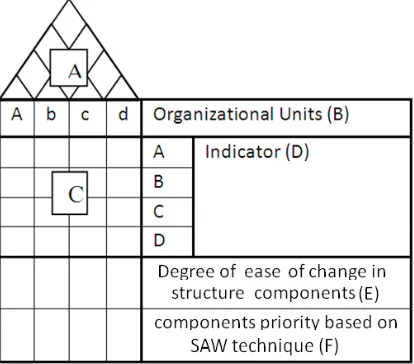
matrix, all network units were compared with each other in terms of five dependencies. In order to determine the final position of each unit from all five perspectives, new matrices were developed by criticality indicator and after non-scaling and calculating internal weight through Shannon entropy method, the final score of units was calculated by the simple additive weighting (SAW) technique and finally organizational units were ranked in order of scores obtained. As the DSM technique is a minimizing optimization method, the final results of these matrices led to the identification of organizational units that could be removed from the network and obtained the lowest scores in the organizational structure. In order to ensure the accuracy of results, indirect one-way and two-one-way dependencies between units were determined by algebra calculations. Thus, the elimination of units depended on obtaining the minimum score and the lack of important indirect dependence in the network structure. The second part of the research data related to the implementation of the QFD technique which covered functional indicators of network structure. In Figure 1 the main components of a house of quality are shown.
Figure 1 An example of a house of quality used in this research
In order to complete the roof of the house of quality (A), the relationships obtained from the final MDM were used as follows: number one was used if there was a one-way relationship between the two organizational units in each of the five aspects, number two was used if there
was a two-way relationship between them and zero was used if there was no relationship between the two units. Then, Likert scale was used to show the correlation in the roof of the house of quality in the range of (0-3-6, and 9). The main range and scope of the houses of quality (B) were extracted from the documentations of units such as network development center and city healthcare center and they were finalized by comparing with the main DSM tables. To achieve the overall view on the intended indicators of structure functions (D), the existing network functions were extracted and then the primary form of indicators was adjusted according to the dimensions used in similar studies, review of literature and the experts’ opinion. These forms were adjusted separately for each existing sector in network. By using the Delphi technique in two rounds and until reaching 80% agreement level, the opinions of team members were collected and recorded in the forms. Finally, the views of managers were integrated by Borda technique in group decision-making [21].
organizational units. Due to network activities in a non-competitive environment, their many free-of-charge services and their equal services in terms of the type and amount, in the use of the QFD technique, the technical and competitive comparisons with another network have not been performed.
The tools used were the LOOMEO software 2.33 for DSM technique and the QFD Designer software 4 for QFD technique.
Results
In the current organizational chart of Firuzabad healthcare network, 120 organizational units are organized in 4 main parts including: the network headquarters, city healthcare center, emergency center and city hospital. The results from the DSM technique for each of the five perspectives (indicators) considered in this research indicate critical organizational units in each of the four parts of the main network. Based on the DSM technique in the network headquarters, the most critical unit is support manager. The head of staff among others ranks the twelfth due to the criticality of the support manager at three indicators out of the five main indicators compared to other staff units. Other significant units in the network headquarters include secretariat, typing, properties, and transportation, while the cultural affairs manager, food and drug management, treatment monitoring, and other technical staff units did not obtain high ranks. The staff laboratory complex acquired the lowest rank in terms of all indicators in network headquarters (7.8) and compared with the support manager rank (203.1), a wide gap can be seen between them. The results of indirect dependency calculations indicate a relatively strong relationship between the head of staff, support manager, the cultural affairs manager, food and drug management and the accounting officer. These dependencies are often one-way and the dependencies direction is toward the support manager.
The results of the QFD technique show that the laboratory complex in the network headquarters obtained the lowest scores in terms of both techniques. On the other hand, secretariat
and typing can be integrated together by maintaining the functional results (Table 1). The most important and critical organizational in Firuzabad healthcare center unit was communicable and non-communicable diseases based on the DSM technique,. The other technical units obtained the third to eleventh ranking. The remarkable unit in the health center is the head of center that has the last rank with a score of zero. Also the results of algebra calculations showed no indirect important dependency between the head of center and the other healthcare center units. The organizational units of statistics, radiology and Maymand laboratory obtained the lowest scores according to results of the QFD technique and they can be also changed from the perspective of the organization. The units of environmental health and occupational health acquired similar scores in the QFD technique. This result has also been obtained for the units of communicable and non-communicable diseases as well as nutrition, family health and schools health. The Healthcare Providing School and health education are also in similar situation (Table 1).
Based on the DSM technique, nursing manager ranks the most important among hospital organizational units and the hospital internal manager ranks next, followed by the hospital treatment sections. Of total forty-nine rankings, the head of the hospital ranked forty-first, and screen department ranked the lowest. In the QFD also, screen ranked 327 out of 466. The results of this technique indicate the similarity among scores and the following organizational units’ performance in the city hospital:
-General and equipment warehouse -Utilities and public services
-Thalassemia and hemodialysis
-Men and women surgery and internal medicine
-ICU and CCU.
Reviewing the results of the DSM technique on the emergency center indicates that it cannot simply determine the most or the least important organizational unit in the emergency. The center units of Payam, Jokan, Maymand and Firuzabad all have the same score and ranked the first and also the units of emergency manager and transportation with similar scores ranked the second in importance. Due to the network headquarters and the financial focus governing the healthcare network of the city, none of the emergency units obtained score in terms of money indicator.
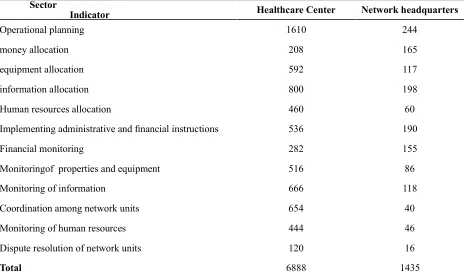
The results of the QFD technique indicate that the lowest score in the emergency center is related to the emergency manager unit and the highest score is related to Firuzabad, Maymand and Jokan sites. In terms of both techniques used in the research, none of the 6 units in the emergency center can be deleted or merged with another unit. Table 1 shows an overview of the least important organizational units in each of the network four main parts from the perspective of five indicators considered in this research. Comparing the main body of two houses of quality of network headquarters and healthcare center indicates that the healthcare center has earned better ranks in performing network headquarters technical duties (Table 2).
Discussion
Reviewing the network functions in the houses of quality indicates that the three main parts of network headquarters, the city hospital and the city healthcare center are constantly struggling to maintain their position of power and decision making in the whole network. This has resulted in an increased focus on the network structure, so middle managers have no opportunity to apply a defined management in the network and only deal with making relationships between operational core and senior managers in their own center. Monavarian et al. argue that this situation not only subject the main function of higher and middle part of organization to the threat but also would damage the proper transfer of information in the organization [23,24]. Such a horizontal separation between
Section Indicator
Emergency
Center Network headquarters City Hospital Healthcare Center
Information laboratory,
security sector
security, supplies, screen
the head of center, mental health, attraction of
partici-pations, laboratory, site 4, site 5,
Maymand laboratory, Maymand site,
Maymand pharmacy, site 1
patient/cus-tomer Emergency manager, transportation secretariat, typing, computer, properties
collector, cultural af-fairs manager,
person-neloffice,
leave issue, archive, supplies store, income
C.S.R, security, counting, financial affairs, public services, medical equipment, environmental health, computer, tailor sector, personnel office, Utili-ties, deputy executive.
head of centre, Healthcare Providing School
health education, statistics unit equipment / documents Firuzabad site, Jokan site, Maymand site, Payam cen-ter,
guarding sector, ar-chive, Utilities, computer, security, the
medicinal plants center
fund, accounting, security, financial affairs, public
services, income, utilities,
per-sonnel office, deputy executive
Maymand attachment site, Maymand pharmacy, site 1, radiology, Maymand
radiology,
head of center, mental health, attraction of participations,
health education, statistics unit, site 4
human resources
laboratory, medicinal plants center,
archive, leave issue, treatment monitoring,
drug and food agement, head of staff,
personnel office
pharmacy, security, supplies, screen, tailor sector,
laundry, personnel office
Maymand radiology, head of center,
health centers of Jaydasht, Jokan,
Ahmadabad and Maymand, coordination staff Healthcare Providing School
money
Payam Cen-ter,
transpor-tation, Sites of Firu-zabad, Jokan, Maymand,
laboratory, guarding sector, security, computer, accounting,
cultural affairs er, personnel office
Personnel office, fund, security, CCU, screen, women’s
surgery, men’s surgery, tailor
sector, utilities, ICU, specialized clinic
statistics unit, Healthcare Providing School, non-communicable diseases,
health education, attraction of participations,
Maymand laboratory, head of center, Maymand
radiology,
Maymand pharmacy, mouth and teeth,
occupational health Total
cator (A total of five indica-tors) emergency manager, transportation laboratory, guarding
sector fund, accounting
attraction of participations, Maymand laboratory, Maymand radiology,
May-mand pharmacy, head of center
Table 1 Organizational units with the minimum scores obtained in the DSM technique in each of the main indicators of Firuzabad healthcare network, 2011
In the above table, the underlined organizational units are the units that obtained the lowest scores in 3
Network headquarters Healthcare Center
Sector
Indicator
244 1610
Operational planning
165 208
money allocation
117 592
equipment allocation
198 800
information allocation
60 460
Human resources allocation
190 536
Implementing administrative and financial instructions
155 282
Financial monitoring
86 516
Monitoringof properties and equipment
118 666
Monitoring of information
40 654
Coordination among network units
46 444
Monitoring of human resources
16 120
Dispute resolution of network units
1435 6888
Total
Table 2 Comparison of scores of common functions in two main units of network headquarters and city health center based on the QFD technique
and therefore its complexity will be reduced. By removing network headquarters, a major portion of its duties will be assigned to the city healthcare center, and other parts will be assigned to the head of the network, the city hospital and emergency center [7]. With the removal of the support headquarters from the structure and reducing network concentration, the main operational body will more effectively respond to the needs of network customers and beneficiaries according to QFD technique. These results have been proved from quality function deployment technique in other studies, e.g.: Ramanthan and Youfing [28].
By eliminating network headquarters, the following changes will be made in the network structure:
-Security unit goes under the supervision of the head of network
-Drug and food management unit goes under the supervision of the head of healthcare center -Treatment monitoring unit goes under the supervision of hospital manager
-Units of transportation, stores and supplies, financial affairs, secretariat and typing go under the supervision of staff units at the healthcare center
-Personnel office unit goes under the supervision of hospital personnel office -Units of support manager and the cultural affairs manager will take responsibility for supervising other staff units of this center, along with the support headquarters at the city healthcare center.
characteristics have an acceptable proportion with the characteristics of city healthcare center and the new organizational chart of this part of the network can follow sectoral structure (Fig. 2 and 3).
Reviewing and analyzing hospital functions indicate that in the current structure of city hospital, the center’s different units have been organized based on type of duties and specialties. Standardization is a key concept that has been emphasized throughout the hospital organization. Operational duties are very repetitive, rules and regulations are very formal, organizational duties are grouped in functional sectors, decision making follows hierarchy and a kind of accurate and very distinctive organizational structure is dominant between queue and staff activities. Technicians (head nurses, supervisors and treatment supervisors) are the key part of the hospital organizational structure. The above points indicate that the current hospital structure is based on the design of a machine bureaucracy [6,23]. Given the hospital’s basic functions and their role in the
treatment of patients and the need to establish a referral system, hospital requires a structure that employs a combination of standardization and decentralization simultaneously. In this structure, it should be possible that technicians are used for activities in the operating core and at the same time the hospital complex can achieve the necessary efficiency due to the standardization of its activities. These features recall the organizational structure of “professional bureaucracy” [23].
The findings will not cause a significant change in hospital structure, but they will only transfer power from the higher part of the hospital (the head of the hospital, executive manager, internal manager and nursing manager) to technicians and operational body (medical and paramedical staff) (Figs. 4 and 5). Aghlmand, in a separate study on the healthcare structures in Iran has achieved similar results [29]. With the change of center of power and decision-making, the power struggles in the higher part of the healthcare network are decreased and the
hospital structure can respond to customers' needs in a more desirable way. Raharjo et al. state that attention to customers' needs will result in a more successful performance of the organization in developing its strategic goals and a more appropriate organizational structure [30]. The results of Harmling studies in Brazil show that the participation of people, customers and other beneficiaries will dramatically help improve healthcare provision [31].
The results obtained from this research will not lead to important changes in the emergency structure, but it seems that emergency site layout should be revised. In reviewing Fars emergency site layout, Zare also provides similar results [32].
Conclusion
As Park et al. emphasize the usefulness of combining two DSM and QFD techniques [17], combination of these methods will create
Figure 3 The proposed organizational chart of the city health center
significant changes in the network structure. Due to the possibility of eliminating the part of network headquarters and assigning its activities to other sectors and also considering the sectoral structure for the city healthcare center and professional bureaucracy structure for the city hospital, it can be concluded that the overall structure of Firuzabad healthcare network will be a “hybrid structure”. Hybrid structures are usually composed of two or more simpler structures and organizations. The use of this type of structure should act in such a way that they can organize their activities as coordinated and integrated autonomous units. In
level and operation procedures in the network can be modified as well.
Acknowledgement
This research has been registered in the center of health research and policy-making (No. hp00171226) and the authors greatly appreciate the financial and administrative help of this research center.
Contribution
Study design: MM, SJAT, AAN, EK Data Collection and analysis: EK Manuscript Preparation: AAN, EK
Conflicts of Interest
"The authors declare that they have no competing interests."
Refrences
1- Hatami, H, Razavi, M, Eftekhar, H. Public health. Arjmand publications, First volume, Tehran, 2004. [In Persian]
2- Sadik, N. An Agenda for People (Unfpa through Three Decade). New York University publication; 2002. 3- Unisef Report, Global Health. WHO publication, 2002, 4(8): 143-149.
4- WHO Report, A snapshot of global health, WHO publication, 210, 12(9): 48-55.
5- Asefzade S, Rezapoor A. Healthcare management. Ghazvin university publications. First edition, 2006. [In Persian]
6- Stiffen R. Organization Theory. Translated by Alvani s, Danaeefard H, Saffar publications, 2004. [In Persian] 7-Arrab, M. Studding the effect of organization structure and leadership style on hospital indicators, Designing a model in Governmental hospitals, [dissertation]. Tehran university, 2000, PP: 320, [In Persian] .
8- Alinejad, A. Studding the management of Gilan health network. [dissertation]. (MO). Tehran university, 1998, PP: 220,[In Persian] .
9- Shadpoor, K. Reforming health system in Iran. Hakim, 2008, 9(5): 16-24 [In Persian].
10- Fidler, A. Health reform experiences: future challenges in the European region. Open Health Institute Presentation and Discussion at the Summer School, Moscow 2004 .
11- Nabiloo, B. Comparative study of health excellence models in selected countries and offering a pattern, [dissertation]. Tehran university, 2003, PP: 380, [In Persian] .
12- Linderman, U, etal, Structural Complexity Management. Springer – Verlag Berlin Heidelberg, 2009. 13- Browning T. The Many Views of a Process: Towards
a Process Architecture Framework for Product Development Processes. Systems Engineering,2009; 12(1): 1098-1102.
14- Simons J, Simons M. Service Management. Cultural Research publications, First Volume, 2004 [In Persian].
15- Andronikidis A, Georgiou A, Gotzaman K. The application of quality function deployment in service quality management, The TQM J2009, 21(4): 319-333. 16- Moores B. Radiation safety management in health care- the application of quality function deployment, Radiology, 2006, 12(4): 291-304.
17- Park. J. A product platform concept development method, Journal of Engineering Design2008, 19 (6), 515-532(18)
18- Windle P., Delphi technique: assessing component needs. J Perianesth Nurs2004 Feb;19(1):46-7.
19- Powell C., The Delphi technique: myths and realities. Journal of Advanced Nursing.200341( 4): 376–382.
20- Skulmoski G, Hartman F, Krahn J., The Delphi method for graduate research. Journal of Information Technology Education, 2007, 6 (1):21-28.
21- Asgharpoor ,M. Group Decision Making and Theory of Game. University of Tehran publications, 2003, [In Persian].
22- Franceschini, F. Advanced Quality Function Deployment, BMO publications,2001.
23- Shafritz G, Out S. Organization Theory. Translated by Parsaiean a, Terme publications, Tehran, 2002[In Persian].
24- Monavarian e, Kheirandish, M, Askari N. Developing Structural Organization Dimensions with Knowledge Management, IT Management, 2011, 7(1):25-30.
25- Ziaee M. Studding Tehran University
Organizational Structure and Modeling Optimum Structure, [dissertation]. Tehran university, 2003, PP: 380, [In Persian] .
26- Ahmadvand A. Health Sector Reforms. Great Ebne Sina publications, First edition, Tehran, 2005 [In Persian] .
27- Alizade M. Studding Health centers structures in Markazi Province, [dissertation]. Tehran university, 1998, PP: 260, [In Persian] .
28- Ramanathan R, Yunfeng J. Incorporating cost and environmental factors in quality function deployment using data envelopment analysis. Omega2009, 37(3): 711-723.
29- Aghlmand S, Akbari F, Lamei A, etal. Promoting Obstetric Cares in Fayaz Bakhsh Hospital By QFD. Hakim, 2009, 12(1): 56-60[In Persian] .
30- Raharjo H, Xie M, Goh T. A methodology to improve higher education quality using the quality function deployment and analytic hierarchy process, Total quality management & business excellence, 2007, 18(10): 1097-1115.
institute,
Washington, D.C, January, 1999.