O R I G I N A L A R T I C L E
Open Access
Postdictive confidence (but not predictive
confidence) predicts eyewitness memory
accuracy
Thao B. Nguyen
*, Erica Abed and Kathy Pezdek
Abstract
If testing conditions are uncontaminated, confidence at test reliably predicts eyewitness memory accuracy. Unfortunately, information about eyewitness postdictive confidence (at the time of the identification test) is frequently unavailable or not well documented. In cases where postdictive confidence is unavailable, a useful indicator of eyewitness accuracy might be an eyewitness’s predictive confidence made shortly after the event. How do the accuracy of predictive and postdictive confidence judgments compare; and do variables reported to affect memory (e.g. exposure duration, face race) affect the reliability of the confidence-accuracy relationship for predictive and postdictive judgments? In two experiments, we tested the accuracy of memory predictions
(immediate and delayed judgments of learning [JOLs]) and postdictions (confidence) for same- and cross-race faces. Although delayed high JOLs were indicative of higher recognition memory accuracy than delayed low JOLs for both same- and cross-race faces, the accuracy of even high predictive JOLs was objectively low. Postdictive confidence was a far stronger indicator of memory accuracy than predictive JOLs; high postdictive confidence was indicative of high accuracy; and this was true for both same- and cross-race recognition memory.
Keywords:Judgments of learning, Confidence-accuracy, Metamemory, Cross-race effect, Eyewitness memory
Significance
Eyewitness identification is often critical for solving crimes and is commonly used as evidence in legal trials. Thus, it is important to find factors that could assist the legal system in determining whether an identification is likely to be accurate or inaccurate. One such factor is an eyewitness’s expressed confidence. Shortly after viewing a crime, eyewitnesses are often asked how confident they are that they will be able to recognize the perpetrator in the future; this ispredictive confidence. In addition, after selecting someone from a lineup, eyewitnesses are often asked how confident they are that they identified the correct person as the perpetrator; this ispostdictive con-fidence. Are these confidence ratings indicative of actual accuracy? And how do they compare? In our study, we tested whether predictive and postdictive confidence rat-ings accurately reflect memory for same- and cross-race faces, stimuli selected because of known differences in
memory strength. We found that postdictive confidence was a better indicator of memory accuracy than predict-ive confidence for both same- and cross-race faces. These results suggest that when possible, investigators should collect eyewitness confidence at the time of iden-tification (under testing conditions free of contamin-ation) as it will help investigators and jurors assess the reliability of an identification. The practice of asking eye-witnesses at the scene how likely it is that they will be able to identify the perpetrator in the future and then using these predictions as an indicator of eyewitness ac-curacy is discredited by our findings.
Background
Eyewitness confidence is frequently used to determine the accuracy of eyewitness memory. However, metamemory judgments of confidence can be assessed at numerous times and how well these judgments predict eyewitness ac-curacy is likely to vary. In the legal system, the focus has been on eyewitness confidence collected at the time of the identification test (i.e. postdictive confidence) because what
* Correspondence:[email protected]
Department of Psychology, Claremont Graduate University, Claremont, CA 91711, USA
happens at this stage is typically better documented. Under unbiased testing conditions, eyewitnesses can accurately assess the strength of their memories at test, with high confidence indicative of high accuracy. These unbiased test-ing conditions include ustest-ing a double-blind procedure, showing a fair lineup, and collecting confidence immedi-ately after the initial identification (Wixted & Wells,2017). In addition, semi-contaminated testing conditions also pro-duce a reliable confidence-accuracy relationship, although the utility of a high confidence identification is still better in unbiased than biased testing conditions (Mickes, Clark, & Gronlund,2017; Wixted & Wells,2017).
More important, estimator variables reported to affect discrimination accuracy (i.e. the ability to distinguish be-tween an old versus new face), such as exposure duration, retention interval, and face race, in fact do not affect the re-liability of the postdictive confidence-accuracy relationship (Dodson & Dobolyi, 2015; Nguyen, Pezdek, & Wixted,
2017; Palmer, Brewer, Weber, & Nagesh, 2013; Semmler, Dunn, Mickes, & Wixted,2018). In these studies, although overalldiscrimination accuracywas higher under better en-coding conditions (e.g. longer rather than shorter exposure time, same-race rather than cross-race face), thereliability (i.e. the probability that an identification is likely to be cor-rect) of a high confidence judgment did not significantly differ for faces presented under better versus poorer encod-ing conditions.
It is important to differentiate between these two differ-ent measures, discriminability and reliability, because each measure reflects different aspects of memory accuracy and addresses different research questions. Whereas asses-sing discriminability is most informative when testing the effects of system variables on eyewitness memory, asses-sing reliability is most informative when testing the effects of estimator variables on eyewitness memory (Mickes,
2015). Discrimination accuracy informs policymakers about best practices for collecting an eyewitness identifica-tion (i.e. methods that will increase the rate of correct identifications and decrease the rate of incorrect identifi-cations). On the other hand, when judges and jurors are presented with eyewitness evidence in trial, they are most concerned with the issue of reliability(i.e. given that an eyewitness identified the suspect with a particular level of confidence, how likely is it that the identified suspect is guilty?). Thus, when deciding whether an eyewitness’s identification is trustworthy, it is a forensically important finding that estimator variables have been reported not to affect the reliability of eyewitness memory at high postdic-tive confidence. In other words, postdicpostdic-tive confidence is a useful indicator of eyewitness reliability, regardless of whether the encoding conditions were more or less opti-mal (Semmler et al.,2018).
Although confidence at test can be informative of the reli-ability of memory, in legal settings, postdictive confidence is
not always well documented or uniformly collected. When confidenceiscollected at test, it is often done under biased testing conditions such as a non-blind lineup (Wixted & Wells, 2017). In fact, according to the Police Executive Research Forum (2013), although most of the surveyed agen-cies reported collecting eyewitness confidence during lineup identifications, they reported that a non-blind lineup proced-ure is used in 60% of photo lineups and in 92.1% of live lineups. Furthermore, it is unclear whether confidence is typ-ically collected at the initial identification test rather than at a subsequent identification test. And, like other types of fo-rensic evidence, eyewitness confidence can be contaminated by external sources making it an unreliable indicator of memory accuracy. In cases where postdictive confidence at test is not available, not well documented, or has been con-taminated, a better indicator of eyewitness reliability might be an eyewitness’spredictive confidence, that is, their meta-memory judgment made near the time that the perpetrator was observed. Shortly after witnessing a crime, eyewitnesses are often asked how likely it is that they will be able to iden-tify the perpetrator in the future. Officers on the scene trying to determine which eyewitnesses are worth pursuing are likely to consider these predictions to be useful indicators of subsequent eyewitness reliability. How do the accuracy of predictive and postdictive confidence judgments compare? And do estimator variables reported to affect discrimination accuracy also affect the reliability of the predictive and post-dictive confidence-accuracy relationship? This is the focus of our study.
consequently provide a high JOL. In contrast, when retrieval of the target items from long-term memory is difficult or un-successful, people would consequently provide a low JOL.
Similar to the confidence-accuracy relationship for postdic-tive judgements of eyewitness memory, it is important as well to examine the confidence-accuracy relationship for pre-dictive judgments of eyewitness memory. In a meta-analysis of nine studies, Cutler and Penrod (1989) reported that predictive confidence was only weakly correlated with subse-quent identification accuracy and predictive confidence was less accurate than postdictive confidence. However, none of the studies included in the meta-analysis assessed the predictive confidence-accuracy relationship as a function of specific estimator variables, a theoretically and forensically important research question addressed in the current study. Furthermore, Cutler and Penrod examined the confidence-accuracy relationship using correlations and did not assess eyewitness reliability at specific levels of confidence. Since the meta-analysis, researchers (Juslin, Olsson, & Winman,
1996; Wixted & Wells,2017) have reported that correlational measures are an inappropriate measure of the confidence-ac-curacy relationship as it relates to eyewitness memory and the legal system and, instead, proposed the use of more in-formative measures such as confidence-accuracy characteris-tic (CAC) analysis (Mickes, 2015). CAC analysis is a more informative method of assessing the confidence-accuracy re-lationship because it addresses the question that is most fo-rensically relevant to judges and jurors who are evaluating whether an eyewitness’s identification is trustworthy (i.e. given that an eyewitness identified the suspect with a par-ticular level of confidence, how likely is it that the identified suspect is guilty?). In the current study, we extend past re-search on predictive judgments in eyewitness memory by using CAC analysis to examine the reliability of the predict-ive confidence-accuracy relationship across levels of an estimator variable known to affect discrimination accuracy and how it compares to the reliability of the postdictive confidence-accuracy relationship.
The central question in our study is how do immediate and delayed predictive confidence compare to postdictive confidence in predicting the reliability of eyewitness iden-tifications? To make this assessment, we need to manipu-late a variable known to affect the strength of overall memory (i.e. discrimination accuracy) and then compare confidence ratings and memory accuracy across levels of this variable. In this study, we manipulate discriminability of face memory by using same-race and cross-race faces. It is well documented that discrimination accuracy is higher for faces of the same race than of a different race as the observer, a phenomenon known as the cross-race effect (CRE; Malpass & Kravitz, 1969). Meissner, Brigham, and Butz (2005) and others (Hills & Pake, 2013; Hugenberg, Young, Bernstein, & Sacco,2010) have argued that the CRE is a result of qualitative differences in encoding same- and
cross-race faces. In our study as well as related studies dis-cussed below, face race is simply included as a manipula-tion of memory strength. However, these findings should apply as well to any estimator variables that affect discrim-ination accuracy, variables that are likely to influence eye-witness memory in real-world scenarios.
Hourihan, Benjamin, and Liu (2012) tested whether the CRE affects the reliability of predictive JOLs. They assessed White and Asian observers’accuracy of imme-diate predictive JOLs using the measureda(Benjamin & Diaz, 2008). Using only an immediate measure of JOLs (JOLs were presented 1 s after offset of each stimulus), they reported that whereas White observers were more accurate predicting memory performance for White than Asian faces, Asian observers were similarly accurate pre-dicting memory performance for White and Asian faces. And, most important, overall predictive metamemory accuracy was low (Mda= 0.32 and Mda= 0.34 for White and Asian observers, respectively; values close to zero indicate low metamemory accuracy), indicating that when predictive judgments take place immediately after stimulus presentation, people tend to have poor meta-memory insight into their future face recognition ability for both same- and cross-race faces.
However, based on the findings of Nelson and Dunlosky (1991) with both immediate and delayed tests of JOLs, it is predicted that for White participants, although the reli-ability of immediate JOLs for cross-race faces is low, the reliability of delayed JOLs for cross-race faces would be higher. This is because observers rely on information from their short-term memory when making immediate JOLs, but from relatively more long-term memory when making delayed JOLs. Due to qualitative differences in encoding, the forgetting of information in memory over time is predicted to be faster for cross- than same-race faces (Deffenbacher, Bornstein, McGorty, & Penrod, 2008). If observers perceive this difference, then predictive meta-memory judgments for cross-race faces will be more ac-curate after a brief delay than when made immediately. We test this hypothesis in our study.
accuracy for same- than cross-race faces (Hourihan et al.,
2012), the reliability of high predictive JOLs may not differ between same- and cross-race faces (or for other estimator variables) and this has not been examined previously.
In two experiments, we test the relative utility of pre-dictive versus postpre-dictive metamemory judgments and whether the reliability of these metamemory judgments changes across an estimator variable known to vary in dis-crimination accuracy, same- versus cross-race faces. Ex-periment 2 is a replication of ExEx-periment 1 using a different sample of participants and a different sample of stimulus faces. The experimental procedure and statistical analyses were identical across both experiments. Although we analyzed the data for Experiment 1 and Experiment 2 separately, for brevity, we report the results for both ex-periments together. In addition, to simplify and clarify the presentation of the primary results, we report the second-ary results in footnotes and Additional file1.
Methods Experiments 1–2
Participants and design
A total of 244 White participants (Experiment 1) and 241 White participants (Experiment 2) who live in the U.S. were recruited from Amazon’s Mechanical Turk.1 After cleaning the data (see Additional file1 where this procedure is clarified), 53 participants in Experiment 1 and 43 participants in Experiment 2 were excluded from the analyses, with the final NExp.1= 191; NExp.2= 198.
The study was a 2 (Face Race: White or Black) × 2 (JOL type: immediate or delay) mixed factorial design with face race manipulated within-subjects. Analyses were conducted on: (1) discrimination accuracy, measured by
d´; (2) predictive metamemory accuracy, measured by proportion correct; (3) postdictive metamemory accur-acy, measured by proportion correct; and (4) the associ-ation between predictive and postdictive metamemory judgments, measured by regression coefficients.
Materials and procedure
The experiment was conducted on Qualtrics. Face stim-uli were obtained from a database of male faces used by Meissner et al. (2005). Two sets of 40 faces were selected at random from this database. The first set of 40 faces (20 White and 20 Black) was used in Experiment 1; the second set was used in Experiment 2. Meissner et al. provided two different headshots of each person: (1) smiling and wearing a casual shirt–used as study stim-uli; and (2) neutral facial expression and dressed in a similar maroon colored shirt – used as test stimuli. Across participants, each face equally often served as a target (old) and a foil (new) face.
Participants were randomly assigned to either the immedi-ate or the delayed JOL condition. In the study phase,
participants viewed 10 White and 10 Black faces presented one at a time for 3 s. The order of the faces presented was randomized for each participant. After viewing each face, participants made a JOL either immediately or after a 30-s delay. We chose a delay of 30 s because we wanted to minimize participant fatigue and, importantly, the delayed-JOL effect is reported to still occur over short delay intervals of less than 1 min, although of a smaller magnitude compared to longer JOL delay intervals of several minutes (Rhodes & Tauber,2011).
In making each JOL response, participants were asked to
“Please indicate how likely you think it is that you will later recognize the face you just studied” on a 6-point Likert scale in increments of 20 (i.e. 0, 20, 40, 60, 80, or 100), with 0 being“I am sure that I will NOT remember this face”and 100 being “I am sure that I WILL remember this face.” Immediately after viewing each face, those in the immediate JOL condition were asked to make their JOL and then complete a 30-s distractor task in which they generated as many items as possible for a variety of different semantic categories.2
Those in the delayed-JOL condition completed the JOL and distractor task in reverse order; that is, after viewing each face, those in the delayed-JOL condition were first asked to complete the same 30-s distractor task and then make their JOL. At the end of all 20 study trials (with a JOL and distractor task for each face trial), all participants completed 30 s of the same distractor task for before begin-ning the test phase. Thus, the total length of the study phase was the same in the immediate and delayed-JOL conditions.
The test phase followed immediately (on average, the time between the last studied face and the first test face was 1 min). In the test phase, participants completed an old/new recognition memory test on 40 test faces (20 White and 20 Black), half old and half new. The order of faces presented was randomized for each participant. After making an old/new judgment for each test face, participants were asked “How confident are you that your old/new judgment is accurate?” and responded on a similar 6-point scale that had been used to make JOL judgments (i.e. 0, 20, 40, 60, 80, 100) with 0 being “not
at all accurate”and 100 being“completely accurate.”
Results
Assessing recognition memory accuracy
We assessed discrimination accuracy (d´) to ensure that the manipulation of face race was successful in eliciting a CRE, and it was. A correction of 0.5/n and (n–0.5)/n
was applied to hit (HR) and false alarm (FAR) rates of 0 and 1, respectively (Stanislaw & Todorov, 1999). Mean
the analyses of variance (ANOVAs) on these three mea-sures of recognition memory accuracy. The focus of these analyses is on the d´ data and these are presented below. Analyses of FAR and HR data are reported in the Additional file1.
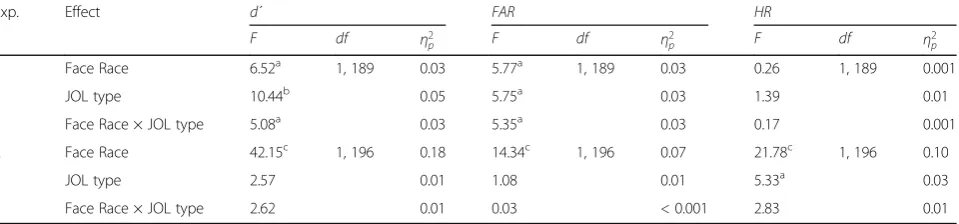
In Experiments 1 and 2, a 2 (Face Race: White or Black) × 2 (JOL type: immediate or delay) ANOVA performed ond´ data yielded a significant main effect of face race with higher discrimination accuracy for same-race (MExp.1=1.14 [0.06]; MExp.2= 1.40 [0.05]) than cross-race faces (MExp.1 = 0.98
[0.04];MExp.2= 0.99 [0.05]), indicating the presence of a CRE
in both experiments, with a stronger effect size in Experi-ment 2 than ExperiExperi-ment 1, as reported in Table2. In Experi-ment 1, there was also a significant main effect of JOL type ond´ with higher discrimination accuracy for faces followed by a delayed,M =1.18 (0.05), than an immediate JOL, M =0.93 (0.06), and a significant interaction between face race and JOL type. For same-race faces, discrimination ac-curacy was significantly higher in the delayed, M = 1.33 (0.07), than immediate JOL condition, M = 0.94 (0.09), t(189) =−3.54, p< 0.001, 95% CI of the difference [−0.61,−0.17,],d=−0.51; however, for cross-race faces, discrimination accuracy was similar in the delayed,M = 1.03 (0.06), and immediate JOL conditions, M = 0.92 (0.06), t(189) =−1.29,p= 0.20, 95% CI of the difference [− 0.28, 0.06,],d=−0.18. The main effect of JOL type and the interaction were non-significant in Experiment 2.
Together, these results indicate that the manipulation of face race was successful in varying the strength of overall memory in both experiments. Furthermore, as reported in Table2, compared to Experiment 1, the size of the CRE was larger in Experiment 2, allowing us to compare the reliability of the JOL-accuracy and confidence-accuracy relationship across experiments, where the differences in discrimination accuracy varied.
Assessing the accuracy of predictive metamemory judgments (JOLs)
Analyses of the accuracy of JOLs focused on responses to
oldtest faces (i.e. faces participants had previously studied), because JOLs were only made foroldfaces presented in the study phase. To assess whether we replicated the findings of Hourihan et al. (2012), we ran a mixed effects logistic re-gression only on participants in the immediate JOL condi-tion.3 Statistics for this analysis are presented in Table 3. Examining only immediate JOLs, whereas Hourihan et al. (2012) reported more accurate JOLs for same- than cross-race faces, we found that in both Experiments 1 and 2, the JOL-accuracy relationship was not different for same-versus cross-race faces. The discrepancy between our findings and those of Hourihan et al. may be due to the fact that overall d´ values were exceptionally high in the Hourihan study and relatively lower in our study (although well above chance). Participants in our study may have
Table 2Results from three separate 2 (Face Race) × 2 (JOL type, Immediate vs Delayed) ANOVAs on d’values, false alarm rates (FAR), and hit rates (HR)
Exp. Effect d´ FAR HR
F df η2
p F df η2p F df η2p
1 Face Race 6.52a 1, 189 0.03 5.77a 1, 189 0.03 0.26 1, 189 0.001
JOL type 10.44b 0.05 5.75a 0.03 1.39 0.01
Face Race × JOL type 5.08a 0.03 5.35a 0.03 0.17 0.001
2 Face Race 42.15c 1, 196 0.18 14.34c 1, 196 0.07 21.78c 1, 196 0.10
JOL type 2.57 0.01 1.08 0.01 5.33a 0.03
Face Race × JOL type 2.62 0.01 0.03 < 0.001 2.83 0.01
df degrees of freedom per test
Effect sizes reported are partial-eta squared. These statistics indicate that on all three measures of recognition memory accuracy, the effect size for the Cross-Race Effect was greater in Experiment 2 than Experiment 1
a
p< 0.05,bp< 0.01,cp< 0.001
Table 1Mean (SE) d’values, false alarm rates (FAR), and hit rates (HR) per experimental condition
JOL type
Exp. Face Race Immediate Delayed
d’ FAR HR N d’ FAR HR N
1 Same-Race 0.94 (0.06) 0.23 (0.02) 0.54 (0.02) 92 1.33 (0.07) 0.16 (0.01) 0.57 (0.02) 99
Cross-Race 0.92 (0.06) 0.24 (0.02) 0.54 (0.02) 1.03 (0.06) 0.22 (0.01) 0.56 (0.02)
2 Same-Race 1.28 (0.07) 0.16 (0.02) 0.56 (0.02) 101 1.51 (0.07) 0.18 (0.02) 0.65 (0.02) 97
Cross-Race 0.98 (0.07) 0.21 (0.02) 0.52 (0.02) 1.01 (0.07) 0.23 (0.02) 0.55 (0.02)
perceived the face recognition memory task to be difficult overall and thus may have been conservative with their JOL ratings. In fact, overall, participants in our study were less likely to provide high ratings of JOLs; this was true for both same- and cross-race faces (see Additional file 1 for JOL frequency distribution).
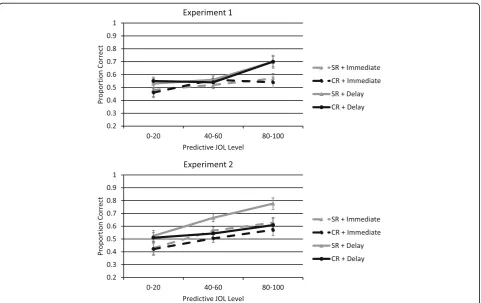
More important, to address our research question of whether the reliability of the predictive JOL-accuracy re-lationship varies as a function of face race, we compared the reliability of immediate and delayed JOLs using mea-sures that would be most informative to the legal system (Mickes,2015). We plotted the average proportion correct
[# hitsJ / (# hitsJ+ # missesJ)] for each JOL level, whereJ
indicates that the hits and misses were made with a spe-cific level of JOL (see Fig.1). These JOL-specific accuracy curves and the proportion correct reveal how reliable pre-dictive judgments are at each JOL level. Because there were too few observations at each of the six JOL levels, for all analyses of proportion correct, we collapsed across rat-ings of 0 and 20 to create a“low”JOL level, across ratings of 40 and 60 to create a“medium”JOL level, and across ratings of 80 and 100 to create a“high”JOL level. Thus, the JOL scale became an aggregate of three levels (low, medium, and high). This is commonly done to create more stable estimates of proportion correct when there are too few responses made at a particular JOL or confi-dence level (see for example, Wixted, Mickes, Clark, Gronlund, & Roediger III,2015). For each analysis, we re-moved participants who made zero ratings at each JOL level for either same-race and cross-race faces; therefore, the sample sizes across all tests were slightly different.
Are high predictive JOLs indicative of higher accur-acy than medium or low predictive JOLs, and does the reliability of the predictive JOL-accuracy relationship vary by face race or JOL type (immediate versus delay)? To answer these questions, for each experiment, we
Fig. 1Predictive JOL-accuracy curves for Experiment 1 (top) and Experiment 2 (bottom). Proportion correct [# hits / (# hits + # misses)] is reported at each level of predictive JOL per experimental condition.Error barsrepresent standard error. SR same-race face condition, CR cross-race face condition
Table 3Results from a multilevel model analysis for the immediate JOL condition
Exp. Effect Estimate z p
1 Face Race 0.03 (0.29) 0.10 0.92
JOL level 0.17 (0.06) 2.79 0.01
Face Race × JOL level −0.01 (0.08) −0.12 0.91
2 Face Race −0.02 (0.31) −0.07 0.94
JOL level 0.23 (0.06) 3.76 < .001
Face Race × JOL level 0.06 (0.08) 0.72 0.47
conducted two ANOVAs on the proportion of test faces correctly recognized (using the measure specified above). Figure 1 displays the average proportion correct per experimental condition for this analysis. We did not con-duct one overall analysis with all three levels of JOL (low [0–20], medium [40–60], high [80–100]), as there would have been too few participants who had non-missing data (i.e. a calculable proportion correct with non-zero values) acrossallJOL levels. For these analyses, a Bonferroni cor-rection ofα= 0.025 (0.05 / # of ANOVAs) was used.
First, the 2 (Face Race: White or Black) × 2 (JOL type: immediate or delay) × 2 (JOL Level: low [0–20] or high [80–100]) ANOVA on proportion correct in each experi-ment yielded a significant main effect of JOL level in both Experiment 1,F(1, 39) = 11.50,p =0.002,η2
p = 0.23, and Experiment 2, F(1, 39) = 8.39, p = 0.006, η2
p = 0.18. The proportion correct was significantly higher at high JOLs (MExp.1= 0.64 [0.04]; MExp.2= 0.65 [0.04]) than at
low JOLs (MExp.1= 0.44 [0.05]; MExp.2= 0.47 [0.05]). No other effects were significant in either experiment.
Next, the 2 (Face Race: White or Black) × 2 (JOL type: immediate or delay) × 2 (JOL Level: medium [40–60] or high [80–100]) ANOVA on proportion correct yielded a significant main effect of JOL level in both Experiment 1,F(1, 92) = 17.56, p< 0.001, η2
p = 0.16, and Experiment 2,F(1, 102) = 8.74, p= 0.004, η2p = 0.08. The proportion correct was significantly higher at high JOLs (MExp.1=
0.63 [0.02]; MExp.2= 0.65 [0.03]) than at medium JOLs
(MExp.1= 0.51 [0.02];MExp.2= 0.56 [0.02]).
There were some discrepancies between the two experi-ments in the analyses of high versus medium JOLs. In Experiment 1, there was a significant interaction between JOL Level and JOL type, F(1, 92) = 5.45, p= 0.02, η2
p =
0.06; when participants made immediate JOLs, the pro-portion correct was similar for high JOLs,M= 0.57 (0.03), and medium JOLs, M= 0.51 (0.03), t(48) = 1.36, p= 0.18,
d= 0.19. However, when participants made delayed JOLs, as predicted, the proportion correct was significantly higher for high JOLs,M= 0.69 (0.04), than medium, JOLs,
M= 0.51 (0.03),t(44) = 4.47,p< 0.001,d= 0.67. These re-sults support the delayed-JOL effect; JOLs were more ac-curate if made after a brief delay than immediately. In Experiment 2, this interaction was non-significant, but there was a significant main effect of face race,F(1, 102) =11.01,p= 0.001, η2
p = 0.10. The proportion correct was significantly higher for same-race, M= 0.65 (0.02), than cross-race faces,M= 0.56 (0.02). There may not have been a face race effect on proportion correct in Experiment 1 because the size of the CRE (measured byd´) was smaller in Experiment 1 than Experiment 2.
Across these analyses, although accuracy was higher for high JOLs than for lower JOLs, accuracy was objectively low (relative to chance performance at 0.50) even at the highest level. This suggests that predictive metacognitive assessments are likely to be of limited utility for making
real-world predictions of accuracy. Follow-up mixed ef-fects logistic regression analyses replicated the results from the above two ANOVAs (see Additional file1).
Is a high predictive JOL indicative of high accuracy for both same-race and cross-race faces, and does it depend on whether JOLs are made immediately or after a delay?To answer these questions, for each experi-ment, three 2 (Face Race: White or Black) × 2 (JOL type: immediate or delay) ANOVAs were conducted on the proportion recognition correct data at each of the three levels of JOL (low, medium, and high). Figure 1 displays the average proportion correct per experimental condition for this analysis. For these analyses, a Bonferroni correc-tion ofα= 0.017 (0.05 / # of ANOVAs) was used.
The most important result here for real-world cases of eyewitness identification concern high predictive JOL re-sponses because eyewitnesses who are more confident in their ability to make a later identification are more likely to be asked to undergo a line-up identification (Cutler & Penrod, 1989). The ANOVA on the proportion correct recognition for faces with high JOL responses yielded a significant main effect of JOL type in Experiment 1,F(1, 101) = 10.71,p= 0.001, η2
p = 0.10, but not in Experiment 2, F(1, 108) = 3.93, p= 0.05, η2
p = 0.04; the direction of the effect was consistent in both experiments. As pre-dicted, the proportion correct was higher for faces followed by a delayed JOL (MExp.1= 0.70 [0.03];MExp.2=
0.69 [0.04]) than an immediate JOL (MExp.1= 0.56 [0.03]; MExp.2= 0.60 [0.03]). The main effect of face race was
non-significant in Experiment 1,F(1, 101) = 0.18,p =0.67,
η2
p = 0.002, but significant in Experiment 2, F(1, 108) = 6.39,p =0.01,η2
p= 0.06. In both experiments, the propor-tion correct was higher for same-race (MExp.1= 0.64
[0.03];MExp.2= 0.70 [0.03]) than cross-race faces (MExp.1=
0.62 [0.03];MExp.2= 0.59 [0.03]). Again, the differences
be-tween results of Experiments 1 and 2 can be explained by the larger CRE in Experiment 2.4
These results indicate that the proportion correct rec-ognition at high JOLs were more accurate for same-than cross-race faces in Experiment 2 but not in Experi-ment 1, where the size of the CRE was smaller. These results make sense given the higher d´ for same-race faces in Experiment 2; the sample of same-race faces used in Experiment 2 was apparently easier to remember relative to the cross-race faces, thus resulting in a same-race advantage in predictions of memory perform-ance. Furthermore, the accuracy of immediate JOLs made at even the highest level was low (MExp.1= 0.56; MExp.2= 0.60). Specifically, participants who made
indicates that delaying the JOL improved accuracy for same-race faces (Mdelayed= 0.78 [0.05], Mimmediate= 0.63
[0.04], d= 0.47) more than cross-race faces (Mdelayed=
0.61 [0.05],Mimmediate= 0.57 [0.05],d= 0.11).
We also performed analyses on frequency data (i.e. the number of times participants provided high versus low JOL ratings to same- and cross-race faces) and found that in Experiment 1, participants provided low JOL rat-ings more frequently to cross- than same-race faces, and in Experiment 2, participants provided high JOL ratings more frequently to same- than cross-race faces. These results support the notion that participants were meta-cognitively aware that cross-race faces were going to be more difficult to recognize in the future than same-race faces (see Additional file1).
Assessing the accuracy of postdictive metamemory confidence judgments
We next analyzed the results for ratings of postdictive confidence to assess the reliability of the postdictive confidence-accuracy relationship. For this set of analyses, we focused on“old” responses (i.e. faces that participants said they had previously studied), similar to analyzing the
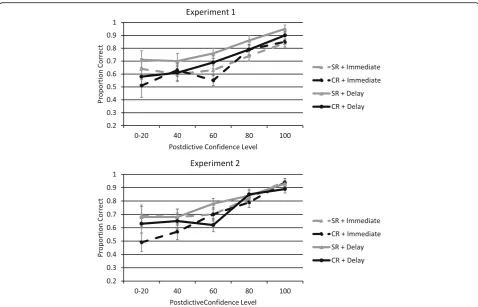
data only for “choosers” in an eyewitness identification paradigm. Consistent with previous research on the CA relationship, we plotted the average proportion correct [# hitsc/(# hitsc+ # false alarmsc)] for each level of confi-dence, where C indicates that the hits and false alarms were made with a specific level of confidence. Thus, the proportion correct at each level of postdictive confidence is the probability that a positive identification of “old” is accurate. These results are displayed in Fig. 2. Because there were too few observations at the two lowest levels of confidence, for all analyses of proportion correct for post-dictive confidence we collapsed across confidence ratings of 0 and 20; thus, the final confidence scale consisted of five levels (0–20, 40, 60, 80, and 100). For each analysis, we removed participants who made zero ratings at each confidence level for same-race faces and for cross-race faces; therefore, the sample sizes were slightly different in all tests (totalNExp.1= 191;NExp.2= 198).
we conducted four ANOVAs to compare the proportion correct at the highest confidence level (100) to the propor-tion correct at each of the lower four confidence levels (0– 20, 40, 60, 80). Figure2displays the average proportion cor-rect per experimental condition for this analysis. We did not conduct one overall 2 (Face Race: White or Black) × 2 (JOL type: immediate or delay) × 5 (confidence level: 0–20, 40, 60, 80, 100) ANOVA on the proportion correct data as there would have been too few participants who had non-missing data (i.e. a calculable proportion correct with non-zero values) acrossallconfidence levels. For these four analyses, a Bonferroni correction ofα= 0.0125 (0.05 / # of ANOVAs) was used.
First, we found that higher postdictive confidence was indicative of higher recognition memory accuracy than lower postdictive confidence. A 2 (Face Race: White or Black) × 2 (JOL type: immediate or delay) × 2 (confi-dence level: 0–20 or 100) ANOVA of the proportion correct yielded a significant main effect of confidence level in both Experiment 1, F(1, 24) = 15.58, p = 0.001,
η2
p = 0.39, and Experiment 2, F(1, 21) = 45.92,p< 0.001, η2
p = 0.69. No other effects were significant. These re-sults indicate that the proportion correct at the highest level of confidence (MExp.1= 0.85 [0.05]; MExp.2= 0.93
[0.04]) was significantly higher than at the lowest confi-dence level (MExp.1= 0.58 [0.06]; MExp.2= 0.51 [0.06]);
this did not vary with race or JOL type. Subsequent ANOVAs comparing each of the other three lower con-fidence levels to concon-fidence ratings of 100 yielded similar results.5
Across these analyses, it is evident that compared to face race and JOL type, postdictive confidence is the stronger predictor of accuracy, with postdictive confi-dence accounting for a larger amount of the variability in proportion correct. Most important, high confidence (100), when compared to all lower levels of confidence, was indicative of higher accuracy; this did not vary with race or JOL type. Follow-up mixed effects logistic regres-sion analyses replicated results from the ANOVAs (see Additional file 1). Together, these findings replicate our previous work on the confidence-accuracy relationship in same- and cross-race faces (Nguyen et al.,2017).
Is high postdictive confidence indicative of high ac-curacy for both same-race and cross-race faces, and does it depend on whether participants had made im-mediate or delayed JOLs before test? It is important to include JOL type as a factor in the analysis of postdic-tive confidence because in Experiment 1, there were dif-ferences in d´ between the immediate and delayed JOL conditions. For each experiment, five 2 (Face Race: White or Black) × 2 (JOL type: immediate or delay) ANOVAs were conducted on the proportion correct data at each of the five levels of confidence. Figure 2
displays the average proportion correct per experimental condition for this analysis. For these analyses, a Bonferroni correction ofα= 0.01 (0.05 / # of ANOVAs) was used.
Analyses of the proportion correct for confidence rat-ings of 100 yielded non-significant main effects of face race [FExp.1(1, 111) = 0.61, p = 0.44, η2p = 0.01; FExp.2(1,
113) = 1.43,p= 0.23,η2p = 0.01], JOL type [FExp.1(1, 111) =
4.58,p= 0.04, η2
p = 0.04; FExp.2(1, 113) = 2.07,p= 0.15, η2p = 0.02], and their interaction [FExp.1(1, 111) = 0.98, p=
0.32, η2
p = 0.01;FExp.2(1, 113) = 0.55,p= 0.46, η2p = 0.01].
The three ANOVAs on the proportion correct for confi-dence ratings of 80, 40, and 0–20 for Experiment 1 and ratings of 80, 60, 40, and 0–20 for Experiment 2 also yielded no significant effects. However, in Experiment 1, analyses of the proportion correct for confidence ratings of 60 yielded a significant main effect of JOL type, F(1, 123) = 10.24,p= 0.002,η2
p= 0.08, with a higher proportion correct for faces followed by a delayed, M= 0.73 (0.03), than an immediate JOL,M= 0.59 (0.03). No other effects were significant.
In the above analyses, the most important result for real-world cases of eyewitness identification concern high postdictive confidence responses of 100, because eyewitnesses who make identifications at the highest level of confidence are most likely to testify at trial and to do so confidently. We found that at a high level of postdictive confidence, same-race and cross-race recog-nition judgments were similarly accurate (Cohen’sdExp.1
= 0.07; dExp.2= 0.11), suggesting that participants are
metacognitively able to accurately adjust their postdic-tive judgments to account for any encoding differences between same- and cross-race faces. Although the CRE (as measured by d´) was larger in Experiment 2 than Experiment 1 (dExp1= 0.16;dExp2= 0.42), the CRE at high
postdictive confidence in both Experiments 1 and 2 were of a similar magnitude. Importantly, as evidenced by the small Cohen’s d values reported above, the size of the CRE at high postdictive confidence in both experiments was minimal. This finding replicates our previous work on the postdictive confidence-accuracy relationship in memory for same- and cross-race faces (Nguyen et al.,
2017). Furthermore, in contrast to predictive JOLs, the proportion correct recognition for postdictive confi-dence was objectively high (relative to chance perform-ance at 0.50) (see Fig. 2). This suggests that postdictive judgments are more accurate than predictive judgments, which is supported by later analyses.
Similar to the analysis of frequency data for predictive JOLs, we also compared the frequency of postdictive confidence ratings for same- versus cross-race faces (see Additional file 1). These results suggest that although participants more frequently provided high confidence ratings to same- than cross-race faces, when participants
that participants had some metacognitive awareness of a memory deficit for cross-race faces because they were aware that they should not be highly confident as often for cross-race than same-race faces and were more likely to rate low postdictive confidence for cross-race than same-race faces.
The relative utility of predictive JOLs versus postdictive confidence in predicting memory accuracy
To address the critical research question, how does the reliability of predictive and postdictive confidence judg-ments compare, we ran a mixed effects logistic regres-sion model for each experiment. For this analysis, we focused on responses toold faces(i.e. target faces partic-ipants had previously studied). Although analyses of confidence typically focus on“old”responses(which may include both old and new test faces), because JOLs are made only forold facespresented in the study phase, we wanted to compare the predictive power of JOLs and postdictive confidence on the same subset of faces, with accuracy coded as 0 = miss and 1 = hit.
The model consisted of random intercepts of participants and face race, JOL type, JOL level, and confidence as predic-tors. JOL level and confidence were assessed at six levels: 0, 20, 40, 60, 80, and 100. Results indicated that while a statisti-cally significant predictor of accuracy, JOLs were far less predictive when postdictive confidence was also in the model (Experiment 1: estimateJOL [log odds] = 0.07 (0.03, z = 2.01, p= 0.04; estimateconfidence[log odds] = 0.47 (0.03, z = 15.66, p< 0.001; Experiment 2: estimateJOL [log odds] = 0.17 (0.03, z = 4.98,p< 0.001; estimateconfidence[log odds] = 0.39 (0.03, z = 12.72, p< 0.001). Postdictive confi-dence was a far more reliable indicator of memory accur-acy than JOLs. This is a key finding in this study.
Neither face race nor JOL type (immediate versus de-layed) was a significant predictor of accuracy in Experi-ment 1. However, in ExperiExperi-ment 2, face race (estimate [log odds] = 0.24 [0.07, z = 3.52,p< 0.001], and JOL type (estimate [log odds] = 0.41 [0.12, z = 3.44,p< 0.001) were significant predictors of accuracy. This discrepancy can be explained by the fact that in Experiment 1, face race and JOL type affected discrimination accuracy of new
faces more than old faces; earlier results indicated sig-nificant effects on FAR but not HR. However, in Experi-ment 2, there were significant effects of face race and JOL type on HR as well, in other words, on discrimin-ation accuracy ofoldfaces.
We conducted additional analyses to assess whether there was a reliable relationship between predictive JOLs and postdictive confidence.6Overall, the relationship be-tween predictive JOLs and postdictive confidence was weak and did not differ between same- and cross-race faces nor between immediate and delayed JOLs. This
suggests that predictive and postdictive metamemory judgments are likely to involve different underlying cog-nitive processes.
Discussion
This study examines two main issues. First, how does the reliability of immediate and delayed predictive JOLs compare, and does the reliability of these metamemory judgments differ across an estimator variable known to affect the discrimination accuracy of eyewitness memory, face race? Second, and more important, how do ive JOLs and postdictive confidence compare in predict-ing the accuracy of face memory?
First, we found that high JOLs were associated with a higher proportion correct than low JOLs in the delayed but not the immediate JOL condition. However, al-though the proportion correct was higher for high than low levels of JOL, accuracy at the highest JOL level was still objectively low (MExp.1= 0.63;MExp.2= 0.65) (chance
recognition accuracy was 0.50). Furthermore, when there is a larger CRE on discrimination accuracy (in Experi-ment 2), the reliability of a high predictive JOL was greater for same- than cross-race faces; delaying the JOL improved the accuracy of predictions for same-race memory more than cross-race memory. These results suggest that although delaying JOLs allow participants to evaluate their future memory performance more ac-curately for same- than cross-race faces, nonetheless, the utility of predictive metamemory judgments for estimat-ing subsequent memory accuracy is limited for both same-race and cross-race faces.
We also found that in Experiment 1, whether partici-pants had made immediate or delayed JOLs in the study phase affected their subsequent discrimination accuracy for same-race but not cross-race faces. When assessing memory for same-race faces, discrimination accuracy was significantly higher for delayed than immediate JOLs; however, when assessing memory for cross-race faces, discrimination accuracy was similar for delayed and immediate JOLs. One interpretation of this finding is that due to superior qualitative encoding of same-than cross-race faces, when making delayed JOLs, ob-servers are more likely to engage in successful retrieval practice of same- than cross-race faces. Although there was not a significant interaction between face race and JOL type in Experiment 2, the pattern of means repli-cated that of Experiment 1.
(MExp.1= 0.89; MExp.2= 0.93). Importantly, as evidenced
by the regression analyses, postdictive confidence was a far stronger indicator of memory accuracy than both im-mediate and delayed predictive JOLs. And unlike the predictive JOL-accuracy relationship, the reliability of the postdictive confidence-accuracy relationship did not differ between same- and cross-race faces. This suggests that observers are metacognitively aware of differences in encoding difficulty between same- and cross-race faces at test. This may be because when making postdic-tive metamemory judgments at test, observers receive more specific information about their performance (i.e. they are aware that memory weakens faster for cross-than same-race faces) and can adjust their confidence ratings more accurately. Using more informative mea-sures of the confidence-accuracy relationship, CAC curves, this finding replicates earlier work in the do-mains of education (Pierce & Smith, 2001) and eyewit-ness memory (Cutler & Penrod, 1989) that reported higher correlations between postdictive confidence and accuracy than predictive confidence and accuracy.
Another important finding from a cognitive point of view is that overall, the relationship between predictive JOLs and postdictive confidence was weak. This finding suggests that these two types of metamemory judgments involve different underlying cognitive processes. One possible explanation for the differences in the utility of predictive and postdictive confidence is that people may be relying on different information from memory when making these two metamemory judgments. For example, although people are likely to engage in active retrieval of information from memory when making predictive JOLs, based on response time data, Tauber, Dunlosky, and Rawson (2015) postulated that predictive JOLs may not always involve a complete memory search. If people do not conduct a thorough memory search when mak-ing JOLs, then their judgments of future memory per-formance will be less accurate. However, people are likely to spend more time performing a thorough mem-ory search when tested on their memmem-ory, and thus meta-memory judgments provided at this time are more likely to be accurate. Although Tauber et al. (2015) did not dir-ectly compare predictive and postdictive judgments of confidence, their proposed explanation may account for why the distribution of predictive JOLs in our study was clustered around low to medium JOLs; if participants were performing an incomplete memory search when making a JOL, then they are less likely to retrieve suffi-cient information from memory and, consequently, pro-vide lower predictions of future memory performance.
A second possible explanation for the low accuracy of even high predictive delayed JOLs is that although delayed JOLs rely more on information from long-term than short-term memory, the information available in memory
during a delayed JOL still may not be similar to the infor-mation that is available at test, which occurs after an even longer delay from encoding. These potential explanations for the reported differences in the reliability of predictive and postdictive metamemory judgments are not exhaust-ive and our study does not offer a critical test of the mech-anisms involved. Articulating the cognitive processing differences between predictive and postdictive metamem-ory judgments is a fruitful direction for future research.
Conclusion
In summary, we found that both immediate and delayed predictive JOLs were a weak indicator of subsequent memory accuracy. In contrast, postdictive confidence was a strong indicator of subsequent memory accuracy, with high confidence associated with high accuracy. The find-ing that postdictive confidence is a more reliable indicator of memory accuracy than predictive JOL has applied rele-vance and importance to the field of eyewitness memory given that eyewitnesses are often asked to make these metamemory judgments at different times throughout their interactions with the legal system. Our findings sug-gest that when possible, investigators should collect judg-ments of eyewitness confidence at the time of the initial identification (with minimized contamination of testing procedures) as these judgments will help triers of fact as-sess the reliability of an identification. However, if infor-mation about eyewitness confidence at test is not available or if it has been highly contaminated, predictive judg-ments, collected after a brief delay, provide information somewhat prognostic of subsequent identification accur-acy, information that is less useful but better than chance.
Endnotes
1
We did not conduct a fully-crossed race design and collected data from only White participants because the magnitude of the CRE is largest in White participants (Meissner & Brigham,2001); therefore, if any differences exist in metacognitive ability, it should be most evident in White participants. In addition, Black and White Mechanical Turk participants are not comparable; whereas White participants make up a larger percentage of the Mechanical Turk population, Black participants are underrepresented in the Mechanical Turk population compared to the U.S. population (Paolacci & Chandler,
2014). 2
Participants had to generate as many items as they could in 30 s for the following categories: States, marine animals, fruits/vegetables, male names, book titles, furni-ture, kitchen items,“S”words, ice cream flavors, movie ti-tles, celebrities, cities, song titi-tles, office items, TV shows, sports, female males, countries, land animals, professions,
3
The model consisted of random intercepts of pants (as judgment trials were nested within partici-pants), and face race, JOL level, and their interaction as predictors, with accuracy coded as 0 = miss and 1 = hit. For this analysis, JOL level was assessed at six levels: 0, 20, 40, 60, 80, and 100. Results from the logistic regres-sion assessing the accuracy of immediate JOLs indicated that JOL level was a significant predictor of recognition accuracy in both experiments; faces rated with higher JOLs were more accurately recognized. No other effects were significant. Examining only immediate JOLs, whereas Hourihan et al. (2012) reported more accurate JOLs for same- than cross-race faces, we found that the JOL-accuracy relationship was not different for same-versus cross-race faces.
4
The ANOVA on the proportion correct recognition for faces with medium JOL responses yielded no significant effects in Experiment 1, but a significant main effect of face race in Experiment 2,F(1, 184) = 10.79,p= 0.001,η2
p = 0.06. The proportion correct was significantly higher for same-race, M = 0.62 (0.02), than cross-race faces,
M = 0.52 (0.02). There was also a significant main effect of JOL type in Experiment 2,F(1, 184) = 4.49,p= 0.035,
η2
p = 0.02. The proportion correct was significantly higher for delayed, M = 0.61 (0.02), than immediate JOLs,
M = 0.54 (0.02). In both Experiments 1 and 2, the ANOVA on the proportion correct recognition for faces with low JOL responses yielded no significant effects.
5
The 2 (Face Race: White or Black) × 2 (JOL type: im-mediate or delay) × 2 (confidence: 40 or 100) ANOVA of the proportion correct also yielded a significant main effect of confidence level in both Experiment 1, F(1, 43) = 15.47,p< 0.001,η2
p = 0.27, and Experiment 2,F(1, 42) = 82.85, p< 0.001, η2
p = 0.66. No other effects were significant. These results indicate that the proportion correct at the highest level of confidence (MExp.1 = 0.85
[0.05];MExp.2 = 0.96 [0.02]) was significantly higher than
at a confidence judgment of 40 (MExp.1 = 0.66 [0.04]; MExp.2= 0.55 [0.04]); this did not vary with race or JOL
type.Next, the 2 (Face Race: White or Black) × 2 (JOL type: immediate or delay) × 2 (confidence: 60 or 100) ANOVA on the proportion correct also yielded a signifi-cant main effect of confidence level in both Experiment 1,F(1, 66) = 40.04,p< 0.001,η2p = 0.38, and Experiment 2,F(1, 65) = 50.92,p< 0.001,η2
p = 0.44. No other effects were significant. These results indicate that the propor-tion correct at the highest level of confidence (MExp.1 = 0.89 [0.02]; MExp.2 = 0.93 [0.02]) was
signifi-cantly higher than at a confidence judgment of 60 (MExp.1 = 0.64 [0.03]; MExp.2 = 0.68 [0.03]); this did not
vary with race or JOL type.Finally, a 2 (Face Race: White or Black) × 2 (JOL type: immediate or delay) × 2 (confidence:
80 or 100) ANOVA on the proportion correct also yielded a significant main effect of confidence level in both Experiment 1,F(1, 71) = 18.49,p< 0.001, η2p = 0.21, and Experiment 2,F(1, 71) = 17.35,p< 0.001, η2
p = 0.20. No other effects were significant in this analysis. These results indicate that the proportion correct at the highest level of confidence (MExp.1= 0.89 [0.02];MExp.2= 0.91 [0.02]) was
significantly higher than at a confidence judgment of 80 (MExp.1 = 0.74 [0.03]; MExp.2 = 0.80 [0.03]); this did not
vary with race or JOL type. 6
Is there an association between predictive JOLs and postdictive confidence judgments? If an eyewitness pro-vides a high postdictive confidence judgment at test, is the identified suspect someone the eyewitness had previ-ously said they were highly likely to remember (i.e. a high JOL)? In the examination of the relationship be-tween JOLs and postdictive confidence, we focused our analysis on hits (i.e. old target faces correctly identified as“old”). This is because we want to assess the relation-ship between predictive and postdictive judgments on the same subset of faces. JOLs are made on old faces (faces previously studied, resulting in test trials that are either hits or misses) whereas postdictive confidence rat-ings can be made onoldandnewfaces, with typical ana-lyses of the confidence-accuracy relationship focusing on
“old” responses(test faces participants had responded to as having been seen before). This is similar to analyzing data from “choosers” in an eyewitness identification paradigm and is thus forensically relevant.Thus, we computed a Spearman’s rank correlation between JOL and postdictive confidence on hits for each participant and analyzed the average correlation across participants in each experimental condition. Some participants were excluded from this set of analyses because their correl-ation could not be computed due to no variability (a standard deviation of zero) in either their JOLs or post-dictive confidence judgments for hits. The sample sizes in all tests was thus slightly different. Table 3in Supple-mentary Materials presents the mean correlation and sample size per condition.The correlation between pre-dictive JOLs and postpre-dictive confidence judgments was low, and similarly low for both immediate and delayed predictive JOLs. In Experiments 1 and 2, the mean cor-relation collapsed across all conditions was significantly different from zero (rejecting the null hypothesis of no relationship) but small, Experiment 1: rs = 0.10,
(JOL type: immediate or delay) ANOVA onrsyielded no significant differences across experimental conditions, with non-significant main effects of Face Race [FExp.1(1,
158) = 1.55, p = 0.22, η2
p = 0.01; FExp.2(1, 140) = 1.86, p = 0.17, η2
p = 0.01], JOL type [FExp.1(1, 158) < 0.001, p= 0.99, η2
p < 0.001;FExp.2(1, 140) = 1.71,p= 0.19, η2p = 0.01], and their interaction [FExp.1(1, 158) = 0.06,p= 0.81, η2
p< 0.001;FExp.2(1, 140) = 0.10,p= 0.75,η2p= 0.001].
Additional file
Additional file 1:Includes detailed information about data cleaning procedures and supplementary analyses, tables, and figures. (DOCX 57 kb)
Abbreviations
ANOVA:Analysis of variance; CAC: Confidence-accuracy characteristic; CRE: Cross-race effect; JOL: Judgment of learning
Availability of data and materials
Anonymized data and supplementary materials for this study have been made publicly available on Open Science Framework and can be accessed at osf.io/s4aew.
Authors’contributions
The three authors contributed equally to the conceptual development of this study and together crafted the research design. EA collected the data, and TN and EA analyzed the data under the supervision of KP. TN drafted the manuscript and all three authors participated in the revision process. All authors read and approved the final manuscript.
Ethics approval and consent to participate
Ethics approval was obtained from the Institutional Review Board at Claremont Graduate University. Informed consent was obtained from each participant before participation.
Consent for publication Not applicable.
Competing interests
The authors declare that they have no competing interests.
Publisher’s Note
Springer Nature remains neutral with regard to jurisdictional claims in published maps and institutional affiliations.
Received: 30 April 2018 Accepted: 22 July 2018
References
Benjamin, A. S., & Diaz, M. (2008). Measurement of relative metamnemonic accuracy. In J. Dunlosky, & R. A. Bjork (Eds.),Handbook of memory and metamemory, (pp. 73–94). New York: Psychology Press.
Cutler, B. L., & Penrod, S. D. (1989). Forensically relevant moderators of the relation between eyewitness identification accuracy and confidence.Journal of Applied Psychology,74(4), 650–652.https://doi.org/10.1037/0021-9010.74.4.650. Deffenbacher, K. A., Bornstein, B. H., McGorty, E. K., & Penrod, S. D. (2008).
Forgetting the once-seen face: Estimating the strength of an eyewitness’s memory representation.Journal of Experimental Psychology: Applied,14(2), 139–150.https://doi.org/10.1037/1076-898X.14.2.139.
Dodson, C. S., & Dobolyi, D. G. (2015). Confidence and eyewitness identifications: The cross-race effect, decision time and accuracy.Applied Cognitive Psychology,30, 113–125.https://doi.org/10.1002/acp.3178.
Hills, P. J., & Pake, J. M. (2013). Eye-tracking the own-race bias in face recognition: Revealing the perceptual and socio-cognitive mechanisms.Cognition,129(3), 586–597.https://doi.org/10.1016/j.cognition.2013.08.012.
Hourihan, K. L., Benjamin, A. S., & Liu, X. (2012). A cross-race effect in metamemory: Predictions of face recognition are more accurate for members of our own race.Journal of Applied Research in Memory and Cognition,1(3), 158–162.https://doi.org/10.1016/j.jarmac.2012.06.004. Hugenberg, K., Young, S. G., Bernstein, M. J., & Sacco, D. F. (2010). The
categorization-individuation model: An integrative account of the other-race recognition deficit.Psychological Review,117(4), 1168–1187.https://doi.org/10. 1037//a0020463.
Juslin, P., Olsson, N., & Winman, A. (1996). Calibration and diagnosticity of confidence in eyewitness identification: Comments on what can be inferred from the low confidence-accuracy correlation.Journal of Experimental Psychology: Learning, Memory, and Cognition,22, 1304–1316.https://doi.org/ 10.1037/0278-7393.22.5.1304.
Malpass, R. S., & Kravitz, J. (1969). Recognition for faces of own and other race.
Journal of Personality and Social Psychology,13(4), 330–334.https://doi.org/10. 1037/h0028434.
Meissner, C. A., & Brigham, J. C. (2001). Thirty years of investigating the own-race bias in memory for faces: A meta-analytic review.Psychology, Public Policy, and Law,7(1), 3–35.https://doi.org/10.1037//1076-8971.7.1.3.
Meissner, C. A., Brigham, J. C., & Butz, D. A. (2005). Memory for own- and other-race faces: A dual-process approach.Applied Cognitive Psychology,19, 545– 567.https://doi.org/10.1002/acp.1097.
Mickes, L. (2015). Receiver operating characteristic analysis and confidence-accuracy characteristic analysis in investigations of system variables and estimator variables that affect eyewitness memory.Journal of Applied Research in Memory and Cognition,4(2), 93–102.https://doi.org/10.1016/j. jarmac.2015.01.003.
Mickes, L., Clark, S. E., & Gronlund, S. D. (2017). Distilling the confidence-accuracy message: A comment on Wixted and wells (2017).Psychological Science in the Public Interest,18(1), 6–9.https://doi.org/10.1177/1529100617699240. Nelson, T. O., & Dunlosky, J. (1991). When people’s judgments of learning (JOLs)
are extremely accurate at predicting subsequent recall: The“delayed-JOL effect”.Psychological Science,2(4), 267–270.
Nguyen, T. B., Pezdek, K., & Wixted, J. T. (2017). Evidence for a confidence-accuracy relationship in memory for same- and cross-race faces.Quarterly Journal of Experimental Psychology,70(12), 2518–2534.https://doi.org/10. 1080/17470218.2016.1246578.
Palmer, M. A., Brewer, N., Weber, N., & Nagesh, A. (2013). The confidence-accuracy relationship for eyewitness identification decisions: Effects of exposure duration, retention interval, and divided attention.Journal of Experimental Psychology: Applied,19(1), 55–71.https://doi.org/10.1037/a0031602. Paolacci, G., & Chandler, J. (2014). Inside the turk: Understanding mechanical turk
as a participant pool.Current Directions in Psychological Science,23(3), 184–188.https://doi.org/10.1177/0963721414531598.
Pierce, B. H., & Smith, S. M. (2001). The postdiction superiority effect in metacomprehension of text.Memory & Cognition,29, 62–67.https://doi.org/ 10.3758/BF03195741.
Police Executive Research Forum. (2013). A national survey of eyewitness identification procedures in law enforcement agencies.http://www. policeforum.org/assets/docs/Free_Online_Documents/Eyewitness_ Identification/a%20national%20survey%20of%20eyewitness%20identification %20procedures%20in%20law%20enforcement%20agencies%202013.pdf. Rhodes, M. G., & Tauber, S. K. (2011). The influence of delaying judgments of learning on metacognitive accuracy: A meta-analytic review.Psychological Bulletin,137(1), 131–148.https://doi.org/10.1037/a0021705.
Semmler, C., Dunn, J., Mickes, L., & Wixted, J. T. (2018).The role of estimator variables in eyewitness identification. Journal of Experimental Psychology: Applied.https://doi.org/10.1037/xap0000157.
Stanislaw, H., & Todorov, N. (1999). Calculation of signal detection theory measures.Behavior Research Methods, Instruments, & Computers,31(1), 137–149.https://doi.org/10.3758/BF03207704.
Tauber, S. K., Dunlosky, J., & Rawson, K. A. (2015). The influence of retrieval practice versus delayed judgments of learning on memory.Experimental Psychology,62(4), 254–263.https://doi.org/10.1027/1618-3169/a000296. Wixted, J. T., Mickes, L., Clark, S. E., Gronlund, S. D., & Roediger III, H. L. (2015).
Initial eyewitness confidence reliably predicts eyewitness identification accuracy.American Psychologist,70(6), 515–526.https://doi.org/10.1037/ a0039510.