The Thirty-Third AAAI Conference on Artificial Intelligence (AAAI-19)
DeepCF: A Unified Framework of Representation Learning and Matching
Function Learning in Recommender System
Zhi-Hong Deng,
1Ling Huang,
1Chang-Dong Wang,
1Jian-Huang Lai,
1Philip S. Yu
2,31School of Data and Computer Science, Sun Yat-sen University, Guangzhou, China 2Department of Computer Science, University of Illinois at Chicago, Chicago, USA
3Institute for Data Science, Tsinghua University, Beijing, China
[email protected], [email protected], [email protected] [email protected], [email protected]
Abstract
In general, recommendation can be viewed as a matching problem, i.e., match proper items for proper users. However, due to the huge semantic gap between users and items, it’s al-most impossible to directly match users and items in their ini-tial representation spaces. To solve this problem, many meth-ods have been studied, which can be generally categorized into two types, i.e., representation learning-based CF meth-ods and matching function learning-based CF methmeth-ods. Rep-resentation learning-based CF methods try to map users and items into a common representation space. In this case, the higher similarity between a user and an item in that space implies they match better. Matching function learning-based CF methods try to directly learn the complex matching func-tion that maps user-item pairs to matching scores. Although both methods are well developed, they suffer from two fun-damental flaws, i.e., the limited expressiveness of dot prod-uct and the weakness in capturing low-rank relations respec-tively. To this end, we propose a general framework named DeepCF, short for Deep Collaborative Filtering, to combine the strengths of the two types of methods and overcome such flaws. Extensive experiments on four publicly avail-able datasets demonstrate the effectiveness of the proposed DeepCF framework.
Introduction
Over the past decades, with the fast development of web-based service platforms such as e-commerce platforms and news/music/movie platforms, recommender systems have been extensively studied and widely deployed in many dif-ferent scenarios to alleviate the information overload prob-lem (Hu et al. 2018; Srivastava et al. 2018). Due to the dis-tinguishing capability of utilizing collective wisdoms and experiences, Collaborative Filtering (CF) algorithms, es-pecially Matrix Factorization (MF) algorithms, have been widely used to build recommender systems (Wang et al. 2018a; Zhao et al. 2018; Hu et al. 2017).
Matrix factorization assumes some relationship can be es-tablished between users and items through some latent fac-tors. By mapping users and items into a common representa-tion space in which they can be compared directly, the simi-larity between them can be further used to estimate how well
Copyright c⃝2019, Association for the Advancement of Artificial Intelligence (www.aaai.org). All rights reserved.
they match. In this case, the model learns low-dimensional dense representation for user and item, and then adopts dot product as matching function to calculate matching score. Since Deep Neural Networks (DNNs) are extremely good at representation learning, deep learning methods have been widely explored and have shown promising results in vari-ous areas such as computer vision and natural language pro-cessing (He et al. 2016a; Serban et al. 2016). In the past few years, there are also many works adopting DNNs to intro-duce auxiliary data such as images, text descriptions and de-mographic information, to improve the representation learn-ing process. What’s more, in vanilla matrix factorization, the mapping between the original representation space and the latent space is assumed to be linear, which can not be always guaranteed. To better learn the complex mapping between these two spaces, Xue et al. (Xue et al. 2017) proposed a Deep Matrix Factorization (DMF), which uses a two path-way neural network architecture to replace the linear embed-ding operation used in vanilla matrix factorization. However, when it comes to the matching score prediction, matrix fac-torization methods still resort to dot product which simply combines latent factors linearly and seriously limits the ex-pressiveness of the model.
experi-ence, the learning process may be inefficient. This is also why NeuMF needs to incorporate MLP with a shallow ma-trix factorization model.
According to the above discussion, we can see that there are two types of methods for implementing collaborative filtering (Xu, He, and Li 2018). One is based on repre-sentation learning and the other one is based on matching function learning. To overcome the shortages of these two types of methods and further improve the performance of CF methods, we incorporate them under the proposed DeepCF framework. In particular, we first use these two types of CF methods to obtain different representations for the in-put user-item pair. Since these two types of methods have different advantages and learn the representation from dif-ferent perspectives, a stronger and more robust joint repre-sentation for the user-item pair can be obtained by concate-nating their learned representations. To calculate the match-ing score, we then pass this joint representation into a fully connected layer which enables the model to assign different weights on the features. Besides, since the quantity of im-plicit data far outweighs the quantity of exim-plicit data in real world, designing recommendation algorithms that can work with implicit feedback data is extremely important and has been one of the hot research topics in recommender system. As a result, we focus on implicit feedback in this paper.
The main contributions of this work are as follows.
• We point out the significance of incorporating collab-orative filtering methods based on representation learn-ing and matchlearn-ing function learnlearn-ing, and present a general Deep Collaborative Filtering (DeepCF) frame-work. The proposed framework abandons the traditional Deep+Shallow pattern and adopts deep models only to implement collaborative filtering with implicit feedback.
• We propose a novel model named Collaborative Filtering Network (CFNet) based on the vanilla MLP model un-der the DeepCF framework, which has great flexibility to learn the complex matching function while being efficient to learn low-rank relations between users and items.
• We conduct extensive experiments on four real-world datasets to demonstrate the effectiveness and rationality of the proposed DeepCF framework.
Related Work
Collaborative Filtering with Implicit Data
Since most of users would not tend to rate items, it’s often difficult to collect explicit feedback. As a result, the quantity of implicit data, such as a click, view, collect, or purchase, far outweighs the quantity of explicit data, such as a rat-ing or a like. In this case, it’s very important to design rec-ommendation algorithms that can work with implicit feed-back data (Oard, Kim, and others 1998). The well-known ALS model (Hu, Koren, and Volinsky 2008) and SVD++ model (Koren 2008) are the early exploration that studied collaborative filtering on datasets with implicit feedback. Both of the two models factorize the binary interaction ma-trix and assume user dislike unselected items, i.e., assign 0
for unselected items in the binary interaction matrix. Sev-eral works have been done to further improve collaborative filtering with implicit data by assuming user prefer the se-lected items than the unsese-lected items (Rendle et al. 2009; Mnih and Teh 2012; He and McAuley 2016).
Collaborative Filtering based on Representation
Learning
Since Simon Funk proposed Funk-SVD (Funk 2006) in the famous Netflix Prize competition, matrix factorization for collaborative filtering has been widely studied and con-stantly developed over the past ten years (Salakhutdinov and Mnih 2008; Koren, Bell, and Volinsky 2009; Koren 2009; Ma 2013; Hu, Sun, and Liu 2014). Although these works tried to improve matrix factorization from different ways, e.g., introducing time, social information, text description, and location, their main idea is still mapping user and item into a common representation space where they can be com-pared directly. Recently, deep learning methods have shown promising results in various areas such as computer vision, speech recognition and natural language processing. There are also some works proposed to use DNNs for collaborative filtering based on representation learning. AutoRec (Sedhain et al. 2015) is the first model attempting to learn user repre-sentation and item reprerepre-sentation by using autoencoder to reconstruct the input ratings. Collaborative Denoising Auto-Encoders (CDAE) (Wu et al. 2016) further improved it by in-putting both ratings and IDs. On the other hand, DMF (Xue et al. 2017) uses a two pathway neural network architecture to factorize rating matrix and learn representations. Overall, representation learning-based methods learn representation in different ways and can flexibly incorporate with auxiliary data such as images, text descriptions, demographic infor-mation and so on. However, they still resort to the dot prod-uct or cosine similarity when predicting matching score.
Collaborative Filtering based on Matching
Function Learning
be effective (Zhao, Shi, and Hong 2017; Zhu et al. 2017; Wang et al. 2018b). In this paper, we focus on pure collabo-rative filtering without using auxiliary data. In this case, we mainly discuss NeuMF and compare it with the proposed DeepCF framework.
According to the above discussion, both representation learning-based and matching function learning-based col-laborative filtering methods have been broadly studied and proven to be effective. Despite their strengths, both of the two types of methods have weaknesses, i.e., the limit ex-pressiveness of dot product and the weakness in capturing low-rank relations. To our best knowledge, so far there is no work to point out the significance of combining the strengths of the two types of collaborative filtering methods to over-come these weaknesses. In this paper, we present a general framework that ensembles these two types of methods to en-dow the model with a great flexibility of learning the match-ing function while maintainmatch-ing the ability to learn low-rank relations efficiently.
Preliminaries
Problem Statement
Suppose there areM users andN items in the system, fol-lowing (Wu et al. 2016; He et al. 2017), we construct the user-item interaction matrixY ∈ RM×N from users’
im-plicit feedback as follows,
yui=
{
1, if interaction (useru, itemi) is observed;
0, otherwise. (1)
Comparing with explicit feedback, implicit feedback has two major problems. First, unlike ratings, an observed in-teraction (yui = 1) can only reflects users’ preference indi-rectly, i.e., it can not tell how much exactly a user likes an item. Second, an unobserved interaction (yui = 0) does not mean userudoes not like itemi. In fact, userumay have never seen itemisince there are too many items in a system. These two problems pose huge challenges in learning from implicit data, especially the second one.
To perform collaborative filtering on implicit data which lacks real negative feedback is also known as the One-Class Collaborative Filtering (OCCF) problem (Pan et al. 2008). In general, there are two ways to tackle this problem, one is to treat all unobserved interactions as weak negative in-stances (Hu, Koren, and Volinsky 2008; Pan et al. 2008) and the other is to sample some negative instances from unobserved interactions (Pan et al. 2008; Wu et al. 2016; He et al. 2017). In this paper, we prefer the second method, i.e., uniformly sample negative instances from unobserved interactions.
The recommendation problem with explicit feedback is usually formulated as a rating prediction problem which es-timates the missing values in rating matrixR. The predicted scores are then used for ranking items and finally the top-ranking items are recommended to users. Similarly, to tackle the recommendation problem with implicit feedback, we can formulate it as an interaction prediction problem which es-timates the missing values in interaction matrixY, i.e., es-timates whether the unobserved interactions would happen
or not. However, unlike explicit feedback, implicit feedback is discrete and binary. Solving the above binary classifica-tion problem can not help us to further rank and recom-mend items. One feasible solution is to employ a probabilis-tic treatment for interaction matrixY. We can assumeyui obeys a Bernoulli distribution:
P(yui=k|pui) =
{
1−pui, k= 0;
pui, k= 1
=pkui(1−pui)1−k, (2)
wherepui is the probability ofyuibeing equal to 1. What’s more, pui can be further interpreted as the probability that useruis matched by itemi. In this case, a value of 1 forpui indicates that item iperfectly matches user uand a value of 0 indicates that user uand item i do not match at all. Rather than modelingyui which is discrete and binary, our method modelspuiinstead. In this manner, we transform the binary classification problem, i.e., the interaction prediction problem, to a matching score prediction problem.
Learning the Model
A model-based method generally assumes that data can be generated by an underlying model as yˆui = f(u, i|Θ), whereyˆui denotes the prediction of yui, i.e., the predicted probability that user u is matched by item i, Θ denotes model parameters, and f denotes the function that maps model parameters to the predicted score. In this manner, we need to figure out two key questions, i.e., how to define func-tionfand how to estimate parametersΘ. We will answer the first question in the next section.
For the second question, most of the existing works gen-erally estimate parameters through optimizing an objec-tive function. Two types of objecobjec-tive functions are com-monly used in recommender system, namely, point-wise loss (Hu, Koren, and Volinsky 2008; He et al. 2016b) and pair-wise loss (Rendle et al. 2009; Mnih and Teh 2012; He and McAuley 2016). In this paper, we explore the point-wise loss only and leave the pair-point-wise loss in our future work. Point-wise loss has been widely studied in collabo-rative filtering with explicit feedback under the regression framework (Funk 2006; Salakhutdinov and Mnih 2008). The most commonly used point-wise loss is the squared loss (SE). However, the squared loss is not suitable for implicit feedback because it’s derived by assuming the error between the given ratingruiand the predicted ratingrˆuiobeys a nor-mal distribution, which does not hold in the implicit feed-back scenario since yui is discrete and binary. As afore-mentioned in Problem Statement, we assume yui obeys a Bernoulli distribution, i.e.,yui ∼ Bern(pui). By replac-ingpuiwithyˆuiin Equation 2, we can define the likelihood function as
L(Θ) = ∏
(u,i)∈Y+∪Y−
P(yui|Θ)
= ∏
(u,i)∈Y+∪Y−
ˆ yyui
ui (1−yˆui)1−yui,
whereY+denotes all the observed interactions inYandY−
denotes the sampled unobserved interactions, i.e., the nega-tive instances. Furthermore, taking the neganega-tive logarithm of the likelihood (NLL), we obtain
ℓBCE=−
∑
(u,i)∈Y+∪Y−
yuilog ˆyui
+ (1−yui) log(1−yˆui). (4)
Based on all the above assumptions and formulations, we finally obtain an objective function which is suitable for learning from implicit feedback data, i.e., the binary cross-entropy loss function.
To sum up, the recommendation problem with implicit feedback can be formulated as an interaction prediction problem. To endow algorithm with the ability to rank items, we employ a probabilistic treatment for interaction matrix Y so thatyui is assumed to obey a Bernoulli distribution. Instead of modelingyui, we modelpui which is the prob-ability ofyui being equal to 1. Since pui can also be in-terpreted as the probability that useruis matched by item
i, the interaction prediction problem can be transformed to a matching score prediction problem. In this manner, using maximum likelihood estimation to estimate model parame-tersΘis equivalent to minimizing the binary cross-entropy betweenyuiandyˆui.
The Proposed Framework
In this section, we first introduce the general processes of representation learning-based CF methods and match-ing function learnmatch-ing-based CF methods. Then we elaborate these two types of methods and their MLP implements we used in this paper. Finally we illustrate how to fuse these two methods in the proposed DeepCF framework and how to learn the final model.
The General Process
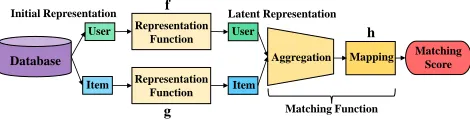
The processes for representation learning-based CF meth-ods and matching function learning-based CF methmeth-ods can be concluded as the workflow shown in Figure 1. Both of the two types of methods start from extracting data from database. IDs, historical behaviors and other auxiliary data can all be used to construct the initial representations of user
uand itemi, which are denoted byvUu andvIi respectively. The CF models then calculatepu=f(vUu)andqi=g(vIi), i.e., the latent representations for useruand itemi. Next, a non-parametric operation is performed onpuandqi to ag-gregate the latent representations. Finally, mapping function
h(·)is used to calculate the matching scoreyˆui. Notice that the last two steps are referred to as the matching function.
Representation Learning
For representation learning-based CF methods, the model focuses more on learning representation function and the matching function is usually assumed to be simple and non-parametric, e.g., dot product or cosine similarity. In this manner, the model is supposed to learn to map users and items into a common space where they can be directly com-pared. For example, taking one-hot IDs as inputs, the vanilla
Matching Score
Item User
Database
f
g
h
Matching Function Initial Representation Latent Representation
Aggregation
Representation Function Representation
Function User
Item
Mapping
Figure 1: The general process for representation learning-based CF methods and matching function learning-learning-based CF methods.
MF (Funk 2006) adopts linear embedding function as func-tionf(·)and functiong(·)to learn the latent representations. The latent representationspuandqiare then aggregated by the dot product function to calculate the matching score. In this case, mapping functionh(·)is assumed to be the iden-tity function. For another example, taking ratings as inputs, DMF (Xue et al. 2017) adopts MLP as function f(·)and functiong(·)to learn better latent representation by making full use of the non-linearity and high capacity characteristics of neural networks. The cosine similarity betweenpuandqi is then calculated and used as matching score.
In this paper, we focus on implicit data only so no aux-iliary data are used. The user-item interaction matrixY is taken as input, i.e., useruis represented by the correspond-ing rowyu∗ inY and itemi is represented by the
corre-sponding columny∗iinY. In this paper, we adopt MLP to learn latent representations for users and items. Therefore, the representation learning part for users can be defined as:
a0=WT0yu∗
a1=a(WT1a0+b1)
· · · ·
pu=aX=a(WXTaX−1+bX),
(5)
whereWx,bx, andaxdenote the weight matrix, bias vector and activation for the x-th layer’s perceptron respectively.
a(·)is the activation function and we useReLUfunction in this paper. The latent representationqi for itemiis calcu-lated in the same manner. Different from the existing repre-sentation learning-based CF methods, the matching function part is defined as:
ˆ
yui=σ(WTout(pu⊙qi)), (6)
where Wout and σ(·) denote the weight matrix and the sigmoid function respectively. By substituting the non-parametric dot product or cosine similarity with element-wise product and a parametric neural network layer, our model still focuses on catching low-rank relations between users and items but is more expressive since the importance of latent dimensions can be different and the mapping can be non-linear.
In summary, the representation learning component used in this paper is implemented by Equation 5 and Equation 6, which is called CFNet-rl.
Matching Function Learning
Matching score
User latent factor Item latent factor
User Rating Item Rating MLP Input MLP Input
MLP Layer 1 MLP Layer 1
Predictive vector Predictive vector
MLP Layer 1 Fusion Layer
User latent factor Item latent factor
MLP Input
… …
σ
ReLU ReLU
ReLU
ReLU
Concatenation Concatenation
Element-wise Product
ReLU ReLU
Linear Linear Linear Linear Representation
Learning
Matching Function Learning
… …
… …
MLP Layer Y-1 ReLU
MLP Layer X-1 MLP Layer X-1
ReLU ReLU
1 0 1 … … 0 1 0 0 0 1 … … 1 0 1
Figure 2: The architecture of CFNet.
learning part is still necessary sincevU
u andvIi are usually extremely sparse and have high dimension, making it diffi-cult for the model to directly learn the matching function. Therefore, matching function learning-based CF methods usually use a linear embedding layer to learn latent represen-tations for users and items. With the dense low-dimensional latent representations, the model is able to learn the match-ing function more efficiently.
In this paper, we adopt MLP to learn the matching func-tion. Instead of IDs, we take the interaction matrixYas in-put. Therefore, the matching function learning component can be formalized as:
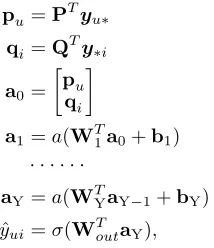
pu=PTyu∗
qi=QTy∗i
a0=
[
pu qi
]
a1=a(WT1a0+b1)
· · · ·
aY=a(WTYaY−1+bY)
ˆ
yui=σ(WToutaY),
(7)
where P and Q are the parameter matrices of the linear embedding layers. The meanings of other notions are the same as CFNet-rl. In this manner, the representation learn-ing functions f(·)andg(·)are implemented by the linear embedding layers. The latent representationspuandqi are then aggregated by a simple concatenation operation. Fi-nally, MLP is used as the mapping functionh(·)to calcu-late the matching scoreyˆui. Notice that although concatena-tion is the simplest aggregaconcatena-tion operaconcatena-tion, it maintains max-imally the information passed from the previous layer and allows to make full use of the flexibility of the MLP model.
In summary, the matching function learning component used in this paper is implemented by Equation 7, which is called CFNet-ml.
Table 1: Statistics of the Datasets.
Statistics ml-1m lastfm AMusic AToy # of Users 6040 1741 1776 3137 # of Items 3706 2665 12929 33953 # of Ratings 1000209 69149 46087 84642 Sparsity 0.9553 0.9851 0.9980 0.9992
Fusion and Learning
Fusion In the previous two subsections, we have presented the MLP implementations for the two types of methods, i.e., the CFNet-rl model and the CFNet-ml model. To incorporate these two models, we need to design a strategy to fuse them so that they can enhance each other. One of the most com-mon fusing strategies is to concatenate the learned represen-tations to obtain a joint representation and then feed it into a fully connected layer. In our case, for CFNet-rl, the match-ing function shown in Equation 6 can be split into two steps. The model first calculates the element-wise product for user latent factor and item latent factor, and then sums it up with different weights. The product vector obtained in the first step is called the predictive vector in this paper. For CFNet-ml, the last layer of MLP is called the predictive vector as well. In both cases, the predictive vectors can be viewed as the representation for the corresponding user-item pair. Since the two types of CF methods have different advantages and learn the predictive vectors from different perspectives, the concatenation of the two predictive vectors will result in a stronger and more robust joint representation for the user-item pair. What’s more, the consequent fully connected layer enables the model to assign different weights on the features contained in the joint representation. Suppose we denote the predictive vectors of the representation learning component and the matching function learning component as arl
Y and
amlY respectively, then the output of the fusion model can be defined as:
ˆ
yui =σ(WTout
[
arl
Y
amlY
]
). (8)
Using Equation 8 to incorporate CFNet-rl and CFNet-ml, we finally obtain the proposed CFNet model. The architecture of CFNet is shown in Figure 2.
Learning As discussed in the previous section, the objec-tive function to minimize for the DeepCF framework is the binary cross-entropy function. To optimize the model, we use mini-batch Adam (Kingma and Ba 2014). The batch size is fixed to 256 and the learning rate is 0.001. The model pa-rameters are randomly initialized with a Gaussian distribu-tion (with a mean of 0 and standard deviadistribu-tion of 0.01) and the negative instancesY− are uniformly sampled from
un-observed interactions in each iteration.
Table 2: Comparison results of different methods in terms of NDCG@10 and HR@10.
Datasets Measures Existing methods CFNet Improvement of
ItemPop eALS DMF NeuMF CFNet-rl CFNet-ml CFNet CFNet vs. NeuMF
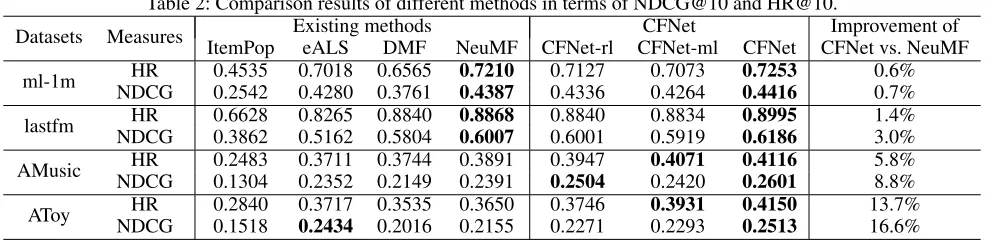
ml-1m HR 0.4535 0.7018 0.6565 0.7210 0.7127 0.7073 0.7253 0.6% NDCG 0.2542 0.4280 0.3761 0.4387 0.4336 0.4264 0.4416 0.7%
lastfm HR 0.6628 0.8265 0.8840 0.8868 0.8840 0.8834 0.8995 1.4% NDCG 0.3862 0.5162 0.5804 0.6007 0.6001 0.5919 0.6186 3.0%
AMusic HR 0.2483 0.3711 0.3744 0.3891 0.3947 0.4071 0.4116 5.8% NDCG 0.1304 0.2352 0.2149 0.2391 0.2504 0.2420 0.2601 8.8%
AToy HR 0.2840 0.3717 0.3535 0.3650 0.3746 0.3931 0.4150 13.7% NDCG 0.1518 0.2434 0.2016 0.2155 0.2271 0.2293 0.2513 16.6%
CFNet-ml, we can pre-train these two components and use them to initialize CFNet. Notice that rl and CFNet-ml are trained from scratch using Adam while the CFNet with pre-training is optimized by the vanilla SGD. This is because Adam requires momentum information of the pre-vious updated parameters which is not saved in CFNet with pre-training.
Experiments
In this section, we conduct experiments to demonstrate the effectiveness of the proposed DeepCF framework and its MLP implementation (i.e., the CFNet model). We also ver-ify the utility of pre-training by comparing the CFNet mod-els with and without pre-training. Hype-parameter sensitiv-ity analysis is discussed in the last part of this section. We implement the proposed model based on Keras1and Tensor-flow2, which will be released publicly upon acceptance.
Experimental Settings
Dataset We evaluate our models on four public datasets: MovieLens 1M (ml-1m)3, LastFM (lastfm)4, Amazon music (AMusic) and Amazon toys (AToy)5. The ml-1m dataset has been preprocessed by the provider. Each user has at least 20 ratings and each item has been rated by at least 5 users. We process the other three datasets in the same way. The statistics of these four datasets are summarized in Table 1.
Evaluation Protocols Following (He et al. 2017), we adopt the leave-one-out evaluation, i.e., the latest interaction of each user is used for testing. Since ranking all items is time-consuming, we randomly sample 100 unobserved in-teractions for each user. We then rank the 100 items with the test item according to the prediction. Two widely adopted evaluation measures, namely Hit Ratio (HR) and Normal-ized Discounted Cumulative Gain (NDCG) are used to eval-uate the ranking performance. The ranked list is truncated at 10 for both measures. Intuitively, the HR measures whether the test item is present on the top-10 list or not, and the
1
https://github.com/keras-team/keras
2
https://github.com/tensorflow/tensorflow
3https://grouplens.org/datasets/movielens/
4
http://www.dtic.upf.edu/∼ocelma/
MusicRecommendationDataset/
5
http://jmcauley.ucsd.edu/data/amazon/
NDCG measures the ranking quality which assigns higher scores to hit at top position ranks.
Comparison Results
The comparison methods are as follows.
• ItemPopis a non-personalized method that is often used as a benchmark for recommendation tasks. Items are ranked by their popularity, i.e., the number of interactions. • eALS(He et al. 2016b) is a state-of-the-art MF method. It uses all unobserved interactions as negative instances and weights them non-uniformly by item popularity.
• DMF(Xue et al. 2017) is a state-of-the-art representation learning-based MF method which performs deep matrix factorization with normalized cross entropy loss as loss function. We ignore the explicit ratings and take the im-plicit feedback as input.
• NeuMF (He et al. 2017) is a state-of-the-art matching function learning-based MF method which combines hid-den layers of GMF and MLP to learn the interaction func-tion based on cross entropy loss. It is the most related work to the proposed models. Different from our mod-els, it adapts the deep+shallow pattern which has been widely adopted in many works such as (Cheng et al. 2016; Guo et al. 2017). What’s more, NeuMF takes IDs as input and the proposed CFNet takes interaction matrix as input. Since the proposed models focus on modeling the rela-tionship between users and items, we mainly compare with user-item models. The comparison results are listed in Ta-ble 2. The best and the second best scores are shown in bold. According to the table, we have the following key observa-tions:
• CFNet achieves the best performance in general and ob-tains high improvements over the state-of-the-art meth-ods. Most importantly, such improvement increases along with the increasing of data sparsity, where the datasets are arranged in the order of increasing data sparsity. This justifies the effectiveness of the proposed DeepCF framework that combines representation learning-based CF methods and matching function learning-based CF methods.
Table 3: Performance of CFNet with/without pre-training. Without pre-training With pre-training
Datasets HR NDCG HR NDCG
ml-1m 0.6962 0.4222 0.7253 0.4416 lastfm 0.8685 0.5920 0.8995 0.6186 AMusic 0.3530 0.2204 0.4116 0.2601 AToy 0.3067 0.1653 0.4150 0.2513
the non-parametric cosine similarity with element-wise product and a parametric neural network layer signifi-cantly improves the performance.
Impact of Pre-training
Different from the CFNet with pre-training, we use mini-batch Adam to learn the CFNet without pre-training with random initializations. As shown in Table 3, the CFNet with pre-training outperforms the CFNet without pre-training in all cases. This result verifies the utility of the pre-training process which ensures CFNet-rl and CFNet-ml to learn fea-tures from different perspectives and therefore allows the model to generate better results.
Sensitivity Analysis of Hyperparameters
Negative Sampling Ratio To analyze the effect of nega-tive sampling ratio, we test different neganega-tive sampling ratio, i.e., the number of negative samples per positive instance, on the ml-1m dataset. From the results shown in Figure 3, we can find that sampling merely one or two instances is not enough and sampling more negative instances is helpful. The best HR@10 is obtained when the negative sampling ratio is set to 3 and the best NDCG@10 is obtained when the nega-tive sampling ratio is set to 6. Overall, the optimal sampling ratio is around 3 to 7. Sampling more negative instances not only requires more time to train the model but also degrades the performance, which is consistent with the results shown in (He et al. 2017).
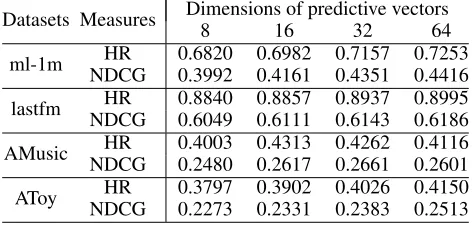
The Number of Predictive Factors Another hyper-parameter used in the CFNet model is the number of predic-tive factors, i.e., the dimensions ofarl
Y anda
ml
Y . As shown
in Table 4, the proposed model generates the best perfor-mance with 64 predictive factors on most of the datasets ex-cept the AMusic dataset. On the Amusic dataset, the best performance is achieved with 16 factors. According to our observation, more predictive factors usually lead to better performances since it endows the model with larger capabil-ity and greater abilcapabil-ity of representation.
Conclusion and Future Work
In this work, we have explored the possibility of fusing rep-resentation learning-based CF methods and matching func-tion learning-based CF methods. We have devised a general framework DeepCF and proposed its MLP implementation, i.e., CFNet. The DeepCF framework is simple but effective. Although we have implemented the two components with MLP in this paper, different types of representation learning-based methods and matching function learning-learning-based
1XPEHURI1HJDWLYHV
+5#
&)1HWUO &)1HWPO &)1HW
1XPEHURI1HJDWLYHV
1'&*#
&)1HWUO &)1HWPO &)1HW
Figure 3: The effect of negative sampling ratio on perfor-mance on the ml-1m dataset.
Table 4: Performance of CFNet with different number of predictive factors.
Datasets Measures Dimensions of predictive vectors
8 16 32 64
ml-1m HR 0.6820 0.6982 0.7157 0.7253 NDCG 0.3992 0.4161 0.4351 0.4416
lastfm HR 0.8840 0.8857 0.8937 0.8995 NDCG 0.6049 0.6111 0.6143 0.6186
AMusic HR 0.4003 0.4313 0.4262 0.4116 NDCG 0.2480 0.2617 0.2661 0.2601
AToy HR 0.3797 0.3902 0.4026 0.4150 NDCG 0.2273 0.2331 0.2383 0.2513
ods can be integrated under the DeepCF framework. This work points out the significance of incorporating these two types of methods, allowing the model to have both great flexibility to learn the complex matching function and high efficiency in learning low-rank relations between users and items. In future work, we will study the following problems. First, auxiliary data can be used to further improve the initial representations of users and items. Richer information usu-ally leads to better performance. Second, except for element-wise product and concatenation, it is also very interesting to explore other aggregation methods. Third, DeepCF does not only support point-wise loss, using pairwise loss is also a feasible solution for learning the model. Finally, although we use DeepCF to solve the top-N recommendation prob-lem with implicit data, it’s also suitable for other data mining tasks that study the relations between two kinds of objects.
Acknowledgments
This work was supported by NSFC (61502543, 61876193 and 61672313), Guangdong Natural Science Funds for Distinguished Young Scholar (2016A030306014), Tip-top Scientific and Technical Innovative Youth Talents of Guangdong special support program (2016TQ03X542), Na-tional Key Research and Development Program of China (2016YFB1001003), and NSF through grants IIS-1526499, IIS-1763325, and CNS-1626432.
References
Beutel, A.; Covington, P.; Jain, S.; Xu, C.; Li, J.; Gatto, V.; and Chi, E. H. 2018. Latent cross: Making use of context in recurrent recommender systems. InWSDM, 46–54. Cheng, H.-T.; Koc, L.; Harmsen, J.; Shaked, T.; Chandra, T.; Aradhye, H.; Anderson, G.; Corrado, G.; Chai, W.; Ispir, M.; et al. 2016. Wide & deep learning for recommender systems. In Proceedings of the 1st Workshop on Deep Learning for Recommender Systems, 7–10.
Erhan, D.; Bengio, Y.; Courville, A.; Manzagol, P.-A.; Vin-cent, P.; and Bengio, S. 2010. Why does unsupervised pre-training help deep learning? Journal of Machine Learning Research11(Feb):625–660.
Funk, S. 2006. Netflix update: Try this at home. http:// sifter.org/∼simon/journal/20061211.html. Online; accessed
27-June-2018.
Guo, H.; Tang, R.; Ye, Y.; Li, Z.; and He, X. 2017. Deepfm: A factorization-machine based neural network for CTR pre-diction. arXiv preprint arXiv:1703.04247.
He, X., and Chua, T.-S. 2017. Neural factorization machines for sparse predictive analytics. InSIGIR, 355–364.
He, R., and McAuley, J. 2016. VBPR: Visual bayesian per-sonalized ranking from implicit feedback. InAAAI, 144– 150.
He, K.; Zhang, X.; Ren, S.; and Sun, J. 2016a. Deep residual learning for image recognition. InCVPR, 770–778. He, X.; Zhang, H.; Kan, M.-Y.; and Chua, T.-S. 2016b. Fast matrix factorization for online recommendation with implicit feedback. InSIGIR, 549–558.
He, X.; Liao, L.; Zhang, H.; Nie, L.; Hu, X.; and Chua, T.-S. 2017. Neural collaborative filtering. InWWW, 173–182.
He, X.; Du, X.; Wang, X.; Tian, F.; Tang, J.; and Chua, T.-S. 2018. Outer product-based neural collaborative filtering. In
IJCAI.
Hornik, K.; Stinchcombe, M.; and White, H. 1989. Mul-tilayer feedforward networks are universal approximators.
Neural networks2(5):359–366.
Hu, Q.-Y.; Zhao, Z.-L.; Wang, C.-D.; and Lai, J.-H. 2017. An item orientated recommendation algorithm from the multi-view perspective. Neurocomputing269:261–272. Hu, Q.-Y.; Huang, L.; Wang, C.-D.; and Chao, H.-Y. 2018. Item orientated recommendation by multi-view intact space learning with overlapping.Knowledge-Based Systems. Hu, Y.; Koren, Y.; and Volinsky, C. 2008. Collaborative filtering for implicit feedback datasets. InICDM, 263–272.
Hu, L.; Sun, A.; and Liu, Y. 2014. Your neighbors affect your ratings: on geographical neighborhood influence to rat-ing prediction. InSIGIR, 345–354.
Kingma, D. P., and Ba, J. 2014. Adam: A method for stochastic optimization.arXiv preprint arXiv:1412.6980. Koren, Y.; Bell, R.; and Volinsky, C. 2009. Matrix factoriza-tion techniques for recommender systems.Computer42(8). Koren, Y. 2008. Factorization meets the neighborhood: a multifaceted collaborative filtering model. In KDD, 426– 434.
Koren, Y. 2009. Collaborative filtering with temporal dy-namics. InKDD, 447–456.
Ma, H. 2013. An experimental study on implicit social rec-ommendation. InSIGIR, 73–82.
Mnih, A., and Teh, Y. W. 2012. Learning label trees for probabilistic modelling of implicit feedback. InNIPS, 2816– 2824.
Oard, D. W.; Kim, J.; et al. 1998. Implicit feedback for rec-ommender systems. InProceedings of the AAAI workshop on recommender systems, volume 83.
Pan, R.; Zhou, Y.; Cao, B.; Liu, N. N.; Lukose, R.; Scholz, M.; and Yang, Q. 2008. One-class collaborative filtering. In
ICDM, 502–511.
Rendle, S.; Freudenthaler, C.; Gantner, Z.; and Schmidt-Thieme, L. 2009. BPR: Bayesian personalized ranking from implicit feedback. InUAI, 452–461.
Salakhutdinov, R., and Mnih, A. 2008. Bayesian probabilis-tic matrix factorization using Markov chain Monte Carlo. In
ICML, 880–887.
Sedhain, S.; Menon, A. K.; Sanner, S.; and Xie, L. 2015. Au-torec: Autoencoders meet collaborative filtering. InWWW, 111–112.
Serban, I. V.; Sordoni, A.; Bengio, Y.; Courville, A. C.; and Pineau, J. 2016. Building end-to-end dialogue systems us-ing generative hierarchical neural network models. InAAAI, volume 16, 3776–3784.
Srivastava, R.; Palshikar, G. K.; Chaurasia, S.; and Dixit, A. 2018. What’s next? a recommendation system for industrial training. Data Science and Engineering3(3):232–247. Wang, C.-D.; Deng, Z.-H.; Lai, J.-H.; and Yu, P. S. 2018a. Serendipitous recommendation in e-commerce us-ing innovator-based collaborative filterus-ing. IEEE TCYB. Wang, X.; He, X.; Feng, F.; Nie, L.; and Chua, T.-S. 2018b. Tem: Tree-enhanced embedding model for explainable rec-ommendation. InWWW, 1543–1552.
Wu, Y.; DuBois, C.; Zheng, A. X.; and Ester, M. 2016. Col-laborative denoising auto-encoders for top-n recommender systems. InWSDM, 153–162.
Xu, J.; He, X.; and Li, H. 2018. Deep learning for matching in search and recommendation. In SIGIR Tutorial, 1365– 1368.
Xue, H.-J.; Dai, X.-Y.; Zhang, J.; Huang, S.; and Chen, J. 2017. Deep matrix factorization models for recommender systems. InIJCAI, 3203–3209.
Zhao, Z.-L.; Huang, L.; Wang, C.-D.; and Huang, D. 2018. Low-rank and sparse cross-domain recommendation algo-rithm. InDASFAA.
Zhao, Q.; Shi, Y.; and Hong, L. 2017. GB-CENT: Gradi-ent boosted categorical embedding and numerical trees. In
WWW, 1311–1319.