https://doi.org/10.5194/ars-15-181-2017
© Author(s) 2017. This work is distributed under the Creative Commons Attribution 3.0 License.
Optimizing the wireless power transfer over MIMO Channels
Karsten Wiedmann and Tobias Weber
Institute of Communications Engineering, University of Rostock, Richard-Wagner-Str. 31, 18119 Rostock, Germany
Correspondence to:Karsten Wiedmann ([email protected]) and Tobias Weber ([email protected])
Received: 6 December 2016 – Accepted: 27 March 2017 – Published: 21 September 2017
Abstract. In this paper, the optimization of the power transfer over wireless channels having multiple-inputs and multiple-outputs (MIMO) is studied. Therefore, the trans-mitter, the receiver and the MIMO channel are modeled as multiports. The power transfer efficiency is described by a Rayleigh quotient, which is a function of the channel’s scat-tering parameters and the incident waves from both trans-mitter and receiver side. This way, the power transfer ef-ficiency can be maximized analytically by solving a gen-eralized eigenvalue problem, which is deduced from the Rayleigh quotient.
As a result, the maximum power transfer efficiency achiev-able over a given MIMO channel is obtained. This maxi-mum can be used as a performance bound in order to bench-mark wireless power transfer systems. Furthermore, the op-timal operating point which achieves this maximum will be obtained. The optimal operating point will be described by the complex amplitudes of the optimal incident and reflected waves of the MIMO channel. This supports the design of the optimal transmitter and receiver multiports.
The proposed method applies for arbitrary MIMO chan-nels, taking transmitter-side and/or receiver-side cross-couplings in both near- and farfield scenarios into considera-tion. Special cases are briefly discussed in this paper in order to illustrate the method.
1 Introduction
The efficiency of wireless power transfer (WPT) systems is a crucial figure of merit. In order to optimize and/or as-sess WPT systems, the maximum power transfer efficiency (PTE), which can be achieved over a given channel, has to be investigated. This gives rise to an optimization problem since the maximum PTE as well as the optimum channel
in-put and outin-put, i.e., the optimal operating point, are not a-priori known in general.
parame-ters. Unfortunately, an analytical solution of the optimization problem was not presented.
As can be seen, for the best knowledge of the authors, the WPT optimization over general MIMO channels is not sufficiently investigated in the literature so that basic in-sights regarding the PTE maximization over MIMO chan-nels are missing, e.g., the influence of transmitter-side and/or receiver-side cross-couplings.
The contribution of this paper is in the investigation of the optimal operating point, which maximizes the PTE over a given MIMO channel. The optimal operating point will be described by the complex amplitudes of the optimal incident and reflected waves of the MIMO channel. Considering N transmit antennas andMreceive antennas, the transmitter is modeled as an activeN-port and the receiver as a passive M-port so that the MIMO channel can be modeled as a passive (N+M)-port. It is assumed that the scattering parameters are fully known, e.g., by measurement or simulation. No fur-ther restrictions on the WPT systems under investigation are required.
In order to find the optimum operating point, the PTE def-inition stated in the aforementioned literature is adopted. As Yuan et al. (2013) for the 2×2 system, the MIMO channel is described by its scattering parameters yielding a Rayleigh quotient. Different to the approach of Yuan et al. (2013), the derived Rayleigh quotient will be reformulated as a function of the scattering parameters of the MIMO channel and the incident waves from both transmitter and receiver side. The Rayleigh quotient will be solved by determining the eigen-values of a generalized eigenvalue problem, which deduces from the derived Rayleigh quotient. Fortunately, the solution yields both the maximum PTE and the corresponding opti-mal incident and reflected waves that achieve the maximum. As will be discussed, the proposed optimization framework applies for arbitrary MIMO channels taking transmitter-side and/or receiver-side cross-couplings in both near- and farfield scenarios into consideration. However, if the scattering matrix features certain properties, e.g., due to matched ports or due to the absence of antenna array cross-couplings, the mathematical effort reduces significantly and the outcomes of the proposed method coincide with the specific solutions in the literature.
The optimization framework can be used to gain insights in the WPT over arbitrary MIMO channels so that the de-sign of the optimal transmitter and receiver multiports is sup-ported. Furthermore, if only suboptimal transmitter and/or receiver multiports can be applied, the herein derived PTE can be regarded as a performance bound, which can be used in order to assess and/or enhance WPT systems.
Structure Section 2 introduces the system model. The op-timization framework is subsequently introduced in Sect. 3. The proposed framework will be applied to the analysis of different special cases in Sect. 4 in order to demonstrate the method. The paper concludes in Sect. 5.
aT1
bT1
aTN
bTN (
N+M)-port T1
TN
R1
RM
aR1
bR1
aRM
bRM
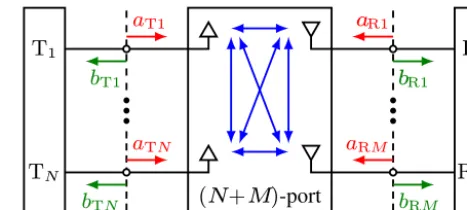
Figure 1.Modeling a MIMO WPT system by means of the network theory.
Notation Column vectors are denoted by bold italic letters andk·kis the Euclidean norm of a vector. Matrices are denoted by capitalized bold letters. The matrices IN
and0N×M denote the N×N-identity matrix and the
N×M-zero matrix, respectively. The superscripts∗,T and−1denote the conjugate complex, the transposition and the matrix inverse, respectively.
2 System model
A WPT system havingN transmit antennas andM receive antennas is considered, see Fig. 1. Here, the MIMO channel is modeled as an(N+M)-port, the transmitter is an active N-port and the receiver is a passiveM-port. Since WPT sys-tems reasonably operate at a single transmission frequency, see the discussions in Grover and Sahai (2010), the following investigations are done for one operating frequency as well. The channel input vectora, which contains both the incident waves at the transmitter sideaTx= [aT1· · ·aTN]Tand at the
receiver sideaRx= [aR1· · ·aRM]T, reads
a= [aT1· · ·aTN
| {z } aTTx
aR1· · ·aRM
| {z } aT
Rx
]T. (1)
Accordingly, the channel output vector is defined as b= [bT1· · ·bTN
| {z } bTTx
bR1· · ·bRM
| {z } bTRx
]T (2)
and contains the reflected waves at the transmit-ter side bTx= [bT1· · ·bTN]T and at the receiver side
bRx= [bR1· · ·bRM]T. Assuming the multiport to be linear,
the relation between the incident waves in Eq. (1) and the reflected waves in Eq. (2) can be expressed by scattering parameters (Pozar, 2012) in form of a block matrix S, reading
bTx bRx
=
STT STR SRT SRR
| {z }
S
aTx aRx
, (3)
and the receiver array, respectively, and SRT∈CM×N and STR∈CN×M represent the MIMO channel in forward and backward direction, respectively.
The transmitter radiates the power PTx=
1 2
kaTxk2− kbTxk2
=1 2a
∗T IN−S
∗T
TTSTT −S
∗T TTSTR −S∗TRTSTT −S∗TRTSTR !
| {z }
B
a
≥0 . (4)
It is worth noticing that in Eq. (4) some manipulations are done in order to obtain the transmitted powerPTxas a func-tion of the channel input vector a alone. Furthermore, the radiated powerPTxis constrained to be non-negative in or-der to ensure the that power is transferred from the transmit-ter into the multiport. Analogously, the received powerPRx, which is the power dissipated in the load at the receiver side, is
PRx= 1 2
kbRxk2− kaRxk2
=1 2a
∗T S
∗T
RTSRT S
∗T RTSRR S∗T
RRSRT S
∗T
RRSRR−IM !
| {z }
A
a
≥0. (5)
For convenience, the Hermitian matrices
A∈C(N+M)×(N+M)andB∈C(N+M)×(N+M)are introduced.
3 Optimization problem
The power transfer efficiency (PTE) η is defined in accor-dance to (Hui et al., 2014; Yuan et al., 2013) as the ratio of the dissipated power in the load PRx to the total transmit-ted powerPTx. The total system efficiency is not discussed within the following optimization so that power losses in the source are not considered here, see the discussion in Hui et al. (2014).
Using the Eqs. (1)–(5), the PTE can be written as η=dissipated power in the loadPRx
total transmitted powerPTx =a
∗TAa
a∗TBa, (6) which is a generalized Rayleigh quotient (Moon and Stirling, 2000). On the basis of Eq. (6), the optimization problem to be solved reads
ηi =max
a η (7)
subject to: PRx, PTx≥0.
Equating the gradient of the generalized Rayleigh quotientη to zero, one finds thatηreaches an extreme value ifasolves the generalized eigenvalue problem
Aai=ηiBai. (8)
aT
bT
(1+M)-port
T
R1
RM aR1
bR1
aRM
bRM
SR1T
STR1
SRMT
STRM
Figure 2.Modeling a SIMO WPT system by means of the network theory. Cross-coupling at the receive antenna array is neglected. STR= [STR1· · ·STRM]T=01×M holds true for an unidirectional channel model.
Notice that the multiport is assumed to be passive, i.e. a∗Ta≥b∗Tb, so that together with the constraints PRx, PTx≥0, only the solutions of the generalized eigen-value problem of Eq. (8) with 0≤ηi≤1 are relevant for the
solution of Eq. (7). Corresponding solutions are denoted as WPT in the forward direction in the following. If the MIMO channel can be considered as unidirectional, then the con-straints become irrelevant.
4 Examples
4.1 SIMO WPT systems
First, SIMO WPT systems, see Fig. 2, are considered to illustrate the convenience of the new approach. It is as-sumed at this point that the receive antennas are well in the farfield of the transmit antenna and that power transmission in the forward direction is possible, i.e.,kSRTk>0. This mo-tivates an unidirectional channel model with STR=01×M
(Ivrlac and Nossek, 2010). For simplification, receiver-side cross-couplings are neglected at this point and the ports are assumed to be ideally matched. Then, it is STT=0, SRR=0M×M. Having said this, the nonsingular Hermitian
matrix of Eq. (5) reads
A=
kSRTk2 01×M
0M×1 −IM
!
, (9)
and the Hermitian matrix of Eq. (4) reads
B=
1 01×M
0M×1 0M×M
! =
1 0M×1
1 01×M . (10)
Since the inverse of the matrixAexits, the generalized eigen-value problem of Eq. (8) reduces to the specific eigeneigen-value problem
1 ηi
Using the matrix decomposition of Eq. (10), the specific eigenvalue problem of Eq. (11) yields
1 ηi
ai=
1 ηi aT aRx = 1
kSRTk2
aT 0M×1
. (12)
As a result, only one relevant solution with the eigenvalue
η1= kSRTk2 (13)
is obtained. Since 0≤η1≤1, the maximum PTE is accord-ingly achieved in the forward direction. Straightforwardly, the optimal incident and reflect Eqs. (12) and (3), reading a1=
h aT
|{z} aT
Tx 01×M
| {z } aT
Rx iT
, (14)
b1= h
0 |{z}
bTTx aTSTRT | {z } bTRx
iT
. (15)
As can be seen, an optimal receiver multiport for this sce-nario must realize zero reflection. However, this does not hold true for arbitrary MIMO channels, which will be illus-trated below in the example of receiver-side cross-couplings. SettingM=1 in the above discussion directly yields the SISO solution, i.e.,η1= |SRT|2anda1= [1 0]T. This corre-sponds to the literature when transmitter and receiver match-ing is considered for the PTE optimization of SISO WPT systems, compare e.g., Yuan et al. (2010); Agbinya (2012).
For simplicity, the number of receive antennas is set to M=2 in the following discussion. A special case of cross-couplings between the receive antennas is S23=S32=K, where the coupling is assumed to be reciprocal and quan-tified by 0≤ |K|<1. Reflections are still neglected so that SRR=
0 K
K 0
, (16)
which modifies the matrixAof Eq. (9) to
A=
kSRTk2 KS21∗ KS21∗ K∗S31 K2−1 0 K∗S21 0 K2−1
. (17)
Applying again the discussed solution of Eq. (12), one ob-tains the relevant solution
1 ηi
ai=
1 ηi aT aR1 aR2 =
1− |K|2 kSRTk2
aT aTK∗S31
1− |K|2 aTK∗S21
1− |K|2 , (18)
with the corresponding eigenvalue
η1,c=
kSRTk2
1− |K|2 (19)
and the optimal incident and reflected waves
a1,c=
aT
|{z}
aTx
aTK∗S31
1− |K|2 | {z }
aR1
aTK∗S21
1− |K|2 | {z }
aR2 T
, (20)
b1,c=
0 |{z}
bTx
aTS21
1− |K|2 | {z }
bR1
aTS31
1− |K|2 | {z }
bR2 T
. (21)
As can be seen by comparing to Eq. (13), the cross-couplings enhance the PTE in this particular case. Note that the in-cident wavesaRx at the receiver side are now nonzero due to the antenna cross-couplings. This may become crucial if |aR1|>|bR1| or |aR2|>|bR2|, respectively, since then one receive antenna has to be switched to transmit mode in order to maximize the PTE. The investigation of this phenomenon is beyond the scope of this paper. Thus, the influence of an-tenna cross-couplings on the PTE may be studied in more detail in a future work.
4.2 MISO WPT systems
Next, a bidirectional channel withkSRTk>0 andkSTRk>0 is considered for the scenario of Sect. 4.1, see Fig. 2. Whereas Eq. (9) still holds, Eq. (10) changes to
B= 1 01×M
0M×1 −S∗TRTSTR !
(22)
so that the matrixBcannot be decomposed anymore. As a consequence, the characteristic polynomial
IN+M−ηiA−1B
a=0 (23)
of the specific eigenvalue problem of Eq. (11) has to be eval-uated. Equating the determinant to zero followed by a substi-tution of the Eqs. (9) and (22) yields
ηiN+M−2kSRTk2−ηi kSTRk2ηi−1
=0 . (24) As a result, one obtains η0=0, which is a semisim-ple eigenvalue having a multiplicity equal to N+M−2, and two nonzero eigenvalues. The first nonzero eigenvalue η1= kSRTk2agrees with the solution in Eq. (13) and corre-sponds to the WPT in the forward direction, which is due to the assumed matched ports and the absence of antenna array cross-couplings. Again, this holds true only for the consid-ered scenario.
aT1
bT1
aT2
bT2 4-port
T1
T2
R1
R2
aR1
bR1
aR2
bR2
S13
S13 S14 S14
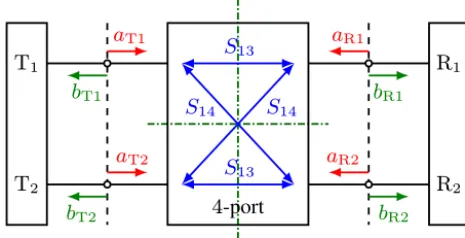
Figure 3. Modeling the WPT over a (2×2) channel having a double-symmetric scattering matrix.
max a
1
η (25)
subject to: PRx, PTx≤0.
This is of interest if the transmitter and receiver function-ality shall be exchanged. Then, 1/η2= kSTRk2is the maxi-mum PTE, which can be achieved in backward direction over the corresponding (M×1)-MISO channel. Substituting the Eqs. (9) and (22) as well as η2 into the generalized eigen-value problem of Eq. (8), one easily proofs that
a2= h
0 |{z}
aTTx S∗TR |{z}
aTRx iT
(26)
and b2=
h kSTRk2 | {z }
bT Tx
01×M
| {z } bT
Rx iT
(27)
describe the corresponding operating point for the WPT sys-tem. This solution is known as “energy beamforming” in the literature, see Zhang and Ho (2013).
4.3 Directional coupler
Furthermore, a (2×2)-MIMO channel is considered in or-der to discuss the optimization framework. For simplicity, the scattering matrix is considered to be double-symmetric, i.e., Smn=Snm,∀m, n=1. . .N, see Fig. 3. Again, the ports are
matched and both transmitter-side and receiver-side cross-couplings are neglected. The corresponding 4-port scattering matrix is
S=
0 0 S13 S14 0 0 S14 S13 S13 S14 0 0 S14 S13 0 0
. (28)
With the substitution κ=S13S14∗ +S
∗
13S14=2 Re S13S14∗
, (29)
the matrix
A=
|S13|2+ |S14|2 κ 0 0 κ |S13|2+ |S14|2 0 0
0 0 1 0
0 0 0 1
(30)
is obtained from Eq. (5) and, analogously, the matrix
B=
1 0 0 0
0 1 0 0
0 0 −|S13|2− |S14|2 −κ 0 0 −κ −|S13|2− |S14|2
(31)
is obtained from Eq. (4). Again, the inverse of the matrixB exits so that the corresponding specific eigenvalue problem has to be solved. Regarding the WPT in the forward direc-tion, the eigenvectors are
η1,2= |S13|2+ |S14|2±κ (32) with the corresponding channel vectors
a1,2= h
±1 1 | {z }
aTTx
0 0 | {z } aTRx
iT
, (33)
b1,2= h
0 0 | {z } bTTx
S14±S13 S13±S14
| {z }
bTRx
iT
. (34)
As can be seen, two relevant solutions for the optimal inci-dent waves can be found. The basic difference is in the argu-ment ofaT1. If
|arg(S13)+arg(S14)|< π
2, (35)
i.e., the angle between S13 and S14 is smaller than π/2, κin Eq. (32) is positive and the optimal way for WPT in the forward direction is to transmit the same signal via both transmit antennas. If contrarily the angle is larger thanπ/2, κin Eq. (32) is negative and the optimal way is to transmit twoπ-phase shifted signals, each via one transmit antenna.
Due to the symmetry, the eigenvalues for the backward direction can be easily found by using
η3,4= 1 η1,2
. (36)
Now, the (2×2)-MIMO system described by the scatter-ing matrix of Eq. (28) is further assumed to be lossless, i.e., SS∗T=I4. Then, the matrix of Eq. (28) equals the scatter-ing matrix of an ideal directional coupler (Maloratsky, 2003). The relative phase difference of the ideal coupler’s output is ±π/2 so that the constraint
arg(S13)+arg(S14)= ± π
2 (37)
follows. Without loss of generality, arg(S13)=0 is assumed in the following. Then and by means of Eq. (37), the equality
S14= −S∗14 (38)
holds so that
κ=0, (39)
compare Eq. (29). Using the Eqs. (37)–(39), the matrices
A=B=
I2 02×2 02×2 −I2
(40) are obtained from the Eqs. (30)–(31), respectively. Since the inverse of the matrix Bstill exists, the specific eigenvalue problem
I4ai=ηiai (41)
is obtained from Eq. (8). As a result, all eigenvalues are equal to one, which is trivial due to the absence of losses in this sce-nario. Eq. (41) is fulfilled by arbitraryai so that all possible
waves are optimal for the ideal directional coupler.
5 Conclusions
This paper discusses an optimization framework for the PTE over general MIMO channels using network theory. This framework yields the maximum achievable PTE and the cor-responding operating point.
The proposed framework can be used in order to gain ba-sic insights into the wireless power transfer systems from a theoretical point of view. This is demonstrated in the paper by means of special cases, e.g., SIMO, MISO and a special (2×2)-MIMO system. As it is shown, a significant reduction in the analysis effort is obtained, if the considered multiport features certain properties. It is beyond the scope of this pa-per to entirely discuss all propa-perties so that further investiga-tions may have to be done.
In future work, simulations and real-world measurements may be carried out in order to assess the performance gap of suboptimal system realizations and the herein determined upper bounds. Furthermore, the relevance of the proposed framework for the performance maximization of the com-bined communication and power transfer over MIMO chan-nels may be investigated.
Data availability. No data sets were used in this article.
Competing interests. The authors declare that they have no conflict of interest.
Edited by: J. Anders
Reviewed by: two anonymous referees
References
Agbinya, J. I. (Ed.): Wireless Power Transfer, River Publishers, Aal-borg, 2012.
Grover, P. and Sahai, A.: Shannon meets Tesla: Wireless informa-tion and power transfer, IEEE Internainforma-tional Symposium on In-formation Theory, 2363–2367, 2010.
Hui, S., Zhong, W., and Lee, C.: A Critical Review of Recent Progress in Mid-Range Wireless Power Transfer, IEEE T. Power Electr., 29, 4500–4511, 2014.
Ivrlac, M. and Nossek, J.: Toward a Circuit Theory of Communica-tion, IEEE T. Circuits-I, 57, 1663–1683, 2010.
Kim, J. W., Son, H. C., Kim, D. H., and Kim, K. H.: Analysis of wireless energy transfer to multiple devices using CMT, Asia-Pacific Microwave Conference, 2149–2152, 2010.
Lang, H.-D., Ludwig, A., and Sarris, C.: Convex Optimization of Wireless Power Transfer Systems With Multiple Transmitters, IEEE T. Antenn. Propag., 62, 4623–4636, 2014.
Lee, J. and Nam, S.: Fundamental Aspects of Near-Field Coupling Small Antennas for Wireless Power Transfer, IEEE T. Antenn. and Propag., 58, 3442–3449, 2010.
Maloratsky, L.: Passive RF & Microwave Integrated Circuits, Else-vier Science, Burlington, 2003.
Moon, T. K. and Stirling, W. C.: Mathematical Methods and Algo-rithms for Signal Processing, Prentice Hall, Upper Saddle River, 2000.
Nguyen, M. Q., Plesa, D., Rao, S., and Chiao, J. C.: A multi-input and multi-output wireless energy transfer system, IEEE MTT-S International Microwave Symposium, 1–3, 2014.
Pozar, D. M.: Microwave Engineering, John Wiley & Sons, Inc, Hoboken, 4. Edn., 2012.
Wallace, J. W. and Jensen, M. A.: Mutual coupling in MIMO wire-less systems: a rigorous network theory analysis, Transactions on Wireless Communications, 3, 1317–1325, 2014.
Wu, M., Chen, Q., and Yuan, Q.: Analysis of near-field power trans-fer of multi-antenna using multiport scattering parameters, Pro-ceedings of the International Symposium on Antennas & Propa-gation, 313–316, 2013.
Xiang, Z. and Tao, M.: Robust Beamforming for Wireless Informa-tion and Power Transmission, IEEE Wireless CommunicaInforma-tions Letters, 1, 372–375, 2012.
Xu, J. and Zhang, R.: A General Design Framework for MIMO Wireless Energy Transfer With Limited Feedback, IEEE T. Sig-nal Proces., 64, 2475–2488, 2016.
Yoon, I.-J. and Ling, H.: Investigation of Near-Field Wireless Power Transfer Under Multiple Transmitters, IEEE Antenn. Wirel. Pr., 10, 662–665, 2011.
Wire-less Power Transfer System, IEEE T. Antenn. Propag., 58, 1751– 1758, 2010.
Yuan, Q., Wu, M., Chen, Q., and Sawaya, K.: Analysis of near-field power transfer using scattering parameters, European Con-ference on Antennas and Propagation, 3073–3075, 2013. Zargham, M. and Gulak, P.: Maximum Achievable Efficiency in
Near-Field Coupled Power-Transfer Systems, IEEE Transactions on Biomedical Circuits and Systems, 6, 228–245, 2012.
![Figure 2. Modeling a SIMO WPT system by means of the networktheory. Cross-coupling at the receive antenna array is neglected.STR = [STR1···STRM]T = 01×M holds true for an unidirectionalchannel model.](https://thumb-us.123doks.com/thumbv2/123dok_us/9634537.1945504/3.612.311.545.65.170/figure-modeling-networktheory-coupling-receive-antenna-neglected-unidirectionalchannel.webp)