The Thirty-Third AAAI Conference on Artificial Intelligence (AAAI-19)
Improving Search with Supervised Learning in Trick-Based Card Games
Christopher Solinas, Douglas Rebstock, Michael Buro
Department of Computing Science, University of Alberta Edmonton, Canada
{solinas,drebstoc,mburo}@ualberta.ca
Abstract
In trick-taking card games, a two-step process of state sam-pling and evaluation is widely used to approximate move val-ues. While the evaluation component is vital, the accuracy of move value estimates is also fundamentally linked to how well the sampling distribution corresponds the true distribu-tion. Despite this, recent work in trick-taking card game AI has mainly focused on improving evaluation algorithms with limited work on improving sampling. In this paper, we focus on the effect of sampling on the strength of a player and pro-pose a novel method of sampling more realistic states given move history. In particular, we use predictions about locations of individual cards made by a deep neural network — trained on data from human gameplay — in order to sample likely worlds for evaluation. This technique, used in conjunction with Perfect Information Monte Carlo (PIMC) search, pro-vides a substantial increase in cardplay strength in the popular trick-taking card game of Skat.
1
Introduction
Games have always been at the forefront of AI research be-cause they provide a controlled, efficient, and predictable environment to study decision-making in various contexts. Researchers are constantly trying to develop new techniques that allow for intelligent decisions to be made in more com-plex environments.
Imperfect information games require players to make de-cisions without being able to observe the full state. This set-ting is attractive to researchers because it is a closer approx-imation to real life. To make good decisions, the player to move must account for the private holdings of every player in the game, and must consider that each action they take re-veals information about their holdings. These are just some of the reasons that algorithms developed for perfect infor-mation games may not translate well to games with hidden information.
For imperfect information games with information sets too large to game theoretically solve, most game-playing algorithms can be broken down into two key components: inference and state evaluation. State evaluation tells a player how advantageous a particular state is; whereas inference al-lows a player to determine the likelihood of said state. Both
Copyright c⃝2019, Association for the Advancement of Artificial Intelligence (www.aaai.org). All rights reserved.
components are vital to good play. Even if a player could perfectly evaluate every state in an information set, com-bining them with inaccurate inference can easily introduce catastrophic errors in the final move values. In trick-taking card games like Contract Bridge or Skat, private information slowly becomes public as cards are played, but every move each player makes can reveal additional information through careful reasoning. The most experienced human players are able to read into the implications of every opponent move and act accordingly.
In this paper, we investigate inference in trick-taking card games. We show that the history of moves in the game thus far can be used to infer the hidden cards of other players, and that this information can be used to considerably boost the performance of simple search-based evaluation techniques in the domain of Skat.
The rest of this paper is organized as follows. We first summarize the state of research related to state evaluation and inference for cardplay in trick-taking card games, and explain the basic rules of Skat — our application domain. Next, we describe a technique for performing state infer-ence by predicting the locations of individual cards using move history. Then, we provide statistically significant ex-perimental results that show the effectiveness of this type of inference in trick-based card games like Skat. Finally, we finish the paper with conclusions and ideas for future re-search.
2
Background and Related Work
Card games have long been an important application for researchers wishing to study imperfect information games. Recent advances in computer poker (Moravˇc´ık et al. 2017; Brown and Sandholm 2017) have led to theoretically sound agents which are able to outperform professional human players in the full variant of Poker called Heads Up No Limit Texas Hold’em. However, the same techniques have thus far been unable to find success in trick-taking card games be-cause they rely on expert abstractions in order to scale to such large games. Compact yet expressive abstractions are difficult to construct in trick-taking card games because ev-ery single card in each player’s hand can immensely affect the value of a state or action.
card games like Contract Bridge (Ginsberg 2001), Skat (Buro et al. 2009), Hearts and Spades (Sturtevant 2008). PIMC has been heavily criticized over the years, starting with Frank and Basin (1998) because it naively evades the imperfect information elements of the game tree. However, it has remained relevant because it is still among the state-of-the-art algorithms for these games. In Long et al. (2010) the authors attempt to understand this success and conclude that for classes of games with certain properties, including trick-taking card games, “PIMC will not suffer large losses in comparison to a game-theoretic solution.”
Furtak and Buro (2013) implement a recursive variant of PIMC (IIMC) to alleviate some of the issues pointed out by Frank and Basin — resulting in the current state-of-the-art player for Skat. Elsewhere, Information Set Monte Carlo Tree Search (ISMCTS) (Cowling, Powley, and Whitehouse 2012) addresses the same issues in three different domains, but as Furtak and Buro (2013) argue, the resulting move val-ues are biased because the player leaks private information to their playout adversaries by only sampling states consis-tent with the player’s private information and allowing the strategies of the playout adversaries to adapt across roll-outs. Sampling inconsistent states makes the search space intractable for many applications. Baier et al. (2018) pro-poses a method for biasing MCTS techniques by boosting the scores of nodes reached by following actions that are judged likely to be played by humans according to a super-vised model. Applying this to ISMCTS in the imperfect in-formation setting is straightforward, but the resulting algo-rithm neglects the action history occurring before the root of the search and samples states uniformly from root infor-mation set before proceeding. Each of these contributions improve state evaluation quality, but they fail to address the sampling problem investigated in this work.
Kermit (Buro et al. 2009; Furtak and Buro 2013) uses a table-based procedure that takes opponent bids or declara-tions into account in order to infer the likelihood of states within an information set. Unlike our work, Kermit does not use the sequence of actions during the cardplay phase for further inference — only marginalizing over its own private cards and those that have already been played. Ginsberg’s bridge-playing GIB (Ginsberg 2001) was the first successful application of PIMC in a trick-taking card game. GIB also appears to perform some state inference in that it samples “a setDof deals consistent with both the bidding and play”, but details regarding the inference are absent from the paper. In other domains, Richards and Amir (2007) used oppo-nents’ previous moves to infer their remaining tiles in Scrab-ble. Their program samples and weighs possible sets of let-ters that could remain on an opponent’s rack after a move — assuming that the opponent made the highest ranked play according to their static evaluation.
Skat
Though particularly popular in Germany, Skat is a 3-player card game that is played competitively in clubs around the world. Each player is dealt 10 cards from a 32-card deck, and the remaining two (called the skat) are dealt face down. Players earn points by winning rounds which can be broken
down into two main phases: bidding and cardplay.
In the bidding phase, players make successively higher bids to see who will become the soloist for the round. Play-ing as the soloist means playPlay-ing against the other two play-ers during cardplay and carrying the risk of losing double the amount of possible points gained by a win. The soloist has the advantage of being able to pick up the skat and dis-card two of their 12 dis-cards. The soloist then declares which of the possible game types will be played for the round. Stan-dard rules include suit games (where the 4 jacks and a suit chosen by the soloist form the trump suit), grands (where only the 4 jacks are trump), and nulls (where there are no trump and the soloist must lose every trick to win). In suit and grand games, players get points for winning tricks con-taining certain cards during the cardplay phase. Unless oth-erwise stated, the soloist must get 61 out of the possible 120 card points in order to win suit or grand games. The number of points gained or lost by the soloist depends the game’s base value and a variety of multipliers. Most of the multi-pliers are gained by the soloist having certain configurations of jacks in their hand. The game value (base×multiplier) is also the highest possible bid the soloist can have made without automatically losing the game.
Cardplay consists of 10 tricks in which the trick leader (either the player who won the previous trick or the player to the left of the dealer in the first trick) plays the first card. Play continues clockwise around the table until each player has played. Players may not pass and must play a card of the same suit as the leader if they can — otherwise any card can be played. The winner of the trick is the player who played the highest card in the led suit or the highest trump card. Play continues until there are no cards remaining, and then the outcome of the game is decided. Many of the details of this complex game have been omitted because they are not required to help understand this work. For more in-depth ex-planation about the rules of Skat we refer interested readers tohttps://www.pagat.com/schafk/skat.html.
One of the main challenges with developing search-based algorithms that can play Skat at a level on par with human experts is the number and size of the information sets within the game. For instance if a player is leading the first trick as a defender, there are over 42 million possible states in the player’s information set. Other challenges include playing cooperatively with the other defender when on defense in order to have the best chance of beating the soloist. This requires players to infer opponent’s and partner’s cards, and human experts resort to intricate signalling patterns to pass information to their teammates.
3
Guiding PIMC search with Cardplay
Inference
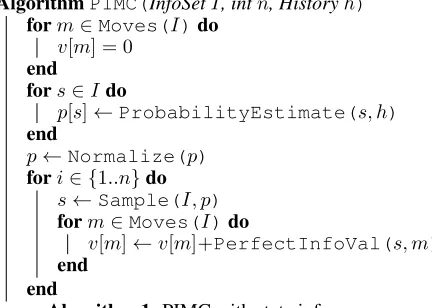
AlgorithmPIMC(InfoSetI, intn, Historyh)
form∈Moves(I)do v[m] = 0
end
fors∈Ido
p[s]←ProbabilityEstimate(s, h)
end
p←Normalize(p)
fori∈ {1..n}do s←Sample(I, p)
form∈Moves(I)do
v[m]←v[m]+PerfectInfoVal(s, m)
end end
Algorithm 1:PIMC with state inference
PIMC+ Search
Algorithm 1 shows the basic PIMC algorithm, modified so that evaluated states are sampled from an estimated distribu-tion based on move historyh. Resulting move values are av-eraged over all evaluated states, so improving the state prob-ability estimate has the potential to increase PIMC’s playing strength considerably.
In particularly large information sets, estimating proba-bilities for the entire set of states may become intractable. However, because this algorithm is easily parallelizable, in practice, information sets must contain billions of states be-fore this becomes a problem on modern hardware. In these cases, uniformly sampling a subset of states without replace-ment as an approximation for the complete information set should be sufficient.
Individual Card Inference with Neural Networks
Previous work in trick-taking card games uses table-based approaches for inference. This works well if the context is small enough that there is sufficient data corresponding to every table entry. However, as the context grows larger and the amount of training data for each context declines, table-based approaches become more prone to overfitting and more difficult to work with. Eventually it becomes nec-essary to generalize across contexts in order to make good predictions.
Neural networks are well suited for this type of problem, but in our case the straightforward approach of predicting the state directly is too difficult because of the sheer number of possible states to consider. In order to make the problem tractable, we propose a method that instead predicts the lo-cations of individual cards.
To turn predictions about individual card locations into a probability distribution of the possible states in an informa-tion set, we apply Equainforma-tion 1. Assuming independence, we multiply the probabilities of each card c’s true location in state sgiven move history h. This provides a measure for each state that can be normalized into a probability distribu-tion for the set of statesSin the information set:
p(s|h)∝∏
c∈C
L(h)c,loc(c,s) (1)
whereCis the set of cards,L(h)is a real|C| ×lmatrix,l
is the number of possible card locations, andloc(c, s)is the location of cardcin states. In Skat,|C| = 32,l = 4, and
loc(c, s)∈ {0,1,2,3}because there are 32 cards and each card is located either in hand 0, 1, 2, or the skat. Entries of
L(h)are estimated probabilities of cards in locations given move historyh.
In this framework it is possible to provide structure to the network output in order to capture game-specific elements. For instance, taking softmax over the rows ofLconstrains the probability masses so that the sum for each card adds up to 1. Our work does not impose any additional constraints, but constraints on the number of total cards in each hand or each suit’s length could be added as well.
One practical insight for making this type of prediction is that learning is easier when the full targets are used instead of just predicting the unknown elements. In our case, this means predicting the full 32-card configuration rather than only trying to predict the missing cards.
The next section describes how we approach feature en-gineering and network design in Skat, but it can be adapted to other games using domain-specific knowledge. It is im-portant to consider how to incorporate the move history and other game state features to allow the network to learn a good representation. Sequences in Skat are relatively short, so we are able to have success using a simple fully-connected network. However, our approach is not dependent on such details and more complex constructs, such as re-current units to capture dependencies in longer sequences, should be considered if they fit the problem.
Application to Skat
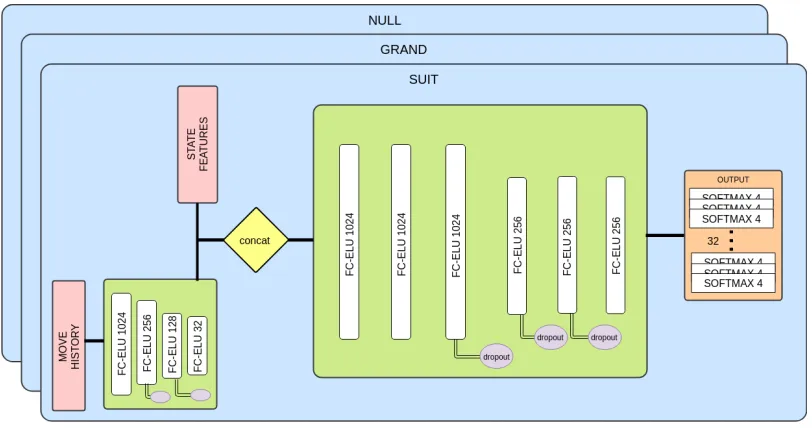
Figure 1 details our network architecture. We train a separate network for each game type (suit, grand, and null). Regard-less of the game type, there are 32 total cards in Skat that can be in any of 4 potential positions (3 hands and the skat), Each network has the same overall structure. We use dropout (Srivastava et al. 2014) of 0.8 on layers 2, 3, and 4 and early-stopping (Prechelt 1998) on a validation set to reduce over-fitting. Table 1 lists all hyperparameters used during training. Hidden layers use ELU activations (Clevert, Unterthiner, and Hochreiter 2015), and the network is trained by mini-mizing the average cross-entropy of each card output.
We use various input features to represent the state of the game in the view of the player to move — they are listed
Table 1: Network training hyper-parameters
Parameter Value
Dropout 0.8
Batch Size 32
Optimizer ADAM
Learning Rate (LR) 10−4
Figure 1: Inference network architecture. Shown is a Skat-specific architecture for predicting the pre-cardplay locations of all 32 individual cards. Each card can be in one of four possible locations (each player’s hand and the skat). Output targets have 10 cards in each player’s hand and the remaining 2 in the skat.
in Table 2. Lead cards are the first cards played in a trick, and sloughed cards are those that are played when a player cannot follow suit but also does not a trump card. Void suits indicate when players’ actions have shown they cannot have a suit according to the rules of the game. Bidding features are broken down into type and magnitude. Type indicates a guess as to which game type the opponent intended to play had they won the bidding with their highest bid. This is computed by checking if the bidding value is a multiple of the game type base value. Magnitude buckets the bidding value into 1 of 5 ranges that are intended to capture which hand multiplier the opponent possesses. Domain knowledge is used to construct ranges that group different base game values with the same multiplier together. The exact ranges used are 18..24,27..36,40..48,50..72, and > 72. These ranges contain some unavoidable ambiguity because some bids are divisible by multiple game values, but bid multiplier is a strong predictor for the locations of jacks in particular. The soloist and trump suit features indicate which player is the soloist and which suit is trump for the current game, re-spectively. All of the above features are one-hot encoded.
Due to its length, we provide the entire cardplay history (padded with zeros for future moves) as a separate input to the network. This input is fed through 4 separate hidden lay-ers that reduce its dimensionality to 32, at which point it is concatenated with the rest of the state input features and fed through the rest of the network.
The networks are trained using a total of 20 million games played by humans on a popular Skat server (DOSKV 2018). A design decision was made to only train the network to make predictions about the first 8 tricks because informa-tion gained by inference in the last tricks is minimal beyond what is already known by considering void suits. The entire training process uses Python Tensorflow (Abadi et al. 2016).
The network output is used as described in Equation 1 to compute probabilities for Algorithm 1, and likely states are sampled for evaluation with PIMC. As previously men-tioned, the algorithm is computationally expensive in early tricks where the information sets are relatively large. The rough maximum of 42 million states in Skat is manageable in around 2 seconds on modern hardware and our current implementation could be parallelized further. It should be noted that this process only performs a single forward pass of the network per information set, so the performance bot-tleneck is in multiplying the card probabilities for each state and normalizing the distribution.
4
Experiments
We use two methods of measuring inference performance in this work. First, we measure the quality of our inference technique in isolation using a novel metric. Second, we show the effect of using inference in a card player by running tour-naments against several baseline players.
cre-1 2 3 4 5 6 7 8 1E+0 1E+1 1E+2 1E+3 1E+4 1E+5 1E+6 1E+7 1E+8 Trick Number In fo rm at io n G ai n
1 2 3 4 5 6 7 8 1E-1 1E+0 1E+1 1E+2 1E+3 1E+4 1E+5 1E+6 Trick Number In fo rm at io n G ai n
1 2 3 4 5 6 7 8 1E+0 1E+1 1E+2 1E+3 1E+4 1E+5 1E+6 1E+7 1E+8 Trick Number
1 2 3 4 5 6 7 8 1E+0 1E+1 1E+2 1E+3 1E+4 1E+5 1E+6 1E+7 1E+8 Trick Number
1 2 3 4 5 6 7 8 1E-1 1E+0 1E+1 1E+2 1E+3 1E+4 1E+5 1E+6 Trick Number
1 2 3 4 5 6 7 8 1E-1 1E+0 1E+1 1E+2 1E+3 1E+4 1E+5 1E+6 Trick Number GRAND SUIT NULL S O L O IS T D E F E N D E R
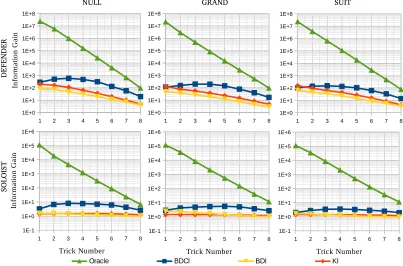
Figure 2: AverageTSSRfor BDCI, BDI, KI, and Oracle inference, separated by trick number for each game type (null, grand, suit) and role (defender, soloist) combination.
ated to control for any possible effects of our new sampling algorithm (no previous work considers computing probabil-ities for all states in the larger information sets). We expect this player to perform comparably to KI.
Inference Performance
In order to directly measure inference performance, we pare the probability of sampling the true state from the com-puted distribution and the probability of uniformly sampling it from the information set. This comparison provides the True State Sampling Ratio (TSSR) which conveys how many times more likely the true state is going to be selected, com-pared to uniform random sampling.
TSSR = p(s∗|h)/(1/n) = p(s∗|h)·n (2)
p(s∗|h)is the probability the true state is sampled given the history, andnis the number of possible states. For BDI and BDCI, this is calculated directly. For KI, the expectation of
p(s∗|h)is determined using a Monte-Carlo estimate. To evaluate inference performance in isolation,TSSR is calculated for each algorithm and each trick, with defender and soloist and game-types separated. Each trick number (1 through 8), role (defender or soloist), and game type were evaluated for each algorithm on 3,000 samples from holdout sets containing games previously played by humans.
Figure 2 shows the average value ofTSSR for the algo-rithms as well as a strict upper bound forTSSRdubbed the
Oracle. The Oracle predicts the true world’s probability to be 1.0, so itsTSSR value is equivalent to the total number
of possible worlds. The value ofTSSRis markedly impacted by both game type and player role. For all algorithms,TSSR
is uniformly larger for defender compared to soloist. This is due to the declarer choosing the game that fits their cards, making inference much easier for the defender. Furthermore, the soloist knows the locations of more cards to begin with because they know the skat — meaning that there is less po-tential for inference in the first place.
For BDI and KI, the average value of TSSR reaches its peak in early tricks and decreases over time. BDCI, however, peaks around tricks 3-5, and performs consistently better in the mid-game. We attribute this to the inclusion of move his-tory in prediction. With the exception of the very first trick for grand and suit defender games, BDCI performs consid-erably better in terms ofTSSR. Due to their reliance on the same input features, the baselines of KI and BDI perform comparably as expected.
through BDCI’sTSSR performance compared to the other algorithms we tested. The combination of both of these phe-nomena is evident in the plots of BDCI, as the effect of card history dominates until around trick 6, and then the expo-nential decrease in the number of states per information set starts to equalize the inference capabilities of all techniques.
Skat Cardplay Tournaments
Tournaments are structured so that pairwise comparisons can be made between players. Two players play 2,500 matches in each matchup, and each match consists of two games. Each player gets a chance to be the soloist against two copies of the other player as defenders. The games start at the cardplay phase — with the bidding, discard, and decla-ration previously performed by human players on DOSKV. These games are separate from the sets that were used as part of the training process, and we calculate results sepa-rately for each of Skat’s game types.
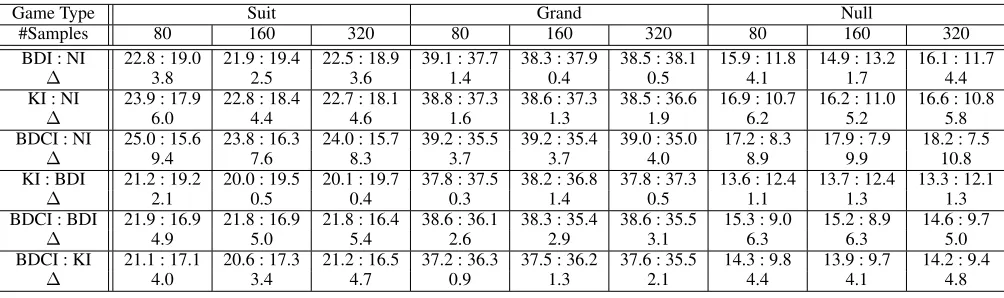
Table 3 shows results from each tournament type. The positive effect of our sampling technique is clearly shown in null and suit games, with a statistically significant points increase for BDCI against current state-of-the-art KI in these game types. The lack of statistical significance in grand games for this matchup can be explained by the high soloist winning percentage for grands in the test set. Considering that the difference in tournament points per game between KI and NI is not significant either, it seems that inference cannot overcome the overwhelming favorability toward the soloist in our test set of grand games.
NI’s overall performance suggests that some type of in-ference is undoubtedly beneficial to PIMC players in suit and null games, but the effect of inference in grands is less noticeable in general. The tournaments between BDCI and BDI suggest that move history helps the predictive power of our networks, which in turn causes a substantial increase in playing strength. Results for matches between KI and BDI show that Kermit’s count-based approach may be slightly more robust than using individual card predictions, but only when the full move history is not considered.
Game type effects are observed in the tournament setting; grand games have a substantially higher soloist win percent-age and null games seem the most difficult for our PIMC
Table 2: Network input features
Feature Width
Player Hand 32
Skat 32
Played Cards (Player, Opponent 1&2) 32*3 Lead Cards (Opponent 1&2) 32*2 Sloughed Cards (Opponent 1&2) 32*2 Void Suits (Opponent 1&2) 5*2 Max Bid Type (Opponent 1&2) 6*2 Max Bid Magnitude (Opponent 1&2) 5*2
Current Trick 32
Soloist 3
Trump Suit 5
Cardplay History 32*24
players. Conservative human play is the main cause of in-ference seeming less important in grands. In Skat, grand games are worth more than any other game type. They offer a hefty reward when won, but an even larger penalty when lost. This explains why we observe that human players are overly-conservative when it comes to bidding on and declar-ing grands; they only take a chance and play when the game is easy to win. Therefore in the games from our test set, good players won’t benefit as much from superior play because the games are too easy for the soloist and too hard for the defenders for skill to make a difference. This is supported by the overall soloist win percentages for each player shown in Table 4.
A similar explanation can be made for the surprising dif-ficulty all of our players seem to have playing null games as the soloist. Null games have one of the smallest base values for winning or losing in Skat, and they have no possibil-ity of additional multipliers. So when players gamble on the contents of the skat and bid too high relative to their hand, they will often play null games because they are the cheap-est to lose. These are notoriously difficult to win because the soloist’s hand would typically contain cards tailored toward the suit or grand game that they bid on, whereas a successful null requires completely different cards.
BCDI’s superior performance comes with the cost of tak-ing longer to choose moves than KI. In matches between BCDI and KI with 320 states evaluated per move, BDCI takes an average of 0.286 seconds to take an action whereas KI only takes an average of 0.093 seconds per move — a 3.1x slowdown. However, BDCI is still fast enough that it is feasible to play tournaments with humans in a reason-able amount of time. Furthermore, KI was shown to reach a performance saturation point after sampling 160 states per move (Furtak and Buro 2013), so increasing the time avail-able to KI would not affect the results reported in this work.
Discussion
BDCI’s cardplay tournament performance is an exciting re-sult considering that Kermit (KI) was already judged as comparable to expert human players (Buro et al. 2009). Ad-ditionally, a per-game tournament point increase of more than 4 in suit and null games means that the gap between the two players is substantial.
Decomposingp(s|h)into a product of individual card lo-cation probabilities (Equation 1) is a useful approximation. First and foremost, it makes it tractable to include entire move histories in the context. Even when lacking the predic-tive power of move history (BDI), the method still provides some degree of disambiguation between likely and unlikely states. However, move history clearly impacts what we can infer about hidden information in trick-based card games like Skat.
Game Type Suit Grand Null
#Samples 80 160 320 80 160 320 80 160 320
BDI : NI 22.8 : 19.0 21.9 : 19.4 22.5 : 18.9 39.1 : 37.7 38.3 : 37.9 38.5 : 38.1 15.9 : 11.8 14.9 : 13.2 16.1 : 11.7 ∆ 3.8 2.5 3.6 1.4 0.4 0.5 4.1 1.7 4.4 KI : NI 23.9 : 17.9 22.8 : 18.4 22.7 : 18.1 38.8 : 37.3 38.6 : 37.3 38.5 : 36.6 16.9 : 10.7 16.2 : 11.0 16.6 : 10.8
∆ 6.0 4.4 4.6 1.6 1.3 1.9 6.2 5.2 5.8 BDCI : NI 25.0 : 15.6 23.8 : 16.3 24.0 : 15.7 39.2 : 35.5 39.2 : 35.4 39.0 : 35.0 17.2 : 8.3 17.9 : 7.9 18.2 : 7.5
∆ 9.4 7.6 8.3 3.7 3.7 4.0 8.9 9.9 10.8 KI : BDI 21.2 : 19.2 20.0 : 19.5 20.1 : 19.7 37.8 : 37.5 38.2 : 36.8 37.8 : 37.3 13.6 : 12.4 13.7 : 12.4 13.3 : 12.1
∆ 2.1 0.5 0.4 0.3 1.4 0.5 1.1 1.3 1.3 BDCI : BDI 21.9 : 16.9 21.8 : 16.9 21.8 : 16.4 38.6 : 36.1 38.3 : 35.4 38.6 : 35.5 15.3 : 9.0 15.2 : 8.9 14.6 : 9.7
∆ 4.9 5.0 5.4 2.6 2.9 3.1 6.3 6.3 5.0 BDCI : KI 21.1 : 17.1 20.6 : 17.3 21.2 : 16.5 37.2 : 36.3 37.5 : 36.2 37.6 : 35.5 14.3 : 9.8 13.9 : 9.7 14.2 : 9.4
∆ 4.0 3.4 4.7 0.9 1.3 2.1 4.4 4.1 4.8
Table 3: Tournament results for each game type. Shown are average tournament scores per game for players NI (No Inference), BDI (Bidding-Declaration Inference), BDCI (Bidding-Declaration-Cardplay Inference), and KI (Kermit’s Inference) which were obtained by playing 2,500 matches in each matchup. Each match consists of two games with soloist/defender roles reversed. One standard deviation, averaged over all matchups in a game type, amounts to 1.0, 1.4, and 1.0 tournament points per game for null, grand, and suit games respectively.
Table 4: Overall soloist win percentage for each game type across all opponents on test set of games played by humans. Grand games in our test set have a high success rate for the soloist.
Player Suit Grand Null
BDCI 81.5 92.5 64.0
KI 80.5 92.6 62.3
BDI 79.2 92.2 61.4
NI 78.0 91.9 59.0
Extending beyond what we have shown here, it is our be-lief that the effectiveness of our inference technique is not limited to simple evaluation techniques like PIMC and could be applied in games other than Skat. IIMC samples states from the root information set before estimating the value of each move in them by simulating to the end of the game with a playout module. Applying our technique would result in more realistic states being simulated by the playout module. Furthermore, if the playout module is a player that samples and evaluates states as well, it could also take advantage of our technique to improve the value estimates returned to the top-level player. Applying our technique to ISMCTS is sim-ilarly straightforward because the algorithm samples a state from the root information set before each iteration. ISM-CTS proceeds by only using actions that are compatible with this sampled state, so better sampling should cause ISMCTS to perform more realistic playouts and achieve more accu-rate move value estimates. Adapting our technique to games other than Skat simply requires training a neural network with game-specific input features. As explained in Equa-tion 1, network output size must be defined by the number of cards|C|and the number of possible locations for each cardlaccording to the rules of the game.
5
Conclusions and Future Work
In this paper we have shown that individual card inference trained by supervised learning can improve the performance of PIMC-based players in trick-based card games consider-ably. This may not come as a surprise to seasoned Contract Bridge or Skat players as they routinely draw a lot of infor-mation about the whereabouts of remaining cards from past tricks. However, this paper demonstrates how to do this us-ing modern learnus-ing techniques for the first time. It shows how neural networks trained from human data can be used to predict fine-grained information like the locations of indi-vidual cards. Lastly it shows how to incorporate such predic-tions into current state-of-the-art search techniques for trick-taking card games — improving an already-strong Skat AI system significantly in the process.
This result is exciting and opens the door for further im-provements. Playing strength could be increased by further improving inference so that the model can adjust to indi-vidual opponents. State probability distributions could be smoothed to account for opponents who often make mis-takes or play clever moves to confuse inference. Further-more, creating strong recursive IIMC players (Furtak and Buro 2013) should be possible by incorporating effective in-ference into the top-level player as well as its low-level roll-out policies. This has the potential to overcome some of the key limitations of PIMC players and potentially achieve su-perhuman level in trick-taking card games.
References
Abadi, M.; Barham, P.; Chen, J.; Chen, Z.; Davis, A.; Dean, J.; Devin, M.; Ghemawat, S.; Irving, G.; Isard, M.; et al. 2016. Tensorflow: a system for large-scale machine learn-ing. InOSDI, volume 16, 265–283.
Baier, H.; Sattaur, A.; Powley, E.; Devlin, S.; Rollason, J.; and Cowling, P. 2018. Emulating human play in a leading mobile card game.IEEE Transactions on Games.
heads-up no-limit Poker: Libratus beats top professionals.
Scienceeaao1733.
Buro, M.; Long, J. R.; Furtak, T.; and Sturtevant, N. R. 2009. Improving state evaluation, inference, and search in trick-based card games. InIJCAI, 1407–1413.
Clevert, D.-A.; Unterthiner, T.; and Hochreiter, S. 2015. Fast and accurate deep network learning by exponential linear units (ELUs). arXiv preprint arXiv:1511.07289.
Cowling, P. I.; Powley, E. J.; and Whitehouse, D. 2012. In-formation set Monte Carlo tree search. IEEE Transactions on Computational Intelligence and AI in Games4(2):120– 143.
DOSKV. 2018. DOSKV: Deutcher Online Skatverband. https://www.doskv.de/skat-spielen.htm.
Frank, I., and Basin, D. 1998. Search in games with in-complete information: A case study using Bridge card play.
Artificial Intelligence100(1-2):87–123.
Furtak, T., and Buro, M. 2013. Recursive Monte Carlo search for imperfect information games. InComputational Intelligence in Games (CIG), 2013 IEEE Conference on, 1– 8. IEEE.
Ginsberg, M. L. 2001. GIB: Imperfect information in a computationally challenging game. Journal of Artificial In-telligence Research14:303–358.
Levy, D. N. 1989. The million pound Bridge program.
Heuristic Programming in Artificial Intelligence.
Long, J. R.; Sturtevant, N. R.; Buro, M.; and Furtak, T. 2010. Understanding the success of perfect information Monte Carlo sampling in game tree search. InAAAI. Moravˇc´ık, M.; Schmid, M.; Burch, N.; Lis`y, V.; Morrill, D.; Bard, N.; Davis, T.; Waugh, K.; Johanson, M.; and Bowling, M. 2017. Deepstack: Expert-level artificial intelligence in heads-up no-limit Poker. Science356(6337):508–513. Prechelt, L. 1998. Automatic early stopping using cross vali-dation: quantifying the criteria.Neural Networks11(4):761– 767.
Richards, M., and Amir, E. 2007. Opponent modeling in Scrabble. InIJCAI, 1482–1487.
Srivastava, N.; Hinton, G.; Krizhevsky, A.; Sutskever, I.; and Salakhutdinov, R. 2014. Dropout: a simple way to prevent neural networks from overfitting. The Journal of Machine Learning Research15(1):1929–1958.