
R E S E A R C H A R T I C L E
Open Access
Excretion of complement proteins and its
activation marker C5b-9 in IgA nephropathy in
relation to renal function
Kisara Onda
1, Isao Ohsawa
1, Hiroyuki Ohi
1, Mariko Tamano
1, Satoshi Mano
1, Michiro Wakabayashi
1, Akie Toki
1,
Satoshi Horikoshi
1, Teizo Fujita
2and Yasuhiko Tomino
1*Abstract
Background:Glomerular damage in IgA nephropathy (IgAN) is mediated by complement activation via the alternative and lectin pathways. Therefore, we focused on molecules stabilizing and regulating the alternative pathway C3 convertase in urine which might be associated with IgAN pathogenesis.
Methods:Membrane attack complex (MAC), properdin (P), factor H (fH) and Complement receptor type 1 (CR1) were quantified in urine samples from 71 patients with IgAN and 72 healthy controls. Glomerular deposition of C5, fH and P was assessed using an immunofluorescence technique and correlated with histological severity of IgAN and clinical parameters. Fibrotic changes and glomerular sclerosis were evaluated in renal biopsy specimens. Results:Immunofluorescence studies revealed glomerular depositions of C5, fH and P in patients with IgAN. Urinary MAC, fH and P levels in IgAN patients were significantly higher than those in healthy controls (p < 0.001), but CR1 was significantly lower than that in healthy controls (p < 0.001). Urinary MAC and fH levels were positively correlated with serum creatinine (sCr), urinary N-acetyl-b-D-glucosaminidase (u-NAG), urinaryb2 microglobulin (u-Bm), urinary protein (p < 0.001), interstitial fibrosis (MAC: p < 0.01, fH: p < 0.05) and the percentage of global glomerular sclerosis (p < 0.01). Urinary P was positively correlated with u-NAG, u-Bm, and urinary protein (p < 0.01). Conclusions:Complement activation occurs in the urinary space in IgAN and the measurement of levels of MAC and fH in the urine could be a useful indicator of renal injury in patients with IgAN.
Background
IgA nephropathy (IgAN) is the most common form of glomerular disease worldwide. Predominant deposition of IgA1 and C3 in mesangial areas is accepted as a hallmark diagnostic feature of IgAN. Immunohistological findings on complement components showed deposits of C3 and properdin (P) in the glomerular mesangial areas and the absence of C1q in patients with IgAN [1-3]. Thus, it has been thought that the activation of the alternative path-way plays a crucial role in the pathogenesis of IgAN. However, recent studies revealed that 25% of patients with IgAN had mesangial deposits of mannose-binding lectin (MBL), L-ficolin, MBL-associated serine protease
and C4, suggesting that the lectin pathway activation may also be important in some IgAN patients [4-7]. In any event, activation of C3 and C3 convertase production are the key causes of histological damage induced following membrane attack complex (MAC; C5b-9) formation. MAC is produced via the activated common terminal pathway of all three complement pathways.
There are several proteins which stabilize or regulate C3 convertase activation via the alternative or lectin pathways. C3bBb is an unstable form of C3 convertase with a half-life of 90 seconds. C3bBb associates with and is stabilized by P, to form the C3bBbP, with a half-life extended 5-10-fold [8]. Factor H (fH) plays a crucial role in inhibition of the alternative pathway by the following mechanism: 1) fH is a cofactor for factor I (fI) in cleaving C3b to inactivate C3bi [9,10] and 2) fH accelerates the decay of C3b, Bb, and C3bBbP [11]. Complement receptor type 1 (CR1;
* Correspondence: [email protected]
1
Division of Nephrology, Department of Internal Medicine, Juntendo University Faculty of Medicine, Tokyo, Japan
Full list of author information is available at the end of the article
CD35) is a natural membrane-bound regulator and has specificity for C3b and C4b with the ability to displace the catalytic subunits from C3 or C5 convertase and to func-tion as a co-factor for the degradafunc-tion of C3b and C4b mediated by factor I [12,13].
Because our previous work established that the serum levels of B, P, fH and fI in patients with IgAN were signifi-cantly higher than those in healthy controls [14], we hypothesized that targeting the alternative pathway C3 convertase activation could be therapeutically beneficial in IgAN. In other types of glomerular disease, such as mem-branous nephropathy and lupus nephritis, patients’urine contains complement regulatory proteins and MAC, amounts of which fluctuate with disease activity [15-17]. Here, we investigated these issues using urine samples from patients with IgA nephropathy, which, unlike serum, can be obtained noninvasively.
Methods
Patients and controls
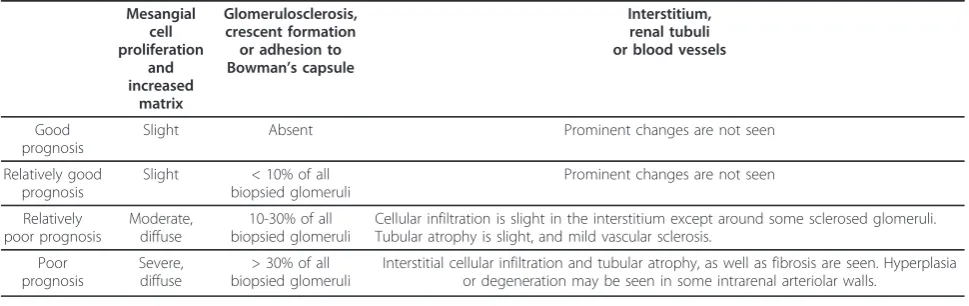
Seventy-one patients with IgAN (38 males and 33 females), who had been referred to Juntendo University Hospital between March 2003 and May 2005, were enrolled. Age of these patients at the time of urine collec-tion ranged from 16 to 67 years old (37.8 ± 12.8, mean ± SD). Normal controls were 72 healthy volunteers (58 males and 14 females). This study was approved by the institutional human study Ethics Committee and informed consent was obtained before participation. Histological diagnosis was classified by standard examination of renal biopsy specimens by light microscopic findings with the results of immunoglobulin and complement deposition by immunofluorescence technique. According to the Japanese Clinical Guidelines for Patients with IgAN [18], patients were divided into four groups as follows: good prognosis, relatively good prognosis, relatively poor prognosis and poor prognosis (Table 1).
Laboratory data
Serum total protein (TP), urinary protein (urinary pro-tein (mg/dl)/urinary creatinine (mg/dl)), urinary
N-acetyl-b-D-glucosaminidase (u-NAG), urinary b2
-microglobulin (u-Bm) and serum levels of urea nitrogen (SUN), and creatinine (s-Cr) were measured as part of the routine clinical analyses at the time of urine collec-tion. Laboratory data were undertaken at the central laboratory in the Juntendo University Hospital.
Glomerular deposition of Immunoglobulins, C1q, C3, C5, fH and P
Renal biopsy specimens were frozen and examined by direct immunofluorescence staining, performed using fluorescein-5-isothiocyanate-labeled rabbit anti-human IgG, IgA, IgM, C1q and C3 antisera (Dako, Denmark), goat anti-human C5 and P antisera (Nordic Immunologi-cal Laboratories, Tilburg, Netherlands), and rabbit anti-human fH antiserum labeled by Linkit™Fluoro-Link (ISL, Paignton, UK). IgG, IgA, IgM, C1q and C3 were diluted to 1:50 in 0.01 mol/l PBS, ph7.4, and C5, fH and P were diluted to 1:10 in the same buffer.
Measurement of complement regulatory proteins and MAC in urine
Urine samples were obtained and stored at -80°C until use. Rabbit antisera to human fH, P, CR1, and purified P were kindly provided by Professor Teizo Fujita (Department of Biochemistry, Fukushima Medical University, Japan). Bio-tinylated anti-human properdin antibody was purchased from AntibodyShop (Gentofte, Denmark).
Urinary concentrations of fH and MAC were measured by commercially available sandwich enzyme-linked immu-nosorbent assay (ELISA) kits (BTA TRAK Kit, Alidex, Inc., Redmond, WA, USA, and SC5b-9 EIA, Quidel, San Diego, CA, USA). ELISA for P and CR1 were developed in our institute. Urinary P was quantified as described in our
Table 1 Histological severity of IgAN (Japanese Clinical Guidelines )
Mesangial cell proliferation and increased matrix Glomerulosclerosis, crescent formation or adhesion to Bowman’s capsule
Interstitium, renal tubuli or blood vessels
Good prognosis
Slight Absent Prominent changes are not seen
Relatively good prognosis
Slight < 10% of all biopsied glomeruli
Prominent changes are not seen
Relatively poor prognosis
Moderate, diffuse
10-30% of all biopsied glomeruli
Cellular infiltration is slight in the interstitium except around some sclerosed glomeruli. Tubular atrophy is slight, and mild vascular sclerosis.
Poor prognosis
Severe, diffuse
> 30% of all biopsied glomeruli
previous report [14]. CR1 in urine was determined using 4 μg/ml rabbit anti-human CR1 antibody and 0.1μg/ml bio-tinylated mouse anti-human CR1 antibody (Ancell Cor-poration, Bayport, MN, USA) [19].
Western blot analysis for urinary fH
To obtain a detectable amount of urinary fH, the urine samples were concentrated fourfold by Ultrafree-MC Centrifugal Filter Units (Millipore, Bedford, MA, USA). Urine samples were electrophoresed on 5% SDS-PAGE gradient gels under non-reducing conditions and the resultant bands were transferred to Immobilon™ (Milli-pore, Bedford, MA, USA). The immunoblots were incu-bated with biotinylated mouse anti-human fH antibody (AntibodyShop, Gentofte, Denmark), and incubated with streptavidin-peroxidase (Streptavidin-HRP, Southern Bio-technology Associates, Inc. Birmingham, AL, USA), and then developed using the ECL-plus system (Amersham Biosciences, Little Chalfont, UK).
Evaluation of fibrotic changes and glomerular sclerosis Fibrotic changes were evaluated on Azan and Masson-Trichrome-stained slides from 60 cases. Interstitial fibro-sis was assessed by measuring the percentage of fibrotic (collagen-positive) area against whole area of specimen, using the KS400 Carl Zeiss image analysis system (KS400, Carl Zeiss Imaging Solutions GmbH, Hallberg-moos, Germany).
The percentage of global glomerular sclerosis as a fraction of all glomeruli was determined in 39 renal biopsy specimens by light microscopy.
Statistical analysis
Data are shown as mean ± SD. Comparisons among the groups were performed by the Mann-Whitney U test, and comparisons of the four classifications were performed by
the Bonferroni’s Multiple Comparison test. Correlations among the groups were evaluated by linear regression. P values < 0.05 were considered significant in all analyses.
Results
Patients’background
All patients with IgAN were classified according to the Japanese Clinical Guidelines [18] and their clinical char-acteristics are shown in Table 2. U-NAG levels in the poor prognosis group were significantly higher than those in the other groups (p < 0.05). Significant differ-ences in levels of TP, s-Cr and urinary protein were observed among the four groups. Regarding differences associated with disease severity, levels of urinary MAC were increased; especially in the poor prognosis group it was tending significantly higher than in the good prog-nosis group.
Glomerular deposition of complement components and regulatory proteins
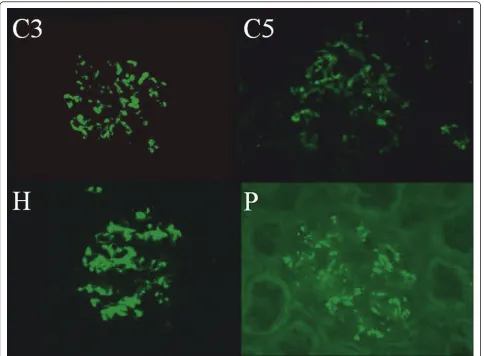
Immunofluorescence technique revealed deposits of C3, C5, fH and P in glomeruli of IgAN patients (Figure 1). The coarse granular deposits of all these factors appeared to have a similar mesangial distribution pat-tern. From these results, we inferred that the alternative pathway C3 convertase was activated and regulated in the IgAN glomeruli.
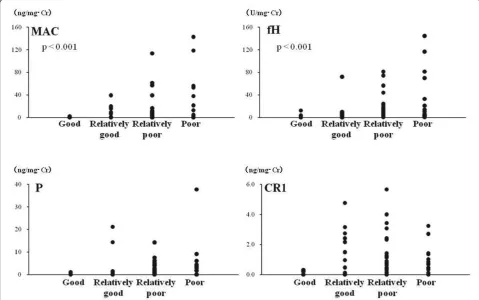
Urinary MAC and complement regulatory proteins Urinary complement components in IgAN patients and healthy controls are shown in Figure 2. In IgAN patients, urinary MAC, fH, and P levels were significantly higher than those in healthy controls (Figure 2A, B, C), whereas urinary CR1 was significantly lower (Figure 2D). Figure 3 shows the relationship between urinary MAC, fH, P, CR1 and disease severity. In particular, levels of urinary MAC
Table 2 Clinical characteristics of the patients
Classification
(The number of biopsies and range of glomeruli) TP (g/dl)
s-Cr (mg/dl)
u-Protein (g/g•Cr)
u-NAG (10-3U/mg•Cr)
u-Bm (ng/mg•Cr)
u-MAC (ng/mg•Cr)
Good prognosis (n = 6, 7.5 ± 4.5)
7.3 ± 0.6 0.64 ± 0.18 0.41 ± 0.19 3.6 ± 2.3* 57.7 ± 17.3 0.3 ± 0.8
Relatively good prognosis (n = 17, 15.3 ± 9.6)
7.4 ± 0.3** 0.80 ± 0.19 0.39 ± 0.36* 3.6 ± 2.0* 110.2 ± 113.1 6.5 ± 11.0
Relatively poor prognosis (n = 30, 13.0 ± 6.9)
7.0 ± 0.5 0.72 ± 0.23* 0.75 ± 0.67 4.5 ± 2.2* 222.9 ± 570.5 12.1 ± 24.9
Poor prognosis (n = 18, 14.9 ± 9.6)
6.8 ± 0.4 0.98 ± 0.48 1.10 ± 0.92 9.3 ± 6.7 254.4 ± 528.3 25.4 ± 42.7
Total (n = 71)
7.1 ± 0.5 0.80 ± 0.32 0.72 ± 0.70 5.4 ± 4.4 189.9 ± 458.4 14.0 ± 28.4
(mean ± SD)
*: p < 0.05 vs. poor prognosis,
**:p < 0.05 vs. relatively poor prognosis and poor prognosis
and fH significantly increased with increased disease severity (p < 0.001).
Correlations between urinary complement and clinical markers for renal disease were sought (Table 3). Urinary MAC was significantly correlated with s-Cr (p < 0.01), u-NAG (p < 0.001), u-Bm (p < 0.001) and urinary protein (p < 0.001). There was also a significant correlation between fH and all parameters (p < 0.001). Levels of urin-ary MAC and fH dovetail with clinical disease activity. Levels of urinary CR1 were significantly correlated with u-Bm (p < 0.01), but there was no significant correlation between CR1 and any other parameters.
Molecular weight of urinary fH
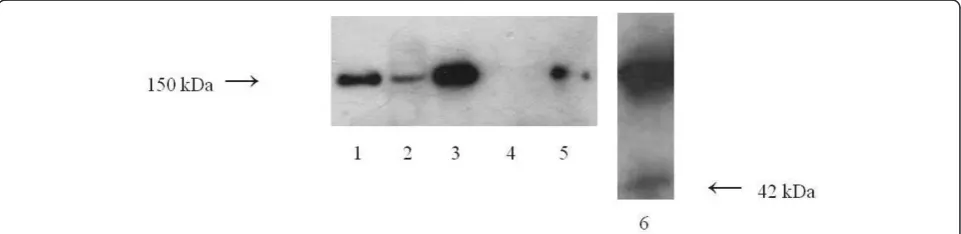
The molecular weight of urinary fH was evaluated by Wes-tern blotting in 7 patients with levels>50 U/mg·Cr (Figure 4). Serum fH had an estimated molecular weight of 150 kDa in all patients, as well as in the healthy controls. There was no fH in the urine of healthy controls. Urinary fH in
IgAN patients was also 150 kDa, except for one patient whose urine had the highest level of fH and contained a 42 kDa protein (factor H like protein 1: FHL-1).
Urinary complement and histological changes
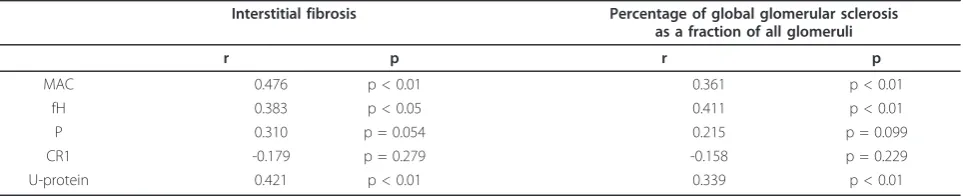
Correlations between urinary complement levels and interstitial fibrosis, and between urinary complement levels and percentage of global glomerular sclerosis, were evaluated in IgAN patients (Table 4). Urinary MAC was significantly correlated with interstitial fibro-sis (p < 0.01) and the percentage of global glomerular sclerosis as a fraction of all glomeruli (p < 0.01). Urinary fH levels were significantly correlated with interstitial fibrosis (p < 0.05) and the percentage of global glomeru-lar sclerosis (p < 0.01).
Significant correlations were also found between inter-stitial fibrosis and urinary protein (r = 0.421, p < 0.01), and between percentage of global glomerular sclerosis and urinary protein (r = 0.339, p < 0.01).
Discussion
IgAN is the most common chronic glomerulonephritis with one third of patients developing progressive end-stage renal failure [20,21]. Although complement activation leads to tissue damage in IgAN, the role of complement
regulatory proteins in the pathogenesis of IgAN has not been clearly defined. Our previous report and others docu-mented increased serum levels of fH and P in IgAN patients and that serum levels of complement regulatory proteins reflected IgAN disease activity [14,22]. Based on
Figure 2Urinary MAC and complement regulatory protein levels differ between patients with IgA nephropathy and healthy controls. Levels of urinary MAC, fH, and P are significantly higher in IgAN patients than those in healthy controls, but CR1 is significantly lower.
these findings, we planned to evaluate the significance of urinary complement components in the pathogenesis of IgAN.
In other renal diseases, strong associations of urinary fH and MAC levels with disease progression have been demonstrated (15-17). Recently, Zang et al. proposed that urinary fH in patients with IgAN may be a useful biomar-ker to evaluate kidney injury [23]. In that report, the analy-sis was limited to urinary fH. Here, we extend our evaluation to other proteins, namely, P, CR1 and MAC. We found that levels of urinary MAC, fH and P in patients with IgAN were significantly higher than those in healthy controls. Furthermore, urinary MAC and fH levels were significantly increased with increasing disease severity. Urinary MAC levels reflected disease state in patients with IgAN, as is the case in other nephropathies [24]. Urinary fH and P, which are involved in the regulation and stabili-zation of the alternative pathway C3 convertase, might also be associated with renal damage. Although only 4 patients had taken steroids when they were collected the urine samples, results of complement components pre-sented not particular tendency.
In renal disease, renal function is closely related to tubulo-interstitial injury, part of which is due to MAC for-mation on tubular epithelial cells [25]. Indeed, urinary fH and P levels were strongly correlated with u-NAG and might reflect the occurrence of intra-tubular activation of C3. In additional work, we did find significant correlations
between urinary fH and P (p < 0.001), fH and MAC (p < 0.001), and P and MAC (p < 0.001) (data not shown).
The human fH family consists of seven multi-domain and multifunctional serum proteins, including fH itself (MW 150 kDa), factor H-like protein 1 (FHL-1) (MW 42 kDa) and five factor H-related proteins (FHR-1, -2, -3, -4 and -5) [26]. This study demonstrated that fH, a 150 kDa protein, was detected in patients’urine samples, but lower MW members of this family were not detected in IgAN, with the exception of one patient with FHL-1. Because human mesangial cells and proximal tubular epithelial cells are capable of producing fH [27,28], urinary fH might be derived from glomeruli and/or tubules, not from the blood.
Previous studies showed that synthesis of membrane-bound CR1 on the podocytes is reduced in patients with advanced glomerular disease [29,30]. Urinary CR1 was released from podocytes, and did not originate from ery-throcyte CR1 and soluble CR1 [31]. Likewise, as estab-lished here, urinary CR1 in patients with IgAN was significantly lower than in healthy controls.
There was a significant correlation between interstitial fibrosis and the percentage of global glomerular sclerosis as a fraction of all glomruli (p < 0.01). Thus, tubulointer-stitial damage may be affected by glomerular injury. There were significant correlations between interstitial fibrosis and urinary protein, and between the percentage of global glomerular sclerosis and urinary protein. It was previously
Table 3 Correlations between levels of urinary MAC and complement regulatory proteins in IgAN patients
MAC fH P CR1
r p r p r p r p
s-Cr 0.297 p < 0.01 0.531 p < 0.001 0.192 p = 0.102 -0.174 p = 0.137
u-NAG 0.589 p < 0.001 0.633 p < 0.001 0.419 p < 0.001 0.491 p = 0.481
u-Bm 0.414 p < 0.001 0.384 p < 0.001 0.367 p < 0.01 0.323 p < 0.01
u-Protein 0.458 p < 0.001 0.645 p < 0.001 0.502 p < 0.001 -0.181 p = 0.122
Abbreviations: MAC, membrane attack complex; fH, factor H; P, properdin; CR1, complement receptor 1; s-Cr, serum creatinine; u-NAG, urinary N-acetyl-b -D-glucosaminidase; u-Bm, u-b2 microglobulin; u-Protein, urinary protein
considered that the presence of urinary protein reflected glomerular damage and interstitial fibrosis. Therefore, interstitial fibrosis and the percentage of global glomerular sclerosis might be a marker of renal damage. Urinary fH and MAC were significantly correlated with interstitial fibrosis and the percentage of global glomerular sclerosis. Moreover, MAC showed a better correlation with intersti-tial fibrosis than did urinary protein, and fH correlated better with global sclerosis than urinary protein in patients with IgAN. Urinary fH showed a better correlation with serum creatinine, urinary NAG, urinary protein and global sclerosis than urinary MAC in patients with IgAN. It is proposed that in fact, fH might not regulate complement activation and subsequent formation of MAC. Therefore, MAC formation and renal damage might occur in IgAN. Further research is needed to clarify whether the relation-ships between urinary fH and complement activation might recapitulate in other types of glomerulonephritis.
Conclusions
Complement activation occurs in the urinary space in IgAN and the measurement of levels of MAC and fH in the urine could be a useful indicator of renal injury in patients with IgAN.
Acknowledgements
We are very grateful to by Ms. Shibata Terumi for technique support.
Author details
1Division of Nephrology, Department of Internal Medicine, Juntendo
University Faculty of Medicine, Tokyo, Japan.2Department of Immunology, Fukushima Medical University School of Medicine, Fukushima, Japan.
Authors’contributions
KO collected samples, carried out the study, analyzed the data and wrote the manuscript. IO and HO principal investigator advised on the study and reviewed the manuscript. MT advised the experimental methods. SM and MW helped to collect samples. AT helped evaluation of fibrotic change and glomerular sclerosis. SH participated in the design of the study. TF gave us rabbit antisera to human fH, P, CR1 and purified P. YT primary principal investigator advised on the study. All authors have read and approved the final manuscript.
Competing interests
We (Kisara Onda, Isao Ohsawa, Hiroyuki Ohi, Mariko Tamano, Satoshi Mano, Michiro Wakabayashi, Akie Toki, Satoshi Horikoshi, Teizo Fujita and Yasuhiko Tomino) declare no conflict of interest in this study.
Received: 30 May 2011 Accepted: 23 November 2011 Published: 23 November 2011
References
1. Shirai T, Tomino Y, Sato M, Yoshiki T, Itoh T:IgA nephropathy: clinicopathology and immunopathology.Contrib Nephrol1978,9:88. 2. Burkholder PM, Zimmermans SW, Moorthy AV:A clinicopathologic study
of natural history of mesangial IgA nephropathy.Glomerulonephritis, Japan Medical Research Foundation Tokyo, Univ. of Tokyo Press1979, 143. 3. Sakai O, Kitajima T, Kawamura K, Ueda Y:Clinicopathological studies on
IgA glomerulonephritis.Glomerulonephritis, Japan Medical Research Foundation Tokyo, Univ. of Tokyo Pres1979, 167.
4. Endo M, Ohi H, Ohsawa I, Fujita T, Matsushita M, Fujita T:Glomerular deposition of mannose-binding lectin (MBL) indicates a novel mechanism of complement activation in IgA nephropathy.Nephrol Dial Transplant1998,13:1984-90.
5. Endo M, Ohi H, Satomura A, Hidaka M, Ohsawa I, Fujita T, Kanmatsuse K, Matsushita M, Fujita T:Regulation of in situ complement activation via the lectin pathway in patients with IgA nephropathy.Clinical Nephrology 2001,55:185-191.
6. Roos A, Rastaldi MP, Calvaresi N, Oortwijn BD, Schlagwein N, van Gijlswijk-Janssen DJ, Stahl GL, Matsushita M, Fujita T, van Kooten C, Daha MR: Glomerular activation of the lectin pathway of complement in IgA nephropathy is associated with more severe renal disease.J Am Soc Nephrol2006,17:1724-1734.
7. Roos A, Bouwman LH, Gulswijk-Janssen DJ, Faber-Krol MC, Stahl GL, Daha MR:Human IgA activates the complement system via the mannan-binding lectin pathway.J Immunol2001,167:2861-2868.
8. Fearon DT, Austen KF:Properdin: binding to C3b and stabilization of the C3b-dependent C3 convertase.J Exp Med1975,142:856-863.
9. Whaley K, Ruddy S:Modulation of C3b hemolytic activity by a plasma protein distinct from C3b inactivator.Science1976,193(4257):1011-3. 10. Pangburn MK, Schreiber RD, Müller-Eberhard HJ:Human complement C3b
inactivator: isolation, characterization, and demonstration of an absolute requirement for the serum protein beta1H for cleavage of C3b and C4b in solution.J Exp Med1977,146(1):257-70.
11. Weiler JM, Daha MR, Austen KF, Fearon DT:Control of the amplification convertase of complement by the plasma protein beta1H.Proc Natl Acad Sci USA1976,73(9):3268-72.
12. Klickstein LB, Wong WW, Smith JA, Weis JH, Wilson JG, Fearon DT:Human C3b/C4b receptor (CR1). Demonstration of long homologous repeating domains that are composed of the short consensus repeats characteristics of C3/C4 binding proteins.J Exp Med1987, 165(4):1095-112.
13. Miwa T, Song WC:Membrane complement regulatory proteins: insight from animal studies and relevance to human diseases.Int
Immunopharmacol2001,1(3):445-59.
14. Onda K, Ohi H, Tamano M, Ohsawa I, Wakabayashi M, Horikoshi S, Fujita T, Tomino Y:Hypercomplementemia in adult patients with IgA
nephropathy.J Clin Lab Anal2007,21:77-84.
15. Ogrodowski JL, Hebert LA, Sedmak D, Cosio FG, Tamerius J, Kolb W: Measurement of SC5b-9 in urine in patients with the nephritic syndrome.Kidney Int1991,40:1141-1147.
16. Tamano M, Fuke Y, Endo M, Ohsawa I, Fujita T, Ohi H:Urinary complement factor H in renal disease.Nephron2002,92:705-707.
Table 4 Correlations between urinary complement levels and fibrosis in IgAN patients
Interstitial fibrosis Percentage of global glomerular sclerosis as a fraction of all glomeruli
r p r p
MAC 0.476 p < 0.01 0.361 p < 0.01
fH 0.383 p < 0.05 0.411 p < 0.01
P 0.310 p = 0.054 0.215 p = 0.099
CR1 -0.179 p = 0.279 -0.158 p = 0.229
U-protein 0.421 p < 0.01 0.339 p < 0.01
17. Endo M, Fuke Y, Tamano M, Hidaka M, Ohsawa I, Fujita T, Ohi H: Glomerular deposition and urinary excretion of complement factor H in idiopathic membranous nephropathy.Nephron Clin Pract2004,97: c147-c153.
18. Tomino Y, Sakai H:Clinical guidelines for immunoglobulin A (IgA) nephropathy in Japan, second version.Clin Exp Nephrol2003,7:93-97. 19. Tamano M, Ohi H, Sudo S, Tomino Y:Quantitative polymorphism of
complement receptor type 1 (CR1) in patients undergoing haemodialysis.Nephrol Dial Transplant2004,19(6):1467-73. 20. D’amico G:The commonest glomerulonephritis in the world: IgA
nephropathy.Q J Med1987,64:709-727.
21. Johnston PA, Brown JS, Braumholtz DA, Davison AM:Clinicopathological correlations and long-term follow-up of 253 United Kingdom patients with IgA nephropathy. A report from the MRC Glomerulonephritis Registry.Q J Med1992,84:619-627.
22. Julian BA, Wyatt RJ, McMorrow RG, Galla JH:Serum complement proteins in IgA nephropathy.Clin Nephrol1983,20:251-258.
23. Zhang JJ, Jiang L, Liu G, Wang SX, Zou WZ, Zhang H, Zhao MH:Levels of urinary complement factor H in patients with IgA nephropathy are closely associated with disease activity.Scand J Immunol2009, 69(5):457-64.
24. Nangaku M, Shankland SJ, Couser WG:Cellular response to injury in membranous nephropathy.J Am Soc Nephrol2005,16(5):1195-1204. 25. Abbate M, Zoja C, Corna D, Rottoli D, Zanchi C, Azzollini N, Tomasoni S,
Berlingeri S, Noris M, Morigi M, Remuzzi :Complement-mediated dysfunction of glomerular filtration barrier accelerates progressive renal injury.J Am Soc Nephrol2008,19(6):1158-67.
26. Cheng ZZ, Corey MJ, Parepalo M, Majno S, Hellwage J, Zipfel PF, Kinders RJ, Raitanen M, Meri S, Jokiranta TS:Complement factor H as a marker for detection of bladder cancer.Clin Chem2005,51:856-863.
27. van den Dobbelsteen ME, Verhasselt V, Kaashoek JG, Timmerman JJ, Schroeijers WE, Verweij CL, van der Woude FJ, van Es LA, Daha MR: Regulation of C3 and factor H synthesis of human glomerular mesangial cells by IL-1 and interferon -gamma.Clin Exp Immunol1994,95:173-180. 28. Gerritsma JS, Gerritsen AF, De Ley M, van Es LA, Daha MR:
Interferon-gamma induces biosynthesis of complement components C2, C4 and factor H by human proximal tubular epithelial cells.Cytokine1997, 9:276-283.
29. Iida K, Koyama A, Nakamura H, Inage H, Narita M, Tojyo S, Kamisato J, Fujita T, Tamura N:Abnormal expression of complement receptor (CR1) in IgA nephritis: increase in erythrocytes and loss on glomeruli in patients with impaired renal function.Clin Immunol Immunopathol1983, 40:393-400.
30. Moll S, Miot S, Sadallah S, Gudat F, Mihatsch MJ, Schifferli JA:No complement receptor 1 stumps on podocytes in human glomerulopathies.Kidney Int2001,59:160-168.
31. Pascual M, Steiger G, Sadallah S, Paccaud JP, Carpentier JL, James R, Schifferli JA:Identification of Membrane-bound CR1 (CD35) in Human Urine: Evidence for Its Release by Glomerular Podocytes.J Exp Med1994, 179:889-899.
Pre-publication history
The pre-publication history for this paper can be accessed here: http://www.biomedcentral.com/1471-2369/12/64/prepub
doi:10.1186/1471-2369-12-64
Cite this article as:Ondaet al.:Excretion of complement proteins and its activation marker C5b-9 in IgA nephropathy in relation to renal
function.BMC Nephrology201112:64. Submit your next manuscript to BioMed Central
and take full advantage of:
• Convenient online submission
• Thorough peer review
• No space constraints or color figure charges
• Immediate publication on acceptance
• Inclusion in PubMed, CAS, Scopus and Google Scholar
• Research which is freely available for redistribution

![Poly[μ azido κ2N1:N3 μ 2 (2 pyridylmethylamino)ethanesulfonato κ4N,N′,O:O′ copper(II)]](data:image/gif;base64,R0lGODlhAQABAIAAAP///wAAACH5BAEAAAAALAAAAAABAAEAAAICRAEAOw==)