SYSTEMATIC REVIEW PROTOCOL
The effectiveness of non-native
fish eradication techniques in freshwater
ecosystems: a systematic review protocol
Lisa A. Donaldson
1,2*and Steven J. Cooke
1,2Abstract
Background: This systematic review will address the need for having a better understanding of the evidence-base for the effectiveness of different management techniques focussed on the eradication of non-native fish species in the freshwater environment. Many resource management agencies around the world attempt to eradicate non-native fish species to achieve management goals with respect to ecological integrity. There is a need to better understand the effectiveness of each management technique to provide resource managers with the information necessary to effectively manage aquatic resources, and to choose the best technique to yield desired outcomes given different ecological and biological conditions. The findings of this systematic review will inform evidence-based manage-ment and conservation activities for resource managers around the globe that deal with non-native fish eradication programs.
Methods: This systematic review will search for, compile, summarize, and synthesize evidence on the effectiveness of fisheries management techniques used for the eradication of non-native fish species in global freshwater systems. The review will use public search engines and specialist websites, and will include both primary and grey literature. All studies that assess the effectiveness of a fish eradication technique, in freshwater, will be included in the review. Potential effect modifiers will be identified to obtain a better understanding of the factors that affect the success of different eradication techniques, given different environmental conditions and biological factors. Study quality will be assessed to allow for critical evaluation, including study design, confounding factors and statistical analysis. Data will be compiled into a narrative synthesis and a meta-analysis will be conducted where data availability and quality allow. Keywords: Alien invasive species, Removal, Restoration, Nonindigenous species, Invasive species, Invasion biology, Evidence-based policy
© 2016 The Author(s). This article is distributed under the terms of the Creative Commons Attribution 4.0 International License (http://creativecommons.org/licenses/by/4.0/), which permits unrestricted use, distribution, and reproduction in any medium, provided you give appropriate credit to the original author(s) and the source, provide a link to the Creative Commons license, and indicate if changes were made. The Creative Commons Public Domain Dedication waiver (http://creativecommons.org/ publicdomain/zero/1.0/) applies to the data made available in this article, unless otherwise stated.
Background
In aquatic systems, biological invasions can result in adverse ecological effects [1, 2]. Invasive species threaten biodiversity [3–5] and impose considerable economic costs [6], placing increased demands on policy-makers, resource managers, and scientists [7]. The introduction and spread of invasive species can occur by natural or human pathways and can include: shipping networks and
canals [8, 9], escapes from aquaculture, aquaria and orna-mental trade [10], stocking (including authorized and unauthorized attempts), recreational boating, live food trade, as well as sport fish and baitfish introductions, which may be deliberate or accidental. Additionally, the secondary spread of introduced species poses challenges for resource managers [11–13].
Options for managing non-native fish species can include no action, control and/or containment, popula-tion extirpapopula-tion, and/or species eradicapopula-tion [14]. Con-tainment, such as implementing barriers, is typically the most desirable tactic to prevent the spread of non-native species into novel environments [15–18]. How-ever, where containment is not possible or has not been
Open Access
*Correspondence: [email protected]
1 Canadian Centre for Evidence-Based Conservation and Environmental Management, Institute of Environmental Sciences, Carleton University, 1125 Colonel By Drive, Ottawa, ON, Canada
successful, eradication has been proposed as a valid option for managing biological invasions [19, 20]. Eradi-cation is the elimination of whole fish populations or fish species from distinct habitats or bodies of water [21]. Eradication approaches tend to be targeted, for example, by exploiting vulnerable periods in the life cycle [22, 23] or by focusing on areas of high abundance [24].
The types of fish management techniques available to resource managers to implement eradication programs can vary widely. They can include chemicals, harvest regimes, physical removal, or biological control [25]. The effectiveness of chemical eradication (e.g., rotenone, Fin-trol) depends on environmental conditions (e.g., water temperature, depth, pH, discharge, target fish species, hydrology, substrate composition, areas of groundwater recharge; [26]); there are also concerns of collateral dam-age when non-target species are affected by chemical treatments [27]. Harvest regimes can include intentional over-fishing (e.g., gill netting, angling) of target spe-cies [28–30] or modification of angling regulations (e.g., favour overharvest of target species). Physical removal techniques can include traps, electrofishing, and/or net-ting programs while biological controls can include the introduction of predators, intraspecific manipulation, or targeted pathological reactions [31]. When implement-ing fish management programs, risk analysis is required to help decide when management strategies should be utilized, what strategy should be chosen, and what the likelihood of success of different strategies are [18]. The risk analysis includes identification and assessments of hazards, including predicting the likelihood and severity of adverse effects [32].
The success of non-native fish management approaches can vary greatly depending on the management objec-tives for the project: whether control, eradication, removal or containment (amongst others) was the ulti-mate goal of the project. As can be expected given the complexities of the natural environment, success can be difficult to quantify and some approaches can be unsuccessful despite best efforts [7, 19, 25]. Failure of non-native fish eradication techniques can occur due to a number of factors, including (but not limited to) inef-fective capture techniques (e.g., size-specific efficiencies), habitat complexity (e.g., areas of refuge, plant density), species-specific factors (e.g., size, habitat preferences), and physical water properties (e.g., water chemistry, tem-perature, water depth; [33]). Determining the outcomes of management interventions, especially when restora-tion of freshwater ecosystems is a goal (i.e., to eradicate non-native target fish species from a specific waterbody), requires long-term evaluation and assessment in relation to meeting the objectives [19, 25, 34]. Post-program eval-uation and assessment is required not only to determine
the effectiveness of techniques but also to explore the cost-effectiveness and cost/benefit of each strategy. Nar-rative syntheses, meta-analyses and systematic reviews can be valuable approaches to determine broad-scale effectiveness of how management interventions can be effective and to identify future research needs.
Objective of the review
The objective of the systematic review is to evaluate the existing literature base to assess the effectiveness of dif-ferent non-native fish eradication methods in global freshwater environments. The purpose of the review is not to question whether or not the eradication of a target species is an appropriate objective, but simply to evalu-ate the effectiveness of each technique for eradicating the target species in a desired freshwater body (including both lakes and rivers).
Primary question
What is the effectiveness of non-native fish eradication techniques in freshwater ecosystems and what effects do the various sources of potential heterogeneity have on the outcome?
Components of the primary question
The primary study question can be broken down into the study components:
Subject (population) Non-native freshwater fish
Intervention Fish eradication method
Comparator No intervention or alternative method
Outcomes Magnitude of decreased
abundance relative to control or eradication of target fish species.
Secondary questions
Following the development of the primary question, sec-ondary questions were developed to expand on relevant areas of interest to project stakeholders and user groups, including Canadian federal natural resources government agencies (e.g., Parks Canada) and members of the inter-national scientific community specializing in invasive fish eradication science. The secondary questions are meant to help guide the overall goals of the systematic review and to ensure that areas of interest are encompassed in the meth-ods. The secondary questions for this systematic review are:
(b) What other strategies/techniques are being employed but are under-represented in the evidence and litera-ture base?
(c) What factors (e.g., type and size of water body, spe-cies, elevation, time since invasion/introduction, ecoregion) influence the effectiveness of each type of eradication method and in what context is each technique most effective?
Methods
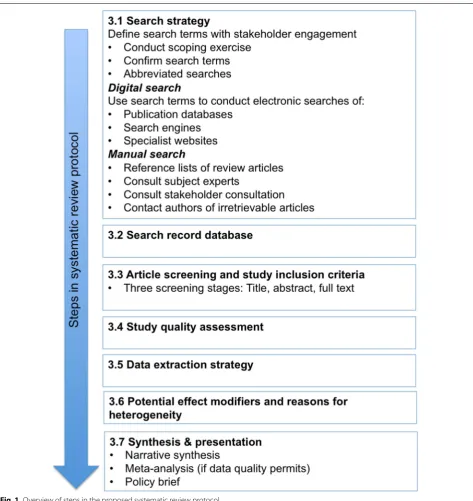
Details related to each step in the systematic review pro-tocol are outlined in Fig. 1.
Search strategy
Search terms
Similar to the way that the Review Team formulated the primary and secondary questions, the Review Team
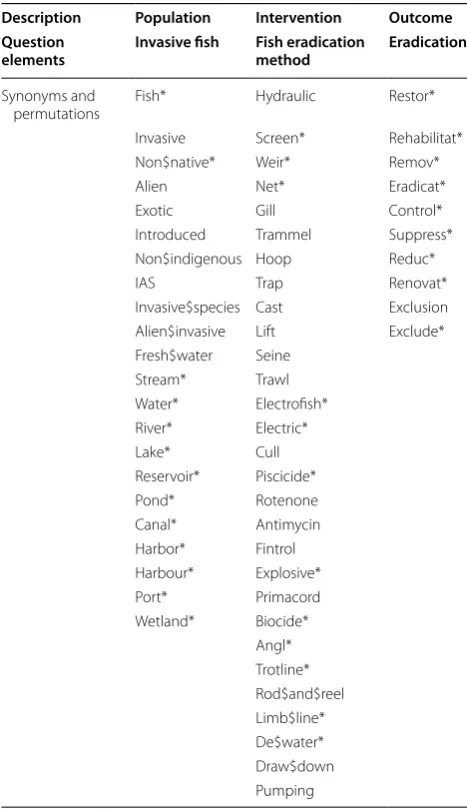
collaborated with project stakeholders (e.g., Parks Can-ada) and members of the international scientific com-munity specializing in invasive fish eradication science to generate a list of relevant search terms (Table 1). The terms were broken into three components: population, intervention and outcome.
The terms in each of the categories of population, inter-vention and outcome can be combined using the Boolean operators “OR” and/or “AND”, as suggested in the search string. The asterisk (*) is a wildcard and represents any characters (e.g., remov* includes remove, removal, removing, removed) while the dollar sign ($) includes zero or one character (e.g., rod$ and $reel includes rod-and-reel, rod and reel). The terms are combined in the following general format:
(Population)AND [(Intervention term)AND(Outcome term)]
[Fish* AND (Invasive OR Non$Native OR Alien OR Exotic OR introduced OR non$indigenous OR IAS OR Invasive$species OR Alien$invasive) AND (Fresh$water OR Stream* OR Water* OR River* OR Lake* OR Reser-voir* OR Pond* OR Canal* OR Harbor* OR Harbour* OR Port* OR Wetland*)] AND [(Hyraulic OR Screen* OR Weir* OR Net* OR Gill OR Trammel OR Hoop OR Trap OR Cast OR Lift OR Seine* OR Trawl* OR Electrofish* OR Electric OR Cull OR Piscicide* OR Rotenone OR Antimycin OR Fintrol OR Explosive* OR Primacord OR Biocide OR Angl* OR Trotline* OR “Rod-and-reel” OR Limb$line* OR De$water OR Drawn&down OR Pump*) AND (Restor* OR Rehabilitat* OR Remov* OR Eradicat* OR Control* or Suppress* OR Reduc* OR Renovat* OR Exclusion or Exclude*)].
Abbreviated search
When a complex search string is not accepted by the search engine, the help menu will be consulted and the search terms will be modified. The search terms will be recorded in the article databases in order to preserve all metadata associated with the search.
Article type
The search will include a variety of article types, includ-ing primary literature in peer-reviewed journals and grey literature. The search strategy will strive to minimize publication biases by focussing efforts equally on each article type and putting equal weight on the information provided in each article type.
Document/file formats
The search will not have any document type restrictions (e.g., PDF vs. MS-PowerPoint vs. MS-Word). All formats will be acquired and if specialized software is required, alternative formats will be requested for ease of file trans-ferability. Where books are identified, digital copies will be sought (either through internet searches for avail-ability or requests to authors) in order to ensure that all obtainable records are made available as an output from this review.
Computer settings
The browsing history and cookies will be disabled on all computers used to conduct the search. The members of the Review Team will not access any electronic accounts (e.g., email, website) during the search period and will use “private mode” (Safari) for web browsers to reduce the possibility of user-specific search results.
Language
English search terms will be used to conduct all searches in all databases. All references that are returned will be Table 1 Proposed search string for the execution of the
search strategy
Description Population Intervention Outcome Question
elements Invasive fish Fish eradication method Eradication
Synonyms and
permutations Fish* Hydraulic Restor*
Invasive Screen* Rehabilitat*
Non$native* Weir* Remov*
Alien Net* Eradicat*
Exotic Gill Control*
Introduced Trammel Suppress*
Non$indigenous Hoop Reduc*
IAS Trap Renovat*
Invasive$species Cast Exclusion
Alien$invasive Lift Exclude*
Fresh$water Seine
Stream* Trawl
Water* Electrofish*
River* Electric*
Lake* Cull
Reservoir* Piscicide*
Pond* Rotenone
Canal* Antimycin
Harbor* Fintrol
Harbour* Explosive*
Port* Primacord
Wetland* Biocide*
included in the database. When articles in other lan-guages are returned using the search strategy, those records will be reported in the database.
Publication databases
1. Waves (Fisheries and Oceans Canada)—Canadian government books, reports, government documents, theses, conference proceedings and journal titles 2. Index to Theses Online—Dissertations and theses
from the UK & Ireland
3. Science.gov—U.S. Federal Science
4. ISI Web of Science core collection—Multidiscipli-nary research topics including journals, books, pro-ceedings, published data sets, and patents
5. Scopus—Abstract and citation database of peer-reviewed literature including journals, books, and conference proceedings.
Search engines
The first 100 hits (based on relevance) will be examined for the appropriate fit for the review questions.
6. Google Scholar.
Specialist websites
The first 50 documents from each search will be included in the reference database and checked for relevance. Reference lists of included material will be searched and any relevant documents will be included and added to the reference database. Where links to other organisations are included on the websites, the links will be followed to try to capture any organisations that were not initially included in the website searches. All articles will be exported into EndNote prior to assessment of relevance.
7. Atlantic Salmon Federation 8. Centre for Ecology and Hydrology
9. Centre for Environment, Fisheries and Aquaculture Science
10. Commonwealth Scientific and Industrial Research Organisation
11. Convention on Biological Diversity
12. Department of the Environment, Food and Rural Affairs
13. Desert Fishes Council 14. Fisheries and Oceans Canada 15. Fisheries Research Service
16. Food and Agriculture Organization of the United Nations
17. Joint Nature Conservation Committee
18. National Institute of Water and Atmospheric Research 19. National Park Service
20. Natural England
21. Natural Resources Canada 22. Natural Resources Wales
23. Northern Ireland Environment Agency 24. Pacific Salmon Foundation
25. Parks Canada 26. Trout Unlimited
27. The Nature Conservancy
28. United Nations Environment Programme 29. US Forest Service
30. US Fish and Wildlife Service 31. Western Native Trout Initiative 32. World Wide Fund for Nature 33. World Wildlife Fund.
Other literature searches
Reference sections of accepted articles will be hand searched to evaluate relevant titles, symposium papers, and other articles that have not been found using the search strategy. Authors of any unpublished references will be contacted to request access to the full article. Stakeholders will be consulted for insight and advice for new sources of information.
The Review Team will contact authors of unobtainable articles in an attempt to gain access to the full article. We will also use social media to alert the community of this systematic review and to reach out to area experts for research articles that are difficult to obtain, or for sug-gestions of articles to include. Any article provided will also be used to test the comprehensiveness of our search strategy and, where appropriate, adjustments will be made to the search strategy to make sure it is compre-hensive and inclusive. Any changes made to the search strategy will be justified and documented in the final review document.
Search record database
Article screening and study inclusion criteria
Screening process and inclusion criteria
Articles found using the search criteria will be screened in three distinct stages; title, abstract and full text.
Before the screening process begins, two review-ers using a subset of 10 % of all articles or 100 abstracts (whichever is bigger) will undertake consistency checks to ensure consistent and repeatable decisions are being made in regards to which articles get screened out and which go on in the process to be further reviewed. The two reviewers will use a Kappa test to determine con-sistencies in screening decisions. A Kappa score of ≥0.6
indicates substantial agreement between reviewers and will be required to be achieved before any further screen-ing is conducted for the review. The results from the con-sistency check will be discussed and discrepancies will be reviewed by both reviewers to understand why the choice was made to include/exclude the article.
All article screening decisions will be included in the database, so it will be clear at what level any article was excluded. If the decision to include or exclude a specific article is unclear, that article will be retained and will go on to the next level of screening. If there is further doubt, the Review Team will discuss those articles as a group to come up with a decision. Any articles that do not have abstracts (as is the case for some grey literature), those articles will automatically be screened at the full text level. Justification of the reason for inclusion or exclusion of an article will be explained and recorded in the article database, and all arti-cles excluded at the full text level will be included with the review, in compliance with CEE guidelines.
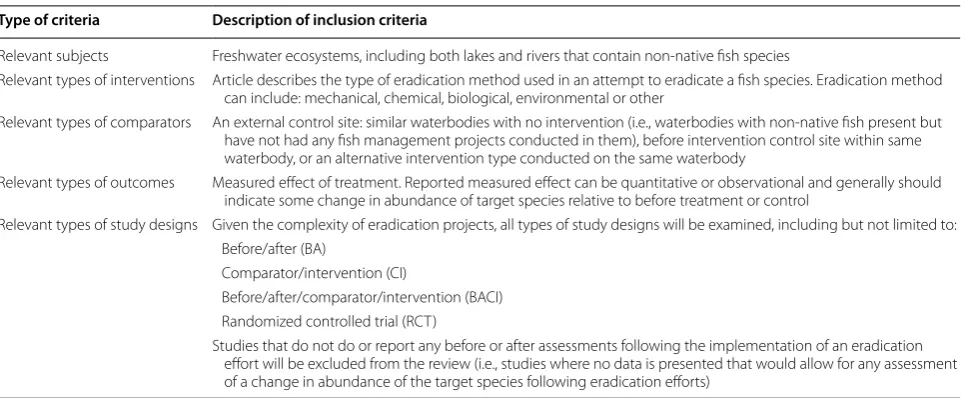
Articles will be excluded based on the following pre-defined inclusion criteria (Table 2).
Study quality assessment
Each of the studies that make it to the full text screening level will be classified and coded in the article database using a number of parameters including (but not limited to):
• Study setting—Lab or field
• Study design (BA/CI/BACI/RCT)
• Temporal extent of study
• Replication—Replicated or unreplicated
• Confounding factors—Present, not present, unclear, and whether they were accounted for in the study
• Clarity of objectives in relation to methods used (e.g., is the ultimate type of management intervention objective clearly identified, including eradication, controlling, containing etc.)
• Use of (and number of) control and reference sites
• Effort devoted to eradication techniques (e.g., press versus pulse, proportional area treated)
• Statistical methods used in assessment of success (e.g., were results analysed statistically?)
• Accounting for and/or identifying potential effect modifiers (see list in following sections).
Bilotta et al. [35] have outlined criteria for the ment of the internal validity of a study. Their assess-ment criteria have been adapted from the Cochrane Collaboration’s Risk of Bias Tool [36] for use in the field of environmental science. The assessment criteria include assessing selection bias, performance bias, attri-tion bias, reporting bias, as well as those biases that may only be relevant in unique situations (e.g., contamina-tion). The criteria outlined in Bilotta et al. will be used
Table 2 Description of inclusion criteria used by the Review Team when screening articles at the title and abstract level Type of criteria Description of inclusion criteria
Relevant subjects Freshwater ecosystems, including both lakes and rivers that contain non-native fish species
Relevant types of interventions Article describes the type of eradication method used in an attempt to eradicate a fish species. Eradication method can include: mechanical, chemical, biological, environmental or other
Relevant types of comparators An external control site: similar waterbodies with no intervention (i.e., waterbodies with non-native fish present but have not had any fish management projects conducted in them), before intervention control site within same waterbody, or an alternative intervention type conducted on the same waterbody
Relevant types of outcomes Measured effect of treatment. Reported measured effect can be quantitative or observational and generally should indicate some change in abundance of target species relative to before treatment or control
Relevant types of study designs Given the complexity of eradication projects, all types of study designs will be examined, including but not limited to: Before/after (BA)
Comparator/intervention (CI)
Before/after/comparator/intervention (BACI) Randomized controlled trial (RCT)
by the Review Team for this review and included in the reference database. The information for each arti-cle retrieved using the search strategy will be uniquely coded based on the criteria (generally categorised as “low risk”, “high risk”, or “unclear risk”) to help assess the quality of each article, and to provide insight into any potential risk of bias present in each of the stud-ies. This information will be instrumental in helping to determine reliability of the evidence base available for potentially conducting a meta-analysis on the effective-ness of each eradication method.
Data extraction strategy
Metadata will be extracted from the included studies by the Review Team and will be recorded in a MS-Excel database that will be made available with the published systematic review article, as an additional supporting file. The extracted information will be used to assess the overall effectiveness of each intervention strategy, and when sufficient, good quality data exists, the informa-tion will be used in a meta-analysis. Some of the out-come data that will be recorded will include: outout-come means, measures of variation (e.g., standard deviation, standard error, confidence intervals), and sample sizes. When data is presented in tables or graphs, all informa-tion will be extracted and recorded. If it is not possible to decipher information from graphs, the main contact author for the article will be contacted (via email or phone) by the Review Team to request the information. During that request, the Review Team will also solicit the author to suggest any grey literature that they may know of related to the systematic review topic. Where only raw data is provided in the article, the Review Team will calculate summary statistics. In those instances, it will be recorded in the MS-Excel database how the calculations were done and with what informa-tion. To ensure that data is being extracted in a consist-ent and repeatable manner, two reviewers will extract information from 10 of the same articles. Afterwards, the information will be compared. Any inconsistencies will be discussed amongst the Review Team members, and if any disagreement occurs, they will be discussed with the entire Review Team to ensure all reviewers are extracting and interpreting data in the same manner.
Potential effect modifiers and reasons for heterogeneity
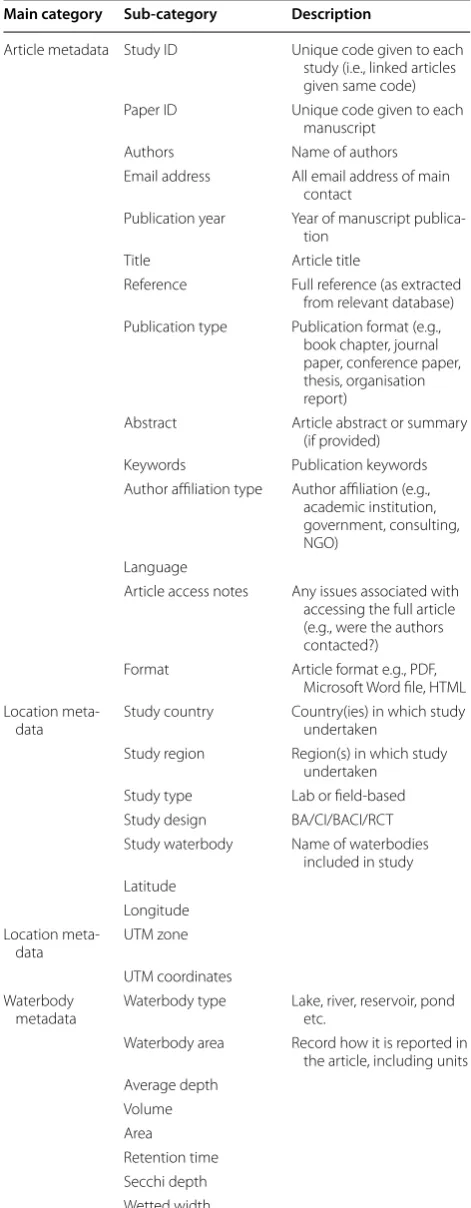
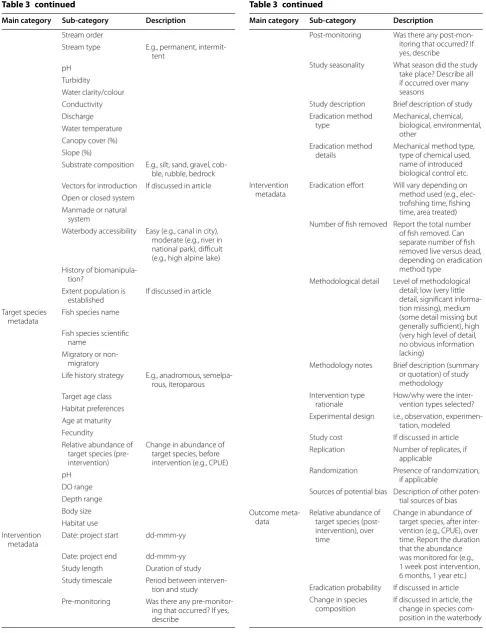
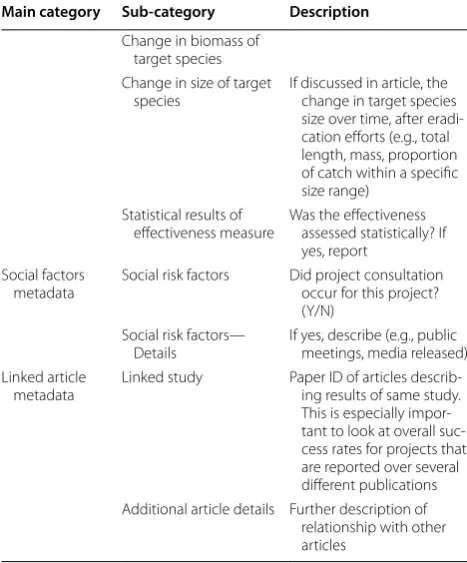
The Review Team will extract data on potential effect modifiers (see Table 3) from articles that are included at the full-text level of screening. All information will be recorded in the MS-Excel database.
Table 3 presents the criteria that will be consid-ered as potential effect modifiers and/or reasons for
Table 3 Data extraction table
Main category Sub-category Description
Article metadata Study ID Unique code given to each study (i.e., linked articles given same code)
Paper ID Unique code given to each
manuscript
Authors Name of authors
Email address All email address of main contact
Publication year Year of manuscript publica-tion
Title Article title
Reference Full reference (as extracted from relevant database) Publication type Publication format (e.g.,
book chapter, journal paper, conference paper, thesis, organisation report)
Abstract Article abstract or summary (if provided)
Keywords Publication keywords
Author affiliation type Author affiliation (e.g., academic institution, government, consulting, NGO)
Language
Article access notes Any issues associated with accessing the full article (e.g., were the authors contacted?)
Format Article format e.g., PDF, Microsoft Word file, HTML Location
meta-data Study country Country(ies) in which study undertaken Study region Region(s) in which study
undertaken
Study type Lab or field-based
Study design BA/CI/BACI/RCT
Study waterbody Name of waterbodies included in study Latitude
Longitude Location
meta-data UTM zone
UTM coordinates Waterbody
metadata Waterbody type Lake, river, reservoir, pond etc. Waterbody area Record how it is reported in
the article, including units Average depth
Table 3 continued
Main category Sub-category Description
Stream order
Stream type E.g., permanent, intermit-tent
pH Turbidity
Water clarity/colour Conductivity Discharge Water temperature Canopy cover (%) Slope (%)
Substrate composition E.g., silt, sand, gravel, cob-ble, rubcob-ble, bedrock Vectors for introduction If discussed in article Open or closed system
Manmade or natural system
Waterbody accessibility Easy (e.g., canal in city), moderate (e.g., river in national park), difficult (e.g., high alpine lake) History of
biomanipula-tion?
Extent population is
established If discussed in article Target species
metadata Fish species name Fish species scientific
name Migratory or
non-migratory
Life history strategy E.g., anadromous, semelpa-rous, iteroparous Target age class
Habitat preferences Age at maturity Fecundity
Relative abundance of target species (pre-intervention)
Change in abundance of target species, before intervention (e.g., CPUE) pH
DO range Depth range Body size Habitat use Intervention
metadata Date: project start dd-mmm-yy Date: project end dd-mmm-yy Study length Duration of study Study timescale Period between
interven-tion and study
Pre-monitoring Was there any pre-monitor-ing that occurred? If yes, describe
Table 3 continued
Main category Sub-category Description
Post-monitoring Was there any post-mon-itoring that occurred? If yes, describe
Study seasonality What season did the study take place? Describe all if occurred over many seasons
Study description Brief description of study Eradication method
type Mechanical, chemical, biological, environmental, other
Eradication method
details Mechanical method type, type of chemical used, name of introduced biological control etc. Intervention
metadata Eradication effort Will vary depending on method used (e.g., elec-trofishing time, fishing time, area treated) Number of fish removed Report the total number
of fish removed. Can separate number of fish removed live versus dead, depending on eradication method type
Methodological detail Level of methodological detail; low (very little detail, significant informa-tion missing), medium (some detail missing but generally sufficient), high (very high level of detail, no obvious information lacking)
Methodology notes Brief description (summary or quotation) of study methodology Intervention type
rationale How/why were the inter-vention types selected? Experimental design i.e., observation,
experimen-tation, modeled Study cost If discussed in article Replication Number of replicates, if
applicable
Randomization Presence of randomization, if applicable
Sources of potential bias Description of other poten-tial sources of bias Outcome
meta-data Relative abundance of target species (post-intervention), over time
Change in abundance of target species, after inter-vention (e.g., CPUE), over time. Report the duration that the abundance was monitored for (e.g., 1 week post intervention, 6 months, 1 year etc.) Eradication probability If discussed in article Change in species
heterogeneity and will be extracted. Further factors may be identified, defined and included throughout the pro-cess, through consultation with external experts.
Data synthesis and presentation
A narrative synthesis of data from all articles included in the systematic review will be generated. The synthesis will aim to be as visual as possible, summarizing informa-tion in tables and figures. The ultimate goal of this review is to assess the effectiveness of each different eradication technique and to identify the factors that influence the overall success rate of each type of method, in order to better inform management agencies who routinely have to decide when, where and how non-native fish eradica-tion programs should be implemented. All efforts will be made to provide quantitative assessments and meta-anal-ysis of the articles included in this review, when the study designs and evidence-base allow. The review team has conducted some scoping exercises, particularly to help develop an efficient search strategy and to get a sense of the existing literature base. When doing so, the review team got the sense that sufficient evidence may exist to allow them to conduct a meta-analysis on some inter-vention types, but it is unlikely that a meta-analysis may be possible for all intervention types. It will also depend on the literature base for each target species. Sufficient
evidence may exist for some more common target (prob-lem) species but not for more regionally-relevant species. Authors’ contributions
All authors participated in the drafting, revision, and approval of the manu-script. Both authors read and approved the final manumanu-script.
Author details
1 Canadian Centre for Evidence-Based Conservation and Environmental Management, Institute of Environmental Sciences, Carleton University, 1125 Colonel By Drive, Ottawa, ON, Canada. 2 Fish Ecology and Conservation Physi-ology Laboratory, Department of BiPhysi-ology, Carleton University, 1125 Colonel By Drive, Ottawa, ON, Canada.
Acknowledgements
The authors would like to thank several reviewers and collaborators who provided valuable insights to strengthen this review protocol including: Robert Britton (Bournemouth University, UK), David Browne (Canadian Wildlife Federation, CA), Robert Gresswell (United States Geological Survey, USA), and Mark Lintermans (University of Canberra, AU), and Parks Canada staff including Kent Prior, Marlow Pellatt, Mark Taylor, Bill Hunt, Chantal Vis, Scott Parker, and Shelley Humphries. The study was supported by Parks Canada, the Natural Sci-ences and Engineering Research Council, the Canada Research Chairs Program and the Carleton University Research Excellence Fund.
Competing interests
The authors declare that they have no competing interests.
Received: 19 January 2016 Accepted: 2 June 2016
References
1. Gozlan RE, Whipps C, Andreou D, Arkush K. Identification of a rosette-like agent as Sphaerothecum destruens, a multi-host fish pathogen. Int J Parasitol. 2009;39:1055–8.
2. Ricciardi A, MacIsaac HJ. Impacts of biological invasions on freshwater ecosystems. In: Fifty years of invasion ecology: the legacy of Charles Elton. 2011; p. 211–24.
3. Vitousek PM, Mooney HA, Lubchenco J, Melillo JM. Human domination of Earth’s ecosystems. Science. 1997;277:494–9.
4. Sala OE, Chapin FS, Armesto JJ, et al. Biodiversity—global biodiversity scenarios for the year 2100. Science. 2000;287(1770–1774):5. 5. Koel TM, Bigelow PE, Doepke PD, Ertel BD, Mahony DL. Nonnative lake
trout result in Yellowstone cutthroat trout decline and impacts to bears and anglers. Fisheries. 2005;30:10–9.
6. Pimentel D, Zuniga R, Morrison D. Update on the environmental and eco-nomic costs associated with alien-invasive species in the United States. Ecol Econ. 2005;52:273–88.
7. Simberloff D, Martin J, Genovesi P, Maris V, Wardle DA, Aronson J, Cour-champ F, Galil B, García-Berthou E, Pascal M. Impacts of biological inva-sions: what’s what and the way forward. Trends Ecol Evol. 2013;28:58–66. 8. Ruiz GM, Carlton JT, Grosholz ED, Hines AH. Global invasions of marine
and estuarine habitats by non-indigenous species: mechanisms, extent, and consequences. Am Zool. 1997;37:621–32.
9. Levine JM, D’Antonio CM. Forecasting biological invasions with increasing international trade. Conserv Biol. 2003;17:322–6.
10. Padilla DK, Williams SL. Beyond ballast water: aquarium and ornamental trades as sources of invasive species in aquatic ecosystems. Front Ecol Environ. 2004;2:131–8.
11. Fredenberg W. Further evidence that lake trout displace bull trout in mountain lakes. Int J Sci. 2002;8:143–52.
12. Lintermans M. Human-assisted dispersal of alien freshwater fish in Aus-tralia. N Z J Mar Freshw. 2004;38:481–501.
13. Vander Zanden MJ, Olden JD. A management framework for preventing the secondary spread of aquatic invasive species. Can J Fish Aquat Sci. 2008;65:1512–22.
Table 3 continued
Main category Sub-category Description
Change in biomass of target species Change in size of target
species If discussed in article, the change in target species size over time, after eradi-cation efforts (e.g., total length, mass, proportion of catch within a specific size range)
Statistical results of
effectiveness measure Was the effectiveness assessed statistically? If yes, report
Social factors
metadata Social risk factors Did project consultation occur for this project? (Y/N)
Social risk factors—
Details If yes, describe (e.g., public meetings, media released) Linked article
metadata Linked study Paper ID of articles describ-ing results of same study. This is especially impor-tant to look at overall suc-cess rates for projects that are reported over several different publications Additional article details Further description of
• We accept pre-submission inquiries
• Our selector tool helps you to find the most relevant journal • We provide round the clock customer support
• Convenient online submission • Thorough peer review
• Inclusion in PubMed and all major indexing services • Maximum visibility for your research
Submit your manuscript at www.biomedcentral.com/submit
Submit your next manuscript to BioMed Central
and we will help you at every step:
14. Varley JD, Schullery P. The Yellowstone Lake crisis: confronting a lake trout invasion: a report to the Director of the National Park Service. Yellowstone Center for Resources, National Park Service; 1995.
15. Fausch KD, Rieman BE, Young MK, Dunham JB. Strategies for conserving native salmonid populations at risk from nonnative fish invasions: trade-offs in using barriers to upstream movement. General Technical Report RMRS-GTR-174, USDA Forest Service, Rocky Mountain Research Station, Fort Collins, Colorado; 2006.
16. Finnoff D, Shogren JF, Leung B, Lodge D. Take a risk: preferring prevention over control of biological invaders. Ecol Econ. 2007;62:216–22.
17. Peterson DP, Rieman BE, Dunham JB, Fausch KD, Young MK. Analysis of trade-offs between threats of invasion by nonnative trout brook trout (Salvelinus fontinalis) and intentional isolation for native west-slope cutthroat trout (Oncorhynchus clarkii lewisi). Can J Fish Aquat Sci. 2008;65:557–73.
18. Britton JR, Copp GH, Brazier M, Davies GD. A modular assessment tool for managing introduced fishes according to risks of species and their populations, and impacts of management actions. Biol Invasions. 2011;13:2847–60.
19. Rinne JN, Turner PR. Reclamation and alteration as management tech-niques, and a review of methodology in stream renovation. In: Minckley WL, Deacon JE, editors. Battle against extinction: native fish management in the American West. Tuscon: The University of Arizona Press; 1991. p. 219–44.
20. Genovesi P. Eradication of invasive alien species in Europe: a review. Biol Invasions. 2005;7:127–33.
21. Gresswell RE. Use of antimycin for removal of brook trout from a tributary of Yellowstone Lake. Trans Am Fish Soc. 1991;11:83–90.
22. Buhle ER, Margolis M, Ruesink JL. Bang for buck: cost effective control of invasive species with different life histories. Ecol Econ. 2005;52:355–66. 23. Syslo JM, Guy CS, Cox BS. Comparison of harvest scenarios for the cost-effective suppression of lake trout in Swan Lake, Montana. N Am J Fish Manag. 2013;33:1079–90.
24. Lodge DM, Williams A, MacIsaac HJ, et al. Biological invasions: rec-ommendations for US policy and management. Biol Invasions. 2006;16:1035–2054.
25. Meronek TG, Bouchard PM, Buckner ER, Burri TM, Demmerly KK, Hatleli DC, Klumb RA, Schmidt SH, Coble DW. A review of fish control projects. N Am J Fish Manag. 1996;16:63–74.
26. Finlayson BJ, Schnick RA, Cailteux RL et al. Rotenone use in fisheries management: administrative and technical guidelines manual. American Fisheries Society: Maryland, Bethesda, Maryland; 2000. http://www.fisher-iessociety.org/rotenone/Rotenone_Manual.pdf. Accessed online July 2015. 27. Vinson MR, Dinger EC, Vinson DK. Piscicides and invertebrates: after
70 years, does anyone really know? Fisheries. 2010;35:61–71. 28. Paul AJ, Post JR, Stelfox JD. Can anglers influence the abundance of
native and nonnative salmonids in a stream from the Canadian Rocky Mountains? N Am J Fish Manag. 2003;23:109–19.
29. Syslo JM, Guy CS, Bigelow P, Doepke PD, Ertel BD, Koel TM. Response of non-native lake trout (Salvelinus namaycush) to 15 years of harvest in Yellowstone Lake, Yellowstone National Park. Can J Fish Aquat Sci. 2011;68:2132–45.
30. Gaeta JW, Hrabik TR, Sass GC, Roth BM, Gilbert ST, Vander Zanden MJ. A whole-lake experiment to control invasive rainbow smelt (Actinoperygii, Osmeridae) via overharvest and food web manipulation. Hydrobiologia. 2015;745:433–44.
31. Davis GS, Britton JR. Assessing the efficacy and ecology of biocontrol and biomanipulation for managing invasive pest fish. J Appl Ecol. 2015;52:1264–73.
32. Koel TM, Arnold JL, Bigelow PE, Ruhl ME. Native fish conservation plan/ environmental assessment. Wyoming: National Park Service, Yellowstone National Park; 2010.
33. Britton JR, Gozlan RE, Copp GH. Managing non-native fish in the environ-ment. Fish Fish. 2011;12:256–74.
34. Britton JR, Brazier M. Eradicating the invasive topmouth gudgeon, Pseudorasbora parva, from a recreational fishery in northern England. Fish Manag Ecol. 2006;13:329–35.
35. Bilotta GS, Milner AM, Boyd IL. Quality assessment tools for evidence from environmental science. Environ Evid. 2014;3:14.