Chemistry Publications
Chemistry
1-20-1997
Structural Analysis of the Fivefold Symmetric
Surface of the Al70Pd21Mn9 Quasicrystal by Low
Energy Electron Diffraction
M. Gierer
University of California, Berkeley
M. A. Van Hove
University of California, Berkeley
A. I. Goldman
Iowa State UniversityZ. Shen
Iowa State University
S.-L. Chang
Iowa State UniversitySee next page for additional authors
Follow this and additional works at:
http://lib.dr.iastate.edu/chem_pubs
Part of the
Biological and Chemical Physics Commons
, and the
Physical Chemistry Commons
The complete bibliographic information for this item can be found at
http://lib.dr.iastate.edu/
chem_pubs/82
. For information on how to cite this item, please visit
http://lib.dr.iastate.edu/
howtocite.html
.
This Article is brought to you for free and open access by the Chemistry at Iowa State University Digital Repository. It has been accepted for inclusion in Chemistry Publications by an authorized administrator of Iowa State University Digital Repository. For more information, please contact
Al70Pd21Mn9 Quasicrystal by Low Energy Electron Diffraction
Abstract
The atomic structure of the fivefold symmetric quasicrystal surface of Al70Pd21Mn9was investigated by
means of a dynamical low energy electron-diffraction analysis. Approximations are developed to address the high structural complexity of quasicrystals, yielding average layer-by-layer structural and compositional information. A mix of several relaxed bulklike terminations is found, consistently favoring dense Al-rich outermost atomic layers. These results can be understood in terms of principles known to govern surface structures of simpler, crystalline metals.
Keywords
Ames Laboratory, Physics and Astronomy
Disciplines
Biological and Chemical Physics | Physical Chemistry
Comments
This article is fromPhysical Review Letters78, no. 3 (1997): 467–470, doi:10.1103/PhysRevLett.78.467.
Authors
M. Gierer, M. A. Van Hove, A. I. Goldman, Z. Shen, S.-L. Chang, Cynthia J. Jenks, C.-M. Zhang, and Patricia A. Thiel
VOLUME78, NUMBER3 P H Y S I C A L R E V I E W L E T T E R S 20 JANUARY1997
Structural Analysis of the Fivefold Symmetric Surface of the Al
70Pd
21Mn
9Quasicrystal
by Low Energy Electron Diffraction
M. Gierer and M. A. Van Hove
Lawrence Berkeley National Laboratory, University of California at Berkeley, Berkeley, California 94720
A. I. Goldman
Department of Physics and Astronomy and Ames Laboratory, Iowa State University, Ames, Iowa 50011
Z. Shen, S.-L. Chang, C. J. Jenks, C.-M. Zhang, and P. A. Thiel
Department of Chemistry and Ames Laboratory, Iowa State University, Ames, Iowa 50011 (Received 22 August 1996)
The atomic structure of the fivefold symmetric quasicrystal surface of Al70Pd21Mn9was investigated
by means of a dynamical low energy electron-diffraction analysis. Approximations are developed to address the high structural complexity of quasicrystals, yielding average layer-by-layer structural and compositional information. A mix of several relaxed bulklike terminations is found, consistently favor-ing dense Al-rich outermost atomic layers. These results can be understood in terms of principles known to govern surface structures of simpler, crystalline metals. [S0031-9007(96)02211-9]
PACS numbers: 61.44.Br, 61.14.Hg, 68.35.Bs
Over the past ten years great strides have been made in our understanding of quasicrystalline alloys. In particular, since their discovery in 1984 [1], we have gained signifi-cant insight into the bulk atomic-scale structure of icosa-hedral and decagonal alloys through x-ray and neutron diffraction measurements coupled with structural model-ing based upon realistic atomic pair potentials [2,3]. At the same time, surface sensitive measurements such as photo-emission, scanning tunneling microscopy (STM), and low energy electron diffraction (LEED) [4 – 7] have become possible through advances in our understanding of the met-allurgy of quasicrystalline alloys, which have permitted the growth of very sizable, high quality, single grain samples [8]. While much is understood about the bulk atomic-scale structure of quasicrystals, determining their surface struc-ture presents new and important challenges. Information about the surface structure, composition, chemistry, topol-ogy, and possible surface reconstructions is a prerequisite to understanding recent findings that quasicrystalline sur-faces and coatings exhibit low surface friction and high oxidation resistance, properties important to many techno-logical applications.
The surface structures of both icosahedral and decago-nal alloys have been examined previously with both STM and LEED techniques. Most germane to the present dis-cussion is the work of Schaub et al., who investigated the surface structure of microfacets which formed on a sur-face of the Al70Pd21Mn9icosahedral alloy, oriented close to the twofold surface, upon heating in vacuum [6,7]. The microfacets themselves grow perpendicular to a fivefold axis of the bulk alloy and exhibit fivefold symmetry in their LEED patterns. The surface topology of these facets can be described by a set of atomically flat terraces with steps of two different heights in a succession
correspond-ing to a quasiperiodic (Fibonacci) sequence. However, the STM study suffered from limitations typical of the technique: It could not provide information about the chemical composition of the surface being imaged, nor could it clearly correlate certain STM features common on the terraces with atomic structures.
Previous LEED studies have been limited to observa-tions and discussions of the symmetry and spacing of the diffraction spots, in order to determine whether the surface retains the quasicrystallinity of the bulk. They did not exploit the strength of dynamical LEED as a tool for ob-taining atomic-scale information on surface structure and composition.
In this Letter we describe the results of a dynamical LEED analysis on the fivefold surface of an Al70Pd21Mn9 alloy. Specifically, we find that the surface is a mixture of very similar terminations with a dense, Al-rich outermost atomic layer followed by a layer containing about 50% Al and 50% Pd. This information on composition and sub-surface structure complements that available from STM. Furthermore, it provides a basis for predicting and under-standing the step heights present on these surfaces, since steps must separate the different terminations. Together, these lay the groundwork for a more quantitative under-standing of the atomic-scale structure of quasicrystalline surfaces.
As with bulk x-ray and neutron diffraction, the LEED pattern for an ideal quasicrystal surface should exhibit sharp intense reflections (beams) at well-defined exit angles (Fig. 1). This leads to conventional-looking LEED IV curves, as shown in Fig. 2. To obtain such data, the sample is treated in an ultrahigh vacuum chamber equipped for Auger electron spectroscopy (AES), LEED, and other standard methods of surface analysis and
FIG. 1. LEED pattern at 85 eV incident electron energy and normal incidence. For each major set of five equivalent spots, only a single spot is indexed. The dark shadow at top and middle is the sample manipulator, which obscures some spots.
modification [9]. Other papers describe our methods of quasicrystalline sample preparation [10], and data acquisition and reduction in LEED [10,11]. Our method
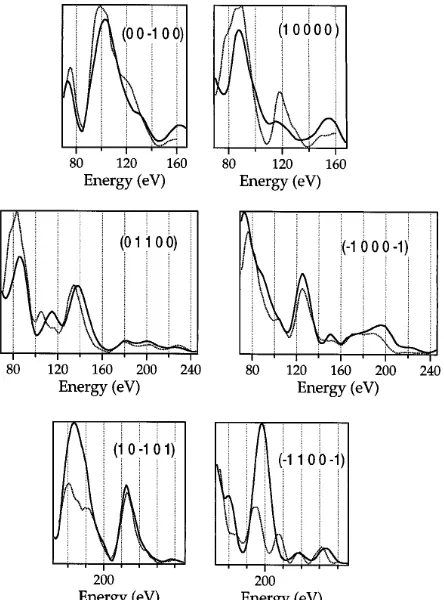
FIG. 2. Best-fit experimental and theoretical IV curves, aver-aging theory equally over the ten best individual terminations, including relaxations in the top four interlayer spacings of each. The intensity scales are arbitrary.
of surface preparation in ultrahigh vacuum involves ion bombardment at room temperature and annealing (to temperatures in the range 870 – 1100 K), and is similar to that employed by Schaub et al. in the STM work [6,7]. These techniques are used until no surface contaminants (mainly oxygen) are detectable by AES, and until the fivefold pattern reaches a high quality. There is no evidence for a surface phase transformation, such as that reported for decagonal AlCuCo [12].
Like previous authors, we find that the symmetry and spacing of the LEED beams indicate that the fivefold surface of this alloy retains the bulk quasicrystallinity. IV curves were measured at normal incidence for six sets of bright diffraction spots in the energy range 70 –260 eV. Each set consists of five symmetrically equivalent spots which we average, thus producing a database of six symmetry-inequivalent IV curves, indexed as shown in Figs. 1 and 2. Under a wide variety of surface preparations, a sharp fivefold diffraction pattern was obtained, and the IV curves were very similar. Thus, the IV data shown in Fig. 2 are very robust. These form the experimental basis for deducing the surface structure from diffraction theory.
Quasicrystals pose special challenges to diffraction theory, previously worked out for the cases of x rays and neutrons. In LEED, multiple scattering adds further complications: The aperiodicity of quasicrystals, and of quasicrystal surfaces in particular, implies a wide variety of local structures, and an intractable number of atoms with different scattering properties; note that the scattering properties of an atom depend in effect on its local environment in the case of multiple scattering. Thus, approximations in the LEED theory are necessary, and an appropriate LEED formalism, described in this Letter, was developed for a quasicrystalline surface region.
As a starting point for the LEED analysis, we used the bulk structure of icosahedral AlPdMn determined by x-ray and neutron diffraction [3] and produced first a large set of possible ideal bulklike fivefold surface terminations bounded by a box of1003100350Å3. As a result of quasiperiodicity, all of these terminations are, in principle, different. Many of them have, however, very similar chemical compositions and geometry so that only a finite number of qualitatively different terminations has to be considered. Each of these surfaces is represented as individual layers (parallel to the surface) of coplanar atoms with a particular composition and density. The average t-matrix approximation [13] is applied to each layer with its own bulklike composition to generate a unique atom with average scattering properties. The layer density also scales the contribution from each layer.
To account for multiple scattering, we use the giant ma-trix approach in the framework of the Beeby mama-trix inver-sion [14]. We assume that the scattering properties of all atoms in a particular layer parallel to the surface are equal. We describe the average neighborhood of an aver-age atom in a given layer by a kind of radial distribution
[image:4.612.64.286.379.679.2]VOLUME78, NUMBER3 P H Y S I C A L R E V I E W L E T T E R S 20 JANUARY1997
function: A representative number of neighbor atoms is distributed uniformly on rings, with proper polar angles but without regard to proper azimuthal angles. This lo-cal “cluster” is summed over in the sense of the lattice sum familiar in theX matrix of LEED theory [14]. The Xmatrix, which describes the propagation of the electron wave field within and between layers, is thereby assumed to be independent of the azimuthal angle; this works best at normal incidence, as used in the experiment. Inversion of the matrix 12 X then introduces multiple scattering paths to infinite order. Checks on the sufficiency of these approximations were performed by also using more rep-resentative structural models. These checks will be pre-sented elsewhere, together with further details about phase shifts, Debye temperatures, muffin-tin zero, and inelastic damping, which are standard. The Pendry R factor [15] was used to evaluate the fit to experiment.
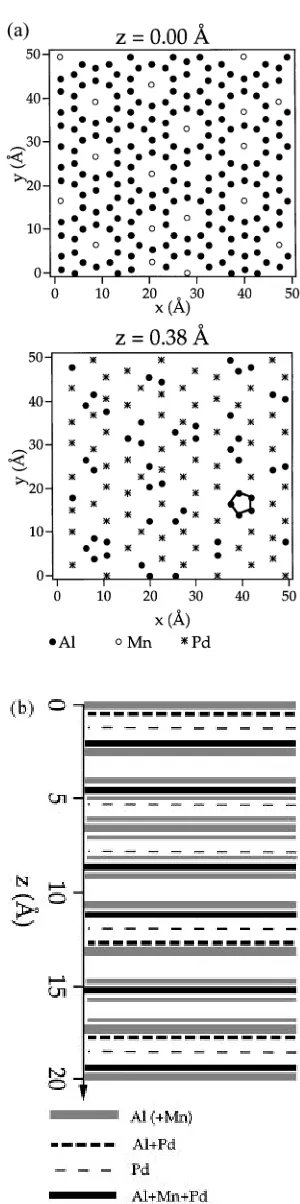
In analyzing the experimental LEED data, we first assumed single terminations of the bulk, i.e., no mix of terminations due to possible steps. The top two interlayer spacings were optimized for each termination within a cube of 50 Å depth, yieldingR factors varying from about 0.42 to 0.85 for the different terminations. The better fitting terminations share a common feature: a pair of closely spaced dense layers with an interlayer spacing of about 0.4 Å. The top one of these two layers is composed primarily of Al, mixed with about 10% Mn, while the second one contains about 50% Al and 50% Pd and only small amounts of Mn (Fig. 3). In line with the STM observations of Schaub et al. [6,7], many of these terminations are separated by steps with heights of 4.08 or 6.60 Å. Low energy ion scattering data also support the composition of the favored layers [16].
Next, the ten best terminations were averaged together with equal weights to model the case of equal-sized ter-races, each having one of the different terminations. By an automated optimization after the intensity mixing, we got information about the average interlayer spacings and could reduce the R factor to 0.31, which is comparable to that found in many other successful structure determi-nations, particularly for complex surfaces. The topmost interlayer spacing of 0.38 Å is reduced by 0.1 Å from the bulk value of 0.48 Å, which trend is consistent with clean single-crystal results of comparable local buckled struc-tures (e.g., stepped fcc surfaces); the interlayer spacings of deeper layers are almost bulklike. Note that the two topmost layers are so close that they might be considered a single, buckled layer, in which case the lateral density of this buckled layer is 0.135 atomsyÅ2, close to the value of 0.141 atomsyÅ2for the close-packed Al(111) fcc surface. This high density is probably one factor which favors the terminations we find for the quasicrystal, since for metals, the closest-packed face generally has the lowest surface free energy.
[image:5.612.359.509.41.643.2]The Al-rich terminations found here also correlate with factors known to govern surface compositions of crystalline alloys. At those simpler surfaces, one finds
FIG. 3. One of the favored terminations of Al70Pd21Mn9:
(a) The two topmost planar bulk layers perpendicular to the fivefold axis; many Mn atoms in the top layer are surrounded by pentagons in the second layer, one of which is indicated at the lower right. In ( b), the layers are drawn at their respective depths z, as bars with thickness proportional to the atomic density in each layer, together with their approximate composition; parentheses indicate minority species.
preferential segregation by components with the lower surface free energy, larger atomic volume and more posi-tive heat of solution [17]. (Surface free energy typically is the dominant factor.) The Al-rich terminations found here are expected if these factors are taken into account.
As shown in Fig. 3(a), many of the Mn atoms in the topmost layer of the favored terminations are surrounded by five atoms (Al or Pd) in the second layer. The orientation of these AlyPd “pentagons” in the second layer is the same for all terminations, and by connecting their edges with straight lines, one obtains a Fibonacci pentagrid. Interestingly, in the STM study [6], fivefold symmetric holes with very similar quasiperiodic long range order were found; one may speculate that these holes can be identified with Mn atoms, surrounded by five atoms in the second layer since no other features fit the STM images better.
In summary, the atomic structure of the fivefold sym-metric quasicrystal surface of Al70Pd21Mn9 has been in-vestigated by means of a dynamical LEED analysis. Approximations were developed to make the structure of an aperiodic, quasicrystalline surface region accessible to LEED. A mix of several relaxed, bulklike terminations is found with a dense Al-rich layer on top followed by a layer with a composition of about 50% Al and 50% Pd. The interlayer spacing between these two topmost layers is contracted by 0.1 to 0.38 Å, and the lateral density of the two topmost layers taken together is similar to that of an Al(111) surface.
We thank M. de Boissieu for supplying information about the atomic surfaces in AlPdMn as well as the software used to generate the 3d atomic bulk positions. The quasicrystalline sample was grown and supplied by T. Lograsso and D. Delaney through the Materials Prepa-ration Center of the Ames Laboratory. We thank P. J. Pinhero and J. W. Anderegg for contributing to the LEIS measurements. This work was supported in large part by the Director, Office of Energy Research, Office of Basic Energy Sciences, Materials Sciences Division, of the U.S. Department of Energy under Contracts No.
DE-AC03-76SF00098 and No. W-405-Eng-82. M. G. acknowledges a postdoctoral fellowship from the German DFG.
[1] D. Shechtman, I. Blech, D. Gratias, and J. W. Cahn, Phys. Rev. Lett. 53, 1951 (1984).
[2] A. Katz and D. Gratias, in Quasicrystals, edited by C. Janot and R. Mosseri (World Scientific, Singapore, 1995), pp. 164 – 167; R. Phillips, J. Zou, A. E. Carlsson, and M. Widom, Phys. Rev. B 49, 9322 (1994).
[3] M. Boudard, M. de Boissieu, C. Janot, G. Heger, C. Beeli, H. U. Nissen, H. Vincent, R. Ibberson, M. Audier, and J. M. Dubois, J. Phys. C 4, 10 149 (1992).
[4] X. Wu et al., Phys. Rev. Lett. 75, 4540 (1995); C. J. Jenks et al., Phys. Rev. B (to be published).
[5] E. G. McRae, R. A. Malic, T. H. Lalonde, F. A. Thiel, H. S. Chen, and A. R. Kortan, Phys. Rev. Lett. 65, 883 (1990). [6] T. M. Schaub, D. E. Bürgler, H.-J. Güntherodt, and J.-B.
Suck, Phys. Rev. Lett. 73, 1255 (1994).
[7] T. M. Schaub, D. E. Bürgler, H.-J. Güntherodt, and J.-B. Suck, Z. Phys. B 96, 93 (1994).
[8] M. de Boissieu et al., Philos. Mag. Lett. 65, 147 (1992); T. Lograsso and D. Delaney, J. Mater. Res. (to be published).
[9] C. J. Jenks, D. Delaney, T. Bloomer, S.-L. Chang, T. Lo-grasso, and P. A. Thiel, Appl. Surf. Sci. (to be published). [10] S.-L. Chang, W. B. Chin, C.-M. Zhang, C. J. Jenks, and
P. A. Thiel, Surf. Sci. 337, 135 (1995).
[11] O. L. Warren and P. A. Thiel, Phys. Rev. B 47, 10 848 (1993).
[12] E. G. McRae, R. A. Malic, T. H. Lalonde, F. A. Thiel, H. S. Chen, and A. R. Kortan, Phys. Rev. Lett. 65, 883 (1990). [13] Y. Gauthier, Y. Joly, R. Baudoing, and J. Rundgren, Phys.
Rev. B 31, 6216 (1985).
[14] M. A. Van Hove and S. Y. Tong, Surface Crystallography by LEED (Springer-Verlag, Berlin, 1979).
[15] J. B. Pendry, J. Phys. C 13, 937 (1980). [16] P. J. Pinhero and J. W. Anderegg (unpublished).
[17] A. R. Miedema, Z. Metallkd. 69, 287 (1978); A. R. Miedema, F. R. de Boer, and R. Boom, Calphad 1, 341 (1977).