Tech Transfer Summaries
Institute for Transportation
12-2014
Optimizing Pavement Base, Subbase, and Subgrade
Layers for Cost and Performance of Local Roads
David J. White
Iowa State University, [email protected]
Pavana Vennapusa
[email protected]Follow this and additional works at:
http://lib.dr.iastate.edu/intrans_techtransfer
Part of the
Civil and Environmental Engineering Commons
This Report is brought to you for free and open access by the Institute for Transportation at Iowa State University Digital Repository. It has been accepted for inclusion in Tech Transfer Summaries by an authorized administrator of Iowa State University Digital Repository. For more information, please [email protected].
Recommended Citation
White, David J. and Vennapusa, Pavana, "Optimizing Pavement Base, Subbase, and Subgrade Layers for Cost and Performance of Local Roads" (2014).Tech Transfer Summaries. 41.
Optimizing Pavement Base, Subbase, and Subgrade Layers for Cost and
Performance of Local Roads
Abstract
This report is one of two products for this project with the other being a design guide. This report describes test results and comparative analysis from 16 different portland cement concrete (PCC) pavement sites on local city and county roads in Iowa. At each site the surface conditions of the pavement (i.e., crack survey) and foundation layer strength, stiffness, and hydraulic conductivity properties were documented. The field test results were used to calculate in situ parameters used in pavement design per SUDAS and AASHTO (1993) design methodologies. Overall, the results of this study demonstrate how in situ and lab testing can be used to assess the support conditions and design values for pavement foundation layers and how the measurements compare to the assumed design values. The measurements show that in Iowa, a wide range of pavement conditions and foundation layer support values exist. The calculated design input values for the test sites (modulus of subgrade reaction, coefficient of drainage, and loss of support) were found to be different than typically assumed. This finding was true for the full range of materials tested. The findings of this study support the recommendation to incorporate field testing as part of the process to field verify pavement design values and to consider the foundation as a design element in the pavement system. Recommendations are provided in the form of a simple matrix for alternative foundation treatment options if the existing foundation materials do not meet the design intent. The PCI prediction model developed from multi-variate analysis in this study demonstrated a link between pavement foundation conditions and PCI. The model analysis shows that by measuring properties of the pavement foundation, the engineer will be able to predict long term performance with higher reliability than by considering age alone. This prediction can be used as motivation to then control the engineering properties of the pavement foundation for new or re-constructed PCC pavements to achieve some desired level of performance (i.e., PCI) with time.
Keywords
Drainage, Falling weight deflectometers, Low volume roads, Coefficient of subgrade reaction, Pavement performance, Portland cement concrete, PCC
Disciplines
Civil and Environmental Engineering
Comments
See also the 456 page full report under the same title.
tech transfer summary
Optimizing Pavement Base,
Subbase, and Subgrade Layers
for Cost and Performance
of Local Roads
This project involved field forensic investigations of various strategies for optimizing the pavement support layers at 16 different portland cement concrete (PCC) pavement sites on city and county roads in Iowa. RESEARCH PROJECT TITLE
Optimizing Pavement Base, Subbase, and Subgrade Layers for Cost and Performance of Local Roads
SPONSORS
Iowa Highway Research Board (TR-640) Iowa Department of Transportation (InTrans Project 11-402) PRINCIPAL INVESTIGATOR Tom Cackler, P.E.
Director, National CP Tech Center CO-PRINCIPAL INVESTIGATORS David J. White, PhD, P.E.
Richard L. Handy Professor of Civil Engineering and Director, CEER
Pavana K.R. Vennapusa, PhD, P.E. Assistant Director, CEER MORE INFORMATION www.ceer.iastate.edu
CEER, National CP Tech Center Iowa State University
2711 S. Loop Drive, Suite 4700 Ames, IA 50010-8664
515-294-8103
The mission of CEER is to be the nation’s premier institution for developing fundamental knowledge of earth mechanics, and creating innovative technologies, sensors, and systems to enable rapid, high quality, environmentally friendly, and economical construction of roadways, aviation runways, railroad embankments, dams, structural foundations, fortifications constructed from earth materials, and related geotechnical applications. The mission of the National CP Tech Center is to unite key transportation stakeholders around the central goal of advancing concrete pavement technology through research, tech transfer, and technology implementation.
The sponsors of this research are not responsible for the accuracy of the information presented herein. The conclusions expressed in this publication are not necessarily those of the sponsors.
December 2014
Problem Statement
It is common for local street and road pavements to be constructed using portland cement concrete (PCC) directly supported on natural subgrade without considering subgrade treatment or structural support layers such as granular subbase. In order to optimize the performance of concrete pavement, it is critical to understand how the support layers can be designed and constructed to provide the most economical life cycle cost of the pavement system and minimize public funds expenditures on local roads.
Project Overview
To improve the understanding of the relationship between PCC pavement performance and foundation support conditions, 16 different sites on local city and county roads in Iowa were tested. The sites tested varied in the following aspects:
a) Pavement age, from about 30 days to 42 years
b) Surface distress conditions, from “poor” to “excellent” (PCI values from 35 to 100)
c) Type of support conditions, from directly supported over natural subgrade to fly ash–stabilized subgrade to 12-in. thick granular subbase materials
d) Pavement thickness, from 6 in. to 11 in.
e) Annual average daily traffic (AADT) from 110 to 8900
At each site, pavement condition, surface deflections under falling weight deflectometer loading, support layer stiffness, and support layer drainage were studied. The field test results were used to calculate in situ parameters used in pavement design per Iowa Statewide Urban Design and Specifications (SUDAS) and AASHTO (1993) design methodologies. The results were documented in a final report and used in the
development of a companion set of guidelines.
Field Measurements
The foundation layer design input parameters determined from field testing include:
a) Modulus of subgrade reaction (k),
b) Composite modulus of subgrade reaction (if subbase layer is present) (kc),
c) Loss of support (LOS), and d) Coefficient of drainage (Cd).
permeameter (CHP) test device (Figure 3). FWD tests provided a measure of subgrade k values (hereafter, referred to as kFWD). The kFWD values determined from this study were corrected for slab size and dynamic effects and reported as Static kFWD-Corr values. DCP tests were used to empirically estimate the modulus of subgrade and subbase layers, and then graphically determine the composite modulus of subgrade reaction kcomp values (hereafter, referred to as
kcomp-DCP), per AASHTO (1993) guidelines. kcomp values were also determined from Static kFWD-Corr values using subbase layer modulus estimated from DCP tests and the AASHTO (1993) graphical procedure and are reported as Static
kcomp-FWD-Corr. Loss of support under pavements was evaluated based on FWD testing using the concept of zero load intercept, and also by comparing the kcomp values determined from FWD and DCP tests. It is assumed that the FWD tests take into account the loss of support that is existing under pavements at the time of testing, but the DCP tests do not because only properties of individual layers are used in the calculation.
CHP tests were conducted to determine in situ hydraulic conductivity (KCHP) values. The Cd values were determined by estimating the time of drainage using the KCHP values, pavement geometry (i.e., width and cross slope), and effective porosity of the drainage layer material.
In addition to these design input parameters, frost-heave susceptibility classification of the foundation materials was determined based on soil classification determined on excavated samples from field sites (Figure 4).
[image:4.612.55.306.54.235.2]Previous research indicated that uniformity of pavement support conditions plays a critical role in long-term performance of PCC pavements. Uniformity of pavement support conditions was also evaluated in this study based on FWD test results. A uniformity classification matrix was developed to compare results from each site.
[image:4.612.53.308.266.504.2]Figure 1. Falling weight deflectometer testing
Figure 2. Dynamic cone penetrometer testing
[image:4.612.326.577.510.719.2] [image:4.612.56.306.534.718.2]Summary of Key Findings
Overall, the results of this study demonstrate how in situ and lab testing can be used to assess the support conditions and design values for pavement foundation layers. The measurements show that in Iowa, a wide range of pavement conditions and foundation layer support values exist. The calculated design input (k,
kCOMP, Cd, and loss of support) values are different than typically assumed. This finding was true for the full range of materials tested. This finding supports the recommendation to incorporate field testing as part of the process to field verify the selected pavement design values.
A summary of key analysis results obtained from all field sites are as follows:
• The joint LTE at 13 out of the 15 sites showed an average of ≥ 92% at the joints, irrespective of the foundation layer conditions. The remaining three projects showed average LTE < 50%.
• It was found that modulus of subgrade reaction values determined from FWD test (Static kFWD-Corr) correlate well with subgrade layer CBR, when the weakest layer CBR within the top 16 in. of subgrade (CBRSG-Weak) is used. These correlations are also in line with the data published previously in the literature. There is significant variability in the k versus CBR relationships, however.
• Composite k values that account for subbase layer modulus and thickness based on FWD tests (Static kcomp-FWD-Corr) were on average about 0.9 to 6.2 times lower than the values determined from DCP test results using CBRSG-Weak (kcomp-DCP-Weak).
• The kcomp-DCP-Weak values do not account for LOS under the pavement in situ, while the kcomp-FWD-Corr values do as the measurement is directly on the pavement. The LOS values back-calculated by comparing the averages (per site) of these values ranged from about 0.7 to 1.7. These LOS values are higher than the values currently suggested in the SUDAS design procedures (1 for natural subgrade and 0 for granular subbase). For sections with granular subbase, the LOS values ranged from 0.7 to 1.3.
• On average, the kcomp-FWD-Corr and kcomp-DCP
values increased with increasing subbase layer thickness. The Westlawn Dr. site (with 8.5 to 10 in. of subbase) was an
exception because of poorly compacted backfill material in the subgrade at that site, which contributed to LOS and lower kcomp-FWD-Corr values. The W38/Locust Rd. section with 12 in. of granular subbase (3 in. of subbase and 9 in. of macadam subbase) showed the highest
kcomp-FWD-Corr and kcomp-DCP values.
• In situ hydraulic conductivity measurements (KCHP) values measured for the seven different foundation layer support categories did not show improvement in Cd values with increasing subbase layer thickness and were generally lower than suggested for design in SUDAS (Cd = 1.0 for natural subgrade and 1.1 when granular subbase is present).
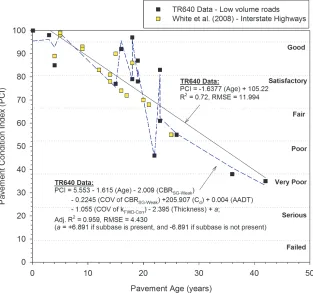
[image:5.612.244.557.417.710.2]• Multi-variate statistical analysis performed on various parameters measured during this study revealed that improving subgrade strength/stiffness (within about the top 16 in. of the subgrade layer), improving drainage, providing a subbase layer, and reducing variability, can contribute to increasing the PCI value (Figure 5). Subgrade layer properties can be improved by stabilization, drainage can be improved by the presence of a relatively thin drainable subbase layer (note that subbase layer thickness was not statistically significant), and variability can be reduced by adequate in situ testing. Some recommendations regarding these aspects are provided in Chapter 8. The PCI prediction model developed from this analysis is based on limited data (16 sites), and must be validated with a larger pool of data.
Recommendations
The field investigation demonstrates that there can be several factors that affect pavement foundation performance, including at least the following:
a) Poor support (due to low stiffness or CBR) b) Poor drainage
c) Seasonal variations (freeze-thaw and frost-heave) d) Shrink-swell due to moisture variations
e) Loss of support (due to erosion, non-uniform settlement, curling/warping)
f) Poorly compacted utility trench backfill g) Differential settlement of foundation layers h) Overall non-uniformity
These problems can be identified through in situ testing. Options for field testing to characterize these problems are summarized in the field data report.
The PCI prediction model developed from multi-variate analysis in this study demonstrated a link between pavement foundation conditions and PCI. These results should be validated with data collected from more projects. The key aspect of this model is that by measuring properties of the pavement foundation, the engineer will be able to predict long-term performance with higher reliability (by factor of 2.4 based on ratio of standard errors) than by considering age alone. These predictions can be used as motivation to then control the engineering properties of the pavement foundation for new or reconstructed PCC pavements to achieve some desired level of performance (i.e., PCI) with time.
Implementation Readiness
This project resulted in two deliverables: the Final Field Data Report, with detailed analyses of the tested strategies for optimizing pavement support layers, and Guidance for Improving Foundation Layers to Increase Pavement Performance on Local Roads, a set of guidelines for implementing the findings from the forensic investigations. The guidelines include a brief summary of what information was understood before this project, what information was learned from project, and brief guidance on improving concrete pavement performance.The guidelines benefit Iowa’s local agencies by helping them implement the findings of the field studies. In particular, local agencies can accomplish the following on new or reconstructed concrete pavement projects:
• Conduct geotechnical investigations to determine what soils are present and understand their characteristics
• Prepare the foundation layers and treat problem areas (performance and cost considerations are discussed in the guidelines)
• Utilize appropriate inspection and quality assurance procedures for foundation layers
The Final Field Data Report andthe Guidance for Improving Foundation Layers to Increase Pavement Performance on Local Roads will be distributed across the state of Iowa and made available on the National Concrete Pavement Technology (CP Tech) Center website. In addition, a one-hour presentation based on this project will be developed and presented at locations within the six Iowa Department of Transportation (DOT) districts as part of the lunch-hour forums sponsored by the Iowa Concrete Paving Association and the Iowa DOT.
In addition, the Iowa SUDAS program will consider adding supplemental information to the pavement design parameters in Chapter 5 of the SUDAS Design Manual. Supplemental information may include the benefits of using aggregate subbase such as improving support, improving drainage, and increasing service life.