Ames Laboratory Accepted Manuscripts
Ames Laboratory
7-18-2018
Using controlled disorder to probe the interplay
between charge order and superconductivity in
NbSe2
Kyuil Cho
Iowa State University and Ames Laboratory, [email protected]
M. Kończykowski
Université Paris-Saclay
Serafim Teknowijoyo
Iowa State University and Ames Laboratory, [email protected]
Makariy A. Tanatar
Iowa State University and Ames Laboratory, [email protected]
J. Guss
Ames Laboratory
See next page for additional authors
Follow this and additional works at:
https://lib.dr.iastate.edu/ameslab_manuscripts
Part of the
Atomic, Molecular and Optical Physics Commons
, and the
Condensed Matter
Physics Commons
This Article is brought to you for free and open access by the Ames Laboratory at Iowa State University Digital Repository. It has been accepted for inclusion in Ames Laboratory Accepted Manuscripts by an authorized administrator of Iowa State University Digital Repository. For more information, please [email protected].
Recommended Citation
Cho, Kyuil; Kończykowski, M.; Teknowijoyo, Serafim; Tanatar, Makariy A.; Guss, J.; Gartin, P. B.; Wilde, John M.; Kreyssig, A.; McQueeney, Robert; Goldman, Alan I.; Mishra, V.; Hirschfeld, P. J.; and Prozorov, Ruslan, "Using controlled disorder to probe the interplay between charge order and superconductivity in NbSe2" (2018).Ames Laboratory Accepted Manuscripts. 223.
Using controlled disorder to probe the interplay between charge order and
superconductivity in NbSe2
Abstract
The interplay between superconductivity and charge-density wave (CDW) in 2
H
-NbSe2 is not fully
understood despite decades of study. Artificially introduced disorder can tip the delicate balance between two
competing long-range orders, and reveal the underlying interactions that give rise to them. Here we introduce
disorder by electron irradiation and measure in-plane resistivity, Hall resistivity, X-ray scattering, and London
penetration depth. With increasing disorder, the superconducting transition temperature,
T
c, varies
non-monotonically, whereas the CDW transition temperature,
T
CDW, monotonically decreases and becomes
unresolvable above a critical irradiation dose where
T
cdrops sharply. Our results imply that the CDW order
initially competes with superconductivity, but eventually assists it. We argue that at the transition where the
long-range CDW order disappears, the cooperation with superconductivity is dramatically suppressed. X-ray
scattering and Hall resistivity measurements reveal that the short-range CDW survives above the transition.
Superconductivity persists to much higher dose levels, consistent with fully gapped superconductivity and
moderate interband pairing.
Disciplines
Atomic, Molecular and Optical Physics | Condensed Matter Physics | Physics
Authors
Kyuil Cho, M. Kończykowski, Serafim Teknowijoyo, Makariy A. Tanatar, J. Guss, P. B. Gartin, John M. Wilde,
A. Kreyssig, Robert McQueeney, Alan I. Goldman, V. Mishra, P. J. Hirschfeld, and Ruslan Prozorov
ARTICLE
Using controlled disorder to probe the interplay
between charge order and superconductivity in
NbSe
2
Kyuil Cho
1,2, M. Ko
ń
czykowski
3, S. Teknowijoyo
1,2, M.A. Tanatar
1,2, J. Guss
1, P.B. Gartin
1,2, J.M. Wilde
1,2,
A. Kreyssig
1,2, R.J. McQueeney
1,2, A.I. Goldman
1,2, V. Mishra
4, P.J. Hirschfeld
5& R. Prozorov
1,2The interplay between superconductivity and charge-density wave (CDW) in 2H-NbSe2is
not fully understood despite decades of study. Artificially introduced disorder can tip the delicate balance between two competing long-range orders, and reveal the underlying interactions that give rise to them. Here we introduce disorder by electron irradiation and measure in-plane resistivity, Hall resistivity, X-ray scattering, and London penetration depth. With increasing disorder, the superconducting transition temperature, Tc, varies
non-monotonically, whereas the CDW transition temperature, TCDW, monotonically decreases
and becomes unresolvable above a critical irradiation dose where Tc drops sharply. Our
results imply that the CDW order initially competes with superconductivity, but eventually assists it. We argue that at the transition where the long-range CDW order disappears, the cooperation with superconductivity is dramatically suppressed. X-ray scattering and Hall resistivity measurements reveal that the short-range CDW survives above the transition. Superconductivity persists to much higher dose levels, consistent with fully gapped super-conductivity and moderate interband pairing.
DOI: 10.1038/s41467-018-05153-0 OPEN
1Ames Laboratory, Ames, IA 50011, USA.2Department of Physics and Astronomy, Iowa State University, Ames, IA 50011, USA.3Laboratoire des Solides
Irradiés, École Polytechnique, CNRS, CEA, Université Paris-Saclay, F-91128 Palaiseau, France.4Computer Science and Mathematics Division, Oak Ridge
National Laboratory, Oak Ridge, TN 37831, USA.5Department of Physics, University of Florida, Gainesville, FL 32611, USA. Correspondence and requests for
materials should be addressed to R.P. (email:[email protected])
123456789
T
he interplay between superconductivity (SC) and density wave orders has been a central issue in high-temperature superconductors such as cuprates and iron-basedsuper-conductors1. The recent discovery of a charge-density wave
(CDW) phase in the middle of the pseudogap region of cup-rates2–7 has revitalized interest in the interplay between SC and CDW orders in other unconventional superconductors, such as the layered transition-metal dichalcogenides, in particular the well-studied 2H-NbSe28–11. This system has fascinated investigators for decades due to the microscopic coexistence of CDW (TCDW=33 K) and SC (Tc=7.2 K) states12,13. The cou-pling between the two long-range orders is apparently responsible for the observability of the elusive Higgs bosonic amplitude mode of the superconductor14,15, revealed by Raman scattering on 2H -NbSe216,17.
Despite intense effort, however, a key question regarding the nature of the coupling of the two orders in this system is still under debate. In recent years, the conventional weak coupling picture where CDW and SC compete for parts of the Fermi surface has been challenged by the realization that the electron-phonon coupling is very strong due to the two-dimensional confinement of the Nb layer10,18–21. In such a situation, the usual
mean field picture of a CDW order with rigid amplitude and
phase disappearing atTCDWmay no longer be valid, as the short-range CDW order together with a gap in the electronic spectrum has been observed outside the long-range ordered phase22.
The situation in 2H-NbSe2 is complicated by the complex
electronic bandstructure of this material and apparent multiband SC with two effective gaps23. Different superconducting gaps on different Fermi surface sheets were inferred from angle-resolved
photoemission spectroscopy (ARPES) by Yokoya et al.24 and
thermal conductivity measurements by Boaknin et al.25. Kiss
et al.26proposed that the CDW actually boosts the SC, based on the correlation with the largest electron-phonon coupling and lowest Fermi velocities at the same k-points. Borisenko et al.27 observed Fermi arcs, suggesting that the CDW inhibits the for-mation of superconducting order by gapping the nested portion of the Fermi surface.
The pressure dependence ofTCDW and Tc is another way to
study the interplay between SC and CDW orders. Leroux et al.28 suggest that the pressure and temperature dependence of the phonon dispersion, observed by inelastic X-ray scattering, sup-ports the insensitivity of Tc to the CDW transition. However, Feng et al.29reported a broad regime of order parameter fl uc-tuations in X-ray diffraction (atT=3.5 K) and attributed it to the
presence of a CDW quantum critical point (PCDW=4.6 GPa)
buried beneath the superconducting dome29. They also claimed that this is partially consistent with the increasing Tc under pressure up to about 4.6 GPa30. Suderow et al.31 proposed a peculiar interplay among SC, CDW order, and Fermi surface complexity, based on the mismatch between the suppression of
TCDW at 5 GPa and the maximum Tc at 10.5 GPa. Chatterjee
et al.22studied the effect of transition-metal doping on the CDW state using ARPES, X-ray diffraction, scanning tunneling micro-scopy (STM), and resistivity, and showed that short-range CDW order with an energy gap survives at high temperatures and high disorder beyond the phase coherence transition.
Another way to probe CDW and SC states is to introduce non-magnetic point-like disorder32–36. Electron irradiation, which has been shown to create pure atomic disorder without doping the system as deduced from Hall effect measurements, is an effective tool to influence both the SC and other orders37,38. Moreover, independent simultaneous measurements ofTc,TCDW, and low-temperature London penetration depth in the same samples with controlled point-like disorder become powerful techniques that can distinguish different types of superconducting pairing such as
d-wave, s±, and s++ pairings34,35,39. Indeed, this approach was successfully used in various iron-based superconductors36,37,40,41. According to early studies of the effect of electron irradiation on NbSe2 by Mutka et al.32, an increase of Tc was reported but attributed to inhomogeneous SC. This result was theoretically discussed by Grest et al.33and Psaltakis et al.42, but direct evi-dence determining the effect of homogeneously distributed dis-order on the interplay between CDW and SC states is still missing.
In this study, we systematically investigate the effect of con-trolled point-like disorder on SC and CDW order in 2H-NbSe2. The disorder is generated by applying 2.5 MeV electron irradia-tion with different doses. For each dose, the changes inTc, resi-dual resistivity, Hall coefficient, and London penetration depth
are measured. For low irradiation doses, Tc shows
non-monotonic behaviour, first increasing slightly and then decreas-ing until a critical dose of 1.0 C cm−2where it drops abruptly. At this critical dose, the long-range CDW feature in resistivity
dis-appears as well. The vanishing of TCDW appears to be
dis-continuous. Upon further irradiation, we find the existence of persistent short-range CDW correlations based on X-ray scat-tering and Hall resistivity measurements, and attribute the abrupt drop in Tcto the loss of coherence of the phase-coherent CDW order. Among various possible mechanisms, we conclude that the effect of the reconstruction of the electronic structure by the CDW leads to a rapid change of electron-phonon scattering at the critical dose of 1.0 C cm−2, explaining the remarkable qualitative change in the Hall effect and the abrupt drop ofTc. This repre-sents clear evidence for a special role of the coherent CDW state coupling to SC. Furthermore, the change in Tc provides impor-tant information on the nature of the pairing both within and outside of the long-range CDW state. Upon irradiation above the critical dose,Tc continuously decreases down to the largest dose applied, suggesting a substantial degree of gap anisotropy. The low-temperature London penetration depths of three post-irradiated samples consistently show exponentially saturating behaviour below 0.2Tc, with gaps that increase with disorder and are therefore consistent with this picture.
Results
Effect of electron irradiation on resistivity. Electron irradiation (maximum dose of 8.93 C cm−2) effectively introduces artificial disorder into the system, resulting in the substantial increase of residual resistivity in the normal state, as shown in Fig.1. Above 40 K without long-range CDW order, the increase of resistivity is rather constant. However, near and below 40 K, a violation of Matthiesen’s rule was observed due to the presence of the CDW phase. For cases with high doses of irradiation (>1.0 C cm−2) where the CDW feature in resistivity was completely suppressed due to disorder, Matthiesen’s rule was obeyed over the entire temperature region of the normal state. To investigate how effectively the electron irradiation introduces disorder, the in-situ resistivity of sample R1 was measured during the irradiation
at 22 K (inset of Fig. 1). It increases monotonically with
increasing dose of irradiation. The blue arrows indicate when the irradiation stopped and room-temperature annealing occurred. About 30–40 % annealing occurred for each case. For each dose (blue arrows), the sample was removed from the irradiation chamber and moved to a different cryostat for measurement of the temperature-dependent resistivity as shown in Figs.1and2. With increasing irradiation dose, both the superconducting and CDW phases were substantially affected. As shown in Fig.2
(a), TCDW (kink feature marked by an arrow) decreases with
increasing irradiation and disappears after 1.0 C cm−2. The behaviour of the CDW feature is more clearly shown in a plot
ARTICLE
NATURE COMMUNICATIONS | DOI: 10.1038/s41467-018-05153-0ofdρ/dTvs. temperature (Fig.2(d)). The important fact is that the feature associated with the CDW transition disappears at afinite temperature of 27 K, instead of continuing down to zero Kelvin. This result suggests the absence of a quantum critical point with disorder, in contrast to the previous pressure study by Feng et al.29. Figure2(b) is an enlargement of the low-temperature part of Fig.2(a) that shows the change ofTc. It is clearly seen thatTc
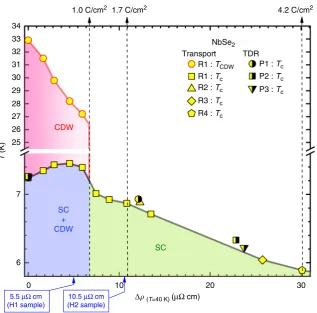
initially increases and then decreases upon irradiation. All the values ofTcand TCDWfor sample R1 are summarized in Fig. 3 along withTc’s from other samples (R2, R3, R4, P1, P2, P3). The
x-axis of Fig.3 is the increase of resistivity at 40 K, Δρ(T=40K), upon irradiation (representing increased disorder). With increas-ing dose of irradiation up to 1.0 C cm−2(Δρ(T=40K)=7.3μΩcm),
Tc gradually increases from 7.25 K to 7.45 K, and then starts decreasing back to 7.3 K, whereasTCDWmonotonically decreases. Upon further irradiation, the feature associated with the CDW transition disappears and simultaneously Tc abruptly drops by 0.3 K, indicating strong correlation between SC and CDW phases.
Note the mismatch between the maximum Tc and the
disappearance of the CDW feature, suggesting a complex interplay between the two phases, potentially including other factors such as complicated Fermi surfaces. Upon further irradiation, Tc continues to decrease toward about 33% of its
pristine value for the maximum electron dose of 8.93 C cm−2
(Δρ(T=40K)=61μΩcm) as shown in the full phase diagram in Supplementary Figure 1.
Effect of electron irradiation on the London penetration depth.
Figure 4 shows the temperature dependence of the London
penetration depth (Δλ) of P1, P2, and P3 samples upon irra-diation. The low-temperature saturation is clearly seen below 0.2T/Tcfor all samples before and after irradiation, suggesting
the presence of s-wave type superconducting gaps.
Interestingly, the saturation tendency gets stronger after irra-diation, suggesting that the initial anisotropic gaps get more isotropic due to the gap-smearing effect of point-like disorder. Note that the irradiation doses shown correspond to residual resistivities Δρ beyond the initial enhancement of Tc due to competition with the CDW phase, so a uniform enhancement of the superconducting gap is not the main cause of the saturation inΔλ. In addition, a substantial decrease ofTcfrom 7.25 K to 4.8 K (about 33% decrease) was found in sample P3 upon 8.93 C cm−2. TheseTcsuppressions of three samples (P1,
P2, P3) are summarized in Fig. 3. Since we cannot directly
obtainρ(T=40K)for P1, P2, and P3, we used the relation between
dose and Δρ obtained from transport-measured samples (R1,
R2, R3, and R4) as shown in Supplementary Figure 2(a). The
substantial decrease ofTcand exponential-like saturation ofΔλ
can be explained with multibands-wave type superconducting
gaps with some amount of interband coupling.
Phase diagram upon electron irradiation. Figure 3shows the temperature versus Δρ(T=40K) phase diagram of SC and CDW upon electron irradiation obtained from seven samples. Upon initial irradiation up to 1.0 C cm−2, an anticorrelation of TCDW andTcwas observed, which is most naturally interpreted in terms of strong competition between SC and CDW phases. However, afterTcreaches its maximum, bothTCDWand Tcdecrease until the CDW phase abruptly disappears at a critical irradiation dose of 1.0 C cm−2, whereTcalso drops discontinuously. The simplest
explanation of the non-monotonic behaviour ofTcin the CDW
coexistence phase is that the initial increase is due to the com-petition between SC and CDW phases. The effect of disorder on this competition was studied already by Grest et al.33and Psal-takis et al.42. Within this weak coupling approach, non-magnetic disorder suppresses the CDW rapidly, and since the CDW order
0 100 200 300
0 40 80 120
0.0 0.5 1.0 1.5 2.0 2.5 5
10 15 20 25 Sample R1: 0, 0.23, 0.47, 0.72, 0.95,
1.18, 1.4, 1.7, 2.4 C/cm2
Sample R2: 0, 1.57 C/cm2
Sample R3: 0, 3.67 C/cm2
Sample R4: 0, 4.18 C/cm2
(
μΩ
cm)
T (K)
Sample R1
In situ resistivity at 22 K
(
μΩ
cm)
Dose (C/cm2)
* Blue arrows indicate annealing at 300 K.
Fig. 1Temperature dependence of resistivity upon electron irradiation. Resistivities of four different samples: R1 (0, 0.23, 0.47, 0.72, 0.95, 1.18, 1.4, 1.7, and 2.4 C cm−2), R2 (0, 1.57 C cm−2), R3 (0, 3.67 C cm−2), and R4 (0, 4.18 C cm−2). Note that all 0-dose curves for samples R1, R2, R3, and R4 are coincident. Overall resistivity increase with increasing dose was consistently seen for all samples, as shown by the arrows. The inset shows in-situ measurement of resistivity of sample R1 as a function of dose during electron irradiation at 22 K. The blue arrows indicate stops in irradiation, during which the sample was extracted from the irradiation chamber and characterized. Partial annealing of about 30–40% of resistivity increase occurred on warming the sample to room temperature and subsequently cooling down to 22 K
[image:5.595.141.457.48.293.2]is competing with SC for the Fermi surface, Tc increases. Note that these theoretical calculations assume an isotropics-wave gap;
within their approximations, Tc would have saturated when
the CDW order vanishs, due to Anderson’s theorem. However, it is clear from Fig. 3that disorder continues to suppress Tc long
after the CDW order is gone; this implies that the s-wave gaps have quite different amplitudes (and, possibly, anisotropy) and substantial interband pairing. Furthermore, as shown in Figs. 5
and6, we found from the Hall resistivity and X-ray scattering that a short-range CDW phase survives long after the critical dose of 1.0 C cm−2.
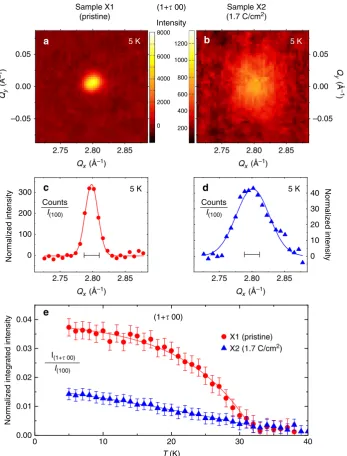
X-ray diffraction upon electron irradiation. Figure5shows the characterization of the CDW of samples X1 (pristine) and X2 (1.7 C cm−2) by high-energy X-ray diffraction. The structure of NbSe2consists of layers of Nb atoms surrounded by six Se atoms and the Nb atoms located in the corners of the hexagonal unit cell43. The CDW displaces the six nearest Nb neighbors of every third Nb atom, yielding a superstructure with tripling of the
unit-cell dimensions in both aand bdirections, and corresponding
propagation vectors (τ0 0) and (0τ0) withτ=1/344. For both samples, the CDW Bragg peaks are observed in all measured Brillouin zones at low temperature. The CDW Bragg peaks are
0 10 20 30 40
0 5 10 15 20 25
6.6 6.8 7.0 7.2 7.4 7.6
0 5 10 15 20
20 25 30 35
0.2 0.4 0.6 0.8 1.0 1.2
0 1 2
0 1 2 3
Sample R1
a
CDW Dose
(C/cm2)
(
μΩ
cm)
T (K)
0
0.23 0.47 0.72
0.95
1.18 1.4
1.7
2.4
b
SC
(
μΩ
cm)
T (K)
0 0.23 0.47 0.72
0.95 1.18 1.4 1.7 2.4
1.7
1.4
1.18
0.95
0.72
0.47
0.23
0
d
CDW
d
/ d
T
(
μΩ
cm/K)
T (K) * Offset applied for clarity.
c
Δ
(T= Tc
)
-Δ
(T= T40 K
)
(
μΩ
cm)
Dose (C/cm2)
Fig. 2Resistivity measurement conducted on sample R1.aThe temperature dependence of resistivity upon irradiation. Overall, the resistivity above the CDW transition was parallel-shifted upward suggesting that preservation of Matthiessen’s rule only occurs above the transition (see text for further discussion).bThe zoom of superconducting transition area shows the increase and subsequent decrease ofTcupon irradiation.cΔρ(T=7.6K)−Δρ(T=40K)
shows the disappearance of the CDW above 1.0 C cm−2.dThe derivative of resistivity with respect to temperature manifests the location of the CDW transitions
ARTICLE
NATURE COMMUNICATIONS | DOI: 10.1038/s41467-018-05153-0 [image:6.595.119.482.51.531.2]resolution limited, as illustrated in Fig. 5(a, c) for sample X1, whereas they show a significant broadening in panels (b) and (d) for sample X2, which is temperature-independent. Note that the intensity scales in panels (a) and (c) are about seven times larger than those in panels (b) and (d). From the peak widths deter-mined by Gaussian fits to the cuts shown in Fig. 5(c, d), the correlation length of the CDW is estimated to be about 80 Å for the irradiated sample X2 and a lower limit of 200 Å for the pristine sample X1. The temperature dependence of the nor-malized integrated CDW Bragg peak intensity shown in Fig.5(e) represents the square of the CDW order parameter and is clearly consistent with a second-order phase transition at TCDW=33 K and long-range order for sample X1. In contrast, the CDW intensity of the irradiated sample X2 increases continuously with decreasing temperature without a clear onset, indicating a crossover like behaviour. Together with the reduced correlation length, it is clear that the CDW manifests only short-range order in the irradiated sample X2, although the strength of the CDW is almost similar to the pristine sample X1 with the integrated Bragg peak intensity only reduced by 65% at low temperature.
The CDW appears in the same manner with comparable strength in irradiated samples but with a reduced correlation length. The irradiation induced defects likely form barriers or pinning centers for boundaries of the CDW state and prevent a coherently ordered state beyond these defects when the CDW state develops with decreasing temperature. The crossover-like temperature dependence of the short-range CDW without a clear onset observed for the sample X2 is consistent with the lack of a
well-defined feature or signature of the CDW in transport
measurements for samples with radiation levels above the critical dose of 1.0 C cm−2.
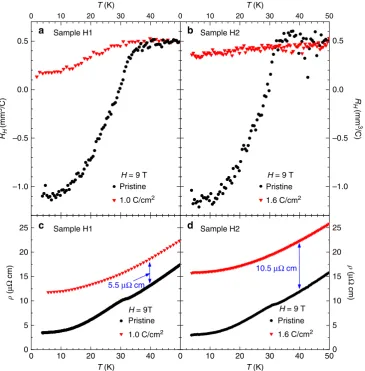
Hall resistivities upon electron irradiation. Hall resistivities were measured for samples H1 and H2 as shown in Fig.6(a, b). For sample H1, two measurements were conducted before and after irradiation with 1.0 C cm−2and for sample H2 before and after irradiation with 1.6 C cm−2. First of all, the Hall resistivity of
both pristine samples shows a sign change below TCDW=33 K,
consistent with previous reports45,46. This indicates an increase of mobility in the CDW phase, consistent with previous reports in resistivity and Nernst effect46, due to an opening of the pseudo-gap47. The change of in-plane resistivity,ρxx, as shown in panels
(c) and (d), was used to accurately calibrate the amount of
dis-order, yielding Δρ(T=40K)=5.5μΩcm for sample H1 and
10.5μΩcm for H2. These values allow us to place the samples
before and after the critical transition, respectively, as shown in the phase diagram (blue arrows in x-axis) of Fig.3. The CDW transition is clearly seen for sample H1 in Fig. 6(a), consistent with the observation of a feature in the resistivity derivative. For sample H2, however, the feature at the CDW transition almost disappears in Fig. 6(b), although a slight slope change can be noticed at 30 K. This is consistent with the disappearance of the long-range CDW feature (resistivity) and the presence of a short-range CDW (X-ray scattering) above the critical dose. Another important fact is that the Hall resistivity above 40 K did not change upon irradiation. This implies that the defects introduced by electron irradiation do not change the electronic carrier den-sity above 40 K, but only increase the scattering rate.
0 10 20 30
6 7 25 26 27 28 29 30 31 32 33 34
10.5 μΩ cm (H2 sample)
1.7 C/cm2 4.2 C/cm2
1.0 C/cm2
Δ(T=40 K) (μΩ cm)
TDR
P1 : Tc
P2 : Tc
P3 : Tc
SC
T
(K)
Transport
R1 : TCDW
R3 : Tc
R2 : Tc
R1 : Tc
R4 : Tc
CDW
SC + CDW
NbSe2
5.5 μΩ cm (H1 sample)
Fig. 3Temperature versusΔρ(T=40K)phase diagram upon electron irradiation. For low doses of irradiation up to 1.0 C cm−2,Tcvaries non-monotonically,
whereasTCDWmonotonically decreases. When the resistivity feature of CDW disappears around 1.0 C cm−2(shown in Fig.2(b,d)),Tcsuddenly drops by
0.3 K, indicating strong correlation between SC and CDW phases. Upon further irradiation,Tcmonotonically decreases. The full phase diagram up to the highest dose of 8.93 C cm−2is shown in Supplementary Figure1. Hall resistivity is measured in two samples H1 and H2 (Fig.6(a,b)). Two blue arrows in
x-axis indicate their locations in the phase diagram, based on the increase in resistivity (Fig.6(c,d))
[image:7.595.141.459.48.361.2]Discussion
Evidence for an anisotropic superconducting gap in NbSe2 is
provided, e.g., by STM measurements, which show a significantly broadened gap edge12. In addition, the flattening of the low-T
penetration depth upon irradiation at doses corresponding to the pure superconducting phase is evident in Fig. 4. As the smallest
gap in the system will determine the asymptotic low-T
expo-nential dependence, it suggests that the disorder increases the minimum gap, i.e., gap averaging. The non-monotonic behaviour
of Tc in the CDW/SC coexistence phase can therefore be
understood simply by assuming that the effect of losing compe-tition from the CDW is overcome by the gap averaging effect before the CDW disappears. It should be noted, however, that the behaviour with pressure is also non-monotonic31 In this case, the reason for the continued suppression ofTcis less obvious and the pressure dependence of the couplings of various phonons may be necessary to explain the complete behaviour quantitatively.
The possibility of afirst-order transition at the disappearance of CDW order is also intriguing and recalls the question of the CDW mechanism. A simple Fermi surface nesting model48fails to explain the CDW ordering vector and is therefore not appropriate for NbSe220,49. Similarly, a saddle point-driven CDW instability pro-posed by Rice and Scott50has been ruled out by ARPES51. How-ever, a generalized Fermi surface nesting model, which includes the strong anisotropy in the electron-phonon matrix elements, does capture the correct CDW ordering vector21,52. The generalized
Fermi-surface nesting model is still effectively a weak coupling model, where a strong momentum dependence of the electron-phonon matrix elements modifies the peak position of the charge susceptibility. Hence, from a weak coupling perspective, a disorder-drivenfirst-order transition, as apparently observed here, appears to be a natural one. This is because the CDW is a Stoner-type instability, where with increasing disorder the charge susceptibility at the ordering vector should drop below a critical value corre-sponding to ordering.
Observation of a quantum critical point under pressure might be taken as evidence against the idea of a first-order transition29. However, one should keep in mind that pressure also changes the bare electronic structure, which does not happen in case of point-like impurities. Disorder is often thought to drive a first-order transition, e.g. in the manganites53. We note that Chatterjee et al.22 deduced a smooth decay of CDW order with chemical substitution, but in fact their data are entirely consistent with ours because of the relatively small number of doping levels studied in that work.
We cannot definitively rule out the possibility that the feature observed in transport, here identified as the signature of long-range CDW order, simply becomes too weak to observe because of broadening due to significant short-range fluctuations, as observed in Chatterjee et al.22.However, our new observation of a
concomitant abrupt drop in Tc suggests that a thermodynamic
transition is indeed taking place at this critical value of disorder. Unlike incommensurate CDW systems, commensurate CDW transitions as in NbSe2in the presence of quenched disorder may occur54. The ordered phase in such a situation breaks transla-tional symmetry discretely, so that a second-order transition with exponents dependent on the order of the commensurability is allowed, but this can be preempted by afirst-order transition, as apparently observed here.
We investigated the interplay between CDW and SC phases in 2H-NbSe2by measuring in-plane resistivity, Hall resistivity, X-ray scattering, and London penetration depth before and after elec-tron irradiation. Upon initial irradiation, Tc increased from
7.25 K to 7.45 K and then decreased, whereas TCDW
mono-tonically decreased. This indicates a complex interplay between two phases with potential other factors such as a complicated Fermi surface. Upon further irradiation, the feature associated
with the CDW transition disappeared at finite temperature.
When the CDW feature disappears, Tc abruptly drops by 0.3 K,
indicating strong correlation between two phases and suggesting a
first-order, disorder-driven phase transition. Further irradiation
up to
8.93 C cm−2effectively and monotonically decreasedTcdown to 4.8 K (about 33% of its pristine value), suggestive of the averaging
of an anisotropic s-wave superconducting order parameter.
According to X-ray scattering and Hall resistivity studies, the short-range CDW is still present after the critical dose of ~1.0 C cm−2 (~7.3μΩcm), indicating that the effect of electron irra-diation decreases the coherence of the CDW phase. The low-temperature penetration depth shows exponential-like behaviour below 0.2 T/Tcfor all samples before and after irradiation. The combined results of resistivity and penetration depth can be
explained with multiband anisotropic s-wave type
super-conducting gaps with some amount of interband coupling.
Methods
Crystal growth. The single crystals of 2H-NbSe2from Bell Laboratories were grown using the iodine vapor transport technique and are known to be of high quality (RRR ~40). These are the samples from the same batch as used in Ref.23.
Four-probe resistivity. Four-probe measurements of in-plane resistivity were performed for four samples (R1, R2, R3, and R4). Samples for resistivity mea-surements had typical dimensions of (1–2) × 0.5 × (0.02–0.1) mm3. Electrical con-tacts to samples before irradiation were made by soldering 50μm silver wires with
2 4 6 8
0 10 20 30 40 50 60
0.0 0.2 0.4 0.6
0 50 100 150 200
0.0 0.2 0.4 0.6
0.0 0.2 0.4 0.6
Δ
(
μ
m)
T (K)
Sample P1 Pristine 1.77 C/cm2
Pristine 1.77 C/cm2 Sample P2
Pristine 3.47 C/cm2
Pristine
3.47 C/cm2 3.34 C/cm2 8.93 C/cm2 Sample P3
Pristine 3.34 C/cm2 8.93 C/cm2
a
Δ
(nm)
T/Tc(K) T/Tc(K) T/Tc(K)
Sample P1 b Sample P3 Pristine d Sample P2 c
Fig. 4Temperature dependence of London penetration depthΔλupon electron irradiation. Results of three samples before and after irradiation: P1 (0 and 1.77 C cm−2), P2 (0 and 3.47 C cm−2), and P3 (0, 3.34, and 8.93 C
cm−2).aWide temperature span ofΔλthat shows a substantial decrease ofTcupon irradiation.b–dThe low-temperature part ofΔλofbP1,cP2, and dP3 samples before and after irradition. All data clearly show the saturating behaviour below 0.2T/Tc, supporting the presence ofs-wave type superconducting gaps
ARTICLE
NATURE COMMUNICATIONS | DOI: 10.1038/s41467-018-05153-0 [image:8.595.49.288.47.356.2]indium and mechanically strengthened by silver paste as described elsewhere55. For in-situ resistivity measurements during the electron irradiation at 22 K, the R1 sample was mounted on a Kyocera chip and measured during irradiation.
Hall resistivity. Simultaneous Hall effect and resistivity measurements were performed on samples H1 and H2 mounted infive-probe configuration using the same contact making technique as in resistivity measurements. Measure-ments were taken in a Quantum Design PPMS in constant magneticfields+9 T and−9 T. The same samples with the same contacts were measured before and after irradiation, thus excluding geometric factor errors in quantitative comparison.
London penetration depth. The in-plane London penetration depthΔλ(T) of three other samples (P1, P2, and P3) was measured before and after irradiation using a self-oscillating tunnel-diode resonator technique56–58. The samples had typical dimensions of 0.5 × 0.5 × 0.03 mm3.
X-ray diffraction. The high-energy X-ray diffraction study was performed at station 6-ID-D at the Advanced Photon Source, Argonne National Laboratory. The use of X-rays with an energy of 100.5 keV minimizes sample absorption and allows to probe the entire bulk of the sample using an incident beam with a size of 0.5 × 0.5 mm2, over-illuminating the sample. The samples were held on Kapton tape in a Helium closed-cycle refrigerator and Helium exchange gas was used. Extended regions of selected reciprocal lattice planes were recorded by a MAR345 image plate system positioned 1468 mm behind the sample as the sample was rocked through two independent angles up to ± 3.2° about axes perpendicular to the incident beam59.
Electron irradiation. The 2.5 MeV electron irradiation was performed at the SIRIUS Pelletron facility of the Laboratoire des Solides Irradies at the Ecole Polytechnique in Palaiseau, France60. The acquired irradiation dose is conveniently measured in C cm−2, where 1 C cm−2=6.24 × 10¹⁸electrons/cm2.
2.75 2.80 2.85
0 100 200 300
Normalized intensity
Qx (Å–1)
2.75 2.80 2.85
Qx (Å–1)
2.75 2.80 2.85
Qx (Å–1)
Qy
(Å
–1
) y Q
(Å
–1
)
2.75 2.80 2.85
Qx (Å–1)
c 5 K 5 K
Counts
0 10 20 30 40
0.00 0.01 0.02 0.03 0.04
I(1+00)
(1+ 00)
(1+ 00)
I(100) I(100)
Counts I(100)
Normalized integrated intensity
T (K)
X1 (pristine)
X2 (1.7 C/cm2)
–0.05 0.00 0.05 Sample X2
(1.7 C/cm2)
Sample X1 (pristine)
b
–0.05 0.00 0.05
5 K 5 K
a
Intensity
0 10 20 30 40
d
e
Normalized intensity
8000 1200
1000
800
600
400
200 6000
4000
2000
0
Fig. 5High-energy X-ray diffraction measurement of the CDW Bragg peak (1+τ0 0) withτ=1/3. Results of two NbSe2samples (X1: pristine, X2: 1.7 C cm−2).
a,bDiffraction patterns of X1 and X2 recorded by the two-dimensional detector in the (H K0) plane with intensity encoded in a linear color scale for each detector pixel.c,dCuts along the longitudinal directionQx, integrated along the transverse directionQyand normalized to the integrated intensity I(100)of the
weak (1 0 0) Bragg peak of the regular chemical lattice which is three orders of magnitude less intense than the strong (1 1 0) Bragg peak. The bars represent the instrumental resolution full-width half-maximum determined from the (1 0 0) Bragg peak.eTemperature dependence of the normalized integrated intensity of the CDW Bragg peak
[image:9.595.126.474.49.506.2]Data availability. The authors declare that all data supporting thefindings of this study are available within the article and its supplementary informationfiles or from the corresponding author upon reasonable request.
Received: 31 October 2017 Accepted: 7 June 2018
References
1. Dai, P. Antiferromagnetic order and spin dynamics in iron-based superconductors.Rev. Mod. Phys.87, 855–896 (2015).
2. Ghiringhelli, G. et al. Long-range incommensurate chargefluctuations in (Y, Nd)Ba2Cu3O6+x.Science337, 821–825 (2012).
3. Chang, J. et al. Direct observation of competition between superconductivity and charge density wave order in YBa2Cu3O6.67.Nat. Phys.8, 871–876 (2012). 4. Achkar, A. J. et al. Distinct charge orders in the planes and chains of ortho-iii-ordered YBa2Cu3O6+δsuperconductors identified by resonant elastic x-ray
scattering.Phys. Rev. Lett.109, 167001 (2012).
5. Comin, R. et al. Charge order driven by fermi-arc instability in Bi2Sr
2-xLaxCuO6+δ.Science343, 390–392 (2014).
6. da Silva Neto, E. H. et al. Ubiquitous interplay between charge ordering and high-temperature superconductivity in cuprates.Science343, 393–396 (2014). 7. Tabis, W. et al. Charge order and its connection with Fermi-liquid charge
transport in a pristine high-Tccuprate.Nat. Commun.5, 5875 (2014). 8. Gabovich, A. M., Voitenko, A. I., Annett, J. F. & Ausloos, M. Charge- and
spin-density-wave superconductors.Supercond. Sci. Technol.14, R1 (2001).
9. Wilson, J., Salvo, F. D. & Mahajan, S. Charge-density waves and superlattices in the metallic layered transition metal dichalcogenides.Adv. Phys.24, 117–201 (1975).
10. Moncton, D. E., Axe, J. D. & DiSalvo, F. J. Study of superlattice formation in 2H-NbSe2and 2H-TaSe2by neutron scattering.Phys. Rev. Lett.34, 734–737 (1975).
11. Harper, J., Geballe, T. & Salvo, F. D. Heat capacity of 2H-NbSe2at the charge density wave transition.Phys. Lett. A54, 27–28 (1975).
12. Guillamon, I., Suderow, H., Guinea, F. & Vieira, S. Intrinsic atomic-scale modulations of the superconducting gap of 2H-NbSe2.Phys. Rev. B77, 134505 (2008).
13. Sooryakumar, R. & Klein, M. V. Raman scattering by superconducting-gap excitations and their coupling to charge-density waves.Phys. Rev. Lett.45, 660–662 (1980).
14. Littlewood, P. B. & Varma, C. M. Gauge-invariant theory of the dynamical interaction of charge density waves and superconductivity.Phys. Rev. Lett.47, 811–814 (1981).
15. Littlewood, P. B. & Varma, C. M. Amplitude collective modes in
superconductors and their coupling to charge-density waves.Phys. Rev. B26, 4883–4893 (1982).
16. Méasson, M.-A. et al. Amplitude higgs mode in the 2H-NbSe2 superconductor.Phys. Rev. B89, 060503 (2014).
17. Grasset, R. et al. Higgs-mode radiance and charge-density-wave order in 2H
-NbSe2.Phys. Rev. B97, 094502 (2018).
18. Inglesfield, J. E. Bonding and phase transitions in transition metal dichalcogenide layer compounds.J. Phys. C Solid State Phys.13, 17 (1980). 19. Varma, C. M. & Simons, A. L. Strong-coupling theory of charge-density-wave
transitions.Phys. Rev. Lett.51, 138–141 (1983).
20. Weber, F. et al. Extended phonon collapse and the origin of the charge-density wave in 2H-NbSe2.Phys. Rev. Lett.107, 107403 (2011).
0 10 20 30 40
–1.0 –0.5 0.0 0.5
0 10 20 30 40 50
–1.0 –0.5 0.0 0.5
0 10 20 30 40
0 5 10 15 20 25
0 10 20 30 40 500
5 10 15 20 25 T (K)
RH
(mm
3/C)
Pristine
1.0 C/cm2
a Sample H1
H = 9 T
Pristine
1.0 C/cm2
H = 9T
Pristine
1.6 C/cm2
H = 9 T
Pristine
1.6 C/cm2
H = 9 T
Sample H2
b
T (K)
R
H
(mm
3
/C)
5.5 μΩ cm
(
μΩ
cm)
T (K)
c Sample H1
10.5 μΩ cm (μΩ
cm)
T (K)
d Sample H2
Fig. 6Temperature dependence of Hall resistivities of two NbSe2samples measured under 9 T.aSample H1 before and after 1.0 C cm−2irradiation and
bsample H2 before and after 1.6 C cm−2irradiation.c,dIn-field resistivities were also measured for both samples that clearly show the increase of disorder:Δρ(T=40K)=5.5 and 10.5μΩcm for samples H1 and H2, respectively
ARTICLE
NATURE COMMUNICATIONS | DOI: 10.1038/s41467-018-05153-0 [image:10.595.117.483.50.422.2]21. Flicker, F. & van Wezel, J. Charge order from orbital-dependent coupling evidenced by NbSe2.Nat. Commun.6, 7034 (2015).
22. Chatterjee, U. et al. Emergence of coherence in the charge-density wave state of 2H-NbSe2.Nat. Commun.6, 6313 (2015).
23. Fletcher, J. D. et al. Penetration depth study of superconducting gap structure of 2H-NbSe2.Phys. Rev. Lett.98, 057003 (2007).
24. Yokoya, T. et al. Fermi surface sheet-dependent superconductivity in 2H
-NbSe2.Science294, 2518–2520 (2001).
25. Boaknin, E. et al. Heat conduction in the vortex state of NbSe2: evidence for multiband superconductivity.Phys. Rev. Lett.90, 117003 (2003).
26. Kiss, T. et al. Charge-order-maximized momentum-dependent superconductivity.Nat. Phys.3, 720–725 (2007).
27. Borisenko, S. V. et al. Two energy gaps and fermi-surface“arcs”in NbSe2.
Phys. Rev. Lett.102, 166402 (2009).
28. Leroux, M. et al. Strong anharmonicity induces quantum melting of charge density wave in 2H-NbSe2under pressure.Phys. Rev. B92, 140303 (2015). 29. Feng, Y. et al. Order parameterfluctuations at a buried quantum critical point.
Proc. Natl Acad. Sci. USA109, 7224–7229 (2012).
30. Berthier, C., Molinié, P. & Jérome, D. Evidence for a connection between charge density waves and the pressure enhancement of superconductivity in 2H-NbSe2.Solid State Commun.18, 1393–1395 (1976).
31. Suderow, H., Tissen, V. G., Brison, J. P., Martnez, J. L. & Vieira, S. Pressure induced effects on the fermi surface of superconducting 2H-NbSe2.Phys. Rev.
Lett.95, 117006 (2005).
32. Mutka, H. Superconductivity in irradiated charge-density-wave compounds 2H-NbSe2, and 2H-TaSe2.Phys. Rev. B28, 2855–2858 (1983).
33. Grest, G. S., Levin, K. & Nass, M. J. Impurity andfluctuation effects in charge-density-wave superconductors.Phys. Rev. B25, 4562–4569 (1982). 34. Hirschfeld, P. J. & Goldenfeld, N. Effect of strong scattering on the
low-temperature penetration depth of ad-wave superconductor.Phys. Rev. B48, 4219 (1993).
35. Wang, Y., Kreisel, A., Hirschfeld, P. J. & Mishra, V. Using controlled disorder to distinguishs±ands++gap structure in fe-based superconductors.Phys. Rev. B87, 094504 (2013).
36. Cho, K. et al. Energy gap evolution across the superconductivity dome in single crystals of (Ba1-xKx)Fe2As2.Sci. Adv.2, e1600807 (2016).
37. Prozorov, R. et al. Effect of electron irradiation on superconductivity in single crystals of Ba(Fe1−xRux)2As2(x=0.24).Phys. Rev. X4, 041032 (2014). 38. Cho, K., Kończykowski, M., Teknowijoyo, S., Tanatar, M. A. & Prozorov, R.
Using electron irradiation to probe iron-based superconductors.Supercond.
Sci. Technol.31, 064002 (2018).
39. Mizukami, Y. et al. Disorder-induced topological change of the
superconducting gap structure in iron pnictides.Nat. Commun.5, 5657 (2014). 40. Strehlow, C. P. et al. Comparative study of the effects of electron irradiation
and natural disorder in single crystals of SrFe2(As1-xPx)2superconductor (x=0.35).Phys. Rev. B90, 020508 (2014).
41. Psaltakis, G. C. Non-magnetic impurity effects in charge-density-wave superconductors.J. Phys. C Solid State Phys.17, 2145 (1984).
42. Marezio, M., Dernier, P., Menth, A. & Hull, G. The crystal structure of NbSe2 at 15 k.J. Solid State Chem.4, 425–429 (1972).
43. Malliakas, C. D. & Kanatzidis, M. G. Nb-nb interactions define the charge density wave structure of 2H-NbSe2.J. Am. Chem. Soc.135, 1719–1722 (2013). 44. Yamaya, K. & Sambongi, T. Low-temperature crystal modification and the
superconductive transition temperature of NbSe2.Solid State Commun.11, 903–905 (1972).
45. Bel, R., Behnia, K. & Berger, H. Ambipolar nernst effect in NbSe2.Phys. Rev.
Lett.91, 066602 (2003).
46. Evtushinsky, D. V. et al. Pseudogap-driven sign reversal of the hall effect.Phys.
Rev. Lett.100, 236402 (2008).
47. Wilson, J. A. Charge-density waves in the 2H-NbSe2family: Action on the fermi surface.Phys. Rev. B15, 5748–5757 (1977).
48. Valla, T. et al. Quasiparticle spectra, charge-density waves, superconductivity, and electron-phonon coupling in 2H-NbSe2.Phys. Rev. Lett.92, 086401 (2004). 49. Rice, T. M. & Scott, G. K. New mechanism for a charge-density-wave
instability.Phys. Rev. Lett.35, 120–123 (1975).
50. Rossnagel, K. et al. Fermi surface of 2H-NbSe2and its implications on the charge-density-wave mechanism.Phys. Rev. B64, 235119 (2001). 51. Doran, N. J. A calculation of the electronic response function in 2H-NbSe2
including electron-phonon matrix element effects.J. Phys. C Solid State Phys. 11, L959 (1978).
52. Dagotto, E. Complexity in strongly correlated electronic systems.Science309, 257–262 (2005).
53. Nie, L., Tarjus, G. & Kivelson, S. A. Quenched disorder and vestigial nematicity in the pseudogap regime of the cuprates.Proc. Natl. Acad. Sci.111, 7980–7985 (2014).
54. Tanatar, M. A. et al. Origin of the resistivity anisotropy in the nematic phase of fese.Phys. Rev. Lett.117, 127001 (2016).
55. Prozorov, R., Giannetta, R. W., Carrington, A. & Araujo-Moreira, F. M. Meissner-london state in superconductors of rectangular cross section in a perpendicular magneticfield.Phys. Rev. B62, 115–118 (2000).
56. Prozorov, R. & Giannetta, R. W. Magnetic penetration depth in unconventional superconductors.Supercond. Sci. Technol.19, R41 (2006). 57. Prozorov, R. & Kogan, V. G. London penetration depth in iron-based
superconductors.Rep. Progress. Phys.74, 124505 (2011).
58. Kreyssig, A. et al. Crystallographic phase transition within the magnetically ordered state of Ce2Fe17.Phys. Rev. B76, 054421 (2007).
59. van der Beek, C. J. et al. Electron irradiation of Co, Ni, and P-doped BaFe2As2—type iron-based superconductors.J. Phys. Conf. Ser.449, 012023 (2013).
60. Efremov, D. V., Korshunov, M. M., Dolgov, O. V., Golubov, A. A. & Hirschfeld, P. J. Disorder-induced transition betweens±ands++states in two-band superconductors.Phys. Rev. B84, 180512 (2011).
Acknowledgements
We grateful to H. Suderow, S. Raghu, S. Sachdev, and R. J. Cava for useful discussions. The work in Ames Laboratory was supported by the U.S. Department of Energy (DOE), Office of Science, Basic Energy Sciences, Materials Science and Engineering Division. Ames Laboratory is operated for the U.S. DOE by Iowa State University under contract DE-AC02-07CH11358. P.J.H. was supported by NSF Grant No. DMR-1407502. We thank the SIRIUS team, O. Cavani, and B. Boizot, for operating electron irradiation SIRIUS facility at École Polytechnique [supported by the EMIR (Réseau national d'ac-célérateurs pour les Études des Matériaux sous Irradiation) network, proposal 15-5788]. We thank Bing Li, W. R. Meier, and D. S. Robinson for experimental support of the X-ray diffraction study. The X-X-ray study used resources of the Advanced Photon Source, a U.S. Department of Energy (DOE) Office of Science User Facility operated for the DOE Office of Science by Argonne National Laboratory under Contract No. DE-AC02-06CH11357.
Author contributions
K.C. and S.T. measured London penetration depth and analyzed the data. M.A.T. han-dled sample preparation and performed resistivity and Hall effect measurements. M.K. and K.C. performed electron irradiation and resistivity measurements between sub-sequent runs. J.G. and P.B.G. performed AC magnetic susceptibility measurements to select high quality crystals. J.W., A.K., R.M. and A.I.G. performed and analyzed X-ray scattering measurements. V.M. and P.J.H. led theoretical analysis. R.P. coordinated the project and performed initial magnetic and London penetration depth measurements. All authors contributed to discussion, analysis, and writing of the manuscript.
Additional information
Supplementary Informationaccompanies this paper at https://doi.org/10.1038/s41467-018-05153-0.
Competing interests:The authors declare no competing interests.
Reprints and permissioninformation is available online athttp://npg.nature.com/ reprintsandpermissions/
Publisher's note:Springer Nature remains neutral with regard to jurisdictional claims in published maps and institutional affiliations.
Open Access This article is licensed under a Creative Commons Attribution 4.0 International License, which permits use, sharing, adaptation, distribution and reproduction in any medium or format, as long as you give appropriate credit to the original author(s) and the source, provide a link to the Creative Commons license, and indicate if changes were made. The images or other third party material in this article are included in the article’s Creative Commons license, unless indicated otherwise in a credit line to the material. If material is not included in the article’s Creative Commons license and your intended use is not permitted by statutory regulation or exceeds the permitted use, you will need to obtain permission directly from the copyright holder. To view a copy of this license, visithttp://creativecommons.org/ licenses/by/4.0/.
© The Author(s) 2018