DEPA RTMENT OF JUSTIC
E O FF
ICE
OF J USTICEPRO
GR AM
S
B
J
A
N I J
OJJ DP BJS
OVC U.S. Department of Justice
Office of Justice Programs
Office of Juvenile Justice and Delinquency Prevention
Shay Bilchik, Administrator
From the Administrator
Traditional mental health approaches for serious, violent, and chronic juvenile offenders have all too often failed to yield the successful results we desire. Adolescent drug and substance abuse has also proven to be remarkably resistant to treatment.
The multisystemic therapy (MST) approach was designed to provide communities with affordable and effective remedies for these difficult problems. Best of all, MST offers new hope to young people with serious behavioral disorders.
If we are going to help troubled youth, we must strengthen the support systems that surround them so that they may continue to benefit long after immediate intervention has ended. With its focus on family preservation through home-based services, MST shows real promise of achieving such lasting results.
This Bulletin features evaluations of programs that have implemented the MST approach. Of particular interest is the Simpsonville, South Carolina, program, which services serious, violent, and chronic juvenile offenders at imminent risk of out-of-home place-ment. The Simpsonville program has significantly reduced recidivism rates at substantial savings in terms of both human and financial considerations.
I am pleased to share this excellent program design with the juvenile justice field.
Shay Bilchik Administrator
May 1997
Treating Serious
Anti-Social Behavior in Youth:
The MST Approach
The Multisystemic Therapy (MST) approach to the treatment of serious anti-social behavior in adolescents represents a significant departure from more tradi-tional strategies. MST is a home-based services approach that was developed in response to the lack of scientifically proven, cost-effective treatment.
The majority of funding currently available for children’s mental health needs in the United States is spent on expensive out-of-home placements such as residential treatment facilities, psy-chiatric inpatient treatment, or incar-ceration. However, no scientific evidence has shown that these treatments are ef-fective in ameliorating or reducing the serious behavioral difficulties demon-strated by juvenile offenders. Other less restrictive treatments that do not in-volve out-of-home placements, such as outpatient or clinic-based services, also have failed to demonstrate desired lev-els of effectiveness. Furthermore, re-search on adolescent substance abuse has failed to substantiate the effective-ness of any treatment in curtailing that problem. Thus, MST was developed as a means to provide scientifically validated, cost-effective, community-based treat-ment as a viable alternative to expen-sive, ineffective treatments that have
Scott W. Henggeler, Ph.D.
traditionally been provided to youth with serious behavior disorders.
This Bulletin highlights evaluations of several programs that have imple-mented the MST approach. In particular, success demonstrated by the Simpsonville, South Carolina, program has led to major funding by the National Institute of Mental Health (NIMH)—targeting violent and/or chronic juvenile offenders and youth with serious emotional disturbance—and the National Institute on Drug Abuse—target-ing substance-abusAbuse—target-ing delinquents. The Bulletin also includes an overview of feder-ally funded controlled evaluations of MST projects that are currently under way.
The MST Treatment
Approach
Program Overview
addresses the known causes of delin-quency on an individualized, yet compre-hensive, basis. MST interventions, there-fore, focus on the individual youth and his or her family, peer context, school/ vocational performance, and neighbor-hood/community supports. For example:
◆ Family interventions often seek to
pro-mote the parent’s capacity to monitor and discipline the adolescent—MST counselors must determine the barri-ers to effective parental discipline and intervene accordingly. Commonly ob-served barriers include parental drug abuse, psychiatric conditions, and low social support.
◆ The central thrust of MST peer
inter-ventions is to remove offenders from deviant peer groups and facilitate their development of friendships with prosocial peers, with the parent viewed as the key to accomplishing such goals.
◆ School and vocational interventions
seek to enhance the youth’s capacity for future employment and financial success.
Across all interventions, MST attempts to change the real-world functioning of youth by changing their natural settings— home, school, and neighborhood—in ways that promote prosocial behavior while decreasing antisocial behavior.
Program Results
MST defines success in terms of re-duced recidivism rates among participat-ing youth, improved family and peer rela-tions, decreased behavioral problems, and decreased rates of out-of-home place-ments. Research has demonstrated that MST is more effective than usual commu-nity treatment for inner-city juvenile of-fenders, specifically in improving intrafamilial relations and decreasing youth behavioral difficulties.
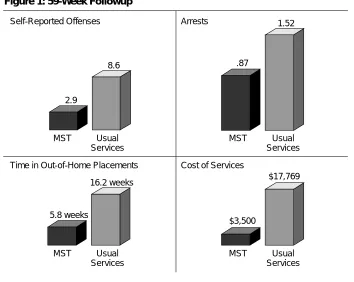
In addition, recent research indicates that when compared with youth who re-ceived “usual services”—court-ordered stipulations such as curfew, school atten-dance, and participation in various agency programs that were typically monitored by probation officers—youth who received MST had fewer arrests, re-ported fewer criminal offenses, and spent an average of 10 fewer weeks in detention during a 59-week followup.
Results from other followup studies indicate that the effects of MST treatment are long lasting, with reduced recidivism
rates for sexual and criminal offenders who received MST versus individual out-patient counseling. Ongoing research is also evaluating the effectiveness of MST in community settings and with other dif-ficult populations—adolescent substance abusers and youth with serious psychiat-ric emergencies such as suicidal, homi-cidal, or psychotic presentations.
MST’s program strengths include its cost-effectiveness, proven success in treating difficult clinical populations, and relative ease of implementation across geographic locations and commu-nity agencies.
The Family
Preservation Model of
Service Delivery
Philosophy
MST’s family preservation model of service delivery is based on the philoso-phy that the most effective and ethical route to helping children and youth is
through helping their families. MST views families as valuable resources, even when they are characterized by serious and multiple needs. Services are directed to-ward the psychological, social, educa-tional, and material needs that face fami-lies in which a child is in imminent danger of out-of-home placement.
Service Delivery Approach
While the particular treatment modali-ties used in family preservation programs vary, certain critical service delivery characteristics, described below, are shared by all of them. Summarized in table 1, these characteristics distinguish treatment programs delivered in a family preservation model from traditional men-tal health and juvenile justice services. ◆ Length of Service. Service durationranges from 3 to 5 months in MST, with the average duration of treatment be-ing approximately 60 hours of contact over 4 months, with the final 2 to 3 weeks involving less intensive contact to monitor the maintenance of thera-peutic gains.
Table 1: Differences Between Traditional Mental Health Services and Family
Preservation Using Multisystemic Therapy
Service Element Traditional Services Family Preservation
Treatment Sites In the clinic (outpatient) In the field (home,
In the hospital, RTC* (inpatient) school, neighborhood,
community)
Treatment Modality Individual psychotherapy Total care
Group therapy Medication
Provider Individual clinician (outpatient) Generalist team
Multidisciplinary teams (inpatient)
Clinical Staff: Patients 1:60–100 (outpatient) 1:4–6
Varies in inpatient settings
Staff Availability Working office hours (outpatient) Team available
Highly variable (inpatient) 24 hrs/7days/week
Frequency of Contact Weekly or biweekly (outpatient) Daily in most cases
Highly variable (inpatient)
Family Contact Occasional Daily in most cases
Treatment Outcome Responsibility of patient Responsibility of staff
and family
Case Management Broker of services Services provider
Expectations of Outcome Gradual change Immediate, maximum
effort by staff and family to attain goals
◆ Staffing Pattern. A typical staffing pat-tern for the provision of intensive home-based MST is a treatment team consisting of one doctoral-level super-visor and three to four master-level therapists, with each therapist carry-ing a caseload of four to six families. Each youth referred to the program is assigned a therapist who designs indi-vidualized interventions in accordance with MST treatment principles that ad-dress specific needs of the youth and family. Each treatment team provides services for about 50 families per year. ◆ Hours of Service. Staff are available 24
hours per day, 7 days per week, and can usually meet at the families’ conve-nience, resulting in many evening and weekend appointments. In consider-ation of treatment efforts to empower families to solve their own problems and the attenuation of counselor burn-out, however, use of services at unusual times (e.g., 10 p.m. to 8 a.m.) is discour-aged except in cases of emergency. ◆ Location of Services. MST is typically
delivered in home and community set-tings to increase cooperation and en-hance generalization. Sessions are usu-ally held in the family’s home at a convenient time, although meetings in community locations, such as a school, recreation center, or project office, are often needed. Moreover, the specific family members who attend will vary with the nature of the particular prob-lem that is being addressed (e.g., youth are usually not included in sessions that address lax parental discipline, so as not to undermine parental authority).
Training
Training in the MST model of family preservation is provided in the following ways:
1. Five days of introductory training are provided for all staff who will engage in treatment and/or clinical supervision of MST cases to familiarize participants with the scope, correlates, and causes of the serious behavior problems ad-dressed with MST; describe the theo-retical and empirical underpinnings of MST; describe family, peer, school, and individual intervention strategies used in MST; train participants to conceptual-ize cases and interventions in terms of MST principles; and provide partici-pants with practice in delivering multisystemic interventions.
2. Quarterly booster sessions are de-signed to provide training in special topics, such as marital therapy, treat-ment of parental depression, or early childhood intervention, and to address issues that may arise for individuals and agencies using the approach. Booster sessions are also designed to allow discussion of particularly diffi-cult cases.
3. Weekly telephone consultations via 1-hour conference calls allow the treat-ment team and supervisor to consult with an MST expert regarding case conceptualization, goals, intervention strategies, and progress. Such ongoing consultation is critical for maintaining therapist adherence to the MST treat-ment protocol.
In South Carolina, the Family Services Research Center (FSRC) is under con-tract with the South Carolina Depart-ment of Health and Human Services to provide training and consultation ser-vices to public and private providers of Medicaid-reimbursed home-based treat-ment services. FSRC is responsible for conducting certification reviews of these providers to ensure compliance with Medicaid standards.
Training in MST using home-based ser-vices is also provided to sites outside South Carolina. Several training sites in-volve randomized trials and pilot projects in State and county agencies (e.g., depart-ments of juvenile justice, mental health,
and social services). Training and quality assurance are provided to out-of-State entities by MST Services, Inc., of Charles-ton, South Carolina.
The Simpsonville,
South Carolina, Project
Funded by NIMH, Henggeler et al. con-ducted an evaluation of the Simpsonville, South Carolina, MST program, which used the family preservation model of service delivery. Participants were 84 violent and chronic offenders at imminent risk of out-of-home placement and their families, who had multiple needs. Each offender had at least one felony arrest (54 percent had been arrested for violent crimes). The mean number of arrests was 3.5, and the average number of weeks of prior placement in correctional facilities was 9.5. The average age of the juveniles was 15.2 years, 77 percent were male, and the average social class score was 25 (i.e., semiskilled workers). Twenty-six percent of the offenders lived with neither biologi-cal parent. Fifty-six percent were African American, and the remainder were Cauca-sian.In a rigorous, controlled evaluation, youth were randomly assigned to receive either MST using family preservation (n = 43) or usual services from the De-partment of Youth Services (n = 41). These usual services included incarcera-tion and/or referral for mental health, educational, or vocational services. The MST therapists were three master-level counselors with an average of 2 years of experience and caseloads of four families each. The average duration of treatment was 13 weeks. Assessment batteries, com-posed of standardized measurement in-struments, were administered pre- and posttreatment.
[image:3.612.220.390.72.320.2]usual services, reported increased family warmth and cohesion and decreased youth aggression with peers. In addition, youth receiving MST reported less crimi-nal activity than their counterparts receiving usual services.
Figure 2 shows that positive results for MST were maintained to a 2.4-year followup. MST essentially doubled the percentage of youth not rearrested at the long-term followup.
The relative efficacy of MST was nei-ther moderated by demographic charac-teristics—race, age, social class, gender, arrest, and incarceration history—nor mediated by psychosocial variables— family relations, peer relations, social competence, behavior problems, and pa-rental symptomatology. Thus, MST was equally effective with youth and families of divergent backgrounds.
The findings of this evaluation support the short- and long-term efficacy of MST with serious juvenile offenders and their families. In addition, despite its intensity, MST was a relatively inexpensive inter-vention. With a client-to-therapist ratio of 4 to 1 and a course of treatment lasting 3 months, the cost per client for treatment in the MST group was about $3,500, which compares favorably with the average cost of institutional placement in South Caro-lina of $17,769 per offender.
Results of the Simpsonville project, combined with other evaluations dis-cussed below, strongly support MST’s ef-fectiveness with types of behavior prob-lems that traditionally are regarded as highly resistant to change. MST has proven effective with chronic juvenile offenders and adolescent sexual offenders in studies conducted in Missouri, and abusive and neglectful families and inner-city delinquents in studies conducted in Memphis.
In each of the following additional controlled outcome studies conducted by Henggeler et al., the samples included both genders and high percentages of economically disadvantaged and minority families.
Evaluations of Other
MST Programs
Columbia, Missouri
[image:4.612.36.390.90.372.2]MST With Adolescent Sexual Offend-ers, 1990. The first controlled outcome evaluation conducted with adolescent sexual offenders to appear in the litera-ture compared MST with individual outpatient counseling. Recidivism data approximately 3 years after treatment showed that significantly fewer partici-pants had been rearrested for sexual crimes (12.5 percent versus 75 percent) and that the frequency of sexual rearrests was significantly lower in the MST condi-tion (average = .12) than in the individual counseling condition (average = 1.62). Moreover, the frequency of rearrest for
Figure 1: 59-Week Followup
2.9
8.6 .87
1.52
5.8 weeks
16.2 weeks
$3,500
$17,769 Self-Reported Offenses
Time in Out-of-Home Placements
Arrests
Cost of Services
MST Usual
Services
MST Usual
Services
MST Usual
Services
MST Usual
[image:4.612.37.399.483.732.2]Services
Figure 2: Simpsonville, South Carolina, Project: Survival Analysis
P
ercentage of Off
enders Not Rearrested
Weeks Past Referral
MST
Usual Services
0 20 40 60 80 100 120
100%
80%
60%
40%
20%
nonsexual crimes was greater for adoles-cents who received individual counseling (average = 2.25) than for the adolescents who received MST (average = .62). Find-ings from this study should be considered tentative because the sample size was only 16 sexual offenders. A more exten-sive replication study is currently being prepared in South Carolina.
MST With Chronic Juvenile Offend-ers, 1995. This study examined the long-term effects of MST versus individual therapy (IT) on the prevention of crimi-nal behavior and violent offending among 176 juvenile offenders at high risk for committing additional serious crimes. Results from multiagent, multi-method assessment batteries conducted pretreatment and posttreatment showed that MST was more effective than IT in improving key family correlates of antiso-cial behavior and in ameliorating adjust-ment problems in individual family mem-bers.
Moreover, a 4-year followup of rearrest data showed that MST was more effec-tive than IT in preventing future criminal behavior, including violent offending. For example, 4-year recidivism was 22 per-cent for youth who received MST com-pared with 72 percent for youth who re-ceived IT and 87 percent for youth who refused to participate in either treatment (figure 3).
Memphis, Tennessee
MST With Inner -City Juvenile Offend-ers, 1986. This study evaluated the effi-cacy of MST compared with usual commu-nity treatment for inner-city juvenile offenders and their families. At posttest, the adolescents who received MST evi-denced significant decreases in conduct problems, anxious-withdrawn behaviors, immaturity, and association with delin-quent peers, based on maternal reports.
Observational measures showed that mother-adolescent and marital relations in these families were significantly warmer, mother-adolescent interactions were less aggressive, mothers’ interac-tions were more supportive, and adoles-cents were significantly more involved in family interactions. In contrast, families who received usual community treatment evidenced no positive changes and showed deterioration in observed affec-tive family relations.
MST Versus Behavioral Parent Train-ing in the Treatment of Child Abuse and Neglect, 1987. This study randomly as-signed abusive families and neglectful families either to MST or behavioral par-ent training. At posttest, parpar-ents who re-ceived either treatment showed reduction in emotional distress, overall stress, and severity of identified problems. Analyses of sequential observational measures, however, showed that MST was more ef-fective than parent training at restructur-ing parent-child relations in those behav-ior patterns that differentiate maltreating families from nonproblem families.
Following MST, maltreating parents controlled their children’s behavior more effectively, maltreated children exhibited less passive noncompliance, and neglect-ing parents became more responsive to their children’s behavior.
Simpsonville, South
Carolina, and Columbia,
Missouri
The Effects of MST on Substance Use and Abuse in Juvenile Offenders, 1991. Data from two independent evaluations of the efficacy of MST in treating serious juvenile offenders focused specifically on reductions in substance use and abuse.
Arrest data in the Missouri project col-lected for an average of 4 years of post-treatment showed that youth who partici-pated in MST had a significantly lower rate of substance-related arrests than youth who participated in individual counseling (4 percent versus 16 percent). Similarly, in the Simpsonville project, youth in the MST condition reported signifi-cantly less soft-drug (alcohol and mari-juana) use at posttreatment than did youth who received usual services.
Federally Funded
Projects Under Way
[image:5.612.226.569.95.354.2]Charleston, South Carolina
MST With Substance Abusing/Depen-dent Delinquents, 1992–1997. This project, funded by the National Institute on Drug Abuse, is evaluating the effectiveness of MST with substance abusing/dependent delinquents and their families in compari-son with usual community services. In its fifth year of funding, the project has ran-domly assigned 118 substance abusing/ dependent youth to treatment conditions, and preliminary findings are quite positive. Fully 98 percent of families assigned to the MST condition have completed a full course of treatment, whereas onlyFigure 3: Columbia, Missouri, Delinquency Project: Survival Analysis
P
ercentage of Off
enders Not Rearrested
Years Past Treatment Termination
MST Completers
*Individual Therapy
MST Dropouts
IT Dropouts IT* Completers
Refusers of MST and IT 100%
80%
60%
40%
20%
0%
22 percent of families assigned to usual services received any substance abuse or mental health services during their first 5 months in the program.
Data analyses show that, in compari-son with delinquents and families receiv-ing usual services, youth in the MST con-dition evidenced decreased substance use at posttreatment and had 26 percent fewer rearrests and a 40-percent reduc-tion in days incarcerated at an approxi-mately 1-year followup.
Moreover, cost analyses have shown that the costs of MST were nearly offset by savings incurred as a result of reduc-tions in days of out-of-home placement during the year following referral.
MST Using Family Preservation as an Alternative to the Hospitalization of Youth Presenting Psychiatric Emergen-cies, 1994–1999. This NIMH-funded study evaluates MST as a family-based alternative to the costly and clinically unproven practice of hospitalizing youth presenting psychiatric emergencies such as psychosis and threats of suicide and homicide. Community-based emergency psychiatric services are being blended with MST to safely prevent hospitalization and reduce the symptoms and environ-mental factors precipitating the crisis. Analyses will focus on the clinical- and cost-effectiveness of this blending.
Blending MST With the Community Reinforcement Approach in Treating Substance Abusing Parents of Young Children, 1996–1998. In collaboration with State substance abuse and mental health authorities and funded by the Cen-ter for Mental Health Services, the Family Services Research Center is conducting a quasi-experimental evaluation of an inno-vative treatment and service delivery model targeting substance-abusing parent figures of young children. The treatment service is based on ecological models of behavior and blends crucial components of MST, the community reinforcement ap-proach, and innovations that have oc-curred at the local level in treating adult substance abusers.
The Charleston Collaborative Project: A Family-Based Approach to the Safe and Efficacious Reunification of Abused and Neglected Children With Their Families, 1996–1997. Several local and State agencies are collaborating to develop effective family-based services for children who have been taken into custody because of abuse or neglect.
Funded by the South Carolina Department of Health and Human Services, the Fam-ily Services Research Center is conduct-ing a randomized evaluation of the clinical- and cost-effectiveness of these services.
Orangeburg and
Spartanburg, South
Carolina
MST Using Family Preservation With Serious Juvenile Offenders Living in Ru-ral Areas, 1991–1997. Funded by NIMH, this study examined the effects of MST on treating violent and chronic juvenile of-fenders and their families in the absence of ongoing treatment fidelity checks. Across two public sector mental health sites, 155 youth and their families were randomly assigned to MST versus usual juvenile justice services. Although MST improved adolescent symptomatology at posttreatment and decreased incarcera-tion by 47 percent at a 1.7-year followup, findings for decreased criminal activity were not as favorable as observed on other recent trials of MST.
However, analyses of parent, adoles-cent, and therapist reports of MST treat-ment adherence indicated that outcomes were substantially better in cases where treatment adherence ratings were high. These results, which are expected to be published later this year, highlight the importance of maintaining treatment
fidelity when disseminating complex family-based services to community settings.
Sumter, South Carolina
Meeting the Mental Health and Sub stance Abuse Needs of Pregnant Adoles-cents and Adolescent Parents, 1996–2000. In collaboration with Sumter School District 17 and funded by the Head Start Bureau of the U.S. Department of Health and Human Services Administration on Children, Youth and Families, FSRC is conducting a qualita-tive and quantitaqualita-tive evaluation of a pro-gram of integrated substance abuse, mental health, primary care, and educational/voca-tional services for pregnant adolescents and adolescent parents.Conclusion
MST has demonstrated decreased criminal activity and incarceration in studies with violent and chronic juvenile offenders, and results are promising in studies of other populations that present complex clinical problems. The success of MST is based on several factors, including its emphasis on addressing the known causes of delinquency; the provision of treatment services where the problems are—in home, school, and community settings; and a strong focus on issues of treatment adherence and program fidelity.
Recognizing the viability of the MST approach, OJJDP will be funding the Uni-versity of South Carolina Consortium on Children, Families, and the Law to pro-duce materials that will guide the estab-lishment of supervisory and organiza-tional structures necessary to develop, maintain, and evaluate effective MST programs. The consortium will create startup, supervisory, and organizational manuals and measurement methods that promote MST treatment fidelity, and will establish MST programs in several new sites. This project will help to provide a means for effective, large-scale dissemina-tion and evaluadissemina-tion of the MST model.
For further information about program development, dissemination, and training, contact:
Mr. Keller Strother MST Services, Inc.
884 Johnnie Dodds Boulevard Suite 4
Mount Pleasant, SC 29464 803–856–8226
For information about research-related issues, contact:
Dr. Scott W. Henggeler
Family Services Research Center
Department of Psychiatry and Behavioral Sciences
Medical University of South Carolina 171 Ashley Avenue
Charleston, SC 29425–0742 803–792–8003
803–792–7813 (Fax)
References
Borduin, C.M., S.W. Henggeler, D.M. Blaske, and R. Stein. 1990. Multisystemic treatment of adolescent sexual offenders. International Journal of Offender Therapy and Comparative Criminology 34: 105–113.
Borduin, C.M., B.J. Mann, L.T. Cone, S.W. Henggeler, B.R. Fucci, D.M. Blaske, and R.A. Williams. 1995. Multisystemic treatment of serious juvenile offenders: Long-term prevention of criminality and violence. Journal of Consulting and Clinical Psychology 63: 569–578.
Brunk, M., S.W. Henggeler, and J.P. Whelan. 1987. A comparison of multi-systemic therapy and parent training in the brief treatment of child abuse and neglect. Journal of Consulting and Clinical Psychology 55: 311–318.
Haley, J. 1976. Problem Solving Therapy. San Francisco, CA: Jossey-Bass.
Henggeler, S.W. 1989. Delinquency in Adolescence. Newbury Park, CA: Sage.
Henggeler, S.W., and C.M. Borduin. 1990. Family Therapy and Beyond: A Multisystemic Approach to Treating the Be-havior Problems of Children and Adolescents. Pacific Grove, CA: Brooks/Cole. (Out-of-print; available from Family Services Re-search Center.)
———. 1995. Multisystemic treatment of serious juvenile offenders and their families. In I.M. Schwartz and P. AuClaire, eds. Home-Based Services for Troubled Children. Lincoln, NB: University of Ne-braska Press.
Henggeler, S.W., C.M. Borduin, G.B. Melton, B.J. Mann, L. Smith, J.A. Hall, L. Cone, and B.R. Fucci. 1991. Effects of multisystemic therapy on drug use and abuse in serious juvenile offenders: A progress report from two outcome stud-ies. Family Dynamics of Addiction Quar-terly 1: 40–51.
Henggeler, S.W., S.K. Schoenwald, C.M. Borduin, M.D. Rowland, and P.B. Cunning-ham. (in press). Multisystemic Treatment of Antisocial Behavior in Youth. New York, NY: Guilford.
Henggeler, S.W., G.B. Melton, and L.A. Smith. 1992. Family preservation using multisystemic therapy: An effective alter-native to incarcerating serious juvenile offenders. Journal of Consulting and Clini-cal Psychology 60: 953–961.
Henggeler, S.W., G.B. Melton, L.A. Smith, S.K. Schoenwald, and J.H. Hanley. 1993. Family preservation using
multisystemic treatment: Long-term followup to a clinical trial with serious juvenile offenders. Journal of Child and Family Studies 2: 283–293.
Henggeler, S.W., S.G. Pickrel, M.J. Brondino, and J.L. Crouch. 1996. Eliminat-ing (almost) treatment dropout of sub-stance abusing or dependent delinquents though home-based multisystemic therapy. American Journal of Psychiatry 153: 427–428.
Henggeler, S.W., J.D. Rodick, C.M. Borduin, C.L. Hanson, S.M. Watson, and J.R. Urey. 1986. Multisystemic treatment of juvenile offenders: Effects on adoles-cent behavior and family interactions. Developmental Psychology 22: 132–141.
Henggeler, S.W., S.K. Schoenwald, S.G. Pickrel, M.J. Brondino, C.M. Borduin, and J.A. Hall. 1994. Treatment Manual for Family Preservation Using Multisystemic Therapy. Columbia, SC: South Carolina Health and Human Services Finance Com-mission.
Higgins, S.T., and A.J. Budney. 1993. Treatment of cocaine dependence through the principles of behavior analy-sis and behavioral pharmacology. In L.S. Onken, J.D. Blaine, and J.J. Boren, Behav-ioral Treatment for Drug Abuse and Depen-dence; National Institute on Drug Abuse Research Monograph 137. Rockville, MD: NIH Publication No. 93–3684.
Kendall, P.C., and L. Braswell. 1993. Cognitive-Behavioral Therapy for Impulsive Children, 2d Edition. New York, NY: Guilford.
Mann, B.J., C.M. Borduin, S.W. Henggeler, and D.M. Blaske. 1990. An investigation of systemic conceptualizations of parent-child coalitions and symptom change. Jour-nal of Consulting and Clinical Psychology 58: 336–344.
Minuchin, S. 1974. Families and Family Therapy. Cambridge, MA: Harvard Univer-sity Press.
Munger, R.L. 1993. Changing Children’s Behavior Quickly. Lanham, MD: Madison Books.
Schoenwald, S.K., D.M. Ward, S.W. Henggeler, S.G. Pickrel, and H. Patel. 1996. MST treatment of substance abusing or dependent adolescent offenders: Cost of reducing incarceration, inpatient, and residential placement. Journal of Child and Family Studies 4: 431–444.
Acknowledgments
This Bulletin was written by Scott W. Henggeler, Ph.D., Professor of Psychiatry and Behavioral Sciences and Director of the Family Services Research Center at the Medical University of South Carolina. Dr. Henggeler developed the theoretical rationale and intervention procedures for multisystemic therapy.
OJJDP extends its sincere appreciation to the Juvenile Justice Clearinghouse staff, especially Anne Pike, who played an integral role in the writing, editing, and production of this Bulletin.
U.S. Department of Justice
Office of Justice Programs
Office of Juvenile Justice and Delinquency Prevention
Washington, D.C. 20531
Official Business
Penalty for Private Use $300
BULK RATE POSTAGE & FEES PAID