S O F T W A R E
Open Access
LTRsift
: a graphical user interface for
semi-automatic classification and postprocessing
of
de novo
detected LTR retrotransposons
Sascha Steinbiss, Sascha Kastens and Stefan Kurtz
*Abstract
Background: Long terminal repeat (LTR) retrotransposons are a class of eukaryotic mobile elements characterized by a distinctive sequence similarity-based structure. Hence they are well suited for computational identification. Current software allows for a comprehensive genome-widede novodetection of such elements. The obvious next step is the classification of newly detected candidates resulting in (super-)families. Such ade novoclassification approach based on sequence-based clustering of transposon features has been proposed before, resulting in a preliminary
assignment of candidates to families as a basis for subsequent manual refinement. However, such a classification workflow is typically split across a heterogeneous set of glue scripts and generic software (for example, spreadsheets), making it tedious for a human expert to inspect, curate and export the putative families produced by the workflow. Results: We have developedLTRsift, an interactive graphical software tool for semi-automatic postprocessing ofde novopredicted LTR retrotransposon annotations. Its user-friendly interface offers customizable filtering and
classification functionality, displaying the putative candidate groups, their members and their internal structure in a hierarchical fashion. To ease manual work, it also supports graphical user interface-driven reassignment, splitting and further annotation of candidates. Export of grouped candidate sets in standard formats is possible. In two case studies, we demonstrate howLTRsiftcan be employed in the context of a genome-wide LTR retrotransposon survey effort. Conclusions: LTRsiftis a useful and convenient tool for semi-automated classification of newly detected LTR retrotransposons based on their internal features. Its efficient implementation allows for convenient and seamless filtering and classification in an integrated environment. Developed for life scientists, it is helpful in postprocessing and refining the output of software for predicting LTR retrotransposons up to the stage of preparing full-length reference sequence libraries. TheLTRsiftsoftware is freely available at http://www.zbh.uni-hamburg.de/LTRsift under an open-source license.
Keywords: Software, ERV, LTR retrotransposons, Classification, Postprocessing, Prediction, Annotation, User interface
Background
Large portions of eukaryotic genomes are repetitive, that is, the sequences in question appear in more than one genomic location. Repetitive DNA (in the scope of this paper also referred to as repeats) can be further subdi-vided into a hierarchy of categories, the most general of which are simple repeats – for example, satellite DNA or telomeres – and interspersed repeats, for example, trans-posable elements (TE). Interspersed repeats are abundant
*Correspondence: [email protected]
Center for Bioinformatics, University of Hamburg, Bundesstrasse 43, 20146 Hamburg, Germany
in the genomes of many higher organisms. For example, about 46% of the human genome [1] and 38% of the mouse genome [2] consists of interspersed repeats, most of which are transposons. These, in turn, are further characterized by their transposition mechanism: class I transposons or retrotransposons replicate via an RNA intermediate, while class II transposons or DNA transposons replicate via a DNA intermediate [3,4].
An important order of retrotransposons are LTR retro-transposons, which are less common in animals, but the predominant order in plants. Similar in structure to retroviruses (Figure 1), they show long terminal repeat
Figure 1Structure of a typical long terminal repeat retrotransposon.Adapted from [5]. AP:Aspartic protease; IN: integrase; LTR: long terminal repeat; PPT: polypurine tract; RH: RNase H; RT: reverse transcriptase; TSD: target site duplication. The numbers below the illustration denote typical lengths of the respective component. This example is of thecopia-like superfamily, as it shows the IN-RT-RH domain order.
(LTR) sequences at their flanks, with adjacent small direct repeats resulting from target site integration (target site duplications or TSD). The sequence between the LTRs typically encodes polyprotein genes, for example,gagand pol, containing structural proteins for an intracellular replication compartment as well as enzymatic functions required to perform the reverse transcription and inte-gration process. This includes an aspartic protease (AP), reverse transcriptase (RT), RNase H (RH), and integrase (IN) function.
Additionally, several other structural elements are required for successful transposition. These include the primer binding site (PBS), which is essential as the start point for reverse transcription [6-8]. Typically the PBS is 8 to 18 base pairs long and expected to be found directly downstream of the inner 5LTR boundary. In this region of 8 to 18 nucleotides, it is also highly complementary to the 3 region of a transfer RNA of the host organism. Another important feature is the polypurine tract (PPT), needed as a primer for plus-strand DNA synthesis. The A/G-rich polypurine tracts vary in length and are usually in the range of 8 to 22 bases [8]. Often a U-rich section (the so-called U-box) can be found just upstream of the PPT [9].
The presence of these distinctive structural features have led to the development of various software tools using these features as markers to identify potential LTR retrotransposon insertions (called candidates in the scope of this paper) [10-14]. These tools do not use any external reference sequence, an approach called de novo identifi-cation. The rationale behind this approach is that transpo-son sequences are typically species-specific and a purely homology-based identification approach is not guaran-teed to be successful. Instead, for transposon annotation in newly sequenced genomes with no or only few related and annotated genomes, ade novoapproach is required. Some tools also detect internal features of the candidates and exploit their occurrence to improve the candidate detection results [13] or output the feature annotations for further analysis [5].
For about a decade, de novosoftware tools have been in use, delivering useful results in a variety of detailed studies covering LTR retrotransposons in insect [5,15,16], crustacean [17], mammalian [18,19], avian [20], meta-zoan [21] and plant [22,23] genomes. In these studies, the
prediction is followed by several postprocessing steps to clean up the result set and to infer additional informa-tion from the predicted candidate sequences and features. For example, it is reasonable to separate all candidates from the analysis set which do not satisfy a given set of rules (for example, presence of significant open reading frames or profile hidden Markov models (pHMM) domain hits) to identify and discard potential false positives [5,12,21].
Furthermore, it is desirable to classify each candidate according to a hierarchical schema consisting of classes, subclasses, orders, superfamilies and – on the lowest level – individual families. We will use these terms as defined in the classification scheme proposed by Wicker and col-leagues [4]. This schema has been widely accepted despite some initial discussions regarding its consistency [24] and originality [25].
It has to be noted that in this paper we will focus on the order of LTR retrotransposons from the retrotranspo-son class (class I), as such elements are the result of thede novoidentification tools. However, if more general repeat detection approaches are used, a preclassification on a higher level is possible using existing software, for exam-ple, TEclass [26] on the class level, or REPCLASS [27] up to the superfamily level.
In the LTR retrotransposon order, several superfami-lies have been established, for most of which membership can be determined by the order of protein domains in the coding region. For example,copia-like elements (IN-RT-RH configuration) are distinct from gypsy-like elements (RT-RH-IN configuration). Thus if protein domain loca-tions are known, subfamily assignment is straightforward. If protein domain locations are not known, pHMM-based approaches using superfamily-specific reference sequences have proven to be successful [21].
context - follow an aggregation procedure based on pair-wise distances [29]. Another approach is to obtain sets of similarity-based clusters per feature (LTR, PBS, PPT, protein domains and so on), then to combine them adher-ing to the principle of cluster compatibility [5], arrivadher-ing at final family assignments. This approach makes use of biologically relevant sequence information only and is expected to work for families containing candidates with partially deleted or mutated internal regions. A case study of this method on Drosophila melanogaster candidates predicted byLTRharvest[14] and annotated using LTRdi-gest[5] showed that this approach recovers the majority of the known families in this species, with well-reproduced reference sequences [5].
However, putting this family classification scheme into practice is rather complex and time-consuming. A possi-ble approach would be to augment the tabular file output ofLTRdigest with cluster number data using third-party matching and/or clustering tools (for example, Vmatch [30]), then open the augmented table in a spreadsheet soft-ware (for example, Microsoft Excel or OpenOffice Calc) and to iteratively sort the candidates by cluster num-ber, inspecting candidates with identical cluster number sets and marking compatible groups as putative fami-lies in the process. Removal of uninteresting candidates or false positives is in this case only a matter of delet-ing the corresponddelet-ing rows in the spreadsheet. While this manual approach is feasible (but tedious) for smaller non-mammalian genomes (713 candidates and 25 features in the D. melanogaster example from [5]), it does not scale too well with growing candidate sets. This is due to both the long run times of sorting rows in such soft-ware and the presentation and/or visualization of results getting more and more difficult to follow with increasing candidate and family numbers. Another important issue is the reproducibility of such a manual approach when prediction runs are repeated, for example with modified parameters.
Since the classification as proposed is an algorithmically well-defined problem, an alternative would be a purely automatic software implementation of the approach, for instance using a scripting language. However, a human expert often would like to inspect and improve the result-ing family assignments, not only to get an impression of how the individual families look, but also to verify that no two families were inadvertently joined, or that one family could be split up into two at a second glance. Later steps then would include matching the sequence of a family representative to a set of reference sequences to identify relatives to known families, or to create multiple sequence alignments (MSA) of family members determining varia-tions across family members. As an alternative to MSAs, the identification and analysis of units called modules has been proposed [31].
The final step, after filtering and classification, is the preparation of a species-specific reference sequence library of full-length LTR retrotransposons. Consisting of one representative sequence per putative family, this library can then be used as a basis for homology-based identification and classification of incomplete, non-autonomous insertions or solo LTRs in the whole genome sequence. This can be done using well-established soft-ware, for example, based onRepeatMasker[32].
In this manuscript we propose a de novo analysis approach of LTR retrotransposons relying on a com-bination of automatic and manually guided interactive processing of a given dataset. For this approach a com-prehensive workbench for LTR retrotransposon candidate postprocessing with the following features is needed:
• intuitive display of a candidate set (for example, unclassified candidates or putative families) and its properties in a flexible, concise table representation
• hierarchical display of detected features for each candidate, including a linear diagram illustrating the feature locations and orientations
• convenient maintenance of putative families and their members via a drag-and-drop interface
• flexible, extensible filtering and reassignment of candidates based on simple, annotation-based rules
• assisted assignment of candidates to putative families, based on feature sequence matches, single-linkage clustering and joining of compatible candidates
• automatic selection of candidates suitable for a reference library
• automatic annotation of candidates with matches to a reference library
• input and output of library sequences and
annotations in standard output formats (GFF3 [33] and FASTA) to ensure interoperability with external preprocessing and/or postprocessing software.
To address this need we have developedLTRsift, an open source graphical software tool implementing these fea-tures. AsLTRsift is based on a larger software suite that also includesLTRharvest[14] andLTRdigest[5], a typical and complete use case will likely include all three tools.
results. We give a comprehensive discussion of the result and finally conclude with some remarks on the usability of the software.
Implementation
This section describes the use of theLTRsiftsoftware and the design of its user interface. We explain the import of input data into the software and the initial prepro-cessing. Then we describe the components of theLTRsift window and show what information they depict and how they allow curation of the candidate sets. We show how to define filtering rules, possibly incorporating all the infor-mation given in the annotation file. Finally, we give some examples for such rules.
Working with data
All data handled by LTRsift are organized as projects. A project is a collection of data, consisting of the can-didate annotation, the sequence set the annotations are based upon (given as an external encoded sequence file in the GtEncseq format [34] that is produced by soft-ware coming with LTRsift), and various metadata (such as the currently open tabs, parameter sets for classifica-tion/matching, and so on). A user can create a new project by selecting the ‘New’ entry from the ‘File’ menu. A series of dialog windows then guides the user through the steps of specifying all components of the project. The first step is to specify a project (file) name as well as the initial annotation and sequence inputs. This is done by choos-ing the correspondchoos-ing GFF3 andGtEncseqfiles from disk. The GFF3 annotations have to satisfy the following basic requirements:
• candidates must be of the Sequence Ontology [35] type ‘LTR retrotransposon’,
• additional features (for example, ‘protein match’, ‘primer binding site’, ‘RR tract’) must be children of this root type, and
• the GFF3 sequence identifier for all features must start with ‘seqX ’, where X is the sequence number (0-based) of the corresponding sequence in the associated genome, for example, ‘seq3’ references the fourth sequence in the encoded input index.
The GFF3 output produced byLTRharvestand LTRdi-gestsatisfies these requirements. More information about the input data formats can be found in Additional file 1, Section 1.2.
If the user chooses to compute the matches required for the clustering process, then the second step is param-eterization of the matching and clustering parameters. LTRsift utilizes the sensitive and efficient sequence com-parison software LAST [36] to calculate matches if feature sequences are longer than 80 nucleotides on average.
If the user has chosen to perform the automatic clas-sification at this point, the next step is to specify which features should be used as the basis of classification, that is, for which features in the annotation cluster numbers should be compared. In addition, a prefix for automati-cally assigned family names can be given. Since the notion of most complete candidates depends on the deviation of candidates from the group median in terms of LTR and whole-candidate length [5], deviation thresholds can be stated as well. All settings can be reviewed and corrected if necessary before starting the actual import and prepro-cessing run. This process finally delivers a new project file, which can later be opened at any time using the ‘Open’ entry from the ‘File’ menu. This allows the user to continue a previously interrupted session.
User interface
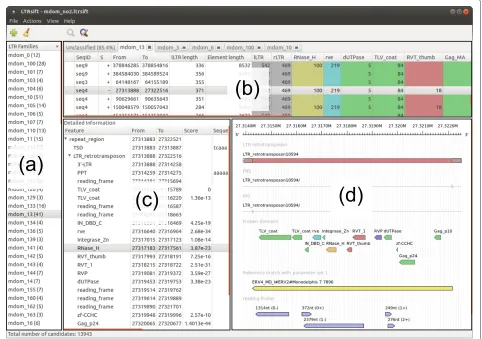
After opening a project file, its content appears in the main window of LTRsift. The main window is subdi-vided into four main components (Figure 2). The family list (Figure 2a) shows the current list of putative fami-lies, identified by their names. Names are automatically assigned whenever a new family is created by the classifi-cation algorithm. However, a family name can be edited at any time.
A double click on a family opens a new tab holding the candidate list comprising the family (Figure 2b). Each tab, labeled with the family name, shows all member candi-dates of a given family, with columns specifying sequence, strand, location, LTR and element lengths, and cluster numbers for all detected features according to a color code. Colors are user-configurable via a style definition file. By default LTR,gag-associated domains, AP domains, RT domains, RH domains and IN domains, as well as PPT and PBS are displayed in different colors. Candi-dates which could not be placed unambiguously in one of the families remain in an ‘unclassified’ tab, as do can-didates with no cluster numbers (singletons). The rows making up the candidate list can be sorted according to the values in any column. Moreover, individual columns can be hidden to improve legibility on screens with low horizontal resolution. Candidates can be moved from one family to another by dragging and dropping the respec-tive row in the candidate list. Whenever candidates are deleted from families, they are added to a project-wide list of unclassified candidates. Candidates deleted from the list of unclassified candidates will be removed from the project entirely.
Figure 2Screenshot of theLTRsiftmain window.(a) Putative family list, (b) candidate list, (c) candidate details, (d) candidate visualization. The currently loaded project contains 13, 943 candidates from theMonodelphis domesticagenome, with the currently selected candidate showing a full set of detected features (PBS, PPT, protein domains). ORF detection and reference matching have been performed. Additional details, such as PPT and PBS sequences, Pfam IDs and so on, are available by scrolling to the right in (c). The graphical representation in (d) depicts the retrotransposon (red) with PPT and PBS as small lines in the two tracks below. The next track shows protein domain matches, coded in different colors. Here integrase domains are depicted in blue, reverse transcriptase domains in red, protease domains in purple, RNase H domains in gold, and any other domains in green. The RNase H domain is marked in red because it has been selected in the candidate detail list. The reference match in the track below (shown in yellow) spans the interior region of the candidate completely, suggesting that it likely is a full-length element. The bottom track shows open reading frames in blue color. LTR: long terminal repeat; ORF: open reading frame; PBS: primer binding site; PPT: polypurine tract; TSD: target site duplication.
reading direction and internal features, intuitively spread out into separate tracks reminiscent of the representation used in a genome browser such as Ensembl [37].
Augmenting annotations with additional data
LTRsiftdoes not only allow displaying results of the auto-matic classification, but can also perform additional oper-ations which add extra information to the annotoper-ations stored in the project. One possible augmentation con-sists of detecting the longest open reading frames (ORFs) inside candidates. The ORFs are added to the candi-date annotations as ‘reading frame’ features. For cross-referencing the de novo results with custom sequence data,LTRsiftalso allows users to match candidates against
Filtering rule definitions
Besides the described presentation of candidate sets, LTR-sift allows for flexible filtering of candidates based on their internal structure or external data. This is done by evaluating each candidate with regard to a given chain of annotation-based rules. Each rule specifies one aspect of the candidate which is satisfied or not, expressed via a boolean value (true or false). We call these rules predicates. For example, the presence of detected pro-tein domains is a predicate, as is the property of being Copia-like (orGypsy-like, for that matter). The predicate is captured in a rule returning the appropriate boolean value.
When a filtering run is started, candidates are selected according to rules, keeping a candidate in its original fam-ily if the evaluation returns the value false. If it returns the value true, the desired behavior can be selected by the user. Either the candidate in question is taken out of a putative family and put back into the unclassified set. This means that filtered candidates already in the unclassified set are deleted from the project altogether. Alternatively the candidate in question can be assigned to a separate family, newly created for candidates which were filtered out in this run. Which one of these options is used can be selected in the filtering dialog (Figure 3). Rules are chainable: if more than one rule is given, LTR-siftallows their combination by requiring that all of them must be true to filter out a candidate (boolean AND), or that it suffices to have one of them evaluate to true (boolean OR).
The rule is stored in a text file which is interpreted by the software when added to the project. Each filtering rule contains a set of metadata, such as its author contact, description, and version to ease distributability and repro-ducability of results (see Additional file 1, Section 1 for more details).
As the filtering rules are not built intoLTRsiftitself, but rather described in Lua, a powerful but simple program-ming language [39], the filtering functionality is extensible which gives a user a maximum amount of flexibility. We will now show example filtering rules to illustrate how annotation data are accessed.
Filtering by protein domain presence
As the protein domain coding sequences are the main basis for the matching and clustering steps leading to fam-ily assignment, a common task is to remove all candidates which do not contain at least one domain hit.
This task can be solved by a rule implemented in a function named filter. This function has access to a representation of each candidate in the form of a directed acyclic graph in which nodes represent individual features (for example, LTR, TSD, PBS, . . . ) and edges represent ’part of ’ relationships between such features. The latter
indicate, for instance, that an LTR is part of an LTR retro-transposon, which in turn is part of a repeated region.
The actual rule defined in the programming language Lua looks as follows:
function filter(candidate node)
gfi = gt.feature node iterator new (candidate node)
node = gfi:next()
while not (node == nil) do
if (node:get type() == "protein match") then
return false
end
node = gfi:next()
end
return true
end
The rule evaluates whether the candidate contains a ‘protein match’ feature. The traversal stops and returns falseonce a node with the type ‘protein match’ is found. If no such node is found,trueis returned. This is the case whennodebecomes nil, indicating that all children have been examined without breaking the loop.
Besides the type, the following additional data are stored in each node and can conveniently be queried from a filtering rule:
• the sequence region (for example, chromosome, contig, and so on) the feature is located on,
• location of the feature on that region in terms of start and end position (1-based),
• strand (forward/reverse),
• a numeric score value (the meaning of which depends on the tool which produced this value, for example, an E-value),
• a set of key-value pairs containing arbitrary named attributes (for example, feature name/ID, anticodon for PBS-binding tRNAs, Pfam ID for matching pHMMs, and so on).
Filtering by match coverage
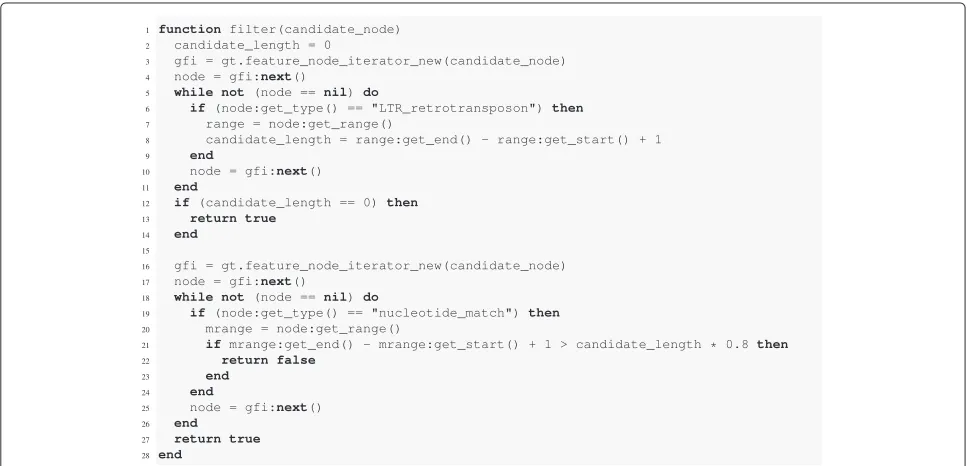
Another use case for the filtering component is to separate candidates with high local sequence similarity to a refer-ence sequrefer-ence set from those that do not contain such similarities. To give an example, a filtering rule which fil-ters out all candidates not matching a reference sequence over at least 80% of their length is easily implemented (Figure 4).
Figure 3Screenshot of theLTRsiftfilter selection dialog.The left side of the dialog shows the filtering rules added to the project and available to be used. The right side shows the filtering rules to be applied in the current filtering run. The checkbox next to each rule allows the user to negate it. This dialog is set to unclassify or delete all candidates not passing the filtering step - in this case, this means all candidates that do not contain protein domains and no long reference matches. The buttons on the left allow adding rules to the project and removing them again. Moreover rules can be edited directly from withinLTRsiftin a simple built-in text editor, avoiding the need to locate and open them in a separate text editor. Clicking the button on the lower left starts the filtering process.
the node in this connected component with the type ‘LTR retrotransposon’. We only store the length of the last occurrence of such a node because in a valid annotation there is only one such node per connected component. The length is stored in the variablecandidate length. If no “LTR retrotransposon” node was found, we are not
looking at an LTR retrotransposon element (lines 12 to 14). This case can occur when filtering annotation files in which LTR retrotransposon annotations occur besides other annotations, e.g. gene annotations, which this rule is designed to ignore. The second step then iterates over all features again, comparing the lengths of the matches
with 80% of the candidate length (line 21) and returns the appropriate value in the process (lines 16 to 27).
Additional command-line tools
For very large data sets or for scripted processing (for example, in an automated pipeline), the filtering and clus-tering functionality is also accessible using command-line tools, which are part of theGenomeToolspackage.
Data export
Candidate sequences (in FASTA format) and candidate annotations (in GFF3 format) can be exported to files. LTRsift supports exporting all candidates in the whole project into a single file as well as exporting the mem-bers of one or more specific families into one or multiple separate files. This makes it easy to prepare sequence sets for subsequent external analysis, for example, multiple sequence alignment.
Software requirements
LTRsift is intended for use on UNIX-like operating sys-tems, like Linux, Mac OS X or the BSD family of operating systems. The GUI is built upon the GTK+ version 2 toolkit for creating graphical user interfaces [40,41], a wide-spread library component which is already being used as the basis of many popular free software packages like the GIMP image editor [42] or the GNOME desktop environ-ment [43]. GTK+ is included in the majority of currently available Linux distributions.
The necessary components for parsing and handling both sequence and annotation data are provided by the GenomeTools genome analysis library [44], freely available from http://genometools.org. For drawing the schematic illustration of each candidate, the AnnotationS-ketchengine [45] is used, which is based on the Cairo 2D vector graphics engine [46] for rendering. Again, Cairo is a standard library very likely to be present on a recent graphical UNIX or Linux machine. It can be installed on Mac OS X using one of several package managers, for example, Fink [47].
As an external component to compute initial matches for clustering, the LAST software [36] is used and must be installed on the system. Likewise, for reference match-ing the BLAST software (version 2.2 and higher) must be present in order to use thisLTRsiftfeature.
Also, we provide a statically linked version of LTR-sift for the Linux platform which does not require any pre-installed version of theGenomeToolsshared library.
Results
To illustrate the use ofLTRsiftinde novoLTR retrotrans-poson analysis efforts, we performed example analyses of the Drosophila melanogaster(fruit fly) andMonodelphis domestica(gray short-tailed opossum) genomes.
Results of theDrosophila melanogasteranalysis
We utilized LTRsift to semi-manually curate and postprocess putative LTR retrotransposon families and potential full-length members in the Drosophila melanogaster release 5.8 genome [GenBank:AE014134, GenBank:CM000456, GenBank:AE013599, GenBank:CM 000457, GenBank:AE014296, GenBank:CM000458, Gen Bank:AE014297, GenBank:CM000459, GenBank:AE01 4135, GenBank:AE014298, GenBank:CM000460] from scratch, detected usingLTRharvestandLTRdigest. These were parameterized with range, similarity and offset constraints for the detection of LTR pairs, and with tRNA sequences as well as profile HMMs to annotate the internal region. These parameters were identical to the parameters used in previous publications [5,14]. We refer to Additional file 1 for more details on the param-eterization of these two external tools. For both the initial detection and the subsequentLTRsiftanalysis steps described below, an Intel Core 2 Duo system (2.4GHz, 4GB RAM, Ubuntu Linux 12.04) was used.
The encoded genome sequence and the sorted GFF3 file were added to the project using the guided project cre-ation dialog. Then matching and clustering of all feature sequences was performed in a matter of minutes, keep-ing the default parameters in the appropriate dialogs, with the exception that the query step size (LAST parame-ter-k) was increased to 10 to speed up the process. We required matches to span 80% of the shorter sequence and 30% of the longer sequence. For the classification step, all detected features were used as evidence in the group join-ing process by selectjoin-ing all of them in the classification dialog. As deviation thresholds for putative full-length candidate detection, an LTR length deviation of 50 bp and a candidate length deviation of 200 bp were set. No filtering was done at this time.
domain. This situation was regarded as evidence for a deletion inside the candidate in question. After inspecting all groups in this way, we had a closer look at the pre-viously unclassified candidates by opening the respective tab and manually joined another 134 of them into four additional groups, again looking at their details. In addi-tion to cluster compatibility, this joining was based again on element and LTR length as well as specific features such as the presence of ORFs and their lengths. For this man-ual approach, new empty families were created using the LTRsiftGUI and the respective member candidates were moved into them using the drag-and-drop functionality.
To evaluate which existing families our de novo iden-tified families correspond to, we used the reference sequence matching function inLTRsiftto compare all can-didate sequences with the reference sequence set of LTR retrotransposons used in our previous work [5], contain-ing 61 sequences. After matchcontain-ing the reference sequences to the candidates from within LTRsift using BLASTN (E-value threshold: 0.01), the results are displayed as an extra track in the candidate visualization. That is, in the delivered image the matched candidate region is cov-ered by a separate feature, while the label of the feature describes the matched region on the reference. We exam-ined our putative families for consistency according to the match features and assigned names which incorporate the recovered reference family (for example, the group corre-sponding to the existingmdg3family was called ‘dmel 1 (mdg3)’).
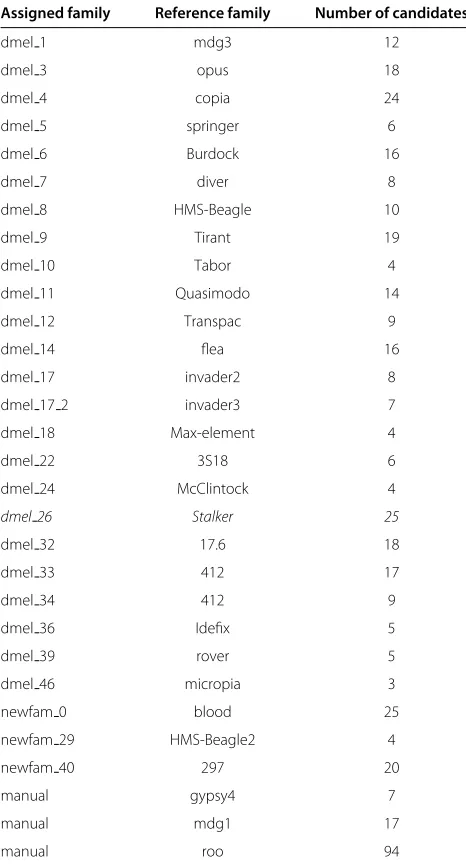
With little effort, we were able to recover 28 of the 61 known families as defined by the reference sequence set (Table 1). In one case (the family named412), we obtained two automatically derived putative families for one refer-ence family due to the LTR sequrefer-ences of the candidates ending up in different clusters, breaking their compati-bility. The roo family proved to be a difficult family to recover due to the presence of only short protein domain matches within their members. However, joining them on the basis of the LTR sequences alone allowed us to obtain a putative family of 94 candidates, though not all of them appeared to be full-length. Another group diffi-cult to separate was a group of elements belonging to the Stalker/Stalker2/Stalker3T/Stalker4families. Members of all of these were clustered into one large family, possibly due to the high similarity of their coding sequence.
Seven additional putative families were found which could not be uniquely matched to any reference fam-ily. The majority of these consist only of three to five candidates with widely varying element and LTR lengths. These candidates are linked only by one protein domain or LTR sequence match and show short ORFs only. In some of them, spurious short matches to theDm88and GATEfamilies were found in non-coding areas of these candidates.
Table 1 Results for theDrosophila melanogasteruse case
Assigned family Reference family Number of candidates
dmel 1 mdg3 12
dmel 3 opus 18
dmel 4 copia 24
dmel 5 springer 6
dmel 6 Burdock 16
dmel 7 diver 8
dmel 8 HMS-Beagle 10
dmel 9 Tirant 19
dmel 10 Tabor 4
dmel 11 Quasimodo 14
dmel 12 Transpac 9
dmel 14 flea 16
dmel 17 invader2 8
dmel 17 2 invader3 7
dmel 18 Max-element 4
dmel 22 3S18 6
dmel 24 McClintock 4
dmel 26 Stalker 25
dmel 32 17.6 18
dmel 33 412 17
dmel 34 412 9
dmel 36 Idefix 5
dmel 39 rover 5
dmel 46 micropia 3
newfam 0 blood 25
newfam 29 HMS-Beagle2 4
newfam 40 297 20
manual gypsy4 7
manual mdg1 17
manual roo 94
This table lists the putative families as assigned during our semi-automatic evaluation run on theDrosophila melanogastergenome (left column). The center column shows the name of the known family represented by that putative family, obtained from matching of the candidate sequence against a reference sequence set. The rightmost column lists the number of candidates in the respective family. Thedmel 26group (matched to variousStalkersequences) was not counted as recovered due to the multitude of non-unique matches to multiple references. Families with thenewfamprefix were obtained by re-running the classification algorithm on subsets of the unclassified candidate set. Finally, families marked asmanualwere derived non-automatically.
We have included the annotation files generated by LTRsiftfor this analysis as Additional file 2.
Results of theM. domesticaanalysis
As an example dataset, we appliedLTRharvestand LTRdi-gestto the genome ofM. domestica, the gray short-tailed opossum [48]. It is estimated that 10% of its approxi-mately 3.5 gigabase genome is comprised of endogenous retroviruses (ERV) [49,50]. This has been detected in a homology-based approach searching for protein-coding sequences known from the Repbase database [51], but not incorporating the LTRs as structural features forde novo detection.
The M. domestica sequence (Broad Institute assem-bly version MonDom5) [GenBank:CM000368, GenBank: CM000369, GenBank:CM000370, GenBank:CM000371, GenBank:CM000372, GenBank:CM000373, GenBank: CM000374, GenBank:CM000375, GenBank:CM000376] was downloaded from the Ensembl website [52].
TheLTRharvestandLTRdigestruns and the subsequent LTRsiftanalysis were performed on the same Linux stan-dard desktop system equipped with the same hardware as described above. We used a slightly different set of param-eters than in theDrosophilacase because some peculiari-ties in the fly genome (such as unusual PBS-tRNA binding offsets) are not known for the opossum genome. In addi-tion, we used some extra protein domain pHMMs suitable for mammals (see Additional file 1, Section 3).
The LTRharvest prediction with default parameters (see Additional file 1, Section 3) delivered 58,684 candi-dates. We then utilized the command-line filtering tool to remove all candidates which did not contain any protein domain hits, reducing the number of candidates to 13,944. This set of candidates was then loaded into anLTRsift project and preprocessed. The matches used for clus-tering were computed with the same settings as in the Drosophila case (LAST option-k 10, matches need to span 80% of the shorter sequence and 30% of the longer sequence). Full-length member deviation thresholds were identical as well.
Matching and joining of the 13,944 candidates took about 30 minutes. As a result of the initial classi-fication on the basis of the parameters above, 171 putative families were created containing 2,015 candi-dates altogether. There were initially 11,929 candicandi-dates that were unclassified, and 76 of the 171 initial puta-tive families contained only two members and were again discarded using the respective LTRsift function-ality. This left 95 remaining families comprising 1,863 candidates.
A look at the 95 remaining putative families reveals that the distribution of candidates across the families is skewed: 937 of the 1,863 candidates are in two puta-tive families, one with 722 members and one with 215 members. The candidates in the smaller one are linked via their LTR and RT clusters only. The linear visual-ization in LTRsift shows that the location of the RT matches widely varies across the family members. Only
very short ORFs are present. This may suggest that this family of 215 members is composed of non-autonomous candidates with many mutations. By contrast, the major-ity of the members of the second, larger putative family of 722 members contain a full set of protein domain hits – that is, protease, RT, RH and IN domains. In most candidates, hits to a protein domain associated with Gag were found as well. The candidates are consistently linked on the basis of these protein domain clusters, as well as their LTR sequence clusters. ORFs are predom-inantly longer (up to thousands of bases). We matched these candidates to knownM. domesticaERV sequences downloaded from Repbase using the LTRsift reference matching functionality, resulting in partial and full-length matches to the ERV2 MD, ERV37 MD and ERV11 MD reference sequences. The other, smaller families, contain-ing between 3 and 74 members, in many cases showed full sets of protein domains without being covered by a reference match, suggesting that there may be poten-tial for previously undiscovered or unclassified elements. Some of these protein domains also contain other rel-evant protein domain hits, such as other Gag domains (Gag p30, Gag MA and Gag p24) or a potential Env/coat polyprotein (TLV coat).
To assess the possible number of yet undetected full-length candidates, we prepared a filter rule selecting only those candidates with a full set of protein domains. That is, the protease, RT, IN and RH functions must all be represented with at least one pHMM hit associated with that function. We used this rule to select matching can-didates from the whole candidate set usingLTRsift. This delivered a new group containing 1,009 candidates pass-ing the filter. Afterwards we used the reference match coverage filter with threshold 80% to weed out those can-didates among the 1,009 that were already matched to a known reference sequence. As a result, we only found 159 candidates with a full set of protein domain hits which have a match to a reference sequence over at least 80% of their internal sequence or more, leaving 850 still unmatched and interesting for further analysis. This illus-trates that LTRsift allows a user to conveniently prepare interesting subgroups of candidates on the basis of their features.
Discussion
Once input data are imported into a project file, the project and all associated data are loaded quickly, even when the number of candidates is in the tens of thousands, as may occur when analyzing large mammalian genomes. The window configuration of the user interface, includ-ing all open tabs, is saved with the project, allowinclud-ing the user to continue previously interrupted work in the same environment.LTRsiftdisplays candidates and their family memberships in an intuitive way, using common GUI con-cepts like drag-and-drop to support manipulation. A user familiar with web-based genome browsers can intuitively understand the visual candidate representation. Features are shown in color-coded tracks and are labeled with addi-tional information, such as domain names, match targets, or reading frame and orientation. The view is extensively configurable using a style file, making it possible to adjust both colors and other layout options such as font sizes, as well as enable or disable the display of specific feature types.
Filtering rules are powerful while easy to write with basic programming skills. They support extensive access to the candidate annotation and can be combined to form more complex conditions, not only allowing the user to discard candidates but also to add them to new subgroups that do or do not satisfy the condition described by the fil-tering rules. Another advantage is that filfil-tering rules are self-contained in one text file per rule. This makes it possi-ble to distribute user-defined filtering rules in the research community.
The matching, clustering and classification components used inLTRsifthave been designed to be modular, making it possible to quickly add support for new matching tools, clustering strategies or classification algorithms. A unified representation of the candidates as graphs allows the same for other tasks working on annotations and sequences, creating new annotations in the process.
The currently implemented ORF detection and refer-ence annotation components are good examples for such tasks, employing GenomeTools functionality and third-party tools like BLAST to transparently extend the anno-tation within the graphical interface.
We are not aware of any other tool for this exact task of supporting postprocessing and curation ofde novoLTR retrotransposon annotations in a fashion similar to LTR-sift. There is a graphical tool,VisualRepbase[53], available to display occurrences of TEs, for example, taken from the Repbase Update database [51] in a genomic context together with annotations, for example, downloaded from the NCBI databases. However, VisualRepbase does not support the formation of families inside the database, nei-ther does it display the internal structure of the displayed elements in terms of features. By contrast,LTRsift does not take the genomic neighborhood of the candidates into account.
The classification approach as described in [5] works well in theDrosophilagenome. Nevertheless, a large vari-ety of clustering and family assignment strategies exists, and it would be a natural assumption that other, more sophisticated approaches may work better on candidates from other genomes. The modular architecture of LTR-siftallows the user to incorporate alternative classification strategies in the future, creating a comprehensive and flex-ible solution for the integration of tools among the diverse landscape of classification methods.
A basic requirement of our classification approach is the presence of annotated internal feature sequences, whose similarities are used to separate candidates into putative families. Many of the candidates satisfy this requirement. Unfortunately, in the M. domesticadata set no features were detected in the majority of the candidates. Con-sequently, these candidates can be either false positives or non-autonomous copies. While non-autonomous ele-ments are indisputably important in general, prior anal-yses have shown that suchde novopredicted candidates are often unreliable and may well be false positives, as we demonstrated in an earlier use case [5]. However, there are also non-autonomous elements which still retain internal features, which can readily be processed usingLTRsiftand included in a reference sequence set. This set could then be used as a starting point for homology-based detection of more truncated copies in the genome.
World Wide Web-based solutions are becoming increasingly popular for interactive and sometimes dis-tributed analysis of structured data sets due to their platform independence on the user side – only a web browser is needed to access the data from any loca-tion with a network connecloca-tion. We did not follow a web-based approach for the design and development of LTRsift. The main reason is that the size of the underlying genome sequences may well become too large to be con-veniently uploaded to a web server when analyzing large, for example, mammalian, genomes. By contrast, the size of the annotations is of moderate size (approximately 42 MB for the full unfiltered M. domestica candidate set). The sequence is required to perform sequence-based analyses like reference matching, ORF finding or simply to display short motif sequences like PBS and PPT in the candidate details. Hence uploading the annotation alone would not suffice to display every interesting bit of information on the candidates. Instead, we chose to build LTRsifton an open source GUI platform intended to run on freely available desktop operating systems. Sharing project files, for example, via a shared network drive, allows a distributed annotation.
selection window. This would also allow the use of multi-ple instances of the same filter with different parameters without having to copy the file. Another desirable feature would be support for multiple levels of group member-ship per candidate. For example, a candidate may appear in multiple groups, which in this context describe the candidate on multiple levels: it may appear once in its spe-cific family, and once in a more general ‘copia-like’ group. This could be implemented by assigning tags to candi-dates and allowing queries on the tags to group candicandi-dates together. While functionality to export sequences already exists, it could be very useful to be able to start exter-nal tools on given candidate sets (for example, selected candidates or all members of a putative family). A typical example for this kind of use would be a multiple sequence alignment tool such as ClustalX [54] or others. Finally, on some occasions, exporting the linear candidate visualiza-tion as an image file would be desirable. Such funcvisualiza-tional- functional-ity could easily be implemented as theAnnotationSketch engine supports output in a variety of vector and bitmap formats [45].
Conclusions
We have developedLTRsift, a software tool for visualiza-tion and postprocessing ofde novopredicted LTR retro-transposon annotations. It literally allows the user to ‘sift’ through a possibly large quantity of results from a pre-diction and annotation software like LTRharvest and/or LTRdigest, which it was designed to work with. How-ever, it relies on standard data formats and can also work on results from other tools, given that the input data are appropriately formatted. LTR retrotransposons can be assigned both automatically and manually to groups con-sidered putative families, which can then serve as a basis for comprehensive sequence library preparation. To the best of our knowledge,LTRsiftis the first software for this specific task, implementing not only classification but also flexible, customizable filtering in a graphical environment. Relying on a common GUI toolkit from the open source world, the user interface is familiar to everyday computer users.LTRsiftis efficient enough to allow work with large datasets consisting of up to tens of thousands of candi-dates on standard desktop hardware, making it likely to be used by life scientists preferring a visual, exploratory hands-on approach to dealing with result data.
Availability and requirements
• Project name:LTRsift
• Project home page:
http://www.zbh.uni-hamburg.de/LTRsift
• Operating system(s):UNIX-like systems, for example, Linux or Mac OS X
• Programming language:C (GUI software), Lua (filtering rules)
• Other requirements:GenomeTools version 1.4.2 and higher (not required by the static version), GTK+ 2.2.4 and higher
• License:GPL2
Additional files
Additional file 1: Technical information.This PDF file contains additional information on how to write filtering rules for theLTRsift software. Besides a description of the rule file structure, it also contains a documentation of the functions to access the representation of the candidate annotation and a documentation of the command line tools. Finally, it lists parameterization details for the example runs.
Additional file 2: Example annotation forD. melanogaster.This gzipped tar archive contains the annotation GFF3 file created as a result of our evaluation runs for theD. melanogastergenome, as well as the corresponding sequence in FASTA format.
Competing interests
The authors declare that they do not have any competing interests.
Author’s contributions
StK conceived and guided the project. SaK and SS developed the software. SS performed the example runs. SS and StK wrote the manuscript. All authors read and approved the final version of the manuscript.
Acknowledgements
The authors wish to thank Gordon Gremme for theGenomeToolssoftware, without which the development ofLTRsiftwould not have been possible.
Received: 3 July 2012 Accepted: 31 August 2012 Published: 7 November 2012
References
1. International Human Genome Sequencing Consortium:Initial sequencing and analysis of the human genome.Nature2001, 409(6822):860–921.
2. Mouse Genome Sequencing Consortium:Initial sequencing and comparative analysis of the mouse genome.Nature2002, 420:520–562.
3. Finnegan DJ:Eukaryotic transposable elements and genome evolution.Trends Genet1989,5:103–107.
4. Wicker T, Sabot F, Hua-Van A, Bennetzen J, Capy P, Chalhoub B, Flavell A, Leroy P, Morgante M, Panaud O, Paux E, SanMiguel P, Schulman A:A unified classification system for eukaryotic transposable elements.
Nat Rev Genet2007,8(12):973–982. [http://dx.doi.org/10.1038/nrg2165] 5. Steinbiss S, Willhoeft U, Gremme G, Kurtz S:Fine-grained annotation
and classification of de novo predicted LTR retrotransposons.
Nucleic Acids Res.2009,37:7002–7013. [http://nar.oxfordjournals.org/cgi/ content/full/37/21/7002]
6. Marquet R, Isel C, Ehresmann C, Ehresmann B:tRNAs as primer of reverse transcriptases.Biochimie1995,77:113–124.
7. Mak J, Kleiman L:Primer tRNAs for reverse transcription.J Virol1997, 71:8087–8095.
8. Wilhelm M, Wilhelm FX:Reverse transcription of retroviruses and LTR retrotransposons.Cell Mol Life Sci2001,58:1246–1262.
9. Wilhelm M, Heyman T, Boutabout M, Wilhelm FX:A sequence immediately upstream of the plus-strand primer is essential for plus-strand DNA synthesis of theSaccharomyces cerevisiaeTy1 retrotransposon.Nucleic Acids Res1999,27:4547–4552.
10. Bergman CM, Quesneville H:Discovering and detecting transposable elements in genome sequences.Brief Bioinform2007,8:382–392. 11. McCarthy EM, McDonald JF:LTR STRUC: a novel search and
identification program for LTR retrotransposons.Bioinformatics2003, 19:362–367.
13. Xu Z, Wang H:LTR FINDER: an efficient tool for the prediction of full-length LTR retrotransposons.Nucleic Acids Res2007, 35:W265–W268.
14. Ellinghaus D, Kurtz S, Willhoeft U:LTRharvest, an efficient and flexible software for de novo detection of LTR retrotransposons.BMC Bioinformatics2008,9:18. [http://www.biomedcentral.com/1471-2105/9/ 18]
15. Minervini CF, Viggiano L, Caizzi R, Marsano RM:Identification of novel LTR retrotransposons in the genome ofAedes aegypti.Gene2009, 440(1–2):42–49. [http://www.sciencedirect.com/science/article/pii/ S0378111909001590]
16. Marsano RM, Leronni D, D’Addabbo P, Viggiano L, Tarasco E, Caizzi R: Mosquitoes LTR retrotransposons: a deeper view into the genomic sequence ofCulex quinquefasciatus.PLoS ONE2012,7:e30770. [http:// dx.doi.org/10.13712Fjournal.pone.0030770]
17. Rho M, Schaack S, Gao X, Kim S, Lynch M, Tang H:LTR retroelements in the genome ofDaphnia pulex.BMC Genomics2010,11:425. [http:// www.biomedcentral.com/1471-2164/11/425]
18. McCarthy EM, McDonald JF:Long terminal repeat retrotransposons of Mus musculus.Genome Biol2004,5:R14.
19. Polavarapu N, Bowen NJ, McDonald JF:Identification, characterization and comparative genomics of chimpanzee endogenous
retroviruses.Genome Biol2006,7:R51. [http://genomebiology.com/ 2006/7/6/R51]
20. Huda A, Polavarapu N, Jordan IK, McDonald JF:Endogenous
retroviruses of the chicken genome.Biol Direct2008,3:9. [http://www. biology-direct.com/content/3/1/9]
21. de la Chaux N, Wagner A:BEL/Pao retrotransposons in metazoan genomes.BMC Evolutionary Biol2011,11:154. [http://www. biomedcentral.com/1471-2148/11/154]
22. McCarthy E, Liu J, Lizhi G, McDonald JF:Long terminal repeat retrotransposons ofOryza sativa.Genome Biol2002,
3(10):research0053.1–research0053.11. [http://genomebiology.com/ 2002/3/10/research/0053]
23. Wang H, Liu JS:LTR retrotransposon landscape inMedicago truncatula: more rapid removal than in rice.BMC Genomics2008, 9:382. [http://www.biomedcentral.com/1471-2164/9/382]
24. Seberg O, Petersen G:A unified classification system for eukaryotic transposable elements should reflect their phylogeny.Nat Rev Genet 2009,10(4):276. [http://dx.doi.org/10.1038/nrg2165-c3]
25. Kapitonov VV, Jurka J:A universal classification of eukaryotic transposable elements implemented in Repbase.Nat Rev Genet2008, 9:411–412. [http://dx.doi.org/10.1038/nrg2165-c1]
26. Abrus´an G, Grundmann N, DeMester L, Makalowski W:TEclass – a tool for automated classification of unknown eukaryotic transposable elements.Bioinformatics2009,25(10):1329–1330.
27. Feschotte C, Keswani U, Ranganathan N, Guibotsy ML, Levine D: Exploring repetitive DNA landscapes using REPCLASS, a tool that automates the classification of transposable Elements in eukaryotic genomes.Genome Biol Evol2009,2009:205–220.
28. Kapitonov VV, Tempel S, Jurka J:Simple and fast classification of non-LTR retrotransposons based on phylogeny of their RT domain protein sequences.Gene2009,448(2):207–213. [http://www. biomedsearch.com/nih/Simple-fast-classification-non-LTR/19651192. html]
29. Rouault JD, Casse N, Ch´enais B, Hua-Van A, Fil´ee J, Capy P:Automatic classification within families of transposable elements: Application to the mariner family.Gene2009,448(2):227–232. [http://www. sciencedirect.com/science/article/pii/S0378111909004570] 30. The Vmatch large scale sequence analysis software.[http://www.
vmatch.de]
31. Tempel S, Rousseau C, Tahi F, Nicolas J:ModuleOrganizer: detecting modules in families of transposable elements.BMC Bioinformatics 2010,11:474. [http://www.biomedcentral.com/1471-2105/11/474] 32. Smit AFA, Hubley R, Green P:RepeatMasker Open-3.0.Unknown Month
1996. [http://www.repeatmasker.org]
33. Stein L:Generic Feature Format Version 3.[http://www. sequenceontology.org/gff3.shtml]
34. Steinbiss S, Kurtz S:A new efficient data structure for storage and retrieval of multiple biosequences.IEEE/ACM Trans Comput Biol
Bioinform2012,9(2):345–357. [http://www.computer.org/portal/web/ csdl/doi/10.1109/TCBB.2011.146]
35. Eilbeck K, Lewis S, Mungall C, Yandell M, Stein L, Durbin R, Ashburner M: The sequence ontology: a tool for the unification of genome annotations.Genome Biol2005,6(5):R44. [http://genomebiology.com/ 2005/6/5/R44]
36. Kiełbasa SM, Wan R, Sato K, Horton P, Frith MC:Adaptive seeds tame genomic sequence comparison.Genome Res2011,21(3):487–493. [http://genome.cshlp.org/content/early/2011/02/04/gr.113985.110. abstract]
37. Flicek P, Amode MR, Barrell D, Beal K, Brent S, Carvalho-Silva D, Clapham P, Coates G, Fairley S, Fitzgerald S, Gil L, Gordon L, Hendrix M, Hourlier T, Johnson N, K¨ah¨ari AK, Keefe D, Keenan S, Kinsella R, Komorowska M, Koscielny G, Kulesha E, Larsson P, Longden I, McLaren W, Muffato M, Overduin B, Pignatelli M, Pritchard B, Riat HS, et al.:Ensembl 2012.Nucleic Acids Res2012,40(D1):D84–D90. [http://nar.oxfordjournals.org/content/ 40/D1/D84.abstract]
38. Altschul SF, Gish W, Miller W, Myers EW, Lipman DJ:Basic local alignment search tool.J Mol Biol1990,215:403–410. 39. Ierusalimschy R, de Figueiredo LH, Filho WC:Lua – an extensible
extension language.Software: Practice & Experience1996,26:635–652. 40. Krause A:Foundations of GTK+ Development. Berkeley, CA, USA: Apress;
2007.
41. The GTK+ Project.[http://www.gtk.org]
42. GIMP – The GNU Image Manipulation Program.[http://www.gimp. org]
43. GNOME.[http://www.gnome.org]
44. Gremme G, Steinbiss S, Kurtz S:GenomeTools.[http://genometools.org] 45. Steinbiss S, Gremme G, Sch¨arfer C, Mader M, Kurtz S:AnnotationSketch: a genome annotation drawing library.Bioinformatics2009,25(4):533– 534. [http://bioinformatics.oxfordjournals.org/cgi/content/full/25/4/533] 46. Worth C, Packard K:Xr: Cross-device rendering for vector graphics.In
Proceedings of the Ottawa Linux Symposium; 2003. [http://cworth.org/ cworth/papers/xr ols2003]
47. Fink.[http://www.finkproject.org]
48. Mikkelsen TS, Wakefield MJ, Aken B, Amemiya CT, Chang JL, Duke S, Garber M, Gentles AJ, Goodstadt L, Heger A, Jurka J, Kamal M, Mauceli E, Searle SMJ, Sharpe T, Baker ML, Batzer MA, Benos PV, Belov K, Clamp M, Cook A, Cuff J, Das R, Davidow L, Deakin JE, Fazzari MJ, Glass JL, Grabherr M, Greally JM, Gu W, et al.:Genome of the marsupialMonodelphis domesticareveals innovation in non-coding sequences.Nature2007, 447(7141):167–177. [http://www.nature.com/nature/journal/v447/ n7141/full/nature05805.html]
49. Samollow PB:The opossum genome: Insights and opportunities from an alternative mammal.Genome Res2008,18(8):1199–1215. [http://genome.cshlp.org/content/18/8/1199.abstract]
50. Gentles AJ, Wakefield MJ, Kohany O, Gu W, Batzer MA, Pollock DD, Jurka J: Evolutionary dynamics of transposable elements in the short-tailed opossumMonodelphis domestica.Genome Res2007,17(7):992–1004. [http://genome.cshlp.org/content/17/7/992.abstract]
51. Jurka J, Kapitonov VV, Pavlicek A, Klonowski P, Kohany O, Walichiewicz J: Repbase Update, a database of eukaryotic repetitive elements.
Cytogenet Genome Res2005,110:462–467.
52. Ensembl genome browser 67:Monodelphis domestica.[http://www. ensembl.org/Monodelphis domestica/Info/Index]
53. Tempel S, Jurka M, Jurka J:VisualRepbase: an interface for the study of occurrences of transposable element families.BMC Bioinformatics 2008,9:345. [http://dx.doi.org/10.1186/1471-2105-9-345]
54. Larkin M, Blackshields G, Brown N, Chenna R, McGettigan P, McWilliam H, Valentin F, Wallace I, Wilm A, Lopez R, Thompson J, Gibson T, Higgins D: Clustal W and Clustal X version 2.0..Bioinformatics2007,
23(21):2947–2948.
doi:10.1186/1759-8753-3-18
![Figure 1 Structure of a typical long terminal repeat retrotransposon. Adapted from [5]](https://thumb-us.123doks.com/thumbv2/123dok_us/643341.2064294/2.595.59.539.88.132/figure-structure-typical-long-terminal-repeat-retrotransposon-adapted.webp)