PhD Dissertation
International Doctorate School in Information and Communication Technologies
DISI - University of Trento
A General Framework for Exploiting
Background Knowledge in Natural
Language Processing
Kateryna Tymoshenko
Advisor:
Claudio Giuliano
Fondazione Bruno Kessler, Human Language Technology Research Unit.
Abstract
The two key aspects of natural language processing (NLP) applications based on machine learning techniques are the learning algorithm and the feature representation of the documents, entities, or words that have to be manipulated. Until now, the majority of the approaches exploited syntactic features, while semantic feature extraction suffered from low coverage of the available knowledge resources and the difficulty to match text and ontology elements. Nowadays, the Semantic Web made available a large amount of logically encoded world knowledge called Linked Open Data (LOD). How-ever, extending state-of-the-art natural language applications to use LOD resources is not a trivial task due to a number of reasons, including nat-ural language ambiguity and heterogeneity and ambiguity of the schemes adopted by different LOD resources.
In this thesis we define a general framework for supporting NLP with se-mantic features extracted from LOD. The main idea behind the framework is to (i) map terms in text to the unique resource identifiers (URIs) of LOD concepts through Wikipedia mediation; (ii) use the URIs to obtain background knowledge from LOD; (iii) integrate the obtained knowledge as semantic features into machine learning algorithms. We evaluate the framework by means of case studies on coreference resolution and relation extraction. Additionally, we propose an approach for increasing accuracy of the mapping step based on the “one sense per discourse” hypothesis. Fi-nally, we present an open-source Java tool for extracting LOD knowledge through SPARQL endpoints and converting it to NLP features.
Keywords
Natural Language Processing, Information Extraction, Relation
Acknowledgments
I would like to thank all the people who made this thesis possible.
First of all, I thank my advisor, Claudio Giuliano, for his guidance,
ad-vices, availability for discussions, enthusiasm, support and encouragement.
I am extremely grateful to him for helping me to learn a lot in this years
and to grow professionally.
I thank my colleagues from the Human Language Technologies unit,
FBK, who create an inspiring and motivating working environment.
An-other thanks goes to Volha Bryl, DKM unit, FBK, for the fruitful
collab-oration and advices.
I would like to thank Swapna Somasundaran, my internship supervisor
at Siemens Corporate Research, U.S., for her guidance, valuable advices,
friendliness and for our joint work. I also thank my other Siemens
col-leagues and the very friendly and helpful Siemens intern community.
I am grateful to the colleagues from the Web of Data unit, FBK, for
their availability to help and to answer the questions.
I would like to thank Diana Maynard, Roberto Navigli and Marco Baroni
for agreeing to be my thesis defense committee members, an interesting
discussion after the defense and their valuable feedback.
I thank all friends whom I met during these years. I cannot list all the
names here due to the space limitations. I am grateful to all my flatmates,
both in Italy and U. S., for creating a warm home atmosphere.
I would like to thank Stanislav for his love and support during all these
years and for constantly believing in me.
Finally and most importantly, I want to thank my parents, Marina and
Valeriy Tymoshenko, for all they did for me, for their love, for always being
Contents
1 Introduction 1
1.1 The context . . . 1
1.2 The problem . . . 3
1.3 The solution . . . 4
1.4 Contributions . . . 4
1.4.1 Coreference resolution . . . 5
1.4.2 Semantic relation extraction between nominals. . . 6
1.4.3 Relation mining in the biomedical domain . . . 7
1.4.4 Improving text-to-Wikipedia mapping by expanding internal link annotations in Wikipedia pages . . . . 8
1.5 Structure of the thesis . . . 8
2 Introduction to Linked Open Data 11 2.1 Introduction . . . 11
2.2 Origins of the LOD . . . 12
2.3 LOD principles . . . 16
2.4 Consuming Linked Open Data . . . 19
2.4.1 Resource Description Framework . . . 19
2.4.2 Accessing LOD data . . . 20
2.4.3 SPARQL query language . . . 20
2.4.4 Processing RDF data . . . 22
2.5 Overview of the LOD content . . . 22
2.5.1 Frequently used data models . . . 23
2.5.2 DBpedia . . . 25
2.5.3 YAGO . . . 27
2.5.4 Freebase . . . 28
2.5.5 WordNet . . . 29
2.5.6 Cyc . . . 30
3 The Framework Implementation 31 3.1 Introduction . . . 31
3.2 Overall picture . . . 32
3.3 The Wiki Machine . . . 34
3.3.1 Training set . . . 35
3.3.2 Learning algorithm . . . 35
3.3.3 Implementation details . . . 37
3.3.4 Evaluation . . . 37
3.3.5 Related work . . . 39
3.4 LOD-based semantic feature extraction schema and imple-mentation details . . . 42
3.4.1 Extracting LOD data relevant for feature extraction 42 3.4.2 Extracting features . . . 43
4 Coreference resolution 47 4.1 Introduction . . . 47
4.2 Related work . . . 49
4.2.1 Machine learning approaches to coreference resolution 51 4.2.2 Semantic features employed for co-reference resolution 52 4.3 Background knowledge (BK) acquisition . . . 58
4.3.1 Feature extraction . . . 59
4.3.2 Feature selection . . . 60
4.4 Experiments . . . 61
4.4.1 Baseline model definition . . . 61
4.4.2 Injecting background knowledge into coreference model 66 4.5 Conclusion and future work . . . 70
5 Semantic relation extraction between pairs of nominals 71 5.1 Introduction . . . 72
5.2 Related work . . . 74
5.3 Kernel methods for Relation Extraction . . . 77
5.3.1 Shallow syntactic kernels . . . 77
5.3.2 Semantic kernels . . . 79
5.3.3 Semantic kernel instantiation . . . 80
5.4 Experiments . . . 83
5.4.1 Experimental setup . . . 83
5.4.2 BK enrichment evaluation and discussion . . . 84
5.4.3 SRE experiments and discussion . . . 88
5.5 Conclusion . . . 91
6 Biomedical entity relation mining 93 6.1 Introduction . . . 94
6.2 Entity-level semantics . . . 96
6.3 Semantic features . . . 98
6.3.1 Entity-specific features . . . 98
6.3.2 Entity pair linkage features . . . 100
6.4 Experiments . . . 100
6.4.1 Data . . . 101
6.4.2 Baseline . . . 102
6.4.3 Entity-level semantics (ELS) systems . . . 105
6.4.4 Ensemble of entity-level semantics classifiers . . . . 107
6.5 Discussion . . . 108
6.6 Related work . . . 110
6.7 Conclusion . . . 113
7 Improving linking to Wikipedia 115
7.1 Introduction . . . 115
7.2 Adapting the One Sense Per Discourse hypothesis to Wikipedia117
7.3 Experiments . . . 120
7.3.1 Test set . . . 121
7.3.2 One sense per article procedure evaluation . . . 123
7.3.3 One sense per category procedure evaluation . . . . 124
7.4 Discussion . . . 125
7.5 Conclusion . . . 126
8 Conclusions 129
Bibliography 135
List of Tables
2.1 RDF statements examples . . . 19
2.2 Linked Data by domain . . . 23
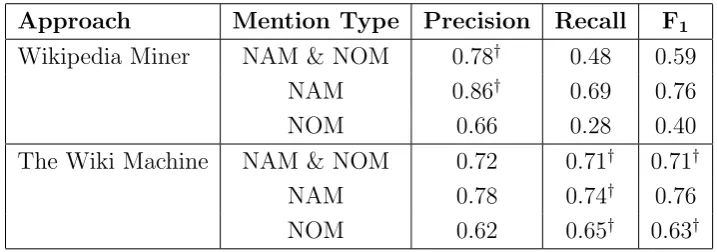
3.1 Comparative evaluation of the two disambiguation methods on ACE05-WIKI (micro-average). Symbol† indicates signif-icant differences relative to the corresponding mention type (p < 0.01). Significance tests are computed using approxi-mate randomization procedure. . . 39
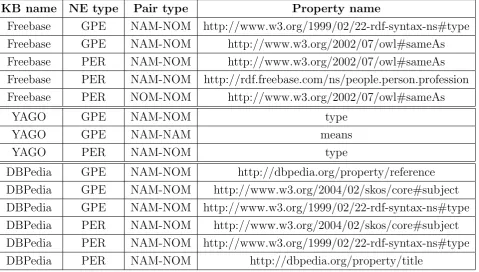
4.1 Feature examples . . . 60
4.2 Feature examples . . . 60
4.3 Selected features . . . 67
4.4 MUC scores for GPE and PER NE types, ACE-SUBSET-2 document set . . . 69
4.5 MUC scores for GPE and PER NE types, ACE-SUBSET-3 document set . . . 69
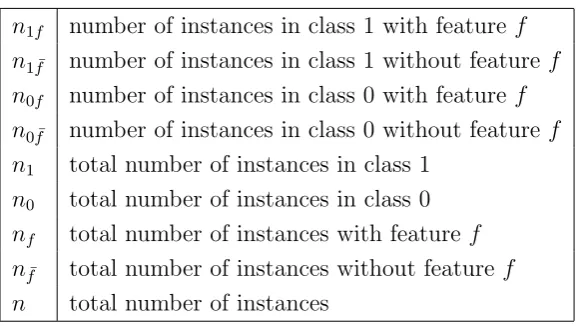
5.1 Notation . . . 80
5.2 Coverage . . . 85
5.3 TWM performance (in %) . . . 85
5.4 Results of manual analysis of mappings produced by the framework . . . 86
5.5 Overall performance on the test set, macro-average over all
relation excluding “other”. † indicates significant differences (p < 0.05). Significance tests are computed using
approxi-mate randomization procedure. . . 89
5.6 Performance in 10-fold cross-validation on the training set,
macro-average over all relations excluding “other” . . . 90
5.7 Per-relation performance on the test set in terms of F1
mea-sure. Value in parentheses in the SL+WordNetAll column corresponds to the relative improvement as compared toSL. Value in parentheses in the SL+WordNetAll+OpenCycAll
column corresponds to the relative improvement as
com-pared to SL+WordNetAll . . . 90
6.1 Relations of interest from NDF-RT . . . 97
6.2 Baseline system performance. . . 103
6.3 Performance of best feature sets per relation on test
in-stances covered by a specific feature set. R and F1 for the
same feature set on the full data set are reported in
paren-theses (P remains the same under both conditions). . . . 104
6.4 Performance of ensemble and STCUI baseline systems.
Over-all is obtained by macro-averaging over results for individual
relations. . . 109
6.5 Distance Supervision - Using STCUI . . . 111
List of Figures
2.1 The Semantic Web Stack . . . 15
2.2 Part of DBpedia RDF graph describing Douglas Adams . . 18
2.3 Part of the LOD cloud . . . 24
3.1 Overall schema of extracting LOD knowledge and converting
it to NLP features. . . 32
7.1 The ratio between the number of acquired and existing
la-beled examples. . . 124
7.2 The performance comparison between the different
disam-biguation models: (a) in page label propagation procedure,
(b) in-category label propagation procedure. Ace Y
corre-sponds to the accuracy; ace X correcorre-sponds to the fraction of
labeled training data used for the propagation propagation
procedure. . . 127
Chapter 1
Introduction
1.1
The context
Natural language processing (NLP) field is concerned with developing
au-tomatic systems capable of “understanding” natural human language, e.g.
answering questions or converting human language into structured
com-mands.
State-of-the-art approaches to NLP tasks are based on machine
learn-ing. The two key aspects of NLP applications based on machine learning
techniques are the learning algorithm and the feature representation of the
documents, entities, or words that have to be manipulated. Both aspects
are important. Reviewing the relevant literature of the last years, one
re-alizes that, on the one hand, the difference between the results obtained
by different learning algorithms (e.g., support vector machines vs. decision
trees) is statistically significant when they are fed with the same
informa-tion. On the other hand, feature extraction and representation methods
also play a crucial role for the accuracy of the system. For example, in
rela-tion extracrela-tion approaches that exploit deep syntactic parsing outperform
the ones that use only shallow syntactic analysis.
The majority of NLP features encode properties and relations of words
in text in consideration, e.g. bag-of-words, syntactic information such as
2 CHAPTER 1. INTRODUCTION
part-of-speech tags, syntactic constituency information or grammar
depen-dency relations. However, in many works it has been shown that
perfor-mance of NLP algorithms considerably improves when one employs features
encoding implicit or background knowledgeabout concepts or individu-als mentioned in a text [Ponzetto and Strube, 2006, Chan and Roth, 2010, Soon et al., 2001, Zhou et al., 2005]. For example, consider the sentence:
“Towel Day: Douglas Adams Fans Celebrate Late Hitchhikers Guide To The Galaxy Author.”1
Here knowledge that “Douglas Adams” is a noun phrase, “fans” is a
pos-session modifier of “Adams” is knowledge about words and text, while
knowledge that “Douglas Adams” is a writer and writer is an author is
background knowledge about an individual referred to as “Douglas Adams”
and a concept referred to as “writer”.
After reading the sentence, a human not familiar with the subject would
not understand that the mentions [Douglas Adams] and the [“Hitchhikers Guide to The Galaxy” author] refer to the same entity. Similarly, a state-of-the-art coreference resolution system2 might not detect that the mentions are coreferent. Intuitively, background knowledge that Douglas Adams
is an author (or even more specific knowledge that he is the author of
the book called “Hitchhikers Guide to The Galaxy”) can help a human
reader and even more so an automatic system to resolve the coreference.
While humans can query the World Wide Web for the unfamiliar names,
automatic systems need structured data. Such data can be obtained from
external structured sources such as knowledge bases.
1From
http://www.inquisitr.com/242961/towel-day-douglas-adams-fans-celebrate-late-hitchhikers-guide-to-the-galaxy-author/\#G7m0bVp0ftR1w47W.99
2We processed the sentence with the online version of the Stanford CoreNLP toolkit:
http://nlp.
1.2. THE PROBLEM 3
1.2
The problem
So far,3 background knowledge extracted from knowledge bases has been restricted to WordNet [Fellbaum et al., 1998], ad-hoc gazetteers and, more
recently, Wikipedia. Problems typically encountered were the low coverage
of the available knowledge resources and the difficulty to match text and
ontology elements. Recently, Wikipedia4 became a partial solution for the problem of coverage [Ponzetto and Strube, 2006], however, it lacks formal
ontological structure.
Nowadays, the Semantic Web made available a large amount of logically
encoded information (e.g., ontologies, RDF(S)-encoded knowledge bases,
etc.) called Linked Open Data (LOD) which constitute a valuable source
of semantic knowledge. However, extending the state-of-the-art NLP
ap-plications to use these resources is not a trivial task due to the following
reasons:
1. The ambiguity of natural human language. Semantic Web knowledge is concept-level, hence different meanings of an ambiguous word may
refer to different concepts.
2. The heterogeneity and the ambiguity of the schemes adopted by the different resources of the Semantic Web. This means, e.g., that the
same relation can be encoded by different unique resource identifiers
(URIs).
These issues define our research directions.
4 CHAPTER 1. INTRODUCTION
1.3
The solution
In this thesis we define a general framework for supporting natural language
processing with background knowledge available in the LOD and propose
practical solutions for the aforementioned problems. The framework can
be described as follows.
First, we map terms in text to the Semantic Web concepts’ URIs through Wikipedia mediation. We benefit from the fact that most of the resources
available in the LOD are aligned with Wikipedia on concept level, so it
can be used as a semantic mediator. Therefore, we propose to link text to Wikipedia articles and then to exploit the linking between Wikipedia and
the other resources to access the knowledge encoded in them. Wikipedia
represents a practical choice as it is playing a central role in the
develop-ment of the Semantic Web. The large and growing number of resources
linked to it makes Wikipedia one of the central interlinking hubs of the
Linked Open Data.
Second, we query the LOD using the URIs to obtain the background knowledge expressed in the RDF/OWL formalism. We select relevant
knowledge manually or apply feature selection techniques to retrieve
knowl-edge relevant for a specific task.
Finally, we integrate the obtained knowledge as features into machine learning algorithms.
1.4
Contributions
The contribution of this thesis is the idea of the general framework for
using semantic features extracted from background knowledge from LOD
resources in NLP tasks and recommendations for its implementation. We
1.4. CONTRIBUTIONS 5
nominal and named entity mentions (see Section 1.4.1); semantic relation
extraction between pairs of nominals (see Section 1.4.2) and relation mining
between biomedical entities such as drugs and diseases (see Section 1.4.3).
Finally, we have developed a Java tool for extracting LOD knowledge
through SPARQL endpoints, storing the knowledge locally, and extracting
semantic features from the local knowledge repository. We plan to release
this tool as an open-source.
Subsections below list our contributions in specific case studies.
1.4.1 Coreference resolution
We combine semantic information available in LOD with statistical
meth-ods for the coreference resolution task, using Wikipedia as a semantic
me-diator between text and LOD. LOD sources are represented by YAGO,
Freebase and DBpedia, while the machine learning method employed is
MLN, that is Markov Logic Networks. The results show that background
knowledge helps to increase the overall MUC F1 measure due to the
in-crease in recall. This work has led to the following publications:
• Volha Bryl, Claudio Giuliano, Luciano Serafini,Kateryna Tymoshenko. “Using Background Knowledge to Support Coreference Resolution.”
In Proceedings of 19th European Conference on Artificial Intelligence (ECAI 2010), pp. 759–764, Lisbon, Portugal, 2010.
• Volha Bryl, Claudio Giuliano, Luciano Serafini,Kateryna Tymoshenko. “Supporting Natural Language Processing with Background
Knowl-edge: Coreference Resolution Case.” In Proceedings of the 9th Inter-national Semantic Web Conference (ISWC2010), Shanghai, China, 2010.
• Luisa Bentivogli, Claudio Giuliano, Pamela Forner, Alessandro Marchetti,
6 CHAPTER 1. INTRODUCTION
ACE 2005 Corpus Annotation with Ground-truth Links to Wikipedia.”
In Proceedings of the 2nd Workshop on The Peoples Web Meets NLP: Collaboratively Constructed Semantic Resources, Coling 2010., pp. 19–27, Beijing, China, 2010.
This work has contributed to the collaboration resulting in the following
publications (which are not included into the thesis):
• Olga Uryupina, Massimo Poesio, Claudio Giuliano, Kateryna Ty-moshenko. “Disambiguation and Filtering Methods in Using Web Knowledge for Coreference Resolution”. In Proceedings of 24th Inter-national FLAIRS Conference, pp. 317–322, Florida, USA, 2011.
• Olga Uryupina, Massimo Poesio, Claudio Giuliano, Kateryna Ty-moshenko, “Disambiguation and Filtering Methods in Using Web Knowledge for Coreference Resolution”, in Chutima Boonthum-Denecke , Philip M. McCarthy, Travis Lamkin (eds.), Cross-Disciplinary Ad-vances in Applied Natural Language Processing: Issues and Approaches,
Hershey, IGI Global , 2011, pp. 185 – 201
1.4.2 Semantic relation extraction between nominals.
We have shown how semantic relation extraction between nominals can be
improved by combining background knowledge with shallow syntactic
pro-cessing. Background knowledge is obtained from WordNet, OpenCyc and
YAGO. We use kernels measuring similarity of pairs of nominals within a
context in terms of shallow syntactic features and define new kernels
op-erating upon semantic properties of the nominals. The approach is shown
to be state-of-the-art ranking 2nd in the Task 8, “Semantic relation
be-tween pairs of common nominals”, during the SemEval 2010 evaluation
campaign.
1.4. CONTRIBUTIONS 7
• Kateryna Tymoshenko and Claudio Giuliano. “FBK-IRST: Se-mantic Relation Extraction Using Cyc.” In Proceedings of the 5th In-ternational Workshop on Semantic Evaluation (SemEval-2010), pp. 214–217, Uppsala, Sweden, 2010.
1.4.3 Relation mining in the biomedical domain
In this work5 we have explored the use of semantic information from back-ground knowledge sources for the task of relation mining between medical
entities such as diseases, drugs, and their functional effects/actions. When
conducting this research we have discovered that the biomedical resources
currently available on LOD have limited coverage for our medical entities
of interest due to the proprietary nature of the data in the domain.
Therefore, in this research direction we have deviated from the first
two steps of the framework, and employed alternative ways of extracting
knowledge. We extract features from Wikipedia and specialized
biomed-ical resources, including UMLS Semantic Network, MEDCIN, MeSH and
SNOMED CT. Given that the resources might have different coverage, we
propose a two-step approach. First, we learn multiple classifiers
combin-ing features from different resources, and correspondcombin-ingly havcombin-ing different
amount of semantic knowledge/coverage balance. Then we combine the
predictions of the individual classifiers by means of an ensemble classifier.
We show than in contrast to the general domain, semantic features can be
highly discriminative, even in absence of syntactic evidences.
This work has led to the following publication:
• Kateryna Tymoshenko, Swapna Somasundaran, Vinodkumar Prab-hakaran, Vinay Shet. “Relation Mining in the Biomedical Domain
5The author conducted this study while she was at Siemens Corporate Research, Princeton, New
8 CHAPTER 1. INTRODUCTION
using Entity-level Semantics.” Proceedings of the 20th European Con-ference on Artificial Intelligence (ECAI 2012), Montpellier, France, 2012.
1.4.4 Improving text-to-Wikipedia mapping by expanding in-ternal link annotations in Wikipedia pages
In our framework Wikipedia is a mediator between text and background
knowledge, therefore the quality of linking text to Wikipedia articles
con-stitutes an important factor in its overall performance. The last part of
the thesis is concerned with improving the accuracy of this linking.
We annotate text with links to Wikipedia using a supervised
Wikipedia-based word sense disambiguation system. It is trained on the labeled
data automatically extracted from the Wikipedia internal link annotations.
However, the distribution of the data is highly skewed, e.g., rare senses
of-ten have a lot of examples, while more frequent ones are sometimes absent.
We propose an approach based on applying the one sense per discourse
hypothesis to Wikipedia pages and categories in order to automatically
expand Wikipedia annotations. Experiments show that the hypothesis is
generally correct within Wikipedia allowing us to improve disambiguation
accuracy on a benchmark data set.
1.5
Structure of the thesis
The remainder of the thesis is structured as follows:
Chapter 2 introduces the idea and the principles of Linked Open Data (LOD), major LOD resources relevant for the further chapters, major
techniques of handling RDF data from LOD.
1.5. STRUCTURE OF THE THESIS 9
namely the approach that we employ to map plain text to Wikipedia
and technical aspects of extracting LOD knowledge by the mediation
of the Wikipedia links.
Chapter 4 describes the application of the framework to the task of coref-erence resolution.
Chapter 5 describes application of the framework to the task of semantic relation extraction between nominals.
Chapter 6 describes usage of background knowledge in the task of biomed-ical relation mining.
Chapter 7 describes our methodology for increasing the amount of train-ing data for a Wikipedia-based word sense disambiguation system.
Chapter 8 draws the conclusions.
Given that this thesis is cross-task and cross-domain, we do not have
a single state-of-the-art chapter. Instead, in each chapter we propose an
Chapter 2
Introduction to Linked Open Data
This chapter aims to give introduction to Linked Open Data (LOD).
2.1
Introduction
Linked Data is a paradigm under which structured data are published
on the Web by different data providers who use standard formats and
vocabularies. Similarly to the HTML web-documents, these data can be
dereferenced by means of HTTP protocol, and datasets provided by the
dif-ferent data contributors are interlinked. Thus Linked Data can be viewed
as a global data space, a web of data, organized similarly to the web of
documents, but in the contrast to the latter destined to be used by the
automatic agents. Freely available Linked Data datasets constitute the
Linked Open Data (LOD).
In this chapter we aim to provide the general introduction to LOD,
in-cluding its origins (Section 2.2), main principles (Section 2.3), terminology
and mechanisms (Section 2.4), core datasets and vocabularies (Section 2.5).
12 CHAPTER 2. INTRODUCTION TO LINKED OPEN DATA
2.2
Origins of the LOD
The origins of LOD trace back to 2001. At that time World Wide Web
(WWW) was a web of text documents interconnected by means of untyped
hyperlinks. It did contain structured data as well, but they were published
in multiple different formats, e.g. CSV, XML documents or HTML tables.
Some services, like Amazon, provided APIs that sent structured data
en-coded in a micro-format in a response to a structured query. However,
formats of documents or API queries and responses varied from provider
to provider. The other problem was different semantics of the structured
sources, e.g. two fields named “Address” in two different databases do
not necessarily contain the same data. For example, one database could
contain geographic coordinates, while another listed human readable post
addresses. Format heterogeneity and absence of semantics made the task
of automatic accessing and processing structured data challenging as each
data source had to be processed separately, with its data format and
se-mantics taken into account.
Let us describe what this means in our specific use case of enriching
plain-text documents with background semantic knowledge. Consider the
following snippet:
“Towel Day: [Douglas Adams]EM1 Fans Celebrate Late
[‘Hitch-hikers Guide To The Galaxy’]EM3 [Author]EM2”1.
Intuitively, knowledge that Douglas Adams is a writer (along with syn-tactic and contextual information) might be helpful to establish that EM1
and EM2 refer to the same entity. Knowing that EM3 is a book would be a helpful feature to extract the fact
(DouglasAdams,authorOf,Hitchhikers-1From
2.2. ORIGINS OF THE LOD 13
GuideToTheGalaxy). Back in 2001, in order to enrich text with such knowl-edge one would have to use multiple tools and resources. Gazetteer of
names (GZN) or a NER tool (NERT) would provide intuition that
Dou-glas Adams is a person; navigating the WordNet (WN) lexical database
would help to understand that “author” is a hyponym of a “person”.
Alter-natively API of a bookstore (API) could provide information that Douglas
Adams is an author. NERT or an API would give intuition that the EM3
as an artifact or a book.
A set of problems may arise when obtaining the information from the
above-mentioned resources. First, GZN, NERT, WN, API would require
different software to extract this kind of knowledge because of their
differ-ent data formats and access mechanisms. Second, we would need to study
the semantics of each source in detail in order to understand which data
from it are useful, and what do specific fields (or labels in case of NERT)
mean.
Finally, in case of GZN, WN and API we would have to solve the
prob-lem of ambiguity and lack of coverage. For example, there are other famous
people called Douglas Adams, including an English professor2 and a music journalist.3 Moreover, there is also a Douglas township in Adams County, in Iowa.4 Gazetteer of geographical names might contain the latter, and thus we are likely to wrongly assume that EM1 is a location. WN does not know any Douglas Adams, but it has four possible meanings for the
surname Adams. Finally, even if we manage to find a reference to Douglas Adams in a bookstore, we are not guaranteed that he is not a namesake
of the Adams mentioned in the text. We could try to solve the ambiguity
problem by building word sense disambiguation (WSD) systems. However,
since all the above-mentioned background knowledge sources have different
2http://en.wikipedia.org/wiki/Douglas_Q._Adams
3http://en.wikipedia.org/wiki/Doug_Adams_(music_journalist)
14 CHAPTER 2. INTRODUCTION TO LINKED OPEN DATA
sense inventories and different structures, we would need to create a WSD
system for each knowledge source separately.
In 2001 Tim Berners-Lee formalized the limitations of the WWW of
those days in the perspective of automatic processing: it was intended
mostly for human use or for the use by very specialized agents [Berners-Lee
et al., 2001]. He proposed an idea of extending the WWW with
machine-readable data, published in a decentralized fashion by independent data
providers, and inference mechanisms on the top of these data. Berners-Lee
et al. [2001] provided a use-case of an automatic agent, scheduling a visit to
a doctor for the mother of a hypothetic user. In order to deliver a solution
the agent would need to retrieve, understand and analyze the schedules
of the doctor and the user, to take into account the distance from the
user’s home to the doctor’s office. This can be achieved by using standard
approaches to describing knowledge (e.g. Resource Description Framework
(RDF) (see Section 2.4.1)), standard data formats, unambiguous identifiers
for things and ontologies describing the world in a standardized language.
By 2006, the e-science communities accepted the idea and created a
number of new ontologies [Shadbolt et al., 2006]. At the same time a
set of organizations, including World Wide Web Consortium (W3C),
de-vised the Web Ontology Language (OWL) to describe the complex
mod-els, RDFS (Resource Description Framework Schema) to describe simpler
things, and various reasoners and rule exchange formats to support the
inference. Triple stores permitted to store and index RDF data, and
SPARQL query language was designed to extract information on demand.
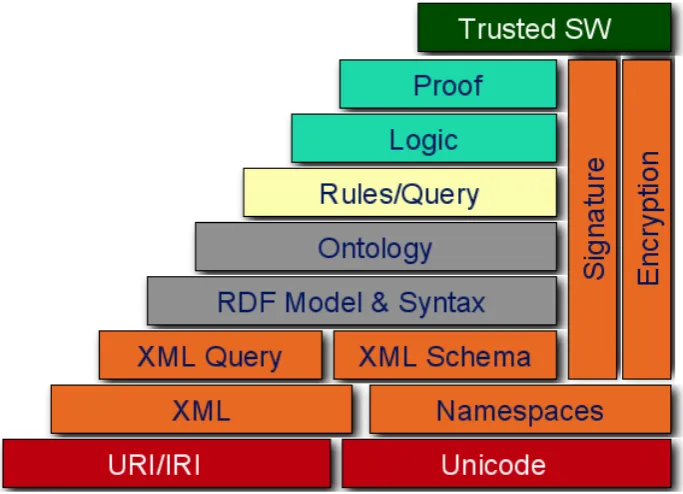
Figure 2.15 demonstrates how these components are integrated into the global view of the Semantic Web (SW) architecture. However, despite the
technological advances of SW, Shadbolt et al. [2006] stressed that the
se-mantic web technologies lacked “real viral uptake” and the “data exposure
2.2. ORIGINS OF THE LOD 15
Figure 2.1: The Semantic Web Stack
revolution had not yet happened.”
In the same year, the online document by Berners-Lee [2006] noted that
SW is also about linking data to each other. Berners-Lee [2006] published a
set of principles to be observed by the data contributors to SW. Data
pub-lished under observance of these principles constitute the so-called Linked
Data (LD). Linked data published under an open license are called Linked
Open Data (LOD). In his presentations he stated that Linked Data is “the
Semantic Web done right”.6
According to the official document published by W3C “Linked Data lies at the heart of what Semantic Web is all about: large scale integration of, and reasoning on, data on the Web.”7 Nowadays, SW is called also the Web of Data, as the name “Semantic Web” is often considered difficult to
16 CHAPTER 2. INTRODUCTION TO LINKED OPEN DATA
understand and misleading.
In the following subsections we will consider the mechanisms behind the
LD in more detail and overview some of the LOD resources.
2.3
LOD principles
Berners-Lee [2006] introduced the concept of the Linked Data (LD). It is
the web of structured descriptions of “things” interconnected by links. He
listed the main principles to be observed by the LD publishers.8 1. Use URIs as names for things.
2. Use HTTP URIs so that people can look up those names.
3. When someone looks up a URI, provide useful information, using the
standards (RDF*, SPARQL).
4. Include links to other URIs. so that they can discover more things.
The first principle means that each data publisher must give a unique
name, called a Unique Resource Identifier (URI), to each “thing” from
his/her dataset. The second principle suggests that given a URI a user or
a machine must be enabled to retrieve the corresponding resource by means
of the HTTP protocol. Naturally, if the resource is a physical thing it
can-not be transmitted by HTTP, but it is possible to transmit the description
of this thing. Heath and Bizer [2011] describe the technical details in their
book.
Let us consider the principles in detail using our example from the
previous section. For convenience we repeat it here:
2.3. LOD PRINCIPLES 17
“Towel Day: [Douglas Adams]EM1 Fans Celebrate Late
[Hitch-hikers Guide To The Galaxy]EM3 [Author]EM2”9.
URIs for EM1, EM2, EM3 taken from DBpedia (one of the core resources in
the LOD, see Section 2.5.2) arehttp://dbpedia.org/resource/Douglas_ Adams,http://dbpedia.org/resource/The_Hitchhiker’s_Guide_to_the_ Galaxyandhttp://dbpedia.org/resource/Author. Note that the writer’s namesakes have different URIs, e.g. http://dbpedia.org/resource/Douglas_ Q._Adams for the English professor and http://dbpedia.org/resource/ Doug_Adams_(music_journalist) for the music journalist. If one pastes these links into the address line of a browser he or she will retrieve the
descriptions of the corresponding “things”.
Principle 3 means that if one dereferences the URI he or she should be
provided with information considered useful by the data publisher. The
information will be encoded in the Resource Description Framework (RDF)
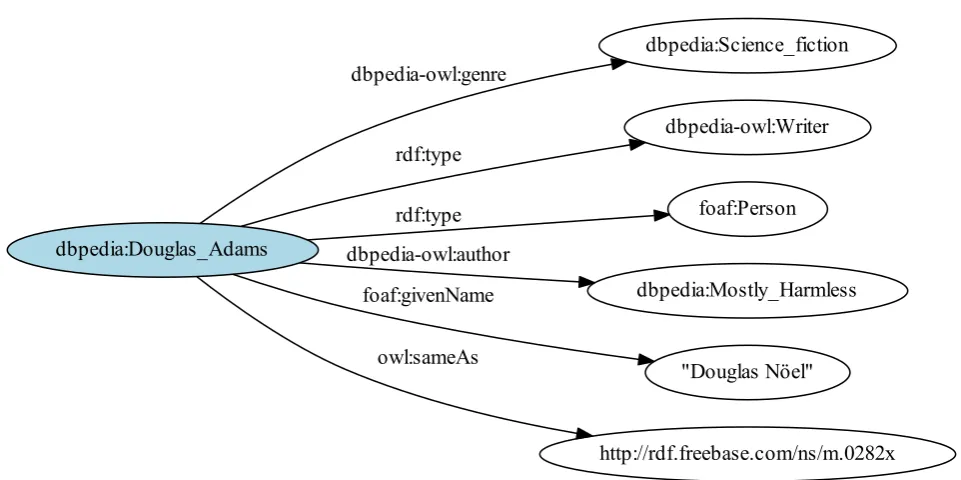
formalism (see Section 2.4.1). For example, when dereferencing http: //dbpedia.org/resource/Douglas_Adams we obtain information about the type of the entity, genres he worked in, list of his books, his full given
name and other kinds of information. Figure 2.2 shows a subgraph of
useful information about the writer, available in DBpedia. In the context
of our example this information is the background knowledge we require
to extract NLP features.
Finally, the last principle means that the data providers should link
their URIs to URIs in the other datasets. For instance, in the Figure 2.2
the rdf:type link connects the Adams’ URI to the foaf:Person. The latter is a URI corresponding to the abstract notion of a person in theThe Friend of a Friend (FOAF) ontology, that is independent from DBpedia. Therefore, among other things, linking allows datasets and applications
9From
18 CHAPTER 2. INTRODUCTION TO LINKED OPEN DATA
dbpedia:Douglas_Adams
dbpedia:Science_fiction dbpedia-owl:genre
dbpedia-owl:Writer rdf:type
foaf:Person rdf:type
dbpedia:Mostly_Harmless dbpedia-owl:author
"Douglas Nöel" foaf:givenName
http://rdf.freebase.com/ns/m.0282x owl:sameAs
Figure 2.2: Part of DBpedia RDF graph describing Douglas Adams
to use common vocabularies for the high-level concepts, e.g. person or
location.
One of the most important links is the owl:sameAs link. Typically, different LOD datasets have different URIs (and correspondingly
differ-ent descriptions) for the same thing. For example, Freebase (large-scale
database collaboratively constructed by the users, see Section 2.5.4) URI
for the writer Douglas Adams is http://rdf.freebase.com/ns/m.0282x. In Figure 2.2 owl:sameAs link connects the DBpedia URI to the Freebase URI. We can dereference the Freebase URI and retrieve the alternative
description of the writer from Freebase. owl:sameAs links are the LOD “glue”. Using them we can navigate between datasets published by
2.4. CONSUMING LINKED OPEN DATA 19
Subject Predicate Object
dbpedia:Douglas_Adams rdf:type dbpedia-owl:Writer
dbpedia:Douglas_Adams foaf:givenName “Douglas Noel”
Table 2.1: RDF statements examples
2.4
Consuming Linked Open Data
In this section we will briefly describe the RDF data format and the
con-ventional ways to get access to LOD.
2.4.1 Resource Description Framework
Resource Description Framework (RDF)10 is a model for describing data. In RDF data are described as a set of statements consisting ofsubject, pred-icate and object. A predicate describes a directed relationship between a subject and an object. All three may be identifiers, i.e. URIs, of the other
resources. Objects may also be typed literals, e.g. integers, strings, and
plain (untyped) literals. Subjects and objects may be blank literals
typi-cally needed for technical purposes, e.g. for encoding complex attributes.
We provide some examples of RDF statements in Table 2.1. Note that
predicates are resources, and may be dereferenced in order to obtain their
description. Alternatively, one can regard an RDF description as a directed
graph where predicates are directed labeled edges which connect subject
and object nodes. Figure 2.2 shows an example of such graph.
Currently, there exists a number of standard RDF serializations
un-derstood by the main Semantic Web processing engines. They include
RDF/XML11 serialization, Turtle,12 N-Triples.13 10http://www.w3.org/RDF/
20 CHAPTER 2. INTRODUCTION TO LINKED OPEN DATA
2.4.2 Accessing LOD data
In order to use the LOD datasets we can download them locally. However,
in many cases this is excessive, because the datasets might be large, and
we might need only a subset of knowledge, e.g. information about few
“things”. [Heath and Bizer, 2011] in Section 6.3 of their book summarize
the major patterns used to obtain a subset of relevant data from LOD as
follows:
1. Crawling. Obtain data by consequentially dereferencing URIs (e.g. LDSpider [Isele et al., 2010]). This is similar to browsing WWW by
following hyperlinks. In case of LOD this means dereferencing a URI,
examining the obtained RDF statements, and then dereferencing other
components of these statements if needed.
2. Dereferencing on-fly. Run complex queries on LOD, by dereferenc-ing multiple URIs on-fly and on-demand, e.g. [Hartig et al., 2009].
3. Query federation. Sending queries to multiple public SPARQL (see Section 2.4.3) endpoints.
2.4.3 SPARQL query language
SPARQL (SPARQL Protocol and RDF Query Language)14 is a query lan-guage designed for querying RDF graphs.
A SPARQL query is a graph pattern. The simplest example of a graph
pattern is the basic graph pattern (BGP). BGP can be regarded as a set of RDF statements or an RDF graph in which some elements are uninitialized
variables.
The following is an example of a query against the DBpedia graph:
2.4. CONSUMING LINKED OPEN DATA 21
PREFIX rdf : <http://www.w3.org/1999/02/22-rdf-syntax-ns#> SELECT distinct ?type
FROM <http://dbpedia.org> where {
<http://dbpedia.org/resource/Douglas_Adams> rdf:type ?type }
Here keyword “PREFIX” specifies a shorthand for the frequently used
parts of URIs designed to make queries more readable. “FROM” is an
optional keyword which specifies the name of the RDF graph in a repository
on which the query should be resolved. ?type is the variable that should be bound to concrete values in a resolved query.
Resolving a SPARQL query against an RDF graph, means finding
sub-graphs of this graph that match the graph pattern expressed by the query.
For example, one of the DBpedia (see Section 2.5.2) subgraphs matching
the query above would be the triple
(dbpedia:Douglas_Adams, rdf:type, dbpedia-owl:Writer).
Here variable ?type is bound to the URI dbpedia-owl:Writer.
Remote RDF graphs can be queried through SPARQL endpoints. A
SPARQL endpoint “is a conformant SPARQL protocol service as defined in the SPROT15 specification.”16 Many large-scale knowledge stores have publicly available SPARQL endpoints. For example, the SPARQL
end-point of one of the core LOD datasets, DBpedia, can be accessed at
http://dbpedia.org/sparql/. Lately, OpenLink Software17 made avail-able the OpenLink Software LOD Cache18 mirroring a number of LOD resources, e.g. YAGO, OpenCyc and WordNet (see Section 2.5) .
15SPROT stands for SPARQL Protocol for RDF ( http://www.w3.org/TR/rdf-sparql-protocol/) 16http://semanticweb.org/wiki/SPARQL_endpoint
22 CHAPTER 2. INTRODUCTION TO LINKED OPEN DATA
2.4.4 Processing RDF data
A number of tools allows to operate the RDF data. Two of the most
popular tools are the Java-based Apache Jena Framework19 and Sesame Framework.20 They provide utilities for creating and modifying various data models, including RDFS and OWL (see Section 2.5.1), performing
inference on them, performing SPARQL queries on both local and remote
resources.
We can store RDF data locally in several ways. First, data can be
stored as RDF files and uploaded directly into the RAM to be processed.
However, if the data are large-scale it is more reasonable to store them
in an index called a triple store. Triple stores allow to store and quickly access the large-scale data. They may have their own storage mechanism
implementation, e.g. Jena TDB,21 Virtuoso,22 AllegroGraph,23 Sesame,24 or use a third party storage implementation, e.g. a common relational
database management system. For example, Jena SDB25 uses SQL.
2.5
Overview of the LOD content
Currently, the amount of Linked Data grows rapidly. Contributors to
the W3C Linking Open community project26 are concerned with making their datasets available in RDF format and connecting them to the other
datasets in compliance with the LOD principles. Current state of LOD is
19
http://jena.apache.org/
20
http://www.openrdf.org/
21
http://jena.apache.org/documentation/tdb/index.html
22
http://virtuoso.openlinksw.com/
23
http://www.franz.com/agraph/allegrograph/
24
http://www.openrdf.org/
25
http://jena.apache.org/documentation/sdb/index.html
26
2.5. OVERVIEW OF THE LOD CONTENT 23
Domain Datasets Triples % (Out-)Links %
Media 25 1,841,852,061 5.82% 50,440,705 10.01%
Geographic 31 6,145,532,484 19.43% 35,812,328 7.11%
Government 49 13,315,009,400 42.09% 19,343,519 3.84%
Publications 87 2,950,720,693 9.33% 139,925,218 27.76%
Cross-domain 41 4,184,635,715 13.23% 63,183,065 12.54%
Life sciences 41 3,036,336,004 9.60% 191,844,090 38.06%
User-generated content 20 134,127,413 0.42% 3,449,143 0.68%
295 31,634,213,770 503,998,829
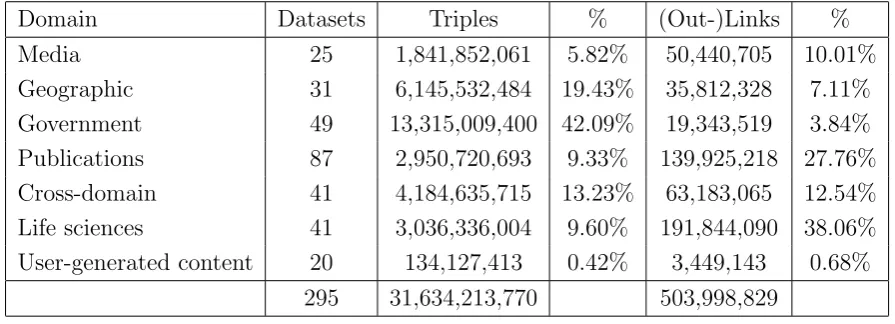
Table 2.2: Linked Data by domain
visualized in the so-called Linking Open Data cloud diagram.27 Figure 2.3 shows a part of the diagram.28 Here bubbles correspond to the datasets, and edges correspond to the links between datasets. Additionally, the
datasets available under Linked Open Data are catalogized on the Data Hub website.29
The LOD datasets may be cross-domain or belong to a specific domain,
e.g. media, geography, life sciences. Table 2.230 shows the state of the LOD by 19/09/2011. In the following subsections we describe the most
important vocabularies employed in LOD and the largest cross-domain
datasets.
2.5.1 Frequently used data models
A vocabulary defines concepts and relationships, called terms, to be used to organize and describe knowledge [voc, 2012]. Below we provide brief
descriptions of the vocabularies (also referred to as ontologies) widely
ac-27
http://richard.cyganiak.de/2007/10/lod/imagemap.html
28We could not include the entire cloud due to its large size. The original figure is available at
http:
//richard.cyganiak.de/2007/10/lod/lod-datasets_2011-09-19_colored.png
29http://thedatahub.org/group/lodcloud
24 CHAPTER 2. INTRODUCTION TO LINKED OPEN DATA
Figure 2.3: Part of the LOD cloud
cepted in the LOD community.
RDFS. Resource Description Framework Schema (RDFS)31 is a basic shallow vocabulary. It contains basic elements for definition of other
vo-cabularies. For example, in includes predicate rdf:type, used to indicate that a given instance is member of a class, and rdfs:subClassOf, used to describe the class taxonomy. Another widely exploited predicate is
rdfs:label used to describe a human readable name of a resource.
OWL. Web ontology language or OWL32 is a language for describing the data with maximum expressiveness. It is available in three versions, OWL
Lite, OWL DL and OWL Full, listed in the order of their expressiveness.
Inter alia, OWL provides inventory for describing classes and properties,
defining new classes on tops of existing ones, expressing relations of
equiv-alence and non-equivequiv-alence. The most important term of this vocabulary
2.5. OVERVIEW OF THE LOD CONTENT 25
for our purposes isowl:sameAs that interlinks two individuals or concepts.
SKOS. Simple Knowledge Organization System or SKOS33 is a vocab-ulary for the knowledge organization systems such as nomenclatures or
libraries. Its basic unit is a concept, skos:Concept. SKOS provides inventory to organize concepts into schemes, connect them by semantic
relations, e.g. skos:broader or skos:narrower, record their preferred,
skos:prefLabel, and alternative labels, skos:altLabel, and other utili-ties.
Naturally, most of the resources define their specialized vocabularies for
describing more specific things, however, many of them use the vocabularies
listed above.
2.5.2 DBpedia
DBpedia [Bizer et al., 2009] is a large-scale knowledge base
automati-cally extracted from Wikipedia. Wikipedia pages are included to
DB-pedia as “things”. A “thing” is assigned to a unique URI created by
adding Wikipedia page name to the DBpedia prefix “http://dbpedia. org/resource/.” For instance, Wikipedia page about Douglas Adams,
http://en.wikipedia.org/wiki/Douglas_Adams, is used to create a DB-pedia URI, namelyhttp://dbpedia.org/resource/Douglas_Adams. Ev-idently, this means that given a Wikipedia page name we can easily convert
it into DBpedia URI.
The core DBpedia content is created by converting Wikipedia infoboxes
to RDF triples. DBpedia URI corresponding to a page with an infobox
serves as a subject of a triple. Predicates and objects are obtained by
means of generic or mapping-based extraction. Generic extraction con-verts names of infobox attributes into URIs of properties by adding the
26 CHAPTER 2. INTRODUCTION TO LINKED OPEN DATA
http://dbpedia.org/property to their names. Corresponding values of attributes are converted into objects. Their types (e.g., literal, typed
lit-eral or URI) are defined heuristically. The main problem here is that the
Wikipedia infobox attribute names do not use the same vocabulary, and
this results in multiple properties having the same meaning but different
names and vice versa. In order to do the mapping-based extraction Bizer et al. [2009] organize the infobox templates into a hierarchy, thus creating
the DBpedia ontology with infobox templates as classes. They manually
construct a set of property and object extraction rules based on the
in-fobox class. This classification is more consistent as compared to the one
obtained by means of generic extraction, however it has smaller coverage.
Other kinds of Wikipedia markup contributed to the DBpedia content
as well. For example, values of therdfs:labelproperty are extracted from the human-readable representations of the Wikipedia page names, and
first paragraphs of articles become the values of the dbpedia:abstract34
property. Wikipedia category taxonomy is represented in DBpedia in
terms of SKOS vocabulary with each Wikipedia category regarded as a
SKOS concept. DBpedia “things” are then connected to the corresponding
categories by means of the http://purl.org/dc/elements/1.1/subject
predicate.35 In addition to Wikipedia category information and DBpedia ontology classes, each “thing” is also classified in terms of YAGO
cate-gories (combination of Wikipedia catecate-gories with WordNet taxonomy, see
Section 2.5.3) and UMBEL36, a lightweight ontology intended for describ-ing thdescrib-ings on web. Recently, these classifications have been extended with
the WordNet classification37 created by manually mapping infoboxes into 34
dbpedia:stands forhttp://dbpedia.org/property/
35“The topic of the resource” in terms of the Dublin Core Metadata Initiative (DCMI),
http://
dublincore.org/documents/dcmi-terms/
36http://umbel.org/
2.5. OVERVIEW OF THE LOD CONTENT 27
WordNet synsets.
As the Figure 2.3 shows, DBpedia is heavily interlinked with other
datasets. It is connected byowl:sameAslinks to at least 35 other datasets,38 including Freebase, YAGO and OpenCyc.
DBpedia can be downloaded as a dump,39 or it can be queried through a SPARQL endpoint, http://dbpedia.org/sparql/.
2.5.3 YAGO
YAGO [Suchanek et al., 2007] is an automatically created ontology. Its
taxonomy is derived from WordNet and Wikipedia, and knowledge about
individuals is extracted from Wikipedia.
The YAGO class taxonomy is created as follows. Suchanek et al. [2007]
remove individuals from the WordNet taxonomy and convert the
remain-ing data to the YAGO class system. Then they determine a subset of
Wikipedia categories which they call conceptual. These categories iden-tify entity classes, e.g. English novelists, in contrast to the other cate-gories which define topics, e.g. St John’s College, Cambridge, or are purely administrative. Conceptual categories are detected by using a heuristics
which takes into account whether the head of a category is plural. Leaf
conceptual categories are added as subclasses to the classes derived from
the WordNet taxonomy by means of a heuristic algorithm, described in
detail in [Suchanek et al., 2007]. In brief, Suchanek et al. [2007] parse the
category names and map the obtained constituents to the WordNet synsets
using the most frequent sense strategy. Pages that belong to conceptual
categories become YAGO individuals.
Non-taxonomy relations are obtained by means of a variety of heuristics.
rdfs:label relations are extracted from WordNet synonymy information 38http://wiki.dbpedia.org/Downloads38#h236-1
28 CHAPTER 2. INTRODUCTION TO LINKED OPEN DATA
and Wikipedia redirection links. Certain relations are extracted by
apply-ing patterns to the category names, e.g. if a page p belongs to category
<NN>_deaths this would result in the fact (p, diedIn, N N). More recently YAGO has been enriched with temporal and spatial dimensions [Hoffart
et al., 2012], the latter is imported from GeoNames.40 Currently, the core version of YAGO contains knowledge about 2.6 million entities and 124
million facts about them.41
The quality of YAGO has been assessed manually. Humans found a
randomly selected subset of YAGO facts to be correct in 95% of the cases.
Yago can be downloaded as a dump.42 YAGO SPARQL endpoint is hosted by OpenLink Software43 as a part of the OpenLink Software LOD Cache.44
2.5.4 Freebase
Freebase [Bollacker et al., 2008] is a collaboratively constructed database
originally developed by Metaweb and now owned by Google.45 It contains knowledge automatically extracted from a number of resources, including
Wikipedia, MusicBrainz,46 NNDB,47 Food and Drug Administration, and others.48 The knowledge is supplied by both the automated data pipelines and the human volunteers.
Freebase can be considered as a huge graph. Its nodes have types
”/type/object” and a set of narrower types. They are interconnected by
40http://www.geonames.org/
41http://www.mpi-inf.mpg.de/yago-naga/yago/downloads.html. Core version contains
informa-tion only about entities present in Wikipedia/WordNet, without informainforma-tion about inner links from Wikipedia or GeoName entities that cannot be mapped to any Wikipedia article.
42http://www.mpi-inf.mpg.de/yago-naga/yago/downloads.html 43http://www.openlinksw.com/
44http://lod.openlinksw.com/sparql
45http://googleblog.blogspot.it/2010/07/deeper-understanding-with-metaweb.html 46http://musicbrainz.org/
47http://www.nndb.com/
2.5. OVERVIEW OF THE LOD CONTENT 29
the edges corresponding to the node properties. Type of nodes define which
properties they might have. Nodes typically correspond to the Freebase
topics49 which have the similar meaning to “things” in DBpedia, i.e. they can be concepts or an individual entities. Currently Freebase describes
more than 23 million of them. Each topic is assigned a global unique
iden-tifier and a set of human-readable unique IDs, assembled of a key and a
namespace. For example, one of the namespaces is the Wikipedia
names-pace, and respective key is the name of the Wikipedia page describing the
topic. Moreover, topics are connected by means of owl:sameAs links to DBpedia.
Freebase data can be queried automatically in several ways. Its native
query language is Metaweb Query Language (MQL). One can use an API
to send automatic queries or run queries directly in the query editor.50 In 2008 Metaweb created an RDF version of Freebase, thus making it part of
the LOD cloud.51
2.5.5 WordNet
WordNet [Fellbaum et al., 1998] is a manually elaborated lexical semantic
database developed in Princeton University. It organizes knowledge about
the word meanings into a network of synsets. Synset is a collection of
syn-onyms. Synsets are interconnected by various lexical relations, including
hyperonymy, hyponymy, antonymy. Currently, WordNet is one of the most
widely used resources in NLP.
Two WordNet versions are available on LOD:WordNet (W3C), [Van As-sem et al., 2006] converted from Princeton 2.0 WordNet Prolog
distribu-49Freebase can contain also nodes that are not topics, e.g. image metadata, see
http://wiki.
freebase.com/wiki/Topicfor a complete list
30 CHAPTER 2. INTRODUCTION TO LINKED OPEN DATA
tion, and WordNet (VUA),52 an RDF verson of WordNet 3.0 created using the methodology similar to the one described in [Van Assem et al.,
2006].
2.5.6 Cyc
Cyc is a comprehensive manually constructed knowledge base developed
since 1984 by CycCorp. According to Lenat [1995] it can be considered
as an expert system with domain spanning all everyday actions and
en-tities, e.g. Fish live in water. Its development has taken more than 900 person-years [Matuszek et al., 2006]. Complete Cyc knowledge base
con-tains more than 500,000 concepts and more than 5 million assertions about
them. They may refer both to common human knowledge like food or
drinks and to specialized knowledge in domains like physics or chemistry.
A Cyc constant represents a thing or a concept in the world. It may be an
individual, e.g. BarackObama, or a collection, e.g. Gun, Screaming.
Cyc is a proprietary commercial resource, however its full content is
freely available for the research community as ResearchCyc. Originally,
the knowledge base has been formulated using CycL language. In 2008,
the open-source version of Cyc named OpenCyc,53 which contains the full Cyc ontology and a restricted number of assertions, was made freely
avail-able as a part of LOD. A number of efforts connected Cyc to the other
datasets. For example, OpenCyc concepts have been automatically linked
to Wikipedia articles by Medelyan and Legg [2008] and Sarjant et al. [2009]
with the purpose of further extending Cyc with Wikipedia knowledge such
as new synonyms and translations. In addition, OpenCyc also contains
owl:sameAs links to DBpedia, UMBEL, WordNet and other resources.
Chapter 3
The Framework Implementation
In this chapter we provide the implementation details of the LOD-based semantic feature extraction: we describe the tool that we employ to link terms to Wikipedia and provide high-level details of the LOD knowledge extraction process.
3.1
Introduction
The main focus of this thesis is to exploit the Linked Open Data (LOD)
datasets as a source of semantic knowledge in NLP, to detect the problems
and to give practical solutions. We have already defined the high-level view
of the framework for injecting semantic features to NLP in Section 1.3. In
brief, it includes the following conceptual modules: (1) mapping terms in
text to DBpedia URIs using Wikipedia as a mediator; (2) using the URIs to
extract relevant knowledge from LOD; (3) extracting task-relevant features
to be plugged into NLP engines. In this chapter we describe the practical
details of how we realized these conceptual modules when performing our
case studies.
The section is structured as follows. First, we describe the main
com-ponents of our framework implementation and their interactions in
Sec-tion 3.2. Then, in SecSec-tion 3.3, we describe The Wiki Machine (TWM), the
32 CHAPTER 3. THE FRAMEWORK IMPLEMENTATION
Figure 3.1: Overall schema of extracting LOD knowledge and converting it to NLP fea-tures.
tool which maps ambiguous terms to Wikipedia pages (module 1). Finally,
in Section 3.4 we describe the technical details of how we extracted RDF
data from LOD (module 2) and converted it into NLP semantic features
(module 3). We have implemented the RDF data extraction and the
fea-ture extraction processes in the Java tool, jlod-feature,1 which we plan to release as open-source.
3.2
Overall picture
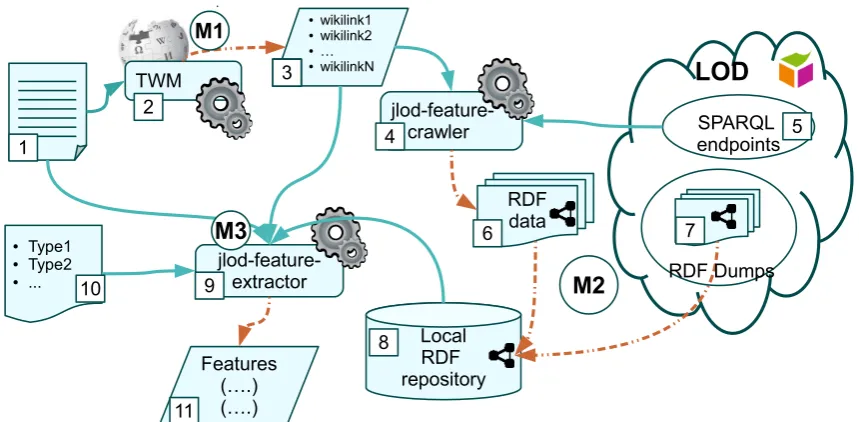
We depict the high-level view of the framework in Figure 3.1. We have
numbered the main components of the figure, and we will refer to them in
our descriptions by specifying the component number in square brackets.
Module 1 (M1). We start feature extraction by processing the original document [1] with a tool [2] which annotates plain text with Wikipedia
3.2. OVERALL PICTURE 33
links or DBpedia URIs [3] (Note that Wikipedia links are equivalent to DBpedia URIs). In our instantiation of the framework we use TWM (see
Section 3.3) as [2].
Module 2 (M2). Then we populate the local RDF repository [8] with
knowledge about URIs of interest [6,7] relevant for the NLP feature extrac-tion. Theoretically, we could avoid having alocal repository [8] and extract features on-fly, but this is time-consuming, because we have to send
multi-ple queries to remote resources that might have different response times or
can even be down for maintenance. RDF repository [8] can be populated in several ways which we describe below.
Local download. First, we can simply download the RDF dumps [7] of LOD datasets which we deem to be useful for a specific task and
upload them into a local repository. This would always be
reason-able if the dataset is not large-scale, e.g. an upper-level ontology or
a type system, or if we are releasing an NLP tool. However, if are
running some preliminary NLP experiments, it would be time- and
space-consuming to download full versions of all the potentially
rele-vant large-scale LOD datasets.
Crawling. The second way is to crawl LOD by dereferencing the URIs. If, for example, we have dereferenced a URI corresponding to a term
in a plain text and retrieved a corresponding RDF graph, we might
require some specific information about the other URIs in this graph.
Then we might have to dereference those URIs as well and lose time
for waiting for a response from a distant server. Moreover, we may
retrieve information that is abundant for our purposes since
34 CHAPTER 3. THE FRAMEWORK IMPLEMENTATION
SPARQL endpoints. Finally, we can employ SPARQL endpoints [5] to extract, when available, to extract portion of LOD knowledge relevant
for our NLP task.
In our case-studies we used the first and the last options, that is we
down-loaded some resources locally (e.g. OpenCyc), and sent SPARQL queries
to the other resources. In Section 3.4.1 we describe our SPARQL query
process. The process is implemented in the jlod-feature-crawler package [4]
of the jlod-feature tool.
Module 3 (M3). Finally, we pass the list of URIs of interest [2], a
local RDF repository [8] containing useful knowledge, the original terms of interest [1], and a list of feature types [9] that we need to extract to the feature extraction tool [10]. Our feature extraction tool is a module of jlod-feature called jlod-feature-extractor. We describe the feature types and the tool in more detail in Section 3.4.2. The output of the process is a
feature representation file [11] to be used by a machine learning algorithm.
3.3
The Wiki Machine
First step of our framework consists in annotating terms in plain text with
links to Wikipedia pages. Wikipedia, along with its structured
representa-tion DBpedia, is heavily interlinked with LOD datasets. Therefore, it can
be used for linking terms in plain text to URIs in LOD datasets.
We have used the tool called The Wiki Machine (TWM).2 TWM is a supervised kernel-based word sense disambiguation system employing local
and global context clues. The approach is summarized in the following
subsections.
3.3. THE WIKI MACHINE 35
3.3.1 Training set
Training data is automatically extracted from Wikipedia as it was first
proposed in [Cucerzan, 2007, Mihalcea, 2007]. To create the training set,
for each term of interest m, TWM collects from the English Wikipedia dump3 all contexts where m is an anchor of an internal link, where a con-text corresponds to a line of con-text in the Wikipedia dump and is represented
as a paragraph in a Wikipedia article. The set of target articles represents
the senses of m in Wikipedia and the contexts are used as labeled training examples. E.g., the proper noun Bush is a link anchor in 17,067 differ-ent contexts that point to 20 differdiffer-ent Wikipedia pages, George_W._Bush,
Bush_(band), and Dave_Bush are some examples of possible senses. The set of contexts with their corresponding senses is then used to train the
WSD system described below. E.g., the context “Alternative Rock bands from the mid-90 ’s , including Bush , Silverchair , and Sponge.” is a train-ing instance for the sense defined by the Wikipedia entry Bush_(band).
3.3.2 Learning algorithm
To disambiguate terms in text, TWM employs a kernel-based approach
originally proposed in [Giuliano et al., 2009]. Different kernel functions
are employed to integrate syntactic, semantic, and pragmatic knowledge
sources typically used in the WSD literature. Kernel methods are
theo-retically well founded in statistical learning theory and have shown good
empirical results in many applications [Shawe-Taylor and Cristianini, 2004].
Their strategy adopted consists in splitting the learning problem into two
parts. They first embed the input data in a suitable feature space, and then
use a linear algorithm (e.g., support vector machines) to discover nonlinear
patterns in the input space. The kernel function is the only task-specific
3
36 CHAPTER 3. THE FRAMEWORK IMPLEMENTATION
component of the learning algorithm. For each knowledge source a specific
kernel has been defined. By exploiting the property of kernels, basic
ker-nels are then combined to define the WSD kernel. Specifically, TWM is
based on a linear combination of gap-weighted subsequence, bag-of-words,
and latent semantic kernels.
Gap-weighted subsequences kernel. This kernel learns syntactic and associative relations between words in a local context. Roughly speaking,
it compares two sequences of words by means of the number of contiguous
and non-contiguous sequences of a given length they have in common. The
kernel employed by TWM is extended with subsequences of word forms,
stems, part-of-speech tags, and orthographic features (capitalization,
punc-tuation, numerals, etc.). Gap-weighted subsequences kernels employed in
TWM work on subsequences of length up to 5. E.g., suppose one needs
to disambiguate the verb “to score” in the context “Maradona scored
Ar-gentina’s third goal”, given the labeled example “Ronaldo scored two goals
in the second half” as training, a traditional approach, that only considers
contiguous ngrams, has no clues to return the correct answer because the
two contexts have no features in common. The use of gap-weighted
sub-sequences allows to overcame this problem and extract the feature “score
goal,” shared by the two examples.
Bag-of-words kernel. This kernel learns domain, semantic, and topical information. Bag-of-words kernel takes as input a wide context window
around the target mention. Words are represented using stems. The main
drawback of this approach is the need of a large amount of training data
to reliably estimate model parameters. E.g., despite the fact that the
examples “People affected by AIDS” and “HIV is a virus” express related
3.3. THE WIKI MACHINE 37
have no words in common (they are represented by orthogonal vectors).
On the other hand, due to the ambiguity of the word “virus”, the similarity
between the contexts “the laptop has been infected by a virus” and “HIV
is a virus” is greater than zero, even though they convey very different
messages.
Latent semantic kernel. Latent semantic kernel helps to overcome the drawback of the bag-of-words. It incorporates semantic information
ac-quired from English Wikipedia. This kernel extracts semantic information
through co-occurrence analysis in the corpus. The technique used to
ex-tract the co-occurrence statistics relies on a singular value decomposition
(SVD) of the term-by-document matrix. E.g., the similarity in the latent
semantic space of the two examples “People affected by AIDS” and “HIV
is a virus” is higher than in the bag-of-words representation, because the
terms AIDS, HIV and virus very often co-occur in the medicine domain.
3.3.3 Implementation details
The TWM latent semantic model is derived from the 200,000 most visited
Wikipedia articles. After removing terms that occur less than 5 times, the
co-occurrence matrix contains about 300,000 and 150,000 terms
respec-tively. TWM uses the SVDLIBC package to compute the SVD, truncated
to 400 dimensions.4 To classify each mention in Wikipedia entries, TWM uses a LIBSVM package.5 No parameter optimization is performed.
3.3.4 Evaluation
We have evaluated TWM on the ACE05-WIKI Extension [Bentivogli et al.,
2010]. This dataset extends the English Automatic Content Extraction
4
http://tedlab.mit.edu/~dr/svdlibc/
5
38 CHAPTER 3. THE FRAMEWORK IMPLEMENTATION
(ACE) 2005 dataset with ground-truth links to Wikipedia.6 ACE 2005 is composed of 599 articles assembled from a variety of sources selected from
broadcast news programs, newspapers, newswire reports, internet sources
and from transcribed audio. It contains the annotation of a series of
enti-ties (person, location, organization) and their mentions. In the extension
each nominal or named entity mention (in total 29,300 entity mentions)
is manually assigned a Wikipedia link(s). If a mention is assigned more
than one link, the links are ordered from more specific to less specific. The
results of the evaluation are reported in the second part of Table 3.1. The
evaluation is performed considering only the most specific ACE05-WIKI
links as gold standard annotations.
We have compared our approach with the state-of-the-art system as for
2010, Wikipedia Miner tool7 [Milne and Witten, 2008]. We used it with the default parameters. The tool requires a Wikipedia dump preprocessed
in a special way. We used the preprocessed Wikipedia dump of July, 2008,
made available by the authors of the tool. The results are reported in the
first part of Table 3.1. The Wikipedia Miner achieves six points better
precision, however, its recall is considerably lower, thus making the F1 12
points less than that of TWM.
The performance difference between the two systems could not be only
due to the use of different versions of Wikipedia, as the ACE corpus
con-tains references to entities dated before 2005 and Wikipedia covered most
of them in 2008. On the other hand, varying the Wiki Miner free
parame-ters did not produce significant improvement.
Mendes et al. [2011] compared TWM to the other similar tools and
observed it to have the highest F1-measure as compared to the other
sys-tems, including DBpedia Spotlight [Mendes et al., 2011], Zemanta8 and 6http://www.itl.nist.gov/iad/mig//tests/ace/ace05/index.html
3.3. THE WIKI MACHINE 39
Approach Mention Type Precision Recall F1
Wikipedia Miner NAM & NOM 0.78† 0.48 0.59
NAM 0.86† 0.69 0.76
NOM 0.66 0.28 0.40
The Wiki Machine NAM & NOM 0.72 0.71† 0.71†
NAM 0.78 0.74† 0.76
NOM 0.62 0.65