Complete genome sequence of
Brachybacterium faecium
type strain (Schefferle 6-10
T)
Alla Lapidus1, Rüdiger Pukall2, Kurt LaButtii1, Alex Copeland1, Tijana Glavina Del Rio1, Matt Nolan1, Feng Chen1, Susan Lucas1, Hope Tice1, Jan-Fang Cheng1, David Bruce1,3, Lynne Goodwin1,3, Sam Pitluck1, Manfred Rohde4, Markus Göker2, Amrita Pati1, Natalia Ivanova1, Konstantinos Mavromatis1, Amy Chen5, Krishna Palaniappan5, Patrik D'haeseleer1,6, Patrick Chain1,6, Jim Bristow1, Jonathan A. Eisen1,7, Victor Markowitz5, Philip Hugenholtz1, Nikos C. Kyrpides1, and Hans-Peter Klenk2*
1 DOE Joint Genome Institute, Walnut Creek, California, USA
2 DSMZ - German Collection of Microorganisms and Cell Cultures GmbH, Braunschweig, Germany
3 Los Alamos National Laboratory, Bioscience Division, Los Alamos, New Mexico, USA 4 HZI - Helmholtz Centre for Infection Research, Braunschweig, Germany
5 Biological Data Management and Technology Center, Lawrence Berkeley National Labora-tory, Berkeley, California, USA
6 Lawrence Livermore National Laboratory, Livermore, California, USA 7 University of California Davis Genome Center, Davis, California, USA
*Corresponding author
Keywords: mesophile, free-living, non-pathogenic, aerobic, rod-coccus growth cycle, uric ac-id degradation, Dermabacteraceae
Brachybacterium faecium Collins etal. 1988 is the type species of the genus, and is of phylo-genetic interest because of its location in the Dermabacteraceae, a rather isolated family with-in the actwith-inobacterial suborder Micrococcineae. B. faecium is known for its rod-coccus growth cycle and the ability to degrade uric acid. It grows aerobically or weakly anaerobical-ly. The strain described in this report is a free-living, nonmotile, Gram-positive bacterium, originally isolated from poultry deep litter. Here we describe the features of this organism, to-gether with the complete genome sequence, and annotation. This is the first complete ge-nome sequence of a member of the actinobacterial family Dermabacteraceae, and the 3,614,992 bp long single replicon genome with its 3129 protein-coding and 69 RNA genes is part of the Genomic Encyclopedia of Bacteria and Archaea project.
Introduction
Strain Schefferle 6-10
T(DSM 4810 = ATCC 43885
= JCM 11609 = NCIMB 9860) is the type strain of
Brachybacterium faecium
, which is the type
spe-cies of the genus
Brachybacterium
[1] (Figure 1).
B. faecium
was described by Collins
et
al
. in 1988
[1] as Gram-positive and nonmotile. The organism
is of significant interest for its position in the tree
of life where the rapidly growing genus
Brachy-bacterium
(12 species) is located in the
actinobac-terial family
Dermabacteraceae
[2].
Only two accompanying strains (Schefferle 3-8 =
NCIMB 9859, and Schefferle 7-11 = NCIMB 9861)
were initially reported from the poultry deep litter
from which the type strain Schefferle 6-10
Twas
isolated [3]. Both strains were later reclassified as
members of other
Brachybacterium
species:
B.
conglomeratum
(NCIMB 9859) and
B.
para-conglomeratum
(NCIMB 9861). Some closely
ma-rine sediments (JH107; FJ572028), deep-sea
se-diments (PB10; DQ643203), and living room air
(Gauze_W_12_19; FJ267545). Only four sequences
from uncultured bacteria are accessible via EMBL,
showing at least 98% sequence identity to
B.
fae-cium
. These sequences were derived from the
ana-lyses of urban aerosols (DQ129569), human
va-ginal epithelium (AY959187), floor dust
(FM872846), and water 20m downstream of
ma-nure (AY212613). No phylotypes from
environ-mental screening or genomic surveys could be
linked to
B. faecium
(as of February 2009). Here
we present a summary classification and a set of
features for
B. faecium
Schefferle 6-10
T(Table 1),
together with the description of the complete
ge-nomic sequencing and annotation.
Classification and features
B. faecium
Schefferle 6-10
Tcells vary in shape and
exhibit a rod-coccus growth cycle, which is not
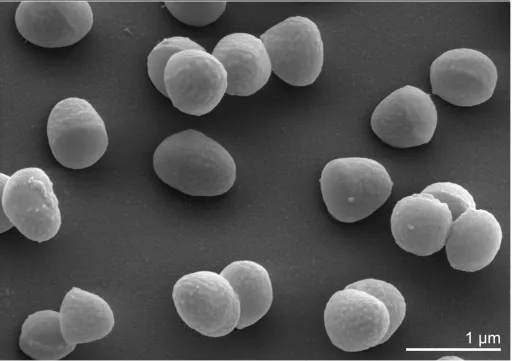
atypical of this evolutionary group. Cells in the
sta-tionary phase are predominantly coccoid (Figure
2), whereas cells in fresh cultures are irregular,
slender rods [1]. Cells are frequently arranged at
an angle to give V-formations [1] (Figure 2).
B.
faecium
cells are non-acid fast and do not form
endospores [1].
B. faecium
is essentially aerobic,
but is also capable of very weak growth under
anaerobic conditions [1].
B. faecium
is capable of degrading uric acid, and
fermenting cellobiose, glucose, maltose, and
man-nose, but not cellulose, chitin, or gelatin. The
op-timal growth temperature is 25-30°C. Nitrate is
reduced to nitrite by some
B. faecium
strains [1] as
a candidate for terminal electron acceptor during
anaerobic growth.
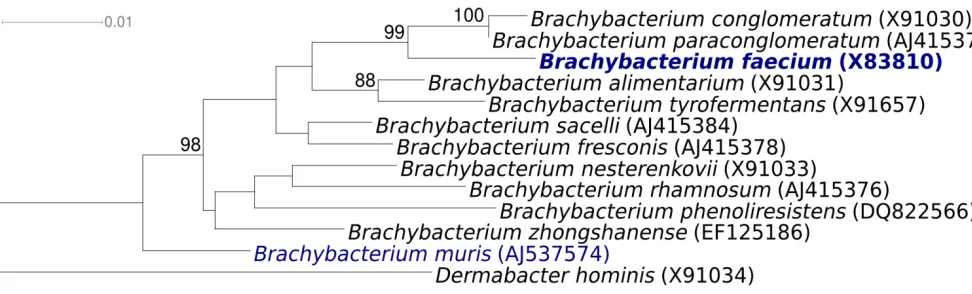
Figure 1 shows the phylogenetic neighborhood of
B. faecium
strain Schefferle 6-10
Tin a 16S rRNA
based tree. The sequences of the three 16S rRNA
genes in the
B. faecium
Schefferle 6-10
Tgenome
differ by up to two nucleotides (nts) from each
other, and by three nts from the reference
se-quence of strain DSM 4810 (X91032). The slight
differences between the genome data and the
pre-viously reported 16S rRNA gene sequence is most
likely due to sequencing errors in the previously
reported sequence data.
Figure 1.
Phylogenetic tree of
B. faecium
Schefferle 6-10
Tand all type strains of the genus
Figure 2.
Scanning electron micrograph of
B. faecium
Schefferle 6-10
TChemotaxonomy
Strain Schefferle 6-10
Twas originally described as
a coryneform bacterium. This descriptive term
applies to a diverse range of taxa and indicates
that the comparisons made in the original
publica-tion need to be reviewed. The murein of
B. faecium
contains
meso
-diaminopimelic acid, alanine and
glutamic acid. The strain possesses a type A4γ
peptidoglycan, type A31.2 according to th
[1]. As in other
Brachybacterium
strains, the fatty
acid pattern of strain Schefferle 6-10
Tis
dominat-ed by branchdominat-ed-chain saturatdominat-ed anteiso- (ai-) fatty
acids: ai-C
15:0(40%), ai-C
17:0(37%), and C
16:0and
iso-C
16:07.5%, each, with smaller amounts of
iso-C
15:0(3.5%), iso-C
17:0(2.0%) [1]. Straight chain and
unsaturated fatty acids are absent [1]. As usual for
most members of the
Actinomycetales
, mycolic
ac-ids were not reported [1]. A menaqui-
none with seven isoprene units (MK-7)
predomi-nates (88%) complemented by 11% MK-8 [1].
Phosphatidylglycerol and diphosphatidylglycerol
were identified as the dominant polar lipids,
to-gether with several glycolipids and an unknown
phospholipid [1]. The R
fvalues of the glycolipids
suggest that they contain different numbers of
su-gars (one, two or possibly three) and may also
show differences in the nature and linkage of the
sugars. It is not known whether these glycolipids
are based on a diglyceride or whether they
con-tain an acylated sugar, directly linked to a
monog-lyceride. The chemical composition is typical of
members of the genus
Brachybacterium
and
simi-lar, but not identical with the members of the only
other genus placed in the family
Dermabactera-ceae
,
Dermabacter
. In addition to cytochrome aa3,
B. faecium
possesses cytochrome d
626, and
Table 1. Classification and general features of B. faecium Schefferle 6-10T based on MIGS recommendations [9]
MIGS ID Property Term Evidence
code
Current classification
Domain Bacteria Phylum Actinobacteria Class Actinobacteria Order Actinomycetales Family Dermabacteraceae Genus Brachybacterium Species Brachybacterium faecium Type strain Schefferle 6-10
TAS [2] TAS [2] TAS [2] TAS [1] TAS [1]
Gram stain positive TAS [1]
Cell shape varies; rod-coccus growth cycle TAS [1]
Motility nonmotile TAS [1]
Sporulation non-sporulating TAS [1]
Temperature range mesophilic TAS [1]
Optimum temperature 25-30°C TAS [1]
Salinity 5g NaCl/L TAS [1]
MIGS-22 Oxygen requirement aerobic; very weak growth under anaerobic conditions TAS [1] Carbon source glucose, maltose, mannose, cellobiose TAS [1]
Energy source starch NAS
MIGS-6 Habitat deep litter (soil) TAS [3]
MIGS-15 Biotic relationship free-living NAS
MIGS-14 Pathogenicity none NAS
Biosafety level 1 TAS [10]
Isolation poultry deep litter TAS [3]
MIGS-4 Geographic location TAS [3]
MIGS-5 Sample collection time about 1966 TAS [3]
MIGS-4.1
MIGS-4.2 Latitude – Longitude not reported
MIGS-4.3 Depth not reported
MIGS-4.4 Altitude not reported
Evidence codes - IDA: Inferred from Direct Assay (first time in publication); TAS: Traceable Author Statement (i.e., a direct report exists in the literature); NAS: Non-traceable Author Statement (i.e., not directly observed for the living, isolated sample, but based on a generally accepted property for the species, or anecdotal evidence). These evidence codes are from th]. If the evidence code is IDA, then the property should have been
di-rectly observed, for the purpose of this specific publication, for a live isolate by one of the authors, or an expert or re-putable institution mentioned in the acknowledgements.
Genome sequencing and annotation
Genome project history
This organism was selected for sequencing on the
basis of its phylogenetic position, and is part of the
G
enomic
E
ncyclopedia of
B
acteria and
A
rchaea
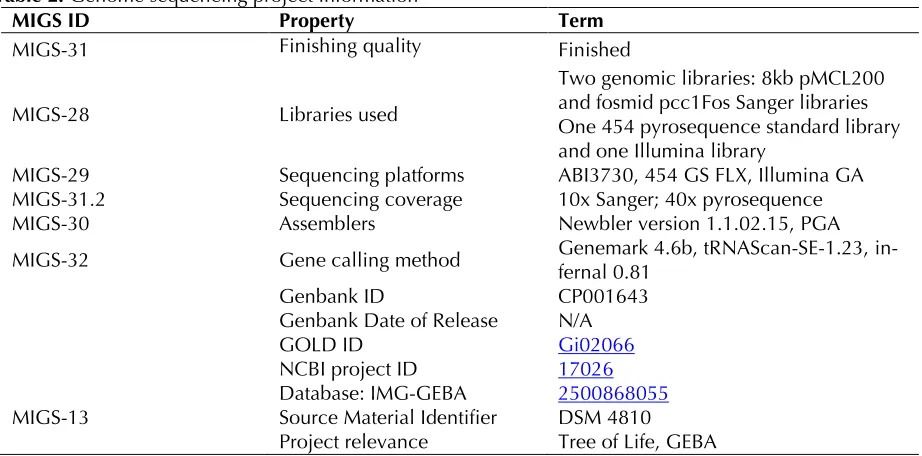
project. The genome project is deposited in the
Genomes OnLine Database [7] and the complete
Table 2. Genome sequencing project information
MIGS ID Property Term
MIGS-31 Finishing quality Finished
MIGS-28 Libraries used
Two genomic libraries: 8kb pMCL200 and fosmid pcc1Fos Sanger libraries One 454 pyrosequence standard library and one Illumina library
MIGS-29 Sequencing platforms ABI3730, 454GS FLX, Illumina GA MIGS-31.2 Sequencing coverage 10x Sanger; 40x pyrosequence
MIGS-30 Assemblers Newbler version 1.1.02.15, PGA
MIGS-32 Gene calling method Genemark 4.6b, tRNAScan-SE-1.23, in-fernal 0.81
Genbank ID CP001643
Genbank Date of Release N/A
GOLD ID
NCBI project ID
Database: IMG-GEBA
MIGS-13 Source Material Identifier DSM 4810
Project relevance Tree of Life, GEBA
Growth conditions and DNA isolation
B. faecium
Schefferle 6-10
T, DSM 4810, was grown
in
broth, 0.3% yeast extract) at 28°C. DNA was
iso-lated from 1-1.5 g of cell paste using Qiagen
Ge-nomic 500 DNA Kit (Qiagen, Hilden, Germany)
without modification of the manufacturer’s
proto-col for cell lysis.
Genome sequencing and assembly
The genome was sequenced using a combination
of Sanger, 454 and Illumina sequencing platforms.
All general aspects of library construction and
se-quencing performed at th
JGI website. 454 Pyrosequencing reads were
as-sembled using the Newbler assembler version
1.1.02.15 (Roche). Large Newbler contigs were
broken into 4,074 overlapping fragments of 1,000
bp and entered into the assembly as pseudo-reads.
The sequences were assigned quality scores based
on Newbler consensus q-scores with
modifica-tions to account for overlap redundancy and to
ad-just inflated q-scores. A hybrid 454/Sanger
as-sembly was made using the PGA assembler.
Possi-ble mis-assemblies were corrected and gaps
be-tween contigs were closed by custom primer
walks from sub-clones or PCR products. 258
San-ger finishing reads were produced. Illumina reads
were used to improve the final consensus quality
using an in-house developed tool (the Polisher).
The error rate of the completed genome sequence
is less than 1 in 100,000. Together all sequence
types provided 50x coverage of the genome.
Genome annotation
Genes were identified using GeneMark [12] as
part of the genome annotation pipeline in the
In-tegrated
ER) system [13], followed by a round of manual
curation using the JGI
The predicted CDSs were translated and used to
search the National Center for Biotechnology
In-formation (NCBI) nonredundant database,
Uni-Prot, TIGRFam, Pfam, PRIAM, KEGG, COG, and
In-terPro databases. The tRNAScanSE tool [15] was
used to find tRNA genes, whereas ribosomal RNAs
were found by using the tool RNAmmer [16].
Oth-er non-coding RNAs wOth-ere identified by searching
the genome for the Rfam profiles using INFERNAL
(v0.81) [17]. Additional gene prediction analysis
and manual functional annotation was performed
within the
platform [18].
Metabolic network analysis
The metabolic Pathway/Genome Database (PGDB)
was computationally generated using Pathway
Tools software version 12.5 [19] and MetaCyc
version 12.5 [20], based on annotated EC numbers
and a customized enzyme name mapping file. It
has undergone no subsequent manual curation
and may contain errors, similar to a Tier 3 BioCyc
PGDB [21].
Genome properties
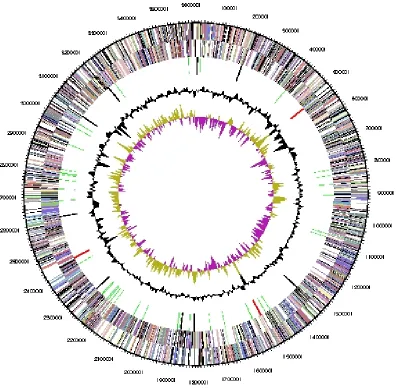
con-tent (Table 3 and Figure 3). Of the 3,198 genes
predicted, 3,129 were protein coding genes, and
69 RNAs. Sixty pseudogenes were also identified.
The majority of genes (77.3%) of the genes were
assigned with a putative function while the
re-maining ones are annotated as hypothetical
pro-teins. The properties and the statistics of the
ge-nome are summarized in Table 3. The distribution
of genes into COGs functional categories is
pre-sented in Table 4, and a cellular overview diagram
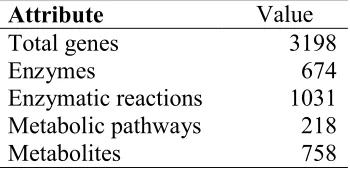
is presented in Figure 4, followed by a summary of
metabolic network statistics shown in Table 5.
Table 3. Genome Statistics
Attribute Value % of Total
Genome size (bp) 3,614,992
DNA Coding region (bp) 3,287,735 90.95%
DNA G+C content (bp) 2,604,449 72.05%
Number of replicons 1
Extrachromosomal elements 0
Total genes 3198
RNA genes 69 2.16%
rRNA operons 3
Protein-coding genes 3129 97.84%
Pseudo genes 60 1.88%
Genes with function prediction 2473 77.33%
Genes in paralog clusters 347 10.85%
Genes assigned to COGs 2371 74.14%
Genes assigned Pfam domains 2440 76.30%
Genes with signal peptides 697 21.79%
Genes with transmembrane helices 836 26.14%
CRISPR repeats 0
Table 4. Number of genes associated with the 21 general COG functional categories Code Value % Description
J 163 5.2 Translation, ribosomal structure and biogenesis A 1 0.0 RNA processing and modification
K 204 6.5 Transcription
L 125 4.0 Replication, recombination and repair B 1 0.0 Chromatin structure and dynamics D 19 0.6 Cell cycle control, mitosis and meiosis Y 0 0.0 Nuclear structure
V 53 1.7 Defense mechanisms
T 88 2.8 Signal transduction mechanisms M 127 4.1 Cell wall/membrane biogenesis
N 2 0.1 Cell motility
Z 1 0.0 Cytoskeleton
W 0 0.0 Extracellular structures
U 25 0.8 Intracellular trafficking and secretion
O 68 2.2 Posttranslational modification, protein turnover, chaperones C 136 4.3 Energy production and conversion
Table 4. Number of genes associated with the 21 general COG functional categories (cont.) Code Value % Description
E 261 8.3 Amino acid transport and metabolism F 84 2.7 Nucleotide transport and metabolism H 107 3.4 Coenzyme transport and metabolism I 92 2.9 Lipid transport and metabolism
P 145 4.6 Inorganic ion transport and metabolism
Q 44 1.4 Secondary metabolites biosynthesis, transport and catabolism R 333 10.6 General function prediction only
S 189 6.0 Function unknown
- 758 24.2 Not in COGs
Figure 4.
Schematic cellular overview of all pathways of the
B. faecium
strain Schefferle 6-10
Tmetabolism.
Nodes represent metabolites, with shape indicating class of metabolite. Lines represent reactions.
Table 5. Metabolic Network Statistics
Attribute
Value
Total genes
3198
Enzymes
674
Enzymatic reactions
1031
Metabolic pathways
218
Metabolites
758
Acknowledgements
We gratefully acknowledge the help of Gabriele Ge-hrich-Schröter for growing B. faecium cultures and
Su-sanne Schneider for DNA extraction and quality analy-sis (both at DSMZ). This work was performed under the auspices of the US Department of Energy's Office of Science, Biological and Environmental Research Pro-gram, and by the University of California, Lawrence Berkeley National Laboratory under contract No. DE-AC02-05CH11231, Lawrence Livermore National La-boratory under Contract No. DE-AC52-07NA27344, and Los Alamos National Laboratory under contract No. DE-AC02-06NA25396, as well as German Research Foun-dation (DFG) INST 599/1-1.
References
1. Collins M, Brown J, Jones D. Brachybacterium faecium gen. nov., sp. nov., a coryneform bacterium from poultry deep litter. Int J Syst Bacteriol 1988; 38:45-48
2. Stackebrandt E, Rainey F, Ward-Rainey N. Proposal for a new hierarchic classification system, Actinobacteria classis nov. Int J Syst Bacteriol 1997; 47:479-491
3. Schefferle H. Coryneform bacteria in poultry deep litter. J Appl Bacteriol 1966; 29:147-160
4. Lee C, Grasso C, Sharlow MF. Multiple sequence alignment using partial order graphs. Bioinformatics 2002; 18:452-
5. Felsenstein J. Evolutionary trees from DNA sequences: a maximum likelihood approach. J Mol Evol 1981; 17:368-
6. Stamatakis A, Hoover P, Rougemont J. A rapid bootstrap algorithm for the RAxML Web servers. Syst Biol 2008; 57:758-771
7. Liolios K, Mavromatis K, Tavernarakis N, Kyrpides NC. The Genomes On Line Database (GOLD) in 2007: status of genomic and metagenomic projects and their associated metadata. Nucleic Acids Res 2008; 36
8. Schleifer K, Lang K. Close relationship among strains of Micrococcus conglomeratus and Arthrobacter sp. FEMS Microbiol 1980; 9
9. Field D, Garrity G, Gray T, Morrison N, Selengut J, Sterk P, Tatusova T, Thomson N, Allen MJ, Angiuoli SV, et al. The minimum information about a genome sequence (MIGS) specification. Nat Biotechnol 2008; 26
10. Anonymous. Biological Agents: Technical rules for biological agents. <www.baua.de>. 11. Ashburner M, Ball CA, Blake JA, Botstein D,
Butler H, Cherry JM, Davis AP, Dolinski K, Dwight SS, Eppig JT, et al. Gene ontology: tool for the unification of biology. The Gene Ontology Consortium. Nat Genet 2000;
25:25-
12. Besemer J, Lomsadze A, Borodovsky M. GeneMarkS: a self-training method for prediction of gene starts in microbial genomes. Implications for finding sequence motifs in regulatory regions. Nucleic Acids Res
2001; 29:2607-26
13. Markowitz V, Mavromatis K, Ivanova N, Chen I-M, Chu K, Palaniappan K, Szeto E, Anderson I, Lykidis A, Kyrpides N. Expert Review of Functional Annotations for Microbial Genomes. Bioinformatics, 2009; in press. 14. Pati A. GenePRIMP: A Gene Prediction
Improvement Pipeline for microbial genomes (In preparation 2009).
15. Lowe TM, Eddy SR. tRNAscan-SE: a program for improved detection of transfer RNA genes in genomic sequence. Nucleic Acids Res
1997; 25:955-
16. Lagesen K, Hallin P, Rodland EA, Staerfeldt HH, Rognes T, Ussery DW. RNAmmer: consistent and rapid annotation of ribosomal RNA genes. Nucleic Acids Res 2007; 35
:3100-3108
17. Griffiths-Jones S, Moxon S, Marshall M, Khanna A, Eddy SR, Bateman A. Rfam: annotating non-coding RNAs in complete genomes. Nucleic Acids Res 2005; 33
:D121-D
18. Markowitz VM, Szeto E, Palaniappan K, Grechkin Y, Chu K, Chen IM, Dubchak I, Anderson I, Lykidis A, Mavromatis K, et al. The integrated microbial genomes (IMG) system in 2007: data content and analysis tool extensions. Nucleic Acids Res 2008; 36
:D528-D53
19. Karp P, Paley S, Romero P. The pathway tools software. Bioinformatics 2000; 18:S225-232 20. Caspi R, Foerster H, Fulcher CA, Kaipa P,
Krummenacker M, Latendresse M, Paley S, Rhee SY, Shearer AG, Tissier C, et al. The MetaCyc Database of metabolic pathways and enzymes and the BioCyc collection of
Pathway/Genome Databases. Nucleic Acids Res 2008; 36:D623-631
21. Karp PD, Ouzounis CA, Moore-Kochlacs C, Goldovsky L, Kaipa P, Ahren D, Tsoka S, Darzentas N, Kunin V, Lopez-Bigas N. Expansion of the BioCyc collection of pathway/genome databases to 160 genomes. Nucleic Acids Res 2005; 33:6083-6089
![Table 1. Classification and general features of B. faecium Schefferle 6-10T based on MIGS recommendations [9]](https://thumb-us.123doks.com/thumbv2/123dok_us/665085.2065597/4.612.53.563.79.486/table-classification-general-features-faecium-schefferle-based-recommendations.webp)