What is a Partial . . . Classifying PDE’s: . . . Examples of Wave . . . Solution of 1-D Wave . . . The Plucked String as . . . Uniqueness of the . . . Solved . . .
Exercise/Practice/Assignment . . . Home Page
Title Page
JJ II
J I
Page1of31 Go Back Full Screen
Close Quit
P
REPA RE
DB Y
D
R
. S
. A
T
H
IT
H
A
N
18MAB201T
Transforms and Boundary Value
Problems
Unit-3
Prepared by
Dr. S. ATHITHAN
Assistant Professor
Department of of Mathematics
Faculty of Engineering and Technology
SRM I
NSTITUTE OFS
CIENCE ANDT
ECHNOLOGYWhat is a Partial . . .
Classifying PDE’s: . . . Examples of Wave . . . Solution of 1-D Wave . . . The Plucked String as . . . Uniqueness of the . . . Solved . . .
Exercise/Practice/Assignment . . . Home Page
Title Page
JJ II
J I
Page1of31 Go Back Full Screen
Close Quit
P
REPA RE
DB Y
D
R
. S
. A
T
H
IT
H
A
N
1.
What is a Partial Differential Equation?
You’ve probably all seen an ordinary differential equation (ODE); for example the pen-dulum equation,
d2θ
dt2 +
g
Lsinθ = 0, (1.1)
describes the angle,θ, a pendulum makes with the vertical as a function of time,t. Here gandLare constants (the acceleration due to gravity and length of the pendulum respec-tively),tis theindependent variableandθis thedependent variable. This is an ODE because there is only one independent variable, heretwhich represents time.
A partial differential equation (PDE) relates the partial derivatives of a function of two or more independent variables together. For example, Laplace’s equation forφ(x, y),
∂2φ
∂x2 +
∂2φ
∂y2 = 0 (1.2)
arises in many places in mathematics and physics. For simplicity, we will use subscript notation for partial derivatives, so this equation can also be writtenφxx+φyy= 0.
What is a Partial . . . Classifying PDE’s: . . .
Examples of Wave . . . Solution of 1-D Wave . . . The Plucked String as . . . Uniqueness of the . . . Solved . . .
Exercise/Practice/Assignment . . . Home Page
Title Page JJ II
J I
Page2of31 Go Back Full Screen
Close Quit
P
REPA RE
DB Y
D
R
. S
. A
T
H
IT
H
A
N
2.
Classifying PDE’s: Hyperbolic, Parabolic, Elliptic
Classify the following PDE’s
1. 3uxx−4uxy−3uy = 0.
Ans.:B2−4AC = 16>0.∴The PDE is hyperbolic∀x, y. 2. y2uxx−2xyuxy+x2uyy−3ux = 0.
Ans.:B2−4AC = 0∀x&y.∴Parabolic in this case. 3. x2uxx+ 2xyuxy+ (1 +y2)uyy−2ux = 0.
Ans.:B2−4AC =−4x2<0forx <0orx >0.∴Elliptic in this case. Ifx= 0, thenB2−4AC = 0.∴Parabolic in this case.
4. x2uxx+ (1−y2)uyy= 0.
Ans.: B2−4AC = 4x2(1−y2)> 0 ∀x, x 6= 0andy > 1, y < −1. ∴ The PDE is hyperbolic in this case.
B2−4AC = 4x2(1−y2)< 0 ∀x, x 6= 0and−1< y <1.∴The PDE is elliptic.
What is a Partial . . . Classifying PDE’s: . . .
Examples of Wave . . . Solution of 1-D Wave . . . The Plucked String as . . . Uniqueness of the . . . Solved . . .
Exercise/Practice/Assignment . . . Home Page
Title Page JJ II
J I
Page3of31 Go Back Full Screen
Close Quit
P
REPA RE
DB Y
D
R
. S
. A
T
H
IT
H
A
N
Example : 1Classify the follow differential equations as PDE’s hyperbolic, parabolic, elliptic.
1. Thediffusion equationforu(x, t): ut =c2uxx
2. Thewave equationforw(x, t):
wtt =c2wxx
3. Thethin film equationforu(x, t):
ut =−(uuxxx)x
4. Theforced harmonic oscillatorfory(t):
ytt+ω2y=F cos(Ωt)
5. ThePoisson Equationfor the electric potentialφ(x, y, z): φxx+φyy+φzz= 4πρ(x, y, z)
whereρ(x, y, z)is a known charge density. 6. Burger’s equationforu(x, t):
What is a Partial . . . Classifying PDE’s: . . . Examples of Wave . . .
Solution of 1-D Wave . . . The Plucked String as . . . Uniqueness of the . . . Solved . . .
Exercise/Practice/Assignment . . . Home Page
Title Page JJ II
J I
Page4of31 Go Back Full Screen
Close Quit
P
REPA RE
DB Y
D
R
. S
. A
T
H
IT
H
A
N
3.
Examples of Wave Equations in Different Situations
As we have seen before the ”classical” one-dimensional wave equation has the form:
utt= c2uxx, (3.1)
whereu = u(x, t)can be thought of as the vertical displacement of the vibration of a string.
The string can be fixed at both ends, or just at one end, or we can think of an ”infinite” string, that is not bound at any end. Each will yield different boundary conditions for the well-posed wave equation. We can also consider the case where the string is ”pushed” with an external forceh(x, t),or where we take under consideration the friction coeffi-cient from the air that the string displaces. These two equations will be called ”forced” and ”damped” respectively. In the ”forced” case, the wave equation is:
utt= c2uxx+h(x, t),
where an example of the acting force is the gravitational force. In the ”damped” case the equation will look like:
utt+kut =c2uxx,
wherekcan be the friction coefficient.
If we have more than one spatial dimension (a membrane for example), the wave equation will look a bit different. In the case of the vibrating membrane we have two spatial variables and the wave equation will look like:
utt= c2(uxx+uyy).
What is a Partial . . . Classifying PDE’s: . . . Examples of Wave . . .
Solution of 1-D Wave . . . The Plucked String as . . . Uniqueness of the . . . Solved . . .
Exercise/Practice/Assignment . . . Home Page
Title Page JJ II
J I
Page5of31 Go Back Full Screen
Close Quit
P
REPA RE
DB Y
D
R
. S
. A
T
H
IT
H
A
N
The initial conditions for the one-dimensional wave equation will be:
(i) u(x,0) =f(x) (ii) ut(x,0) = g(x).
For the finite string the boundary conditions will be:
(i) u(0, t) =A(t) (ii) u(L, t) =B(t).
So, altogether we have 4 conditions which are repeated below together.
(i) u(x,0) =f(x) (ii) ut(x,0) = g(x)
What is a Partial . . . Classifying PDE’s: . . . Examples of Wave . . . Solution of 1-D Wave . . .
The Plucked String as . . . Uniqueness of the . . . Solved . . .
Exercise/Practice/Assignment . . . Home Page
Title Page JJ II
J I
Page6of31 Go Back Full Screen
Close Quit
P
REPA RE
DB Y
D
R
. S
. A
T
H
IT
H
A
N
4.
Solution of 1-D Wave Equation (Dirichlet Problem)
If we tie the string at both ends we can have the following boundary conditions:
u(0, t) =A(t), u(L, t) =B(t),
whereA, BareC1piecewise functions. For example, we can have a sinusoidal function
at one end and a Heaviside function at the other.
When the boundary valuesAandBare0we obtain theDirichlet Problemfor the wave equation:
utt =c2uxx, 0< x < L, t >0 DE
u(0, t) = 0, u(L, t) = 0, t > 0 BC u(x,0) =f(x), ut(x,0) = g(x) 0< x < L IC.
As you have seen in Lecture 5 for the diffusion equation, the method of separating the variables is a very convenient way to obtain solutions for PDEs. In the case of the Dirichlet Problem we will quickly review the method.
Theorem 4.1. A solution of the problem:
utt =c2uxx, 0< x < L, t >0 DE
u(0, t) = 0, u(L, t) = 0, t > 0 BC u(x,0) =f(x), ut(x,0) = g(x) 0< x < L IC.
is given by:
u(x, t) =
N
X
n=1
L nπc
¯ Ansin(
nπct
L ) +Bncos( nπct
L )
What is a Partial . . . Classifying PDE’s: . . . Examples of Wave . . . Solution of 1-D Wave . . .
The Plucked String as . . . Uniqueness of the . . . Solved . . .
Exercise/Practice/Assignment . . . Home Page
Title Page JJ II
J I
Page7of31 Go Back Full Screen
Close Quit
P
REPA RE
DB Y
D
R
. S
. A
T
H
IT
H
A
N
where: f(x) =
N
X
n=1
Bnsin(
nπx
L ),andg(x) =
N
X
n=1
¯ Ansin(
nπx
L ).The coeffi-cientsA¯nandBnare given by:
Bn=
2
L Z L
0
f(x) sin(nπx L ),
¯ An=
2
L Z L
0
g(x) sin(nπx L ).
Proof. We will use the method of separation of variables, namely think of the solution u(x, t)as a product of a function that depends only on the variabletand of a function that depends only on the variablex.
Let
u(x, t) =X(x)T(t) and substitute in the equation
utt= c2uxx,
we obtain:
X(x) ¨T(t) =c2X¨(x)T(t), or
¨ T(t) c2T(t) =
¨ X(x) X(x),
thus the equality is one of functions of different variables, so both quotients have to be constant.
Say
¨ T(t) c2T(t) =
¨ X(x)
X(x) =k= ±p
2,
What is a Partial . . . Classifying PDE’s: . . . Examples of Wave . . . Solution of 1-D Wave . . .
The Plucked String as . . . Uniqueness of the . . . Solved . . .
Exercise/Practice/Assignment . . . Home Page
Title Page JJ II
J I
Page8of31 Go Back Full Screen
Close Quit
P
REPA RE
DB Y
D
R
. S
. A
T
H
IT
H
A
N
Case 1:When the constant is−p2,then the solutions for ¨
X(x) X(x) =−p
2,
are:
X(x) =c1sin(px) +c2cos(px),
and the solutions for
¨ T(t)
c2T(t) =−p 2,
are:
T(t) =d1sin(pct) +d2cos(pct).
Then
u(x, t) = [d1sin(pct) +d2cos(pct)][c1sin(px) +c2cos(px)].
Case 2:When the constant isp2,then the solutions for ¨
X(x) X(x) = p
2,
are:
X(x) =c1epx+c2e−px,
and the solutions for
¨ T(t) c2T(t) =p
What is a Partial . . . Classifying PDE’s: . . . Examples of Wave . . . Solution of 1-D Wave . . .
The Plucked String as . . . Uniqueness of the . . . Solved . . .
Exercise/Practice/Assignment . . . Home Page
Title Page JJ II
J I
Page9of31 Go Back Full Screen
Close Quit
P
REPA RE
DB Y
D
R
. S
. A
T
H
IT
H
A
N
are±cp,are
T(t) =d1epct+d2e−pct.
Then
u(x, t) = (d1epct+d2e−pct)(c1epx+c2e−px).
Case 3:When the constant is0,then the equations become
¨
X(x) = ¨T(t) = 0, andX(x) =c1x+c2,andT(t) =d1t+d2.Then
u(x, t) = (d1t+d2)(c1x+c2).
To confirm which is most suitable solution, we may need the help of the actual nature of the solutions. To check that we may proceed with boundary conditions. Let’s take a look at the boundary conditions:u(0, t) = 0, u(L, t) = 0.
The only solution foru(x, t)that can satisfy them is
u(x, t) = (d1sin(pct) +d2cos(pct))(c1sin(px) +c2cos(px)),
and the boundary conditions translate into:
(d1sin(pct) +d2cos(pct))(c1sin(0) +c2cos(0)) = 0
(d1sin(pct) +d2cos(pct))(c1sin(pL) +c2cos(pL)) = 0, ∀t > 0,
namely:
c2 = 0
What is a Partial . . . Classifying PDE’s: . . . Examples of Wave . . . Solution of 1-D Wave . . .
The Plucked String as . . . Uniqueness of the . . . Solved . . .
Exercise/Practice/Assignment . . . Home Page
Title Page JJ II
J I
Page10of31 Go Back Full Screen
Close Quit
P
REPA RE
DB Y
D
R
. S
. A
T
H
IT
H
A
N
From the last condition we obtainp= πn L ,and
u(x, t) = ∞ X
n=1
d1nsin(
πn
L ct) +d2ncos( πn
L ct)
cnsin(
πn L x). Now, the conditions left to check are the initial conditions:
u(x,0) = f(x) =
N
X
n=1
Bnsin(
nπx L ),
ut(x,0) = g(x) = N
X
n=1
¯ Ansin(
nπx L ).
Thenu(x, t) =
N
X
n=1
L nπc
¯ Ansin(
nπct
L ) +Bncos( nπct
L )
sin(nπx L ),
Remark 4.0.1. In the more general case for the Dirichlet Problem, when initial condi-tions (IC) change to more general homogeneous condicondi-tions:k1u(x,0)+k2ux(x,0) =
0,we can solve the problem in the same manner, using separation of variables.
Exercise: 4.1. Check thatCase 1is the only one that verifies the boundary conditions in the proof above.
Exercise: 4.2. Check that the solution found above verifies the initial conditions.
What is a Partial . . . Classifying PDE’s: . . . Examples of Wave . . . Solution of 1-D Wave . . .
The Plucked String as . . . Uniqueness of the . . . Solved . . .
Exercise/Practice/Assignment . . . Home Page
Title Page JJ II
J I
Page11of31 Go Back Full Screen
Close Quit
P
REPA RE
DB Y
D
R
. S
. A
T
H
IT
H
A
N
find the position of the stringu(x, t)for everyx ∈ [0, π]and for everyt > 0. Find an approximate value for u(x, t) by adding several terms of the series. Animate the approximation and draw a3Dplot.
Exercise: 4.4. Solve the following problem for the string equation:
PDE utt =uxx,
BC u(0, t) = 0, ux(π, t) = 0 for everyt >0;
IC u(x,0) = sin(x), ut(x,0) = 0, for everyx∈ [0, π].
Notice the change in the boundary conditions. This will lead to different eigenvalues and eigenfunctions.
What is a Partial . . . Classifying PDE’s: . . . Examples of Wave . . . Solution of 1-D Wave . . . The Plucked String as . . .
Uniqueness of the . . . Solved . . .
Exercise/Practice/Assignment . . . Home Page
Title Page JJ II
J I
Page12of31 Go Back Full Screen
Close Quit
P
REPA RE
DB Y
D
R
. S
. A
T
H
IT
H
A
N
5.
The Plucked String as an Example for 1-D Wave
Equa-tion
Theplucked stringrefers to the initial condition for the Dirichlet problem , wheref(x) looks like a ”plucked string”, namely:
utt= c2uxx, 0< x < L, t >0 DE
u(0, t) = 0, u(L, t) = 0, t >0 BC u(x,0) =f(x), ut(x,0) = 0 0< x < L IC,
where
f(x) =
u0
x0
x, 0≤x≤x0
u0
x−L x0−L
, x0≤x≤L
We have that:
˙ f(x) =
u0
x0
, 0≤x≤x0
u0
x0−L
What is a Partial . . . Classifying PDE’s: . . . Examples of Wave . . . Solution of 1-D Wave . . . The Plucked String as . . .
Uniqueness of the . . . Solved . . .
Exercise/Practice/Assignment . . . Home Page
Title Page JJ II
J I
Page13of31 Go Back Full Screen
Close Quit
P
REPA RE
DB Y
D
R
. S
. A
T
H
IT
H
A
N
andf(0) =f(L) = 0,thus:
Bn =
2
L( L nπ)
Z x0
0
u0
x0
cos(nπx L )dx+
2 L( L nπ) Z L x0 u0
x0−L
cos(nπx L )dx = 2 L( L nπ)
2(u0
x0
sin(nπx0 L )−
u0
x0−L
sin(nπx0 L ))
= 2L
2u 0
π2x
0(L−x0)
1
n2sin(
nπx0
L ).
Now we can write the formal solution to the plucked string equation:
u(x, t) = 2L 2u
0
π2x0(L−x0)
∞ X
n=1 1
n2sin(
nπx0
L ) cos( nπct
L ) sin( nπx
L ).
5.1.
Musical Instruments (Vibrating Strings)
Many instruments produce sound by making strings vibrate; such are the harp, the piano, the harpsichord, the guitar, the violin, and others. Strings are kept fixed at the endpoints, but they way the instruments are played create different initial conditions. In instruments like the guitar, the string is plucked; this produces an initial perturbation with no initial velocity. In the piano, on the other hand, the string is hit, which creates an initial velocity but no initial perturbation from the initial position.
The oscillations of the string are described by
u(x, t) = ∞ X
n=1
What is a Partial . . . Classifying PDE’s: . . . Examples of Wave . . . Solution of 1-D Wave . . . The Plucked String as . . .
Uniqueness of the . . . Solved . . .
Exercise/Practice/Assignment . . . Home Page
Title Page JJ II
J I
Page14of31 Go Back Full Screen
Close Quit
P
REPA RE
DB Y
D
R
. S
. A
T
H
IT
H
A
N
where
pn=n
π
L and ωn= cpn= cn π L.
The sound we hear is thus a combination of the main harmonic sounds (eigenfunctions)
un(x, t) = (Ancosωnt+Bnsinωnt) sinpnt.
The contribution of each particular harmonic is measured by itsenergy, which turns out to be equal to:
En=
ω2
nM
4 (A
2
n+B
2
n),
whereM =DLis the total mass of the string (recall thatDwas the density). For the plucked string (Section 7.5), the energy is given by:
En=
M u2 0L
2c2
n2π2x2
0(L−x0)2
sin2πnx0 L .
The energy decreases asn−2, so only the main toneu1and a few other harmonics are
audible.
On the other hand, if we hit the string with a flat hammer of length2δwith center atx0
and producing an initial velocityv0, the energy of thenth harmonic is
En=
4M V2 0
n2 π
2sin2πnx0
L sin
2 πnδ
L ,
What is a Partial . . . Classifying PDE’s: . . . Examples of Wave . . . Solution of 1-D Wave . . . The Plucked String as . . .
Uniqueness of the . . . Solved . . .
Exercise/Practice/Assignment . . . Home Page
Title Page JJ II
J I
Page15of31 Go Back Full Screen
Close Quit
P
REPA RE
DB Y
D
R
. S
. A
T
H
IT
H
A
N
concentrated at a pointx0. The corresponding energy is:
En=
v02 L sin
2πnx0
L .
Thus, for a very narrow hammer the energies of all harmonics are of the same order and the generated sound will be saturated with harmonics. This can be checked experimentally, by hitting a string with the blade of a knife. The sound will have a metallic quality. Not all harmonics are desirable. The first ones,u2up tou6, sound well together with the
main harmonicu1. However, the7th and the first harmonics sounding together produce
a sense of dissonance.
There are several ways to try to “kill” those harmonics by percussion (as in the piano).
a). The position of the hammer. The presence of the factorsinπnx0
L shows that by choosing the centerx0of the hammer at the node of the undesired harmonic we may make
it disappear (make the correspondingAnandBn be equal to zero). In modern pianos
the position of the hammer is chosen near the nodes of the7th and the8th harmonics, to “kill” them.
b).The shape of the hammer. In modern pianos the hammers are not flat, but rather round. One can model this situation by choosing the initial velocity to be, say, a parabola on the interval[x0−δ, x0+δ], instead of a horizontal line. Older pianos, which had flatter
and narrower hammers, produced a more piercing, shrilled sound.
c).The rigidity of the hammer. If instead of being rigid the hammer is softer. In this case the motion is not described by its initial position and velocity, but rather by a short-time acting force, which varies in time.
What is a Partial . . . Classifying PDE’s: . . . Examples of Wave . . . Solution of 1-D Wave . . . The Plucked String as . . . Uniqueness of the . . .
Solved . . .
Exercise/Practice/Assignment . . . Home Page
Title Page JJ II
J I
Page16of31 Go Back Full Screen
Close Quit
P
REPA RE
DB Y
D
R
. S
. A
T
H
IT
H
A
N
6.
Uniqueness of the Solution to the 1-D Wave Equation
Theorem 6.1. Letu1(x, t)andu2(x, t)be two solutions of the problem:
utt =c2uxx, 0< x < L, t >0 DE
u(0, t) =A(t), u(L, t) =B(t), t > 0 BC u(x,0) =f(x), ut(x,0) =g(x) 0< x < L. IC,
whereA, B, f, gareC1piecewise continuous. Thenu
1(x, t) =u2(x, t)for all points
in the domain.
Proof. Letv(x, t) =u1(x, t)−u2(x, t),thenvsatisfies the wave equation with initial
conditions:u(x,0) =ut(x,0) = 0,and boundary conditionsu(0, t) =u(L, t) =
0.Our goal is to prove thatv(x, t) = 0 ∀x, t. In order to accomplish this, define:
H(t) = Z L
0
c2vx(x, t)2+vt(x, t)2
dx.
We will prove thatH(t) = 0first. Differentiating with respect totwe obtain:
˙
H(t) = Z L
0
c22vxvxt+ 2vtvttdx
= 2c2 Z L
0
[vxvxt+vtvxx]dx
= 2c2 Z L
0
δ
δx(vxvt)dx= 2c
2[v
x(x, t)vt(x, t)] L
0
What is a Partial . . . Classifying PDE’s: . . . Examples of Wave . . . Solution of 1-D Wave . . . The Plucked String as . . . Uniqueness of the . . .
Solved . . .
Exercise/Practice/Assignment . . . Home Page
Title Page JJ II
J I
Page17of31 Go Back Full Screen
Close Quit
P
REPA RE
DB Y
D
R
. S
. A
T
H
IT
H
A
N
SinceH(t) = 0, H(t)˙ is constant, and asH(0) = 0,we conclude thatH(t) = 0. Thenvt(x, t) = 0,andv(x, t) =v(x, t)−v(x,0) =
Z L
0
vt(x, t)dt= 0.
Remark 6.0.1. The energy integral of the string at timetis:
E(t) = Z L
0
T0ux(x, t)2+Dut(x, t)2
dx,
whereDis the mass per unit length andT0is the constant tension when the string is
straight. We can see that the energy is proportional toH if we construct H using u instead ofv. So the uniqueness proof comes from the conservation of energy for the unforced string.
Example : 2
A damped string of length1has equation
utt =c2uxx−γut,
whereγis a small damping coefficient. Find the solutionu(x, t)assuming that both endpoints are fixed, the initial condition isx(1−x)and the initial velocity is zero.
To see the nature of the by visualization, we can plot and animate the solution for
the case whenc= 1
4andγ = 1
What is a Partial . . . Classifying PDE’s: . . . Examples of Wave . . . Solution of 1-D Wave . . . The Plucked String as . . . Uniqueness of the . . .
Solved . . .
Exercise/Practice/Assignment . . . Home Page
Title Page JJ II
J I
Page18of31 Go Back Full Screen
Close Quit
P
REPA RE
DB Y
D
R
. S
. A
T
H
IT
H
A
N
Example : 3Find the solutionu(x, y, t)of a square membrane with side1fixed on the bound-ary, if the initial position isu(x, y,0) = (x−x2)(y− y2)and the initial velocity is zero.
Same way as said in the previous problem, we can animate several eigenfunctions un,m(x, y, t), say,u1,1,u1,2,u3,5, assuming thatc= 1.
Example : 4
Solve the string equationutt= c2uxxforL= 1, with the boundary conditions
u(0, t) = 0andu(1, t) = 1, with zero initial velocity, assuming that the initial position is
(a) u(x,0) = sinx(easier), (b) u(x,0) =x2(harder).
What is a Partial . . . Classifying PDE’s: . . . Examples of Wave . . . Solution of 1-D Wave . . . The Plucked String as . . . Uniqueness of the . . .
Solved . . .
Exercise/Practice/Assignment . . . Home Page
Title Page JJ II
J I
Page19of31 Go Back Full Screen
Close Quit
P
REPA RE
DB Y
D
R
. S
. A
T
H
IT
H
A
N
Example : 5Solve the string equationutt= c2uxxforL= 1, with the boundary conditions
u(0, t) = 0andux(1, t) +u(1, t) = 0. This corresponds to the case when
the left end is fixed and the right end is attached to an elastic hinge. The initial
conditions areu(x,0) =x− 2
3x
2andu
t(x,0) = x.
Note. This exercise is hard! The eigenvaluespnwill be solutions of a
What is a Partial . . . Classifying PDE’s: . . . Examples of Wave . . . Solution of 1-D Wave . . . The Plucked String as . . . Uniqueness of the . . . Solved . . .
Exercise/Practice/Assignment . . . Home Page
Title Page JJ II
J I
Page20of31 Go Back Full Screen
Close Quit
P
REPA RE
DB Y
D
R
. S
. A
T
H
IT
H
A
N
7.
Solved Problems/Examples
Example : 6
Write one dimensional wave equation and its possible solutions.
Hints/Solution:
One dimensional wave equation is given by ∂
2u
∂t2 =c 2∂
2u
∂x2 (or)utt =c 2u
xx
Its possible solutions are given by
(i)u(x, t) = (c1epx+c2e−px)(c3epct+c4e−pct),
(ii)u(x, t) = (c5cospx+c6sinpx)(c7cospct+c8sinpct)and
(iii)u(x, t) = (c9x+c10)(c11t+c12).
Example : 7
Write one dimensional heat equation and its possible solutions.
Hints/Solution:
One dimensional heat equation is given by ∂u ∂t =c
2∂ 2u
∂x2 (or)ut=c 2u
xx
Its possible solutions are given by (i)u(x, t) = (c1epx+c2e−px)ec
2p2t , (ii)u(x, t) = (c3cospx+c4sinpx)e−c
What is a Partial . . . Classifying PDE’s: . . . Examples of Wave . . . Solution of 1-D Wave . . . The Plucked String as . . . Uniqueness of the . . . Solved . . .
Exercise/Practice/Assignment . . . Home Page
Title Page JJ II
J I
Page21of31 Go Back Full Screen
Close Quit
P
REPA RE
DB Y
D
R
. S
. A
T
H
IT
H
A
N
Example : 8In one dimensional wave equation∂
2u
∂t2 =c 2∂
2u
∂x2 (or)utt =c 2u
xxwhat does
c2stands for?.
Hints/Solution:
In one dimensional wave equation the value ofc2is stands forc2= T
m, whereT is the tension andmis mass per unit length.
Example : 9
In one dimensional heat equation ∂u ∂t = c
2∂ 2u
∂x2 (or)ut = c 2u
xxwhat does
c2stands for?.
Hints/Solution:
In one dimensional heat equation the value ofc2is stands for c2 = k
What is a Partial . . . Classifying PDE’s: . . . Examples of Wave . . . Solution of 1-D Wave . . . The Plucked String as . . . Uniqueness of the . . . Solved . . .
Exercise/Practice/Assignment . . . Home Page
Title Page JJ II
J I
Page22of31 Go Back Full Screen
Close Quit
P
REPA RE
DB Y
D
R
. S
. A
T
H
IT
H
A
N
Example : 10The ends of a rod of length 20 cm are maintained at the temperature10◦C and 20◦Crespectively until steady state prevails. Determine the steady state temper-ature of the rod.
Hints/Solution:
1-D heat equation isut =c2uxx.
In steady state,uxx = 0 =⇒ u(x) =ax+b.
Applying given conditions, we get
b=u(0) =T0anda=
Tl−T0
l =
u(l)−u(0) l =⇒ u(x) = Tl−T0
l x+T0− − −(1) Here,T0= 10◦C, Tl = 20◦Candl= 20.
∴(1) becomesu(x) = 1
2x+ 10.
Example : 11
When the ends of a rod of length 30 cm are maintained at the temperature20◦C and 80◦C respectively until steady state prevails. Determine the steady state temperature of the rod.
What is a Partial . . . Classifying PDE’s: . . . Examples of Wave . . . Solution of 1-D Wave . . . The Plucked String as . . . Uniqueness of the . . . Solved . . .
Exercise/Practice/Assignment . . . Home Page
Title Page JJ II
J I
Page23of31 Go Back Full Screen
Close Quit
P
REPA RE
DB Y
D
R
. S
. A
T
H
IT
H
A
N
1-D heat equation isut =c2uxx.
In steady state,uxx = 0 =⇒ u(x) =ax+b.
Applying given conditions, we get
b=u(0) =T0anda=
Tl−T0
l =
u(l)−u(0) l =⇒ u(x) = Tl−T0
l x+T0− − −(1) Here,T0= 20◦C, Tl = 80◦Candl= 30.
∴(1) becomesu(x) = 2x+ 20.
Example : 12
A tightly stretched string with fixed end pointsx = 0andx = lis initially at rest in its equilibrium position. If it is set vibrating giving each point a velocity 3x(l−x), find the displacement.
Hints/Solution:
One dimensional wave equation is given by∂
2u
∂t2 =c 2∂
2u
∂x2 (or)utt =c 2u
xx− − −
(1)
The boundary conditions becomes, (i)u(0, t) = 0, t ≥0,
What is a Partial . . . Classifying PDE’s: . . . Examples of Wave . . . Solution of 1-D Wave . . . The Plucked String as . . . Uniqueness of the . . . Solved . . .
Exercise/Practice/Assignment . . . Home Page
Title Page JJ II
J I
Page24of31 Go Back Full Screen
Close Quit
P
REPA RE
DB Y
D
R
. S
. A
T
H
IT
H
A
N
(iv)∂u
∂t(x,0) = 3x(l−x), 0≤x≤l The suitable solution is given by
u(x, t) = (c1cospx+c2sinpx)(c3cospct+c4sinpct)− − −(2).
Applying boundary conditions (BC’s)(i)and(ii)in (2), we get
u(x, t) =
c2sin
nπx
l c3cos nπct
l +c4sin nπct
l
− − −(3).
Applying boundary conditions (BC)(iii)in (3), we get
u(x, t) =
c3sin
nπx
l c4sin nπct
l
=cnsin
nπx l sin
nπct
l − − −(4). Sincecnis an arbitrary constant, andnis any integer and since (1) is homogeneous and
linear, the most general solution of (1) becomes,
u(x, t) = ∞ X
n=1
cnsin
nπx l sin
nπct
l − − −(5). Using BC(iv), we have
∂u
∂t(x,0) = ∞ X n=1 cn nπa l sin nπx
l = 3x(l−x), 0≤x≤l Expanding3x(l−x)as Fourier series in(0, l), we have
3x(l−x) = ∞ X
n=1
bnsin
nπx l , then
bn=cn
nπc l = 2 l l Z 0
3x(l−x) sinnπx l dx=
12l2
n3π3[1−(−1)
n] =
0 if n=even 24l2
What is a Partial . . . Classifying PDE’s: . . . Examples of Wave . . . Solution of 1-D Wave . . . The Plucked String as . . . Uniqueness of the . . . Solved . . .
Exercise/Practice/Assignment . . . Home Page
Title Page JJ II
J I
Page25of31 Go Back Full Screen
Close Quit
P
REPA RE
DB Y
D
R
. S
. A
T
H
IT
H
A
N
=⇒ cn=
0 if n= even 24l3
cn4π4 if n= odd
u(x, t) = ∞ X
n=1,3,5,...
24l3
cn4π4sin
nπx l sin
nπct l
i.e.u(x, t) = ∞ X
r=1
24l3
c(2r−1)4π4sin
(2r−1)πx
l sin
(2r−1)πct
What is a Partial . . . Classifying PDE’s: . . . Examples of Wave . . . Solution of 1-D Wave . . . The Plucked String as . . . Uniqueness of the . . . Solved . . .
Exercise/Practice/Assignment . . .
Home Page Title Page JJ II
J I
Page26of31 Go Back Full Screen
Close Quit
P
REPA RE
DB Y
D
R
. S
. A
T
H
IT
H
A
N
8.
Exercise/Practice/Assignment Problems
1. Derive the solution of one-dimensional wave equation.
2. Write down all the possible solutions of one-dimensional wave equation.
3. Derive the solution of one-dimensional heat-flow equation.
4. Write down all the possible solutions of one-dimensional heat equation.
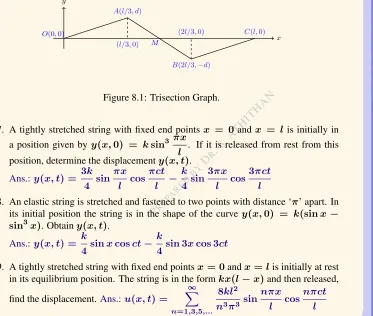
5. The points of trisection of a tightly stretched string of length ‘l’ units with fixed ends pulled aside through a distance of ‘d’ units on opposite sides of the position of equilibrium and the string is released from rest. Find the expression for the displacement of the string at any subsequent time. Show also that the midpoint of the string remains always at rest.
Hint: Use Figure.8.1for the boundary conditions.
Ans.:u(x, t) =
∞
X
n=2,4,6,... 36d
n2π2sin
nπ
3 sin
nπx
l cos
nπct
l
i.e.u(x, t) =
∞
X
r=1 9d
r2π2 sin 2rπ
3 sin 2rπx
l cos
2rπct
l
6. A tightly stretched string with fixed end pointsx = 0andx = lis initially in a position given byy(x,0) =ksin3πx
l cos 2πx
l . If it is released from rest from this position, determine the displacementy(x, t).
Ans.: k 2sin
πx
l cos
πct
l +
k
2sin 5πx
l cos
5πct
What is a Partial . . . Classifying PDE’s: . . . Examples of Wave . . . Solution of 1-D Wave . . . The Plucked String as . . . Uniqueness of the . . . Solved . . .
Exercise/Practice/Assignment . . .
Home Page Title Page JJ II
J I
Page27of31 Go Back Full Screen
Close Quit
P
REPA RE
DB Y
D
R
. S
. A
T
H
IT
H
A
N
x y
A(l/3, d)
B(2l/3,−d)
C(l,0)
(l/3,0)
(2l/3,0)
O(0,0)
M
Figure 8.1: Trisection Graph.
7. A tightly stretched string with fixed end pointsx = 0 andx = lis initially in a position given byy(x,0) = ksin3πx
l . If it is released from rest from this position, determine the displacementy(x, t).
Ans.:y(x, t) = 3k 4 sin
πx
l cos
πct
l −
k
4sin 3πx
l cos
3πct
l
8. An elastic string is stretched and fastened to two points with distance ‘π’ apart. In its initial position the string is in the shape of the curvey(x,0) = k(sinx−
sin3x). Obtainy(x, t). Ans.:y(x, t) = k
4sinxcosct−
k
4sin 3xcos 3ct
9. A tightly stretched string with fixed end pointsx= 0andx= lis initially at rest in its equilibrium position. The string is in the formkx(l−x)and then released, find the displacement.Ans.:u(x, t) =
∞
X
n=1,3,5,... 8kl2
n3π3 sin
nπx
l cos
nπct
What is a Partial . . . Classifying PDE’s: . . . Examples of Wave . . . Solution of 1-D Wave . . . The Plucked String as . . . Uniqueness of the . . . Solved . . .
Exercise/Practice/Assignment . . .
Home Page Title Page JJ II
J I
Page28of31 Go Back Full Screen
Close Quit
P
REPA RE
DB Y
D
R
. S
. A
T
H
IT
H
A
N
10. A tightly stretched string with its end pointsx = 0 andx = l are fastened. The mid point of the string is displaced transversally through a small distanceb and the string is released from rest from that position. Find an expression for the transverse displacement of the string at any time during the subsequent motion.
Ans.:u(x, t) =
∞
X
n=1 8b
n2π2 sin
nπ
2 sin
nπx
l cos
nπct
l
11. A tightly stretched string with its end pointsx = 0andx= lare fastened. The pointx = l/3of the string is displaced transversally through a small distance hand the string is released from rest from that position. Find an expression for the transverse displacement of the string at any time during the subsequent motion.
Ans.:u(x, t) =
∞
X
n=1 9h
n2π2 sin
nπ
3 sin
nπx
l cos
nπct
l
12. A tightly stretched string with its end pointsx = 0andx = 2l are fastened. The mid point of the string is displaced transversally through a small distanceb and the string is released from rest from that position. Find an expression for the transverse displacement of the string at any time during the subsequent motion.
Ans.:u(x, t) =
∞
X
n=1,3,5,... 8b
n2π2(−1)
(n−1) 2
sinnπx
l cos
nπct
l
13. A tightly stretched string with its end pointsx= 0andx=lis initially at rest in its equilibrium position. If it is set vibrating giving each point a velocitykx(l−x). Find the displacementy(x, t).Ans.:u(x, t) =
∞
X
n=1,3,5,... 8kl3
cn4π4sin
nπx
l sin
nπct
l
What is a Partial . . . Classifying PDE’s: . . . Examples of Wave . . . Solution of 1-D Wave . . . The Plucked String as . . . Uniqueness of the . . . Solved . . .
Exercise/Practice/Assignment . . .
Home Page Title Page JJ II
J I
Page29of31 Go Back Full Screen
Close Quit
P
REPA RE
DB Y
D
R
. S
. A
T
H
IT
H
A
N
points are given a velocityv =
ax, when0< x < l 2 ax(l−x), when l
2 < x < l
. Find the
dis-placement at any timet.Ans.:u(x, t) =
∞
X
n=1,3,5,... 4al2 cn3π3sin
nπx
l (−1)
(n−1) 2
sinnπct
l
15. If a string of length ‘l’ is initially at rest in its equilibrium position and each of its
points are given a velocityv = (
ax, when0< x < l
ax(l−x), whenl < x <2l. Find the dis-placement at any timet.Ans.:u(x, t) =
∞
X
n=1,3,5,... 16al
cn3π3sin
nπx
2l (−1)
(n−1) 2
sinnπct 2l
16. A uniform string of length ‘l’ is struck in such a way that an initial velocity of
v0is imparted to the portion of the string between
l 4 and
3l
4 while the string is in its equilibrium position. Find the displacement of the string at any time. Ans.:
u(x, t) =
∞
X
n=1 4v0l
cn2π2 sin
nπ 2 sin nπ 4 sin nπx l sin nπct 2l
17. A uniform string of length ‘l’ is struck in such a way that an initial motion is started
by displacing the string in the form10 sin3πx
l and also by imparting the string with initial velocity15 sin9πx
l . Find the displacement of the string at any time. Ans.:u(x, t) = 10 cos3πct
l sin
3πx
l +
15l
9πcsin
9πct
l sin
9πx
What is a Partial . . . Classifying PDE’s: . . . Examples of Wave . . . Solution of 1-D Wave . . . The Plucked String as . . . Uniqueness of the . . . Solved . . .
Exercise/Practice/Assignment . . .
Home Page Title Page JJ II
J I
Page30of31 Go Back Full Screen
Close Quit
P
REPA RE
DB Y
D
R
. S
. A
T
H
IT
H
A
N
18. A string is stretched and fastened to two points with distance ‘l’ apart. Motion is started by displacing the string into the form of the curveu= x(l−x)and also by imparting a constant velocitykto every point of the string in this position at timet= 0. Determine the displacement of the string.
19. A uniform string of length ‘l’ is struck in such a way that an initial motion is started
by displacing the string in the formu=
x, when0< x < l 2
(l−x), when l
2 < x < l
and also
by imparting the string with initial velocityx(l−x). Find the displacement of the string at any time.
Ans.:u(x, t) =
∞
X
n=1,3,5,...
sinnπx
l
4l
n2π2cos
nπct
l sin
nπ
2 +
8l3
n4π4c2sin
nπct
l
DEARALL, HEREIHAVE SOLVED FEW PROBLEMS ONLY AND SOME TOPICS MAY BE MISSED. PLEASE FOLLOW THE CLASSWORK TO HAVE ALL THE TOPICS FOR PREPARATION. TAKEEXRECISE PROBLEMS GIVEN AT THE END FOR YOUR PRAC-TICE. APART FROM EXERCISE,YOU CAN FOLLOW ANY REFERENCE BOOK FOR YOUR PRACTICE.
SOME OF THE SECTIONS/TOPICS IN THIS UNIT ARE PRELIMINARY IDEAS WHICH ARE BASICS NEEDED TO DO OUR REGULAR COURSE EXAMPLES AND EXERCISES.
Acknowledgement:
What is a Partial . . . Classifying PDE’s: . . . Examples of Wave . . . Solution of 1-D Wave . . . The Plucked String as . . . Uniqueness of the . . . Solved . . .
Exercise/Practice/Assignment . . .
Home Page Title Page JJ II
J I
Page31of31 Go Back Full Screen
Close Quit
P
REPA RE
DB Y
D
R
. S
. A
T
H
IT
H
A
N
Contact: (+91) 979 111 666 3 (or)[email protected]