Meeting Report from the Second “Minimum Information for
Biological and Biomedical Investigations” (MIBBI) workshop
Carsten Kettner1, Dawn Field2*, Susanna-Assunta Sansone3*, Chris Taylor4*, Jan Aerts5, Nigel Binns6, Andrew Blake7,
Cedrik M. Britten8, Ario de Marco9,10, Jennifer Fostel11, Pascale Gaudet12, Alejandra González-Beltrán13, Nigel Hardy14, Jan Hellemans15, Henning Hermjakob4, Nick Juty4, Jim Leebens-Mack16, Eamonn Maguire3, Steffen Neumann17, Sandra Orchard4, Helen Parkinson4, William Piel18, Shoba Ranganathan19,20, Philippe Rocca-Serra3,
Annapaola Santarsiero21, David Shotton22, Peter Sterk23, Andreas Untergasser24, Patricia L. Whetzel25 1 Beilstein-Institut, Frankfurt am Main, Germany
2 Centre for Ecology & Hydrology, Oxfordshire UK
3 University of Oxford, Oxford e-Research Centre, Oxfordshire, UK
4 The European Bioinformatics Institute (EBI), Wellcome Trust Genome Campus, Hinxton, Cambridgeshire, UK 5 Faculty of Engineering - ESAT/SCD, Leuven University, Leuven-Heverlee, Belgium
6 Division of Pathway Medicine, University of Edinburgh Medical School, Edinburgh, UK 7 MRC Harwell, Harwell Science and Innovation Campus, Oxfordshire, UK
8Medical Department, University Medical Center, Johannes Gutenberg University-Mainz, Mainz, DE 9 Consortium for Genomic Technology, Milano, Italy
10 University of Nova Gorica, Nova Gorica, Slovenia 11 US National Toxicology Program, NIEHS, NIH, NC, USA 12 Swiss Institute of Bioinformatics, Geneva, CH
13 Computational and Systems Medicine and Department of Computer Science, University College London, London, UK
14 Department of Computer Science, Aberystwyth University, Aberystwyth, UK 15Center for Medical Genetics, Ghent University, Ghent, Belgium
16 Department of Plant Biology, University of Georgia, Athens, GA, USA
17 Department of Stress- and Developmental Biology, Institute for Plant Biochemistry, Halle, DE 18 Peabody Museum of Natural History, Yale University, New Haven, CT, USA
19 Macquarie University, Sydney NSW, Australia 20 National University of Singapore, Singapore
21 The Mario Negri Institute for Pharmacological Research, Cancer Pharmacology, 20156 Milan, Italy 22 Image Bioinformatics Research Group, Department of Zoology, University of Oxford, Oxford, UK 23 Wellcome Trust Sanger Institute, Wellcome Trust Genome Campus, Hinxton, Cambridgeshire, UK 24 Zentrum für Molekulare Biologie der Universität Heidelberg, Heidelberg, Germany
25 The National Center for Biomedical Ontology / Stanford Center for Biomedical Informatics Research, Stanford University, Stanford, CA, USA
*Corresponding Author: [email protected]
Introduction
There is now a growing trend for grass-roots communities of researchers to define MI check-lists for the description and contextualization of data, in order to facilitate sharing and to fully de-scribe those data for publication and review. These guidelines are used both to describe data and the processes by which they were created, and to guide the creation of electronic resources for the storage of such descriptions. With the pub-lication of a community-level paper in 2008 [1], the ‘Minimum Information for Biological and Bio-medical Investigations’ (MIBBI) initiative was formally established, having begun in 2006 when a group of MI checklist project leaders came to-gether to discuss the increase in common activity within the data sharing community and the conse-quent need for more efficient networking and col-laboration where possible. MIBBI is intended to bring together community leaders for all MI checklist projects, to tackle shared challenges, de-velop best practice and create new solutions that ease the development of MI checklists and help to promote their implementation and adoption.
Seventeen representatives of minimum informa-tion checklist communities attended the first MIBBI meeting in 2008. Today some thirty-six community checklists are registered in the MIBBI Portal. This second MIBBI meeting once again convened the representatives of these minimum information checklist communities for a two day workshop in the historic Hotel Jagdschloss Nie-derwald near Rüdesheim, Germany on Dec 1-2, 2010. The setting and the limited number of par-ticipants provided a convivial atmosphere for the ready exchange of thoughts and ideas. The meet-ing was organized by Carsten Kettner (Beilstein-Institut), Chris Taylor (European Bioinformatics Institute), Susanna-Assunta Sansone (University of Oxford) and Dawn Field (Centre for Ecology and Hydrology) and was hosted and supported by the Beilstein-Institut.
The three primary objectives of the meeting were to: 1) review and advise on the current state of the MIBBI project; 2) formalize the ownership, upkeep and further development of MIBBI Foun-dry module content; and 3) reach a position on interactions with other standards projects and resources. The meeting included a series of com-munity introductions, formal presentations on key
topics to seed debate, extended discussion ses-sions and breakout groups.
Community Introductions
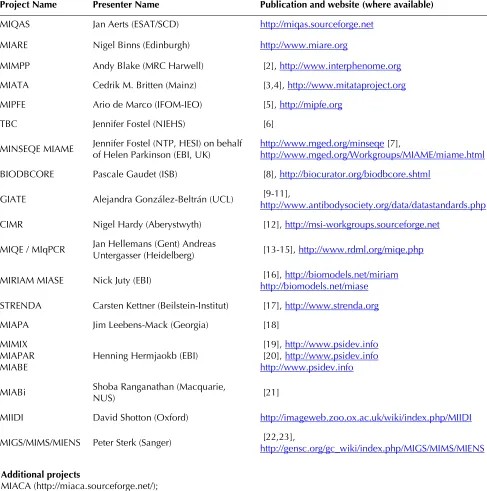
The meeting opened with presentations by the checklist representatives present at the workshop. Attendees representing projects that have gener-ated one or more MI specifications were re-quested to prepare a three-minute introduction to describe the scope and status of those specifica-tions. Each presentation covered: 1) the scope of the specification(s) they represent; 2) the status of the specification(s) and any associated resources; and 3) a summary of their contributors and means of support. These slides, along with others from the meeting, are available via the MIBBI site
listed in Table 1 along with a reference where one exists. They cover a wide range of data types and are in all stages of development from just-envisioned to well-established within the commu-nity.
The MIBBI Foundry - the working
intersection of MI checklist groups
Table 1. Checklists presented at the second MIBBI workshop*.
Project Name Presenter Name Publication and website (where available)
MIQAS Jan Aerts (ESAT/SCD)
MIARE Nigel Binns (Edinburgh)
MIMPP Andy Blake (MRC Harwell) [2],
MIATA Cedrik M. Britten (Mainz) [3,4],
MIPFE Ario de Marco (IFOM-IEO) [5],
TBC Jennifer Fostel (NIEHS) [6]
MINSEQE MIAME Jennifer Fostel (NTP, HESI) on behalf of Helen Parkinson (EBI, UK)
BIODBCORE Pascale Gaudet (ISB) [8],
GIATE Alejandra González-Beltrán (UCL) [9-11],
CIMR Nigel Hardy (Aberystwyth) [12],
MIQE / MIqPCR Jan Hellemans (Gent) Andreas Untergasser (Heidelberg) [13-15],
MIRIAM MIASE Nick Juty (EBI) [16],
STRENDA Carsten Kettner (Beilstein-Institut) [17], MIAPA Jim Leebens-Mack (Georgia) [18]
MIMIX MIAPAR
MIABE Henning Hermjaokb (EBI)
[19],
[20],
MIABi Shoba Ranganathan (Macquarie, NUS) [21]
MIIDI David Shotton (Oxford)
MIGS/MIMS/MIENS Peter Sterk (Sanger) [22,23],
Additional projects
MIACA (http://miaca.sourceforge.net/);
MIAME/Env [24]; MIAME/Nutr & MIAME/Tox
MIAME/Plant [25]; MIAPE [26]; MIASPPE [27]; MIEME [28]; MIFlowCyt [29]; MIfMRI [30];
MIGen
MINI [31]; MINIMESS [32]; MISFISHIE [33]
The participants then discussed the merits of a modular approach to checklist development and use. All agreed that it was sensible for checklist communities to work together both to promote best practice and to ensure as far as possible that their checklists are orthogonal (non-overlapping) and semantically comparable; for example, by tag-ging individual checklist items with ontology terms.
Breakout groups were organized to tackle a varie-ty of issues surrounding the development, main-tenance and use of MI checklists and to deliberate on a variety of questions about the MIBBI Foun-dry. There were three groups, designed to reflect the interests of ‘wet lab’ bench scientists, bioin-formaticians/developers and the ‘meta-standards’ community (i.e., those seeking to integrate stan-dards-based resources). These groups were led by Carsten Kettner (Beilstein-Institut), Pascale Gau-det (Swiss Institute of Bioinformatics) and Hen-ning Hermjakob (European Bioinformatics Insti-tute) respectively, with Jan Hellemans (University of Gent), Jim Leebens-Mack (University of Geor-gia), and Trish Whetzel (Stanford University) re-porting back on their discussions. The groups ranged wide, but common themes emerged, as summarized at the end of this report.
Towards a MIBBI Core - a shared resource
for community checklist developers
Common themes emerged from individual MI group presentations including a desire for flexible and extensible tools for the facilitation of data sharing. In response, Philippe Rocca-Serra (Uni-versity of Oxford) presented the ISA infrastruc-ture, a data sharing software suite that depends critically on the dissemination of mature check-lists for the capture of standards-compliant expe-rimental metadata. The ISA infrastructure [34] provides a set of tools dedicated to the annotation and reporting of classic and functional genomics experiments, enabling efficient reporting, seman-tic tagging and support for submission to various public databases. The highly configurable nature of the architecture has been applied to implement a number of MI checklists. Preliminary validation work resulted in the creation of configurations for MIENS, MISFISHIE, MIAME and MIFlowCyt in di-rect collaboration with representatives of those checklists; the first components of a library of con-figurations for those and many other MI check-lists. For groups defining minimal annotation that
validation tools, the ISA infrastructure was pre-sented as providing a considerable head start for implementing and delivering annotation solutions quickly and effectively.
There then followed a presentation on MICheck-out, developed by Chris Taylor and Eamonn Ma-guire (University of Oxford). This tool, built with Adobe Flash, Java, RESTful web services, XML and XSLT, allows users to compile MIBBI Foundry modules into custom lists that can be viewed or downloaded in various formats. The initial version of the tool, as presented at the workshop, provides users with access to the full range of modules in the MIBBI Foundry; those modules having been derived from the checklists registered in the MIB-BI Portal. The modules are stored in XML, which is transformed by the tool on demand to provide the requested output. Subsequent discussion centered on the healthy tension that exists between the de-sire for integration where MI checklists overlap and the tailoring of checklists to meet the needs of particular user communities. In its current form, MICheckout was considered useful for developers, and for end-users employing multiple technolo-gies. However, scientists, and reviewers for fund-ers, journals or regulators require a much-simplified interface that leans heavily on the do-main/technique-specific checklists listed in the MIBBI Portal to ensure that equivalent users ob-tain identical checklists built on best practices within the field.
contribu-cently produced the MIBBI-registered BioDBCore checklist [8], which aims to improve standardiza-tion across biological databases. Under develop-ment with Annapaola Santarsiero (The Mario Ne-gri Institute) are a ‘one-stop shop’ catalogue and a communication forum to help centralize informa-tion on bioscience data policies, standards and links to other related portals, including MIBBI and the National Center for Biomedical Ontology (NCBO) BioPortal, and to establish the formal communication channels needed to maintain links between stakeholders.
Trish Whetzel (National Center for Biomedical On-tology) then gave a brief overview of the NCBO, which provides online tools and a Web portal - the BioPortal [26] - for biomedical researchers, enabl-ing them to access, review and integrate disparate ontological resources covering all aspects of bio-medical investigation and clinical practice. A ma-jor focus of NCBO is the use of biomedical ontolo-gies to aid in the management and analysis of da-ta; here the interplay with MI checklists is pivotal. Returning to their working groups, the partici-pants next addressed two subjects: the general direction of MIBBI (i.e., how the project should evolve); and the design of the MICheckout tool. Again, the outcomes of these discussions have been fed into the summary at the end of this re-port.
Wrap up session and outcomes
The group then spent one hour wrapping up and deciding on actions in a session chaired by Dawn Field, who gave a brief overview of the meeting and then opened the floor for discussion. All were in agreement that: 1) MIBBI should continue; 2) future meetings would be of value; 3) the Portal should be improved; 4) that there is a need to strike a balance between the independence of MI communities (as listed in the Portal) and the need for harmonization (through the Foundry); 5) that communication should be improved; and that 6) in general there are many ways in which the project could develop.
Attendees felt that the most positive
out-comes of the meeting were:
• The chance to meet other MI
checklist project coordinators
and exchange knowledge.
• The clarification of the roles of
MIBBI:
o For developers: promoting
best practice on creating MIs;
working with those seeking
va-lidation for their
implementa-tion (
e.g.
checklist modules that can be
re-used by communities to
im-prove compatibility;
develop-ment and maintenance of
mappings between community
checklists; providing tutorials
and forums for discussion.
o for end-users: provision of
guidance and tools to simplify
the identification of relevant
standards; links to summaries
of journals’ and funders’
re-quirements and tools to
sup-port those requirements;
pro-vision of instructive examples
of usage; and the development
of a wizard to help end-users
identify checklists with which
they should be trying to
comp-ly.
• The agreement to provide a core
set of MIBBI modules covering
common bioscience workflow
components for reuse in
com-munities’ own checklists.
• The identification of tools to help
users to meet the requirements of
several MI checklists, such as ISA
software suite.
Agreements on the specific roles and
further development of the various parts
of MIBBI included:
1. Portal
Roles
maintain up-to-date versions of
descriptions of MI projects;
ac-tively engage with checklist
project representatives, for
ex-ample, through regular email
circulars.
Best practices
ensure all projects provide
standard descriptions of their
MI checklists; define ‘style
guid-ance’ for checklists (which
cur-rently vary greatly); support
DOIs and ORCIDs; recommend
the use of version control and
the timely handling of requests
for revisions.
Certification/uptake
creation of a process to certify
tools/systems, to maximize
adoption (because the more
tools that are genuinely
com-pliant, the easier it is for users
to comply); opening of dialogs
with national standards groups.
2. Foundry
Role
enhance the compatibility of
community checklists without
encroaching on their
indepen-dence.
Common elements
the MIBBI Foundry should offer
a core set of modules covering
common areas of workflows;
those modules and their
com-ponents should be semantically
tagged and available in several
formats, to be reused by
indi-vidual communities to enhance
checklist compatibility.
Project-specific content
offer the facility to host or
mir-ror communities’ checklist
con-tent to facilitate its discovery
and use, ensuring that users
have straightforward access to
up-to-date guidance.
3. Website
Role
to provide information about
the project to newcomers and
others in concise, bulleted form.
User management
the website should cater to
de-velopers and other kinds of user
(bench scientists, reviewers of
various kinds) separately,
ac-knowledging their different
needs.
4. MIBBI in the context of the
BioSharing initiative
Role
to represent the interests of the
MI checklist community and to
ensure stable links to other
standards and the bodies that
represent them.
Acknowledgements
The authors would like to thank the Beilstein-Institut for both the financial support and hosting this Work-shop.
References
1. Taylor CF, Field D, Sansone SA, Aerts J, Apweiler R, Ashburner M, Ball CA, Binz PA, Bogue M, Booth T, et al. Promoting coherent minimum
re-investigations: the MIBBI project. Nat Biotechnol 2008; 26:889-896
2. Hancock JM, Adams NC, Aidinis V, Blake A, Bo-gue M, Brown SD, Chesler EJ, Davidson D, Duran C, Eppig JT, et al. Mouse Phenotype Database In-tegration Consortium: inIn-tegration [corrected] of mouse phenome data resources. Mamm Genome 2007; 18:157-163
3. Janetzki S, Britten CM, Kalos M, Levitsky HI, Maecker HT, Melief CJ, Old LJ, Romero P, Hoos A, Davis MM. MIATA"-minimal information about T cell assays. Immunity 2009; 31:527-528
4. Britten CM, Janetzki S, Van der Burg SH, Huber C, Kalos M, Levitsky HI, Maecker HT, Melief CJ, O'Donnell-Tormey J, Old LJ, et al. Minimal in-formation about T cell assays: the process of reaching the community of T cell immunologists in cancer and beyond. Cancer Immunol
Immu-nother 2010; (Nov):16
5. de Marco A. Minimal information: an urgent need to assess the functional reliability of recombinant proteins used in biological experiments. Microb
Cell Fact 2008; 7:20
6. Fostel JM, Burgoon L, Zwickl C, Lord P, Corton JC, Bushel PR, Cunningham M, Fan L, Edwards SW, Hester S, et al. Toward a checklist for ex-change and interpretation of data from a toxicolo-gy study. Toxicol Sci 2007; 99:26-34
7. Brazma A, Hingamp P, Quackenbush J, Sherlock GSP, Stoeckert C, Aach J, Ansorge W, Ball CA, Causton HC, Gaasterland T, et al. Minimum in-formation about a microarray experiment (MIAME)-toward standards for microarray data.
Nat Genet 2001; 29:365-371
8. Gaudet P, Bairoch A, Field D, Sansone SA, Taylor C, Attwood TK, Bateman A, Blake JA, Bult CJ, Cherry JM, et al. Towards BioDBcore: a commu-nity-defined information specification for biologi-cal databases. Nucleic Acids Res 2010.
9. Yong M, Begent R. Best use of experimental data in cancer informatics. Future Oncol 2010;
6:1551-1562
10. Yong M, Tolner B, Nagl S, Pedley RB, Chester K, Green AJ, Mayer A, Sharma S, Begent R. Data standards for minimum information collection for antibody therapy experiments. Protein Eng Des Sel 2008; 22:221-224
11. Gonzalez-Beltran A, Yong M, Begent R. Towards an unambiguous and formal description of cancer
therapy experiments. In “Building a Collaborative Biomedical Network“, caBIG Annual Meeting, September 13-15, 2010, Washington, D.C., U.S.A. 2009.
12. Sansone SA, Fan T, Goodacre R, Griffin JL, Hardy NW, Kaddurah-Daouk R, Kristal BS, Lindon J, Mendes P, Morrison N, et al. The metabolomics standards initiative. Nat Biotechnol 2007; 25
:846-848
13. Bustin SA, Benes V, Garson JA, Hellemans J, Huggett J, Kubista M, Mueller R, Nolan T, Pfaffl MW, Shipley GL, et al. The MIQE guidelines: minimum information for publication of quantita-tive real-time PCR experiments. Clin Chem 2009; 55:611-622
14. Bustin SA, Beaulieu JF, Huggett J, Jaggi R, Kibenge FS, Olsvik PA, Penning LC, Toegel S. MIQE pre-cis: Practical implementation of minimum stan-dard guidelines for fluorescence-based quantita-tive real-time PCR experiments. BMC Mol Biol
2010; 11:74
15. Lefever S, Hellemans J, Pattyn F, Przybylski DR, Taylor C, Geurts R, Untergasser A, Vandesompele J. RDML: structured language and reporting guidelines for real-time quantitative PCR data.
Nucleic Acids Res 2009; 37:2065-2069
16. Novère N, Finney A, Hucka M, Bhalla US, Cam-pagne F, Collado-Vides J, Crampin EJ, Halstead M, Klipp E, Mendes P, et al. Minimum informa-tion requested in the annotainforma-tion of biochemical models (MIRIAM). Nat Biotechnol 2005; 23
:1509-1515
17. Apweiler R, Armstrong R, Bairoch A, Cornish-Bowden A, Halling PJ, Hofmeyr JH, Kettner C, Leyh TS, Rohwer J, Schomburg D, et al. A large-scale protein-function database. Nat Chem Biol
2010; 6:785
18. Leebens-Mack J, Vision T, Brenner E, Bowers JE, Cannon S, Clement MJ, Cunningham CW, de-Pamphilis C, deSalle R, Doyle JJ, et al. Taking the first steps towards a standard for reporting on phy-logenies: Minimum Information About a Phyloge-netic Analysis (MIAPA). OMICS 2006; 10
:231-237
Nat Biotechnol 2007; 25:894-898
20. Bourbeillon J, Orchard S, Benhar I, Borrebaeck C, de Daruvar A, Dubel S, Frank R, Gibson F, Glo-riam D, Haslam N, et al. Minimum information about a protein affinity reagent (MIAPAR). Nat
Biotechnol 2010; 28:650-653
21. Tan TW, Tong JC, De Silva M, Lim KS, Rangana-than S. Advancing Standards for Bioinformatics Activities: Persistence, Reproducibility, Disam-biguation and Minimum Information about a Bio-informatics Investigation (MIABi). BMC Genomics 2010; 11(Suppl 4):S27
22. Field D, Garrity G, Gray T, Morrison N, Selengut J, Sterk P, Tatusova T, Thomson N, Allen MJ, An-giuoli SV, et al. The minimum information about a genome sequence (MIGS) specification. Nat
Biotechnol 2008; 26:541-547
23. Yilmaz P, Kottmann R, Field D, Knight R, Cole JR, Amaral-Zettler L, Gilbert JA, Karsch-Mizrachi I, Johnston A, Cochrane G, et al. The “Minimum In-formation about an ENvironmental Sequence” (MIENS) specification. Available from Nature Pre-cedings
<http://dx.doi.org/10.1038/npre.2010.5252.2> 2010.
24. Morrison N, Wood AJ, Hancock D, Shah S, Hakes L, Gray T, Tiwari B, Kille P, Cossins A, Hegarty M, et al. Annotation of environmental OMICS data: application to the transcriptomics domain. OM-ICS 2006; 10:172-178
25. Zimmermann P, Schildknecht B, Craigon D, Gar-cia-Hernandez M, Gruissem W, May S, Mukher-jee G, Parkinson H, Rhee S, Wagner U, et al. MIAME/Plant - adding value to plant microarrray experiments. Plant Methods 2006; 2:1
26. Noy NF, Shah NH, Whetzel PL, Dai B, Dorf M, Griffith N, Jonquet C, Rubin DL, Storey MA, Chute CG, et al. BioPortal: ontologies and inte-grated data resources at the click of a mouse. Nucleic Acids Res 2009; 37:W170-W173
27. Carrascal M, Ovelleiro D, Casas V, Gay M, Abian J. Phosphorylation analysis of primary human T lymphocytes using sequential IMAC and titanium oxide enrichment. J Proteome Res 2008; 7
:5167-5176
28. Frishkoff GW, LePendu P, Frank RM, Liu H, Dou D. Development of Neural Electromagnetic On-tologies (NEMO): Ontology-based Tools for Re-presentation and Integration of Event-related Brain Potentials. Available from Nature Precedings <http://dx.doi.org/doi:10.1038/npre.2009.3458.1 > 2009.
29. Lee JA, Spidlen J, Boyce K, Cai J, Crosbie N, Dal-phin M, Furlong J, Gasparetto M, Goldberg M, Goralczyk EM, et al. MIFlowCyt: the minimum in-formation about a Flow Cytometry Experiment.
Cytometry A 2008; 73A:926-930
30. Poldrack RA, Fletcher PC, Henson RN, Worsley KJ, Brett M, Nichols TE. Guidelines for reporting an fMRI study. Neuroimage 2008; 40:409-414
31. Gibson F, Overton PG, Smulders TV, Schultz SR, Eglen SJ, Ingram CD, Panzeri S, Bream P, Whit-tington M, Sernagor E, et al. Minimum Informa-tion about a Neuroscience InvestigaInforma-tion (MINI): Electrophysiology. Available from Nature Preced-ings 2009.
32. Raes J, Foerstner KU, Bork P. Get the most out of your metagenome: computational analysis of en-vironmental sequence data. Curr Opin Microbiol 2007; 10:490-498
33. Deutsch EW, Ball CA, Berman JJ, Bova GS, Braz-ma A, Bumgarner RE, Campbell D, Causton HC, Christiansen JH, Daian F, et al. Minimum infor-mation specification for in situ hybridization and immunohistochemistry experiments (MISFISHIE).
Nat Biotechnol 2008; 26:305-312
34. Rocca-Serra P, Brandizi M, Maguire E, Sklyar N, Taylor C, Begley K, Field D, Harris S, Hide W, Hofmann O, et al. ISA software suite: supporting standards-compliant experimental annotation and enabling curation at the community level.
Bioin-formatics 2010; 26:2354-2356
35. Field D, Sansone SA, Collis A, Booth T, Dukes P, Gregurick SK, Kennedy KL, Kolar P, Kolker E, Maxon M, et al. 'Omics Data Sharing. Science 2009; 326:234-236