REVIEW
The BAF complex in development
and disease
Amelie Alfert, Natalia Moreno and Kornelius Kerl
*Abstract
The ATP-dependent chromatin remodelling complex BAF (
=
mammalian SWI/SNF complex) is crucial for the
regu-lation of gene expression and differentiation. In the course of evolution from yeast to mammals, the BAF complex
evolved an immense complexity with a high number of subunits encoded by gene families. In this way, tissue-specific
BAF function and regulation of development begin with the combinatorial assembly of distinct BAF complexes
such as esBAF, npBAF and nBAF. Furthermore, whole-genome sequencing reveals the tremendous role BAF complex
mutations have in both neurodevelopmental disorders and human malignancies. Therefore, gaining a more
elabo-rate insight into how BAF complex assembly influences its function and which role distinct subunits play, will
hope-fully give rise to a better understanding of disease pathogenesis and ultimately to new treatments for many human
diseases.
Keywords:
Rhabdoid tumour, Synovial sarcoma, Mammalian SWI/SNF complex, BAF complex, Cancer, Epigenetic,
Chromatin remodelling, Neurodevelopmental disorders
© The Author(s) 2019. This article is distributed under the terms of the Creative Commons Attribution 4.0 International License (http://creat iveco mmons .org/licen ses/by/4.0/), which permits unrestricted use, distribution, and reproduction in any medium, provided you give appropriate credit to the original author(s) and the source, provide a link to the Creative Commons license, and indicate if changes were made. The Creative Commons Public Domain Dedication waiver (http://creat iveco mmons .org/ publi cdoma in/zero/1.0/) applies to the data made available in this article, unless otherwise stated.
Background
Packing a DNA strand, with the length of over 1 m, into
a 5-μm nucleus is obviously a challenge to be met in the
course of evolution. It is known that this can only be
achieved by condensation of DNA with the help of
his-tones [
1
,
2
]. Further compaction is engineered by
addi-tional proteins [
3
]. However, the DNA still needs to be
accessible to the transcription machinery. In this way,
organisation of DNA in chromatin is both an obstacle
and an additional way of gene regulation (see Ref. [
4
] for
a review).
Epigenetic mechanisms allow regulation of DNA
expression and chromatin accessibility and include DNA
methylation (see Ref. [
5
,
6
] for reviews), histone
modifi-cations (see Ref. [
7
,
8
] for reviews) and ATP-dependent
chromatin remodelling. This review will focus on the
SWI/SNF family of ATP-dependent chromatin
remodel-ling complexes and its role in development and disease.
Evolutionary aspects of ATP‑dependent chromatin
remodelling by SWI/SNF complexes
The first subunits of the ATP-dependent SWI/SNF
com-plex were discovered in yeast, where some of its subunits
were detected in two independent genetic screenings,
one for genes being responsible for the regulation of
mat-ing-type switching [
9
] and the other for those being able
to allow changing of nutrient sources used for energy
supply [
10
–
12
]. With respect to these discoveries, the
term SWI/SNF complex (short for SWItch/sucrose
non-fermentable) was coined and is used in other species as
well [
13
–
18
].
The yeast SWI/SNF complex has a molecular weight
of just 1.14 MDa [
19
] and is composed of six core
sub-units (Swi2/Snf2 as ATPase subunit, Swi1, Swi3, Snf5,
Snf4 and Snf6) and additional Swp- and actin-related
proteins (Swp29, Swp59, Swp61, Swp73 and Swp82).
Consequently, it is less elaborate than its mammalian
counterpart [
13
,
19
,
20
].
In Drosophila melanogaster, Brahma (Brm) is the
equivalent of the yeast Swi2/Snf2 ATPase subunit and the
complex it forms with additional proteins is named BAP
(short for Brahma-associated protein) complex [
21
–
23
].
This complex was first discovered in screens to uncover
Open Access
*Correspondence: [email protected]
genes that are able to suppress phenotypes caused by
mutations in Polycomb genes [
23
,
24
].
Mirroring the increasing complexity of the
mamma-lian genome compared to yeast and fly, the mammamamma-lian
equivalents of the earlier discovered ATP-dependent
chromatin remodellers also became more diverse [
25
].
The BAF complex is one of four ATP-dependent
chro-matin remodelling complex families known in
mam-mals (the others being INO80/SWR1, ISWI and CHD)
(see Ref. [
26
] for a review). In the course of evolution,
some of the yeast SWI/SNF subunits stayed conserved in
mammalian genes encoding the BAF complex subunits
BAF250a/b (homologues of Swi1), BRG1/BRM (Swi2),
BAF155/170 (Swi3), BAF60 (Swp73), BAF53 (ARP7/9),
BAF47 (Snf5) and the BAF45 family (Swp 82). More
recently evolved subunits such as BCL7a/b/c, BCL11a/b,
BRD7/9 and SS18/CREST lack homologues in yeast [
18
,
27
,
28
].
Taking into account that the 2 MDa mammalian BAF
(short for BRG1/BRM-associated factor) complex
con-tains up to 15 subunits [
18
,
25
,
27
,
29
] and that many
of these subunits are encoded by gene families and can
therefore be replaced by their paralogues, it becomes
clear that there are hundreds of potential assemblies
pos-sible for mammalian BAF complexes. At the same time,
the high stability of subunit binding amongst each other
prevents frequent subunit alterations [
27
,
30
]. Thus, the
combinatorial assembly becomes a way to ensure
com-plex specificity and allows the BAF comcom-plex to perform
the more elaborate regulation the mammalian genome
requires. Many of the resulting complexes are unique
to specific tissues or biological functions such as neural
development and function [
31
–
34
], heart development
[
35
,
36
], muscle development [
37
–
39
] or embryonic stem
cell pluripotency [
40
,
41
]. Hence, it is not only the BAF
complex itself that controls biological processes but the
expression of distinct BAF complexes with unique
subu-nit compositions is also a major part of the regulatory
process.
BRG1 or BRM is incorporated into the complex as
catalytic subunits with ATPase activity [
18
,
25
], and in
particular, their helicase domains show a high grade
of conservation [
42
,
43
]. Furthermore, BRG1 or BRM
alone is able to remodel nucleosome templates in vitro
without being accompanied by other subunits. Adding
three other dedicated members of the BAF complex,
namely BAF47, BAF155 and BAF170, this core
com-plex reaches a remodelling activity that resembles the
activity of the entire SWI/SNF complex [
44
].
None-theless, Mashtalir et al. recently questioned the idea
of a core complex consisting of the ATPase subunit,
BAF47, BAF155 and BAF170. Their studies revealed
that the assembly of the BAF complex begins with
the dimerisation of a BAF155::155 homodimer or a
BAF155::170 heterodimer. This is the platform for
fur-ther BAF assembly, and the core module is formed by
first incorporating BAF60 and later BAF47 and BAF57.
The next steps are the integration of BAF250 and later
BAF45C. Not until this core intermediate is formed,
can the ATPase module (consistent of BRG1 or BRM,
actin, SS18, BRD7 and BAF53A) bind and complete
the BAF complex [
45
]. Both core subunits and variable
ones contain DNA- and/or histone-binding domains
such as zinc fingers, AT-hooks and chromo- and
bro-modomains. As a result, BAF complexes do not only
recognise binding sites based on DNA sequence but
more importantly also based on architectural
charac-teristics and pre-existing regulatory histone
modifica-tions [
18
,
46
,
47
] (see [
48
] for a review).
Concurrent with changes in subunit composition
and gain in complexity in the course of evolution, the
functions to be fulfilled by SWI/SNF complexes also
expanded. The yeast genome mainly consists of actively
expressed genes, with SWI/SNF being responsible for
transcriptional activation but not for repression. In
this organism, SWI/SNF predominantly targets
his-tones and nucleosomes [
16
,
49
,
50
]. In Drosophila, on
the other hand, the BAP complex mostly executes its
function by opposing the Polycomb gene family [
23
,
51
,
52
]. In comparison with yeast and fly, the total number
of genes encoded by the mammalian genome is only
changed to a minor degree, but the amount of
regula-tory elements increased substantially and large parts
of the genome are in a repressed state. Reflecting this
circumstance, the mammalian BAF complex is able to
activate and repress genes, causing a limited
compara-bility between the yeast SWI/SNF complex and those in
more complex multicellular organisms [
53
–
55
].
The role of BAF complexes during mammalian
development
As already mentioned, distinct subunit compositions
occur at different time points during development and in
different tissues, underlining the importance of
combina-torial assembly in functional specificity of the BAF
com-plex. Three especially well-studied complex assemblies
are esBAF, npBAF and nBAF.
esBAF complex and its role in embryonic development
Embryonic stem cells (ESCs) are characterised by the
ability to self-renew and to differentiate into all cell
line-ages of the adult organism. This is, in part, achieved by
the expression of pluripotency-related transcription
fac-tors such as OCT4, SOX2 and NANOG [
59
–
63
]. Since
the genetic code remains unaltered in all tissues, the
relevance of epigenetic control of chromatin
assem-bly and accessibility as well as of gene expression itself
becomes exceedingly clear. Besides these unique abilities
of embryonic stem cells, they are also characterised by a
unique chromatin structure (e.g. a high amount of
biva-lent domains [
64
]). The assembly of an ES cell-specific
BAF (esBAF) complex is required for regulation of the ES
cell transcriptome. The esBAF complex is, in contrast to
BAF complexes in other cells, marked by the dependency
on BRG1 as ATPase subunit (while BRM is not included
in the esBAF complex). Moreover, it is distinguishable by
the incorporation of Baf250a not 250b, Baf60a/b not 60c
and a Baf155::155 homodimer instead of a Baf155::170
heterodimer in murine ESC [
41
,
54
]. In human ESC
BAF170, and not BAF155, seems to play an important
role in the maintenance of pluripotency [
65
].
A possible way of elucidating the role and importance
of individual subunits of multiprotein complexes in vivo
is the creation of mouse strains that lack these subunits.
Unfortunately, loss of Brg1, Baf155 or Baf47 is lethal to
these animals at a very early embryonic stage. Both Brg1
and
BAF155 knockouts are peri-implantationally lethal
and
Baf47-depleted embryos do not survive beyond day
7.5 [
66
–
69
]. Even if this fact emphasises the importance
of these subunits for early embryonic development and
stem cell function, it makes further research particularly
difficult. Interestingly, Brm-knockout mice reach
adult-hood and are fertile with the only difference to their
lit-termates being a slightly increased body size [
70
].
Regardless of the lethality of core-subunit loss in vivo,
(conditional) knockdown (KD) or knockout (KO)
experi-ments of distinct esBAF subunits proved themselves to
be a promising technique to study their role in in vitro
experiments with embryonic stem cells. Depleting cells
of Brg1 leads to both a loss of self-renewal and a decrease
in proliferation followed by a diminished expression of
the core pluripotency-related factors Oct4, Sox2 and
Nanog and loss of pluripotency. A Baf155 knockout in
ESCs results in a similar phenotype [
41
].
Correspond-ing to the unique subunit composition of esBAF,
nei-ther Brm nor Baf170 overexpression can rescue Brg1 or
Baf155 knockout, respectively. A forced expression of
Baf170-containing complexes also results in the inability
of the transfected cells to form teratoma, indicating a loss
of pluripotency [
41
,
67
]. This cannot be observed when
depleting mouse embryonic fibroblasts (MEFs) or glial
cells of Brg1 [
31
,
67
], once again highlighting the distinct
requirements of the ES cell genome.
Furthermore, chromatin immunoprecipitation
experi-ments followed by sequencing (ChIPseq) allowed a more
specific detection of esBAF binding to the genome. It
was detected that Brg1 binds to approximately four
per-centage of the mouse genome with binding sites located
in genic and promoter regions as well as in intergenic
regions. Both Brg1 and Baf155 are enriched near the
transcriptional starting site (TSS) and at least in part
resemble the binding patterns of core pluripotency
fac-tors Oct4, Nanog and Sox2 [
40
]. Murine ESC
pluri-potency is also ensured by the leukaemia inhibitory
factor (Lif) and the Stat3 pathway that is activated by Lif.
STAT3 signalling also plays a role in human embryonic
stem cell pluripotency [
71
–
73
]. Interestingly, Brg1- and
Stat3-binding sites display a substantial genome-wide
overlap in mESC. Changes in gene transcription upon
Brg1 knockout resemble those being caused by LIF
with-drawal. Stat3 binding is considerably impaired in
Brg1-depleted ES cells. This causes loss of Stat3 binding at
over 80% of sites bound by Stat3 in wild-type cells [
53
].
In the same publication, Ho et al. also observed changes
in Polycomb function that followed Brg1 loss and will be
discussed in the following.
In addition to the long-known esBAF, the newly
dis-covered ncBAF complex also plays an important role in
the regulation of the ESC transcriptome. Gatchalian et al.
showed that ncBAF and esBAF differ in their
localisa-tion—while esBAF preferably binds to
H3K4-monometh-ylated enhancers as well as to super enhancers, ncBAF
seems to prefer H3K4-trimethylated promoter regions.
One of the most striking differences is, however, that
ncBAF binds to TAD (topologically associating domain)
boundaries and CTCF sites and might in this way play a
role in the regulation of chromatin organisation [
58
,
74
].
same publication, Gatchalian et al. also hypothesised
that Brd9 is essential for chromatin binding and might,
in association with Brd4, replace BAF47 in its function to
guide the ncBAF complex to its target genes.
Nonetheless, the ncBAF complex is not only restricted
to ESCs but can also be found in other cell lines like
HEK293T as well as in synovial sarcoma and malignant
rhabdoid tumour cell lines [
74
].
npBAF and nBAF complexes in neural development
Neural development is a well-studied example of how
specification of BAF complexes is achieved by distinct
combinatorial assembly. During differentiation from
ESCs to neural stem cells (NSCs), the neural progenitor
BAF (npBAF) complex evolves and, accompanied by the
final neurogenic cell division, changes into the neuronal
BAF (nBAF) complex. Compared to the BAF subunits in
ES cells, some subunits (Baf45a/d, Baf53a and SS18) are
preserved and ensure self-renewal and proliferation of
the cells that give rise to the nervous system, while
oth-ers undergo changes. Brm can be incorporated as ATPase
subunit instead of Brg1 and so can Baf250a be replaced
by 250b. Instead of the Baf155::155 homodimer, the
npBAF complex can include a Baf155::170 heterodimer
and Baf60c replaces BAF60a/b [
31
,
34
,
75
].
Heterozygous loss of Brg1 and Baf155 leads to defects
in neural tube closure [
67
,
76
]. Furthermore, Brg1
deple-tion in Nestin
+–NSCs results in severe defects of
pro-liferation and formation of the neural progenitor pool,
causing thinning of the cortex and midbrain as well as a
deficiency in cerebellar development, leading to
perina-tal death of the animals [
77
,
78
]. Consistent with
find-ings in ESCs, loss of subunits specific to npBAF (Baf53a,
Baf45a/d and SS18) gives rise to proliferation defects in
NCSs. Whereas ES cells are still able to proliferate, when
being depleted of SS18 until only 20% of wild-type levels
are left, NSCs are much more sensitive to SS18
knock-down, losing their ability to self-renew after a reduction
of 25% compared to wild-type levels [
75
].
The shift from npBAF to nBAF coincides with the
mitotic exit of neural precursors and is distinguishable
by the replacement of Baf53a by 53b, SS18 by CREST,
Baf45a/d by Baf45b/c and changed expression levels of
Baf155 and Baf170 [
31
,
32
,
79
]. This switch has to be
reg-ulated strictly, as both premature and delayed expression
of nBAF-specific subunits cause severe phenotype
altera-tions, either showing a decrease in proliferation (see
above) or disturbances in dendritic processes [
80
]. This
is, most likely, achieved by a regulatory circuitry
involv-ing neural-specific miRNAs. miRNA9* and miRNA124
are both specifically expressed in neural cells, and their
expression is repressed by REST (repressor
element-1-silencing transcription factor) in neural progenitors
[
81
–
84
]. Even if both these miRNAs can, in theory, target
the 3
′
-UTR of BAF53a, they do not influence its
expres-sion as long as REST inhibits their action [
85
]. In
post-mitotic neural cells, however, REST itself is repressed by
RAR (unliganded retinoic acid receptor complex) [
86
]. In
this way, miRNA9* and miRNA124 can target BAF53a,
which leads to its degradation and loss from the npBAF
complex. Additionally, BAF53a expression seems to be
linked directly to BAF53b repression, and following the
loss of BAF53a, BAF53b is expressed [
85
]. This
regula-tory mechanism was shown to be so powerful that it is
possible to convert fibroblasts into functional neurons by
overexpressing miRNA9* and miRNA124 in these cells
[
75
,
87
]. For a more detailed description of the role of
miRNA9* and miRNA124, see Ref. [
88
].
nBAF subunits have an enormous influence on
vari-ous aspects of neural development and plasticity. They
are essential for dendritic morphogenesis [
79
,
89
]. Bcl11b
regulates neuronal subtype maturation [
90
,
91
], and
Baf53b is involved in learning and long-term memory
[
33
]. Moreover, BAF complexes in general control adult
neurogenesis [
92
,
93
], gliogenesis [
92
,
94
] and neural
morphogenesis [
34
,
79
,
95
–
97
].
Nonetheless, not only embryonic stem cells and neural
development are dependent on BAF complex regulation.
Baf60c-containing complexes, for instance, are essential
for heart development, and they mark embryonic tissues
with cardiogenic potential and, in association with
tissue-specific factors, administer the differentiation from
fibro-blasts to cardiomyocytes [
35
,
36
,
98
]. Similar principles
are valid for skeletal muscle development [
99
], and it is
probable there are many more specific BAF complexes
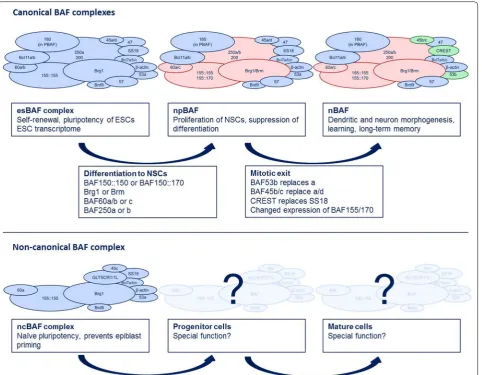
yet to be discovered. In Fig.
1
, an overview of BAF
subu-nit switches during mammalian development is shown.
Mechanistic insights into chromatin remodelling
by BAF complexes
“loop recapture” model was developed. It assumes that
the DNA forms a loop via the formation of new contacts
to histones and in association with the translocase
activ-ity that many ATPase subunits (also from other
remod-elling complexes) have, loop formation allows a shift of
nucleosomes alongside the DNA [
102
–
106
].
Regardless of these remodelling mechanisms, it is
remarkable that most of the BAF subunits are not needed
for in vitro chromatin remodelling [
44
]. Nonetheless, loss
of subunits not needed for in vitro function, such as Baf53a
or Baf250a, causes severely altered phenotypes resembling
those of Brg1 loss, while there are many amongst the most
frequently mutated subunits in cancer that are not
neces-sary for in vitro function [
107
–
109
]. This clearly indicates
that the exact mechanisms of chromatin remodelling are
not yet understood and that there is also the need for a
bet-ter model to study chromatin remodelling in vitro.
BAF–Polycomb opposition as an important mechanism
of chromatin remodelling
The Polycomb gene family has first been discovered in
Drosophila followed by the observation of male flies with
ectopic sex combs [
110
–
115
].
In mammals, the multiprotein-containing Polycomb
repressive complexes (PRC) have repressive influence on
the genome. Similar to the BAF complexes in mammals,
there are several different subunit compositions possible.
PRC1 and PRC2 work in a rather different manner. PRC1
is (in its canonical form) composed of CBX, PHC, PCGF,
RING and SCMH proteins with each having various
vari-ants. Additional diversity is enabled by the assembly of
non-canonical complexes, in which SCMH is replaced
by RYBP or YAF2. It typically represses gene expression
by transferring a single ubiquitin to lysine 119 of
his-tone 2A (H2AK119ub1) (see [
28
] for a review). PRC2 is
formed by at least five subunits, namely EZH1 or 2 as
cat-alytic subunit, EED, SUZ12, RBBP4/7 and AEBP2, with
EZH1/2, EED and SUZ12 being indispensable for
com-plex function [
116
,
117
]. EZH1 and 2 both catalyse the
SAM-dependent trimethylation of lysine 27 of histone 3.
They are the only known mammalian enzymes capable of
depositing this repression mark [
117
–
119
].
In Drosophila, it is well known that BAP complexes
mainly function by opposing Polycomb genes [
23
,
24
]. In
recent years, it also became evident that the same
prin-ciple can be found in mammalian cells as well and that
this opposition is important for normal cell function. Its
disruption can be responsible for tumour formation (see
below). In embryonic stem cells, loss of Brg1 leaves
over-all expression levels of PRC2 subunits and genome-wide
H3K27me3 levels unchanged. Nonetheless, there are
sub-stantial changes following knockdown: Brg1-repressed
genes show a significant decrease in H3K27me3, whereas
Brg1-activated genes show elevated levels of this
repres-sive histone mark. It is shown that Polycomb and BAF
complexes oppose each other at nearly all gene loci
except for the Hox loci, where both act synergistically in
mESCs. The phenotype caused by Brg1 deletion can be
rescued by knockdown of Suz12, indicating the
impor-tant role the loss of Polycomb opposition has for the
changes of chromatin accessibility [
53
].
In order to be able to study chromatin remodelling
pro-cesses in a more precise and a more realistic manner, a
new method has been developed that enables
experi-ments in mouse cells instead of using artificial
nucleo-some templates. This model is called CiAO (short for
chromatin in vivo assay at Oct4) and allows the
recruit-ment of the BAF complex to the Oct4 locus by a
chemi-cal inducer of proximity (like rapamycin), followed by
the investigation of the effects of this recruitment [
120
].
Utilising this technique, it is shown that minutes after
recruitment of BAF to Oct4, PRC2 is removed, with its
accompanying mark H3K27me3 disappearing about
10 min after PRC2 loss. PRC1 eviction from the Oct4
locus can be detected even earlier and coincides with
parallel loss of H2AK119ub1. The corollary is also true, in
that BAF removal is rapidly followed by Ezh2 (PRC2) and
H3K27me3 reappearance [
121
]. This “indirect”
mecha-nism of chromatin remodelling is dependent on Brg1 and
its ability to bind PRC1 subunits directly. Loss of Brg1
causes weakening of the interaction and increases
occu-pancy of PRC1 and PRC2. Furthermore, the opposition
of Polycomb complexes is ATP dependent, illustrated by
the fact that mutations in the ATPase domain cause the
same epigenetic changes as a complete loss [
122
]. Being
most relevant for the explanation of cancer formation,
even a heterozygous mutation of the ATPase domain is
sufficient to significantly alter chromatin accessibility
[
123
]. The consequences of other cancer-related changes
in BAF–Polycomb opposition will be discussed in the
following.
The role of BAF complexes in human disease
The BAF complex in neurodevelopmental disorders
With regard to the importance of the BAF complex and
distinct subunit switches in neural development, it is not
surprising that mutations in BAF-coding genes are
asso-ciated with neurodevelopmental disorders such as
Cof-fin–Siris syndrome, Nicolaides–Baraitser syndrome or
autism spectrum disorders.
One of the syndromes commonly caused by mutations
in BAF subunits is the Coffin–Siris syndrome (CSS), first
described in 1970 as a combination of intellectual
disabil-ity, growth retardation, joint malformations and
brachy-dactyly combined with hypoplastic or missing fingernails
at the fifth finger/toe [
124
,
125
]. These characteristics
can be accompanied by coarse facial features,
numer-ous organ abnormalities (cardiovascular, gastrointestinal
or genitourinary) and feeding difficulties [
126
,
127
]. The
most frequently mutated gene in Coffin–Siris syndrome
is BAF250b, being mutated (dependent on the cohort)
in at least 68% of cases [
128
,
129
]. BAF250b is also the
subunit most frequently mutated in SWI/SNF-related
intellectual disability disorders in general [
130
]. Whereas
its paralogue BAF250a can also be detected in CSS [
131
,
132
], it has a much more dominant role in cancer (see
below). ATPase subunits BRM and BRG1 are also related
to CSS [
129
,
133
,
134
]. BAF47, the subunit known to be
responsible for rhabdoid tumours [
135
], gives rise to a
severe form of CSS [
136
].
disability with speech delay, growth retardation and
char-acteristic facial features [
137
]. It is primarily caused by
missense mutations in the alternative ATPase subunit
BRM [
138
–
140
]. In conformity with the previously
men-tioned difference between BAF250a (mostly in cancer)
and BAF250b (in neurodevelopmental disorders), BRM
is the ATPase subunit predominantly associated with
intellectual disabilities, while its paralogue BRG1 is more
closely related to cancer (see below).
In addition to Coffin–Siris syndrome and Nicolaides–
Baraitser syndrome, there are many other
neurodevel-opmental disorders related to BAF subunit mutations,
such as Kleefstra’s syndrome [
141
,
142
], disorders of the
autism spectrum [
143
,
144
], amyotrophic lateral sclerosis
[
145
] and schizophrenia [
146
,
147
]. For a more detailed
review concerning the role of BAF complexes in neural
developmental disorders, see Ref. [
148
–
150
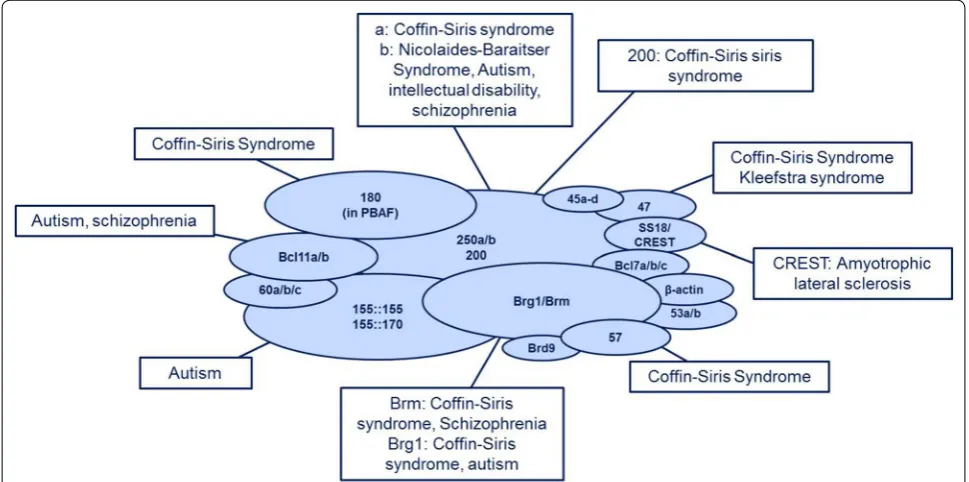
]. BAF
subu-nit mutations and their implication in human
develop-mental disorders are summarised in Fig.
2
.
The BAF complex in cancer
Given its immense influence on both differentiation
and gene expression in general, it is not surprising that
BAF complex subunits are frequently altered in cancer
with up to 20% of human cancers bearing mutations in
this ATP remodelling complex. Thus, it is the chromatin
remodelling complex most frequently involved in human
malignancies [
27
]. Mirroring the tissue specificity of BAF
complex assembly, the influence of subunit mutations
depends on the BAF complex assembly and the tissue in
which they occur. Some are only occasionally associated
with cancer, while others show a much higher mutation
frequency. Furthermore, each is related to only a distinct
subset of cancer entities. Moreover, some mutations only
cause tumorigenesis when biallelic loss occurs, whereas
in other cases a mutation in one allele is detected [
135
,
151
]. The best studied examples of how mutations of
chromatin remodellers can cause malignancies are
BAF47 (
=
SmarcB1) loss in rhabdoid tumours and the
SS18-SSX fusion protein in synovial sarcoma. These two
examples show that the BAF complex can act as both
oncogene and tumour suppressor.
The BAF complex as tumour suppressor
Rhabdoid tumours are aggressive malignancies occurring
in early childhood arising in the brain (atypical teratoid/
rhabdoid tumours
=
AT/RT), soft tissue (malignant
rhab-doid tumours
=
MRT) or kidneys (rhabdoid tumours of
the kidney
=
RTK). Almost all of them show a biallelic
loss of BAF47, but have an otherwise low mutational
burden with no additional recurrent mutations
detect-able. Thus, rhabdoid tumours can mainly be considered
as an epigenetic disease caused by the loss of the
reces-sive tumour suppressor BAF47 [
135
,
152
]. Moreover, this
clear correlation between loss of BAF47 and tumour
for-mation can be remodelled in mice. Conditional knockout
of
BAF47 at a distinct time point leads to tumour
for-mation after 11 weeks with a penetrance of 100%,
illus-trating that loss of BAF47 is sufficient to drive tumour
formation. Other studies have shown that loss of
het-erozygosity can also cause peripheral T cell lymphoma
[
153
,
154
]. In addition, BAF47 loss also occurs in a high
subset of epithelioid sarcoma [
155
].
Mechanistically, it is known that BAF47 plays a crucial
role in BAF-mediated chromatin remodelling. Upon loss
of BAF47, the BAF complex itself is still able to
assem-ble [
156
,
157
] but displays a diminished chromatin
affin-ity. Dissociation of BAF complex and chromatin requires
harsher conditions after BAF47 rescue. Consistent with
this, genome-wide BAF complex occupancy increases
significantly after BAF47 rescue. Furthermore, it results
in a widespread enhancer and super-enhancer activation
as well as an alteration in bivalent promoter regulation
[
158
]. As already mentioned, a key factor in BAF
func-tion is Polycomb opposifunc-tion. In support of this, EZH2
has been shown to be a key player in many malignancies,
including rhabdoid tumours [
159
] (also see Ref. [
160
]
for a review). BAF complexes deficient of BAF47 can
still be recruited to the genome but are unable to evict
Polycomb, as they usually do [
121
]. As a result, tumour
cells show an increase in the H3K27me3 repressive mark,
amongst others, at the p16Ink4a tumour suppressor
locus, which is known to drive rhabdoid tumour
forma-tion [
159
,
161
]. Relevant to translational research, it has
also been shown that additional inactivation of EZH2
in BAF47-deficient MEFs results in wild-type levels of
p16Ink4a [
159
] and that tumour regression in MRTs
can be achieved by chemical inhibition of EZH2 [
162
,
163
]. Currently, a number of EZH2 inhibitors are tested
in phase I/II clinical trials in other cancer entities [
164
,
165
]. Interestingly, the expression of other BAF complex
subunits like BRM seems to determine the sensitivity of
tumours with BAF subunit mutations to EZH2
inhibi-tion, suggesting BRM expression as a possible biomarker
for therapeutic response [
166
]. For those tumours that
are insensitive to EZH2 inhibition, BRM inhibition could
be a promising alternative [
167
–
169
].
Despite the described role of the cBAF complex in
rhabdoid tumours, there are also recent studies
sug-gesting an auxiliary role of the ncBAF complex. Krämer
et al. showed that BRD9 inhibition results in a decrease
in cell proliferation as well as a G1 cell cycle arrest and
an increase in apoptosis in several rhabdoid tumour cell
lines [
170
]. This is also supported by CRISPR-Cas9-based
screens, identifying BRD9, GLTSCR1 and BAF60A, all
being subunits of the ncBAF complex, as critical for
rhab-doid tumour cell line survival [
74
]. ChIPseq experiments
using BRD9 and BRG1 antibodies suggest that many of
the residual BAF complexes in rhabdoid tumours are, in
fact, ncBAF complexes. They localise to enhancers that
have already been identified as tumour associated and
rhabdoid tumour specific. In this way, ncBAF preserves
gene expression at CTCF sites as well as in promoter–
proximal regions. The unique dependency of rhabdoid
tumours on ncBAF complex function might make BRD9
or GLTSCR1 inhibition an additional promising target
for rhabdoid tumour treatment [
74
].
There are also other cancer entities, in which the BAF
complex loses its tumour-suppressive abilities.
Muta-tions of BRG1, for instance, occur in over 90% of small
cell ovarian cancers [
171
,
172
]. BAF250a mutations, the
subunit most frequently mutated in human malignancies,
can be found in a huge subset of cancers, e.g.
endome-trial carcinoma, gastrointestinal carcinoma (colorectal,
gastric), pancreatic carcinoma and cholangiocarcinoma
[
173
–
178
]. Amongst the subunits less frequently involved
in cancer are BAF170 (in gastric and colorectal cancer
with microsatellite instability) [
179
], BAF155 (in small
cell lung cancer) [
27
] as well as BAF45d and BAF60 in
breast cancer [
31
,
180
].
The BAF complex as oncogene: the SS18‑SSX fusion
in synovial sarcoma
Similar to rhabdoid tumours, synovial sarcomas are
tumours in which one single, well-characterised
muta-tion can be found in nearly all patients. It is an
aggres-sive sarcoma arising in the soft tissue and specified by
a t(X;18) chromosomal translocation, fusing 78 amino
acids of the protein SSX to the dedicated BAF complex
subunit SS18 [
151
,
181
,
182
]. Nonetheless, the
mecha-nism underlying the transformation is an entirely
differ-ent one. Unlike rhabdoid tumours, which are caused by
a biallelic loss of BAF47, tumour formation in synovial
sarcoma occurs in spite of a remaining wild-type allele.
This might be possible because the transcription of the
wild-type allele is decreased in sarcoma cells in general.
Additionally, the SS18-SSX fusion protein is
prefer-ably incorporated into the complex, leading to the
deg-radation of the monomeric wild-type protein [
27
,
183
].
Besides, BAF47 is almost completely lost from the BAF
complex upon SS18-SSX incorporation, but in contrast to
rhabdoid tumours, the ability to oppose PRC1 and PRC2
is preserved regardless of the changed subunit
compo-sition [
121
,
151
]. Furthermore, BAF47 rescue and the
following restoration of enhancer action are not
neces-sary to decrease proliferation in synovial sarcoma [
184
].
Therefore, synovial sarcoma is primarily driven not by
BAF47 loss, but by the gain of SS18-SSX which seems to
be the driving force.
complexes. SS18-SSX-containing BAF complexes show
an unusual co-occupancy with PRC2, amongst others,
at the SOX2 and PAX3 loci, which results in the
evic-tion of Polycomb and the loss of H3K27me3 [
121
,
184
].
These changes are sufficient to cause SOX2 expression,
which is a typical feature of synovial sarcoma cell lines,
that show stem cell-like expression patterns [
151
,
185
].
Moreover, recent studies indicate that the
SS18-SSX-con-taining BAF complex interacts with KDM2B and uses its
demethylase activity to activate genes usually repressed
[
186
]. Regardless of the substantial changes the
SS18-SSX fusion protein gives rise to, the original assembly of
the BAF complex (containing SS18 and BAF47) can be
rescued by either overexpression of wild-type SS18 or
SS18-SSX knockdown. Both lead to a proliferation arrest
[
151
,
184
]. Being mindful of the immense effect the
spe-cific inhibition of the fusion gene bcr-abl has in CML
(chronic myelogenous leukaemia) [
187
,
188
], targeted
therapy with inhibitors against SS18-SSX could be a new
approach to treat synovial sarcoma, as already suggested
by Kadoch and Crabtree [
189
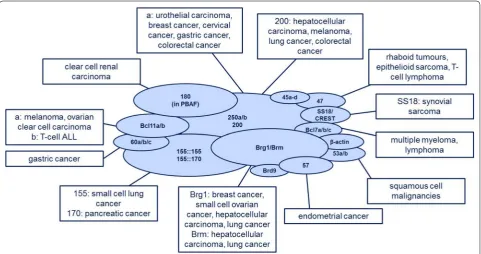
]. Figure
3
shows an outline
of BAF subunit mutations in human cancers.
Similar to the findings in rhabdoid tumours, ncBAF
also seems to play a significant role in synovial sarcoma
as cell lines of this tumour entity are sensitive to the loss
of BRD9, BAF60A or GLTSCR1. SYO-1 cells react with
a decrease in proliferation, a G1 phase arrest and an
increase in apoptosis upon treatment with BRD9
inhibi-tors. Other sarcoma cell lines do not show this
depend-ency on BRD9 which makes it a specific target in cancers
with cBAF perturbations [
74
,
190
]. In contrast to the
canonical BAF complex, ncBAF preferably incorporates
SS18 not SS18-SSX [
74
]. Nonetheless, other experiments
could show the existence of BRD9 and
SS18-SSX-con-taining complexes with BRD9 and SS18-SSX co-binding
on the genome [
190
]. Even if the cells are clearly
depend-ent on ncBAF function, BRD9 inhibition neither
inhib-its SS18-SSX-mediated gene activation nor is it required
for the de novo activation of these genes by SS18-SSX.
Unlike cBAF, ncBAF is only influenced in its localisation
to a minor degree. It still localises to H3K4-trimethylated
regions as well as to CTCF sites and most genes that are
downregulated following BRD9 inhibition are
independ-ent from the SS18-SSX fusion protein. For this reason,
Michel et al. [
74
] suggested that ncBAF might be
respon-sible for maintaining the gene expression of
indispensa-ble genes that are no longer activated by the re-targeted
SS18-SSX-containing BAF complex. The dependency of
synovial sarcoma on BRD9 could make BRD9 inhibition a
promising target for therapy of this cancer entity. For this
purpose, targeted BRD9 degradation might even be more
effective than the inhibition of its bromodomain [
190
].
Conclusion
Evidently, a functioning BAF complex is
indispensa-ble to both differentiation of embryonic stem cells into
mature cell lines and regulation of the transcriptome
of these cells. Even if there has been an enormous gain
in understanding how BAF complexes assemble and
function in vitro, their in vivo function and the role of
distinct subunits still remain an enigma. Why different
mutations of the same subunit, e.g. BAF47, can cause
neurodevelopmental disorders or human malignancies,
is still unclear. Furthermore, the question why some
subunits only cause tumour growth when both alleles
are lost, while in other tumours only heterozygous
mutations are detected, continues to be unanswered.
However, the discovery of EZH2 inhibitors and
BRD9 inhibitors as possible therapeutic approaches for
some cancers with BAF subunit mutations, illustrates
why the comprehension of the precise mechanism by
which subunit mutations result in tumour growth, is
so important. Currently, therapeutic options of many
cancers are limited by the toxicity of the therapy itself
and can scarcely be made more aggressive. Therefore,
developing targeted therapies that address the distinct
mechanisms by which tumour growth can be driven is
indispensable to improving patient survival. However,
these mechanisms first need to be fully understood
making further elucidation of how BAF subunit
muta-tions drive tumour formation essential. Consistent with
this, the cause of neurodevelopmental disorder cannot
be understood without understanding the role of BAF
complexes in early and late neurogenesis.
Abbreviations
AT/RT: atypical teratoid/rhabdoid tumours; BAF complex: BRG/BRM-associated factor complex; BAP complex: Brahma-associated protein complex; ChIP: chromatin immunoprecipitation; ChIPseq: chromatin immunoprecipitation followed by sequencing; CiAO: chromatin in vivo assay at Oct4; CML: chronic myelogenous leukaemia; CSS: Coffin–Siris syndrome; esBAF complex: embry-onic stem cell-specific BAF complex; ESC: embryembry-onic stem cell; LIF: leukaemia inhibitory factor; MEF: mouse embryonic fibroblast; MRT: malignant rhabdoid tumours; nBAF complex: neuronal BAF complex; NCBRS: Nicolaides–Baraitser syndrome; npBAF complex: neural progenitor BAF complex; PRC: Polycomb repressive complex; RTK: rhabdoid tumours of the kidney; SWI/SNF: SWItch/ sucrose non-fermentable.
Authors’ contributions
AA, NM and KK contributed to writing and editing of the manuscript. All authors read and approved the final manuscript.
Acknowledgements
We acknowledge support by Open Access Publication Fund of University of Muenster. Further, we would like to acknowledge Dr. Kiasha Govender for reviewing and editing the manuscript concerning the English language.
Competing interests
The authors declare that they have no conflict of interest.
Ethics approval and consent to participate Not applicable.
Consent for publication Not applicable.
Availability of data and materials Not applicable.
Publisher’s Note
Springer Nature remains neutral with regard to jurisdictional claims in pub-lished maps and institutional affiliations.
Received: 12 December 2018 Accepted: 13 March 2019
References
1. Kornberg RD, Series N, May N. Chromatin structure: a repeating unit of histones and DNA chromatin structure is based on a repeating unit of eight. Society. 1974;184:868–71.
2. Wilkins MHF, Zubay G, Wilson HR. X-ray diffraction studies of the molecular structure of nucleohistone and chromosomes. J Mol Biol. 1959;1:7–10. https ://doi.org/10.1016/S0022 -2836(59)80046 -2. 3. Bak AL, Zeuthen J, Crick FHC. High-order structure of human mitotic
chromosomes. Proc Natl Acad Sci USA. 1977;74:1595–9.
4. Even-Faitelson L, Hassan-Zadeh V, Baghestani Z, Bazett-Jones DP. Com-ing to terms with chromatin structure. Chromosoma. 2016;125:95–110. 5. Moore LD, Le T, Fan G. DNA methylation and its basic function.
Neuropsychopharmacology. 2013;38:23–38. https ://doi.org/10.1038/ npp.2012.112.
6. Jin Z, Liu Y. DNA methylation in human diseases. Genes Dis. 2018;5:1–8. https ://doi.org/10.1016/j.gendi s.2018.01.002.
7. Bannister AJ, Kouzarides T. Regulation of chromatin by histone modifi-cations. Cell Res. 2011;21:381–95. https ://doi.org/10.1038/cr.2011.22. 8. Audia JE, Campbell RM. Histone modifications and cancer. Cold Spring
Harb Perspect Biol. 2016;8:a019521.
9. Stern M, Jensen R, Herskowitz I. Five SWI genes are required for expres-sion of the HO gene in yeast. J Mol Biol. 1984;178:853–68.
10. Carlson M, Osmond BC, Botstein D. Mutants of yeast defetive in sucrose utilization. Genetics. 1981;98:25–40.
11. Neigeborn L, Carlson M. Genes affecting the regulation of Suc2 gene expression by glucose repression in Saccharomyces cerevisiae. Genetics. 1984;108:845–58.
12. Neigeborn L, Carlson M. Mutations causing constitutive invertase synthesis in yeast: genetic interactions with snf mutations. Genetics. 1987;115:247–53.
13. Côté J, Quinn J, Workman JL, Peterson CL. Stimulation of GAL4 deriva-tive binding to nucleosomal DNA by the yeast SWI/SNF complex. Science (80-). 1994;265:53–60.
14. Dingwall AK, Beek SJ, McCallum CM, Tamkun JW, Kalpana GV, Goff SP, et al. The Drosophila snr1 and brm proteins are related to yeast SWI/ SNF proteins and are components of a large protein complex. Mol Biol Cell. 1995;6:777–91.
15. Peterson CL, Tamkun JW. The SWI-SNF complex: a chromatin remod-eling machine? Trends Biochem Sci. 1995;20:143–6.
16. Peterson CL, Herskowitz I. Characterization of the yeast SWI1, SWI2, and SWI3 genes, which encode a global activator of transcription. Cell. 1992;68:573–83.
17. Peterson CL, Dingwall A, Scott MP. Five SWI/SNF gene products are components of a large multisubunit complex required for transcrip-tional enhancement. Proc Natl Acad Sci. 1994;91:2905–8.
18. Wang W, Cote J, Xue Y, Zhou S, Khavari PA, Biggar SR, et al. Purification and biochemical heterogeneity of the mammalian SWI-SNF complex. EMBO J. 1996;15:5370–82.
20. Cairns BR, Kim YJ, Sayre MH, Laurent BC, Kornberg RD. A multisubunit complex containing the SWI1/ADR6, SWI2/SNF2, SWI3, SNF5, and SNF6 gene products isolated from yeast. Proc Natl Acad Sci USA. 1994;91:1950–4.
21. Papoulas O, Daubresse G, Armstrong JA, Jin J, Scott MP, Tamkun JW. The HMG-domain protein BAP111 is important for the function of the BRM chromatin-remodeling complex in vivo. Proc Natl Acad Sci USA. 2001;98:5728–33.
22. Papoulas O, Beek SJ, Moseley SL, Mccallum CM, Sarte M, Shearn A, et al. The Drosophila trithorax group proteins BRM, ASH1 and ASH2 are subu-nits of distinct protein complexes. Development. 1998;125:3955–66. 23. Tamkun JW, Deuring R, Scott MP, Kissinger M, Pattatucci AM, Kaufman
TC, et al. Brahma: a regulator of Drosophila homeotic genes structur-ally related to the yeast transcriptional activator SNF2 SWI2. Cell. 1992;68:561–72.
24. Elfring LK, Deuring R, Mccallum CM, Peterson CL, Tamkunl JW. Identification and characterization of Drosophila relatives of the yeast transcriptional activator SNF2/SWI2. Mol Cell Biol. 1994;14:2225–34. 25. Wang W, Xue Y, Zhou S. Diversity and specialization of mammalian SWI/
SNF complexes. Genes Dev. 1996;10:2117–30.
26. Hargreaves DC, Crabtree GR. ATP-dependent chromatin remodeling: genetics, genomics and mechanisms. Cell Res. 2011;21:396–420. https ://doi.org/10.1038/cr.2011.32.
27. Kadoch C, Hargreaves DC, Hodges C, Elias L, Ho L, Ranish J, et al. Proteomic and bioinformatic analysis of mammalian SWI/SNF com-plexes identifies extensive roles in human malignancy. Nat Genet. 2013;45:592–601. https ://doi.org/10.1038/ng.2628.
28. Poynter ST, Kadoch C. Polycomb and trithorax opposition in develop-ment and disease. Wiley Interdiscip Rev Dev Biol. 2016;5:659–88. 29. Khavari PA, Peterson CL, Tamkun JW, Mendel DB, Crabtree GR. BRG1
contains a conserved domain of the SWI2/SNF2 family necessary for normal mitotic growth and transcription. Nature. 1993;366:170–4. 30. Zhao K, Wang W, Rando OJ, Xue Y, Swiderek K, Kuo A, et al. Rapid
and phosphoinositol-dependent binding of the SWI/SNF-like BAF complex to chromatin after T lymphocyte receptor signaling. Cell. 1998;95:625–36.
31. Lessard J, Wu JI, Ranish JA, Wan M, Winslow MM, Staahl BT, et al. An essential switch in subunit composition of a chromatin remodeling complex during neural development. Neuron. 2007;55:201–15. 32. Olave I, Wang W, Xue Y, Kuo A, Crabtree GR. Identification of a
poly-morphic, neuron-specific chromatin remodeling complex. Genes Dev. 2002;16:2509–17.
33. Vogel-Ciernia A, Matheos DP, Barrett RM, Kramár E, Azzawi S, Chen Y, et al. The neuron-specific chromatin regulatory subunit BAF53b is necessary for synaptic plasticity and memory. Nat Neurosci. 2013;16:552–61.
34. Bachmann C, Nguyen H, Rosenbusch J, Pham L, Rabe T, Patwa M, et al. mSWI/SNF (BAF) complexes are indispensable for the neurogenesis and development of embryonic olfactory epithelium. PLoS Genet. 2016;12:1–29.
35. Lickert H, Takeuchi JK, Von Both I, Walls JR, McAuliffe F, Adamson SL, et al. Baf60c is essential for function of BAF chromatin remodelling complexes in heart development. Nature. 2004;432:107–12. 36. Sun X, Hota SK, Zhou Y-Q, Novak S, Miguel-Perez D, Christodoulou D,
et al. Cardiac-enriched BAF chromatin-remodeling complex subu-nit Baf60c regulates gene expression programs essential for heart development and function. Biol Open. 2018;7:bio029512. https ://doi. org/10.1242/bio.02951 2.
37. Ohkawa Y, Marfella CGA, Imbalzano AN. Skeletal muscle specifica-tion by myogenin and Mef2D via the SWI/SNF ATPase Brg1. EMBO J. 2006;25:490–501.
38. Ohkawa Y, Yoshimura S, Higashi C, Marfella CGA, Dacwag CS, Tachibana T, et al. Myogenin and the SWI/SNF ATPase Brg1 maintain myogenic gene expression at different stages of skeletal myogenesis. J Biol Chem. 2007;282:6564–70.
39. de la Serna IL, Carlson KA, Imbalzano A. Mammalian SWI/SNF com-plexes promote MyoD-mediated muscle differentiation. Nat Genet. 2001;27:187–90.
40. Ho L, Jothi R, Ronan JL, Cui K, Zhao K, Crabtree GR. An embryonic stem cell chromatin remodeling complex, esBAF, is an essential
component of the core pluripotency transcriptional network. Proc Natl Acad Sci USA. 2009;106:5187–91.
41. Ho L, Ronan JL, Wu J, Staahl BT, Chen L, Kuo A, et al. An embryonic stem cell chromatin remodeling complex, esBAF, is essential for embryonic stem cell self-renewal and pluripotency. Proc Natl Acad Sci USA. 2009;106:5181–6.
42. Cairns BR, Lorch Y, Li Y, Zhang M, Lacomis L, Erdjument-Bromage H, et al. RSC, an essential, abundant chromatin-remodeling complex. Cell. 1996;87:1249–60. https ://doi.org/10.1016/S0092 -8674(00)81820 -6.
43. Muchardt C, Yaniv M. A human homologue of Saccharomyces cerevisiae SNF2/SW12 and Drosophila brm genes potentiates transcriptional activation by the glucocorticoid receptor. EMBO J. 1993;12:4279–90.
44. Phelan ML, Sif S, Narlikar GJ, Kingston RE. Reconstitution of a core chromatin remodeling complex from SWI/SNF subunits. Mol Cell. 1999;3:247–53.
45. Mashtalir N, D’Avino AR, Michel BC, Luo J, Pan J, Otto JE, et al. Modular organization and assembly of SWI/SNF family chromatin remod-eling complexes. Cell. 2018;175:1272–88. https ://doi.org/10.1016/j. cell.2018.09.032.
46. Wang W, Chi T, Xue Y, Zhou S, Kuo A, Crabtree GR. Architectural DNA binding by a high-mobility-group/kinesin-like subunit in mammalian SWI/SNF-related complexes. Proc Natl Acad Sci USA. 1998;95:492–8. 47. Wang W, Xue Y, Zhou S. Diversity and specialization of mammalian SWI/
SNF complexes. Genes Dev. 1996;4:2117–30.
48. Clapier CR, Iwasa J, Cairns BR, Peterson CL. Mechanisms of action and regulation of ATP-dependent chromatin-remodelling complexes. Nat Rev Mol Cell Biol. 2017;18:407–22. https ://doi.org/10.1038/nrm.2017.26. 49. Whitehouse I, Flaus A, Cairns BR, White MF, Workman JL, Owen-Hughes T. Nucleosome mobilization catalysed by the yeast SWI/SNF complex. Nature. 1999;400:784–7.
50. Liu X, Li M, Xia X, Li X, Chen Z. Mechanism of chromatin remodelling revealed by the Snf2-nucleosome structure. Nature. 2017;544:440–5. https ://doi.org/10.1038/natur e2203 6.
51. Kennison JA, Tamkun JW. Dosage-dependent modifiers of polycomb and antennapedia mutations in Drosophila. Proc Natl Acad Sci. 1988;85:8136–40. https ://doi.org/10.1073/pnas.85.21.8136. 52. Kennison JA. The polycomb and trithorax group proteins of
dros-ophila: trans-regulators of homeotic gene function. Annu Rev Genet. 1995;29:289–303.
53. Ho L, Miller EL, Ronan JL, Ho WQ, Jothi R, Crabtree GR. EsBAF facilitates pluripotency by conditioning the genome for LIF/STAT3 signalling and by regulating polycomb function. Nat Cell Biol. 2011;13:903–13. https :// doi.org/10.1038/ncb22 85.
54. Kaeser MD, Aslanian A, Dong MQ, Yates JR, Emerson BM. BRD7, a novel PBAF-specific SWI/SNF subunit, is required for target gene activation and repression in embryonic stem cells. J Biol Chem. 2008;283:32254–63.
55. Chi TH, Wan M, Lee PP, Akashi K, Metzger D, Chambon P, et al. Sequen-tial roles of Brg, the ATPase subunit of BAF chromatin remodeling complexes, in thymocyte development. Immunity. 2003;19:169–82. 56. Middeljans E, Wan X, Jansen PW, Sharma V, Stunnenberg HG, Logie C.
SS18 together with animal-specific factors defines human BAF-type SWI/SNF complexes. PLoS ONE. 2012;7:e33834.
57. Alpsoy A, Dykhuizen EC. Glioma tumor suppressor candidate region gene 1 (GLTSCR57) and its paralog GLTSCR57-like form SWI/SNF chro-matin remodeling subcomplexes. J Biol Chem. 2018;293:3892–903. 58. Gatchalian J, Malik S, Ho J, Lee D-S, Kelso TWR, Shokhirev MN, et al. A
non-canonical BRD9-containing BAF chromatin remodeling complex regulates naive pluripotency in mouse embryonic stem cells. Nat Com-mun. 2018;9:5139.
59. Boyer LA, Lee TI, Cole MF, Johnstone SE, Levine SS, Jenner RG, et al. Core transcriptional regulatory circuitry in human embryonic stem cells. Cell. 2005;122:947–56.
60. Loh YH, Wu Q, Chew JL, Vega VB, Zhang W, Chen X, et al. The Oct4 and Nanog transcription network regulates pluripotency in mouse embry-onic stem cells. Nat Genet. 2006;38:431–40.
62. Avilion AA, Nicolis SK, Pevny LH, Perez L, Vivian N, Lovell-Badge R. Multipotent cell lineages in early mouse development depend on SOX2 function. Genes Dev. 2003;17:126–40.
63. Nichols J, Zevnik B, Anastassiadis K, Niwa H, Klewe-Nebenius D, Chambers I, et al. Formation of pluripotent stem cells in the mamma-lian embryo depends on the POU transcription factor Oct4 Jennifer. Cell. 1998;95:379–91.
64. Bernstein BE, Mikkelsen TS, Xie X, Kamal M, Huebert DJ, Cuff J, et al. A bivalent chromatin structure marks key developmental genes in embryonic stem cells. Cell. 2006;125:315–26.
65. Zhang X, Li B, Li W, Ma L, Zheng D, Li L, et al. Transcriptional repres-sion by the BRG1-SWI/SNF complex affects the pluripotency of human embryonic stem cells. Stem Cell Rep. 2014;3:460–74. https :// doi.org/10.1016/j.stemc r.2014.07.004.
66. Han D, Jeon S, Sohn DH, Lee C, Ahn S, Kim WK, et al. SRG3, a core component of mouse SWI/SNF complex, is essential for extra-embry-onic vascular development. Dev Biol. 2008;315:136–46. https ://doi. org/10.1016/j.ydbio .2007.12.024.
67. Bultman S, Gebuhr T, Yee D, La Mantia C, Nicholson J, Gilliam A, et al. A Brg1 null mutation in the mouse reveals functional differences among mammalian SWI/SNF complexes Polycomb and trithorax groups, play crucial roles in transcriptional regulation and participate in diverse processes, including cell proliferation and differentiation. Mol Cell. 2000;6:1287–95.
68. Roberts CWM, Galusha SA, McMenamin ME, Fletcher CDM, Orkin SH. Haploinsufficiency of Snf5 (integrase interactor 1) predis-poses to malignant rhabdoid tumors in mice. Proc Natl Acad Sci. 2000;97:13796–800. https ://doi.org/10.1073/pnas.25049 2697. 69. Kidder BL, Palmer S, Knott JG. SWI/SNF-Brg1 regulates self-renewal
and occupies core pluripotency-related genes in embryonic stem cells. Stem Cells. 2009;27:317–28. https ://doi.org/10.1634/stemc ells.2008-0710.
70. Reyes JC, Barra J, Muchardt C, Camus A, Babinet C, Yaniv M. Altered control of cellular proliferation in the absence of mammalian brahma (SNF2α). EMBO J. 1998;17:6979–91.
71. Hanna J, Cheng AW, Saha K, Kim J, Lengner CJ, Soldner F, et al. Human embryonic stem cells with biological and epigenetic characteristics similar to those of mouse ESCs. Proc Natl Acad Sci. 2010;107:9222–7.
72. Buecker C, Chen H, Polo J, Daheron L, Bu L, Barakat S, et al. A murine-ES like state facilitates transgenesis and homologous recombination in human pluripotent stem cells. Cell. 2011;6:535–46.
73. Yang J, Van Oosten AL, Theunissen TW, Guo G, Silva JCR, Smith A. Stat3 activation is limiting for reprogramming to ground state pluripotency. Cell Stem Cell. 2010;7:319–28. https ://doi.org/10.1016/j. stem.2010.06.022.
74. Michel BC, D’Avino AR, Cassel SH, Mashtalir N, McKenzie ZM, McBride MJ, et al. A non-canonical SWI/SNF complex is a synthetic lethal target in cancers driven by BAF complex perturbation. Nat Cell Biol. 2018;20:1410.
75. Staahl BT, Tang J, Wu W, Sun A, Gitler AD, Yoo AS, et al. Kinetic analysis of npBAF to nBAF switching reveals exchange of SS18 with CREST and integration with neural developmental pathways. J Neurosci. 2013;33:10348–61. https ://doi.org/10.1523/JNEUR OSCI.1258-13.2013. 76. Kim JK, Huh SO, Choi H, Lee KS, Shin D, Lee C, et al. Srg3, a mouse
homolog of yeast SWI3, is essential for early embryogenesis and involved in brain development. Mol Cell Biol. 2001;21:7787–95. 77. Matsumoto S, Banine F, Struve J, Xing R, Adams C, Liu Y, et al. Brg1 is
required for murine neural stem cell maintenance and gliogenesis. Dev Biol. 2006;289:372–83.
78. Zhan X, Shi X, Zhang Z, Chen Y, Wu JI. Dual role of Brg chromatin remodeling factor in Sonic hedgehog signaling during neural development. Proc Natl Acad Sci. 2011;108:12758–63. https ://doi. org/10.1073/pnas.10185 10108 .
79. Wu JI, Lessard J, Olave IA, Qiu Z, Ghosh A, Graef IA, et al. Regulation of dendritic development by neuron-specific chromatin remodeling complexes. Neuron. 2007;56:94–108.
80. Aizawa H, Hu SC, Bobb K, Balakrishnan K, Ince G, Gurevich I, et al. Dendrite development regulated by CREST, a Calcium-regulated transcriptional activator. Science. 2004;303:197.
81. Lim LP, Lau NC, Garret-Engele P, Grimson A, Schelter JM, Castle J, et al. Microarray analysis shows that some microRNAs downregulate large numbers of target mRNAs. Nature. 2005;433:769.
82. Deo M, Yu JY, Chung KH, Tippens M, Turner DL. Detection of mamma-lian microRNA expression by in situ hybridization with RNA oligonu-cleotides. Dev Dyn. 2006;235:2538–48.
83. Conaco C, Otto S, Han J-J, Mandel G. Reciprocal actions of REST and a microRNA promote neuronal identity. Proc Natl Acad Sci. 2006;103:2422–7. https ://doi.org/10.1073/pnas.05110 41103 . 84. Lagos-Quintana M, Rauhut R, Yalcin A, Meyer J, Lendeckel W, Tuschl
T. Identification of tissue-specific microRNAs from mouse. Curr Biol. 2002;12:735–9.
85. Yoo AS, Staahl BT, Chen L, Crabtree GR. MicroRNA-mediated switching of chromatin-remodelling complexes in neural development. Nature. 2009;460:642–6. https ://doi.org/10.1038/natur e0813 9.
86. Ballas N, Grunseich C, Lu DD, Speh JC, Mandel G. REST and its core-pressors mediate plasticity of neuronal gene chromatin throughout neurogenesis. Cell. 2005;121:645–57. https ://doi.org/10.1016/j. cell.2005.03.013.
87. Yoo AS, Sun AX, Li L, Shcheglovitov A, Portmann T, Li Y, et al. Micro-RNA-mediated conversion of human fibroblasts to neurons. Nature. 2011;476:228–31.
88. Lu Y-L, Yoo AS. Mechanistic insights Into microRNA-induced neuronal reprogramming of human adult fibroblasts. Front Neurosci. 2018;12:1– 9. https ://doi.org/10.3389/fnins .2018.00522 /full.
89. Parrish JZ, Kim MD, Lily YJ, Yuh NJ. Genome-wide analyses identify transcription factors required for proper morphogenesis of Drosophila sensory neuron dendrites. Genes Dev. 2006;20:820–35.
90. Arlotta P, Molyneaux BJ, Chen J, Inoue J, Kominami R, MacKlis JD. Neu-ronal subtype-specific genes that control corticospinal motor neuron development in vivo. Neuron. 2005;45:207–21.
91. Enomoto T, Ohmoto M, Iwata T, Uno A, Saitou M, Yamaguchi T, et al. Bcl11b/Ctip2 controls the differentiation of vomeronasal sensory neurons in mice. J Neurosci. 2011;31:10159–73. https ://doi.org/10.1523/ JNEUR OSCI.1245-11.2011.
92. Ninkovic J, Steiner-mezzadri A, Jawerka M, Akinci U, Petricca S, Fischer J, et al. Essential role of BAF complex interacting with Pax6 in establish-ment of a core cross-regulatory neurogenic network. Cell Stem Cell. 2014;13:403–18.
93. Petrik D, Latchney SE, Masiulis I, Yun S, Zhang Z, Wu JI, et al. Chroma-tin remodeling factor Brg1 supports the early maintenance and late responsiveness of Nestin-Lineage adult neural stem and progenitor cells. Stem Cells. 2015;33:3655–65.
94. Tuoc T, Dere E, Radyushkin K, Pham L, Nguyen H, Tonchev AB, et al. Ablation of BAF170 in developing and postnatal dentate gyrus affects neural stem cell proliferation, differentiation, and learning. Mol Neuro-biol. 2016;54:4618–35.
95. John A, Brylka H, Wiegreffe C, Simon R, Liu P, Juttner R, et al. Bcl11a is required for neuronal morphogenesis and sensory circuit formation in dorsal spinal cord development. Development. 2012;139:1831–41. https ://doi.org/10.1242/dev.07285 0.
96. Weinberg P, Flames N, Sawa H, Garriga G, Hobert O. The SWI/SNF chromatin remodeling complex selectively affects multiple aspects of serotonergic neuron differentiation. Genetics. 2013;194:189–98. 97. Choi KY, Yoo M, Han JH. Toward understanding the role of the
neuron-specific BAF chromatin remodeling complex in memory formation. Exp Mol Med. 2015;47:e155. https ://doi.org/10.1038/emm.2014.129. 98. Ieda M, Fu JD, Delgado-Olguin P, Vedantham V, Hayashi Y, Bruneau
BG, et al. Direct reprogramming of fibroblasts into functional car-diomyocytes by defined factors. Cell. 2010;142:375–86. https ://doi. org/10.1016/j.cell.2010.07.002.
99. Albini S, Coutinho Toto P, Dall’Agnese A, Malecova B, Cenciarelli C, Felsani A, et al. Brahma is required for cell cycle arrest and late muscle gene expression during skeletal myogenesis. EMBO Rep. 2015;16:1037– 50. https ://doi.org/10.15252 /embr.20154 0159.
100. Mizuguchi G, Shen X, Landry J, Wu WH, Sen S, Wu C. ATP-driven exchange of histone H2AZ variant catalyzed by SWR1 chromatin remodeling complex. Science (80-). 2004;303:343–8.
102. Strohner R, Wachsmuth M, Dachauer K, Mazurkiewicz J, Hochstatter J, Rippe K, et al. A “loop recapture” mechanism for ACF-dependent nucleosome remodeling. Nat Struct Mol Biol. 2005;12:683–90. 103. Blosser TR, Yang JG, Stone MD, Narlikar GJ, Zhuang X. Dynamics
of nucleosome remodelling by individual ACF complexes. Nature. 2009;462:1022–7.
104. Zofall M, Persinger J, Kassabov SR, Bartholomew B. Chromatin remod-eling by ISW2 and SWI/SNF requires DNA translocation inside the nucleosome. Nat Struct Mol Biol. 2006;13:339–46.
105. Saha A, Wittmeyer J, Cairns BR. Chromatin remodeling through direc-tional DNA translocation from an internal nucleosomal site. Nat Struct Mol Biol. 2005;12:747–55.
106. Dechassa ML, Zhang B, Horowitz-scherer R, Persinger J, Woodcock CL, Peterson CL, et al. Architecture of the SWI/SNF-nucleosome complex. Mol Cell Biol. 2008;28:6010–21.
107. de Bruijn DRH, Peters WJM, de Sousa Chuva, Lopes SM, van Dijk AHA, Willemse MP, Pfundt R, et al. Targeted disruption of the synovial sarcoma-associated SS18 gene causes early embryonic lethality and affects PPARBP expression. Hum Mol Genet. 2006;15:2936–44. 108. Wiegand KC, Shah SP, Al-Agha IM, Yongjun Z, Tse K, Zeng T, et al. ARID1A
mutations in endometriosis-associated ovarian carcinomas kimberly. N Engl J Med. 2010;363:1532–43.
109. Zhao Y, Tse K, Sc B, Zeng T, Sc M, Senz J, et al. Mutations in endometrio-sis-associated ovarian carcinomas. N Engl J Med. 2010;363:1532–43. 110. Slifer E. A mutant stock of Drosophila with extra sex combs. J Exp Zool
Banner. 1942;90:31–40.
111. McKenzie Duncan I. Polycomblike: a gene that appears to be required for the normal expression of the bithorax and antennapedia gene complexes of Drosophila melanogaster. Genetics. 1982;102:49–70. 112. Ingham PW. A gene that regulates the bithorax complex differentially in
larval and adult cells of Drosophila. Cell. 1984;37:815–23.
113. Jürgens G. A group of genes controlling the spatial expression of the bithorax complex in Drosophila. Nature. 1985;316:153–5.
114. Breen TR, Duncan IM. Maternal expression of genes that regu-late the bithorax complex of Drosophila melanogaster. Dev Biol. 1986;118:442–56.
115. Dura JM, Brock HW, Santamaria P. Polyhomeotic: a gene of Drosophila melanogaster required for correct expression of segmental identity. MGG Mol Gen Genet. 1985;198:213–20.
116. Cao R, Zhang Y. SUZ12 is required for both the histone methyltrans-ferase activity and the silencing function of the EED-EZH2 complex. Mol Cell. 2004;15:57–67.
117. Pasini D, Bracken AP, Jensen MR, Denchi EL, Helin K. Suz12 is essential for mouse development and for EZH2 histone methyltransferase activ-ity. EMBO J. 2004;23:4061–71.
118. Copeland RA, Solomon ME, Richon VM. Protein methyltransferases as a target class for drug discovery. Nat Rev Drug Discov. 2009;8:724–32. https ://doi.org/10.1038/nrd29 74.
119. Hansen KH, Bracken AP, Pasini D, Dietrich N, Gehani SS, Monrad A, et al. A model for transmission of the H3K27me3 epigenetic mark. Nat Cell Biol. 2008;10:1291–300.
120. Hathaway NA, Bell O, Hodges C, Miller EL, Neel DS, Crabtree GR. Dynam-ics and memory of heterochromatin in living cells nathaniel. Cell. 2012;149:1447–60.
121. Kadoch C, Williams RT, Calarco JP, Miller EL, Weber CM, Braun SMG, et al. Dynamics of BAF-Polycomb complex opposition on heterochromatin in normal and oncogenic states. Nat Genet. 2017;49:213–22. https ://doi. org/10.1038/ng.3734.
122. Stanton BZ, Hodges C, Calarco JP, Braun SMG, Ku WL, Kadoch C, et al. Smarca4 ATPase mutations disrupt direct eviction of PRC1 from chro-matin. Nat Genet. 2017;49:282–8. https ://doi.org/10.1038/ng.3735. 123. Hodges HC, Stanton BZ, Cermakova K, Chang CY, Miller EL, Kirkland
JG, et al. Dominant-negative SMARCA4 mutants alter the accessibil-ity landscape of tissue-unrestricted enhancers. Nat Struct Mol Biol. 2018;25:61–72. https ://doi.org/10.1038/s4159 4-017-0007-3. 124. Kosho T, Miyake N, Carey JC. Coffin–Siris syndrome and related
disor-ders involving components of the BAF (mSWI/SNF) complex: historical review and recent advances using next generation sequencing. Am J Med Genet Part C Semin Med Genet. 2014;166:241–51.
125. Coffin GS, Siris E. Mental retardation with absent fifth fingernail and terminal phalanx. Am J Dis Child. 1970;119:433–9.
126. Levy P, Baraitser M. Coffin–Siris syndrome. J Med Genet. 1991;28:338–41. 127. Schrier SA, Bodurtha JN, Burton B, Chudley AE, Chiong MAD, D’avanzo
MG, et al. The Coffin-Siris syndrome: a proposed diagnostic approach and assessment of 15 overlapping cases. Am J Med Genet Part A. 2012;158(1):1865–76.
128. Wieczorek D, Bögershausen N, Beleggia F, Steiner-Haldenstätt S, Pohl E, Li Y, et al. A comprehensive molecular study on Coffin–Siris and Nicolaides–Baraitser syndromes identifies a broad molecular and clini-cal spectrum converging on altered chromatin remodeling. Hum Mol Genet. 2013;22:5121–35.
129. Santen GWE, Aten E, Vulto-van Silfhout AT, Pottinger C, van Bon BWM, van Minderhout IJHM, et al. Coffin–Siris syndrome and the BAF complex: genotype–phenotype study in 63 patients. Hum Mutat. 2013;34:1519–28.
130. Wright CF, McRae JF, Clayton S, Gallone G, Aitken S, FitzGerald TW, et al. Making new genetic diagnoses with old data: iterative reanalysis and reporting from genome-wide data in 1133 families with develop-mental disorders. Genet Med. 2018;20:1216. https ://doi.org/10.1038/ gim.2017.246.
131. Tsurusaki Y, Okamoto N, Ohashi H, Kosho T, Imai Y, Hibi-Ko Y, et al. Muta-tions affecting components of the SWI/SNF complex cause Coffin–Siris syndrome. Nat Genet. 2012;44:376–8. https ://doi.org/10.1038/ng.2219. 132. Kosho T, Okamoto N, Ohashi H, Tsurusaki Y, Imai Y, Hibi-Ko Y, et al.
Clinical correlations of mutations affecting six components of the SWI/ SNF complex: detailed description of 21 patients and a review of the literature. Am J Med Genet Part A. 2013;161:1221–37.
133. Miyake N, Abdel-Salam G, Yamagata T, Eid MM, Osaka H, Okamoto N, et al. Clinical features of SMARCA2 duplication overlap with Coffin–Siris syndrome. Am J Med Genet Part A. 2016;170:2662–70.
134. Tsurusaki Y, Okamoto N, Ohashi H, Mizuno S, Matsumoto N, Makita Y, et al. Coffin–Siris syndrome is a SWI/SNF complex disorder. Clin Genet. 2014;85:548–54.
135. Versteege I, Sévenet N, Lange J, Rousseau-Merck M-F, Ambros P, Handgretinger R, et al. Truncating mutations of hSNF5 in aggressive paediatric cancer. Nature. 1998;394:203–6.
136. Kosho T, Okamoto N, Imai Y, Ohashi H, van Eerde AM, Chrzanowska K, et al. Genotype-phenotype correlation of Coffin–Siris syndrome caused by mutations in SMARCB1, SMARCA4, SMARCE1, and ARID1A. Am J Med Genet Part C Semin Med Genet. 2014;166:262–75.
137. Nicolaides P, Baraitser M. An unusual syndrome with mental retardation and sparse hair. Clin Dysmorphol. 1993;2:232–6.
138. Van Houdt JKJ, Nowakowska BA, Sousa SB, Van Schaik BDC, Seuntjens E, Avonce N, et al. Heterozygous missense mutations in SMARCA2 cause Nicolaides–Baraitser syndrome. Nat Genet. 2012;44:445–9. https ://doi. org/10.1038/ng.1105.
139. Sousa SB, Hennekam RC, Abdul-Rahman O, Alders M, Azzarello-Burri S, Bottani A, et al. Phenotype and genotype in Nicolaides–Baraitser syndrome. Am J Med Genet Part C Semin Med Genet. 2014;166:302–14. 140. Ejaz R, Babul-Hirji R, Chitayat D. The evolving features of Nicolaides–
Baraitser syndrome—a clinical report of a 20-year follow-up. Clin Case Rep. 2016;4:351–5.
141. Kleefstra T, Brunner HG, Amiel J, Oudakker AR, Nillesen WM, Magee A, et al. Loss-of-function mutations in euchromatin histone methyl transferase 1 (EHMT1) cause the 9q34 subtelomeric deletion syndrome. Am J Hum Genet. 2006;79:370–7.
142. Kleefstra T, Kramer JM, Neveling K, Willemsen MH, Koemans TS, Vissers LELM, et al. Disruption of an EHMT1-associated chromatin-modification module causes intellectual disability. Am J Hum Genet. 2012;91:73–82. 143. Neale B, Devlin B, Boone BE, Levy SE, Lihm J, Buxbaum JD, et al. Patterns
and rates of exonic de novo mutations in autism spectrum disorders. Nature. 2012;485:242–6. https ://doi.org/10.1038/natur e1101 1. 144. O’Roak BJ, Vives L, Girirajan S, Karakoc E, Krumm N, Coe BP, et al.
Spo-radic autism exomes reveal a highly interconnected protein network of de novo mutations. Nature. 2012;485:246–50. https ://doi.org/10.1038/ natur e1098 9.
145. Chesi A, Staahl BT, Jovicic A, Couthouis J, Fasolino M, Raphael AR, et al. Exome sequencing to identify de novo mutations in sporadic ALS trios. Nat Neurosci. 2013;16:851.
147. Basak A, Hancarova M, Ulirsch JC, Balci TB, Trkova M, Pelisek M, et al. BCL11A deletions result in fetal hemoglobin persistence and neurode-velopmental alterations. J Clin Invest. 2015;125:2363–8.
148. Sokpor G, Xie Y, Rosenbusch J, Tuoc T. Chromatin remodeling BAF (SWI/SNF) complexes in neural development and disorders. Front Mol Neurosci. 2017;10:1–22. https ://doi.org/10.3389/fnmol .2017.00243 /full. 149. Bögershausen N, Wollnik B. Mutational landscapes and phenotypic
spectrum of SWI/SNF-related intellectual disability disorders. Front Mol Neurosci. 2018;11:1–18. https ://doi.org/10.3389/fnmol .2018.00252 /full. 150. Son EY, Crabtree GR. The role of BAF (mSWI/SNF) complexes in
mam-malian neural development. Am J Med Genet Part C Semin Med Genet. 2014;166:333–49.
151. Kadoch C, Cra