Discovering the physical onerous activities in manual sesame seed
harvest using postural analysis
Abdollah Hayati
*, Afshin Marzban, Masoud Leylizadeh
(Department of Agricultural Machinery Engineering and Mechanization, Agricultural Sciences and Natural Resources University of Khuzestan, Mollasani, Khuzestan, Iran)
Abstract: The sesame oil is accounted as high-priced and high-quality oil, but its production is less than that of major oilseeds due to labor-intensive harvest similar to many agricultural activities. These types of activities are often onerous leading the workers to occupational risk factors such as musculoskeletal disorders. Thus, the aim of this study was to evaluate the manual sesame seed harvest (consisting of work tasks of mowing, tying and shaking) regarding postural workloads to identify onerous activities during this operation which would help to mitigate some problems of the sesame seed production chain. Ovako Working posture Analysis System (OWAS) was used for working posture analysis of twenty-six male workers employed for this study. Results showed that stooped and squatting postures were the most common awkward postures similar to other agricultural activities. Posture rotation was recommended as a potential simple ergonomic solution in the present study. Whereas the work task of tying had the highest requirement for corrective measures, most onerous work task could be shaking, due to the low probability of success of posture rotation implementation in it. About this work task, onerous acts may not be mitigated but by introducing a tool. But about some work tasks (i.e. in the work tasks of mowing and tying) ergonomic recommendations including posture rotation could be introduced when the mechanization and technology are still not entered. Overall, further studies would be conducted to discover the effects of some simple ergonomic interventions and manual or mechanized tools in manual sesame seed harvest.
Keywords: agricultural mechanization,ergonomics,occupational health, manual worker, musculoskeletal disorders (MSDs), oilseed, sesame harvesting
Citation: Hayati,A., A. Marzban, and M. Leylizadeh. 2018. Discovering the physical onerous activities in manual sesame seed harvest using postural analysis. Agricultural Engineering International: CIGR Journal, 20(4): 126–131.
1 Introduction
Sesame is one of the major oilseeds, which is used in food and industry(Anilakumar et al., 2010; Nzikou et al., 2009). The results of studies (Hwang, 2005; Anilakumar et al., 2010) indicated that major sesame producer countries locate in Asia, and among the five continents, Asia has the highest area of harvest (4.6 million hectares), which produces around 70% of 3.7 million tons sesame seed in the world annually. Sesame, with about oil
Received date: 2018-02-20 Accepted date: 2018-06-07 ∗Corresponding author: A. Hayati, PhD Student, Department of Agricultural Machinery and Mechanization Engineering, Agricultural Sciences and Natural Resources University of Khuzestan, Mollasani, Khuzestan, Iran. P. O. Box: 6341773637, Tel. No.: +9861365223922, Fax. No.: +9861365223922. Email: [email protected].
content of 50%, is the highest in comparison with most of the famous oilseeds such as soybean. However, due to labor-intensive harvest, its production is less than that of major oilseeds. Moreover, sesame oil is accounted as high-priced and high-quality oil. Therefore, it seems that if problems linked to labor-intensive works in sesame product chain, especially in harvest operations were considered, improvement of economic profits and farmers’ livelihood would be achieved.
Musculoskeletal disorders have been a widespread problem in agricultural labor-intensive works, which resulted from occupational risk factors such as static positioning, forward bending, heavy lifting and carrying (Davis and Kotowski, 2007; Hayati et al., 2015a).
Low back pain and discomfort was reported in manual date palm harvest (Marzban and Hayati, 2014). Longtime squatting and standing, respectively, during manual and mechanized cow milking, increased low back pain and musculoskeletal disorder risks among milking labors (Hayati et al., 2015b). Excessive physiological stress associated with exposure to solar radiation was reported during work with walk-behind power tillers (Tiwari and Gite, 2006). Besides drudgery in labor-intensive farm works, human injuries and their costs are the major problems in all the agricultural sectors, and their prevention is a significant concern in ergonomic issues (O’Neill, 2000). For example, the ladder-related injuries were accounted 31% of all causes of injuries in Washington State orchard workers and their compensable claims were the most frequent, most expensive in terms of medical aid, time loss and other costs (Hofmann et al., 2006). Therefore, paying attention to labor-intensive farm works especially in sesame seed harvest operation in order to the improvement of the working conditions by using ergonomic studies seem to be important.
Manual harvest methods of various agricultural crops are usually different from each other. For example, manual picking the potato is frequently performed in both knee bent posture(Das et al., 2013); kneeling posture was excessively observed in manual radish picking (van Dieen et al., 1997); manual date palm harvest with
frequent climbing and cutting (Marzban and Hayati,
2014); manual harvest at vineyards with repetitive reaching and handgrip; or manual apple harvest with
frequent reaching and picking among (Kirkhorn and
Earle-Richardson, 2006). However, the manual harvest of sesame is different from other seed, fruit, tube, and bulb manual harvests. In order to obtain the sesame seed, the mature plant is harvested, maintained in a specific situation to be dried, and, then, shaken to extract the seeds. In sesame seed harvest, workers should spend a lot of time for the manual sesame seed harvest in the
particular physical works. It is possible that a different harvest nature has the different occupational risk factors.
Overall, economic potential, drudgery and its costs and different nature of sesame seed harvest were the main reasons to investigate the postural evaluation of manual sesame seed harvest to identify onerous activities during this operation. Introduction of onerous activities of sesame seed harvest could help to effectively suggest the ergonomic solutions to mitigate them. By making this circumstance, sesame production would increase due to decline in drudgery and its potential cost which results in improvement of farmer health and livelihood.
2 Material and methods
2.1 Participants
Twenty-six male workers with mean age of 41 years
(Standard Deviation (SD)=12 years), mean height of
173 cm (SD=6 cm), mean weight of 67 kg (SD=5 kg)
and mean body mass index (BMI) of 22 kg m-2 (SD =
2 kg m-2) took part in this study. Four workers were
overweight (BMI 25-29.9 kg m-2) and one was
underweight (BMI <18.5 kg m-2) (World Health
Organization, 2000). Employed participants had no any musculoskeletal symptom and at least five years’ work experience. They were right-handed. All participants were familiarized with their cooperation in this study and were instructed to carry out their related work task in a normal routine time. Participants were entirely full consent to take part in this study.
Operation
sheaves are put under the sunlight about 20 days for drying. In the third work task, the worker walks toward sheaf, squats, lifts and shakes it in order to extract seeds from their capsules in a standing position (work task of shaking). Work task of “putting the sheaves under
sunlight” was negligible because cycle time of this work was negligible in comparison with other tasks. Cycle times taken to complete each work task were measured using a digital stopwatch and were presented as the times equaled to treating one sheaf (Table 1).
Mowing Tying Shaking
Figure 1 Work tasks in manual sesame seed harvest
Table 1 Cycle times of work tasks in manual sesame seed harvest, time in seconds (percentage of the total cycle time)
Work tasks Cycle time (second (%))
1 Mowing 16.8 (43.8)
2 Tying 11.1 (28.9)
3 Shaking 10.5 (27.3)
All works tasks (Total) 38.4 (100)
2.2 Methods and procedure
An observational basic method Ovako Working posture Analysis System (OWAS) was used for postural analysis. This method identifies four work postures for the back, three for arms and seven for legs. In addition, this method considers three classes for the force. So, OWAS has 252 (4×3×7×3) basic combinations of code levels. Finally, works are classified into four action categories (ACs) using combinations of postures and forces showing the level of postural workload severity according to the potential harmfulness of the postures. Therefore, these categories help to identify onerous activities of manual sesame seed harvest. ACs consists of: AC1 indicates normal postures, AC2, AC3, and AC4 represent harmful postures that will require the remedial action(Karhu et al., 1977; Mattila et al., 1993).
Work tasks were recorded by a camera. A skilled observer analyzed the videos in an observational way (Figure 2). Each second divided into four parts in order to increase the precision of analysis. The total number of observations for postural analysis was 480. So, we had 160 (480/3) observations for each work task. Similar to
some studies in the field of ergonomics (Hwang et al., 2010; Hayati et al., 2015b), the results of the present study have been presented as means without statistical comparison.
Figure 2 A schematic of the posture measurement system
3 Results
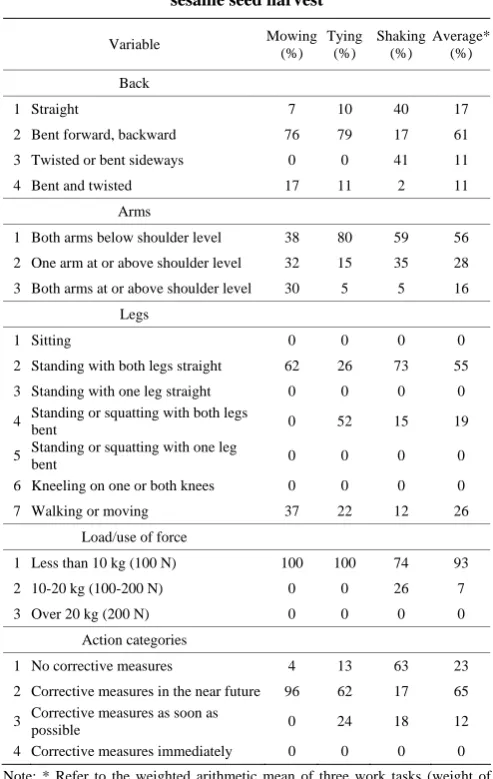
Considering Table 2, the most common work postures in mowing work task were bending forward back and standing with both legs associated with the use of forces less than 10 kg. Postures of bending forward back, both arms below shoulder level and squatting with both legs bent associated with the use of forces less than 10 kg were the most common in the work task of tying. In this work task, corrective measures were needed as soon as possible. About the work task of shaking, the most common posture for the back was straight, for arms was locating below shoulder level and for legs was standing with both legs straight. This work task resulted in the frequent need of forces from 10 kg to 20 kg (Table 2).
below shoulder level (56%), standing with both legs straight (55%) and use of forces less than 10 kg (93%). Corrective measures in the near future (65%) were the most common actions required in manual sesame seed harvest.
Table 2 Distribution of postures (%) of work tasks in manual sesame seed harvest
Variable Mowing (%)
Tying (%)
Shaking (%)
Average* (%)
Back
1 Straight 10 7 40 17
2 Bent forward, backward 76 79 17 61
3 Twisted or bent sideways 0 0 41 11
4 Bent and twisted 17 11 2 11
Arms
1 Both arms below shoulder level 38 80 59 56
2 One arm at or above shoulder level 32 15 35 28
3 Both arms at or above shoulder level 30 5 5 16
Legs
1 Sitting 0 0 0 0
2 Standing with both legs straight 62 26 73 55
3 Standing with one leg straight 0 0 0 0
4 Standing or squatting with both legs
bent 0 52 15 19
5 Standing or squatting with one leg
bent 0 0 0 0
6 Kneeling on one or both knees 0 0 0 0
7 Walking or moving 37 22 12 26
Load/use of force
1 Less than 10 kg (100 N) 100 100 74 93
2 10-20 kg (100-200 N) 0 0 26 7
3 Over 20 kg (200 N) 0 0 0 0
Action categories
1 No corrective measures 4 13 63 23
2 Corrective measures in the near future 96 62 17 65
3 Corrective measures as soon as
possible 0 24 18 12
4 Corrective measures immediately 0 0 0 0 Note: * Refer to the weighted arithmetic mean of three work tasks (weight of each work task was its percentage of time cycle (Table 1)).
4 Discussion
OWAS method proved to be well suited for analyzing working postures in agricultural activities (Das et al., 2013; Nevala-Puranen, 1996). Therefore, this study evaluated the working postures in manual sesame seed harvest using this method. This method made it possible to classify the work tasks based on intensity and extensity of awkward postures.
The sesame was planted in the on-bed planting system. Worker placed in the furrow which was at a lower height in comparison with sesame stem. The worker had to adjust his body in bent forward back with
both legs straight standing posture to mow the stems. This posture is called stooped posture which is common in the manual harvest of agricultural crops and is strongly associated with high incidence of low back disorders and
pains (Fathallah et al., 2004). Sustained shoulder
abduction (both arms at or above shoulder level, 30% (Table 2)) during work task of mowing, as a static work posture and one of physical risk factors at work(Burdorf and Sorock, 1997), may increase the muscle pain at shoulders’ region(Roquelaure et al., 2009).
Sesame farm is usually sparse and it let the worker to rapidly mow the stems. This condition did not let the worker squat or sit beside the crop stems but encouraged him to stand with both legs straight and walk. It could be ergonomically improved, until future mechanization interference, if the worker occasionally squats in-furrow or on the bed in order to break the stooped posture by dividing it into the stooped posture and squatting posture instead of pure stooped posture. This action causes to decrease physical strains on the particular body parts. Posture rotation is a potential way to prorate the physical workloads (Das et al., 2013).
mowing and frequent bent forward postures in these two work tasks, risk of low back disorders could more highly increase with exposure to awkward back postures and increasing duration of this exposure (Sbriccoli et al., 2004).
During work task of the shaking, the worker was observed with postures of bent and twisted back and one arm above shoulder level using a 10-20 kg force in order to shake the sheaves. This awkward posture may cause low back disorder and pain due to heavy lifting (Bernard, 1997) and shoulder musculoskeletal disorders due to heavy physical activities of shoulders(Roquelaure et al., 2009). The act of shaking was not avoidable in this work task, whether posture rotation is introduced or not. It seems that only way to avoid the shoulder heavy activity is the utilization of manual or powered machines for shaking, whilst rest durations could be suggested. Whereas corrective measures required in this work task was not the highest among all of the manual sesame seed harvest work tasks, due to non-avoidably of shoulder heavy activities using potential work rotation, this work task seems to be most critical onerous activity in the present study.
Worker participation in developing ergonomic interventions for stooped and squatting work provides the feedback on efficiency, comfort, and social and cultural issues that are necessary to improve worker acceptance and understand barriers to adoption (Fathallah et al., 2004). Therefore, further studies would be conducted to evaluate the effectiveness of some simple ergonomic interventions, for example, posture rotation or simple tools in manual sesame seed harvest.
Limitations
This study was only performed with considering to the male gender. The scarcity of female workers in manual sesame seed harvest area caused difficulty to prepare the conditions for participation and evaluation them.
5 Conclusions
Stooped and squatting postures were the most common awkward postures in manual sesame seed harvest similar to other agricultural activities, whereas the nature of activities of the present study was different from
them. Some ergonomic recommendations including posture rotation could be implemented where the mechanization and technology are still not entered. Moreover, some onerous work tasks (i.e. shaking) may not be mitigated but by introducing a manual or motorized tool. Overall, further studies would be undertaken to investigate the effects of some simple ergonomic interventions and manual or mechanized tools in manual sesame seed harvest.
Acknowledgments
The authors hereby thank the volunteer workers who made this work possible.
References
Anilakumar, K. R., A. Pal, F. Khanum, and A. S. Bawa. 2010. Nutritional, medicinal and industrial uses of sesame (Sesamum indicum L.) seeds-an overview. Agriculturae Conspectus Scientificus, 75(4): 159–168.
Bernard, B. P. 1997. Musculoskeletal Disorders and Workplace Factors: A Critical Review of Epidemiologic Evidence for Work-Related Musculoskeletal Disorders of the Neck, Upper Extremity, and Low Back. USA: National Institute for Occupational Safety and Health (NIOSH).
Burdorf, A., and G. Sorock. 1997. Positive and negative evidence of risk factors for back disorders. Scandinavian Journal of Work, Environment and Health, 23(4): 243–256.
Das, B., T. Ghosh, and S. Gangopadhyay. 2013. Child work in agriculture in West Bengal, India: assessment of musculoskeletal disorders and occupational health problems.
Journal of Occupational Health, 55(4): 244–258.
Davis, K. G., and S. E. Kotowski. 2007. Understanding the ergonomic risk for musculoskeletal disorders in the United States agricultural sector. American Journal of Industrial Medicine, 50(7): 501–511.
Fathallah, F. A. 2010. Musculoskeletal disorders in labor-intensive agriculture. Applied Ergonomics, 41(6): 738–743.
Fathallah, F. A., J. M. Meyers, and I. Janowitz. 2004. Stooped and Squatting Postures in the Workplace Conference Proceedings.
Oakland, California: University of California Center for Occupational and Environmental Health. July 29–30.
Hayati, A., A. Marzban, and M. A. Asoodar. 2015a. Ergonomic assessment of hand cow milking operations in Khuzestan province of Iran. Agricultural Engineering International: CIGR Journal, 17(2): 140–145.
Hayati, A., A. Marzban, and M. A. Asoodar. 2018. Evaluation of performance and cost of hand and mechanized cow milking methods [in Persian]. Iranian Journal of Biosystems Engineering, 49(1): 27–34.
Hofmann, J., K. Snyder, and M. Keifer. 2006. A descriptive study of workers' compensation claims in Washington State orchards. Occupational Medicine, 56(4): 251–257.
Hwang, J., Y. Kong, and M. Jung. 2010. Posture evaluations of tethering and loose-housing systems in dairy farms. Applied Ergonomics, 42(1): 1–8.
Hwang, L. S. 2005. Sesame Oil. In Bailey's Industrial Oil and Fat Products, ed.F.Shahidi, ch. 2.12, 537–576. New York: John Wiley and Sons Ltd.
Karhu, O., P. Kansi, and I. Kuorink. 1977. Correcting working postures in industry: a practical method for analysis. Applied Ergonomics, 8(4): 199–201.
Keir, P. J., K. Sanei, and M. W. R. Holmes. 2011. Task rotation effects on upper extremity and back muscle activity. Applied Ergonomics, 42(6): 814–819.
Kirkhorn, S. R., and G. Earle-Richardson. 2006. Repetitive motion injuries. In Agricultural Medicine: A Practical Guide, ed. E. J. Lessenger, ch. 24, 324–348. New York: Springer.
Marzban, A., and A. Hayati. 2014. Ergonomic assessment of manual harvesting of date palm. In International Scientific Conference on Applied Sciences and Engineering, 8. Kuala Lumpur, Malaysia, 20-21 Decembers.
Marzban, A., and A. Hayati. 2018. Ergonomic evaluation of traditional date fruit harvesting [in Persian]. Journal of Ergonomics. (Article in press)
Mattila, M., W. Karwowski, and M. Vilkki. 1993. Analysis of working postures in hammering tasks on building construction sites using the computerized OWAS method. Applied Ergonomics, 24(6): 405–412.
Nevala-Puranen, N. 1996. Effects of occupationally-oriented rehabilitation on farmers’ work techniques, musculoskeletal symptoms, and work ability. Journal of Occupational
Rehabilitation, 6(3): 191–200.
Niu, Sh., and K. Kogi. 2014. Ergonomic Checkpoints in Agriculture: Practical and Easy-To-Implement Solutions for Improving Safety, Health and Working Conditions in Agriculture. Geneva: International Labour Office.
Nzikou, J. M., L. Matos, G. Bouanga-Kalou, C. B. Ndangui, P. G. Pambou-Tobi, A. Kimbonguila, Th. Silou, M. Linder, and S. Desobry. 2009. Chemical composition on the seeds and oil of sesame (Sesamum indicum L.) grown in Congo-Brazzaville.
Advance Journal of Food Science and Technology,1(1): 6–11. O’neill, D. H. 2000. Ergonomics in industrially developing
countries: Does its application differ from that in industrially advanced countries. Applied Ergonomics, 31(6): 631–640. Raina, S. M., and C. R. Dickerson. 2009. The influence of job
rotation and task order on muscle fatigue: a deltoid example.
Work, 34(2): 205–213.
Roquelaure, Y., H. A. Catherine, C. Rouillon, N. Fouquet, A. Leclerc, A. Descatha, A. Touranchet, M. Goldberg, E. Imbernon, and Members of Occupational Health Services of the Pays de la Loire Region. 2009. Risk factors for upper-extremity musculoskeletal disorders in the working population. Arthritis and Rheumatology, 61(10): 1425–1434. Sbriccoli, P., M. Solomonow, B. Zhou, R. V. Baratta, Y. Lu, M.
Zhu, and E. L. Burger. 2004. Static load magnitude is a risk factor in the development of cumulative low back disorder.
Muscle and Nerve, 29(2): 300–308.
Tiwari, P. S., and L. P. Gite. 2006. Evaluation of work-rest schedules during operation of a rotary power tiller.
International Journal of Industrial Ergonomics, 36(3): 203–210. Van Dieen, J. H., S. M. A. Jansen, and A. F. Housheer. 1997.
Differences in low back load between kneeling and seated working at ground level. Applied Ergonomics, 28(5-6): 355–363.