Design of Wireless Security Surveillance System in
Remote Unattended Wells
https://doi.org/10.3991/ijoe.v15i07.7837
Jian Du, Guangmin Meng (*), Chao Yang Southwest Petroleum University, Chengdu, China
Abstract—In this study, the characteristics of frame and background differ-ence methods in extracting a moving target using a fixed camera are analyzed, and the background difference method is improved by combining the ad-vantages of the abovementioned two methods. Background modeling is pro-posed to reduce the influence of external environment on mobile target detec-tion. Comparison results show that the effect on moving object detection is bet-ter through the improved background difference method than the background difference method based on a mixed Gaussian model. The relevant test results of the simulation experimental platform show that the designed unattended se-curity video surveillance system is feasible. The safety of the traditional video surveillance systems should be improved to prevent the deliberate invasion of people and ensure the safety of the production and property of unattended well sites.
Keywords—Unattended well, remote control, security surveillance system, wireless network
1
Introduction
China has established numerous unattended wells given the vigorous development of oilfield information construction. Remote wireless monitoring is essential because most unattended wells are located in remote and sparsely populated areas. The tradi-tional monitoring systems consume considerable resource because these systems rely heavily on labor-based monitoring [1]. Moreover, considerable information is lost given the insufficient precision of the naked eyes. Thus, a reliable and efficient detec-tion of the behaviors of moving objects in oilfield has become a challenge for intelli-gent security video surveillance; in particular, the security monitoring of unattended wells has attracted significant attention worldwide [1].
and enhance the effect of video monitoring. The data collected by the server are transmitted by wireless communication to the remote monitoring center for data anal-ysis and processing. First, the characteristics of frame difference and background difference methods for extracting moving targets using a fixed camera are analyzed in this study, and the background difference method is improved by combining the ad-vantages of two methods. Second, experimental verification is conducted by using a designed software platform to design a complete and efficient computer vision securi-ty monitoring system of wells.
2
State-of-the-Art
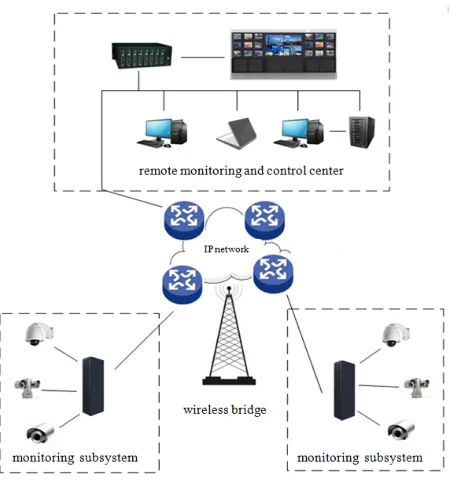
The network of video monitoring systems has become a trend in network technolo-gy development. The network scheme for the system is illustrated in Figure 1. The site monitoring subsystem transmits video information from the internal network to the remote monitoring center by using wireless communication technology through the server. Then, the remote monitoring center decodes video streams with a digital decoder and maps these streams to various TV monitors that are attached to the walls. Simultaneously, video signals are transmitted to PC clients via Wireless Local Area Network for video information processing.
Target monitoring remains in an inactive state extensively because the cameras of unattended wells are fixed, and most of the monitor screens use static monitoring. This study focuses on moving target detection using a stationary camera. The target motion detection for a given video sequence separates the object of interest from the surrounding environment [3]. This process is also the basis of motion target tracking, motion target recognition, and behavior in intelligent video analysis. Existing algo-rithms on motion target detection with static background used include consecutive frame subtraction [4], background difference [5], and optical flow methods [6]. In addition, many detection algorithms are extended from the three abovementioned methods; however, no algorithm can adapt to all applications; thus, a concrete analy-sis is required.
2.1 Consecutive Frame Subtraction
Consecutive frame subtraction method is based on adjacent video frame sequences; in this method, the object moves in video sequences, and the image pixels in several areas between two frames are different, thereby obtaining two adjacent frames or three frame images in a video sequence; then, the results of difference operation are separated from the background by using a binary function [7-9]. This algorithm is commonly used for moving object detection given its simple principle, low complexi-ty, and high real-time performance. However, the pixels that correspond to non-moving objects in adjacent video frames are disturbed despite the inexistence of mov-ing targets in the monitormov-ing screen. In addition, the frame difference effect is signifi-cantly affected by the video frame rate and motion target speed. This algorithm cannot extract all the characteristic pixel points that belong to the object in motion.
2.2 Optical flow
Optical flow method was first introduced in 1950. Optical flow represents the movement speed of patterns in time-varying images. The brightness mode that corre-sponds to the pixel point on the image is also in motion when a moving target exists in the video sequence. This motion is the optical flow, which is represented by the image brightness pattern. However, different additional constraints, such as frequency domain, gradient, and block matching, are frequently added when using the optical flow method. These constraints make the computing complex and real-time perfor-mance unsatisfactory. Occasionally, light flow is detected when external lighting changes, although no movement is found.
2.3 Background difference
the real-time video frame [10-12]. The basic principle of the background model is simple and uncomplicated. However, this method is only suitable for a simple back-ground, and the stabilizing effect is favorable. A background model with high compu-tational and statistical complexity and a neural network should be used for complex background situations to obtain an ideal detection effect. In addition, background difference method is sensitive to light and other weather changes in the monitoring environment.
3
Methods
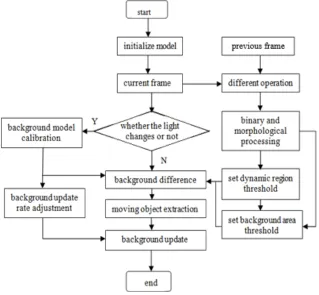
Interference factors are mainly derived from light intensity changes over time giv-en the monitoring scgiv-ene of unattgiv-ended wells is stable; this work presgiv-ents an improved background difference method based on background difference [13-14], which is aimed at moving target detection with global illumination changes under existing problems. The target detection of the method is depicted in Figure 2.
The mean background for the first few frames in the video series is modeled by Formula (1). A single pixel in the image is regarded as random variables based on time because the monitoring scene is incompletely fixed in the time frame of the background model; however, random variables float around a certain value, which is represented in the mean, median, and statistical histogram of the video sequences. This study adopts an initial background model based on the mean method to improve real-time performance.
(1) Where 𝐵𝐵"(𝑥𝑥, 𝑦𝑦) represents the background pixels in position (𝑥𝑥, 𝑦𝑦) after the ini-tialiation of the background model, and 𝐹𝐹)(𝑥𝑥, 𝑦𝑦) represents the first k in previous N
frame video sequence. The difference operation is performed after using the current frame image 𝐹𝐹) and previous frame image𝐹𝐹),-. Then, the results are treated by
bina-rization, as defined in Formula (2).
(2)
Formula (2) indicates that the pixel is located in the foreground and vice versa if the difference between the pixels of two frames is greater than set threshold . The background changes between two frames for video sequences with a huge frame rate are minimal, while the foreground changes are huge. Thus, the frame difference method is used to create a pre-segmentation on the background and motion fore-ground of the frame, and morphological operation is applied to complete the target area of the entire motion. The difference results between the current frame and back-ground model of backback-ground pixels for global illumination changes increase because the update speed can neither be very fast nor very slow. This speed may cause an overlap on the difference results between the ranges of the background and moving regions. Thus, using the same threshold cannot completely extract the target motion or the foreground and background of the movement cannot be completely segmented. Therefore, thresholds in the background difference are set in various regions to solve the problems caused by the same threshold value when using the frame difference method to prejudge the foreground and background motions. Formula (3) expresses the threshold extraction method.
(3)
N
y
x
F
y
x
B
N k kå
-==
1 0 0)
,
(
)
,
(
î
í
ì
£
->
-=
-T
y
x
F
y
x
F
T
y
x
F
y
x
F
y
x
R
k k k kk
0
,
(
,
)
(
,
)
Where z represents the moving target area of , w represents the background region of , 𝑇𝑇1is the empirical threshold, and m is the
scal-ing factor.
Illumination changes are determined by converting the red–green–blue (RGB) col-or space of the video frame image into the HSV colcol-or space [33-34] and using the light path information. The background model does not require calibration if no illu-mination change exists. Otherwise, the background model should be corrected before performing background difference with the current frame. Owing to several fore-ground noises that are obtained in 𝑅𝑅)(𝑥𝑥, 𝑦𝑦)of the two frame difference methods,
sev-eral foreground noises are erroneously detected as foreground because they do not obtain the threshold scaling gain for the pixels that belong to the background. There-fore, the background model is calibrated by using the background model, chromatici-ty, saturation, and brightness information before background difference to reduce the effects of noises. Formula (4) expresses the background calibration method, where
𝐵𝐵)1(𝐻𝐻1, 𝑆𝑆1, 𝑉𝑉1)is the calibrated background; 𝐻𝐻1, 𝑆𝑆1, and 𝑉𝑉1 are the chrominance,
satura-tion, and brightness channels, respectively; (𝐻𝐻7, 𝑆𝑆7, 𝑉𝑉7) are the HSV channels of the
current frame; and (𝐻𝐻8, 𝑆𝑆8, 𝑉𝑉8) are the HSV channels of the uncorrected background 𝐵𝐵).
(4)
where𝑘𝑘:, 𝑘𝑘;, and 𝑘𝑘< are the correction factors. The binarization of the background
frame difference is defined in Formula (5), and 𝑇𝑇1 is the threshold value obtained by
Formula (3).
(5)
Formula (5) expresses different threshold binarization processes that correspond to various regions. The median is the pixel point of the moving target area 𝑧𝑧1if its value
is 255. Otherwise, the median is the pixel point of the background region 𝑤𝑤1.
Then, the background model should be updated, thereby dividing this model into two categories. The first category is by adjusting the update rate when the illumina-tion changes, and the second category is by updating the entire background when no light changes exist.
(6)
1
)
,
(
x
y
=
R
k( , ) 0
k
R x y
=
)
,
,
(
)
,
,
(
h b s b v bk
H
S
V
k
H
k
S
k
V
B
¢
¢
¢
¢
=
T
y
x
B
y
x
F
T
y
x
B
y
x
F
y
x
R
k k k kk
-
¢
£
¢
¢
>
¢
-î
í
ì
=
)
,
(
)
,
(
)
,
(
)
,
(
,
0
,
255
)
,
(
z
)
,
(
)
,
(
)
1
(
)
,
(
)
,
(
1
=
´
-
+
´
Î
¢
È
¢
+
x
y
B
x
y
F
x
y
x
y
w
(7)
3.1 Moving target marking
Moving target detection in security video surveillance systems is aimed at inform-ing the staff in timely detectinform-ing suspicious targets. Thus, locatinform-ing the movinform-ing targets should be identified after these targets are marked on the video screen. To emphasize the location of moving targets, this study adopted block set theory to cover the origi-nal moving target. The principle of block set theory is by sliding a certain size (N × N) of a block on a certain step in the binary outline. If the white pixel points of the block are larger than the percentage of all pixel points in the block area, then the area is considered a part of the moving target and is labeled, and its data expression is defined in Formula (8). K is the proportional factor and is less than 1, which is an estimate of the global pixel change. Here, k = 0.45, andN = 16. These results are the optimal values among repeated experiments.
(8)
4
Results and Analysis
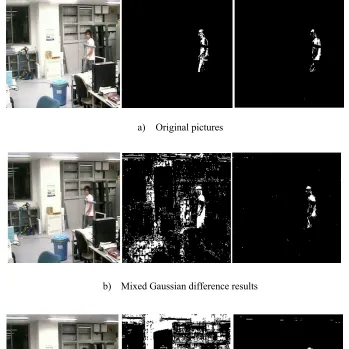
The test sequence in LIMU moving object detection database of Kyushu University is extracted by using the mixed Gaussian background difference and the proposed improved background difference methods to verify that the proposed method has a favorable contour extraction effect on the changes in global illumination. Figure 3 demonstrates the comparison of the contour extraction results based on LIMU test sequence. The results of mixed Gaussian background difference detection are signifi-cantly affected by global illumination when light darkens from frames 50 to 52, espe-cially for the moving target in frame 52 that is submerged with background noises. However, the corresponding detection results of the improved background difference method only exhibit several noise points, and the motion target contour remains clear despite light changes. The improved background difference method can calibrate the background model in real time because this method is slightly sensitive to global illumination changes and reflects improved robustness. When in night conditions, the Hikvision video camera used in this study has a night vision function, which can also updates the background model during nighttime.
z
y
x
w
y
x
y
x
B
y
x
F
y
x
B
y
x
B
k k kk
Î
¢
¢
Î
î
í
ì
´
-
¢
+
´
¢
=
+(
,
)
)
,
(
)
,
(
)
,
(
)
1
(
)
,
(
)
,
(
1a
a
else
k
N
N
j
y
i
x
f
y
x
L
N j i få
+
+
>
´
´
î
í
ì
=
,(
,
)
|
=255a) Original pictures
b) Mixed Gaussian difference results
c) Improved difference method results
Fig. 3. Comparison of contour extraction results based on LIMU test sequence
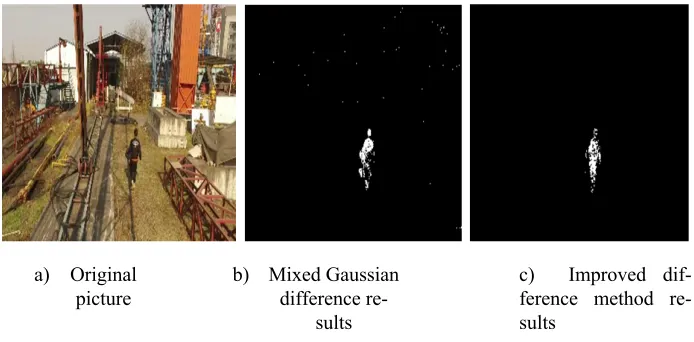
Figure 4 displays the comparison of the contour extraction results based on the re-cording sequence. A certain amount of ambient noise is found in the video sequence. The extraction results of the two methods are compared. On the one hand, the mixed Gaussian model completely extracts the contour of the moving target, but several error detection points are found simultaneously. On the other hand, no error detection point is found despite several empty points that were observed through the improved background difference method. Therefore, the proposed method outperforms the mixed Gaussian model. For mobile target detection, the two cases are acceptable because the abovementioned shortcomings are not critical. The two cases obtain ac-ceptable results through subsequent morphological processing.
a) Original
picture b) Mixed Gaussian difference re-sults
c) Improved dif-ference method re-sults
Fig. 4. Comparison of contour extraction results based on recording sequences
Fig. 5. Labeled diagram of moving target location
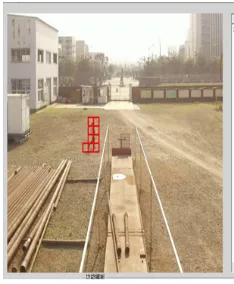
A sound alarm is activated if an intrusion event is detected using the designed in-telligent video analysis software. Figure 6 illustrates the software analysis effect of smart video software based on the improved background difference method. Figures 6 (a) and (b) depict the detection effects of the moving target and pedestrians, corre-spondingly. The results indicated that the designed software realizes the remote wire-less video monitoring and management, and accomplishes the moving target detection and pedestrians, which are suitable for the security video monitoring of unattended well fields.
5
Conclusion
This study systematically investigated the security video surveillance system of unattended wells based on previous research results. A concrete system solution is provided for the particularity of unattended wells and other monitoring occasions. The characteristics of the frame and background difference methods are analyzed, and thus an improved background difference algorithm is proposed based on the advantages of the two methods for guaranteeing the real-time performance of the system. Then, the target location is identified by block collection on the basis of obtaining the moving target contour. The feasibility of this program is experimentally verified by construct-ing the simulation platform. The final results show that this scheme is suitable for securing unattended well sites. In addition, this scheme can be adapted to a scene with a large global light variation by correcting the background model in real time. There-fore, the improved background difference method can satisfy the requirements of unmanned fields in monitoring the moving targets.
Partial research is conducted because the objective of this study is large, and the content is broad. Moreover, all aspects are not completed given the limitation of ob-jective conditions. Ultimately, this study should be improved in the future.
6
References
[1]X. Huang, Y. Zhao, Z. X. Cheng, Y. L. Yuan, X. H. Liang(2014), Detection of Unattended and Removed Objects in Public Areas, Applied Mechanics and Materials, Vol. 678:166-173. https://dx.doi.org/10.4028/www.scientific.net/AMM.678.166
[2]Sumati Manchanda, Shanu Sharma(2016), Identifying Moving Objects in a Video using Modified Background Subtraction and Optical Flow Method, Proceedings of the 10th IN-DIACom; 2016 3rd International Conference on Computing for Sustainable Global Devel-opment, INDIACom 2016: 129-133.
[3]Wenyan Ci. A review of motion target detection methods [J]. Information technology, 2016(12):93-96.
[4]P KaewTraKulPong, R Bowsen. An Improved Adaptive Background Mixture Model for Real-time Tracking with Shadow Detection. In: Proc 2nd European Workshop on Ad-vanced Video Based Surveillance Systems.AVBS01.2001,149-158.
http://dx.doi.org/10.1007/978-1-4615-0913-4_11
[5]Senior A,Hampaur A,Tian Y L,Brown L Pankanti S Bolle R. Appearance models for oc-clusion handling[J].Image and vision computing,2006,(11):1233-1243.
http://dx.doi.org/10.1016/j.imavis.2005.06.007
[6]Horn B K P, Schunck B G. Determining optical[J]. Artifical Interlligence,1981,17:185-203. https://doi.org/10.1016/0004-3702(81)90024-2
[7]Ping Lai Lo,B Sun J,Velastin S A.Fusing Visual and Audio Inormation in Distribute Intel-ligent Surveillance System for Public Transport Systems, Acta Automatica Sini-ca,2003,29(3):393-407.
Classi-fier Architecture. IEEE Transactions On Neural NetWorks,2003,14(3):616-629 .
http://dx.doi.org/10.1109/TNN.2003.810605
[9]I.Haritaoglu, D.Harwood, L.S.Davis.W4: Real-Time Surveillance of People and Their Ac-tivities. IEEE Trans.PAMI.2000, 22(8):809-830. https://doi.org/10.1109/34.868683
[10]Elgammal, Harwood D, Davis L.Non-parametric Model for Background Subtraction.In European Conference on Computer Vision, 2000,751-767 . http://dx.doi.org/10.1007/3-540-45053-X_48
[11]Nguyen H T, Smeulders A W M. Fast occluded object tracking by a robust appearance fil-ter[J].IEEE Transaction on Pattern Analysis and Machine Intelligence,2004:1099-1104 .
https://doi.org/10.1109/TPAMI.2004.45
[12]Yongchao Wang. Multi-objective detection and tracking technology based on background difference [D]. Zhejiang University, 2015.
[13]Haizhou AI,Junliang Xing. Computer vision algorithm and application [M]. Tsinghua uni-versity press, 2012.
[14]Qing lin , Zhu xu, Detect motion targets used HSV adaptive hybrid Gaussian model [J]. Computer science, 2010, 37(10):254-256.
7
Authors
Jian Du is a professor in school of Mechanical Engineering, Southwest Petroleum University, Chengdu, 610500, China. His research interests include intelligent instru-ment, automatic control technology.
Guangmin Meng is a graduate student in school of Mechanical Engineering, Southwest Petroleum University, Chengdu, 610500, China. Her research interests include intelligent instrument. (Email: [email protected])
Chao Yang is an assistant laboratory technician in school of Electrical Engineering and Information, Southwest Petroleum University, Chengdu, 610500, China. His research interests include computer vision technology and automatic control technol-ogy.