BIBECHANA
A Multidisciplinary Journal of Science, Technology and Mathematics
ISSN 2091-0762 (online)
Journal homepage: http://nepjol.info/index.php/BIBECHANA
The effect of tantalum addition on the corrosion behavior
of W-xTa alloys in 1 M NaOH solution
Susil Baral , Jagadeesh Bhattarai*
Central Department of Chemistry, Tribhuvan University, Kathmandu, Nepal.
*E-mail:[email protected].
Article history: Received 25 July, 2013; Accepted 23 September, 2013
Abstract
The role of tantalum addition on the corrosion behavior of the sputter–deposited nanocrystalline and amorphous W–xTa (x=8–77) alloys was studied in 1 M NaOH solution open to air at 25°C using corrosion tests and electrochemical measurements. Tungsten and tantalum metals act synergistically in enhancing the corrosion resistant properties of the W–xTa alloys and hence addition of 23 at% or more tantalum to the alloys were found to be effective to lower the corrosion rate of the alloys than those of alloy–constituting tungsten and tantalum elements. The corrosion rates of the W-xTa alloys containing 23-77 at% tantalum are nearly two orders of magnitude lower than that of tungsten and even slightly lower than that of tantalum in 1 M NaOH. Addition of tantalum metal in W–xTa alloys is effective for ennoblement of the open circuit corrosion potential of the tungsten metal in 1 M NaOH solution at 25°C.
Keywords: Sputter-deposited W−xTa alloys, Corrosion rate, Corrosion potential, NaOH solution, Electrochemical measurement.
1. Introduction
It is generally believed that the preparation of metallic alloys with a liquid like atomic arrangement requires ultra-rapid quenching of the alloy melt. In the early 1960s, amorphous and supersaturated solid solution of metallic alloys prepared by rapid quenching attracted considerable attention from materials scientists, because of their technologically important properties such as physical, chemically, mechanical, magnetic, electronic and catalytic properties [1]. A novel corrosion resistance properties of the rapidly–quenched alloys even in aggressive environments generated tremendous interest of corrosion scientists last four decades. Varieties of corrosion–resistant rapidly quenched alloys were developed in 1970’s [2-6]. Since 1990’s, it has been reported that the sputter– deposited binary tungsten–titanium [7-10], tungsten–zirconium [7,11,12], tungsten–chromium [7,13,14], tungsten–niobium [7,15-17], tungsten–tantalum [7,18-20], tungsten–molybdenum [21-24] and tungsten–nickel [21,25,26], and ternary tungsten–based [27-33] alloys showed higher corrosion
Tungsten and tantalum are regarded as very effective alloying elements for enhancing the corrosion resistance properties of the alloys in aggressive environments. It has been reported that the addition of small amount of tungsten to stainless steels increased the corrosion-resistance of steels and stainless steels [34,35]. Several surface studies have been carried out for the better understanding of the role of tungsten in the passivity of stainless steel in aggressive chloride containing medium [36-40]. Furthermore, it has been also reported that the addition of a small amount of tungsten to amorphous Fe-P-C alloys with or without chromium [41-43], to Ni-Fe [44] alloys and to the amorphous Ni-P alloys [45] is effective in improving the corrosion resistance of these alloys in aggressive hydrochloric acid solutions. Similarly, the addition of only small amount of tungsten (i.e., less than 10 at%) was enough to cause spontaneous passivation of the sputter-deposited nanocrystalline W-xCr alloys in 12 M HCl solution and they showed about five orders of magnitude lower corrosion rate than the corrosion rate of chromium metal [7,14,46]. On the other hand, tantalum is widely known for its superior corrosion resistance properties in aggressive acidic media. Amorphous nickel−base alloys containing certain amounts of tantalum exhibit very high corrosion resistant in boiling acids [47]. It has been reported that a beneficial effect of tantalum to improve the corrosion resistance of nickel−base alloys in 12 M HCl [48]. A series of the sputter−deposited binary tantalum−containing alloys showed higher corrosion resistance than those of alloying elements due to spontaneous passivation in aggressive media [5,20,49-51].
It has been reported that the corrosion resistance of the sputter–deposited amorphous or nanocrystalline W–Ta alloys were passivated spontaneously and observed significantly high corrosion resistance in 12 M HCl solution having the pH value of less than 4 [7,18]. It is meaningful for mentioning here that tungsten is hardly corroded by most of acid solutions, except some complex acids like HF acid which attacks it. However, tungsten metal is corroded in neutral and alkaline solutions [52]. On the other hand, tantalum metal is highly corrosion resistance in all pH values [53], mostly due to the formation of stable and diffusion–barrier tantalum oxides. In this context, it is interesting to study the corrosion behavior of the sputter−deposited W–xTa alloys in alkaline 1 M NaOH solution.
The main objectives of this study are to estimate the corrosion rate and study the electrochemical behavior of the sputter–deposited amorphous or nanocrystalline W–xTa alloys in 1 M NaOH solution open to air at 25°C.
2. Materials and Experimental Methods
The sputter–deposited binary W−xTa (x=23,60 & 77 at%) alloys were characterized as the single– phase solid solutions of amorphous or/and nanocrystalline structures having apparent grain size ranges from 1.6−22 nm [7,18]. The compositions of the sputter–deposited W–xTa alloys hereafter are all denoted in atomic percentage (at%).
Prior to corrosion tests and electrochemical measurements, the surface of the alloy specimen was mechanically polished with a silicon carbide paper up to grit number 1500 in cyclohexane, rinsed by acetone and dried in air. The average corrosion rate of the alloys was estimated from the weight loss after immersion for 240 h in 1 M NaOH solution open to air at 25°C using the formula as described elsewhere (7,54). The time dependence of the corrosion rate of the W–xTa alloys was also estimated at various time intervals ranging from 2 to 240 hours.
3. Results and Discussion
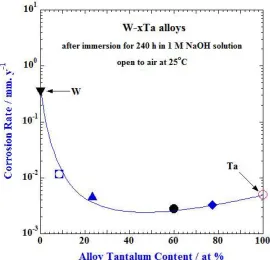
Figure 1 shows the changes in corrosion rates of the sputter–deposited W–xTa alloys including the sputter–deposited tungsten and tantalum metal after immersion for 240 hours in 1 M NaOH solution open to air at 25°C. Corrosion rates of the binary W–xTa alloys containing 23–77 at% tantalum are more than two orders of magnitude lower than that of tungsten and even slightly lower than that of the tantalum. However, the corrosion rate of the W–8Ta alloy is slightly higher than that of tantalum metal. In particular, the sputter–deposited W–xTa alloys containing 60–77 at% tantalum content, which are composed of either amorphous or nanocrystalline single phase solid solution, show lower corrosion rates than those of alloy-constituting elements (i.e., tungsten and tantalum) even immersion for 240 hours in 1 M NaOH solution at 25°C. The corrosion rate of the W–60Ta alloy shows lowest among the examined alloys. Consequently, the addition of tantalum to the sputter–deposited W–xTa alloys is effective in enhancing the corrosion resistance propertied of the alloys in 1 M NaOH solution.
Fig. 1: Changes in corrosion rates of the deposited W-xTa alloys including the sputter-deposited tungsten and tantalum metals in 1 M NaOH solution open to air at 25°C, as a function of alloy tantalum content.
chemical reactivity of the alloys leads to the rapid accumulation of a beneficial species in the passive films. This accounts for the high corrosion resistance of the alloys.
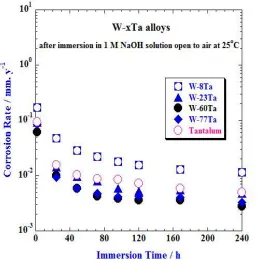
Figure 2 shows the changes in the corrosion rates of all the examined W–xTa alloys including the sputter–deposited tantalum in 1 M NaOH solution open to air at 25°C, as a function of immersion time. In general, the corrosion rates of all the examined W–xTa alloys are significantly high at initial periods (for example, for about 2 h). The corrosion rate is decreased with immersion time till about 2–72 h for all the W–xTa alloys. In particular, the corrosion rates of the W–xTa alloys become almost steady after immersion for about 72–240 hours. Accordingly, initially fast dissolution of the W–xTa alloys results in fast passivation by forming a more protective passive films in 1 M NaOH solution at 25°C. As a result, the average corrosion rates of the W–xTa alloys are lower than that of the tungsten metal after immersion for 240 h as shown above in Fig. 1 also.
Fig.2: Changes in corrosion rates of the W-xTa alloys including tantalum metal in 1 M NaOH solution open to air at 25°C, as a function of immersion time.
immersion for 72 h in 1 M NaOH solution. These results revealed that the stability of the passive films of the W–(23–77)Ta alloys is increased with increasing tantalum content in the alloys and the passive films formed on
the alloys are more stable than those films formed on the sputter–deposited tungsten and tantalum metals.
On the other hand, the open circuit potential of all the examined W-xTa alloys in 1 M NaOH solution is located between the open circuit potential of tungsten and tantalum metals as shown in Fig. 4. It is meaningful to mention here that the open circuit potential of the W-xTa alloys containing 60-77 at% chromium content are located slightly more positive direction than that of tantalum metal. Accordingly, the addition of tantalum enhances the corrosion resistance properties of the sputter-deposited W-xTa alloys.
Fig.4: Changes in corrosion rate and open circuit potential for the W–xTa alloys including tungsten and tantalum metals in the given condition, as a function of alloy tantalum content.
4.Conclusions
In this study, a beneficial effect of tungsten and tantalum in the corrosion behavior of the sputter−deposited binary W−xTa alloys was studied using corrosion tests and electrochemical measurements. Tantalum metal acts synergistically with tungsten in enhancing the corrosion resistance properties of the sputter–deposited W–xTa alloys so as to show lower corrosion rates of the alloys than the corrosion rates of the alloy–constituting elements (i.e., tungsten and tantalum) in 1 M NaOH solution open to air at 25°C. More ennoblement of the open circuit potentials of the W– 60Ta and W–77Ta alloys are observed as compared to those of W–8Ta and W–23Ta alloys after immersion for 72 h in 1 M NaOH and hence more stable passive films were formed on the surface of the sputter–deposited tantalum–rich W–xTa alloys. The stability of the passive films formed on the W–xTa alloys is generally increased with increasing the tantalum content.
Acknowledgements
References
1. K. Hashimoto, H. Habazaki, E. Akiyama, H. Yoshioka, J. H. Kim, P. Y. Park, A. Kawashima and K. Asami. The Science Reports of the Research Institutes of Tohoku University, A42 (1996) 99.
2. M. Naka, K. Hashimoto and T. Masumoto, J. Japan Inst. Metals, 38 (1974) 835. 3. M. Naka, K. Hashimoto and T. Masumoto, Corrosion, 32(1976)146.
4. K. Hashimoto and T. Masumoto, Mater. Sci. Eng., 23 (1976) 258.
5. K. Hashimoto, T. Masumoto, and S. Shimodaira, in Proceeding of the Passivity and its Breakdown on Iron base Alloys. USA-Japan Seminar-1975, NACE, Houston, Texas. (1976) p. 34.
6. K. Hashimoto, K. Asami, M. Naka and T. Masumoto, Corros. Sci., 19 (1979) 857.
7. J. Bhattarai, Tailoring of corrosion resistance tungsten alloys by sputtering. Ph. D. thesis, Department of Materials Science, Tohoku University, Japan. (1998) 229 pp.
8. J. Bhattarai, Nepal J. Sci. Technol., 10 (2009) 109. 9. J. Bhattarai, Tribhuvan Univ. J., 26 (1) (2009) 17.
10. J. Bhattarai, E. Akiyama, A. Kawashima, K. Asami and K. Hashimoto, Corros. Sci., 37 (1995) 2071.
11. J. Bhattarai, E. Akiyama, H. Habazaki, A. Kawashima, K. Asami and K. Hashimoto, Corros. Sci., 39 (1997) 355.
12. P. Shrestha and J. Bhattarai, J. Nepal Chem. Soc., 25 (2010) 37.
13. J. Bhattarai, E. Akiyama, H. Habazaki, A. Kawashima, K. Asami and K. Hashimoto, Corros. Sci., 40 (1998) 155.
14. M. Basnet and J. Bhattarai, J. Nepal Chem. Soc., 25 (2010) 53.
15. J. Bhattarai, E. Akiyama, H. Habazaki, A. Kawashima, K. Asami and K. Hashimoto, Corros. Sci., 40 (1998) 19, 1897.
16. H. Jha and J. Bhattarai, J. Alloys Compd., 456 (2008) 474. 17. J. Bhattarai, J. Sci. Res., 3(3) (2011) 457.
18. J. Bhattarai, E. Akiyama, H. Habazaki, A. Kawashima, K. Asami and K. Hashimoto, Corros. Sci., 40 (1998) 757.
19. J. Bhattarai, Nepal J. Sci. Technol., 12 (2011) 139. 20. J. Bhattarai, Bibechana, 8 (2012) 8.
21. J. Bhattarai, Corrosion behavior of sputter-deposited tungsten-base alloys. Research Reports, Institute for Materials Research (IMR), Tohoku University, Sendai, Japan. (1995) 43+IV pp. 22. J. Bhattarai, J. Nepal Chem. Soc., 21 (2006) 19.
23. A. Khadka and J. Bhattarai, Nepal J. Sci. Technol., 11 (2010) 147. 24. J. Bhattarai, Scientific World, 10 (2012) 71.
32. J. Bhattarai, J. Nepal Chem. Soc., 26 (2010) 13. 33. J. Bhattarai, Afr. J. Pure Appl. Chem., 5(8) (2011) 212. 34. J. Bhattarai, Scientific World 9 (2011) 34.
35. R. R. Kumal and J. Bhattarai, J. Nepal Chem. Soc., 25 (2010) 93.
36. N. Bui, A. Irhzo, F. Dabosi and Y. Limouzin-Maire, Corrosion, 39 (1983) 491. 37. N. D. Tomashov, G. P. Chernova and O. N. Marcova, Corrosion, 20 (1964) 166.
38. A. N. Mansoure and K. L. Vasanth, in Proc. 12th Intl. Corros. Congress, NACE International Publisher, Houstion, TX, USA. 5B (1993) 4009.
39. K. Hashimoto, M. Naka, J. Noguchi, K. Asami and T. Masumoto, “Passivity of Metals”, in Corrosion Monograph Series (eds. R. P. Frankenthal and J. Kruger), The Electrochemical Soc., Princeton, USA, (1978) p. 156.
40. R. Wang and M. D. Merz, Corrosion, 40 (1984) 272.
41. R. Goetz, J. Laurent and D. Landolt, Corros. Sci., 25 (1985) 1115. 42. I. Irhzo, Y. Segui, N. Bui and F. Dabosi, Corros. Sci., 26 (1986) 769.
43. H. Habazaki, A. Kawashima, K. Asami and K. Hashimoto, J. Electrochem. Soc., 138 (1991) 76. 44. H. Habazaki, A. Kawashima, K. Asami and K. Hashimoto, Corros. Sci., 33 (1992) 225.
45. A. Kawashima, K. Asami and K. Hashimoto, Corros. Sci., 24 (1984) 807.
46. D. R. Knittel, M. A. Maguire, A. Bronson and J. S. Chen, Corrosion, 38 (1982) 265. 47. R. Goetz, C. Boband and D. Landolt, in Proc. 8th ICMC, Mainz, (1981) p. 247. 48. J. Bhattarai, J. Inst. Sci. Technol., 12 (2002) 125.
49. A. Kawashima, K. Shimamura, S. Chiba, T. Masunaga, K. Asami and K. Hashimoto. in Proc. 4th Asian−Pacific Corrosion Control Conference, Tokyo. 2 (1985) 1042.
50. H.-J., Lee, E. Akiyama, H. Habazaki, A. Kawashima, K. Asami and K. Hashimoto, Corros. Sci., 39 (1997) 321.
51. J. Kim, E. Akiyama, H. Habazaki, A. Kawashima, K. Asami and K. Hashimoto, Corros. Sci., 36 (1994) 511.
52. Park, P.Y., E. Akiyama, A. Kawashima, K. Asami and K. Hashimoto, Corros. Sci., 38 (1996)397.
53. A. A. El−Moneim, E. Akiyama, H. Habazaki, A. Kawashima, K. Asami and K. Hashimoto, Corros. Sci., 39 (1997) 1965.
54. M. Pourbaix, in Atlas of Electrochemical Equilibrium in Aqueous Solution, National Association of Corrosion Engineers, Huston, TX, (1974) 280.
55. M. Pourbaix, in Atlas of Electrochemical Equilibrium in Aqueous Solution, National Association of Corrosion Engineers, Huston, TX, (1974) 252.