P
P
E
E
R
R
F
F
O
O
R
R
M
M
A
A
N
N
C
C
E
E
E
E
V
V
A
A
L
L
U
U
A
A
T
T
I
I
O
O
N
N
O
O
F
F
P
P
S
S
O
O
,
,
P
P
S
S
O
O
C
C
A
A
A
A
N
N
D
D
M
M
P
P
S
S
O
O
C
C
A
A
F
F
O
O
R
R
S
S
O
O
L
L
V
V
I
I
N
N
G
G
U
U
N
N
I
I
V
V
E
E
R
R
S
S
I
I
T
T
Y
Y
T
T
I
I
M
M
E
E
T
T
A
A
B
B
L
L
I
I
N
N
G
G
P
P
R
R
O
O
B
B
L
L
E
E
M
M
O
Ol
lu
uw
wa
as
se
eu
un
n
M
M.
.
A
Al
la
ad
de
e,
,
C
Ch
hr
ri
is
st
to
op
ph
he
er
r
A
A.
.
O
Oy
ye
el
le
ey
ye
e,
,
O
Ol
lu
uy
yi
in
nk
ka
a
T
T.
.
A
Ad
de
ed
de
ej
ji
i,
,
E
El
li
ij
ja
ah
h
O
O.
.
O
Om
mi
id
di
io
or
ra
a,
,
S
St
te
ep
ph
he
en
n
O
O.
.
O
Ol
la
ab
bi
iy
yi
is
si
i
Department of Computer Science and Engineering, Ladoke Akintola University of Technology, Ogbomoso, Nigeria
Corresponding Author: O. T. Adedeji, [email protected]
ABSTRACT: In this paper, performance evaluation of Particle Swarm Optimization algorithm (PSO), Particle Swarm Optimization based Cultural Algorithm (PSOCA) and Modified Particle Swarm Optimization based Cultural Algorithm (MPSOCA) was carried out using simulation time, fitness value and number of unallocated courses as performance metrics. The evaluation results of PSO, PSOCA and MPSOCA yielded average simulation times of 35.29, 37.68 and 17.42 seconds, respectively. Also, fitness values of 85, 89 and 90% were recorded for PSO, PSOCA and MPSOCA, respectively. PSO have a total average number of 60 subjects unallocated compare to PSOCA and MPSOCA that successfully allocated all the subjects.
KEYWORDS: Particle Swarm Optimization Algorithm, Cultural Algorithm, Timetabling.
1. INTRODUCTION
Timetabling is combinatorial optimization problems, which consist of scheduling a set of courses within a given number of rooms and time periods [AT08]. It takes longer time to solve a real life timetabling problem. The timetable generated using manual approaches requires several days which may also produce an inadequate results because of its constraints violation. Timetabling is the allocation of given resources to objects being placed in space time, subject to constraints, in such a way as to satisfy a set of necessary objectives as virtually as possible [BN02, AT08, O+12, A+16).
Cultural Algorithm (CA) is a technique that incorporates domain knowledge obtained during the evolutionary process so as to make the search procedure more effective [RZ01]. The goal is to increase the learning or convergence rates of the algorithm so as to provide a better response to a large number of problems [BM00].
Particle swarm optimization (PSO) is one of the evolutionary computational techniques and population-based search algorithms [Yuh04]. The characteristics of PSO method makes it very prevalent, it has memory which is vital to the algorithm. Also it is simple to implement, it has
ability to swiftly converge to a good solution, as compared with other optimization methods; it is faster, cheaper and more effective. Also, there are a small number of factors to be adjusted in PSO. Compared with genetic algorithms (GAs), the information sharing mechanism in PSO is significantly different [ZJC04, Qin10].
Different authors had worked on timetable using different methods to tackle the problems associating with timetabling. [A+14] used Genetic Algorithm, [CK10] used hybrid of genetic algorithms and fuzzy logic, [SS11] used Hybrid of Genetic algorithms with Guided and Local Search Strategies, [O+12] used hybrid of genetic algorithms and simulated annealing, hybrid of genetic algorithms and fuzzy logic with randomized iterative local search, simulated annealing and tabu search was used by[MM12, IDM09] solved the problem using hybrid particle swarm optimization- constraint-based reasoning approach, [A+16] employed the use of modified Particle Swarm Optimization based Cultural Algorithm among others.
2. RESEARCH METHODOLOGY
In this paper, PSO, PSOCA AND MPSOCA were used for solving the timetabling problem. The cultural algorithm comprises of population space and belief space. In the population space of the cultural algorithm, Modified Particle swarm optimization (MPSO) was used in the MPSOCA while PSO was used in PSOCA.
Modification of Particle Swarm Optimization Algorithm
standard PSO (equation 2.1). Update formula was adjusted in order to track the historical best particle of cultural algorithm stored in the belief space. To do this acceleration component was incorporated into the cognitive and social component of the update formula of SPSO. Also, Influence factors (1 and 2) were introduced into the equation to represent how population space and cultural framework guides particle’s flight. Acceleration component measures the performance of the particles relative to global best position of the cultural algorithm, thus improving the convergence speed. How population space and cultural framework guides particle’s flight were represented using influence factors. A strong local search capacity was maintained thus making the algorithm to have a fast convergence speed as well as improving the software and computational complexity of the system. In standard PSO, the update formulas of particle i are as follows:
2 2
(2.1)
(2.2)
In Modified PSO, the update formula now becomes:
+ 2 3 3 (2.3)
(2.4)
Where:
Vid is the velocity component of the ith particle in the dth dimension
Xid is the position component of the ith particle in the dth dimension
is constriction factor is sum of learning factors
q1, q2 and q3 are learning factors; (cognitive, social and acceleration)
r1, r2and r3 are random numbers in [0, 1].
1 and 2 are influence factor which represent respectively how population space and cultural framework guides particle’s flight.
Rid is the individual historical best position of particle i in the dth dimension
Rgd is the historical best position component of the Gbest in the dth dimension
Rcd is the historical best population of cultural framework
i
id i
id X
P r
q1 1 is a cognitive component which measures the performance of the particles i relative to past performance
i
id i
gd
X
P
r
q
2 2
is a social component which measures the performance of the particles relative to a group of particles or neighbors?
i
id i
cd X
P r
q3 3 is an acceleration component which measure the performance of the particles relative to global best position of cultural algorithm stored in a belief space.
q1, q2 and q3 together with r1, r2 and r3 maintain the stochastic influence of cognitive, social and acceleration components of the particles velocity respectively.
Modified PSO Algorithm (MPSO)
The MPSO algorithm can be described as follows: Step 1: Identify the number of particles that will be
used to solve the problem.
(2.5)
Step 2: Estimate the fitness value of each particle Step 3: Set Pbest to the current position if the fitness
value of each particle’s current position is better than its previous Pbest
Step 4: Fitness value of the particle is compared with that of the Gbest. If it is better, the Gbestis updated
Step 5: Update the velocity and position of each particles using
(2.6)
(2.7)
Step 6: Repeat the process from step 2 until the termination condition is satisfied.
Formulation of a Modified Particle Swarm Optimization based Cultural Algorithm
(MPSOCA)
In formulating an MPSOCA, the modified particle swarm optimization algorithm (MPSO) was substituted into the population space of the cultural algorithm framework.
The formulated modified particle swarm optimization based cultural algorithm has the following steps
Step 2: Initialize the particle in both population space and belief space
Step 3: Renew population space with MPSO algorithm, compute the fitness of each particle, update and store the individual best particle of the population space Step 4: If accept condition is satisfied, carry on
accept operation, send some better particles to belief space
Step 5: If belief space satisfy reset condition, reset the best particle of belief space
Step6: Renew belief space with update formula, compute fitness of each particle, update and store the best particle of the belief space.
Step 7: If influence condition is satisfied, carry on influence operation, and substitute some better particles of belief space for some worst particle of population space.
Step 8: Check whether the stop condition is satisfy. If the stopping condition is not satisfied then go to step 3. Otherwise stop and obtain the best solution from the global best position
Formulation of a Particle Swarm Optimization based Cultural Algorithm (PSOCA)
In formulating a PSOCA, particle swarm optimization algorithm (PSO) was substituted into the population space of the cultural algorithm framework.
The formulated particle swarm optimization based cultural algorithm has the following steps:
Step 1: Initialize the algorithm parameters of PSOCA
Step 2: Initialize the particle in both population space and belief space
Step 3: Renew population space with PSO algorithm, compute the fitness of each particle, update and store the individual best particle of the population space Step 4: If accept condition is satisfied, carry on
accept operation, send some better particles to belief space
Step 5: If belief space satisfy reset condition, reset the best particle of belief space
Step 6: Renew belief space with update formula, compute fitness of each particle, update and store the best particle of the belief space.
Step 7: If influence condition is satisfied, carry on influence operation, and substitute some better particles of belief space for some worst particle of population space.
Step 8: Check whether the stop condition is satisfy. If the stopping condition is not satisfied then go to step 3. Otherwise stop and obtain the best solution from the global best position
PSO Algorithm (PSO)
The PSO algorithm can be described as follows:
Step 1: Identify the number of particles that will be used to solve the problem.
(2.8)
Step 2: Estimate the fitness value of each particle Step 3: Set Pbest to the current position if the fitness
value of each particle’s current position is better than its previous Pbest
Step 4: Fitness value of the particle is compared with that of the Gbest. If it is better, the Gbestis updated
Step 5: Update the velocity and position of each particles using
(2.9)
(2.10)
Step 6: Repeat the process from step 2 until the termination condition is satisfied.
Mathematical Representation of the Problem
The following important parameters are defined as follows:
of events, each of which contains certain students and needs certain features
of rooms, each of which has a seat capacity and its own features.
of students, each of whom enrolls in some events
of features, such as overhead projectors or special whiteboards
of timeslots where p = 40 (5 days with 8 periods on each day)
of days where each day has 8 periods Ordered subsets Pd of P corresponding to a period in a day d where
…. An ordered subset that contains the last periods of each day.
e, r, s, f, p are the number of events, rooms, students, features and timeslots respectively
the size of room r, e E
the number of students enrolled in event e, e E
Decision variables
x are binary decision variables indexed by events, rooms, and timeslots.
(last period of day): Its value representing the number of violations of soft constraint S1 by student s.
(More than three events in a row): Its value representing the number of violations of soft constraint S2 by student s.
(single class in a day): Its value representing the number of violations of soft constraint S3 by student s.
(student and room ratio): Its value representing the number of violations of soft constraint S4 by student s.
are binary decision variables indexed by student and day; their value indicates that student s has a single class in a day d. s S and d Dd
The objective function is given as follows: Minimize
(2.11)
, , and consecutively describe the violations of the soft constraints S1, S2, S3 and S4 made against the will of each student. When each violation occurs in the solution, it will be penalized by 1. Soft constraints are described by Equations (2.12) to (2.17).
Subject to
(2.12) (2.13)
(2.14)
(2.15)
(2.16)
(2.17)
Equation (2.12) describes the implicit constraint which means that timetable solution must be complete and each event must be presented once. Equation (2.13) for (S1), equation (2.14) for (S2), equation (2.16) for (S3), equation (2.15) is necessary for describing (S3) which penalizes students who have only attended a single event in a day by 1, while equation (2.16) calculates all violations of any students for all days. Equation (2.17) for (S4). Also in equation (2.17) True represent 1 and false represent 0.
Hard and Soft Constraints
Hard constraints are the constraints that must be fulfilled, while soft constraints are the one to be fulfilled as much as possible. A feasible timetable is one in which all hard constraint are satisfied and nearly all soft constraint are satisfied too, while a non-feasible timetable is the one in which part of the hard constraint is not fulfilled even though all soft constraints are satisfied. In this research, the hard constraints under consideration are as follows: H1: Lectures having students in common cannot take place at the same time
H2: Each classroom can only be used for one course in the same timeslot
H3: Lecturer cannot teach more than one course at a time
H4: No courses are to be conducted in the 13-14 hours and 15-17 hours each Friday and Wednesday as that slot are allotted for Muslim prayers and Sport respectively in LAUTECH
Concurrently, the following soft constraints were used:
S1: A student shall not have a class in the last slot of the day.
S2: A student shall not have more than three classes in a row
S3: A student shall not have a single class on one day
S4: The number of students that attend the course for each lecture, must be less than or equal to the number of seats of all the rooms that host its lectures.
3. EXPERIMENTAL RESULTS
Table 1: Result after four runs of PSO Algorithm Run Time
(sec)
Fitness value
Hard constraint violation
Soft constraint violation
Number of subjects unallocated
1 35.59 0.83 0 2 58
2 32.33 0.85 0 2 60
3 33.31 0.84 0 2 60
4 40.33 0.89 0 2 62
Average 35.39 0.85 0 2 60
Table 2: Result after 4 runs for MPSO Run Time
(sec)
Fitness value
Hard constraint violation
Soft constraint violation
Number of subjects unallocated
1 22.04 0.88 0 0 0
2 21.12 0.88 0 0 0
3 23.12 0.86 0 0 0
4 20.03 0.90 0 0 0
Average 21.57 0.88 0 0 0
0[
Table 3: Results after 4 runs for PSOCA Run Time
(sec)
Fitness value
Hard constraint violation
Soft constraint violation
Number of subjects unallocated
1 35.57 0.90 0 0 0
2 37.02 0.87 0 0 0
3 39.23 0.92 0 0 0
4 38.90 0.89 0 0 0
Average 37.68 0.89 0 0 0
Table 4: Result after 4 runs for MPSOCA Run Time
(sec)
Fitness value
Hard constraint violation
Soft constraint violation
Number of subjects unallocated
1 17.78 0.89 0 0 0
2 18.84 0.87 0 0 0
3 15.67 0.94 0 0 0
4 17.40 0.91 0 0 0
Average 17.42 0.90 0 0 0
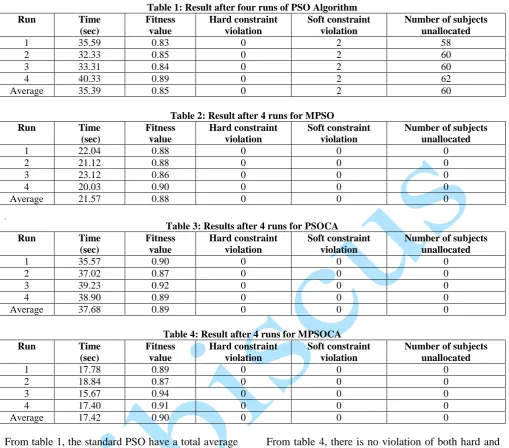
From table 1, the standard PSO have a total average number of 60 subjects unallocated compare to MPSO that successfully allocated all the subjects. The main reason is that the standard PSO doesn’t have the capability to handle constraint like MPSO. From table 2, MPSO successfully allocate all subjects, there is no violation of both hard and soft constraints. MPSO generated higher best fit values with a lower simulation time as compared to the standard particle swarm optimization algorithm. From this result, it can be deduced that MPSO improved the performance of the standard particle swarm optimization in terms of generating more optimized timetable. Acceleration component in MPSO helps in improving the convergence speed which in turns reduced the average time taken to generate a timetable. MPSO have a fitness value of 0.88 while PSO have a fitness value of 0.85. From table 3, there is no violation of both hard and soft constraint, no unallocated subjects was recorded. An average fitness value of 0.89 at an average time of 37.68seconds was recorded.
From table 4, there is no violation of both hard and soft constraint. MPSOCA successfully allocate all the subjects as a result of their capability to handle constraint. As a result of belief space of cultural algorithm, MPSOCA generated an optimal timetable within an average simulation time of 17.42 seconds with an average fitness value of 90% as compared with PSO, MPSO and PSOCA which had an average simulation time of 35.39, 21.57 and 37.68 seconds respectively with a fitness value of 85%, 88% and 89% respectively. From this result, it can be deduced that the modified particle swarm optimization based cultural algorithm improves the performance of the timetable generated both in terms of simulation time and fitness value.
4. CONCLUSION AND FUTURE WORK
acceleration component which are highly probable in minimizing high convergence speed associated with the standard Particle Swarm Optimization algorithm (PSO) and PSOCA.
REFERENCES
[AT08] S. Abdullah, H. Turabieh -
Generating university course timetable using Genetic Algorithms and Local
Search. The Third International
Conference on Convergence and Hybrid Information Technology ICCIT, 1:254-260, 2008.
[AOO14] O. M. Alade, E. O. Omidiora, S. O. Olabiyisi - Development of a University Lecture Timetable using
Modified Genetic Algorithms
Approach, International Journal of Advanced Research in Computer Science and Software Engineering, 4(9):163-168, 214.
[A+16] O. M. Alade, C. A. Oyeleye, O. T. Adedeji, E. O. Omidiora, S. O. Olabiyisi - Development of a modified Particle Swarm Optimization based
Cultural Algorithm for solving
University Course timetabling
Problem, LAUTECH Journal of
Engineering and Technology 10 (1) : 1-5, 2016.
[BM00] F. Benjamin, B. Marcel - Cultural algorithms: Concepts and experiments.
In Proceedings of the 2000 Congress on Evolutionary Computation, Piscataway, NJ, 2000. IEEE Service Center.:1245–1251, 2000.
[BN02] E. K. Burke, J. P. Newall - A New Adaptive Heuristic Framework for
Examination Timetabling Problems,
Working Group on Automated Timetabling, University of Nottingham. 8: 23-43, 2002.
[CK10] A. Chaudhuri, D. Kajal - Fuzzy
Genetic Heuristic for University
Course Timetable Problem. IJASCA, 2(1): 1-13, 2010.
[IDM09] S. Irene, S. Deris, S. Mohad Hashim - A combination of PSO and Local
Search in University Course
Timetabling Problem. International
Conference on Computer engineering and Technology. 492-495, 2009.
[MM12] S. K. Meysam, S. A. Mohammad -
Hybrid Genetic Algorithms for
University Course Timetabling.
International Journal of Computer Science Issues, 9(2)(2): 446-455, 2012.
[O+12] C. A. Oyeleye, S. O. Olabiyisi, E. O.
Omidiora, J. B. Oladosu -
Performance Evaluation of Simulated Annealing and Genetic Algorithm in
solving examination timetabling
problem, Scientific Research and
Essays 7(17): 1727-1733, 2012.
[Qin10] B. Qinghai - Analysis of Particle
Swarm Optimization Algorithm.
Computer and Information Science. 3.(1):180-184, 2010.
[RZ01] R. G. Reynolds, S. Zhun -
Knowledge-based function
optimization using fuzzy cultural
algorithms with evolutionary
programming. IEEE Transactions on
Systems, Man, and Cybernetics-Part B: Cybernetics. 31(1): 1-18, 2001.
[SS11] Y. Shengxiang, N. Sadaf - Genetic Algorithms with guided and local search strategies for university course
timetabling. IEEE Transactions on
systems, MAN and Cybernetics- Part C: Applications and reviews 41(1):93-106, 2011.
[Yuh04] S. Yuhui - Particle Swarm Optimization Electronic Data Systems, Inc. IEEE Neural Networks Society: 8-13, 2004.
[ZJZ04] J. Zheng, J. Jing, C. Zhihua -