Research Article
Introduction
B
asil (Ocimum basilicum L.) is native plant of trop-ical regions. It belongs to genus Ocimum which comprises between 50 and 150 species of herbs and shrubs (Paton et al., 1999). It is one of endemic plant which is used not only as pharmaceutical plant but also used as culinary herb (Naghibi et al., 2005). Seeds of basil have been used as traditional medicine for treatment of dyspepsia, ulcer, diarrhea and oth-er illness. Many parts of Asia basil seeds are used to prepare traditional beverages (sharbat) and many ice desserts like falooda (Hosseini-Parvar et al., 2010). Basil seeds are used as diuretic, antipyretic, antispas-modic and stomachic (Alcicek et al., 2004). Basil seeds are black in color and with oval shape and aregood source of fiber. When seeds of basil are soaked in water they swell up and produce gelatinous mass because poly saccharide layer is present on outer ep-idermis wall of seed (Azoma and Sakamoto, 2003). Two major fractions of poly saccharides has been reported from basil seeds, glucomannan (43%) and (1-4)-linked xylan (24.29%) and a minor fraction of glucan (2.31%) (Hosseini Parvar et al., 2010). Suit-ability of basil seed gum in model system has been reported recently (Bahram-Parvar and Razavi, 2012).
Recent epidemiological studies have strongly suggest-ed that consumption of certain plant materials such as seeds, leaves, fruits and roots may reduce the risk of chronic diseases related to oxidative stress on account of their antioxidant activity and promote general
Abstract | Basil seeds are used not only as pharmaceutical plant but also for culinary purpose. The current study has been undertaken to develop a nutritious, healthy and value added drink. Proximate, mineral anal-ysis, total polyphenol content and mineral analysis of basil seeds was conducted. Result revealed that basil seeds are not only good source of fiber and protein but they provide appreciable amount of minerals and phe-nolic compounds. Swollen basil seeds were used to prepare beverage at three supplementation levels i.e. 0.2, 0.3 and 0.4%. Sensory evaluation of basil seed drink revealed that 0.3% basil seeds supplemented drink was liked most in term of taste, texture and over all acceptability whereas 0.4% basil seeds supplemented drink were least liked as compared to other treatments. It was concluded that basil seed could be supplemented in different food products for the preparation of value added, healthy and nutritious diets.
Masooma Munir1,2*, Aqsa Qayyum1, Saeeda Raza1, Nouman Rashid Siddiqui1, Amer Mumtaz1, Naeem
Safdar1, Sahar Shible1, Sohaib Afzal3, Saiqa Bashir4
1Food Science and Product Development Institute, National Agricultural Research Centre, Islamabad, Pakistan; 2Institute of
Food Science and Nutrition, University of Sargodha, Sargodha, Pakistan; 3Institute of Agricultural Sciences, University of
Pun-jab, Pakistan; 4Department of Food science and Technology, University of Poonch, Rawalakot, Pakistan.
Received | June 13, 2016; Accepted | August 06, 2017; Published |September 28, 2017
*Correspondence | Masooma Munir, National Agricultural Research Centre-Islamabad, Pakistan; Email: [email protected]
Citation | Munir, M., A. Qayyum, S. Raza, N.R. Siddiqui, A. Mumtaz, N. Safdar, S. Shible, S. Afzal and S. Bashir. 2017. Nutritional assessment of basil seed and its utilization in development of value added beverage. Pakistan Journal of Agricultural Research, 30(3): 266-271.
DOI | http://dx.doi.org/10.17582/journal.pjar/2017.30.3.266.271
Keywords | Basil seeds, Nutritional plant seed, Poly phenols, Value addition, Beverage
health benefits (Ramarathnam et al., 1995). Phenolic compounds present in plant parts have been reported to have multiple biological effects such as antioxidant activity, antimutagenic, antitumor and antibacterial properties (Pietta et al. 1998). Essential oil extract-ed from basil leaves and seextract-eds have antimicrobial and antioxidant properties. Physical and chemical com-position of indian and Iranian basil seeds has been reported by Mathews et al. (1993) and Razavi et al. (2009). Basil seeds were used as thickening and sta-bilizing agent because of their high polysaccharide contents or these were usually processed into essential oil products in many studies (Rafe et al., 2012) while information about phenolic profile of basil seeds is limited. So phenolic content estimation of basil seeds is necessary to find relation of basil seed with health promoting functions, as antioxidant capacity of phe-nolic compounds protect the cell from free radicals which cause damage (Zhang et al., 2013).
In recent years, due to busy life styles peoples diet demand and pattern has been changed. They tend to consume delicious, readily available and affordable foods. Intake of such foods many diseases have been found in new generation due to low fiber intake and less nutritious components (antioxidant and miner-als) in ready made food products (NHMRC, 2006). Food scientists and technologists are doing efforts to develop nutritious and healthy foods with suita-ble sensory characteristics. Until now many research and studies have been conducted on enrichment, sup-plementation and value addition of food products such as bakery, dairy and beverages (Alqahtani et al., 2014; Caleja et al., 2015; Hajmohammadi et al., 2016; Paquet et al., 2014; Pentikainen et al., 2014). Carbox-ymethyl cellulose (CMC) is used in most of beverage as stabilizer and it is obtained from drying the stem exudates of Asiatic species of alkali-cellulose. This hydrocolloid is suitable as stabilizers due to its some properties such as high viscosity at low concentration, good suspension and low cost (Arinaitwe and Pawlik, 2014).
Beverage is an excellent media to intake nutrients in-side body, because it is consumed all over the world to quench thrust and to meet water requirement of body. This study was designed to assess the nutrition-al composition of basil seeds and their utilization in beverages so that nutritional requirement of consum-ers can be met by economical way. Basil seeds are eas-ily available and cheaper source of micronutrients.
Materials and Methods
Present research project was conducted at Food Sci-ence and Product Development Institute, National Agricultural Research Center, Islamabad. Raw ma-terials such as basil seeds, sugar, lemons, CMC and Citric acid were purchased from the local market of Islamabad. Chemicals for analysis were purchased from Sigma Aldrich (Seelze, Germany) and Lab-Scan (Dublin, Ireland) available in the local market.
Chemical analysis of basil seed
Proximate composition such as moisture, ash, crude fat, crude protein and crude fiber of basil seeds was determined according to the procedures given in AOAC (2000). For moisture determination samples were dried in oven at 130ºC for 60 minutes. For ash determination samples were placed in muffled fur-nace at 550ºC to burn out all carbon compounds leaving in organic part (ash). Fat was determined by fat extraction unit by using n. Hexane. For fiber deter-mination, samples were treated with 1.25% Sulphuric acid and Sodium Hydroxide solution. After filtration of digested material it was washed with hot water and then ignited. By calculating loss of weight after igni-tion, crude fiber contents were determined. Protein contents were determined by using kjeldhal unit.
Total phenolic contents of basil seed
Total phenolic contents were measured by using Folin–Ciocalteu colorimetric method (Singleton et al., 1999) spectrophotometrically with some modi-fications. Extraction of sample (5g basil seeds) was carried out by using ethanol. One mL of 10% (v/v) Folin–Ciocalteu reagent in distilled water was mixed with sample extract. After 6min, 2.0 mL of a20%so-dium carbonate solution was added. The mixture was placed at 30 ºC for 60 min. Absorbance was deter-mined at 765nm. Gallic acid was used as standard and the total phenol content was expressed as mg GAE/g of sample.
Mineral analysis of basil seeds
Mineral contents were measured by atomic absorp-tion spectrophotometric method according to meth-od given in AOAC (2000). Sample was ashed at 550
Preparation of basil seed beverage
Basil seeds were purchased from local market and cleaned carefully to remove stones, stalks and dust. Seed preparation was done by using modified method based on earlier studies (Razavi et al., 2009). Seeds were soaked in water at 50ºC for 20 min with water/ seed ratio of 50:1. Frequent stirring was done. Then by using perforated container, swollen seeds were sep-arated.
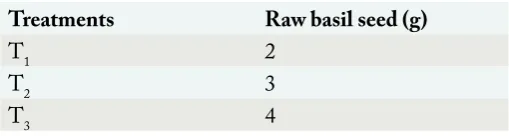
For preparation of hydrocolloid solution 2g CMC powder was dissolved in distilled water at 70ºC for 2 hour with continuous stirring by magnetic hot plate. 1 litter water, 140 g sugar, 2 g salt, 2mL lemon extract, 1g sodium benzoate were mixed together to prepare beverage for all treatments. Swollen basil seeds were added according to treatment as shown in Table 1. This mixture was pasteurized and hot filled in 250 mL bottles.
ºBrix and titratable acidity
The pH was determined by a digital pH meter, ºBrix was measured by Abbe refractometer and Titratable acidity of the sample was determined according to the standard method of AOAC (1999).
Sensory evaluation of basil seed beverage
Sensory evaluation of basil seed drinks were evalu-ated for sensory characteristics such as color, appear-ance, flavor, mouth feel and overall acceptability at 17±5ºC by expert panel of 20 judges (12 females and 08 males) from NARC. The evaluation was done in sensory evaluation laboratory by a panel with normal lights on 9-points Hedonic Scale (Land and Shep-herd, 1988).
Statistical analysis
Results were statistically analyzed by using analysis of variance technique (ANOVA). The difference in means was evaluated by the Least Significant Design. This analysis was done by using statistic 9.0 software (Analytical software, Tallahassee, FL).
Result and Discussion
Proximate composition of basil seeds
Proximate composition of basil seeds in given in Table 2 Basil seeds contain 9.19% moisture, 17.32% crude protein, 9.68% crude fat, 5.80% ash, % fiber and % carbohydrates.
Results of the present study are comparable with the work of Razavi et al. (2009) who reported that the chemical composition of Indian basil seeds was dif-fered with Iranian basil seeds. They reported that the range of moisture content (5-9%), protein (14-20%), fat (13-23%). ash (5-7%) and carbohydrates (47-63%) in Indian and Iranian basil seeds. In Iranian basil seeds protein and fat contents were significantly higher while moisture and ash contents were lower than Indian seeds. Changes in proximate composi-tion of the present study might be due to change in soil chemistry, climate condition and different agri-cultural practices (Mathews et al., 1993). Hajmoham-madi et al. (2016) also determined the chemical com-position of basil seeds who used swollen basil seeds for enrichment of fruit based beverage.
Table 1: Treatment plan for 1 liter of beverage
Treatments Raw basil seed (g)
T1 2
T2 3
T3 4
T1= Beverage with 2g basil seeds; T2= Beverage with 3g basil seeds;
T3= Beverage with 4g basil seeds
Table 2: Proximate composition of Basil seeds (% wet basis)
Moisture 9.19±0.45 Protein 17.32±1.12 Fat 9.68±0.67 Fiber 7.11±0.39 Ash 5.80±0.11 Carbohydrates 50.9±0.35
Table 3: Total phenols(mg GAE/g) and mineral con-tents (ppm)
Total phenols 63.78±1.75 Fe 22.74±1.01 Zn 15.81±0.93 Mg 315.53±2.15 Mn 10.11±0.87
have nutritional importance as far as body physiology concerned. Deficiency of micronutrient is prevailing around the world. High Mg contents may boost bone development and strength also effective against heart stroke. Zinc has also been linked with alleviating hy-perglycemia in diabetics. Fe is important as part of blood (Fallon and Enig, 2001).
Mineral contents in basil seeds have been reported in Table 3. Basil seeds and leaves are good source of minerals. Mg contents were found in high amount (315.53±2.15)as compared to other determined min-erals. Agunbiade et al. (2015) has reported mineral contents in basil seeds and leaves. Mlitan et al. (2014) also studied mineral contents of basil from Libya but change in mineral concentration was observed be-tween our and their findings which might be due to varietal differences and soil chemistry.
ºBrix and acidity of basil seed drink
Titratable acidity and ºBrix of basil seed drinks have been shown in Table 4. There was no significant change in ºBrix and acidity of beverage. These results are in agreement with other previous studies (Jabbar et al., 2014; Saeeduddin et al., 2015).
Table 4: ºBrix and Acidity of beverage
Treatment (T) ºBrix Acidity
T1 12.9±0.09 0.168±0.01
T2 12.7±0.05 0.160±0.03
T3 12.5±0.07 0.155±0.01
T1= Beverage with 2g basil seeds; T2= Beverage with 3g basil seeds;
T3= Beverage with 4g basil seeds
Figure 1: Total phenol standard calibration curve
Sensory evaluation of basil seed beverage
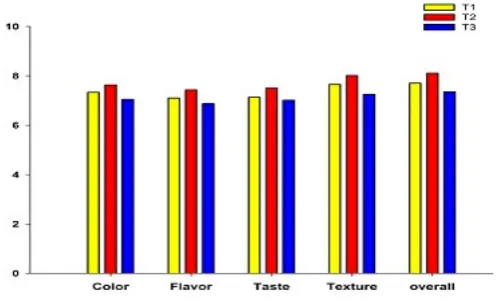
Effect of seed ratio on sensory parameters (color, fla-vor, taste, texture and overall acceptability) of drink is presented in Figure 2. All treatment were in
accept-able range but T2 secured high sensory scores in term of color (7.63± 0.29), flavor (7.43±0.41) taste (7.50± 0.32) texture (8.01± 0.45) and overall acceptability (8.11±0.37) followed by T1 and T3. Reduction in de-sirability of taste flavor and texture with increase in seed ratio was also reported by Hajmohammadi et al. (2016). It might be due to decrease in total soluble solids of drink because seeds had previously swollen in water and had amounts of water inside and be-tween them.
Figure 2: Sensory Evaluation of Basil Seed Beverage
(T1= Beverage with 2g basil seeds, T2= Beverage with 3g basil seeds, T3= Beverage with 4g basil seeds)
Conclusion
Our findings revealed that basil seeds are good source of micronutrients and have antioxidant potential which is highly beneficial for human health. Swol-len basil seeds in beverage also showed good sensory scores (T2) in beverage which shows it would be ac-ceptable by consumers too. Therefore, further studies should be conducted about polyphenol composition and vitamins to better understanding of nutritional importance of basil seed.
Acknowledgement
The present study was supported by the Food Science and Product Development Institute, National Agri-cultural Research Center (NARC), Pakistan.
Authors’ Contributions
Masooma Munir and Aqsa Qayyum: Executed re-search plan
Amer Mumtaz and Nouman Siddiqui: They have participated in research analysis
Saeeda Raza: reviewed the manuscript.
Sahar Shibbli and Saiqa Bashir: Helped in drafting the manuscript
Sohaib Afzal: Statistical analysis
References
Agunbiade, S.O., M.O. Ojezele and O.O. Alao. 2015. Evaluation of the nutritional, phytochemical compositions and likely medicinal benefits of vernomiaamygdalina, talinumtriangulare and ocimumbasilicum leafy-vegetables. Adv. Bio. Res., 9: 151-155.
Alcicek, A., M. Bozkurt and M. Cabuk. 2004. The effect of a mixture of herbal essential oils, an organic acid or a probiotic on broiler performance. S. Afr. J. Anim. Sci., 34: 217-222. Alqahtani, N.K., J. Ashton, L. Katopo, E. Haque,
O.A.H. Jones and S. Kasapis. 2014. Consistency of UHT beverages enriched with insoluble fiber during storage. J. Bioact. Carbohyd. Diet. Fiber, 4: 84- 92. https://doi.org/10.1016/j. bcdf.2014.06.005
AOAC. 1999. Official methods of analysis (16th edition ed.). USA: Gaithersburg.
AOAC, 2004. Official method of analysis of association of official Analytical chemists. 15th ed., Washington. USA.
Arinaitwe, E., and M. Pawlik. 2014. Dilute solution properties of Carboxymethyl celluloses of various molecular weights and degrees of substitution. Carbohyd. Polymers., 99: 423-431. https://doi.org/10.1016/j.carbpol.2013.08.030 Aydemir, T. and S. Becerik. 2011. Phenolic content
and antioxidant activity of different extracts from Ocimumbasilicum, Apiumgraveolens and Lepidiumsativum seeds. J. Food Biochem., 35: 62-79. https://doi.org/10.1111/j.1745-4514.2010.00366.x
Azoma, J. and M. Sakamoto. 2003. Cellulosic hydrocolloid system present in seed of plants. Trends Glycosci. Glycotechnol., 15: 1-14 https://doi.org/10.4052/tigg.15.1
Bahram-Parvar, M. and S.M.A. Razavi. 2012. Rheological interactions of selected hydrocolloids-sugar-milk-emulsifier systems. Int. J. Food Sci. Technol. 47: 854-860. https:// doi.org/10.1111/j.1365-2621.2011.02918.x Caleja, C., L. Barros, A.L. Antonio Ciric, J.C.M.
Barreira and M. Sokovic. 2015. Development of a functional dairy food: Exploring bioactive
and preservation effects of Chamomile (Matricariarecutita L.). J. Functional Foods., 16: 114-124. https://doi.org/10.1016/j. jff.2015.04.033
Fallon, S.A.F. and M.G. Enig. 2001. Nourishing Traditions 2 ed. Washington DC. New Trends Publishing, pp: 11. https://doi.org/10.1016/j. lwt.2016.07.033
Hajmohammadi, A., J. Keramat, M. Hojjatoleslami and H. Molavi. 2013. Evaluation effect of enriched with oat beta-glucan on the physical properties of sponge cake. Iran. Food Sci. Technol. Res. J., 9: 253-259. https://doi. org/10.1016/j.jfoodeng.2010.06.025
Hajmohammadi, A., M. Pirouzifard, M. Shahedi and M. Alizadeh. 2016. Enrichment of a fruit-based beverage in dietary fiber using basil seed: Effect of Carboxymethyl cellulose and Gum Tragacanth on stability. LWT-Food Sci. Technol., 74: 84-91. https://doi.org/10.1111/ ijfs.12567
Hosseini-Parvar, S.H., L. Matia-Merino, K.K.T. Goh, S.M.A. Razavi and S.A. Mortazavi. 2010. Steady shear flow behaviour of gum extracted from basil seed (Ocimumbasilicum L.): effect of concentration and temperature. J. Food Eng., 101: 236–243
Jabbar, S., M. Abid, B. Hu, M.M. Hashim, M. Saeeduddin, S. Lei, and X. Zeng. 2014. Influence of sonication and high hydrostatic pressure on the quality of carrot juice. Int. J. Food Sci. Technol., 49: 2449-2457.
Land, D.G. and R. Shepherd. 1988. Scaling and ranking methods. In: J.R. Piggot (ed.). Sensory Analysis of Foods. Elsevier Applied Science, New York, USA
Mathews, S., R.S. Singhal and P.R. Kulkarni. 1993. Ocimumbasilicum: A new non-conventional source of fiber. Food Chem., 47: 399–401. https://doi.org/10.1016/0308-8146(93)90185-I
Mlitan, A.M., M.S. Sasi and A.M. Alkherraz. 2014. Proximate and minor mineral content in some selected basil leaves of Ocimumgratissimum L, in Libya. Int. J. Chem. Eng. Appl., 5: 502.
Naghibi, F., M. Mosaddegh, S.M. Motamed and A. Ghorbani. 2005. Labiatae family in folk medicine in Iran: from ethnobotany to pharmacology. Iran. J. Pharm. Res., 2: 63–79. NHMRC (National Health and Medical
reference values for Australia and New Zealand eIncluding recommended dietary intakes. Canberra: Australian Government Publishing Service.
Paquet, E., R. Hussain, L. Bazinet, J. Makhlouf, S. Lemieux and S.L. Turgeon. 2014. Effect of processing treatments and storage conditions on stability of fruit juice based beverages enriched with dietary fibers alone and in mixture with xanthan gum. LWT Food Sci. Technol., 55: 131-138. https://doi.org/10.1016/j.lwt.2013.08.014 Paton, A., M.R. Harley, and M.M. Harley. 1999.
The genus Ocimum. In: R. Hiltumen, and Y. Holm (Eds.), Basil (pp. 1e38). The Netherlands: Harwood Academic Publishers.
Pentikainen, S., L. Karhunen, L. Flander, K. Katina, A. Meynier and P. Aymard. 2014. Enrichment of biscuits and juice with oat B-glucan enhances postprandial satiety. Appetite, 75: 150-156. https://doi.org/10.1016/j.appet.2014.01.002 Pietta, P., P. Simonetti and P. Mauri. 1998.
Antioxidant activity of selected medicinal plants. J. Agric. Food Chem., 46: 4487–4490. https://doi.org/10.1021/jf980310p
Rafe, A., S.M.A. Razavi and S. Khan. 2012. Rheological and structural properties of b-lactoglobulin and basil seed gum mixture: Effect of heating rate. Food Res. Int., 49: 32–38 https://doi.org/10.1016/j.foodres.2012.07.017 Ramarathnam, N., T. Osawa, H. Ochi and S.
Kawakishi. 1995. The contribution of plant food antioxidants to human health. Trends Food Sci. Technol., 6: 75–82. https://doi.org/10.1016/ S0924-2244(00)88967-0
Razavi, S., S.A. Mortazavi, L. Matia‐Merino, S.H. Hosseini‐Parvar, A. Motamedzadegan and E. Khanipour. 2009. Optimisation study of gum extraction from basil seeds (Ocimumbasilicum L.). Int. J. Food Sci. Technol., 44:
1755-1762. https://doi.org/10.1111/j.1365-2621.2009.01993.x
Razavi, S.M.A., S.A. Mortazavi, L. Matia-Merino, S.H. Hosseini-Parvar, A. Motamedzadegan and E. Khanipour. 2009. Optimization study of gum extraction from Basil seeds (Ocimumbasilicum L.). Int. J. Food Sci. Technol., 44: 1755– 1762. https://doi.org/10.1111/j.1365-2621.2009.01993.x
Saeeduddin, M., M. Abid, S. Jabbar, T. Wu, M.M. Hashim, F.N. Awad and X. Zeng. 2015. Quality assessment of pear juice under ultrasound and commercial pasteurization processing conditions. LWT-Food Sci. Technol., 64: 452-458.
Shen, Y., W. Prinyawiwatkul P. Lotrakul and Z. Xu. 2015. Comparison of phenolic profiles and antioxidant potentials of the leaves and seeds of Thai holy and sweet basils. Int. J. Food Sci. Technol., 50: 1651-1657. https://doi. org/10.1111/ijfs.12817
Simon, J. E., M.R. Morales, W.B. Phippen, R.F. Vieira and Z. Hao. 1999. Basil: A source of aroma compounds and a popular culinary and ornamental herb. In J. Janick (Ed.), Perspectives on new crops and new uses (pp. 499-505). Alexandria, VA: ASHS Press.
Singleton, V.L., R. Orthofer and R.M. Lamuela-Ravento. 1999. Analysis of total phenols and other oxidation substrates and antioxidants by means of Folin Ciocalteu reagent. Method Enzymol., 299: 152–178. https://doi. org/10.1016/S0076-6879(99)99017-1