A
A
N
N
A
A
L
L
Y
Y
T
T
I
I
C
C
A
A
P
P
P
P
R
R
O
O
A
A
C
C
H
H
T
T
O
O
F
F
A
A
C
C
E
E
E
E
M
M
O
O
T
T
I
I
O
O
N
N
R
R
E
E
C
C
O
O
G
G
N
N
I
I
T
T
I
I
O
O
N
N
W
W
I
I
T
T
H
H
S
S
V
V
M
M
K
K
E
E
R
R
N
N
E
E
L
L
S
S
1
1
O
O
m
m
o
o
b
b
o
o
l
l
a
a
j
j
i
i
F
F
.
.
O
O
y
y
e
e
d
d
o
o
k
k
u
u
n
n
,
,
11E
E
l
l
i
i
j
j
a
a
h
h
O
O
.
.
O
O
m
m
i
i
d
d
i
i
o
o
r
r
a
a
,
,
22I
I
b
b
r
r
a
a
h
h
i
i
m
m
A
A
.
.
A
A
d
d
e
e
y
y
a
a
n
n
j
j
u
u
,
,
33F
F
a
a
g
g
b
b
o
o
l
l
a
a
M
M
.
.
T
T
e
e
m
m
i
i
t
t
a
a
y
y
o
o
12
Department of Computer Science and Engineering, Ladoke Akintola University of Technology (LAUTECH), Ogbomosho, Oyo state, Nigeria
2
Department of Computer Engineering, Federal University Oye-Ekiti (FUOYE), Ekiti state, Nigeria 3
Department of Computer Science, Federal University Oye-Ekiti (FUOYE), Ekiti state, Nigeria
Corresponding Author: Fagbola M. Temitayo, [email protected]
ABSTRACT: Face emotion recognition is one of the challenges known with emotion recognition and it has received much attention during the recent years due to its application in different fields. SVM kernels were adopted to increase the robustness of face emotion recognition systems and to identify the most suitable kernel for emotion recognition. This paper uses radial basis function, linear function, sigmoid and polynomial function to identify the six basic emotions and neutral inclusive. In an attempt to achieve this aim the following steps were taken; collection of face emotion images, image pre- processing, features extraction and classification. Face emotion database was created by taken emotional photographs of persons who willing volunteer to help in this paper. The database contains 714 images from 51 persons. However, the photographs were converted from colored images to grayscale images for uniform distribution of colors. Relevant features for classification were extracted from the processed images such as the eyelids, cheeks, nose, eyebrows and lips. Our face emotion database was splitted into two dataset: training set and testing set. SVM classifier used images in the training set to train while images in the testing set were used to test SVM models. The evaluation of the system was performed on MATLAB using classification accuracy and classification time to identify the most suitable kernel for the system. The results obtained shows that sigmoid outperformed other kernels in terms of classification accuracy with overall performance accuracy of 99.33% while polynomial achieved the shortest classification time. In the future, we intend to investigate other classifiers for face emotion recognition and to classify more emotions.
KEYWORDS: feature, extraction, image preprocessing, classifiers, SVM, recognition, Kernels, face emotion.
1. INTRODUCTION
Face emotions are feelings derived from circumstances or events which are unconsciously express through the face. The face uses facial features such as: eyebrow, fore head, cheeks, lips to mention but few to express emotions. There are six basic emotions. Happiness, sadness, fear, anger, surprise and disgust [Ekm03, Dar72]. However it
was argued that a state of being neutral (a state of not being happy or sad) is also referred to as emotion.
Face emotion recognition system has the ability to automatically identify and classify emotions expressed via face. This system has its application in areas like; hospitals, psychiatric centers, physiology centers, education, E-business, and sport [CH00, DP11, Eas05].
In other to have a robust face emotion recognition system with high efficiency and accuracy it is essential to use the appropriate classifier. In this work, SVM kernels were proposed to identify seven emotions: happiness, sadness, disgust, anger, fear, surprise and neutral and to identify the most suitable kernel for face emotion recognition system.
The following components were adopted in our methodology: face emotion database, image pre-processing, features extraction and emotion recognition. The face emotion database was created by capturing the frontal face images of 51 persons who expressed seven different emotions. The database was splitted into two datasets: training set and testing set. The captured images in the database were pre- processed for even distribution of brightness across the images by converting the images from its original color to gray scale images. The essential facial features such as eyelids, eyebrow, cheeks and the lips were extracted and used to train emotions in the training set using SVM kernels as classifier. The emotions were classified based on SVM classification scheme; binary class and multiclass classification. The remaining part of this paper is organized as follows: section 2 discusses more on related works; section 3 discusses more on methodology while section 4 and 5 contains the results and conclusion
2. RELATED WORKS
small database of eight people was used to identify four classes of emotions: anger, disgust surprise and happy. K-nearest neighbor was adopted as a classifier and was able to classify the emotions with 80% accuracy. [RP08] made used of the shape and textures of images in the database that was adopted by them to recognize emotions. Active appearance model (AAM) was implemented to identify seven emotions. The experiment achieved 82.48% accuracy. [Jaw07] Obtained classification accuracy of 96% with self organized map when neural networks failed to give accurate and satisfactory results. Five persons were used to identify the following emotions; happiness, sadness, angry, smile and neutral. [Dum01] Proposed a similar system that uses SVM and neural network to classify six emotions. They made use of 13 people and achieved 85.9% and 88.1% for neural network and SVM respectively.[PR03b] uses SVM precisely rbf to identify six different emotions. They used both still and video images and achieved 87.9% accuracy. However, [BC10, KP06, GM14] were only interested in the capacity of the classifier to classify emotions rather than the performance accuracy of such classifiers. They adopted SVM and artificial neural network respectively. From the reviewed work, it was deduced that the time required to recognize emotions was not stated and a comparative analysis has not be carry out on SVM kernels for face emotion recognition.
3. METHODOLOGY
The process of achieving the most suitable SVM kernel for face emotion recognition system involves the following stages:
a. Collecting/gathering of face emotion images b. Image processing
c. Features extraction d. Training classifier e. Classification.
These stages will be explained in details accordingly.
Collection and gathering of face emotion images: Face emotion images were gathered by taking photographs of persons who willing volunteer to assist in this work. These persons were all black African decent, specifically from Oyo State, Nigeria. Their ages are between 20-50 years, and a ratio of 75:25 of male and female respectively. A total number of 714 emotion images were gathered via this exercise from 51 persons. Each participant was snapshot twice per emotion, the emotions include happiness, sadness, fear, anger, disgust, surprise and Neutral.(51 persons x 7 emotions) x 2 snapshot per emotion = 714 emotion images.
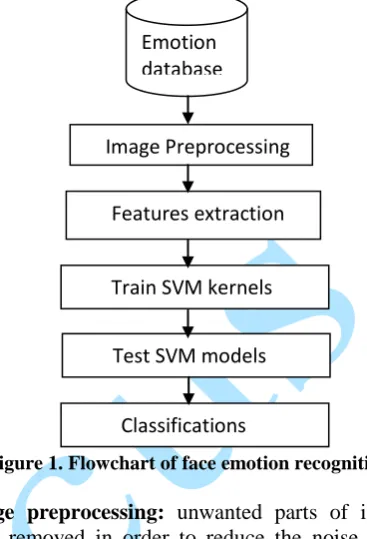
Figure 1 shows the flow chart illustration of the steps taken in this work.
Figure 1. Flowchart of face emotion recognition
Image preprocessing: unwanted parts of images were removed in order to reduce the noise in the database. Parts like the hair, ear, neck and shoulder were manually cropped out. The images were converted to grayscale images for color unification and were brighten using histogram equalization to improve the contrast in the images by stretching out the intensity range.
Features Extraction: Important and relevant features for classification were extracted using principal component analysis (PCA). The pixels value of each converted images ranges from 0-255. The extracted features were encoded and stored as weight vectors for each of the emotion. Features were extracted from the position of the eyebrows, the eyelids, the nose, the cheeks and the lips. PCA was also used to reduce the dimensionality of images in the database.
Training Classifier: SVM constructs a hyper plane or a set of hyper plane in higher or infinite dimensional space and this is why SVM is still the best classifier for classification.SVM has 4 kernels and these kernels were trained to identify the basic six emotions neutral inclusive. Each of these kernels has parameter that increases its dimensionality. The SVM kernels are:
Linear Function
k
Radial Basis Function
Emotion database
Image Preprocessing
Features extraction
Train SVM kernels
Test SVM models
CVM m
Polynomial Function
Sigmoid
The parameters are defined as follows:
= width of Radial Basis function, coefficient in polynomial d = degree of polynomial (d = 3), higher the soft margin from the hyper plane, the higher the degree of accuracy. r = coefficient for Sigmoid.
Our face emotion database was split into training set and testing set using percentage split method. The
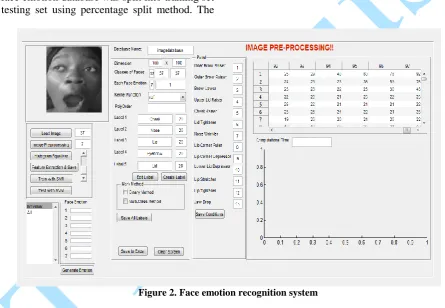
training dataset contains 476 face emotion images and the remaining 238 face emotion images are in the testing dataset. Images in the training dataset were used to train SVM kernels.SVM classification scheme were introduced in the experiment: binary class and multiclass classification. Binary class classification classifies emotions in pairs, for instance: anger Vs happiness, anger Vs fear and anger Vs surprise. Multiclass classification classifies all through the classes at once. The SVM models were implemented using images in the testing dataset to classify images of different dimensions: 50 x50, 100 x 100, 150 x 150 and 200 x 200. Our experiment was evaluated on MATLAB using Classification accuracy and classification time as our performance metrics. Figure 2 shows the graphical user interface of our experiment.
Figure 2. Face emotion recognition system
4. EXPERIMENTAL RESULTS
The classification accuracy and classification time achieved in this experiment are presented in the tables below, the results are in binary class and in multiclass classification.
Table 1: Evaluation result for classification Accuracy (%) for Binary class
Reduced dimension
Linear Function
R BF Sigmoid Poly-
nomial
50 x 50 85.82 52.55 74.68 78.15
100 x 100 91.46 52.86 90.67 92.29
150 x 150 93.69 56.03 93.75 93.71
200 x 200 94.27 60.06 95.97 95.40
Table 2: Evaluation result for classification Accuracy (%) for Multiclass classification
Reduced dimension
Linear Function
R BF Sigmoid Poly-
nomial
50 x 50 95.39 86.38 95.81 95.97
100 x 100 90.60 88.31 96.48 96.35
150 x 150 92.63 87.58 97.16 96.67
200 x 200 97.86 90.94 99.33 97.65
the other three kernels are in high competition for accuracy in both classes most especially in multi class classification. Sigmoid (quadratic function) achieved the most significant level of accuracy with 99.33% which proves to be the best SVM kernel suitable for face emotion recognition system with the highest classification accuracy. However, the accuracy percentage achieved by linear and polynomial functions were very much amazing. Nevertheless, the percentage accuracy achieved in binary class is lower compare to the results obtained in multiclass classification.
Table 3: Evaluation Results for Classification Time (sec) for Binary Class Classification Reduced
dimension
Linear Function
RBF Sigmoid Poly-
nomial
50 x 50 32.82 25.53 38.08 26.82
100 x 100 54.43 52.67 66.99 46.02
150 x 150 55.39 52.44 69.30 49.36
200 x 200 89.38 94.11 118.83 89.19
Table 4: Evaluation Results for Classification Time (sec) for Multiclass Classification
Reduced dimension
Linear Function
RBF Sigmoid Poly-
nomial
50 x 50 36.30 36.79 42.42 33.06
100 x100 234.74 72.95 70.57 105.63
150 x 150 80.57 73.36 93.75 73.57
200 x 200 114.59 105.44 107.12 100.61
Classification time in these tables increases as the size of the image increases which implies that the more visible the facial features (Eigen vectors) the higher the classification time. However, SVM models are not time consuming, it takes less that two minutes to classify face emotions. In this paper Classification time is define as time taken to classify all the images in the testing set. Binary class classification takes shorter time to classify than multiclass classification. In binary class Radial basis function had the shortest classification time at 50 x 50 pixel while at 100 x 100 , 150 x 150 and 200 x 200 (pixels) polynomial achieved the shortest classification time with 46.02 sec, 49.36sec and 89.19sec respectively. A similar result was achieved in multiclass classification, Polynomial function attained the shortest classification time of 33.06 sec and 100.61 sec for image dimensions at 50 x 50 pixels and 200 x 200 pixels respectively. While at 100 x 100 pixels and 150 x 150 pixels had 70.57sec by sigmoid function and 73.36 sec by radial basis function.
It was expected that linear function should have achieved the shortest classification time being the least complex of the kernels. The classification time across the kernels has no regular pattern, and the highest result obtained when the image was reduced to 100 x 100 pixels in multiclass classification seem
to be outrageous or odd. However, it might have occurred due to some activities that were carried out on the computer during the running of the experiment.
5. CONCLUSION
Performance evaluation was carried out on SVM kernels for recognition of seven emotions. The classification was based on SVM classification scheme; binary class and multiclass classification. This paper adopted classification accuracy and classification time as its performance measures or metric.
The results obtained during the experiment shows that sigmoid outperformed other kernels in terms of classification accuracy although with minimal differences while polynomial function achieved the shortest time for classification. In other word sigmoid classifies accurately better than other SVM kernels and polynomial function classifies faster than other SVM kernels.
it was deduced from the result that the average accuracy increases as the image dimension of the extracted features increase and the same thing goes for classification time, the classification time increases as the image dimension of the extracted features increases.
SVM multiclass classification scheme has better classification accuracy than binary class classification. The classification time was rather short in binary class than in multiclass classification.
6. FUTURE WORK
We intend to work on other classifiers for face emotion recognition system and to classify more emotions. Further experiment shall be conducted in order to validate the trend of the classification time. In future work, we shall use video images to achieve the same aim we achieved with still images. Furthermore, we shall investigate the SVM models on a standard face emotion recognition database and finally we intend to embed the most suitable face emotion classifier(s) in computer hardware for real time application.
REFERENCES
[BC10] A. Bajpai, K. Chadha - Real time facial emotion detection using SVM, International Journal of Advanced Computer Science and Applications. Vol 1, No 2, 2010.
computer interaction, ICME2000. IEEE International Conference on Multimedia and Expo, 2000, Volume: 1, 30 July-2 Aug. 2000, Vol. 1, pp: 423 – 426.
[Dar72] C. Darwin - The Expression of the Emotion in Man and Animal, London: John Murray, 1872.
[Dum01] M. Dumas - Emotional Expression Recognition using Support Vector Machines, Department of Computer Science , University of Califonia, San
Diego, 2001, on:
http://cseweb.ucsd.edu/~elkan/254sprin g01/mdumasrep.pdf
[DP11] A. Devis, D. R. Puushothaman - Emotion classification using Facial expressions, (IJACSA) International Journal of Advanced Computer Science and Applications, Vol. 2, pp 7- 13, 2011.
[Eas05] N. Eastman - Classifying emotions in
human-machine spoken dialogs. ICME
'02 Proceedings 2005, IEEE International Conference on Multimedia and Expo, 2005, Vol1, 26-29 Aug. 2005, pp: 737 - 740.
[Ekm03] P. Ekman - Emotion Revealed: Recognizing Faces and Feeling to
Improve Communication and
Emotional Life, Holt, 2003.
[GM14] R. Goyal, T. Mittal - Facial Exprssion Recognition Using Artificial Neural Network, Open International Journal of Tecnology Innovation and Research ; vol 10, July 2014, e- ISSN: 2321-1814, ISBN (print) : 978-1-62951-619-6.
[Jaw07] N. Jawad - Design and development of an efficient high-speed face recognition system, Unpublished Final Year Project Report, College of Engineering, University Tenaga Nasional, Malaysia, 2007.
[KP06] I. Kotsia, I. Pitas - Real time facial expression ecognition from image
sequence using support vector
machines, Aristotle University of
Thessaloniki, Department of
infomatics, 2006, on:
http://poseidon.csd.auth.gr/papers/PUB LISHED/JOURNAL/pdf/Kotsia07a.pdf
[PR03a] M. Pantic, L. J. M. Rothkrantz - Toward an affect-sensitive multimodal
human computer interaction,
Proceedings of the IEEE HCI International Conference, 2003, pp. 1370-1390.
[PR03b] M. Phillip, E. Rana - Facial expression recognition using support vector machine, Technical Report, Computer Laboratory, University of Cambridge, UK, 2003.
[RP08] M. S. Ratliff, E. Patterson - Emotion Recognition Using Facial Expression
with Active Appearance Models,