Volume 3, Issue 1, 2016, pp. 246-253 Available online at www.jallr.com ISSN: 2376-760X
* Correspondence: Kian Pishkar, Email: [email protected] © 2016 Journal of Applied Linguistics and Language Research
Speaking Accuracy and Self-directed Learning
Nadiya Majedi
M.A. in TEFL, Islamic azad university, Bandar Abbas Branch
Kian Pishkar *
Faculty Member of Islamic Azad University, Jieroft Branch
Abstract
Studying the relationship between self-directed learning and speaking accuracy of learners could be significant as its results may help the learners gain better speaking abilities. To fulfill the purpose of the study, sixty Iranian second language learners at the upper intermediate level were selected based on the results of PET as the proficiency english test. They also receive a pretest of speaking accuracy before experiencing the treatment. Following 8 weeks of instruction the participants took a post test of speaking accuracy as well as the self-directed Readiness scale questionnaire. The findings revealed that the participants in the experimental group outperformed the ones in the control group. The results of the study could be employed by EFL teachers to help the learners gain better results in their attempts to learn English as a foreign language.
Key words: self-directed learning, andragogy, speaking accuracy
INTRODUCTION
Forrest and Peterson (2006) claim that the andragogical approach is essential in management education to help prepare students for their working environment. Forrest and Peterson further state, “Modern management requires practical implementation of skills learned, not regulation of principles. Without implementation, students cannot adapt to the ever-changing workplace.” (p. 114) In short, management students value practical knowledge in the workplace. The controversies in the field have led to a number of studies which have been aimed at reaching to the consensus of the nature on strategies in different areas in order to examine (Self Directed Learning) SDL for EFL Iranian learners (Khodabandehlou, Jahandar, Seyedi & Abadi, 2012; Meshkat & Hassanzade, 2014; Rostami, 2014).
adopting a learner-centered approach that pays attention to aspects such as learning styles, proficiency levels and learning goals and needs, motivation, self-monitoring and self-assessment. In this regard, an important role for the teacher is to help students learn strategies and activate cognitive and meta-cognitive processes. This involves encouraging them to reflect on their own learning, suggesting a variety of strategies and making them aware of which ones they are using for a particular task and why. This discipline tries to provide the educators with answers to the central question of “how adults learn?” although andragogy is supposed to be the technological application of psychological and sociological knowledge and not in itself “a science of the system of adult education”; however, recent studies have stressed the significance androgogy in the development of self-directed learning.
Accordingly, stressing the effect of promoting self-directed learning in formal educational institutions, the combination of second language speaking accuracy and self-directed learning could be considered a significant research area required to achieve not only the ability of understanding and reporting the context and environment but also evaluating the processes and activities involved in doing and learning. The ability to speak is one of the essential requirements of the today's modern society. In fact speaking is located at the heart of language learning . One of the observed problems of EFL learners in the Iranian context is presenting an effective way for improving second language speaking. Being weak in the speaking skills seems to frustrate EFL learners and that is why students often complain about the difficulties involved in speaking for the aim of being more fluent and accurate.
THIS STUDY
Self-directed learning activities are a different mechanism of instruction which would impact how students learn. Since equipping the learners with self-directed learning strategies has proved successful in the ESL context (Zare & Noordin, 2011), it could be worthwhile to check the idea in an EFL context such as Iran, an environment in which learning English has been experiencing a lot of problems, though it is felt and considered a necessity With this knowledge, educators will have a basis for making program changes" (Gibbons, 2002, p. 23). Therefore, this experimental research was designed to explore this significant point. Considering the statement of the problem and the purpose of the study the following research questions was formulated.
Does self-directed learning (SDL) significantly affect upper intermediate EFL learners' speaking accuracy?
METHOD
Participants
conducting a pre-test (which was a copy of PET standard test) from among a total population of 90 learners in the same language school.
Instruments
Pre-tests
The instrument used for the purpose of sample homogeneity was a copy of PET which aimed at checking the skills of listening, speaking, reading and writing of the EFL learners taking part in the study. The second instrument in the pre-treatment level was a pretest of speaking (selected from among the standard speaking test topics presented in the test manual of the learners’ course book) which was given to the participants selected after the pretest of language proficiency. The results showed how well they were familiar with second language speaking accuracy before the treatment began. To achieve these, the test results were checked against those of PET itself.
Posttests
To measure the speaking accuracy of the learners’ speaking the scale provided by Ellis and Yuan (2004) was used, based on which the accuracy level of speaking of the learners was measured both before and after the treatment. This scale has been used in different studies in regard with writing, and as both speaking and writing are productive skills, so we used it in this research to measure the speaking accuracy of the learners.
The scale is structured around eight factors, attitudinal and personality that are linked to self-directness. This scale was used in this study because clear correspondence of the instrument with other literature on self-directed learning shows strong content validity. Correlation of the SLDRS with other instruments is reported as follows – Student’s Orientation Questionnaire 0.35, Preference for challenge 0.81, curiosity of Learning 0.79, Perceived Scholastic Competence 0.69, Use of internal criteria for evaluation 0.64, independent mastery 0.56, and independent judgment 0.54 (Posner, 1990). The SDLRS uses a 58-item 5-point Likert scale. Through factor analysis, the scale includes eight factors: openness to learning opportunities, self-concept as an effective learner, initiative and independence in learning, informed acceptance of responsibility for one’s own learning, love of learning, creativity, positive orientation to the future, and skill to use basic study skills and problem-solving skills. Higher scores occurring from using the scale represent higher readiness for self-directed learning (Guglielmino, 1977).
Procedure
to the learners in a stepwise mode, based on the complexity level of the structures used and the length of the materials. Then, the teacher (the researcher, herself) asked the learners to develop their own speaking both in the class and at home in the form of assignments. Summarizing the texts and retelling them, consulting various sources while speaking, oral production, self-expression, using dictionaries for vocabulary choice and selection, and other techniques were introduced to the learners. Such feedback types as listed by Costa (2003, p.2) were as follows:
Reflective questioning: This is the most instrumental type of feedback in promoting
self-directed learning and growth. Posing mediating questions has the highest potential for developing self-directedness, as the intent is to alert the students to the data that will serve to provide self-feedback, process that feedback, construct meaning from it, and set goals to self-modify as needed to achieve desired results.
What did your classmates say that made you realize they were interested in your project?
As you think about the purposes of your project, what are some examples you can give that indicate that those purposes were met?
What did you learn that you can apply to other projects, and how might you remember to do this?
Inferences, causality, and interpretations: This type of feedback has a limited value for
learning because the criteria for judgment are missing from the teacher's evaluation. The teacher may make his own interpretations of the lesson or state a causal relationship. Therefore, the students have only the teacher's opinion to go on. In this type of feedback, the statements are from the teacher's point of view. For example:
Your explanation helped the other students understand your project (Inference). The criteria you developed guided their evaluative judgment (Causality).
The concept you were working on became clearer with each example you gave (Interpretation).
When the teacher makes such statements, it usurps the self-directedness of the students. A higher degree of self-directedness is achieved when the teacher invites the students to make such causal relationships, inferences, and interpretations for themselves in their own activities.
Personal opinions and preferences: This type of feedback is generally better at building
rapport than enhancing a student's capacity for self-directedness because the feedback is based on the teacher's perspective. The teacher states his own opinion or likes and dislikes. Examples of this type of feedback include the following statements:
I really enjoyed observing your presentation, reading your paper, etc. I think the kids enjoyed hearing about your project.
The sorts of statements can assemble reliance on the educator since they recommend that the students ought to give presentations in a way that satisfies the instructor. The students might reason that accomplishment of the undertaking or presentation relies on upon the preferences and aversions of the instructor instead of on whether the presentation or venture accomplished its proposed results. The learners in the control bunch; be that as it may, were learning through the routine strategy introduced by the course book.
Design
There were two variables in this study: working with self-directed learning strategies as the independent variable and development in second language speaking accuracy as the dependent variable. The researcher employed a quasi-experimental design in order to evaluate the effect of the self-directed learning strategies on learners’ second language speaking. Quasi-experimental designs produce results, which have a high degree of internal validity. That is, one can validly conclude from these studies that the differences in outcomes are caused by the differences in treatment (Meyer 1995, p. 152).
Data analysis
The data collected were analyzed via employing the following analyses. At first, the assumption of normality was measured through the ratio of the values of skewness and kurtosis over their respective standard errors to see if the ratios of the scores used were normal and if they could meet the normality assumption, which statistically speaking, were within the ranges of +/- 1.96 (Filed, 2009). Afterwards, an independent t-test was run to compare the experimental and control groups’ mean scores on the PET test in order to prove that both groups enjoyed the same level of general language proficiency prior to the administration of the treatment. Another independent t-test was run to compare the experimental and control groups’ mean scores on the pretest of speaking accuracy in order to prove that both groups enjoyed the same level of second language speaking accuracy prior to the administration of the treatment. The one-way analysis of variance (ANOVA) was used to determine whether there were any significant differences between the means of two or more independent groups.
RESULTS
Table 1, where the ratios of skewness and kurtosis over their respective standard errors are within the ranges of +/- 1.96 (Filed, 2009). The assumption of homogeneity of variances will be discussed when reporting the results of the independent t-tests and one-way ANOVA.
Table 1. Normality Testing
Group N Skewness Kurtosis
Control 30 -.240 .427 -0.562 -.052 .833 -0.062
Posttest 30 .438 .427 1.026 -.853 .833 -1.024
Posttest 30 -.505 .427 -1.183 -.147 .833 -0.176
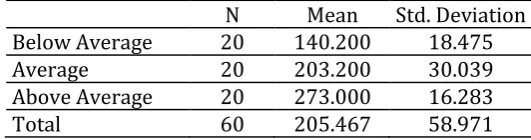
A one-way ANOVA was run to compare the below average, average and above average groups on the post test of speaking accuracy in order to probe the first research question which was whether self-directed learning significantly affect upper intermediate EFL learners' speaking accuracy. It should be mentioned that the subjects were divided into three groups based on their scores on the Self-Directed Learning Readiness scale. That is to say, based on the criteria offered by Guglielmino (1977), those subjects whose scores were between 58 to 201 formed the below average group, those subjects with scores between 202 to 226 were considered as average and the rests of the subjects (227 to 290) formed the above average group (Table 2).
Table 2. Descriptive Statistics of Self-Directed Learning Readiness
N Mean Std. Deviation
Below Average 20 140.200 18.475
Average 20 203.200 30.039
Above Average 20 273.000 16.283
Total 60 205.467 58.971
The results of the one-way ANOVA (F (2, 57) = 82.96, P = .000 < .05, ω2 = .73,
representing a large effect size) indicated that there were significant differences between the means of the three groups on the post test of speaking accuracy. Thus, the null-hypothesis as “self-directed learning (SDL) does not significantly affect upper intermediate EFL learners' speaking accuracy” was rejected.
DISCUSSION AND CONCLUSION
believe their actions and skills impact their learning and are often high achievers (Lynch, Hurford, & Cole, 2002; McClun & Merrell, 1998).
Students with an external locus of control tend to believe the teacher must teach them what they should learn and that they are not responsible for their own learning. The findings of the study also are in line with the results of the previous research conducted on adult’s second language speaking development: As Matsuda and Silva (2014) present that SDL can pave the ground for understanding and facilitating adult learning. They also stress that language skills could be developed better in case the learner tries to comprehensively analyze his/her ways of learning and come to know about the principles and effective practices as well as strategies s/he is more successful in. Developing second language speaking through SLD frame work is an experiential learning (Rafiee, et al., 2014), which could be energized through learner autonomy (Benson, 2013) and is bound to the ever emerging experiences (Conner, 2004).
Experience is considered as an essential element in learning, especially for adult education and many researchers have considered an important element (Costa, 2013;Guglielmino, 2008; Wang, 2014) in adult learning, as it carries with it a rich resource for adult learners. Students should also be encouraged to seek feedback from their peers and their facilitator, and understand that self-direction does not mean learning in isolation. Meshkat and Hassanzade (2014) suggest that more research into cross cultural aspects of self-directed learning within the body of adult education is needed to break the dominance of the North America and European in adult learning. According to the results of the present study, some implications for teaching and learning speaking accuracy through employing Self Directed Learning can be suggested. Watson and Tharp (2013) within the framework of SLA pays attention to the role SDL and interactional feedback play in L2 development. Although he does not directly use the term “SDL based language development”, he emphasizes on the importance of presence of SDL in prompting learners’ second language awareness. English teachers and learners could employ SDL, focus problems to be solved meaningfully, and then SL speaking accuracy in an atmosphere filled with awareness of a mismatch between the input they receive and their current learning. This way the classroom interactions could be enriched and would help subsequent L2 development of the learners.
REFERENCES
Benson, P. (2013). Teaching and researching: Autonomy in language learning. London: Routledge.
Benson, P., & Voller, P. (2014). Autonomy and independence in language learning. London: Routledge.
Bolton, F. C. (2006). Rubrics and adult learners: Andragogy and assessment. Assessment
Update, 18(3), 5-6.
Ellis, R., & Yuan, F. (2004). The effects of planning on fluency, complexity, and accuracy in second language narrative speaking. Studies in second Language
acquisition, 26(1), 59-84.
Gibbons, M. (2002).The self-directed learning handbook: Challenging adolescent students
to excel. San Francisco. Wiley and Sons, Inc.
Grow, G. O. (2012). Teaching learners to be self-directed.Adult Education Quarterly, 41(3), 125 -149.
Guglielmino, L. M. (1977). Development of the self-directed learning readiness scale. In P.Chou & W. Chen (Eds.), Self-directed learning and web-based learning
environment (pp.124-136).Pennsylvania: The Pennsylvania State University.
Guglielmino, L. M. (1989). Reactions to field’s investigation into the SDLRS. Adult
Education Quarterly, 39(4), 235-245.
Guglielmino, L.M. (2008). Why self-directed learning? International Journal of
Self-Directed Learning, 5(1), 1-14.
Guglielmino, L. M. (2013). The case for promoting self-directed learning in formal educational institutions. SA-eDUC, 10(2), 1-18.
Guglielmino, L. M., &Guglielmino, P. J. (2003). Identifying learners who are ready for e-learning and supporting their success. In G. M. Piskurich (Ed.), Preparing learners
for e-learning (pp.18-33).San Francisco, CA: Jossey-Bass.
Lai, C. (2015). Modeling teachers' influence on learners' self-directed use of technology for language learning outside the classroom. Computers & Education, 82, 74-83. Lam, R. (2014). Promoting self-regulated learning through portfolio assessment:
testimony and brecommendations. Assessment & Evaluation in Higher
Education, 39(6), 699-714.
Little, D. (2000). Learner autonomy: Why foreign languages should occupy a central role in the curriculum. In S. Green (Ed), New perspectives on teaching and learning
modern languages(pp. 24-45).Clevedon: Multilingual Matters.
Lu, X. (2010). Automatic analysis of syntactic complexity in second language speaking. International Journal of Corpus Linguistics, 15(4), 474-496.
Mayer, J. D., Roberts, R. D., &Barsade, S. G. (2008). Human abilities: Emotional intelligence. Annual Review of Psychology, 59, 507–536.
Mayer, J. D., Roberts, R. D., &Barsade, S. G. (2008). Human abilities: Emotional intelligence. Annual Review of Psychology, 59, 507–536.
Mezirow, J.A. (1981). Critical Theory of Adult Learning and Education: Adult Education. In S. Merriam (Ed.), Androgogy and self-directed learning?: Pillars of adult Learning
Theory (pp. 107-110). San Frasisco: Joss-Bass, John Wiley & Sons, Inc.
Ni, L. B. (2013). Self-Directed Learning. International Journal of Computer Networks and
Wireless Communications (IJCNWC), 3(2), 62-66.
Ortega, L. (2003). Syntactic complexity measures and their relationship to L2 proficiency: A research synthesis of college-level L2 speaking. Applied Linguistics, 24 (4), 492-518.
Power, F. C. (2008).Moral education. London: Greenwood Publishing Group.
Wang, Z. (2014). Developing accuracy and fluency in spoken English of Chinese EFL learners. English language teaching, 7(2), 110-121.
Watson, D., & Tharp, R. (2013). Self-directed behavior: Self-modification for personal
adjustment. Cengage Learning.