RESEARCH
Identification of discrepancies in grain
quality and grain protein composition
through avenin proteins of oat after an effort
to increase protein content
Bindu A. Sunilkumar
*and Eden Tareke
Abstract
Background: Oat prolamin (avenin) is a family of proteins that contain several polymorphic components. The high interspecific variability of avenin among cultivars, electrophoretic patterns have been used for grain protein compari-son and species relationships. Therefore, the present study was carried out to evaluate the effect of environment on avenin constitution following an effort to increase protein content of oat using different approaches.
Results: The avenin electrophoretic patterns of 25 samples resulting from 20 oat cultivars and 5 mutated oat lines grown or developed in different fields and greenhouses were compared. Quantification of total proteins and SDS-PAGE analysis of avenin protein extracts were carried out. Different pattern of avenin allele in electrophoretic gel allowed the comparison within and between groups. This analysis shows that the cultivars obtained from Swedish fields had differences in the number of alleles compared with the parental cultivar, so were not stable across sites. The study revealed that oats treated with nitrogen and the selected mutated lines showed increase in protein concentra-tion, with consistent avenin loci to the parental line, so these lines are now being used as potential candidates for developing high-protein oat lines in the future.
Conclusions: Our results provide useful information, on the stability of modifications, for breeders aiming to increas-ing the content and nutritional value of oat protein. The study will increase our knowledge in the stability of different modifications and thus to accordingly select oat lines with stable and improved nutritional values.
Keywords: Avenin, Mutation, Nitrogen, Geographical location, Electrophoresis
© 2016 The Author(s). This article is distributed under the terms of the Creative Commons Attribution 4.0 International License (http://creativecommons.org/licenses/by/4.0/), which permits unrestricted use, distribution, and reproduction in any medium, provided you give appropriate credit to the original author(s) and the source, provide a link to the Creative Commons license, and indicate if changes were made. The Creative Commons Public Domain Dedication waiver (http://creativecommons.org/ publicdomain/zero/1.0/) applies to the data made available in this article, unless otherwise stated.
Background
Oat (Avena sativa) kernels contain proteins with good nutritional quality, high bioavailability, and high pro-portion of globular proteins and have been the target of an increasingly intense breeding campaign [1]. Oat lines with increased protein content would therefore be a very good complement to existing animal and plant protein sources. Soil fertility, genotype, geographical ori-gin, and climatic and environmental factors such as alti-tude, humidity, moisture, temperature, photoperiod, and
incident radiations strongly influence oat protein con-centration [1–5]. Protein percent can vary by as much as 3–4 % within the cultivar when this is grown in different geographical regions [5]. Application of nitrogen fertiliz-ers to soil increases protein concentration by up to 2 % [6–9]. Interaction of genetic and non-genetic factors with environmental factors, differences in breeding methods, and additive natural genes due to the double dose of maternal genes of seed endosperm can change the pro-tein concentration in cultivars grown under the same agronomic conditions. This, in turn, can affect nutritional quality [10–13].
High protein content in cereals is a desirable char-acter and goal of many cultivars. Various methods are
Open Access
employed to achieve this, including conventional and mutational breeding, genetic engineering, marker-assisted selection, and genomic analysis. When devel-oping cultivars with improved nutritional value, the improvements must be preserved and the cultivar must be as stable as possible [14]. It is therefore important to ensure that the protein quality is maintained and improvement attained in different environments and under different conditions.
Avenin is the collective name for alcohol-soluble prolamin proteins of oat that are highly heterogeneous in nature because of several polymorphic components [12, 15, 16]. Due to its polymorphic nature and envi-ronmental stability, compared with other cereal grain proteins, avenin is a potential candidate for inheritance studies, for identification of landraces, and for identi-fication of genotype and germplasm [3, 17–20]. These identifications are very important for efficient handling of the breeding stocks for maintaining varietal purity and discriminatory markers for protected varieties [21]. In addition to their polymorphic nature, avenin proteins have charge and size heterogeneity that is absent in two other storage protein fractions, globulin and albumin [22]. Consequently, avenin fractions are more suitable for cultivar identification in cereal grains than globulin and albumin fractions [22, 23]. Separation of avenin using SDS-PAGE is recommended by the International Seed Testing Association (ISTA) for verifying species and cul-tivars [24].
To the best of our knowledge, no study has investigated the stability of avenin in a single oat cultivar exposed to chemicals or grown under different geographical con-ditions. Thus, the purpose of this study was to evaluate the effect of nitrogen fertilizer, mutation, greenhouse, and geographical location on the stability of avenin pro-tein fractions of Belinda oat cultivars (BOCs) so that the cultivar with stably inherited avenin could be selected to assure the original gene pool, resulting in increased pro-tein content and in improved cultivars.
Methods Grain material
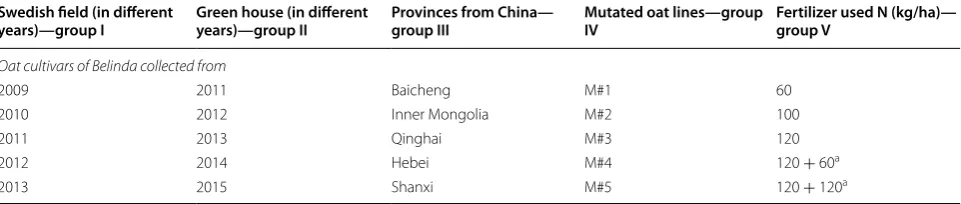
Grains of 20 oat cultivars and 5 mutated lines were evaluated in this study and were divided into five groups (Table 1). The parental Belinda cultivar was obtained from the SW collection (Svalöf Weibull AB, Landskrona, Sweden). The high-protein oat lines were selected after screening 1050 different mutated lines from a tilling population constructed from the spring oat cultivar SW Belinda (Sunil Kumar et al. in prepara-tion). Control plants and plants treated with nitrogen at different concentration [60–240 N (kg/ha)] were grown in a greenhouse under halogen lamps, giving a photon flux density of 240 μmol/m2/s with a photoperiod of
18 h. Day and night temperatures were 25 and 16 °C, respectively. Plants were grown in 5-L pots in stand-ard soil for oat growth. The treatments were arranged in completely randomized pots with three replications. The amount of soil in each pot was quantified to opti-mize fertilizer amount to mimic or reflect the actual field conditions. Split application of nitrogen fertilizer was applied for two members in group V in which the first fertilization was given at sowing and the second was at the tillering stage. Fertilizer was sprayed in the growing crop. Seeds were harvested for one season and analyzed.
Chemicals
PageRuler™ Unstained Protein Ladder (Thermo
Scien-tific), sodium dodecyl sulfate (SDS), and acetone were purchased from Sigma Aldrich. Nacl (1 mol/L), 2-chloro-ethanol, tris(hydroxymethyl)aminomethane, and glycine were obtained from Merck. All chemicals were of analyti-cal grade.
Stock solutions
Five stock solutions were made, using 25 % 2-chloroetha-nol and Milli-Q water. All stock solutions were prepared at room temperature.
Table 1 Sampling location, year of sampling, mutated oat lines, and fertilizer application rates of Belinda oat cultivars
M: mutated, followed by number indicates mutant line
a Split application of nitrogen—dividing total nitrogen application into two or more treatments
Swedish field (in different
years)—group I Green house (in different years)—group II Provinces from China—group III Mutated oat lines—group IV Fertilizer used N (kg/ha)—group V
Oat cultivars of Belinda collected from
2009 2011 Baicheng M#1 60
2010 2012 Inner Mongolia M#2 100
2011 2013 Qinghai M#3 120
2012 2014 Hebei M#4 120 + 60a
Milling and defatting of oat flour
Grain samples were ground using a benchtop ball miller (Minimill Pulversett 23, Fritsch, Germany) at 50 Hz for 5 min one day before analysis and kept in a desiccator to equalize the water content in all samples. The milled oat was defatted with acetone by dispersing 10 wt% of oat flour in acetone, and the mixture was stirred using a mag-netic stirrer for 1 h at room temperature. The mixture was centrifuged at 14,000 rpm for 20 min at 20° C using a Beckman Optima LE-80K Ultracentrifuge (Palo Alto, California). The precipitate was collected and kept open overnight at room temperature to remove the remaining acetone present in the precipitate.
Analysis of total protein content
Total and soluble protein contents of the ground oat seeds were determined by measuring nitrogen content with elemental Flash EA 1112 N (Thermo Fisher Scien-tific, Delft, Netherlands) and using a modified Dumas method [25]. Total protein percentage was calculated by measuring the total nitrogen content in seed flour using a thermal conductivity detector. Aspartic acid was used as the standard. A nitrogen-to-protein conversion factor of 6.25 was used in the calculations. A total protein content of 11.7 % for non-mutated parental oat cultivar Belinda was used as control.
Extraction of avenins
Albumins and globulins were extracted with 200 µL of 1 mol/L Nacl in 0.1 mol/L sodium phosphate buffer, pH 7 and temperature 4 °C. The crude extract was centri-fuged (15 min, 6000 rpm). After centrifugation, 120 µL of supernatant was pipetted into another microcentrifuge tube and lyophilized for 6 h. After separation of albumins and globulins, the lyophilized material was extracted with 25 % 2-chloroethanol (200 µL per grain) for 4 h at the room temperature. The samples were then centri-fuged (15 min, 6000 rpm). After centrifugation, 120 µL of supernatant was pipetted into a fresh microcentrifuge
tube and lyophilized for 6 h. This has been shown to be the optimum concentration of 2-chloroethanol for extraction of avenin. After centrifugation, the clear supernatant was diluted with two volumes of pre-cooled 1.5 % NaCl solution and the precipitate separated by cen-trifugation at 6000 rpm for 30 min. The sample was then dried under vacuum in a desiccator.
Preparation of samples for SDS‑PAGE electrophoresis
The avenin protein fractions in 25 samples under study were separated by SDS-PAGE under reducing conditions using 8–25 % gradient Phast® gels (GE HealthCare) and a GE PhastGel system (GE Healthcare, Uppsala, Sweden). The SDS-PAGE conditions were 250 V, 10.0 mA, 3.0 W, 15 °C, and 65 Vh. The gels were developed at room tem-perature using PlusOne Silver Staining Kit (GE Healthcare, Uppsala, Sweden) and according to the provided instruc-tions. After staining, gels were routinely air-dried at room temperature between two sheets of wetted, untreated cel-lophane and clamped in an acrylic plastic frame.
Statistics
GraphPad Prism Program (GraphPad Softwares, SanD-iego, CA) was applied for the analysis of unpaired t test. Mean and standard error values were calculated using Excel software [26, 27].
Results
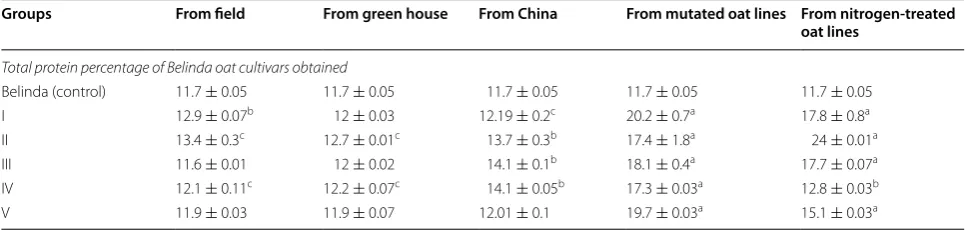
Protein content in the wild BOCs ranged from 11.6 ± 0.01 to 12.9 ± 0.07 and was similar when the BOCs were grown in the field (in Sweden 2009–2013) or in green house (2011–2015) (Table 2). The same oat cultivar grown in China exhibited significantly higher protein levels, 12.01 ± 0.1 to 14.1 ± 0.05, compared to those grown in Sweden, thereby showing the effect of geographical location on protein content. The variation in protein content in the BOCs grown in greenhouses, where growing parameters are controlled, was less than field-grown BOCs. Mutated BOLs, or those cultivars
Table 2 Total protein percentage of all Belinda oat lines (BOLs) analyzed using particle elemental analyzer
Results expressed as mean value ± standard deviation. Mean values followed by different letters on the same line are significantly different. c = p < 0.05, b = p < 0.005, a = p < 0.0001
Groups From field From green house From China From mutated oat lines From nitrogen‑treated oat lines
Total protein percentage of Belinda oat cultivars obtained
Belinda (control) 11.7 ± 0.05 11.7 ± 0.05 11.7 ± 0.05 11.7 ± 0.05 11.7 ± 0.05
I 12.9 ± 0.07b 12 ± 0.03 12.19 ± 0.2c 20.2 ± 0.7a 17.8 ± 0.8a
II 13.4 ± 0.3c 12.7 ± 0.01c 13.7 ± 0.3b 17.4 ± 1.8a 24 ± 0.01a
III 11.6 ± 0.01 12 ± 0.02 14.1 ± 0.1b 18.1 ± 0.4a 17.7 ± 0.07a
IV 12.1 ± 0.11c 12.2 ± 0.07c 14.1 ± 0.05b 17.3 ± 0.03a 12.8 ± 0.03b
treated with N2, had significantly higher protein levels,
clearly showing the effect of treatment on protein lev-els (Sunilkumar B et al., manuscript under preparation). In the mutated lines, the protein content ranged from 17.3 to 20.2 %. Similarly, BOLs treated with N2
fertiliz-ers showed higher protein levels and highest variation in protein content, ranging from 11.7 to 24 %.
A total of 5–8 protein bands were resolved among the five groups numbered I, II, III, IV, and V (Table 2) in the SDS-PAGE gels stained with silver staining procedure, as shown in Fig. 1a. Only one group of cultivars, obtained from the Swedish field, possessed all eight bands, which is shown in the diagrammatic representation of respective alleles based on SDS-PAGE gel, shown in Fig. 1b. Cultivars from the greenhouse, mutated as well as cultivars grown under excess N2, had four bands. The cultivar obtained
from China had five bands. As shown in Fig. 1b, four dis-tinct loci were present in all groups and four additional loci (one dense and three mild bands) in group I, which represent the cultivars grown in Swedish fields. Molecu-lar weight of all major four polypeptides ranged from 15 to 33 kDa (numbered D to I in Fig. 1b). The molecular weight in the three additional bands in the cultivar from the Swedish fields ranged from 40 to 66 kDa (Fig. 1a, group I). Three major bands and one minor band consist-ently stained heavily (mild line region), appearing in all oat lines examined. The cultivars grown in China showed an additional minor band with a molecular weight of 25 kDa, shown by an arrow in the gel picture (Fig. 1b, lane 3).
Discussion
Although the cultivars and mutated lines originated from a Swedish spring oat Belinda cultivar, it is not surprising to find considerable similarities in electrophoretic pat-tern as well as total protein percentage. However, total protein determination showed that the cultivars obtained from Sweden in different years (group I), greenhouse (group II) and from different provinces of China (group III) showed change in protein percentage that was either higher or lower than the 12 % seen in the original SW Belinda. However, the SDS-PAGE electrophoresis of avenin protein fraction showed eight allelic loci for culti-var grown in Sweden compared with five loci for groups II and III, so the Swedish cultivars were markedly differ-ent from the other groups. A small increase in protein percent was observed in the Chinese cultivars, but the variation between lines was not great (12–14 %) com-pared with cultivars from the greenhouse. Both have the same avenin loci, despite a minor band being found in one of the Chinese lines obtained from the province of Shanghai. According to the previous reports, some of the avenin alleles are associated with geographical ori-gin of the cultivars, and SDS-PAGE showed alleles with
alternative protein bands with different mobility [3]; such minor bands may occur in cultivars from Sweden as well as from China.
A significant increase in protein percentage was found in cultivars grown under different treatments. However, both showed nearly identical nature of electrophoretic patterns for avenin loci, indicating no such differences in avenin protein fraction obtained after mutation and fertilizer application. Evidence from the previous experi-ments showed that fertilization with high amounts of N2
increased globulin relative to other fractions of oat pro-tein [28]. Consequently, an increase in protein content here may be due to the capacity for maximum absorption of nitrogen in the container-grown plants in the green-house due to less percolation compared with soil in the field, which allows maximum permeation or percolation [29]. This could probably increase the globulin fractions that eventually gave a high protein percentage. Similarly, in mutated BOLs, the possibility of alteration in protein encoding genes that modulate certain biosynthetic path-ways could overproduce protein [30]. These results indi-cated that the effect of mutation and nitrogen fertilizers on protein content was more pronounced than the effect from geographical factors. However, another discrimina-tory method must be developed to resolve avenin gene families for variety identification in oats.
Production of genetically pure seed is an important cri-terion for any seed certification program. Identification of oat cultivars using electrophoresis offers many advan-tages over some of the current field testing procedures, which are purely based on morphological characteris-tics such as color and size of the plant, and the presence or absence of awns [31]. Even so, ISTA 1999 and other authors [22, 32, 33] reported that SDS-PAGE patterns can be useful to differentiate oat species, only requiring simple laboratory equipment and minimum laboratory supplies. Development of such tests can prove beneficial for developing and protecting high-quality cereal grains, especially for self-fertilizing species [34]. Developing an appropriate oat cultivar and its further acceptability in the market depends solely on the yield, maturity, dis-ease resistance, and nutritional value for food, feed, and functionality [35]. Our results from this study will help us develop new high-protein oat lines that are stable and environmentally sound, with reasonable grain quality, by using those genotypes showing consistency in protein content with distinct banding pattern through a crossing program.
Conclusions
Fig. 1 a Avenin polyacrylamide gel electrophoresis pattern of (I). Belinda oat cultivars from Swedish field from the year 2009–2013 (II). Five different Belinda cultivars grown in green house (III). Five different Belinda cultivars grown in different location from China (IV). Mutated Belinda oat lines (V). Five Belinda plants treated with nitrogen fertilizers. An arrow showed in group III third lines is the nonallelic loci. b Diagrammatic representations of SDS-PAGE banding patterns of the respective allelic blocks which indicated (by arrows) in the figure of SDS-PAGE gel image. The lines numbered 1,
showed the clear indication of adaptive strategy and appeared to be evidence of an ecological pattern of vari-ation in avenin. This needs to be considered when differ-ent breeding strategies are applied to produce cultivars adapted to one or more locations for food and feed.
Abbreviations
SDS-PAGE: sodium dodecylsulfate polyacrylamide gel electrophoresis; ISTA: International Seed Testing Association; BOCs: Belinda oat cultivars; BOLs: Belinda oat lines; SW: Svalöf Weibull AB; N (kg/ha): kilograms of nitrogen/hec-tare; EA: elemental analyzer.
Authors’ contributions
BS and ET conceived the study. BS collected and analysed the samples. BS and ET together interpreted the data, which is going to be a part of BS’s PhD studies in Food Chemistry at Lund University, Sweden. Both authors read and approved the final manuscript.
Authors’ information
BS is a doctoral candidate in Food for Health Science Centre, Lund Univer-sity, Sweden. ET is permanent senior researcher in the same department. ET received her PhD degree in Toxicology and Nutrition, Stockholm University, Sweden, and conducted her postdoctoral studies in nutrition science. ET is expert in food analytical chemistry.
Acknowledgements
The authors would like to thank the Erasmus Mundus External Co-operation Window Lot 13 for project funding. We also grateful to Professor Olof Olsson, Crop Tailor AB, a biotech company for new oat varieties and Dr Yi Ren, China, for provision of samples. We are also grateful to all farmers who helped us to grow the oat plants in the Swedish as well as Chinese fields.
Competing interests
The author(s) declared no potential conflicts of interest with respect to the research, authorship, and/or publication of this article.
Received: 9 March 2016 Accepted: 9 May 2016
References
1. Peterson DM. Protein concentration, concentration of protein fractions, and amino acid balance in oats. Crop Sci. 1976;16(5):663–6.
2. Rayapati PJ, Gregory JW, Lee M, Wise RP. A linkage map of diploid Avena based on RFLP loci and a locus conferring resistance to nine isolates of
Puccinia coronata var. ‘avenae’. Theoret Appl Genet. 1994;89(7–8):831–7. 3. Souza E, Sorrells ME. Prediction of progeny variation in oat from parental
genetic relationships. Theor Appl Genet. 1991;82(2):233–41.
4. Forsberg RA, Reeves DL. Breeding oat cultivars for improved grain quality, vol. 33. Madison: American Society of Agronomy: Crop Science Society of America; 1992.
5. Peterson DM, Wesenberg DM, Burrup DE, Erickson CA. Relationships among agronomic traits and grain composition in oat genotypes grown in different environments. Crop Sci. 2005;45(4):1249–55.
6. Portch S, MacKenzie AF, Steppler HA. Effect of fertilizers, soil drain-age class and year upon protein yield and content of oats. Agron J. 1968;60:672–4.
7. Ohm H. Response of 21 oat cultivars to nitrogen fertilization. Agron J. 1976;68(5):773–5.
8. Welch RW, Yong YY, Hayward MV. The distribution of protein and non-structural carbohydrate in five oat varieties during plant growth and grain development. J Exp Bot. 1980;31(4):1131–7.
9. Eggum BO. Current methods of nutritional protein evaluation. Improving plant protein by nuclear techniques. Vienna: Int. Atomic Energy Agency; 1969. p. 289–302.
10. Shewry P. Avenins: the prolamins of oats. In: Shewry P, Casey R, editors. Seed proteins. Dordrecht: Springer; 1999. p. 79–92.
11. Portyanko VA, Sharopova NR, Sozinov AA. Characterisation of European oat germ plasm: allelic variation at complex avenin loci detected by acid polyacrylamide gel electrophoresis. Euphytica. 1998;102(1):15–27. 12. Kim SI, Mossé J. Electrophoretic patterns of oat prolamines and species
relationships in Avena. Can J Genet Cytol. 1979;21(3):309–18. 13. Polisenska I, Nedomova L, Vyhnanek T. Characterisation of oat genetic
resources using electrophoresis of avenins. Czech J Genet Plant Breed. 2011;47(4):166–71.
14. Wenefrida I, Utomo HS, Linscombe SD. Mutational breeding and genetic engineering in the development of high grain protein content. J Agric Food Chem. 2013;61(48):11702–10.
15. Peterson DM, Smith D. Changes in nitrogen and carbohydrate fractions in developing oat groats. Crop Sci. 1976;16(1):67–71.
16. Kim SI, Charbonnier L, Mosse J. Heterogeneity of avenin, the oat prolamin. Fractionation, molecular weight and amino acid composition. Biochim Biophys Acta. 1978;537(1):22–30.
17. Li Gregová E, Žák I, Kraic J. Electrophoretic distinguishing of cultivated oats (Avena sativa L.) by seed storage proteins. Rostl Výr. 1996;42:169–72. 18. Murphy JP, Phillips TD. Isozyme variation in cultivated oat and its
progeni-tor species Avena sterilis L. Crop Sci. 1993;33(6):1366–72. 19. Dvoráček V, Čurn V, Moudrý J. Suitability of oat-seed storage
pro-tein markers in grain and mixed flour samples. Plant Soil Environ. 2003;49(11):486–91.
20. Jussila M, Sontag-Strohm T, Ulvinen O. The identification of Finnish oat cultivars (Avena sativa L.) by the use of SDS-PAGE of the avenins in homo-geneous and gradient. Acta Agriculturae Scandinavica, Section B — Soil & Plant Science. 1992;42(2):106–10.
21. Peterson DM. Subunit structure and composition of oat seed globulin. Plant Physiol. 1978;62(4):506–9.
22. Robert LS, Nozzolillo C, Altosaar I. Molecular weight and charge hetero-geneity of prolamins (avenins) from nine oat (Avena sativa L.) cultivars of different protein content and from developing seeds. Cereal Chem. 1983;60(6):438–42.
23. Králová M. Vybrané metody chemické analýzy půd a rostlin. Praha: Aca-demia; 1991.
24. International Seed Testing Association. Verification of species and cultivar. Chapter VIII. In: International rules for seed testing, vol. 41–43. ISTA, Bassersdorf; 1999. p. 252–54.
25. Cunniff P. Association of official analytical C: official methods of analysis of AOAC international. Washington, DC: Association of Official Analytical Chemists; 1995.
26. Excel Î. Microsoft Excel 2007. 2013.
27. Motulsky HJ. Analysing data with GraphPad prism. SanDiego, CA: Graph-Pad Software; 1999.
28. Peterson DM, Smith D. Changes in nitrogen and carbohydrate fractions in developing oat groats. Crop Sci. 1976;16(1):67–71.
29. Han J, Shi J, Zeng L, Xu J, Wu L. Effects of nitrogen fertilization on the acidity and salinity of greenhouse soils. Environ Sci Pollut Res Int. 2015;22(4):2976–86.
30. Galili G. New insights into the regulation and functional significance of lysine metabolism in plants. Annu Rev Plant Biol. 2002;53:27–43. 31. Chaugule AA, Mail SN. Evaluation of shape and color features for
classification of four paddy varieties. Int J Image Graph Signal Process. 2014;6(12):32–8.
32. Burgess SR, Shewry PR, Matlashewski GJ, Altosaar I, Miflin BJ. Characteristics of oat (Avena sativa L.) seed globulins. J Exp Bot. 1983;34(147):1320–32.
33. Lauriere M, Mosse J. Polyacrylamide gel-urea electrophoresis of cereal prolamins at acidic pH. Anal Biochem. 1982;122(1):20–5.
34. Shewry PR. Improving the protein content and composition of cereal grain. J Cereal Sci. 2007;46(3):239–50.