Issues
ISSN: 2146-4138
available at http: www.econjournals.com
International Journal of Economics and Financial Issues, 2015, 5(Special Issue) 73-79.
Economics and Society in the Era of Technological Changes and Globalization
Risk Management of Innovation Projects in the Context of
Globalization
Liudmila V. Nikolova
1*, Juriy Ju Kuporov
2, Dmitriy G. Rodionov
31Peter The Great St. Petersburg Polytechnic University, 29 Politekhnicheskaya Street, St. Petersburg, 195251, Russia, 2Peter The
Great St. Petersburg Polytechnic University, 29 Politekhnicheskaya Street, St. Petersburg, 195251, Russia, 3Peter The Great St.
Petersburg Polytechnic University, 29 Politekhnicheskaya Street, St. Petersburg, 195251, Russia. *Email: [email protected]
ABSTRACT
Globalization is becoming increasingly important in the economy. It strongly influences the advanced technologies and innovation processes. The present stage of economic development differs from the preceding one by the increased role and autonomy in the innovation processes management that has led to the need for change in the approach to the application and development of innovation project risk management methods and techniques. The existing methods and ways of assessing and managing innovation project risks do not allow obtaining the maximum effect from their implementation. Therefore there was a need to develop new methods and techniques that would take into account the market conditions and the use of new financial instruments and strategies. The article considers the application of the system optimization method when building a risk management model for innovation projects in the context of globalization. Scientific novelty includes the development of a method and a model to calculate limiting values of factors, which bring the target value of the corresponding criterion of the innovation project efficiency to critical limit at the solution to direct and inverse problems. As a result, the authors have built a model of innovation project sustainability region in the context of globalization, using MATHCAT software (computer algebra system from a class of computer-aided design, focused on preparation of interactive documents with computations and visual tracking).
Keywords: Globalization, Innovation Project, Sustainability Model, Sustainability Method, Risk Factor, System Optimization
JEL Classifications: C61, C63, F62, O33, O32
1. INTRODUCTION
Integrity and the cyclical development of the world community allow considering the globalization, on the one hand, as a process, and, on the other hand, as a system, which is at a certain stage of development. Special features of the innovation processes in the context of globalization are reflected in the following works (Levén et al., 2014; Sirgy et al., 2004; Dreher, 2006; Tsai, 2007; Nikolova et al., 2014; Nikolova et al., 2014; Tüzün et al., 2015; Vambery and Mayer, 2012; Varma et al., 2007).
Risks management of investment projects is possible using economic and mathematical models. An economic and mathematical model is a powerful method of cognition of the
external world, as well as prediction and control. An economic and mathematical model allows penetrating into the essence of the studied phenomena and influence them (Marmier et al., 2013; Marxt and Brunner, 2013; Mikkola, 2001; Moutinho et al., 2015; Stubbs and Cocklin, 2008; Schumpeter, 1939; Short et al., 2012; Borowiec, 2013; Buyanov et al., 2002; Grachova, 2001).
activities, the integrated risk-related cost optimization model, the external and internal risk-related costs optimization model, which are also used in the sensitivity analysis and scenario analysis methods. The computational complexity inherent in probabilistic simulation models of assessment, management, and optimization proposed by Novokreschenov, which are based on the probabilistic simulation method, has led to the fact that these models are rarely used in solving of practical problems on investment. The above noted mathematical economic models can be successfully used for risk assessment and innovation projects management, though neither of them considers the technique to calculate limiting values of the factors affecting the efficiency of the innovation project.
The authors developed a model enabling calculation of limiting values of factors affecting the efficiency of the innovation project, named a model of financial sustainability of innovation projects risk factors management (hereinafter – the sustainability model). The objective of the present model consists in the formation of a sustainability region of innovation project. This model is created using the method of sustainability analysis of innovation project taking into account risk factors (hereinafter – sustainability method), which was developed by the authors.
2. THEORETICAL ASPECTS OF
INNOVATION PROJECTS RISKS
MANAGEMENT
2.1. Innovation Projects Risks Management Methodology
To create a risk management model of innovation project of the region it is necessary to emphasize the methodological, methodical and operating principles, which coherently integrate the diverse interests at both macro- and micro-levels in a single whole (Buyanov et al., 2002).
1. Methodological principles, i.e., the most general principles that define the conceptual provisions of investment, and most importantly – independent of the specifics of the concerned type of risk (even invariant with respect to the nature and specific content of the target and value system). When forming the investment methodology, the optimal control theory is applied at studying of the systems, as well as system analysis methods.
Methodological guidelines take into account contemporary features of investing that allows justifying new approaches to the creation of innovation risks management model in the region. This principle is based on the following rules: • The uniformity of the risks means that all participants of
business activities have the same perception of risk; • The positiveness of the risks means that the integrated risk
factor is at least not more than the level of acceptability. In an innovation project this principle is associated with the “efficiency” principle;
• The objectivity of the risks means the necessity to perform correct formation of the structure and characteristics of the changing object when conducting its assessment; • The correctness of the risks means that the assessment
shall be executed with the certain formal requirements:
a. Providing integral monotonicity, i.e., within a certain range of indicators, increasing the intensity of activity leads in increase of the risk, at that in the border areas the uncertainty changes qualitatively;
b. Disproportionality, i.e., the increase in risk is not directly proportional to the intensity of the activity (within a given range of indicators variations); c. Transitivity, i.e., if the first situation is less risky than
the second one, and the second situation is less risky than the third one, this means that the first situation is less risky than the third one;
d. Additivity, i.e., the risk is equal to the sum of individual risks:
• The complexity of the risks means that together they should form a closed system;
• Interdependence of risks means that in the event of some risks other risks arise due to the interaction effects. 2. Methodological principles, i.e., principles directly associated
with the structure of the innovation project, its specificity, implementation features, and specific situations. The following rules underline this principle:
• Discordance of risks means that any new project has its specific impact on the innovation project; the greater the significance of a new project discordance the greater the risk;
• Divergence of risks perception is due to availability of risks at various implementation stages of the innovation project that predetermines the divergence of interests between project participants and their different attitude to the possible damage;
• The agility of risks of the innovation project suggests that the methodological support takes into account the variability of risks;
• The consistency of the innovation project risks is conditioned by the need that in case of the risks occurrence, prevention processes must be coordinated with other processes.
3. Operating principles, i.e., the principles relating to the availability, reliability, and uniqueness of the information and capability of its processing
• The ability to model innovation project risks means the ability to describe the emerging risks by the model • The ability to simplify the innovation project risks means
that in risk assessment we choose the method that is most simple in the information and computational context.
This has resulted in a creation of the methodology for investigation of innovation project risk analysis in the context of globalization. The authors defined certain methodological, methodical and operating principles, which are based on the rules applied in the formation of model and risk management methods.
2.2. Justification of the Model of Sustainability of
Innovation Projects Risk Factors Management
Innovation projects sensitivity analysis method is a single-objective optimization problem, i.e., its implementation needs the use of a single objective function – factor affecting the efficiency of the innovation project. The authors propose to consider further development of the sensitivity analysis method, i.e., to move from a single-objective analysis to a multi-factor analysis, using the analytical method of Pontryagin for solution to variational problems with restrictions that are encountered at control optimization in dynamic systems.
Analytical method, grounded by Pontryagin, is used to justify the innovation project sustainability method under the uncertainty and risk conditions. The investment sustainability estimation method provides calculation of limiting values of factors affecting the efficiency of the innovation project in solving both direct and inverse problems.
The innovation project is a complex dynamic system. Its risk management needs consideration of many risk factors.
In some cases risk factors can be reduced to a single risk and thereby to revert to a known single-objective optimization method. The simplest way of such reduction consists in the so-called weighting the criteria. If ƒ1(х),…, ƒn (х)are the objective functions expressing the values of the used criteria, than for each of them positive weighting factor λі is selected according to the influence of this criterion on the investment efficiency. The criteria weighing operation (of the objective functions) ƒ1 (х),…, ƒn (х) consists in their replacement by just one criterion (objective function)
ƒ (х) = λ1.ƒ1 (х) +… + λn.ƒn (х)(Chernoruchcky, 2001).
However, for the risk management of innovation project such reduction is practically impossible; therefore a vector (multi-criteria) objective function is used in the course of optimization. In this case, the admissible domain M can be changed in the optimization process. Moreover, its targeted change is the main essence of the optimization process for this class of problems.
Since the laws of possible changes in the admissible domain M are usually set by system of models, the described approach to optimization problems is called systemic. In systemic approach, the changes that specify the admissible domain in the space of those or other parameters occur as a result of the sequence of solutions chosen from a discrete set of possible solutions; at that, at the beginning of the optimization process this set itself is not completely specified and is updated in the course of innovation project development and implementation.
One of the peculiar formalized settings of system optimization problems is a double-criteria analysis. Suppose that an appropriate solution is uniquely determined by the choice of the values of these criteria. In other words, the desired solution is searched directly in the space К of optimization criteria, which we denote as х1and х2. Solving starts with the choice in a given space К of a certain point А0 with coordinates a0, b0, as a desired solution to the problem. Further, the initial restrictions F1(0) (x
1,x2) ≥ 0…, Fn(0) (x
1,x2) ≥ 0, specifying the initial valid region Р0, are constructed. The fact, whether point А0 belongs to the region Р0
is determined through the direct validation. In the first case we can apply in principle conventional (classical) optimization procedure either with respect to one of the criteria х1, х2,or their certain combinations.However, at the systemic approach a totally different stratagem usually is used as follows: In accordance with the highest level model М, which manages the choice of criteria, the point А0 is excluded from the admissible domain Р0.
Then the restrictions, which are not valid at the point А0 are separated (in this case, these are F3(0) и F
4(0)). Turning to the
models М3and М4, which form these restrictions, one or another solutions, which change the appropriate restrictions in the right direction (if such change is possible), are considered interactively. Right is the direction, which reduces the absolute value of negative disparities Fі(0)(а
0, b0)(in this case F3(0) (а0, b0) и F4(0)(а0, b0)). It should be borne in mind that in many cases, the restrictions Fі
are interrelated, so that changing one of them leads to change a certain part of other restriction. Solutions selection management to change the restrictions is determined by minimizing of some penalty function g0 (а0, b0). The maximum absolute value of negative disparities λiFi(0) (а
0, b0) is chosen as such a function (where λ1 - are some positive weighting coefficients). If there are no disparities, than g0 (а0, b0)= 0 by definition.
A number of solutions R1 …, Rm, appear as a result of the management, leading to a decrease in the value of penalty function, which after the тthsolution is denoted as g
m (a0, b0). Modifying restrictions, each of the taken solutions leads to a corresponding change of the admissible domain. Consider two such changes: The first one changes the restrictions F3(0), F
2(0), replacing them respectively by the restrictions F3(1), F
2(1), while the second one affects only one restriction F4(0),replacing it with the
restriction F4(1). Obtained admissible domain Р
2 is restricted by the
lines F1(0), F
2(1), F3(1), F4(1), while the corresponding values of the penalty function are equal to g2 (а0,b0). Preliminary selection of the final valid domain is impossible due to the fact that the sequence of domains Р0, Р1 …may not be ordered by embedding. In addition, the huge complexity when forming new restrictions does not allow performing this work in advance, because this would require a lot of extra work to change non-essential restrictions.
If g2 (а0, b0) ≠ 0, whereas there are no solutions resulting in a further decrease in the value of penalty function, we return back to the model М of the highest level, which controls the selection of the desired solution А (а, b). Through a sequential series of solutions D1, D2,…, Dkchanging the initial solution to the problem
А0(а0, b0)the latter is replaced by А1(а1 b1),…, Ak(ak, bk)until next point Ak(ak bk)is found in the admissible domain (k = 1). Solutions on changes are selected from the feasible set of solutions to minimize the penalty function. This process is close to the classical optimization process, except for the fact that the steps are chosen not arbitrarily, but in accordance with the admissible (by the model М) solutions.
This procedure differs from the classical one just by the fact that the choice of optimization steps is not arbitrary but is controlled by the model М of the highest level. If some restrictions, amenable to further changes in the desired direction, interfere with the chosen criterion in terms of its further improvement, the optimization process can be continued by incorporating sequential solutions on such changes.
The most important feature of system optimization, common for all the approaches, in addition to multicriteriality and the possibility of changing the admissible domain, is the interaction of the different level models. In the current case this is an interaction of two systems during the structural analysis: Risks system, consisting of risk factors, and innovation project implementation system, i.e., a model of М level.
An unambiguous solution to the problem through the choice of the values of all optimization criteria cannot be used to justify an innovation project risk management model, because there is no uniqueness of solution to this problem. The space, in which the solution is sought, in addition to the coordinates corresponding to the optimization criteria, may have also other coordinates. In this case the above-described optimization process becomes more complicated due to the fact that the points А1(а1, b1) are replaced by hyperplanes – the areas of the sustainable investments. The definition of the penalty function also complicates: It can be determined, for example, as a distance from the hyperplane to the next valid region in space with specified compressions (expansions) along the axes corresponding to the optimization criteria – the change agents of the limiting values in the sustainability model.
3. RESULTS
3.1. The Innovation Project Implementation Model Uncertainty and risk are an objective reality of an innovation project, an integral part affecting all its phases and implementation stages.
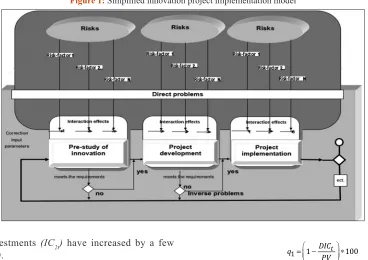
Imagine a hypothetical model of an innovation project in the form of a system formed from two interacting systems - risks system, consisting of risk factors, and the system of conditionally-specified implementation stages (Figure 1). The combination of these systems represents a model for implementation of real innovations. An innovation project is defined also as the totality of the above noted systems and is a closed process - an innovation system, which obeys the laws of the systems optimal control theory.
Innovation system is a system, whose implementation is fraught with risks in solving both current and long-term investment objectives of innovation projects different in their scales. The diversity of approaches to the study of systems is divided into analysis and synthesis, which, in turn, are classified as follows: The analysis can be functional and structural, while synthesis is emergent (determining whether the system has the properties indicating its entirety) and synergetic (characterizing the compatibility, and the multiplicative effects). The emergent properties of investment are associated with the appearance in
the system of new properties that do not belong to any of the systems (elements). The appearance of emergent properties and emergent risks in the system serves the basis for the methodology enabling to determine the consistency of current investment (Buyanov et al., 2002). Identifying emergent risks (risk factors) is a very important process in the study; however, it merely states the fact of appearance of new risks in the interacting objects (Figure 1).
Partially this question answers synergetics – the science of self-organization. Science that does not consider systemic risks emanates from the fact that external influences on the object can always get from this object the desired effect, i.e., to rebuild it the way the researcher wants. However, as experience shows, in most cases, this is extremely difficult.
In its simplest form, structural analysis studies certain structural component of the system (in this case the risk factor). Studying properties of the structural components at different levels, when forming a risk management model, is exactly the subject matter at this approach. The proposed approach allows justifying the consistency of assessment and risk management of innovation project and providing the basis for subsequent research.
3.2. Sustainability Model of Innovation Project
The analysis of risks (risk factors) influence on the efficiency of the innovation project is carried out on the basis of integrated indices: Net present value (NPVT), yield index (
PP
Td), the internal rate of return (IRR), and payback period (PPTd). The sensitivity of effectiveness index towards changes in the risk factors is evaluated by determining the elasticity of the factor-specific indicator. We denote risk factors by q1…qn. Their values can be obtained from formula NPV(q1, q2, q3…qn.) = 0.The sustainability model of innovation project can be defined as a set of risk factors values q1, q2, q3…qn., satisfying the system of inequalities:
NPV(q1) = 0; NPV(q2) = 0; NPV(q3) = 0;…; NPV(qn) = 0.
If conditions, imposed on the NPV index, are fulfilled, the values of
PI
Td, IRR,PP
Td, indicators will change accordingly. Consider the formation of the sustainability region of an innovation project in 3D space under the influence of variations of, let say, four factors (risk factors), namely income (CFt), two components of capital investments - (IC1t) and (IC2t), and the rate of return (r) on the efficiency of the innovation project.I. Let determine the maximum value that can be reached by affecting risk factors (CFt, IC1t, IC2t), provided that NPV=0,
i.e., the values of risk factors, at which the innovation project will have integrated break-even point.
Suppose the results of an innovation project have changed due to the following facts:
• Income (CFt) has decreased by a few percents (q1); • Capital investments (IC1t) have increased by a few
• Capital investments (IC2t) have increased by a few percents (q3).
Calculate limiting values of factors q1, q2, q3, at which the innovation project will have the integrated break-even point (NPV=0).
Determination of the limiting value of revenue differentials
CFt - (q1) in case, where the innovation project will have the integrated break-even point, i.e., NPV will be zero.
NPV IC r CFi CFo r t t t T t t t t T = − + + − + = =
∑
(1 )∑
(1 )0 1
(1)
Equate the expression (1) to zero.
To find the limiting value of revenue differential we transform the formula (1) substituting revenue differential (q1) from (2):
CF 1+ q
100
(1+r)
-IC
(1+r)
=0
t 1 t t=1 T t t t=0 T
∑
∑
(2)By running the transformations, we get q1 (3):
q =
1-IC
(1+r)
CF
1+r
1 t t t=0 T t t t=1 T∑
∑
(
)
* 100
(3)Simplifying the resulting formula we calculate q1 (4), since it is known that: IC r DIC t t t T t (1 )
0 +
=
=
∑
; CFr PV t t t T 1 1
(
+)
=
=
∑
q DIC
PVt 1=1− 100
∗ (4)
The definition of the limiting amount of change in the cost of capital investments IC1t - (q2).
For this purpose, we substitute the changes in capital investments
(q2) in formula (1), andtransform it to calculate the limiting amount of change in the cost of capital investments (IC1t) of the innovation project (5), since it is known that: PV IC− t=NPV
q PV IC IC
NPV IC t
t t
2= − ∗100= ∗100 (5)
The definition of the limiting amount of change in the cost of capital investments IC2t−(q3).
For this purpose, we substitute changes in capital investments(q3)
in formula (5) andtransform it to calculate the limiting amount of change in the cost of capital investments (IC2t) of the innovation project (6):
q PV IC IC NPV IC t t t 3 2 2 100 100
= − ∗ = ∗ (6)
The results obtained are presented in Table 1.
II. We determine how the sustainability region of the innovation project changes if the investor’s desired rate of return on capital (r) increases in the course of innovations implementation
Figure 1: Simplified innovation project implementation model
Table 1: The effect of the limiting amount of factors
change on the innovation project performance efficiency Factor
change, % NPV Parameter
(thousand roubles) r PI
PP
Tdq1 0 IRR 1 T
q2 0 IRR 1 T
q3 0 IRR 1 T
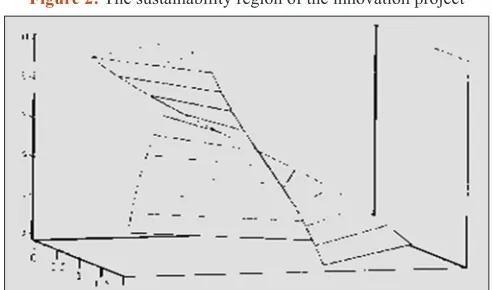
The formation of sustainability region of an innovation project. The practical implementation of the theoretical foundations of the system optimization of risk management of innovation project is carried out using the MATHCAD program. Figure 2 presents the sustainability region of the innovation project for r ranged from 0.12 to 0.25.
4. DISCUSSION OF THE RESULTS
OBTAINED
The innovation project risk management is hindered because of the ambiguity of data on the mechanisms regulating those or other internal processes, forcing the authors to be limited to the description of risks in the form of finite functional relations. At a greater number of factors that must be considered, the methods of logical algebra are used for preliminary conclusions about their significance. First, the working ranges of variables are quantized into separate levels and using the minimization method of Boolean functions, a Boolean model of the system is built. Further the task of interpreting the content of Boolean models is solved. The sustainability model is generated using the innovation project sustainability analysis method, developed by the authors, and taking into account risk factors. This model is a logical extension of sensitivity analysis. The innovation projects sensitivity analysis method is a single-objective optimization problem, i.e. it requires the use of just one objective function – factor, affecting the efficiency of the innovation project. The authors propose to consider further development of the sensitivity analysis method, i.e., to move from a single-objective analysis to a multi-factor analysis, using the analytical method of Pontryagin, i.e., solving variational problems with restrictions that are encountered at control optimization in dynamic systems. Analytical method, grounded by Pontryagin, is used to justify the innovation project sustainability method under the uncertainty and risk conditions. The investment sustainability estimation method provides calculation of limiting values of factors affecting the efficiency of the innovation project when solving both direct and inverse problems.
The innovation project is a complex dynamic system. Its risk management needs consideration of many risk factors.
Finely, the authors have developed the innovation project model for condition when the rate of discount (r) changes every year
during the project implementation. Figure 2 presents 12 models of innovation project sustainability, united in one figure: The lower part corresponds to 7 models and represents efficient area (inside) of the innovation project; the upper part of the figure is an area, in which the innovation project is not efficient; it is presented to the integrity of the study.
The authors’ analysis made it possible to represent an innovation project through a comprehensive dynamic system, whose risk management is possible when using the method for determining the sustainability, which employs the risk management model, based on mathematical method of Pontryagin.
5. CONCLUSION
The authors present the outcome of applying the system optimization method when creating the model to evaluate uncertainties and risks in the regional innovation program management. This model is based on the method of limiting values of the factors reducing the design variable of the relevant investment efficiency criterion to the critical limit, when dealing with direct problems.
As a result, the authors have built a model defining the sustainability area of an innovation program of the region under the conditions of uncertainty and risk, using the MATHCAT program.
The assessment of the risks (risk factors) impact on the efficiency of innovation program is performed on the basis of integrated factors:
NPVT, yield index (
PP
Td), the IRR, and PPTd. The sensitivity of effectiveness index towards changes in the risk factors is assessed by determining the elasticity of the factor-specific indicator. The sustainability model of innovation program of the region can be defined as the set of risk factors values q1, q2, q3…qn., satisfying the system of inequalities: NPV(q1) ≥ 0; NPV(q2) ≥ 0; NPV(q3) ≥0;…;NPV(qn) ≥ 0.
In the most general case the arbitrary point sets can be used instead of hyperplanes. There might be settings of the problems, in which the criteria values on these sets are defined ambiguously, and to determine more or less preferable solutions the corresponding weight functions are given (by a model of the highest level М) to the sets.
The most important feature of system optimization, common to all the approaches, in addition to multicriteriality and the possibility of changing the admissible domain is the interaction of the different level models. In this case this is the interaction of the systems at a structural analysis: Risks system, consisting of risk factors, and the regional innovation program implementation system - a model of М level.
When considering a large number of risks (risk factors) influencing the effectiveness of innovation program in the region to be analyzed and managed, the hyperplane, if it is represented in 3D- space, tends to the one-sheet hyperboloid.
The method proposed by the authors and the innovation project risk management model in the context of globalization, allow creating a sustainability management model under risk and uncertainty.
REFERENCES
Borowiec, A. (2013), Conditions for the development of innovation companies based on public-private partnership. Oeconomia Copernicana, 2, 20-36.
Buyanov, V.P., Kirsanov, К.А., Michaylov, L.А. (2002), Riskology: Risk Management. Moscow: John Wiley & Sons.
Chernoruchcky, I.G. (2001), Methods of Optimization and Decision Making. Moscow: Lan’.
Dreher, A. (2006), Does globalization affect growth? Empirical evidence from a new index. Applied Economics, 38(10), 1091-1110. Grachova, М.V. (2001), Risk-Analiz Investitsionnogo Proekta. Moscow:
Unity.
Levén, P., Holmström, J., Mathiassen, L. (2014), Managing research and innovation networks: Evidence from a government sponsored cross-industry program. Research Policy, 43(1), 156-168.
Marmier, F., Gourc, D., Laarz, F. (2013), A risk oriented model to assess strategic decisions in new product development projects. Decision Support Systems, 56, 74-82.
Marxt, C., Brunner, C. (2013), Analyzing and improving the national innovation system of highly developed countries: The case of Switzerland. Technological Forecasting and Social Change, 80(6), 1035-1049.
Mikkola, J. (2001), Portfolio management of R&D projects: Implications for innovation management. Technovation Journal, 21(7), 423-435. Moutinho, R., Au-Yong-Oliveira, M., Coelho, A., Manso, J. (2015),
Beyond the “innovation’s black-box”: Translating R&D outlays into employment and economic growth. Socio Economic Planning Sciences, 50, 45-58.
Nikolova, L., Rodionov, D., Mokeeva, T. (2014), Sustainability management of strategic alliances in the context of globalization. American Journal of Applied Sciences (AJAS), 10(19), 296-302.
Nikolova, L.V., Sergeev, D.А., Omelaynenko, A.R. (2014), Risk management of banks assets securitization. American Journal of Applied Sciences (AJAS), 11(11), 576-581.
Schumpeter, J. (1939), Business cycles. A theoretical, historical and statistical analysis of the capitalist process. New York, Toronto, London: McGraw-Hill Book Company.
Short, S.W., Rana, P., Bocken, N.M.P., Evans, S. (2012), Embedding sustainability in business modelling through multi-stakeholder value innovation. Proceedings of the APMS Conference, Advances in Production Management Systems, Rhodes. p12-14.
Sirgy, M.J., Lee, D., Miller, C., Littlefield, J.E. (2004), The impact of globalization on a country’s quality of life: Toward an integrated model. Social Indicators Research 68(3), 251-298.
Stubbs, W., Cocklin, C. (2008), Conceptualizing a sustainability business model. Organization and Environment, 21, 103-127.
Tsai, C. (2007), Does globalization affect human well-being? Social Indicators Research, 81(1), 103-126.
Tüzün, E., Tekinerdogan, B., Kalender, M., Bilgen, S. (2015), Empirical evaluation of a decision support model for adopting software product line engineering. Information and Software Technology, 60, 77-101.
Vambery, R.G., Mayer, P. (2012), Mapping the Global Future: Evolution through Innovation and Excellence. A Newly Emerging Economic World Order and its Implications for Global Business: The Challenges to Free Market Oriented Enterprises from the Ever Greater Role of Government and State Owned Corporations. Global Business and Technology Association, Huntington Station, New York.