NARRATIVE STRUCTURES ACROSS TELLINGS OF THE SAME
“GOOD” TEACHING EXPERIENCE
Joseph Ernest Mambu
Satya Wacana Christian University, Salatiga
email: [email protected]
Abstract: This paper investigates narrative structures of the same story told three times by
an advanced male EFL (i.e., English as a foreign language) learner. By narrative structures in this paper, I mean the sequence of narrative, especially in the light of the Labovian tradition of narrative analysis (Labov & Waletzky, 1997; Labov, 1972; Wu, 1995), and how each narrative component (e.g., abstract, orientation, complicating action, result/resolution, evaluation, and
coda) is fleshed out within and across tellings. Data analysis in this paper will attempt to answer the question of the extent to which these structures in one telling are similar or different across tellings of the same “good” experiences (cf. Chafe, 1998; Polanyi, 1981; Prior, 2011). In Labov’s (1972) data, “bad” near-death experiences were elicited, and yet a “good” result is conspicuous: death was overcome. Being asked to tell his “good” story, the EFL learner concentrated on the favorable experience. This said, some hints at unfavorable experiences— typically filling in the complicating action slot, like in telling bad or embarrassing stories (as in Wu, 1995)—also emerged, which make analysis of “good” experiences worthwhile in its own right. In particular, it can be hypothesized that the underlying structure of good experiences fits into the Labovian narrative structure with some nuanced variations across tellings. The findings support the hypothesis and suggest that repeated tellings of the same story provided the speaker in this study ample room to reflect on his past experience such that subsequent tellings can be more engaging than the first (or previous) telling.
Key words: orientation, complicating action, evaluation, result/resolution, coda, discourse
analysis
Abstrak: Makalah ini menyelidiki struktur naratif dari cerita yang sama yang diulang
penceritaannya sebanyak tiga kali oleh seorang pelajar bahasa Inggris sebagai bahasa asing mahir (EFL). Yang saya maksud dengan struktur naratif adalah rangkaian naratif, terutama dalam tradisi analisis naratif Labovian (Labov & Waletzky, 1997; Labov, 1972; Wu, 1995), dan bagaimana tiap komponen naratif (misalnya, abstrak, orientasi, tindakan komplikasi, hasil/resolusi, evaluasi, dan penutup) dipaparkan di dalam dan diantara tiap penceritaan. Analisis data makalah ini akan berupaya menjawab pertanyaan mengenai tingkat kemiripan struktur-struktur ini dalam satu penceritaan atau dalam penceritaan yang berbeda dengan pengalaman “baik” yang sama (cf. Chafe, 1998; Polanyi, 1981; Prior, 2011). Dalam data yang diperoleh Labov (1972), diperoleh pengalaman “buruk” mendekati kematian, tapi hasil yang “baik” terlihat jelas sehingga kematianpun bisa diatasi. Diminta untuk menceritakan pengalaman “baik”nya, pembelajar EFL tersebut fokus pada pengalaman baik. Beberapa isyarat yang mengarah pada pengalaman baik—biasanya mengisi bagian
tindakan komplikasi, seperti dalam penceritaan cerita buruk atau memalukan (seperti dalam Wu, 1995)—juga muncul, yang membuat analisis pengalaman “baik” ini berharga. Khususnya, bisa diprediksi bahwa struktur mendasar dari pengalaman baik masuk dalam struktur naratif Labovian dengan beberapa variasi bertema di semua penceritaan. Temuan-temuan mendukung hipotesis tersebut dan menunjukkan bahwa penceritaan cerita sama yang diulang seperti yang diberikan oleh pembicara dalam kajian ini memberikan ruang yang cukup untuk bercermin pada pengalaman masa lalunya, sehingga penceritaan berikutnya lebih menarik pendengar dibanding sebelumnya.
Similar to other scholars in different schools of thought who analyze narratives (see review by Johnstone, 2003), narrative (in the Labovian tradition) is defined as one means of recounting past events. Structurally, Labov (1972) has suggested that narrative comprises clauses that are chronologically ordered. These clauses are then called narrative clauses
(p. 361). Presumably, the series of clauses conveyed orally by a narrator represents (or are matched with) the actual order of events that happened in the past. If the chronological sequence of at least two narrative clauses is inverted by a narrator, the reversed clauses will result in different meanings (or inferences by a listener) from the narrative clauses prior to inversion. For example, in I punched this
boy and he punched me, it can be implied that
it was “I” who initiated the punching, whereas
in This boy punched me and I punched him,
it was “the boy” who did the punching first (pp. 359-360). Other clauses not expressing time sequence of past narrated events are free
clauses (p. 361). There are also restricted
clauses, “which can be displaced over a
large part of the narrative without altering the temporal sequence the original semantic interpretation”–or the sequence of past reality engendered by a narrator in his/her current storytelling event–“but not over the entire narrative” (Labov, 1972, p. 362), the example of which will be provided in my analysis of the Results/Resolutions below.
A narrative sequence typically consists of six functional components, usually with the following order or structure (see Labov, 1972, pp. 363-393 for further details):
(1) Abstract consists of one or two clauses
that sum up the overall story to come;
(2) Orientation presents characters,
chronological and physical setting, and situation;
(3) Complicating action consists of clauses
that represent a sequence of past events up to a climax, which creates tension that may keep the audience’s attention. It is concerned with answering the question of “[a]nd what happened next?” (Labov, 1997, p. 402);
(4) Evaluation often occurs before the result
and serves to highlight the interesting or unusual point(s);
(5) Result or resolution releases the tension
and explains what eventually took place; (6) Coda is to indicate that the story is
finished, e.g., And that was that, or to link the narrated past to the present situation, e.g., And I see him every now and again
(Labov, 1972, p. 365).
Narrative clauses are typically located in the complicating action and free clauses prevail, especially in the evaluation part or elsewhere, such as in the abstract, orientation to physical setting, and coda. Besides, although evaluation is typically situated (or concentrated) in the fourth sequence in his data, Labov admitted that evaluation is ubiquitous. Whenever a speaker departs from a narrative clause (e.g., Then I went to
the house) and uses a free clause to comment
on an event (e.g., It’s kind of creepy), s/ he is said to have evaluated the event either “externally,” like the hypothetical example I have just provided that shows his/her feeling, or “internally,” when the speaker animates his/her own speech (e.g, I was like “There
must be at least a ghost here!”) or another
person’s speech (e.g., And grandma said,
“Get out of here, you old mangy dog!”) in the
past narrated event (cf. Labov & Waletzky, 1997, pp. 34-35).
can be a part of the variationist approach to discourse analysis where “one can analyze alternative forms that appear within specific slots in a narrative structure” (Schiffrin, 1994, p. 288).
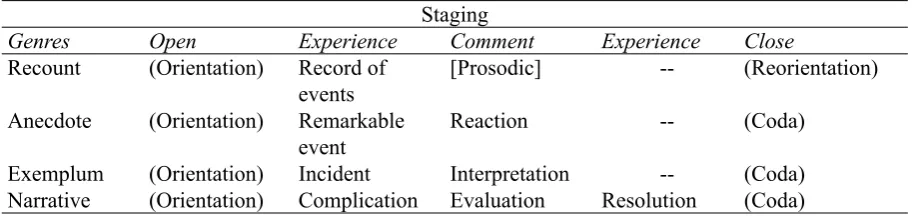
On variations of “the same” story genres, Martin and Plum (1997, p. 302) came up with these categories after they analyzed their narrative data:
Table 1. Some story genres (Martin & Plum, 1997, p. 302). Staging
Genres Open Experience Comment Experience Close
Recount (Orientation) Record of events
[Prosodic] -- (Reorientation)
Anecdote (Orientation) Remarkable event
Reaction -- (Coda)
Exemplum (Orientation) Incident Interpretation -- (Coda)
Narrative (Orientation) Complication Evaluation Resolution (Coda)
Furthermore, as two interviewers (an American English speaker and I myself) listened to and interrupted the student’s narrative development, it is crucial to investigate how the student fleshed out more details in terms of both narrative or free clauses and spoken utterances, either in his/her mother tongue Indonesian or English) in the spoken telling and subsequent written telling. Put another way, the question of whether the level of engagement or “involvement” (cf. Koven, 2011; Tannen, 2007) in re-telling stories as reflected in written clauses and spoken utterances increased or waned is to be substantiated through analyzing this student’s narrative data. Koven (2011) seems to insist on arguing that an “interlocutory role” (akin to Labov’s [1972] external evaluation) accounts for the degree of involvement, such that the more interlocutory roles are in a narrative, the more involved the story is. Following Tannen’s (2007) argument, however, the degree of involvement is much more than the interlocutory role. Drawing upon insights from a Bakhtinian notion of dialogue and conversation analytical framework, Tannen argued that involvement “strategies that work primarily (but never exclusively) on meaning include (1) indirectness, (2) ellipsis, (3) tropes, (4) dialogue, (5) imagery and detail, and (6) narrative” (p. 32). In the Labovian framework, dialogue is represented as internal
evaluation. It is unwieldy to address all of Tannen’s involvement strategies here.
More at issue is that the degree of involvement in this paper may be determined by an overall impression on the part of an audience (including me as a discourse analyst). More specifically, when a narrator expands on his/her abstract, orientation, or evaluation, among other components, in a subsequent telling of the same story, s/he can be said to have been more involved than the previous telling. A more complex picture, however, is that when a narrator is more involved in elaborating on his/her, say, orientation in one telling, but not that involved in a subsequent telling. This warrants further investigations, especially in a context where English is not used as a first language.
METHOD
Data from one male advanced EFL learner (let’s call him Bono) are used in the analysis. The degree of advanced proficiency was determined by his paper-based TOEFL prediction score that exceeded 500 at the time of data collection. The first written narrative of “good” experience was elicited in January, 2007. The same narrative was told sometime in February 2007 in a sociolinguistic interview with me and my American colleague (Vic) as the interviewers. I told Vic to ask Bono anything he would like Bono to elaborate. After the interview, I asked Bono to write the same story again and to include anything based on what had emerged in the interview or other details he would like to add. Bono’s written narratives were copied verbatim. I put clause or sentence numbers (in written narratives) and line numbers (of his recorded oral narrative) to facilitate data analysis. Prior to discussing the narrative structures in more depth, I find it important to establish why certain sentences or utterances are assigned with particular labels. After that, I will analyze the extent to which Bono’s story aligns with the Labovian narrative structure (see also Martin & Plum, 1997) in terms of its sequence and how each component (e.g., abstract, orientation, and evaluation) is embellished or played down across tellings. Insights from some approaches to discourse analysis (e.g.,
pragmatics, interactional sociolinguistics, Birmingham school of discourse, and critical discourse analysis [CDA]) will be briefly incorporated to illuminate analyses of some of the components.
FINDINGS AND DISCUSSION Component naming
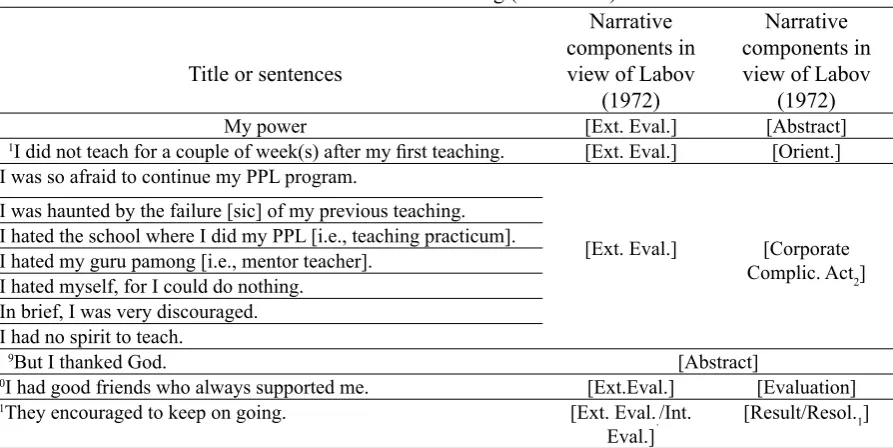
Assigning labels to each sentence/clause or utterance is a challenging task, especially because Labov (1972) himself concedes that evaluations are pervasive, especially external evaluations, which include lexical intensifiers (e.g., he was all wounded [p. 379]), shifts to a second person pronoun, repetitions, comparatives, superlatives, negatives, modals, and embedded clauses, among others. Consequently, in the data that I analyze, I may label a sentence or an utterance with two components. In Table 2, for instance, I assign the first sentence with a dual component of external evaluation and orientation. I did not teach
uses a past tense form typical of narrative clause, which provides a time orientation. The negative marker not may be interpreted as Bono’s negative affect following his first teaching experience, where his mentor teacher defamed him (sentence 18). This orientation, one may argue, can be interpreted as one of the complicating actions. My own argument is that the orientation foregrounds corporate complicating actions that follow (sentences 2 to 8).
Table 2. Bono’s first telling(224 words)
Title or sentences
Narrative components in view of Labov
(1972)
Narrative components in view of Labov
(1972)
My power [Ext. Eval.] [Abstract]
1I did not teach for a couple of week(s) after my first teaching. [Ext. Eval.] [Orient.] 2I was so afraid to continue my PPL program.
[Ext. Eval.] [Corporate Complic. Act2]
3I was haunted by the failure [sic] of my previous teaching. 4I hated the school where I did my PPL [i.e., teaching practicum]. 5I hated my guru pamong [i.e., mentor teacher].
6I hated myself, for I could do nothing. 7In brief, I was very discouraged. 8I had no spirit to teach.
9But I thanked God. [Abstract]
10I had good friends who always supported me. [Ext.Eval.] [Evaluation]
11They encouraged to keep on going. [Ext. Eval.
./Int.
Eval.]
12I should not give up. [Ext. Eval. /Int.
Eval.] [Evaluation]
13One of them said that I need to count on Jesus in my teaching
instead of using my own strength.
[Int. Eval.]
14I applied my friend’s advice.
[Result/Resol.2]
15I confessed [sic] to Jesus that I was so stubborn and could not do
anything without his presence.
[Int. Eval.]
16As a result a miracle happened in my second teaching. [Ext. Eval.] [Result/Resol. 3]
17I could teach well this time. [Ext. Eval.] [Evaluation]
18After being mocked (dihina, dihujat hbs2an [defamed without
mercy]) by Ms. Ax, I got a lot of praise from her.
[Complic. Act. 1] [Result/Resol.4]
19I could not believe that. [Int. Eval.] [Evaluation]
20I thanked to Jesus as he enabled me to do so. [Int. Eval.] [Result/Resol. x] 21He helped me to face the PPL program. [Ext. Eval.]
22Without him and my friends who always supporting me, perhaps I
would get E instead of A for PPL. [Ext. Eval.] [Evaluation]
23They are my power to face PPL indeed. [Ext. Eval.]
24Jesus and my friends are hero [sic] during PPL. [Ext. Eval.] [Coda]
Notes: (1) Indentation has been adjusted to the original text; (2) [Orient.] = orientation, [Complic. Act.] = complication action, [Ext. Eval] = external evaluation, [Int. Eval] = internal evaluation, [Result/Resol.] = result/ resolution; (3) explanations between square parentheses in some of the sentences are mine.
Each of sentences 2 to 8 in Bono’s first telling (Table 2) qualifies Labov’s (1972) notion of evaluation (e.g., so afraid, haunted, failure, hated, very discouraged, had no spirit). Viewed
individually, each of these sentences (or independent clauses) is a restricted clause and does not seem right to be included as a complicating action leads to another complicating action, culminating in a climax. However, if the overall story is taken into account, sentences 2 to 8 comprise a corporate complicating action following the defamation (sentence 18), that is why I used subscripts 1 and 2 respectively.2 The issue of sequencing
will certainly be discussed further in the following section. What matters now is to explain why I label my data as such.
Then, I label a sentence or an utterance as a result or resolution, I make it contrast to the complicating actions. While the complicating actions indexed Bono’s unfavorable situations with the necessity of teaching under pressure, especially after being mocked by his mentor teacher in the first teaching experience,1 the
result or resolutions came to fore when Bono framed his story in positive light at some levels (e.g., applying his friend’s advice
1 This constitutes his narrative of “bad”
experience. Due to space constraints, I do not include the narrative here.
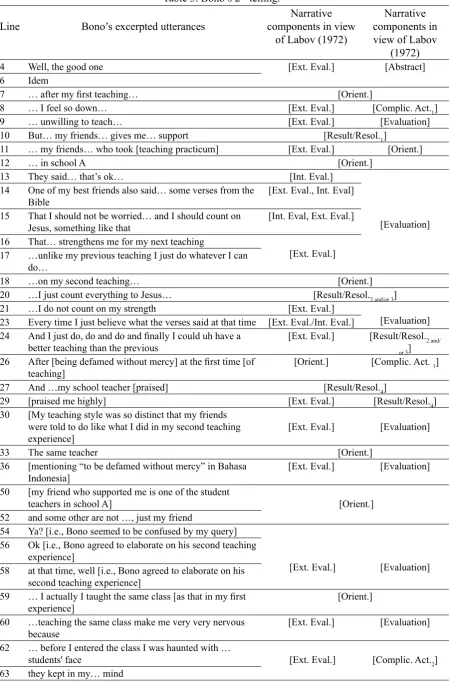
Table 3. Bono’s 2nd telling.3
Line Bono’s excerpted utterances
Narrative components in view
of Labov (1972)
Narrative components in view of Labov
(1972)
4 Well, the good one [Ext. Eval.] [Abstract]
6 Idem
7 … after my first teaching… [Orient.]
8 … I feel so down… [Ext. Eval.] [Complic. Act.1]
9 … unwilling to teach… [Ext. Eval.] [Evaluation]
10 But… my friends… gives me… support [Result/Resol.1]
11 … my friends… who took [teaching practicum] [Ext. Eval.] [Orient.]
12 … in school A [Orient.]
13 They said… that’s ok… [Int. Eval.]
[Evaluation] 14 One of my best friends also said… some verses from the
Bible
[Ext. Eval., Int. Eval]
15 That I should not be worried… and I should count on Jesus, something like that
[Int. Eval, Ext. Eval.]
16 That… strengthens me for my next teaching
[Ext. Eval.] 17 …unlike my previous teaching I just do whatever I can
do…
18 …on my second teaching… [Orient.]
20 …I just count everything to Jesus… [Result/Resol.2 and/or 3]
21 …I do not count on my strength [Ext. Eval.]
[Evaluation] 23 Every time I just believe what the verses said at that time [Ext. Eval./Int. Eval.]
24 And I just do, do and do and finally I could uh have a better teaching than the previous
[Ext. Eval.] [Result/Resol.2 and/
or 3]
26 After [being defamed without mercy] at the first time [of teaching]
[Orient.] [Complic. Act. 1]
27 And …my school teacher [praised] [Result/Resol.4]
29 [praised me highly] [Ext. Eval.] [Result/Resol.4]
30 [My teaching style was so distinct that my friends were told to do like what I did in my second teaching experience]
[Ext. Eval.] [Evaluation]
33 The same teacher [Orient.]
36 [mentioning “to be defamed without mercy” in Bahasa Indonesia]
[Ext. Eval.] [Evaluation]
50 [my friend who supported me is one of the student
teachers in school A] [Orient.]
52 and some other are not …, just my friend
54 Ya? [i.e., Bono seemed to be confused by my query]
[Ext. Eval.] [Evaluation] 56 Ok [i.e., Bono agreed to elaborate on his second teaching
experience]
58 at that time, well [i.e., Bono agreed to elaborate on his second teaching experience]
59 … I actually I taught the same class [as that in my first experience]
[Orient.]
60 …teaching the same class make me very very nervous because
[Ext. Eval.] [Evaluation]
62 … before I entered the class I was haunted with …
students' face [Ext. Eval.] [Complic. Act.2]
65 that's very makes me [a false start]
[Ext. Eval.] [Evaluation] 66 Well, it's hard to step …on my feet it's very very difficult
for me
67 and at that time I just [a false start]
[Orient.] 68 this is the first [hour]
69 so there is also devotion…
70 I just … stand up … and shout to some of my students [Result/Resol.2] 71 call … his [sic] name or (indecipherable) if I'm not
mistaken [Ext. Eval.] [Result/Resol.2]
72 Well I asked them [sic]
73 her name is Lenny [Orient.]
74 I said to her: "Lenny, shut up!" [Int. Eval.]
[Result/Resol.2] 75 I just said that "Shut up!" [Ext. Eval, Int. Eval.]
76 but at that time she was shocked and of course she was shocked
[Ext. Eval.] 77 and I also … said to other students like that
78 And of course the students were… shocked and they were suddenly quiet
80 and at that time …I said to… them [Result/Resol.2]
81 “what …did you feel …after I said like that?”
[Int. Eval.] 82 …I said like that…”what do you feel?”
83 and they answered that they were shocked and they were afraid …
85 No [i.e., Bono’s answer to my question that the students expressed their fear “at that time”, not after his class was over]
[Ext. Eval.] [Orient.]
87 At that time [Orient.]
88 “…what do you feel?” [Int. Eval.] [Evaluation]
89 And they asked me [a false start] n/a n/a
90 and then I …also ask [Int. Eval.] [Evaluation]
91 “is it rude or polite expression that I used?” 92 and then they answered that it is very rude
[Int. Eval.] [Result/Resol.2] 93 …I said to them that this is what we are going to learn
today, that's about command and request
95 the topic is about command and request [Ext. Eval.] [Evaluation] 96 and … I tried to move on to …the lesson to explain to
them, and they listen to me unlike the previous teaching … [Ext. Eval.] [Result/Resol.2] 99 Ya [i.e., he was observed by the same school teacher]
[Orient.] 101 She [i.e., the school teacher was female]
103 She gave good comments [Ext. Eval.] [Result/Resol.4]
105 … I also include games [Result/Resol.3]
107 A simple game Simon says
[Ext. Eval.] [Orient.] 111 yes, the game, and the pre-teaching [impressed the
teacher]
114 Ya [the pre-teaching]
116 I shout [in the pre-teaching part]
122 Not in English [i.e., the verse Vic asked Bono to recite was not remembered at first]
[Ext. Eval.] [Evaluation]
125 [indecipherable] n/a n/a
126 oh in English yes … we can do all things that we can do all thing with Jesus name … if I'm not mistaken
[Ext. Eval./Int. Eval.] [Evaluation]
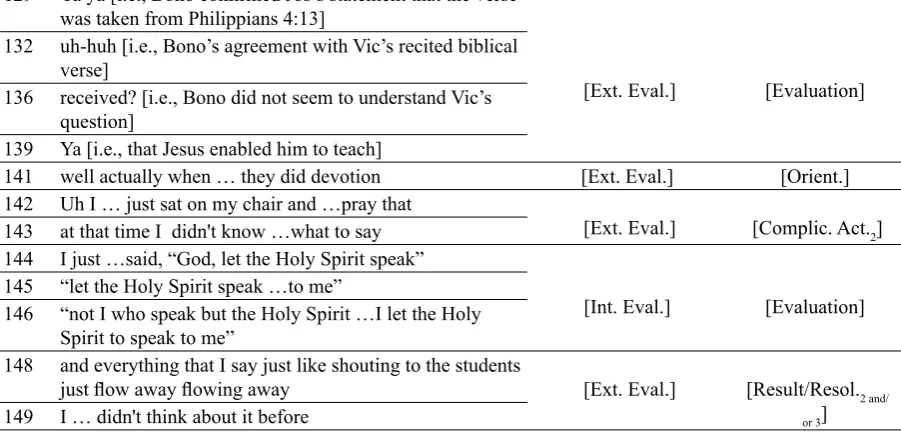
129 Ya ya [i.e., Bono confirmed Jos’s statement that the verse was taken from Philippians 4:13]
[Ext. Eval.] [Evaluation] 132 uh-huh [i.e., Bono’s agreement with Vic’s recited biblical
verse]
136 received? [i.e., Bono did not seem to understand Vic’s question]
139 Ya [i.e., that Jesus enabled him to teach]
141 well actually when … they did devotion [Ext. Eval.] [Orient.] 142 Uh I … just sat on my chair and …pray that
[Ext. Eval.] [Complic. Act.2] 143 at that time I didn't know …what to say
144 I just …said, “God, let the Holy Spirit speak”
[Int. Eval.] [Evaluation] 145 “let the Holy Spirit speak …to me”
146 “not I who speak but the Holy Spirit …I let the Holy Spirit to speak to me”
148 and everything that I say just like shouting to the students
just flow away flowing away [Ext. Eval.] [Result/Resol.2 and/
or 3]
149 I … didn't think about it before
An abstract is determined by a title or a sudden shift from miserable experiences to a relief, i.e., thanking God (as in the first telling and its ninth sentence), which is one of the main ideas of Bono’s good experience. In the second telling, Bono spelled out the abstract “Well the good one” as he took up Jos’s and Vic’s elicitation (see utterance 4 in Table 3 and Appendix). In the third telling, the abstract was not mentioned in the first sentence–similar to that in the first telling–but in the third sentence (see Table 4). From the data, abstract can be in the form of a noun phrase (e.g., My power— the title of Bono’s first telling) and a complete sentence (e.g., But I thanked God—Bono’s ninth sentence in his first telling).
Coda not only indicates the end of the story, but also summarizes, as Bono’s narrative suggests, the main point or his current affective stance of his story (see sentence 24, first telling [Table 2], and sentence 63, third telling [Table 4]). Put another way, the coda related his past to his current emotional standpoint (i.e., that Jesus was one of his heroes). His second telling is not explicitly marked with such a coda.
With regard to labeling external evaluation, I have recourse to Labov’s (1972) framework of evaluative devices that include intensifiers, comparators, correlatives, and explicatives, each with its own sub-devices (p.
394). Due to space constraints, minute details of each evaluative device will not be included in the analysis. Suffice it to say here though that whenever I come across a sentence that contains a lexical intensifier (e.g., the noun phrase my power, the adverb-adjective compound very discouraged; see Table 2 sentence 7), or comparators by means of a negative and a modal (e.g., I should not give up; see Table 2 sentence 12), or embedded clauses representing explicatives (e.g., I had
good friends who always supported me; see
Table 2 sentence 10), then the sentence is regarded as entailing an external evaluation. Internal evaluation is relatively much easier to label, as it signals either Bono’s own speech or other characters’ speech, both of which were at the narrated event. Sometimes, both internal and external evaluations overlap in one sentence. For example, it seems to me that the sentence They encouraged to keep
on going (11th sentence; see Table 2) is a
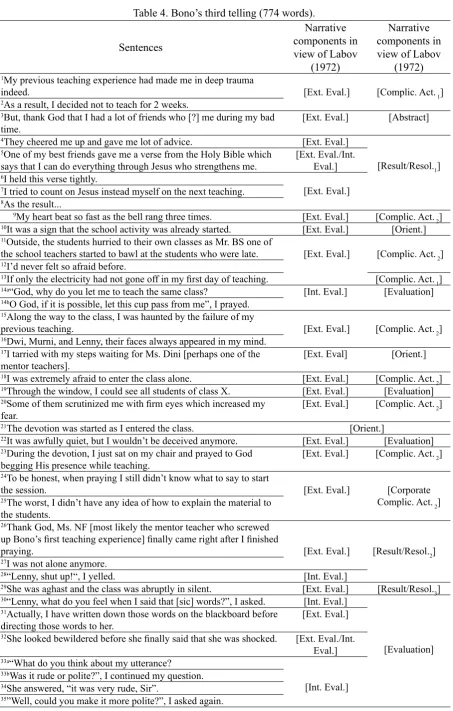
Table 4. Bono’s third telling (774 words).
Sentences
Narrative components in view of Labov
(1972)
Narrative components in view of Labov
(1972)
1My previous teaching experience had made me in deep trauma
indeed. [Ext. Eval.] [Complic. Act. 1]
2As a result, I decided not to teach for 2 weeks.
3But, thank God that I had a lot of friends who [?] me during my bad
time.
[Ext. Eval.] [Abstract]
4They cheered me up and gave me lot of advice. [Ext. Eval.]
[Result/Resol.1]
5One of my best friends gave me a verse from the Holy Bible which
says that I can do everything through Jesus who strengthens me.
[Ext. Eval./Int. Eval.]
6I held this verse tightly.
[Ext. Eval.]
7I tried to count on Jesus instead myself on the next teaching. 8As the result...
9My heart beat so fast as the bell rang three times. [Ext. Eval.] [Complic. Act. 2] 10It was a sign that the school activity was already started. [Ext. Eval.] [Orient.] 11Outside, the students hurried to their own classes as Mr. BS one of
the school teachers started to bawl at the students who were late. [Ext. Eval.] [Complic. Act. 2]
12I’d never felt so afraid before.
13If only the electricity had not gone off in my first day of teaching. [Complic. Act. 1] 14a“God, why do you let me to teach the same class? [Int. Eval.] [Evaluation] 14bO God, if it is possible, let this cup pass from me”, I prayed.
15Along the way to the class, I was haunted by the failure of my
previous teaching. [Ext. Eval.] [Complic. Act. 2]
16Dwi, Murni, and Lenny, their faces always appeared in my mind. 17I tarried with my steps waiting for Ms. Dini [perhaps one of the
mentor teachers].
[Ext. Eval] [Orient.]
18I was extremely afraid to enter the class alone. [Ext. Eval.] [Complic. Act. 2] 19Through the window, I could see all students of class X. [Ext. Eval.] [Evaluation] 20Some of them scrutinized me with firm eyes which increased my
fear.
[Ext. Eval.] [Complic. Act. 2]
21The devotion was started as I entered the class. [Orient.]
22It was awfully quiet, but I wouldn’t be deceived anymore. [Ext. Eval.] [Evaluation] 23During the devotion, I just sat on my chair and prayed to God
begging His presence while teaching.
[Ext. Eval.] [Complic. Act. 2]
24To be honest, when praying I still didn’t know what to say to start
the session. [Ext. Eval.] [Corporate
Complic. Act. 2]
25The worst, I didn’t have any idea of how to explain the material to
the students.
26Thank God, Ms. NF [most likely the mentor teacher who screwed
up Bono’s first teaching experience] finally came right after I finished
praying. [Ext. Eval.] [Result/Resol.2]
27I was not alone anymore.
28“Lenny, shut up!“, I yelled. [Int. Eval.]
29She was aghast and the class was abruptly in silent. [Ext. Eval.] [Result/Resol. 3] 30“Lenny, what do you feel when I said that [sic] words?”, I asked. [Int. Eval.]
[Evaluation]
31Actually, I have written down those words on the blackboard before
directing those words to her.
[Ext. Eval.]
32She looked bewildered before she finally said that she was shocked. [Ext. Eval./Int.
Eval.]
33a“What do you think about my utterance?
[Int. Eval.]
33bWas it rude or polite?”, I continued my question. 34She answered, “it was very rude, Sir”.
36At that moment, I directed the same questions to the other students. [Orient.]
[Orient.]
37Well, those questions were actually my pre-teaching activity of that
day’s topic “Command and Request”.
[Ext. Eval.]
38I tried to engage the students’ attention by giving them a short
command which was probably rude and asking them to change it into polite one.
[Ext. Eval.] [Result/Resol.3]
39Thank God, I made it.
40They were engaged and ready for the further discussion.
41Greatest glory to Jesus, unlike my previous teaching, my
whilst-teaching went very well.
42I could explain the material well without being ignored by the
students.
[Ext. Eval.] [Evaluation]
43They did listen to me and did the exercise enthusiastically. 44I didn’t know why, but it was true.
45Everything did go smoothly until the end of the session. [Ext. Eval.] [Result/Resol. 3 and 4] 46The best part of my teaching of that day was the game session. [Ext. Eval.] [Evaluation] 47We played an old game; “Simon says”, of course I did a bit
modification.
[Ext. Eval.] [Result/Resol.4]
48At first, I was not sure with that game. [Ext. Eval.]
[Evaluation]
49I thought the students would be easily bored. [Int. Eval.] 50Amazingly, they were excited instead. [Ext. Eval.]
51We were really having fun. [Ext. Eval.]
52Through the game, the students actually learn to produce simple
commands as I nominated some of them to be the Simons.
[Ext. Eval.] [Result/Resol. 4]
53Above all, I could not believe with what had happened to me that
day. [Ext. Eval.] [Evaluation]
54I could not imagine that my teaching would be successful.
55In fact, I did less preparation for my teaching and I did not use any
AVA as my previous teaching.
[Ext. Eval.] [Complic. Act.1]
56I did not apply any teaching theories or strategies in my teaching
which have been taught in TLS [Teaching Learning Strategies
course]. [Ext. Eval.] [Evaluation]
57The only teaching strategy that I used at that time was just counted
on Jesus.
58I just surrendered all to Him.
[Ext. Eval.] [Result/Resol.x]
59As the results, God granted my wish.
60He really be with me and gave me strength that enabled to teach.
61At that time, all I did and said just subconsciously flowed away. [Ext. Eval.] [Result/Resol. 3 and/ or 4] 62I didn’t even have to think about what to talk next. [Ext. Eval.] [Evaluation] 63He sent the holly spirit [sic] to speak for me when explaining the
material so that the students did not ignore me but listened carefully to the lesson instead.
[Ext. Eval.] [Coda]
Narrative structures in each telling and across telling
Having discussed the Labovian narrative components, I am in a better position to delineate the narrative sequence of each narrative. To begin with, in view of Labov (1972) and Martin and Plum’s (1997) story genres, it appears that each of the three tellings is narrative as it contains an optional orientation, complication, evaluation,
sentence 18 in Table 2. To illustrate, the first telling looks to be the most straightforward, though not entirely clear-cut because the abstract and evaluation parts recur in various parts of the narrative: Abstract Orientation
corporate Complicating Actions2
abstract Evaluation Result/Resolution1
Evaluation Result/Resolution2
Result/Resolution3 Complicating Action1 vis-à-vis Result/Resolution4 (see sentence 18) Evaluation Result/Resolutionx
Evaluation Coda. At first glance, Tables 4 and 5 display the more complex pictures of narrative sequence in the second and third tellings respectively. As analysts can reconstruct or streamline Bono’s narrative, nonetheless, the sequential structure of Bono’s narrative in all tellings seem to coherently fit into Abstract Orientations (Corporate) Complicating Actions1, 2, x Evaluation
Results/Resolutions1, 2, x (Coda), with the component being in parentheses meaning that it is optional for Bono. Furthermore, subscripted 1, 2, x are inclusive of any possible stages of complicating actions and results/ resolutions.
Abstract. As discussed earlier in the
previous section (i.e., Component Naming), the abstract is not mentioned in the first sentence in the written narrative of first and third tellings. One explanation for this is that Bono needed to sum up his adverse conditions briefly first before he made his overall point (or abstract) of his “good” experience. If this explanation is plausible, then it can be hypothesized that for many other good experiences to be abstracted, a glimpse of misery may occur first. It follows that experiences may not be more difficult to be regarded as “good” if it has no contrasting point (i.e., the “bad” experience). In the second telling, the abstract was provided by the interviewers, which was then taken up by Bono. Nevertheless, Bono went back to his unhappy story first very briefly (see utterances 8-9 in Table 3), before he resumed his focus on a happy ending. Foregrounding (or abstracting) a happy experience since the very beginning, though not necessarily in the
first sentence(s), makes a narrative of “good”
experience distinct from a narrative of “bad,” near-death experiences typical in Labov’s (1972) data, where utterances representing complicating actions seem to outnumber those of results/resolutions.
Orientations. In the second telling (see
Table 3), Bono was likely to have had more ample opportunities than his first telling to orient his audience (or interviewers) to place, time, characters, and an activity involved in his story, either because he intentionally did it (e.g., utterance 7) or because the interviewers were curious about more details in his story (e.g., utterances 33, 50, and 52). For instance, orientation of time includes after my first
teaching (utterance 7, Table 3), on my second
teaching (utterance 18), After [being defamed
without mercy] at the first time [of teaching
(utterance 26), or this is the first [hour]
(utterance 68). An orientation of place entails
in school A (utterance 12) and I actually taught
the same class (utterance 59). At least, one
explicit character not mentioned in the first telling was introduced in the second telling (e.g., Her name is Lenny in utterance 73, with
is being a “stative predicate”; see Schiffrin, 1994, p. 284). Reference to the previously discouraging mentor teacher was also confirmed (She; utterance 101). The “Simon Says” game was also part of the orientation to an activity Bono applied in his teaching session (utterance 107).
In the third telling, orientations are relatively also as vivid as those in the second telling, e.g., the bell that signals that “the school activity was already started” (sentence 10, Table 4), the first mention of Ms. Dini (sentence 17), the devotion (sentence 21), and how Bono managed his activities of learning “Command and Request” (sentences 36-37). The “Simon Says” game, which was introduced in the second telling, was part of the results/resolution in the third telling.
Complicating Actions. Recall as well
experience in the narrative, in Bono’s story the results/orientations seem to have been contrasted with unfavorable events in the past (see [corporate] complicating actions in the three tellings). Therefore, to make Bono’s story (more) straightforward, it is part of a discourse analyst’s (including my) task to reconstruct the narrative sequence after s/he (and I) understand the overall story of each telling. Subscripted labels reflect such reconstruction. That is, before Bono elaborated on his favorable experiences in the result/resolution part, I need to imagine what could have happened based on his narrative.
Let me begin with the first telling (see Table 2). Logically, the source of Bono’s misery was his being defamed without mercy by his mentor teacher (sentence 18, labeled as Complicating Action1), which led to his fear of the PPL (teaching practicum) program and hatred toward the school, the mentor teacher, and himself (sentences 2 to 8, labeled as Corporate Complicating Actions2). The lists of (1) “I + was + so afraid…/haunted…/ very discouraged” construction in sentences 2, 3, and 7, (2) “I + hated + Noun Phrase” construction in sentences 4, 5, and 6, and (3) “I + had + no spirit…” construction in sentence 8 also explain why sentences 2 to 8 belong to a Corporate Complicating Action2. Lists (1) and (3) contain the past tense verbs “hated” and “had” as “active predicates”, and list (2) comprises a stative predicate
was (Schiffrin, 1994, p. 304). These lists dominated by the active predicates, however, can be encapsulated in one narrative clause like “I hated anything that caused my failure in and dislike of the teaching practicum” as one Complicating Action2 after Complicating Action1 (i.e., that Bono was defamed by his mentor teacher). Such encapsulation should be logical. To illustrate, the repetition of “hated” is “iconic simply because the introduction of different items through a single predicate structure is a linguistic reflection of their coexistence in a common conceptual realm” (p. 296)—hatred.
In the second telling (see Table 3), defamatory remarks by Bono’s mentor
teacher also surface and constitute Complicating Action1 (see Table 3, utterances 8, 26). Somewhat different than the Corporate Complicating Actions2 in the first telling, in the second telling Bono seems to focus on the tension he encountered before entering the classroom when he “was haunted with students’ face[s]” (utterances 62-63). The tension is likely to have reached its climax when he was sitting on his chair during the devotion – now already in the classroom – and praying, but he “didn’t know what to say” (utterances 142-143).
(sentences 24-25), the last two of which are similar to those in the second telling. Despite nuanced differences across tellings, the most salient issue of Bono’s complicating actions might have been associated with his offensive mentor teacher, which was not explicitly mentioned in the last telling, but which only exacerbated the second phase of his complicating actions (i.e., the fear of having to teach again).
Evaluation. Evaluations prevent
narratives from being pointless. They not only represent a narrator’s affect, but also make a story worth listening to (Labov, 1972; Polanyi, 1979). Bono’s each telling is highly evaluated. Although evaluation is all over the place, the “standard” location of evaluation in Labov’s (1972) study is that it concentrates between a series of complicating action and result(s)/ resolution(s). This standard does not seem to hold true in Bono’s tellings. What appears to be the case is that Bono’s organization of telling is similar to Wu’s (1995) findings on some episodes or cycles of complications, evaluations, and resolutions. In Bono’s
first telling, for example, the first cycle of evaluation (sentence 10) is between corporate complications (sentences 2 to 8), an abstract (sentence 9), another set of evaluations (sentences 12 and 13), and resolutions (sentences 14-16). After that, evaluations and resolutions take turns from one to another (sentences 17 to 23) before coda (sentence 24).
In the second telling, the concentrations of evaluations occur in (1) utterances 14 to 17 (about his friends’ suggestion that he counted on Jesus), (2) utterances 21 and 23 (about his claim that he relied on Jesus), (3) utterances 56 and 58 (about his willingness to elaborate on his story at the interviewers’ request), (4) utterances 81-83 (when he wanted to know his students’ feelings after they were to shut up), (5) utterances 129, 132, and 136 (when he commented on his interviewers’ remarks or questions), and (6) utterances 144-146 (when he re-emphasized his trust in Jesus), although in many other utterances, external or internal evaluations are embedded within
complicating actions or results/resolutions. The fourth series of evaluation just mentioned was repeated in the third telling (sentences 30-34; Table 4), but was not introduced in the first telling. The internal evaluation “Lenny, shut up!” (utterance 74 in Table 3 and sentence 28 in Table 4) and the fact that it is framed within a past tense form I said to her (in the second telling) or I yelled, thus being part of a result/ resolution, will be discussed in its own right under the results/resolutions section.
Evaluations in the third telling expanded upon Bono’s dialogue with God (clauses 14a and 14b, Table 4; see also Author, 2009c). Sentence 5 contains the biblical verse made salient by Vic in the second telling (see utterances 121-131 in Appendix). This suggests that what is co-authored by an interlocutor (cf. Schiffrin, 1994, p. 307) might have stood out in Bono’s memory in the last telling. The menacing atmosphere was also highlighted (sentences 19 and 20 It was awfully
quiet…). However, Bono also fleshed out his
interactions with his students (sentences 30-35) and how students were more enthusiastic about his session based on his observation (sentences 43-44). Moreover, although the Simon Says game was introduced in the second telling, it was not until the third telling that he highly praised it for leading him to a successful teaching (sentences 46, 48-51). At last, he claimed to be divinely inspired, rather than pedagogically motivated (sentences 56, 57, and 62). These evaluations were not thoroughly narrated in previous tellings.
teman-teman saya disuruch melakukan seperti apa
yang saya lakukan pada waktu mengajar (My
teaching style was so distinct that my friends were told to do like what I did in my second teaching experience) is another case in point (see utterance 30 in Appendix), where Bono seems to have eschewed repeating the idea in the third telling. This avoidance strategy seems to confirm Torres’s (1992) finding that switching to first language accounted for filling second language “lexical gaps” (p. 186). These Indonesian expressions may also be part of enhancing an evaluatively dramatic effect of Bono’s story (Koike, 1987; Torres, 1992), but filling lexical gaps in the first two tellings appears to be a more tenable explanation for their absences in the English version in his third telling. It may be speculated that Bono was not confident about expressing his evaluations in English, which was eloquently articulated in his first language (cf. his quicker pace as indicated by utterance 30’s being located between > and < symbols).
Results/Resolutions. Similar to
Complicating Actions, the Result/Resolution parts can be divided into some stages, too. In the first telling, the resolution part starts from his friends’ encouragement for Bono to “keep on going” (sentence 11, labeled as Result/Resolution1), which was the case as he continued on teaching. The encouragement also led him to apply his friend’s advice and “confess to Jesus” (sentences 14-15, labeled as Result/Resolution2), and yielded “a miracle” (sentence 16; Result/Resolution3), evaluated by sentence 17 when he said that he could “teach well” that time. The good teaching session was highly praised by his teacher (sentence 18; Result/Resolution4). Other parts (Result/ Resolutionx) are what I regard as “restricted clauses” in view of Labov and Waletzky (1997, p. 18).Labov (1972) distinguishes free clauses and narrative clauses, with the former departing from the advancement of plot (or “not confined by any temporal juncture”) typically conveyed by narrative clauses (p. 361). By restricted clauses here I mean that they have temporal juncture as they are in past tense forms, and yet discourse analysts
cannot be totally sure where the events should precisely be located in the real, past narrated event, but these clauses might only represent or reconstruct past reality in a certain, though indefinite, slot (e.g., Result/Resolution, in this case, not as a Complicating Action). At first glance, sentences 20 and 21 are located after Result/Resolution4. It may be possible that he thanked Jesus while teaching in his successful session, although it may also be the case that he did that after the session. Besides, when he claimed that Jesus had helped him “to face the PPL program,” the help may have come in many, if not all, stages of his joining the program, especially when presumably Bono’s strong faith in Jesus is taken into account. The same analysis may apply to Result/Resolutionx in sentences 58 and 59 in the third telling (see Table 4).
In subsequent tellings, Result/Resolution1 took place when Bono said that his friends gave him support (utterance 10, Table 3) or that his friends “cheered [him] up and gave [him] a lot of advice”, especially a biblical advice (sentences 4 to 8, Table 4). Different from the first telling (where Result/Resolution2 was when he confessed how Bono had not relied on Jesus), in the second telling Result/ Resolution2 and/or 3 apparently blended, that is, (1) reliance on Jesus (utterance 20), (2) doing his best in teaching (utterance 24), and (3) not thinking about what teaching strategies would be used (utterances 148-149) may have occurred at stages 2 and/or 3 of his resolution. Result/Resolution2 itself is distinctive in that it supplies details of the first episode of his teaching session when he shouted at his students prior to explaining “Command and Request” and felt successful (utterances 70, 71, 74-78, 93, 96). Result/Resolution3 is marked by Bono’s second episode of his teaching session when he introduced the Simon Says game (utterance 105). The mentor teacher’s commendation of Bono’s successful teaching made up Result/Resolution4 (utterances 27, 29, 103).
considered to be a relief than an enemy; see sentences 26-27 in Table 4), which I label as Result/Resolution2. This episode was absent in previous tellings. Furthermore, in the last telling, Result/Resolution3 is more akin to Result/Resolution2 in the second telling; that is, Result/Resolution3 in the final telling entails Bono’s rich discussion about yelling at his students and interactions with his students to talk about “Command and Request” (sentences 28, 38-41; see also my explication above regarding evaluation on these interactions). Result/Resolution4, about Simon Says game (sentences 47 and 52), is similar to Result/Resolution3 in Bono’s second telling. Slightly different than the second telling, however, in the final telling Bono demonstrated the coherence of his successful teaching: Through the game, the students actually learn to produce simple commands
[Result/Resolution3] as I nominated some of
them to be the Simons [Result/Resolution4]
(sentence 52)
Of particular importance here is the “Shut up!”-shouting episode, which only appears in the second telling (labeled as Result/Resolution2) and in the final telling (Result/Resolution3). In light of the classroom discourse analytical (or Birmingham school of discourse) perspective (Sinclair & Coulthard, 1975), the episode occupies
the preliminary transaction slot of a lesson,
with a predominantly directing transaction, consisting of a boundary (i.e., starting after the devotion was finished), teacher’s direct
(i.e., “Shut up!”), and teacher’s elicit (e.g.,
“Lenny, what do you feel when I said that
[sic] words?”; see sentence 30, Table 4) (pp.
24, 25, 57). Though unusually shocking, how Bono structured (or narrated) his lesson is not atypical in classroom discourse. Further investigations should, therefore, be directed toward how the Labovian slot of Result/ Resolution can be filled in other transaction slots (at preliminary, medial, or terminal position) in similar narratives of “good” pedagogical experiences.
From the pragmatics point of view, when Bono made his students shocked with a “Shut
up!”, he intentionally displayed his impolite persona, who threatened his students’ faces. Fortunately, this strategy did not backfire on him and seem to have confirmed Culpeper’s (2008) contention that “impoliteness is ‘more likely’ to occur in situations where there is an imbalance of social structural power” (p. 39). Starting from feeling timid due to his disappointment in his first teaching session, Bono strategically positioned himself as a “real” teacher who established a sense of agency, if not also imbalanced social structural power, before his students. In his last telling only, Bono implied that he had mitigated the shouting effect by saying that he “had written those words [i.e., shut up!] on the blackboard before directing those words to her [i.e., Lenny]” (sentence 31, Table 4). However, his deliberate impoliteness due to his position as a teacher overpowered the note on the blackboard. More broadly, Culpeper’s insight into (im)politeness may also be integrated in researching into teachers’ result/resolution as well as evaluations. Whether or not teachers’ impoliteness in their classes put them at a disadvantage, as reflected in their narratives, is still understudied.
The directive “Shut up!” in the second and third tellings is also part of Bono’s “discursive aspects of power struggle and of the transformation of power relations” (Fairclough & Wodak, 1997, p. 273). From this perspective of critical discourse analysis (CDA), Bono’s internally evaluated Result/ Resolution (i.e., “Shut up!”) stands in stark contrast to his Complicating Action, which is associated with his dispiriting mentor teacher (recall his being defamed by the mentor) and students (e.g., utterance 62 “… I was haunted with … students’ face” [see Bono’s 2nd telling
in Table 3]; sentences 16: “Dwi, Murni, and Lenny, their faces always appeared in my mind” and 20: “Some of them scrutinized me with firm eyes which increased my fear” [see his 3rd telling in Table 4]). Bono’s experience
teaching practicum, Bono was initially underestimated by his students, most probably Lenny at whom he shouted “Shut up!”, and his mentor teacher. A simple but powerful directive “Shut up!”, nonetheless, signaled and paved the way for Bono’s taking “power over [classroom] discourse” (Fairclough & Wodak, 1997, p. 273), which had a transformative role in winning his students’ as well as his mentor teacher’s hearts. Bono’s “Shut-up!” interjection made him have a more equal power relation with his mentor teacher and his students (or other high school students who often bully or make fun of student teachers doing teaching practicum).
Coda. Only the first and the last tellings
have overt codas: Jesus and my friends are
hero [sic] during PPL (last sentence, Table
2) and He sent the holly spirit [sic] to speak for me when explaining the material so that the students did not ignore me but listened
carefully to the lesson instead (last sentence,
Table 4). While in the first telling Bono gave credit to Jesus and his friends’ belief in Jesus, in the final telling the role of Jesus was more emphasized. Moreover, both codas function as explicit indicators that the story was finished (Labov, 1972).
From the perspective of an interactional sociolinguistic approach to discourse, the codas, though not in his spoken narrative, make sense at least to Bono’s audience at the time of data collection (i.e., Vic and me) that he knew were (devout) Christians, who might have shared the same Christian logic or “situated meaning.” As Schiffrin (1994) noted: “a particular utterance”—as well as sentences such as Bono’s codas in his written narratives—“can act as a contextualization cue to the contextual presuppositions that inform and provide for its meaning[fullness] and use” (Schiffrin, 1994, pp. 107, 113). Following Gumperz, Schiffrin concurred that “… linguistic and socio-cultural knowledge”—like biblical phrasing and knowledge in Bono’s tellings—“… needs to be shared if conversational involvement is to be maintained” (p. 101) in mutual, “intersubjective,” and respectful ways (p.
307). Though personally involved in his own story and religious belief, Bono could not always expect his audience to share the same degree of involvement.
CONCLUSION
In spite of being emphasized on narrating good experiences, this small-scale study, on the whole, attests Labov’s (1972) legacy of outlining narrative structures. Besides, although Bono’s repeated tellings of the same experience seem to be more complex (or more randomly organized) than Labov’s basic narrative structure, my reconstruction of his narrative results in the same basic and coherent structure consisting of Abstract, Orientation, Complication, Evaluation, Result/ Resolution, and Coda. The contents of each of these six components were structured in similarly coherent ways (e.g., Complicating Actions1,
2, … and Result/Resolution1, 2,…x), although the
wording and/or elaboration might be different from one telling to another. The restricted clauses in Result/Resolutionx follow Labov and Waletzky’s (1997) model, though in a modified and simplified way. Besides, Bono’s third telling seems to be the most detailed, thus most personally engaged or involved (to use Koven’s [2011] or Tannen’s [2007] concept of involvement) in some regards (e.g., the Orientation, Results/Resolutions, and Evaluation components) compared to previous tellings, although his mentor teacher’s role in making him upset (see the Complications in his first and second tellings) and Indonesian expressions in the first two tellings were toned down and removed altogether respectively in this last telling.
REFERENCES
Chafe, W. (1998). Things we can learn from repeated tellings of the same experience.
Narrative Inquiry, 8(2), 269-285.
Culpeper, J. (2008). Reflections on impoliteness, relational work and power. In D. Bousfield, & M. A. Locher (Eds.),
Impoliteness in language: Studies on its interplay with power in theory and practice
Enkvist, N. E. (1986). Linearization, text type, and parameter weighting. In J. L. Mey (Ed.), Language and discourse: Test and
protest (A Festschrift for Petr Sgall) (pp.
245-260). Amsterdam: John Benjamins Publishing Company.
Fairclough, N., & Wodak, R. (1997). Critical discourse analysis. In T. A. van Dijk (Ed.),
Discourse as social interaction (Discourse studies: A multidisciplinary introduction
volume 2) (pp. 258-284). London: SAGE.
Johnstone, B. (2003). Discourse analysis and narrative. In D. Schiffrin, D. Tannen & H. E. Hamilton (Eds.), The handbook of
discourse analysis (pp. 635-649). Malden,
MA: Blackwell Publishing.
Kang, J. Y. (2003). On the ability to tell good stories in another language: Analysis of Korean EFL learners’ oral “Frog Story” narratives. Narrative Inquiry, 13(1), 127-149.
Koike, D. A. (1987). Code switching in the bilingual Chicano narrative. Hispania, 70(1), 148-154.
Koven, M. (2011). Comparing stories told in sociolinguistic interviews and spontaneous conversation. Language in Society, 40(1), 75-89.
Labov, W., & Waletsky, J. (1997). Narrative analysis: Oral versions of personal experience. Journal of Narrative and Life
History, 7, 3-38.
Labov, W. (1972). The transformation of experience in narrative syntax. In W. Labov (Ed.), Language in the Inner City (pp. 354-396). Philadelphia, PA: University of Pennsylvania.
Labov, W. (1997). Further steps in narrative analysis. Journal of Narrative and Life
History, 7(1-4), 395-415.
Mambu, J. E. (2009a). Triangulating “possible Englishes” at lexical and syntactical levels used in Indonesian EFL pre-service teachers’ written narratives, The Journal of
Asia TEFL, 6(2), 149-180.
Mambu, J. E. (2009b). Triangulating some discourse-related issues in Indonesian EFL pre-service teachers’ written narratives,
TEFLIN Journal, 20(1), 61-82.
Mambu, J. E. (2009c). Christian discoursing across tellings of the same story: A case in EFL pre-service teacher’s narratives,
English.Edu Journal of Language Teaching
and Research, 9(1), 45-64.
Martin, J. R., & Plum, G. A. (1997). Construing experience: Some story genres. Journal of
Narrative and Life History, 7(1-4),
299-308.
Polanyi, L. (1979). So what’s the point?
Semiotica, 25(3-4), 207-241.
Polanyi, L. (1981). Telling the same story twice. Text, 1(4), 315-336.
Prior, M. T. (2011). Self-presentation in L2 interview talk: Narrative versions, accountability, and emotionality. Applied
Linguistics, 32(1), 60-76.
Schiffrin, D. (1994). Approaches to discourse.
Malden, MA: Blackwell Publishers Ltd. Sinclair, J. M., & Coulthard, R. M. (1975).
Towards an analysis of discourse: The English used by teachers and pupils.
London: Oxford University Press.
Tannen, D. (2007). Talking voices: Repetition, dialogue, and imagery in conversational
discourse (2nd ed.). Cambridge: Cambridge
University Press.
Torres, L. (1992). Code-mixing as a narrative strategy. World Englishes, 11(2-3), 183-193.
Wortham, S. (2000). Interactional positioning and narrative self-construction. Narrative
Inquiry, 10(1), 157-184.
Wu, S.-M. (1995). Evaluating narrative essays: a discourse analysis perspective.