First Year Students’ and Physics Teachers’
Expectations in Learning Physics: Case
Study in Thailand
Neeranart Kritsadatana and Pornrat Wattanakasiwicha,b
Corresponding author: [email protected]
aDepartment of Physics and Materials Science, Faculty of Science, Chiang Mai University, Chiang Mai 50200
Thailand
bThailand Center of Excellence in Physics (ThEP), Commission on Higher Education, Bangkok 10400 Thailand
Keywords: first year students’ expectations in physics, teacher expectations in physics, Maryland Physics Expectation survey (MPEX)
International Journal of Innovation in Science and Mathematics Education, 22(1), 32-42, 2014.
Abstract
Students’ beliefs and expectations in their understanding of physics learning process and knowledge structures affect their learning behaviours. In this paper, we investigated the physics expectations of first year students taking an introductory physics with calculus at Chiang Mai University, Thailand during 2010 and 2011 academic years. The instrument was the Thai version of Maryland Physics Expectations survey (MPEX), a 34-item Likert-scale (agree–disagree) survey that explores student attitudes, beliefs, and assumptions about physics. We reported on the results of the MPEX survey before and after an instruction of medical first year students (N = 181 in 2010 and N =194 in 2011) and first year students in other courses, including associated medical sciences (N = 206), engineering (N = 60) and agro-industry (N = 93) after an instruction. The MPEX survey was also administered to high school physics teachers attending a summer workshop at Chiang Mai University. A large gap between the expectations of physics experts and our samples was observed, and we found that favourable expectations of medical first year students tended to deteriorate as a result of taking the introductory physics course.
Introduction
Students’ beliefs and expectations in the nature of science and learning science play an important role in their learning and study strategies. Expectations are beliefs about the learning process and the structure of knowledge and these expectations can affect how students construct their own knowledge, especially in physics (Redish, Saul, & Steinberg, 1998; Chu, Treagust, & Chandrasegaran, 2008). When coming to the physics classroom, students not just bring their preconceptions about physics but also their attitudes, beliefs and assumptions about what materials will be taught, what skills will be required, what they will be expected to do, and what learning strategies will be used to pass the course (Redish et al., 1998). These beliefs and expectation influence students’ behaviors in learning and studying physics.
an introductory physics course (Redish et al., 1998; Sahin, 2009; Lindstrom & Sharma, 2011). Moreover, the different expectations between the instructors and students could lead to students’ negative attitudes toward physics.
Student negative attitudes can make an impact on physics curriculum. For example at Chiang Mai University, health science faculties had recently reformed their curriculums according to a new regulation from office of the higher education commission to reduce overall credit hours, which indicate numbers of one hour lectures per week. Students are expected to complete up to 18 credit hours per semester. Physics courses are compulsory courses for health science first year students. However many faculties received feedback indicating dissatisfaction from their students under the opinion that physics is not essential to their professions. When faced with the decision to cut a significant number of credit hours, they decided to either reduce credit hours or eliminate introductory physics courses from their curriculums. For instance, physics for medical students are reduced from 3 credits (three lectures per week) to 2 credits (two lectures per week) and laboratory sessions were eliminated. Therefore, this study aimed to investigate first year students’ beliefs and expectations in learning physics. We emphasized our study on medical students because we have another research project in reforming an introductory physics course for medical students.
Background
In this study, we used expectation referred to as cognitive expectations, which are beliefs about how physics knowledge is constructed and evaluated (Redish et al., 1998). These cognitive expectations directly affect students’ learning process of physics (Redish et al., 1998; Wutchana and Emarat, 2011; Adams, Perkins, Podolefsky, Dubson, Finkelstein, & Wieman, 2006).
Measurement of student expectations in learning physics
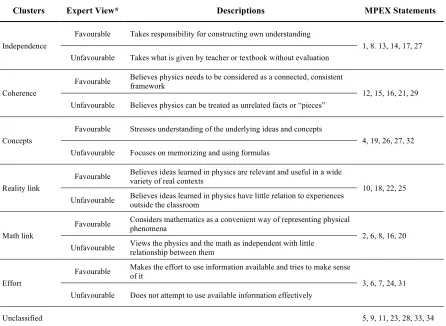
The process of evaluating a student’s beliefs and expectations is not simple and straightforward (Kortemeyer, 2007a), however, physics education researchers have developed surveys for investigating student attitudes, beliefs and assumptions about the subject. There are many surveys for probing student beliefs about the physical sciences such as the Maryland Physics Expectation survey (MPEX) (Redish et al. 1998), the Views about Science Survey (VASS) (Halloun & Hestenes 1998), the Epistemological Beliefs Assessment about Physical Science (EBAPS) (Elby, 2001), and the Colorado Learning Attitudes about Science Survey (CLASS) (Adams et al., 2006). There is also the Physics Self-Efficacy Questionnaire (Lindstrom & Sharma, 2011), aiming to evaluate students’ self-efficacy in learning physics. Both the VASS and the EBAPS have similar aims at probing personal beliefs about nature of science and about learning science. The MPEX and the CLASS focus specifically on student beliefs and expectations in physics and about learning physics. The MPEX was designed to probe six clusters (as shown in Table 1), which are groups of survey items designed to probe different issues of student attitudes (Redish et al., 1998). The CLASS shares similarities with the MPEX because its survey items were modified from many MPEX items to clearly communicate an aspect of each cluster (Wutchana & Emarat, 2011). Moreover, the CLASS is covered a few more aspects, including personal interest, problem solving, and sense making (Adams et al., 2006).
(Wutchana, Emarat, Arayathanitkul, Soankwan, & Chitaree, 2007) and were often used in exploring Thai students’ expectations in introductory physics (Wutchana et al., 2007; Chanprasert 2008; Wutchana & Emarat, 2011).
Student expectations and physics learning
A number of studies in physics education found that students’ learning and achievements in physics courses were correlated with their attitudes, beliefs and expectations toward physics (Kortemeyer, 2007a; Redish et al., 1998; May & Etkina, 2002; Gray et al., 2008; Wutchana & Emarat, 2011).
Wutchana and Emarat (2011) found that pre-course MPEX scores of Thai first year students taking an introductory physics course positively correlated with their conceptual understanding and problem solving abilities. The MPEX was administered at the beginning
of the course during academic years 2007 (N = 212) and 2008 (N = 199). Then the MPEX
results were correlated with each student’s normalized gains from Force and Motion Conceptual Evaluation (FMCE) results and student’s scores on the final exam. As results, students’ MPEX scores showed significantly positive correlation with their final exam scores for all MPEX clusters, except for the effort cluster. They also did a follow-up interview with two groups of students that had low favourable scores and high favourable scores on the pre-course MPEX effort cluster. They found that the student responses on the MPEX effort cluster did not match their behaviors in studying physics.
May and Etkina (2002) also found that students with high conceptual gain were more likely to show learning activities in line with those identified as beneficial in the literature. They were able to reflect on the knowledge construction by reasoning process, interpreting of experimental results, and associating knowledge to their personal experience. The authors administered the Force Concept Inventory (FCI) before and after the instruction and did structured interviews to obtain students’ epistemology views and learning strategies. Students with low conceptual gain were frequently referred to learning activities that are less desirable epistemologically such as memorizing formulas, learning from authority, and solving problems without interpretations. This study confirmed that sets of beliefs and expectations or epistemology aspects have an impact on students’ conceptual understanding.
Health science student expectations
In this study, we were interested in medical students’ expectations in an introductory physics course, so we reviewed previous studies available that investigated students in medical and related fields.
premedical students should emphasize medical applications and include physics problems with medical contexts.
Purpose of the study
The first aim of this study was to investigate and compare first year students’ expectations in learning physics with that of high school physics teachers. The second aim was to compare medical first year students’ expectations before and after taking the introductory physics for medical students.
Methodology
The sample
The sample consists of two groups: first year students and physics teachers. The first group comprised of Thai first year students taking one of four introductory physics courses with calculus at Chiang Mai University, Thailand. Participants consisted of the first year medical
students (N = 181 in 2010 and N =194 in 2011) taking the MPEX survey both before and
after an instruction. The first year students in other courses, including associated medical sciences (N = 206), engineering (N = 60) and agro-industry (N = 93) only took the MPEX survey after an instruction.
Medical first year students received one percent of course credits for completing the survey. Associated medical sciences, engineering and agro-industry first year students completed the MPEX survey voluntarily. Therefore, students in the first year students group, except medical first year students were convenience sample, so these samples would not be a representation of all college first year students.
The second sample group consisted of in-service physics teachers attending a summer teacher workshop during May 2011 at Chiang Mai University. These were experienced teachers and had good physics knowledge because they passed a comprehensive exam to be qualified for the workshop. We asked the teachers to respond with “the answer they would prefer their students to give”. They were informed about objectives of the survey and asked to complete the survey voluntarily. There were 27 out of 67 teachers completing the MPEX surveys.
Data collection
Instrument
The instrument for exploring students and teachers’ expectations used in this study was a Thai version of MPEX (Redish et al. 1998; Wutchana & Emarat 2011), consisting of 34 statements. A subject are asked to rate on a five-point Likert-scale from strongly disagree (1) to strongly agree (5). Most MPEX statements can be divided into six clusters, as shown in Table 1, and there are seven statements that cannot be classified into any clusters (as listed on the last row of Table 1). The details of translating process and validity of the Thai MPEX were mentioned in Wutchana and Emarat (2011).
Table 1: MPEX clusters and corresponding statements with descriptions of favourable and unfavourable views compared with experts
Clusters Expert View* Descriptions MPEX Statements
Independence
Favourable Takes responsibility for constructing own understanding
1, 8. 13, 14, 17, 27 Unfavourable Takes what is given by teacher or textbook without evaluation
Coherence
Favourable Believes physics needs to be considered as a connected, consistent framework
12, 15, 16, 21, 29 Unfavourable Believes physics can be treated as unrelated facts or “pieces”
Concepts
Favourable Stresses understanding of the underlying ideas and concepts
4, 19, 26, 27, 32 Unfavourable Focuses on memorizing and using formulas
Reality link
Favourable Believes ideas learned in physics are relevant and useful in a wide variety of real contexts
10, 18, 22, 25 Unfavourable Believes ideas learned in physics have little relation to experiences outside the classroom
Math link
Favourable Considers mathematics as a convenient way of representing physical phenomena
2, 6, 8, 16, 20 Unfavourable Views the physics and the math as independent with little relationship between them
Effort
Favourable Makes the effort to use information available and tries to make sense of it
3, 6, 7, 24, 31 Unfavourable Does not attempt to use available information effectively
Unclassified 5, 9, 11, 23, 28, 33, 34
*The “expert view” is defined by a previous study (Redish et al., 1998). The experts were experienced physics instructors who were interested in teaching and learning physics and attended a teaching physics workshop in US. The researchers asked the experts to answer the MPEX as if they would like their students to answer. A response is considered favourable if it is similar to the experts, and a response is considered unfavourable if it states the opposite.
Results and discussion
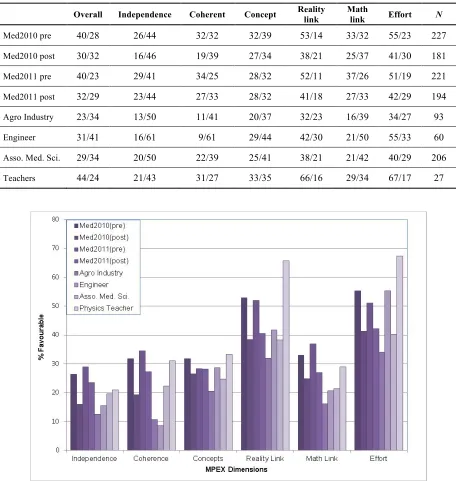
Table 2: Percentages of students and physics teachers giving favourable/unfavourable responses on overall and clusters of the Thai MPEX survey
Overall Independence Coherent Concept Reality link Math link Effort N
Med2010 pre 40/28 26/44 32/32 32/39 53/14 33/32 55/23 227
Med2010 post 30/32 16/46 19/39 27/34 38/21 25/37 41/30 181
Med2011 pre 40/23 29/41 34/25 28/32 52/11 37/26 51/19 221
Med2011 post 32/29 23/44 27/33 28/32 41/18 27/33 42/29 194
Agro Industry 23/34 13/50 11/41 20/37 32/23 16/39 34/27 93
Engineer 31/41 16/61 9/61 29/44 42/30 21/50 55/33 60
Asso. Med. Sci. 29/34 20/50 22/39 25/41 38/21 21/42 40/29 206
Teachers 44/24 21/43 31/27 33/35 66/16 29/34 67/17 27
Figure 1: Favourable percentage of first year students and teacher responses on the MPEX survey
Comparison of first year students and teachers expectations
The first aim of this study was to investigate and compare first year students’ expectations in learning physics with that of high school physics teachers’. From the first year students’ group, only the data from post-instruction were analysed and compared with data from physics teachers.
shown in Figure 1. Although we did not administer the pre-course MPEX to first year students from other courses, their responses followed the same trend as the post-course responses of the medical first year students, except for the results of engineering students in the effort dimension. This result suggested that student positive attitudes and favourable expectations toward physics were deteriorated after the physics instruction (Redish et al., 1998; Kortemeyer, 2007b).
From figure 1, both first year students and physics teachers showed similar favourable responses in almost all clusters, except in the reality link and effort clusters. Both students and teachers’ responses were least favourable on independence, coherence, concept and math link clusters. However, the teachers showed significantly higher favourable responses on the reality link cluster. The effort cluster had the highest favourable scores across both sample groups.
Similarities in low favourable responses between both groups
The independence cluster, the one with the lowest favourable percentage, indicated that most students and physics teachers believed physics knowledge come from authoritative sources such as physics instructors and textbooks. Also, the results suggested that most first year students viewed physics learning process as a kind of memorization of separate pieces of information and take materials covered in class or in a textbook without their own interpretation. In addition, the teachers showed relatively unfavorable expectation in this cluster. This might cause physics to be taught and learned passively in high school because even the physics teachers did not expect their students to actively construct their own understanding of physics.
In the coherence cluster, 9% - 31 % of both students and teachers showed the favourable responses. These results suggested that the lack of coherent view could cause students a failure to notice errors in their reasoning and that they were relying on memorizing facts rather than rebuilding their physics knowledge structure (Redish et al., 1998).
In the concept cluster, 20% - 33% of students and teachers displayed the favourable responses. These results suggested that students and even teachers viewed physics problems as basically mathematical manipulation of an equation (Redish et al., 1998). When they solve physics problems, they tend to use the “plug-and-chug” method without much interpretation of the physics equations.
The favourable percentage of teachers’ scores in the math link cluster was considerably low. This may be due to high school physics courses covering less mathematics than university physics course, and teachers therefore do not expect their students to develop their ability to use abstract and mathematical reasoning in making predictions of real physical systems (Redish et al., 1998).
Similarities in high favourable responses between both groups
The effort cluster had the highest favourable scores across both sample groups. Both the first year students and the high school teachers expected that their efforts should help in learning physics. However, student responses to the surveys on the effort cluster may not reflect their actual behaviors (Wutchana & Emarat, 2011).
Difference in favourable responses between both groups
cluster than the students’. This result revealed that the students involved in this study tended to believe that ideas learned in the physics class are irrelevant to their experiences outside. While the teachers expected their students to be able to link physics to the real world, students believed that physics had little or no relevance to their personal experiences.
Evolution of the medical first year students’ expectations
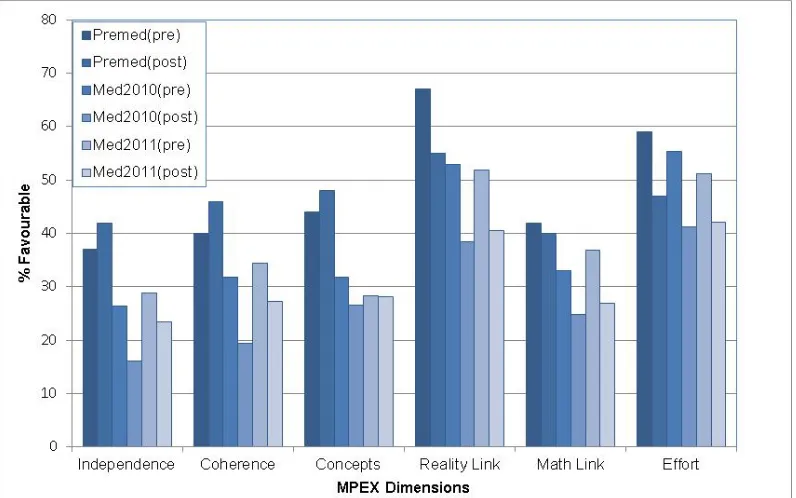
The second aim was to compare medical first year students’ expectations before and after taking the introductory physics course for medical students.In Figure 2, both pre- and post-favourable responses in all clusters were compared between Thai medical (Med) students in their first year with premedical (Premed) students from the study of Kortemeyer (2007b). He also investigated Premed attitudes, beliefs and expectations both before and after taking introductory physics.
Before instruction, first year Thai Med students in both 2010 and 2011 showed the highest and the lowest agreement in the same clusters as the Premed students. After instruction, the Premed students showed higher favourable expectations in the independence, coherence, and concepts clusters. However, Thai first year Med students showed lower favourable expectations in all clusters. The deterioration of students’ overall expectation scores were also found in other universities, including the university employing active learning approaches (Redish et al., 1998).
In the case of Med students, the deterioration of their favourable MPEX scores was significant. This suggested that our physics instruction did not make the medical students realize the connection between physics principles and their profession or even their everyday experiences. Therefore, this suggests the instruction has to be reformed to explicitly make the connection between in-class physics and the real world (Kortemeyer 2007b).
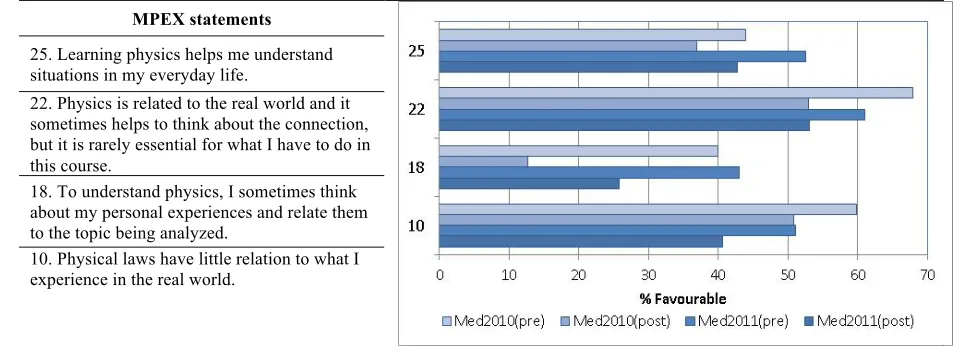
In Figure 2, the reality link cluster had the largest deterioration of the favourable responses. Therefore, we did further analysis on the MPEX responses of Thai first year Med students in both academic years as shown in Figure 3. The Med students showed the largest setback of favourable scores in statement 18 on the MPEX survey. On statement 25, the Med students displayed a small deterioration of favourable scores. The results suggested that the instruction produced an average deterioration rather than an improvement of student expectations that physics is related to the real world.
MPEX statements
25. Learning physics helps me understand situations in my everyday life.
22. Physics is related to the real world and it sometimes helps to think about the connection, but it is rarely essential for what I have to do in this course.
18. To understand physics, I sometimes think about my personal experiences and relate them to the topic being analyzed.
10. Physical laws have little relation to what I experience in the real world.
Figure 3: Favourable percentage of medical student responses on the reality link dimension
Implications for practice
The results in this study suggested that much of what we do in the physics classes do not improve students’ beliefs and expectations and even lower them. Therefore, physics instructors had to find ways to improve students’ beliefs and attitudes toward physics. For example, Duda and Garrett (2008) included a course weblog to discuss real-world applications of physics and to engage students to think about physics outside class. They found that students participating in the weblog still had positive attitudes and expectation toward physics after physics instruction.
Another study suggested that after the physics instruction, more Med students believed that physics learned in class were irrelevant and not useful in real world contexts. Therefore, physics instructors have to make an effort and make explicit connections between physics learned in class and the real world application or students’ professions. In case of the Med students, the previous study suggested that we have to make a visible connection between physics and medical science or medicine by presenting examples of medical topics in the course (Kortemeyer 2007b).
Conclusions
distressing because their expectations differed substantially from the physics experts’ expectations in the previous study (Redish et al., 1998). These might affect how the physics teachers teach physics class and implicitly transferred these unfavourable expectations on to their students. This result placed an alarming concern around how we trained Thai high school physics teachers.
On the other hand, both first year students and physics teachers strongly believed that the students’ efforts should help their physics learning. However, both groups believed differently in terms of how physics learned in class related to real world contexts. Most physics teachers showed favourable responses in the reality cluster while most students exhibited unfavourable responses.
Secondly, this study aimed to compare medical first year students’ expectations before and after taking the introductory physics course for medical students. The medical students’ responses after instruction decreased in favourable terms. This result suggested that student positive attitudes and favourable expectations toward physics were deteriorated after the physics course (Redish et al., 1998). The most deteriorated clusters in terms of favourable responses were in the reality link and effort clusters. After instruction, most students, even high achievers like medical students, had attitudes that their efforts in learning did not relate to their successes in the class. They were then more reluctant to put in the time and effort into understanding and ended up memorizing just to pass exams. Moreover, the medical students perceived that physics was irrelevant to their profession and the real world context. In order to change these beliefs, Kortemeyer, (2007b) suggested that a physics curriculum for medical students should be tailored to fit their future professions in medicine. Moreover, the new curriculum should use an active-learning approach because numerous physics education research studies have shown this instructional approach to be effective in improving students’ conceptual understanding (Paosawatyanyong & Wattanakasiwich, 2010). Future works should investigate the effectiveness of this new curriculum and its effect on medical students’ expectations before and after instruction.
Acknowledgements
This project was supported in part by Graduate school, Chiang Mai University, Chiang Mai, Thailand and Thailand Center of Excellence in Physics (ThEP). We would like to thank the Physics Education Network of Thailand (PENThai) for the Thai version of MPEX. The authors would like to thank the students and the physics teachers participating in this study, as well as anonymous reviewers for their constructive and attentive criticism.
References
Adams, W. K., Perkins, K. K., Podolefsky, N. S., Dubson, M., Finkelstein, N. D. & Wieman, C. E. (2006). New instrument for measuring student beliefs about physics and learning physics: The Colorado Learning Attitudes about Science Survey. Physical Review Special Topics—Physics Education Research, 2 (010101), 1-14.
Chanprasert, K. (2008). The expectations of students from the faculty of nurse on learning life science physics. Retrieved on April 10, 2012, from http://www.scisoc.or.th/stt/34/sec_l/paper/STT34_L_L0001.pdf
Chu, H., Treagust, D. F., & Chandrasegaran, A. L. (2008). Naïve students’ conceptual development and beliefs: The need for multiple analyses to determine what contributes to student success in a university introductory physics course. Research in Science Education, 38 (1), 111-125.
Duda, G. & Garrett, K. (2008). Blogging in the physics classroom: A research-based approach to shaping students’ attitudes toward physics. American Journal of Physics, 76 (11). 1054-1065.
Gray, K. E., Adams, W. K., Wieman, C. E., & Perkins, K. K. (2008). Students know what physicists believe, but they don’t agree: A study using the CLASS survey. Physical Review Special Topics— Physics Education Research, 4(020106), 1-10.
Halloun, I. & Hestenes, D. (1998). Interpreting VASS dimensions and profiles for physics students, Science & Education, 7, 553-577.
Kortemeyer, G. (2007a). Correlations between student discussion behaviour, attitudes, and learning. Physical Review Special Topics— Physics Education Research, 3(010101), 1-8.
Kortemeyer, G. (2007b). The challenge of teaching introductory physics to premedical students. The Physics Teacher, 45, 552-557.
Lindstrom, C. & Sharma, M. D. (2011). Self-efficacy of first year university physics students: Do gender and prior formal instruction in physics matter?, International Journal of Innovation in Science and Mathematics Education, 19(2), 1-9.
May, D. B. & Etkina, E. (2002). College physics students’ epistemological self-reflection and its relationship to conceptual learning. American Journal of Physics, 70 (12). 1249-1258.
Paosawatyanyong, B., & Wattanakasiwich, P. (2010). Implication of physics active-learning in Asia. Latin-American Journal of Physics Education, 4 (3), 501-505.
Redish, E. F., Saul, J. M. & Steinberg, R. N. (1998). Student expectations in introductory physics, American Journal of Physics, 66 (3), 212-224.
Sahin, M. (2009). Exploring university students’ expectations and beliefs about physics and physics learning in a problem-based learning context, Eurasia Journal of Mathematics, Science & Technology Education, 5(4), 321-333.
Wutchana, U. & Emarat, N. (2011). Student effort expectations and their learning in first-year introductory physics: A case study in Thailand, Physical Review Special Topics— Physics Education Research, 7(010111), 1-15.
Wutchana, U., Emarat, N., Arayathanitkul, K., Soankwan, C. & Chitaree, R. (2007). Student expectations in general physics course. Retrieved on April 10, 2012, from