Journal of Applied Linguistics and Language Research Volume 3, Issue 5, 2016, pp. 306-320
Available online at www.jallr.com ISSN: 2376-760X
* Correspondence: Zahra Faghiri, Email: [email protected] © 2016 Journal of Applied Linguistics and Language Research
The Impact of Positive vs. Negative Evidence on the Learning
of Simple Past Tense by Elementary EFL Learners
Gholam-Reza Abbasian
Assistant Professor, Imam Ali University and Islamic Azad University, South Tehran Branch, Tehran, Iran
Zahra Faghiri *
PhD Candidate, Islamic Azad University, Kish International Branch, Iran
Mojdeh Shirvani
PhD Candidate, Islamic Azad University, Kish International Branch, Iran
Abstract
This study aimed at investigating the effect of positive and negative evidence on the learning of simple past tense by Iranian EFL elementary learners. To this aim, two intact classes with a total of 60 elementary learners were selected randomly out of different classes in one of the branches of Kish language institute in Tehran. Then, a Key English Test (KET) was run to ensure that the participants were homogeneous in terms of their language proficiency. Moreover, to ensure the learners' homogeneity in terms of their grammar knowledge of the English past tense, a grammar test was developed and administered to the learners in both groups. Then, the participants in one group were exposed to recast which is one of the manifestations of negative evidence in line with Nicholas, Light brown and Spada (2001). As for the positive evidence, the participants in the other group were exposed to a large number of texts including the correct use of past tense in line with Schmitt (2002). To do so, the instructor applied different techniques to pave the way for learners' exposure to the correct forms of the past tense as extensively as possible. The results of statistical analysis indicated that positive evidence led to enhancement in terms of learning the simple past while providing the learners with the negative evidence did not contribute to a significant impact on the learning of simple past by the participants. Moreover, it was also revealed that the positive evidence group outperformed the negative evidence group on the grammar posttest.
Keywords: feedback, grammar, positive evidence, negative evidence, simple past, recast
INTRODUCTION
that it considered errors as a taboo in L2 classes. The proponents of this approach asserted that errors should be spotted and corrected right away by the L2 instructor (Brown, 2007). Similarly, Long (1996) attaches great importance to the provision of negative evidence (what is impossible in languages), believing that such evidence plays an essential role in acquisition of target language. According to Long (1996) environment contributes to language acquisition through the learners' attempts at attending to the inputs selectively and his/her developing L2 processing capacity. In fact, negative feedback gained during negotiation work or elsewhere can facilitate the development of target language.
Second language learners are exposed to negative feedback reflected in various forms such as recasts. Lyster and Ranta (1997) define recast as the instructor' repetition of all or part of a leaner's utterance without the erroneous part i.e. the error. Based on this definition, L2 instructors need to put emphasis on the correct utterances by focusing the learners' attention on the errors indirectly and uttering the part or all structure including the corrected ones. Yet, the findings of studies are conflicting when it comes to the effectiveness of feedback (Carroll & Swain, 1993; Liu, 2008). In contrast, positive evidence is defined as evidence showing that something is possible in L2 being learned (Schmitt, 2002). According to Ayoun (2001), it is argued that errors in L2 learning need to be dealt with as they are dealt with in acquisition of L1. Put it other way, the teachers in language classes should only provide positive feedbacks. Along the same lines, Rezaei, Mozaffari, and Hatef (2011) maintain that it is not clear yet whether the L2 learners should be exposed to only positive evidence or they must be provided with negative evidence well.
The research adopting nativists' paradigm claim it is adequate to provide the learners with only the target-like language i.e. positive evidence whereas interactionist researchers attach enormous importance to negative evidence as well. These two kinds of evidence, namely positive and negative are often replaced with the terms negative feedback and positive feedback respectively (Panova &Lyster, 2002). Some approaches to L2 learning and teaching have put great emphasis on feedback as an important element in language acquisition. The second language literature shows the following two main types of feedback used in language classes positive and negative. The findings of studies conducted on these two types of feedback do not paint a definitive picture as to which one is more beneficial to the language learners (Jiang, 2014; Russell, 2009). LITERATURE REVIEW
Positive and Negative Evidence
(Ellis, 1994). For instance, language teachers bombarded the learners with enormous amount of grammatical drilling aiming to infuse the habit of correct language production in learners. In the same vein, the contrastive analysis was used as the main guideline based on which syllabus writers developed the lesson plans and modules. All of these efforts were aimed to minimize the factors causing errors such as negative transference. According to Russell (2009) the methodology adopted by teacher plays an essential role in whether and how he/she correct errors. Chronically, the instruction models used by behaviorists led to the dominant teaching methods in the 1950’s and 1960’s (e.g. Audio-lingual Method stressed error correction at all costs). In fact, errors were considered by behaviorists as inevitable, yet they did their best to avoid and overcome them through provision of many examples of correct responses.
However, this obsession with error correction came under attack in 70s as some scholars such as Krashen (1981) painted a more comprehensive picture of that errors, believing that correction has no impact on the quality of language acquisition. Later, he developed monitor model which are made up of 5 hypotheses one of which, namely natural order hypothesis dealing with errors. This hypothesis is based on the findings of the morphemes order studies carried out by Dulay and Burt (1973). Based on the studies, people acquire grammatical forms and structures in a fixed order that cannot be altered by instruction. Inspired by this new perspective to error, new teaching methods focusing on the inclusion of natural order of learning in classes emerged. For instance, Terrel (1977) drew on Krashen's hypothesis to develop a new approach to language instruction called Natural Approach which attached importance to the development of communicative competence. According to Terrell, affective factors are considered as the most essential factors. This is because they determine whether or not the learners would engage in learning activity. Therefore, this approach viewed errors correction as a demoralizing factor.
According to Omaggio Hadley (2001), the Natural Approach helps to maintain learners' affective at lower level by prohibiting both structured grading and error correction. Terrell (1977) maintains that teachers and educator should view affective rather than cognitive factors as the factors of primary concern in L2 classroom. In fact, error correction would influence learners' motivation, attitude, and embarrassment negatively. Adopting the Natural Approach, L2instructors do not teach grammar explicitly or correct oral errors. Learners can decide to study grammar structures outside of class and to correct their own written errors.
instructional environment or the task can influence the degree to which the recast is attended to.
In a study Gass, Mackey, and Ross-Feldman (2005) investigated the role setting can play in the emergence of interactional patterns. The results showed that the task can lead to variation of international process. Furthermore, Long (1998) has pointed out that more research need to be done to replicate and cross-check the robustness of the study’s findings concerning the role of recasts in different task types. Similarly, Robinson (2001) asserts that tasks will have different impact on the effectiveness of recasts based on the extent of attention they demand. According to Long (1996) negative evidence (what is impossible in languages) plays a significant role in language learning in particular in the case of adolescent and adult L2 learners.
Positive feedback includes a group of well-structured sentences to which language learners are exposed (Liu, 2008). In fact, such correct structures give an overall impression to the learner as to what is viewed as acceptable in L2. Richards and Schmitt (2002) argue that positive evidence indicates those structures and utterances that are possible in the L2 being learned. In contrast, as Gass (2003) says, negative feedback gives L2 learner some insights regarding the incorrectness of a second language (L2) form. A review of literature reveals that the following 7 types of corrective feedbacks can be identified within the context of second language learning (Lyster & Ranta, 1997; Panova & Lyster, 2002):
metalinguistic information explicit correction
repetitions elicitation translation
clarification requests and recasts
Sheen and Ellis (2006) present the following two categories of the correction feedback: 1. explicit correction feedback (such as explicit correction with or without
metalinguistic explanation and didactic recasts)
2. Implicit correction feedback which involves no correct form (for example, metalinguistic clues and elicitation).
Due to the varying degree of explicitness of these techniques, they can be displayed on a continuum ranging from completely explicit to completely implicit. These strategies will be discussed below with an extended elaboration on recast because of its importance in the language classes.
Grammar
grammar as the building block of both first and second language. The incorporation of grammatical knowledge as one of the primary competences making up communicative language skill bears witness to this perceived significance (e.g., Bachman, 1990; Bachman & Palmer, 1996). However, ELT scholars cannot come to agreement over the following two main issues. 1) A comprehensive definition of what grammar is. For example, Freeman (2006) argues that no term in the L2 instruction field is as vague as grammar. 2) A lack of consensus among the language teachers as to how grammar should and could most effectively be taught by teachers and learnt by students.
As for the first issue, researchers working on grammar instruction/learning have contributed several definitions. The definition given by Freeman (1992, 2003) is of interest. Freeman (1992) who used the term grammarian for the first time puts emphasis on the dynamism of grammar, asserting that grammar must be viewed as the fifth skill an individual need to acquire in learning a foreign or second language. Furthermore, Freeman (2006) presents multiple definitions discussed in the literature. One of these definition characterizes grammar as an internal system through which new utterances are generated and interpreted. Yet, another definition describes grammar as a set of prescriptions and proscriptions concerning language structures as well as the application of them for a particular language. Consequently, literature appears seems to present various definitions of grammar among which language teaching practitioners need to choose from based on their particular uses and purposes. In fact, grammar is viewed as the backbone for learning a novel language and it should not be deleted from L2 instruction (Freeman, 2006). It should be noted that one of the grammatical features posing problems for both L2 learners and native speakers is simple past tense (Biber et al. 1999). Thus, this study seeks to investigate the impact of positive versus negative evidence on the Iranian EFL elementary learners' learning of simple past tense.
Research Questions
1. Does providing elementary EFL learners with positive evidence have any significant impact on the learning of simple past tense?
2. Does providing elementary EFL learners with negative evidence have any significant impact on the learning of simple past tense?
3. Is there any statistically significant difference between the effects of positive and negative evidence on the learning of simple past by EFL elementary learners? METHOD
Participants
participants. To make sure that these was not any significant different between the two groups in terms of overall language proficiency as well as grammatical knowledge of the simple past tens a Key English Test (KET) as well as a researcher devised grammar test were administered to the participants prior to the administration of the treatment. The same grammar test was also given to the participants in both groups as the grammar post-test.
Instruments
Key English Test (KET)
Initially, it deemed necessary to make sure that the participants in the two groups were homogeneous in terms of overall language proficiency. To this aim, KET was piloted on 30 participants having similar characteristics to the main participants of the study and then it was administered to the two groups. An independent samples t-test was run on the scores of the two groups to assure that they were not significantly different regarding overall English proficiency. KET includes three papers with paper one containing reading and writing. This paper consists of five parts which has %50 of the final marks. Paper two is devoted to listening and contains five parts carrying %25 of final marks. The third paper includes the speaking part with total number of 25 which takes %25 of the total mark.
Grammar Knowledge Test
A grammar knowledge test consisting of 30 questions was devised by the researcher and administered to the two groups to assure that there was no statistically significant difference between the two groups in terms of their knowledge of the simple past tense. The validity of the test was established in two steps. Initially, the content validity of the test was done appealing to expert opinion (Brown, 2007). Following that, the construct validity of the test was checked through concurrent validity procedures adopted by Brown. To this end, the test was given to 30 non-participants. Moreover, an OPT grammar test having 30 grammar items was also given to the same participants and Pearson correlation coefficient was run on the results of both tests hence the validity of the test was established. To assure the reliability of the grammar test, Cronbach’s Alpha was carried out.
Procedure
To ensure the validity and reliability of the test, it was piloted and the scores were analyses through utilizing Pearson correlation coefficient and Cronbach’s alpha. The test was administered both as pretest and posttest. Then, participants in one group were exposed to recast which is one of the manifestations of negative evidence. Today, many L2 teachers use recast as one of the most common implicit negative feedback in their classes. Recast involves the teachers' repetition of the incorrect statement produced by the learners including the corrected structure (Nicholas, Light brown, & Spada, 2001). Using this strategy, the teacher also dealt with the participants’ mistakes with respect to simple past in their written products, providing the correct form of use. Moreover, the teacher determined the erroneous cases of simple past tense, replacing them with corrected ones. Drawing on Nicholas, et al. (2001), the researcher used another technique in this group to make direct reference to the erroneous use of simple past. The teacher asked the learners to correct their wrong instances in a direct way.
As for the group with positive evidence, the participants were exposed to a large number of texts including the correct use of past tense. To this end, the instructor applied different techniques to pave the way for learners' exposure to the correct forms of the past tense as extensively as possible. Some of these techniques were as follows:
Underlining the simple past examples in the texts
Engaging in games with the learners (e.g., “Who can pinpoint the simple past tense first?”
Inserting the simple past examples on flashcards and attaching them to the walls. Applying different texts in which the simple past tense can be used multiple
times.
Requesting the learners to look at the highlighted simple past tense examples in the texts and then seek to remember as many as they can.
At last, both groups took the simple past grammar posttest to examine the research questions. The whole treatment lasted for about 10 sessions and both groups were taught by the same teacher i.e. the researcher.
RESULTS
As mentioned earlier a test of KET was piloted on 30 participants to assure its reliability through running Cronbach’s Alpha. Table 1 displays the descriptive statistics of the KET scores run for piloting purposes.
Table 1. Descriptive Statistics of the KET Scores run for Piloting Purposes
N Minimum Maximum Mean Std.
Deviation Variance Skewness Kurtosis
Statistic Statistic Statistic Statistic Statistic Statistic Statistic Error Std. Statistic Error Std.
KET Pilot Scores
Cronbach’s Alpha was run on the KET scores to establish the reliability of test. Table 2 demonstrates the respective results.
Table 2. Cronbach’s Alpha and Statistics of KET Run for Piloting Purposes
Mean Variance Std. Deviation Cronbach’s Alpha N of Items
46.2000 92.166 9.60029 0.88 65
As it can be seen in Table 2 the Cronbach’s Alpha index is 0.88 which is a satisfactory level of reliability (Brown, 2007). Next, this test was administered to the two groups and an independent samples t-test was run on the scores to make sure that the two groups were not significantly different in terms of overall language proficiency prior to the administration of the treatment. Table 3 displays the descriptive statistics of the scores belonging to the two groups on KET.
Table 3. Descriptive Statistics of the Two Groups’ Scores on KET for Homogenization Purposes
Groups KET N Mean Std. Deviation Std. Error Mean
KET Both Groups
Negative Feedback
Group 30 49.3000 11.43844 2.08836
Positive Feedback Group 30 49.6667 10.73612 1.96014
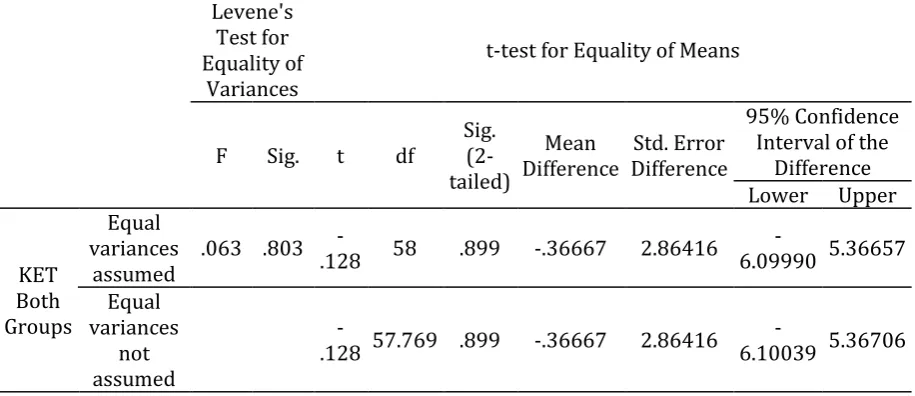
An independent samples t-test was then run on the KET scores of the two groups. Table 4 demonstrates the results.
Table 4. Independent Samples T-test Results of KET for Homogenization Purposes
Levene's Test for Equality of
Variances
t-test for Equality of Means
F Sig. t df
Sig. (2-tailed)
Mean Difference
Std. Error Difference
95% Confidence Interval of the
Difference
Lower Upper
KET Both Groups
Equal variances
assumed
.063 .803 .128 - 58 .899 -.36667 2.86416 6.09990 - 5.36657
Equal variances
not assumed
-.128 57.769 .899 -.36667 2.86416
-6.10039 5.36706
As Table 4 shows the significance level equals .899 which is higher than the confidence level of 0.05 indicating that the two groups were not statistically different in terms of overall language proficiency.
on simple past was developed by the researcher. The content validity of the teat was established appealing to expert opinion. As for the construct validity of the test, concurrent validity procedures were adopted. To do so, the 30 initial grammar items from OPT were administered to 30 non-participants as well as the grammar test for this study. Table 5 illustrates the descriptive statistics for the non-participants’ scores on the OPT and the devised grammar test.
Table 5. Descriptive Statistics of OPT and the Grammar Test for Validation Purposes
N Minimum Maximum Mean Std.
Deviation Variance Skewness Kurtosis
Statistic Statistic Statistic Statistic Statistic Statistic Statistic Std.
Error Statistic
Std. Error OPT
Pilot 30 10.00 26.00 15.1333 4.48548 20.120 1.402 .427 .808 .833
KET Pilot Scores
30 32.00 64.00 46.2000 9.60029 92.166 .330 .427 -1.214 .833
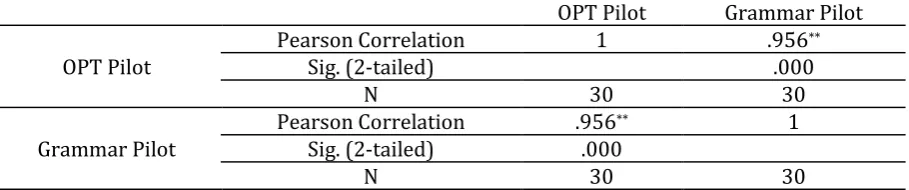
Next, Pearson correlation coefficient was run on the two sets of scores to calculate the concurrent validity of the test (Brown, 2007). Table 6 shows the respective results.
Table 6. Results of Correlation Coefficient for Validation Purposes
OPT Pilot Grammar Pilot
OPT Pilot
Pearson Correlation 1 .956**
Sig. (2-tailed) .000
N 30 30
Grammar Pilot
Pearson Correlation .956** 1
Sig. (2-tailed) .000
N 30 30
**. Correlation is significant at the 0.01 level (2-tailed).
As given in Table 6 the correlation index is .956 which is considered acceptable (Brown, 2007). Following that, the grammar test was given to the both groups and an independent samples t-test was run on the scores to make sure that the two groups were not statistically different in terms of grammatical knowledge concerning the simple past tense. Table 7 indicates the descriptive statistics of the scores for the two groups on the pretest of grammar.
Table 7. Descriptive Statistics of the Grammar Scores for Homogenization Purposes
Groups Pretest N Mean Std. Deviation Std. Error Mean
Pretest Both Groups Negative Feedback group 30 14.9000 3.79064 .69207
Positive Feedback group 30 15.3333 3.45746 .63124
Table 8. Results of Independent Samples t-test of the Grammar Test Scores for Homogenization Purposes
Levene's Test for Equality of
Variances
t-test for Equality of Means
F Sig. t df
Sig. (2-tailed)
Mean Difference
Std. Error Difference
95% Confidence Interval of the
Difference
Lower Upper
Pretest Both Groups
Equal variances
assumed
.156 .694
-.463 58 .645 -.43333 .93671
-2.30837 1.44170
Equal variances
not assumed
-.463 57.516 .645 -.43333 .93671
-2.30871 1.44204
As it can be seen in Table 8 the significance value is .645 which is higher than the confidence level of 0.05 showing that the score means of the two groups on the grammar pretest were not statistically significant.
Testing the First Null Hypothesis
The first null hypothesis of the present study was providing elementary EFL learners with positive evidence does not have any significant impact on the learning of simple past tense. To test this null hypothesis, a paired samples t-test was run on the pretest and posttest grammar scores of the positive evidence group. Table 9 depicts the descriptive statistics.
Table 9. Descriptive Statistics for the Pretest and Posttest Grammar Scores of the Positive Evidence Group
Mean N Std. Deviation Std. Error Mean
Pair 1 Pretest Positive 15.3333 30 3.45746 .63124
Posttest Positive 17.5667 30 2.99060 .54601
Table 10 demonstrates the results of paired samples t-test on the pretest and posttest scores of the positive evidence group.
Table 10. Paired Samples T-test Results for the Pretest and Posttest Grammar Scores of the Positive Evidence Group
Mean Std.
Deviation
Std. Error Mean
95% Confidence Interval of the Difference
Lower Upper
Pretest Positive - Posttest Positive
-2.23333 1.25075 .22835 -2.70037 -1.76630
As given in Table 10 the significant value is 0.00 which is lower than the confidence level of 0.05 indicating that the difference between the means of positive evidence group on the pretest and posttest of grammar is statistically significant. Therefore, the first null hypothesis of the study is rejected and it can be concluded that providing elementary EFL learners with positive evidence has a significant impact on the learning of simple past tense.
Testing the Second Null Hypothesis
To examine the second null hypothesis of the present study as providing elementary EFL learners with negative evidence does not have any significant impact on the learning of simple past tense a paired sample t-test was run on the pretest and posttest scores of the negative evidence group. Table 11 displays the descriptive statistics for the pretest and posttest scores of the negative evidence group.
Table 11. Descriptive Statistics for the Pretest and Posttest Scores of the Negative Evidence Group
Mean N Std. Deviation Std. Error Mean
Pair 1 Pretest Negative 14.9000 30 3.79064 .69207
Posttest Negative Group 15.1667 30 3.34338 .61041
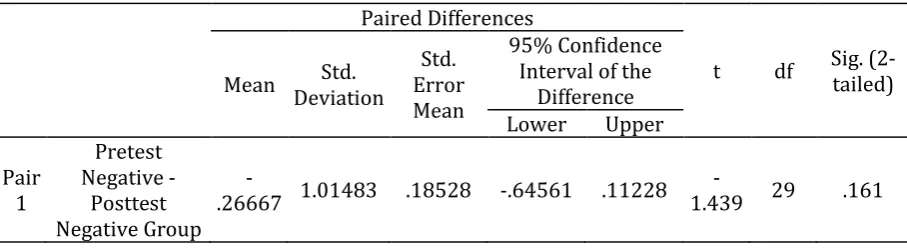
Table 12 shows the results of paired samples t-test run on the pretest and posttest scores of the negative evidence group.
Table 12. Results of the Paired Samples t-test run on the Pretest and Posttest Scores of the Negative Evidence Group
Paired Differences
t df Sig.
(2-tailed)
Mean Deviation Std.
Std. Error Mean
95% Confidence Interval of the
Difference
Lower Upper
Pair 1
Pretest Negative -
Posttest Negative Group
-.26667 1.01483 .18528 -.64561 .11228
-1.439 29 .161
As indicated in Table 12 the significance level is 0.161 which is greater than the confidence level of 0.05 indicating that the difference in means is not statistically significant. Thus, the second null hypothesis of the study failed to be rejected and it can be inferred that providing elementary EFL learners with negative evidence does not have any significant impact on the learning of simple past tense.
Testing the Third Null Hypothesis
negative evidence groups. Table 13 displays the descriptive statistics belonging to the posttest grammar scores of the positive evidence and negative evidence group.
Table 13. Descriptive Statistics for the Posttest Grammar Scores of the Positive Evidence and Negative Evidence Group
Groups Posttests N Mean Std.
Deviation
Std. Error Mean Posttest Negative
Positive
Negative Feedback Group 30 15.1667 3.34338 .61041
Positive Feedback group 30 17.5667 2.99060 .54601
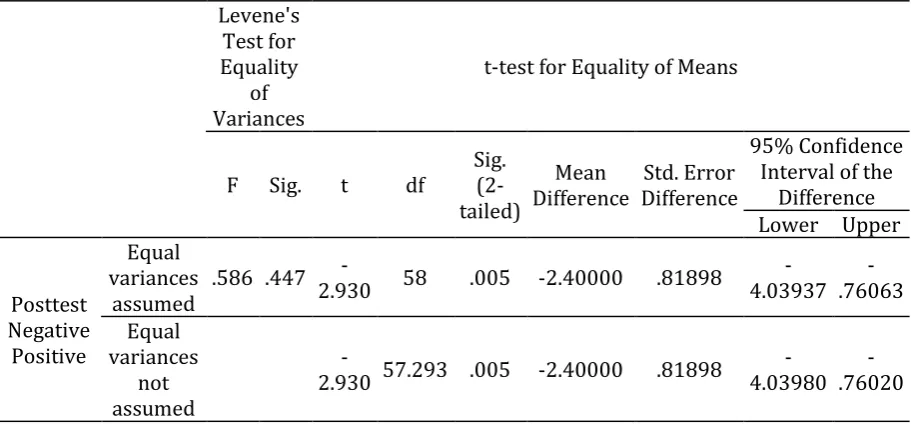
Table 14 demonstrates the results of independent samples t-test run on the posttest grammar scores of the positive and negative evidence groups.
Table 14. The Results of Independent Samples t-test run on the Posttest Grammar Scores of the Positive and Negative Evidence Groups
Levene's Test for Equality
of Variances
t-test for Equality of Means
F Sig. t df
Sig. (2-tailed) Mean Difference Std. Error Difference 95% Confidence Interval of the
Difference Lower Upper
Posttest Negative Positive Equal variances assumed
.586 .447
-2.930 58 .005 -2.40000 .81898
-4.03937 -.76063 Equal variances not assumed
-2.930 57.293 .005 -2.40000 .81898
-4.03980
-.76020
As the above Table shows the significant value equals .005 indicating that there is a statistically significant difference between the posttest scores of the two groups and therefore the third null hypothesis of the study is rejected. Moreover, a comparison of the means of the two groups on the posttest shows that the positive evidence group has achieved a higher mean than that of the negative evidence group (See Table 13) and therefore the positive evidence group has outperformed the negative evidence group on the grammar posttest.
DISCUSSION AND CONCLUSION
Self-determination theory can be drawn on to explain the helpful impact of positive feedback. According to Deci and Ryan (1991), people psychologically need to have competence, autonomy, and social in accordance with self-determination theory. They assert that positive emotional experiences are required so that such needs are met. Expectation Violation Theory (EVT) provides another justification. According to this theory, there is a close connection between interpersonal communication patterns and individuals’ expectations in interactions and responses to violations of expectations. Based on EVT, people expect interactions to be in particular forms (Burgoon& Hale, 1988). The EVT consists of the following:
expectancies
expectancy violations, communicator
behavior attractiveness
As Burgoon and Walthe (1990) assert, one main assumption of EVT is that people expect specific patterns of expected verbal and nonverbal behaviors. Burgoon and Hubbard (2005) maintain that one dimension of expectancies is concerned with the extent to which a behavior is viewed as correct, desired, or preferred. That is, the formation of expectations is often based on learners’ previous experience. People or situations are expected to behave in accordance with their past experience or learning. Seemingly in the context of Iran, ESL learners expect those positive feedbacks rather than negative feedback related to their past experiences. This finding conforms to the findings of the studies carried out by Panaova and Lystre (2002) and Carroll and Swain (1993). The findings of these studies indicated that despite the fact that L2 instructors make use of recasts more frequently compared to other corrective feedbacks, recasts resulted in the lowest rate of uptake.
According to El Tatawy (2002), being exposed to feedback makes learners more sensitive to the accuracy and correctness of their products and feedback. This may impel them to get more vigilant. He asserts that sufficient feedback can improve learners’ performance in different areas provided that this strategy is aimed at specific and focused exercises. Based on the findings of study, the effectiveness of positive feedback can also be explained on the grounds that “input” can greatly influence the performance of L2 learners. Positive feedback is mainly characterized by the provision of a large number of correct examples of the L2. Consequently, it can be concluded that the positive feedback strategy used in this study has exposed learners to many examples of correct simple past, leading to more effective performance. Based on the findings of a study conducted by Kluger and DeNisi (1996) both positive and negative feedbacks enhance learning. The teachers are recommended to exercise caution in the application of negative feedback. According to the findings of some studies (Beuningen, 2011; El Tatawy, 2002) the overuse of negative feedback would be counter-productive, undermining the self-esteem and self-efficacy of the receiver of the feedback.
types. In addition, curriculum developers, by including materials which are enriched with input can provide learners with more positive feedback. Last but not least, it can be concluded that different types of feedback hold different potentials and it is needed to employ these techniques in teaching to contribute as much as possible to the learning process.
This study inspected the effect of negative and positive feedback on the performance of EFL learners in terms of grammar at the elementary level. Other studies can be done to investigate the possible effect of negative and positive feedback on other language skills and components across different proficiency levels. Studies can also be carried out to qualitatively explore the attitudes of teachers and students towards using positive and negative feedback types.
REFERENCES
Ayoun, D. (2001). The role of negative and positive feedback in the second language acquisition of the passé compose and the imparfait. The Modern Language Journal, 85(2), 226–243.
Bachman, L. F. & Palmer, A. S. (1996). Language testing in practice. Oxford: Oxford University Press.
Bachman, L. F. (1990). Fundamental considerations in language testing. Oxford: Oxford University Press.
Beuningen, C. G. (2011). The effectiveness of comprehensive corrective feedback in Second Language writing. Oisterwijk: Uitgeverij BOX Press
Biber, D., Johansson, S., Leech, G., Conrad, S. & Finegan, E. (1999). Longman Grammar of Spoken and Written English. Harlow, Essex: Pearson
Brown, H. D. (2007). Principles of language learning and teaching (5th Ed.). White Plains, NY: Pearson Education.
Brown, J.D. (Eds.). (2007). Understanding research in second language learning: A teacher’s guide to statistics and research design. Cambridge: Cambridge University Press.
Bur goon, J. K., & Hubbard, A. E. (2005). Cross-Cultural and Intercultural Applications of Expectancy Violations Theory and Interaction Adaptation Theory. In Gudykunst, William B. Theorizing About Intercultural Communication. (pp. 149-166). Sage Publications, Inc.
Bur goon, J. K., & Walther, J. B. (1990). Nonverbal expectancies and the consequences of Violations. Human Communication Research, 17(2), 232-265.
Burgoon, J. K., & Hale, J. L. (1988). Nonverbal expectancy violations: Model elaboration and application to immediacy behaviors. Communication Monographs, 55(1), 58-79.
Carroll, S., & Swain, M. (1993). Explicit and implicit negative feedback: An empirical study of the learning of linguistic generalizations. Studies in Second Language Acquisition, 15(3), 357-386.
Deci, E. L., & Ryan, R. M. (1991). A motivational approach to self: Integration In personality. In R. Dienstbier (Ed.), Nebraska symposium on motivation: Vol. 38, Perspectives on motivation (pp. 237-288). Lincoln: University of Nebraska Press Dulay, H.C., & Burt, M. K. (1973). Should we teach children syntax? Language Learning,
Ellis, R. (1993). The structural syllabus and second language acquisition. TESOL Quarterly, 27(1), 91–113.
Ellis, R., & Sheen, Y. (2006). Reexamining the role of recasts in second language acquisition. Studies in Second Language Acquisition, 28(6), 575–600.
Freeman, D. (1992). Language Teacher Education, Emerging discourse, and change in Classroom practice. In J. Flowerdew, M. Brock, & S. Hsia (Eds), Perspectives on language teacher education. Hong Kong: City Polytechnic of Hong Kong, 1–21
Gass, S. M. (2003). Input and Interaction. In Doughty C. J., & Michael. H. Long (Eds.), the Handbook of Second Language Acquisition (pp. 224-255). London: Longman.
Gass, S. M., Mackey, A., & Ross-Feldman, L. (2005). Task-based interactions in classroom and laboratory settings. Language Learning, 55(6), 575–611.
Jiang, L. (2014). IVF the Chinese Way: Zhang Lizhu and Post-Mao Human In Vitro Fertilization Research. East Asian Science, Technology and Society, 285-5449.
Kluger, A. N., &DeNisi, A. (1996). The effects of feedback interventions on performance: Historical review, a meta-analysis, and a preliminary feedback intervention theory. Psychological Bulletin, 119(2), 254-284.
Krashen, S. (1981). The "fundamental pedagogical principle" in second language teaching. StudioLinguistic, 35(1–2), 50–70.
Larsen-Freeman, D. (2003). Teaching language: From grammar to grammarian. Boston, MA: Thomson/Heinle.
Larsen-Freeman, D. (2006). Second language acquisition and the issue of fossilization: There Is no end, and there is no state. In Z-H. Han and T. Odlin.
Liu, D. (2008). Linking adverbials: An across-register corpus study and its implications. International Journal of Corpus Linguistics, 13(4), 491-518.
Long, M. H. (1985). A role for instruction in second language acquisition: task-based language teaching. In K. Hyltenstam and M. Pienemann (Eds.), Modeling and assessing second language acquisition (pp.77–99). Clevedon: Multilingual Matters. Long, M. H. (1998). Focus on form in TBLT. University of Hawai'i Working Papers in ESL,
16(2), 35-49.
Long, M.H. (1996). The role of the linguistic environment in second language acquisition. In W.C. Ritchie & T.K. Bhatia (Eds.), Handbook of second language acquisition (pp. 413–468). San Diego, CA: Academic Press.
Lyster, R., & Ranta, L. (1997). Corrective feedback and learner uptake: Negotiation form in communicative classrooms. Studies in Second Language Acquisition, 19(1), 37– 66.
Richards, J. C. & Schmidt, R. (2002). Longman dictionary of language teaching and applied Linguistics (3rd edition). London: Longman.
Robinson, P. (ed.) (2001). Cognition and second language instruction. Cambridge: Cambridge University Press.
Schmitt, N. (2002). Vocabulary in language teaching. Cambridge: Cambridge University Press.
Tatawy, M. E. (2002). Corrective Feedback in Second Language Acquisition. Tesolal web Journal, 2 (2), 1-19, retrieved from www.tc.columbia.edu