Perceptions towards Codes of Behaviour: A Study of
CAOs, CFOs and Other Employees in Bahrain
Amal Abdel Wakil
Department of Accounting, College of Business Administration
University of Bahrain, P.O. Box 32038, Kingdom of Bahrain
E-mail: [email protected]
Farkhanda Shamim
Department of Economics and Finance, College of Business Administration
University of Bahrain, P.O. Box 32038, Kingdom of Bahrain
E-mail: [email protected]
Received: May 3, 2015 Accepted: June 14, 2015 Published: June 14, 2015 doi:10.5296/ajfa.v7i1.7802 URL: http://dx.doi.org/10.5296/ajfa.v7i1.7802
Abstract
The objective of this study is to investigate the factors that affect Chief Accounting Officers (CAOs), Chief Financial Officers (CFOs) and other employees’ perception of codes of behavior in their organizations in the Kingdom of Bahrain and whether an ethical work environment is influenced by factors such as the establishment of a code of behavior, corporate ethics committee, and/or policy empowerment. The paper is interpretive in nature for which data is collected using survey questionnaires. The findings validate components of an effective code of behavior similar to those identified in the literature which include: implementation of codes of behavior, checking on compliance by internal audit committees, achievement of their goals, follow-up on complaints and confidential channels for reporting ethics violations. Also, results show that the organizations under study generally comply with the values in their codes of behavior. However, the results indicate that the ethical work environment as it currently exists in the Kingdom of Bahrain lacks three aspects. First, setting of a code of behavior seems to be a mixed responsibility between legal departments and outside councils, with minimal participation from the employees. Second, the responsibility to check ethics complaints does not necessarily rest with the ethics committee. Third, lack of a robust mechanism that increases accountants’ and financiers’ awareness of the importance of COE.
1. Introduction
To minimize business and accounting fraud in any organization, there is a need to promote ethical behavior. Ethical deficiency in the accounting profession leads to big disasters in the business world such as Enron, WorldCom and Global Crossing among others. However, it is challenging to balance between private interests and public interests and to avoid accounting fraud (Yen, 2010).
Due to the galloping increase in the number of accounting fraud cases worldwide, corporate codes of behavior – also referred to as corporate codes of ethics or corporate codes of conduct (O'Dwyer and Madden, 2006) – have recently gained legislative momentum and value at both the international and national levels.
At the international level, for example, the Sarbanes-Oxley (SOX) Act of 2002, which became Public Law 107-204 in 2002, is issued with the primary goal of protection of investors by improving the accuracy and reliability of corporate disclosures made pursuant to the securities laws. Section (406) of the SOX Act directed the Securities and Exchange Commission (SEC) to issue rules requiring an issuer of financial reports to disclose whether it had adopted a code of ethics (COE) for its senior financial officers, including its principal financial officer or principal accounting officer. Another example is the 2006 draft issued by the International Federation of Accountants (IFAC) as guidance to help companies develop and implement a code of conduct.
At the national level, the Central Bank of Bahrain (CBB), which is the sole regulator for the financial sector in the Kingdom of Bahrain, requires that an audit committee be formed and preferably there be at least one qualified accountant in the committee. Among the responsibilities of the committee is to review and supervise the operation of the financial institutions’ code of conduct. (CBB Rulebook, Volume 1, 2007).
The main differences among the SOX Act, SEC Release and CBB Rulebook related to enhancement of corporate governance are summarized in the Appendix.
workplace in the Kingdom of Bahrain; and if they exist, how are they developed and perceived by the accountants and other employees in the organizations? The paper is interpretative in nature since it attempts to address an issue identified by Muel Kaptein et. al (2008) that for companies a business code is not an instrument that stands in isolation of others and it could even be said that in and of itself it is meaningless: the process of developing and implementing the code is pivotal.
How codes of behavior are received and interpreted may be influenced, to some extent, by the existence of an ethical culture in the business, professionalism and a distinct corporate philosophy. Schlegelmilch and Houston (1989) believe that all three exist in British businesses. The same environment may currently exist in the Kingdom of Bahrain; or if not, may be promoted in businesses in operation.
The specific research questions dealt with in this paper are as follow:
1. Does an ethical work environment exist in the Kingdom’s business institutions through the establishment of a code of behavior, corporate ethics committee, and/or policy empowerment within organizations?
2. What are the weaknesses and the potential problem areas in the Kingdom’s business institutions’ ethics environment?
3. What are the important components of an effective code of behavior for the Kingdom’s business institutions?
4. To what extent has there been compliance to the values in codes of behavior in the Kingdom’s business institutions?
5. To what extent code of conducts are important for the accounting and financial officers?
The remainder of this paper is organized as follows. Section 2 presents prior international research on ethical codes, followed by Section 3 to describe data and the research methods employed in the study, whereas Section 4 details research findings. Section 5 concludes the study.
2. Literature Review
In the last decade of the 20th century, research on business ethics was receiving greater attention (Dunfee and Werhane, 1997). First descriptive study on the ethical behavior of managers was published in 1961 (Baumhart, 1961). The globalization of business and a corresponding increase in ethical conflicts faced by multinational firms such as Nestle, Union Carbide, Enron, WorldCom etc. have spurred research interest in international business ethics.
Codes of behavior are of two types; namely, Codes of Ethics (COE) and Codes of Conduct (COC). The former (value-based code) outlines principles to guide action while the later (rules-based code) specifies principles to be obeyed (Robin et al., 1989; Farrell and Cobbin, 1996).
In the mid-1970s, the USA was the first major country in the world to experience an extensive movement among large business enterprises in the utilization of COE in their operations. In a study covering several countries such as the US, Canada, Europe, Japan and Australia, Berenbeim (1988) found that companies’ COE were less prevalent outside the US and Canada. Beside utilization of COE in business operations it seems that there appears to be a need to understand how the code is 'received' and interpreted by those whose behavior and attitudes it is presumably intended to influence" Cassell et al. (1997).
The first authoritative research produced was from a study by Cressey and Moore (1983) which, among other things, sought to discover corporate executives’ views on what it meant to act ethically. Hite et al. (1988) examined the content of 67 ethics codes among Fortune 500 corporations. Their findings indicated frequent misuse of funds and improper accounting, conflicts of interest, political contributions and confidential information. Lefebvre and Singh (1992) observed that it was only recently that specific studies had been undertaken to investigate the content of corporate codes of ethics in North America.
In contrast to the USA research findings, Schlegelmilch and Houston (1989) studied, among other things, the respondents' attitudes towards COE in the UK. They observed that little research had been conducted in the UK on business ethics in general and corporate codes of ethics in particular. This was due to the fact that at that time codes of ethics were not as widely used in the UK. COE was viewed as too general and too broad to be reliable or of any use. Fisher (2001) studied managers' perceptions of ethical codes and concluded that, in various ways, both COE and COC contribute to a loss of personal ethical responsibility on the part of employees. In particular, COE undermined or challenged personal integrity, and COC restricted and limited the development of wider loyalties.
Similar studies were conducted in Europe. For example, Langlois and Schegelmilch (1990) surveyed corporate codes in France, Germany and the UK. The codes tended to have "conduct" in their names rather than "ethics". Their findings suggested that there could be difficulties encountered in developing codes for multinational corporations.
In Australia, research into corporate codes has been sparse. Kaye (1992) findings indicated that very few of the firms had COE. Wood (2000) reported that the Australian corporate codes were not distinctly Australian.
companies are short and missionary. Virtually all codes have their roots in the utilitarian ethics.
Al-Khatib et al. (2001) studied business ethics in three Arab Gulf States; namely, Saudi Arabia, Oman and Kuwait. The findings report that ethical judgments and behaviors are influenced by “an employee’s ethical ideology”. As such, an employee who is idealistic is expected to exhibit less unethical behavior and vice versa.
To sum up, the literature surveyed so far indicates that there is a substantial presence of corporate codes in many countries such as the US, UK, Canada and Australia. However, more recent research has indicated that there is a gap between the existence of explicit ethical codes and the attitudes and behavior of the organizations (Simon Webley and Andrea Werner 2008; Lawrence 2006; McNulty 2006).
3. Data and Research Methodology
Data is collected from a random sample of organizations operating in Bahrain. To minimize sampling bias, organizations are chosen carefully to cover various types of organizations such as those which are listed in the Bahrain Stock Exchange and which are not; local and international organizations; banks and non-banking firms; and small, medium and large sized companies.
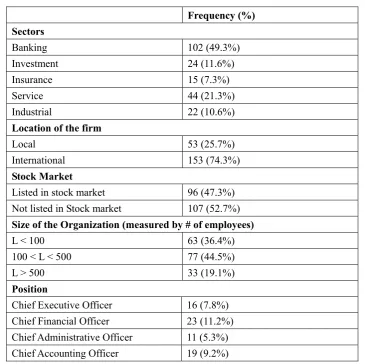
A questionnaire is developed incorporating variables identified in the literature as factors that influence the perception of employees towards COB. The questionnaires are distributed by hand and collected from 207 respondents, which constitute the population under study. To minimize any bias in the responses, the questionnaire targets respondents holding different positions in the organization. Table 1 provides background information about the respondents and their organizations.
3.1 Demographics
Table 1. Profile of the Sample
Frequency (%) Sectors
Banking 102 (49.3%)
Investment 24 (11.6%)
Insurance 15 (7.3%)
Service 44 (21.3%)
Industrial 22 (10.6%)
Location of the firm
Local 53 (25.7%)
International 153 (74.3%)
Stock Market
Listed in stock market 96 (47.3%) Not listed in Stock market 107 (52.7%)
Size of the Organization (measured by # of employees)
L < 100 63 (36.4%)
100 < L < 500 77 (44.5%)
L > 500 33 (19.1%)
Position
Chief Executive Officer 16 (7.8%) Chief Financial Officer 23 (11.2%) Chief Administrative Officer 11 (5.3%) Chief Accounting Officer 19 (9.2%)
Furthermore, 74.27% of the respondents are from organizations that have branches outside the Kingdom of Bahrain, while 47.29% are from organizations listed on the local stock exchange. The fact that the majority of the respondents are from international organizations may have an impact on the results since codes of behavior are more developed and expected to be practiced. Also, 65.70% of the respondents are from relatively large organizations with more than one hundred employees. Finally, most of the respondents occupied positions other than senior ones. The category “Other” (66.5%) included human resource employees and auditors.
4. Results and Discussion
4.1 Descriptive Analysis
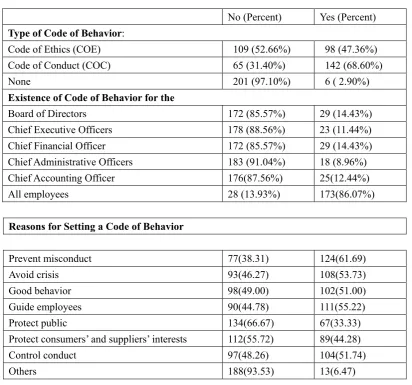
A perusal of Table 2 shows that 52.66% of the respondents believe that their organizations have not adopted a COE, while a majority (68.60%) of them has adopted COC. This indicates that organizations operating in the Kingdom of Bahrain are more sensitive to the importance of COC which is rule-based code than COE which is value-based code. Furthermore, these findings concur with the findings of Farrell and Cobbin (2000) in which most of their respondents adopted a rule-based code.
Table 2. Type, Existence and Reasons of Code of Behavior
No (Percent) Yes (Percent)
Type of Code of Behavior:
Code of Ethics (COE) 109 (52.66%) 98 (47.36%)
Code of Conduct (COC) 65 (31.40%) 142 (68.60%)
None 201 (97.10%) 6 ( 2.90%)
Existence of Code of Behavior for the
Board of Directors 172 (85.57%) 29 (14.43%)
Chief Executive Officers 178 (88.56%) 23 (11.44%)
Chief Financial Officer 172 (85.57%) 29 (14.43%)
Chief Administrative Officers 183 (91.04%) 18 (8.96%)
Chief Accounting Officer 176(87.56%) 25(12.44%)
All employees 28 (13.93%) 173(86.07%)
Reasons for Setting a Code of Behavior
Prevent misconduct 77(38.31) 124(61.69)
Avoid crisis 93(46.27) 108(53.73)
Good behavior 98(49.00) 102(51.00)
Guide employees 90(44.78) 111(55.22)
Protect public 134(66.67) 67(33.33)
Protect consumers’ and suppliers’ interests 112(55.72) 89(44.28)
Control conduct 97(48.26) 104(51.74)
Others 188(93.53) 13(6.47)
It seems that most of the organizations have adopted an overall code of behavior for their employees (86.07%); that is, a code of ethics together with a code of conduct. Few respondents indicated that a code of behavior had been adopted for top management such as Board of Directors, Chief Executive Officers, etc. (Table 2). This result may indicate that organizations focus on the existence of COB for lower level management rather than top management. Furthermore, most of the respondents believe that, to a lesser extent, setting a COB protects the public and it controls behaviors.
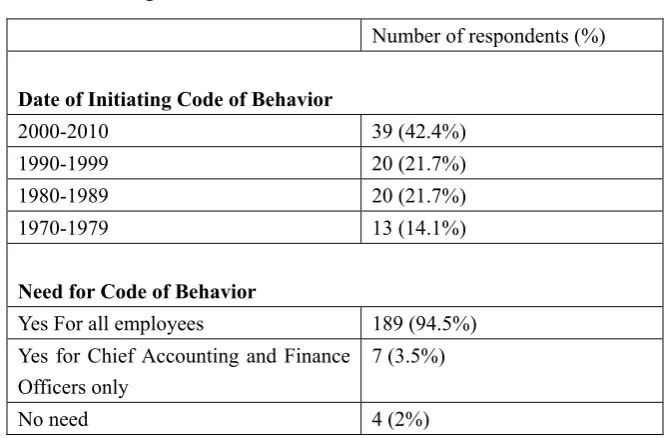
3 further highlight that a majority of the respondents (94.5%) perceive that the code of behavior should be set for all employees so as to prevent misconduct, avoid crisis, encourage good behavior, guide employees and protect consumers and suppliers’ interests.
Table 3. Date of Initiating Code of Behavior and Its Need
Number of respondents (%)
Date of Initiating Code of Behavior
2000-2010 39 (42.4%)
1990-1999 20 (21.7%)
1980-1989 20 (21.7%)
1970-1979 13 (14.1%)
Need for Code of Behavior
Yes For all employees 189 (94.5%)
Yes for Chief Accounting and Finance Officers only
7 (3.5%)
No need 4 (2%)
4.1.1 Evaluation of ethical work environment
Considering the importance of a strong foundation of ethics, the study investigated the existence of the ethics environment in the organizations under study. This was accomplished by studying and analyzing (Tables 4, 5) factors identified in the literature as components of ethics environment. The strengths and weaknesses of the ethics environment are deduced therein.
Table 4 shows that most of the respondents (63.45%) indicated that an ethics committee/officer exists in their organizations and most of these committees (93.72%) have at least one financial expert as a member. This result is in line with the recent legislatives at both national and international levels, as outlined at the beginning of this study.
Table 4. Components of Ethics Environment
No Yes
Existence of Ethics Committee/Officer 72 (36.6%) 125 (63.5%)
Existence of One Financial Expert 12 (6.3%) 179 (93.7%)
Setting of Code of Behavior
Legal Department 117(58.21) 84(41.79)
Outside Counsel 143(71.14) 58(28.86)
Board of Directors 135(67.16) 66(32.84)
Employee Participation 169(84.08) 32(15.92)
Chief Executive Officers 142(70.65) 59(29.35)
Others 152(75.62) 49(24.38)
Global Code of Behavior 61 (30.8%) 137 (69.2%)
Finally, the fact that the code of behavior is global strengthens the ethics environment 69.19% since it is available in more than one language.
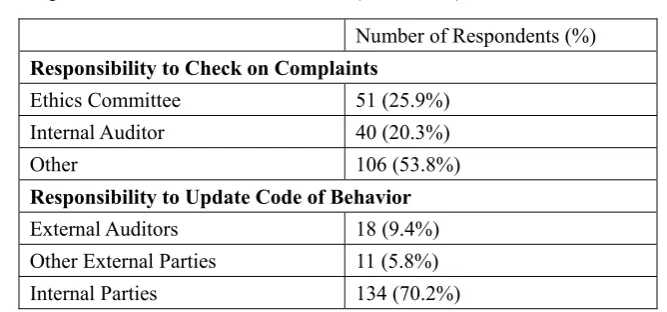
A further weakness deduced from the results of Table 5 is that the responsibility to check ethics complaints does not lie with the ethics committee (25.89%). On a more positive note, most of the respondents (70.16%) indicated that the main responsibility for updating the code of behavior lies with the internal parties who may be better acquainted with the ethics environment.
Table 5. Components of Ethics Environment (continued)
Number of Respondents (%)
Responsibility to Check on Complaints
Ethics Committee 51 (25.9%)
Internal Auditor 40 (20.3%)
Other 106 (53.8%)
Responsibility to Update Code of Behavior
External Auditors 18 (9.4%)
Other External Parties 11 (5.8%)
Internal Parties 134 (70.2%)
4.1.2 Components of an effective code of behavior
Cassell et al. (1997) stated that “There appears to be a need to understand how the code is ‘received’ and interpreted by those whose behavior and attitudes it is presumably intended to influence”. Whether an employee is receptive to a code of behavior or not depends on the boundaries that employee is ready to accept for any ethic-related code.
only and not in their personal lives.
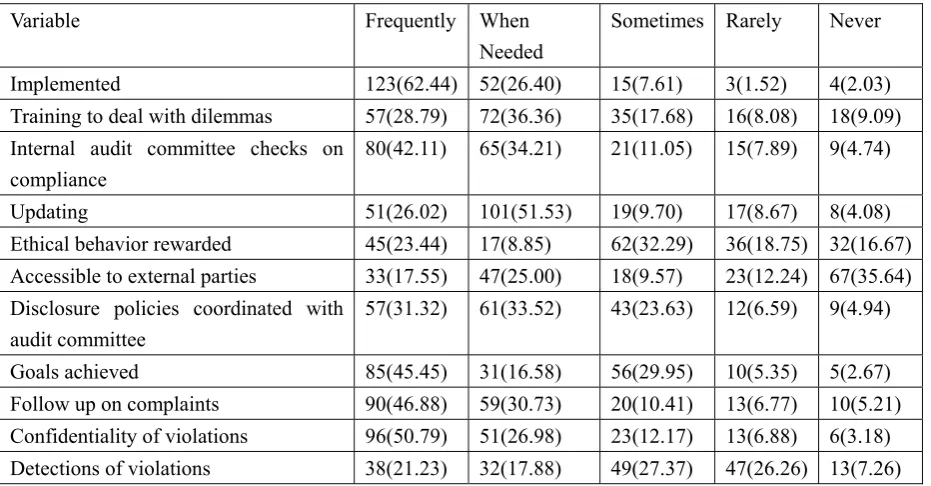
Given the boundaries set by the respondents for code of behavior developed by their organizations, Tables 6 and 7 attempted to audit the organization’s ethics environment and then identify the important components of an effective code of behavior respectively.
Table 6. Employees’ General Perceptions about Codes of Behavior
Variable Frequently When
Needed
Sometimes Rarely Never
Implemented 123(62.44) 52(26.40) 15(7.61) 3(1.52) 4(2.03)
Training to deal with dilemmas 57(28.79) 72(36.36) 35(17.68) 16(8.08) 18(9.09) Internal audit committee checks on
compliance
80(42.11) 65(34.21) 21(11.05) 15(7.89) 9(4.74)
Updating 51(26.02) 101(51.53) 19(9.70) 17(8.67) 8(4.08)
Ethical behavior rewarded 45(23.44) 17(8.85) 62(32.29) 36(18.75) 32(16.67) Accessible to external parties 33(17.55) 47(25.00) 18(9.57) 23(12.24) 67(35.64) Disclosure policies coordinated with
audit committee
57(31.32) 61(33.52) 43(23.63) 12(6.59) 9(4.94)
Goals achieved 85(45.45) 31(16.58) 56(29.95) 10(5.35) 5(2.67)
Follow up on complaints 90(46.88) 59(30.73) 20(10.41) 13(6.77) 10(5.21) Confidentiality of violations 96(50.79) 51(26.98) 23(12.17) 13(6.88) 6(3.18) Detections of violations 38(21.23) 32(17.88) 49(27.37) 47(26.26) 13(7.26) Clark (2004) proposed performing an audit of a company’s ethics environment and suggested some guidelines to do so. Table 6 contains information based on some of Clark’s suggestions.
The findings indicate that, of the eleven variables studied, it seems that respondents believe that five of them exist in their organizations’ codes of behavior. They include: implementation of codes of behavior, checking on compliance by an internal audit committee, achievement of their goals, follow-up on complaints and confidential channels for reporting ethics’ violations.
Table 7. Importance Attached by Employees to Effective COE Program Components
Variable Strongly
Agree
Agree Neutral Disagree Strongly
Disagree Leaders set the example 147(74.24) 32(16.16) 16(8.08) 2(1.01) 1(0.51) Ethics as core value 141(71.57) 45(22.84) 8(4.06) 2(1.02) 1(0.51) All participate in setting
code of behavior
86(43.65) 59(29.95) 27(13.71) 18(9.14) 7(3.55)
Application of code of behavior consistently to all employees
140(70.35) 40(20.10) 9(4.53) 5(2.51) 5(2.51)
Employees feel safe to share concerns
115(57.79) 62(31.16) 11(5.53) 6(3.01) 5(2.51)
4.1.3 Compliance to codes of behavior
In general, organizations’ compliance with codes of behavior including accounting ethics is perceived by respondents to be frequently adhered to integrity, confidentiality, independence, technical Standards, professionalism, public Interest and conflict of interest (Table 8).
Table 8. Employees Perception about Compliance to Codes of Behavior
Values Frequently When
Needed
Sometimes Rarely Never
Integrity 150(76.14) 28(14.21) 14(7.11) 2(1.02) 3(1.52)
Confidentiality 159(80.30) 26(13.13) 8(4.04) 4(2.02) 1(0.51) Independence 142(73.20) 36(18.56) 10(5.15) 5(2.58) 1(0.52) Technical Standards 136(69.74) 38(19.49) 14(7.18) 5(2.56) 2(1.03) Professionalism 148(76.68) 23(11.92) 12(6.22) 6(3.11) 4(2.07) Public Interest 139(71.65) 33(17.01) 13(6.70) 5(2.58) 4(2.06) Conflict of Interest 131(66.84) 35(17.86) 14(7.14) 12(6.12) 4(2.04)
4.2 Statistical Analysis
The data is further analyzed based on the following characteristics of the companies/employees.
• Local versus international ownership • CAOs and CFOs versus other employees • Banking versus non-banking sector • Listed versus non-listed companies
• Small versus medium versus large companies
4.2.1 Local versus international ownership
There are 53 firms owned by Bahrainis and 153 internationally owned firms operated in Bahrain.
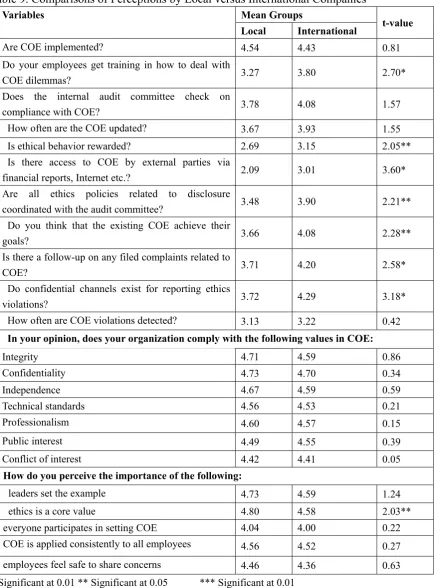
Table 9. Comparisons of Perceptions by Local versus International Companies
Variables Mean Groups
t-value Local International
Are COE implemented? 4.54 4.43 0.81
Do your employees get training in how to deal with
COE dilemmas? 3.27 3.80 2.70*
Does the internal audit committee check on
compliance with COE? 3.78 4.08 1.57
How often are the COE updated? 3.67 3.93 1.55
Is ethical behavior rewarded? 2.69 3.15 2.05**
Is there access to COE by external parties via
financial reports, Internet etc.? 2.09 3.01 3.60*
Are all ethics policies related to disclosure
coordinated with the audit committee? 3.48 3.90 2.21**
Do you think that the existing COE achieve their
goals? 3.66 4.08 2.28**
Is there a follow-up on any filed complaints related to
COE? 3.71 4.20 2.58*
Do confidential channels exist for reporting ethics
violations? 3.72 4.29 3.18*
How often are COE violations detected? 3.13 3.22 0.42
In your opinion, does your organization comply with the following values in COE:
Integrity 4.71 4.59 0.86
Confidentiality 4.73 4.70 0.34
Independence 4.67 4.59 0.59
Technical standards 4.56 4.53 0.21
Professionalism 4.60 4.57 0.15
Public interest 4.49 4.55 0.39
Conflict of interest 4.42 4.41 0.05
How do you perceive the importance of the following:
leaders set the example 4.73 4.59 1.24
ethics is a core value 4.80 4.58 2.03**
everyone participates in setting COE 4.04 4.00 0.22
COE is applied consistently to all employees 4.56 4.52 0.27
Table 9 shows that several variables emerged as significantly different at the 0.01, 0.05 and 0.1 levels between local and international organizations.
It appeared that international organizations provided training to their employees in how to deal with COE dilemmas more than their local counterparts (t= 2.7, p<0.01). This is expected since the international organizations have broader exposure to the issue of ethics in the work environment and hence may well be aware of the importance of training to their employees in this respect. The employees in international organizations who have been trained on how to deal with COE dilemmas may also be aware of the importance of any violations of COE. This is depicted in the variable the employees in the international organizations indicated awareness of the existence of a follow-up procedure on any filed complaints related to COE (t=2.58, p<0.01).
To further understand the previous findings, the study investigated the set-up of the ethics policies and the parties involved in developing them. The results indicated that international organizations may have developed effective COE more than local organizations because they have developed ethics policies that are coordinated with their audit committees (t=2.21, p<0.05).
Finally, in comparison with international organizations, employees in local organizations perceived ethics as a core value (t=2.03, p<0.05). This result may support the argument that codes of behavior may be unnecessary and that an ethical culture, a distinct corporate philosophy and professionalism are deeply valued in the Bahraini business environment that can be promoted without a formal code of ethics.
4.2.2CAOs and CFOs versus other employees
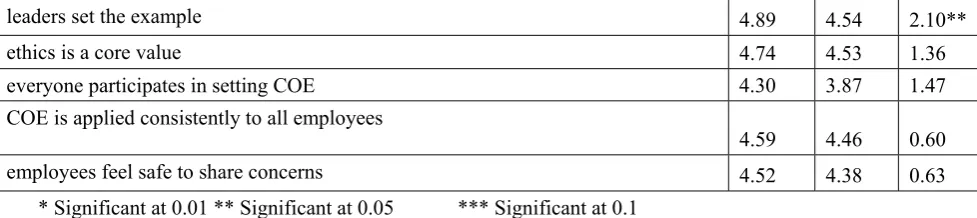
Table 10. Comparisons of Perceptions by Accountants versus Other employees
Variable
Mean Groups
t-value Others CAOs
& CFOs
Are COE implemented? 4.78 4.41 2.01**
Do your employees get training in how to deal with COE dilemmas?
4.19 3.79 1.51 Does the internal audit committee check on compliance with COE?
4.28 4.16 0.44
How often are the COE updated? 4.00 3.82 0.74
Is ethical behavior rewarded? 3.08 3.00 0.21
Is there access to COE by external parties via financial reports, Internet etc.?
2.60 2.53 0.20 Are all ethics policies related to disclosure coordinated with the audit committee?
3.92 3.59 1.23 Do you think that the existing COE achieve their goals?
4.28 3.82 1.57 Is there a follow-up on any filed complaints related to COE?
4.44 4.00 1.44 Do confidential channels exist for reporting ethics violations?
4.26 3.97 1.01
How often are COE violations detected? 3.30 3.00 0.91
In your opinion, does your organization comply with the following values in COE:
Integrity 4.67 4.68 0.05
Confidentiality 4.63 4.84 1.39
Independence 4.67 4.72 0.37
Technical standards 4.70 4.50 1.12
Professionalism 4.63 4.61 0.08
Public interest 4.67 4.51 0.72
Conflict of interest 4.59 4.51 0.35
How do you perceive the importance of the following:
leaders set the example 4.89 4.54 2.10**
ethics is a core value 4.74 4.53 1.36
everyone participates in setting COE 4.30 3.87 1.47
COE is applied consistently to all employees
4.59 4.46 0.60
employees feel safe to share concerns 4.52 4.38 0.63
4.2.3Banking versus non-banking sector
As reported in Table 1, 50% of the respondents work in the banking sector which is a dominant industry in Bahrain.
Many variables in Table 11 appear different between banking and non-banking firms at the 1%, 5% and 10% levels of significance. It is found that as compared to the non-banking sector, the banks in Bahrain act more responsibly in the implementation of code of ethics. They provide training to their employees about COE and internal audit committee keeps an eye on the compliance with COE. The findings are statistically significant at 1% level. It is also observed that the banks’ employees are confident that COE violations are detected promptly and the existing COE achieve their goals (significant at 5% and 10% level respectively).
Table 11. Comparisons of Perceptions by banking versus Non-banking Sector
Variable
Mean Groups
t-value Banking Non-bank
ing
Are COE implemented? 4.65 4.25 3.3*
Do your employees get training in how to deal with COE
dilemmas? 3.92 3.42 2.95*
Does the internal audit committee check on compliance with
COE? 4.29 3.68 3.85*
How often are the COE updated? 3.94 3.79 1.05
Is ethical behavior rewarded? 2.95 3.13 0.91
Is there access to COE by external parties via financial reports,
Internet etc.? 2.76 2.78 0.09
Are all ethics policies related to disclosure coordinated with the
audit committee? 3.86 3.72 0.87
Do you think that the existing COE achieve their goals?
4.10 3.82 1.76***
Is there a follow-up on any filed complaints related to COE?
4.02 4.13 0.66
Do confidential channels exist for reporting ethics violations?
4.09 4.21 0.75
How often are COE violations detected? 3.38 3.00 2.08**
In your opinion, does your organization comply with the following values in COE:
Integrity 4.83 4.40 3.87*
Confidentiality 4.84 4.56 2.99*
Independence 4.65 4.57 0.73
Technical standards 4.67 4.41 2.22**
Professionalism 4.74 4.41 2.57**
Public interest 4.74 4.32 3.38*
Conflict of interest 4.71 4.09 4.56*
How do you perceive the importance of the following:
leaders set the example 4.71 4.54 1.61
ethics is a core value 4.75 4.52 2.49**
everyone participates in setting COE 4.06 3.96 0.63
COE is applied consistently to all employees 4.74 4.31 3.45*
employees feel safe to share concerns 4.60 4.16 3.54*
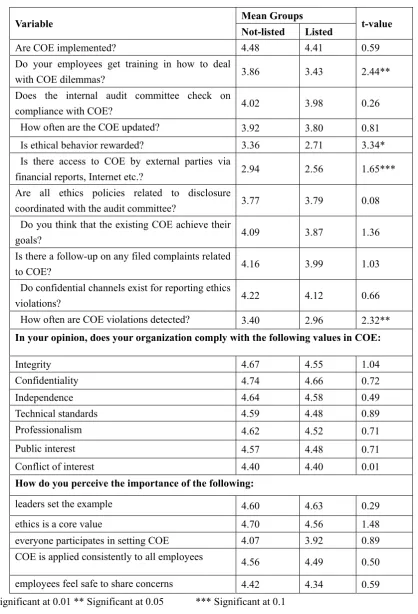
generated from non-listed companies. Many of the findings are significant (Table 12).
Table 12. Comparisons of Perceptions by listed versus non-listed Companies
Variable Mean Groups t-value
Not-listed Listed
Are COE implemented? 4.48 4.41 0.59
Do your employees get training in how to deal
with COE dilemmas? 3.86 3.43 2.44**
Does the internal audit committee check on
compliance with COE? 4.02 3.98 0.26
How often are the COE updated? 3.92 3.80 0.81
Is ethical behavior rewarded? 3.36 2.71 3.34*
Is there access to COE by external parties via
financial reports, Internet etc.? 2.94 2.56 1.65***
Are all ethics policies related to disclosure
coordinated with the audit committee? 3.77 3.79 0.08 Do you think that the existing COE achieve their
goals? 4.09 3.87 1.36
Is there a follow-up on any filed complaints related
to COE? 4.16 3.99 1.03
Do confidential channels exist for reporting ethics
violations? 4.22 4.12 0.66
How often are COE violations detected? 3.40 2.96 2.32**
In your opinion, does your organization comply with the following values in COE:
Integrity 4.67 4.55 1.04
Confidentiality 4.74 4.66 0.72
Independence 4.64 4.58 0.49
Technical standards 4.59 4.48 0.89
Professionalism 4.62 4.52 0.71
Public interest 4.57 4.48 0.71
Conflict of interest 4.40 4.40 0.01
How do you perceive the importance of the following:
leaders set the example 4.60 4.63 0.29
ethics is a core value 4.70 4.56 1.48
everyone participates in setting COE 4.07 3.92 0.89
COE is applied consistently to all employees 4.56 4.49 0.50
employees feel safe to share concerns 4.42 4.34 0.59 * Significant at 0.01 ** Significant at 0.05 *** Significant at 0.1
and listed companies are aware but to a lesser extent. Non-listed firms reward good behaviors, detect COE violations and train their employees to deal with COE dilemma.
4.2.5Small, medium and large companies
Table 13. Comparisons of Perceptions by Small, Medium and Large Companies
Variable Mean Groups t-value
L<100 100>L<500 L>500
Are COE implemented? 4.71 4.43 4.09 2.35*
Do your employees get training in how to deal with COE
dilemmas? 3.83 3.88 3.00 2.63*
Does the internal audit committee check on compliance
with COE? 4.19 3.94 3.58 1.76**
How often are the COE updated? 3.93 3.97 3.31 2.30**
Is ethical behavior rewarded? 2.91 3.17 2.82 0.98
Is there access to COE by external parties via financial
reports, Internet etc.? 2.71 2.93 2.55 0.82
Are all ethics policies related to disclosure coordinated
with the audit committee? 3.88 4.00 3.17 2.49*
Do you think that the existing COE achieve their goals?
3.85 4.23 3.47 2.32*
Is there a follow-up on any filed complaints related to
COE? 3.81 4.26 4.32 1.88**
Do confidential channels exist for reporting ethics
violations? 3.78 4.42 4.19 2.34*
How often are COE violations detected? 3.17 3.30 3.03 0.68
In your opinion, does your organization comply with the following values in COE:
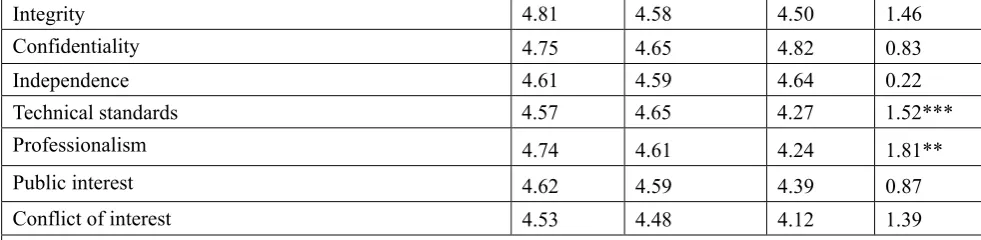
Integrity 4.81 4.58 4.50 1.46
Confidentiality 4.75 4.65 4.82 0.83
Independence 4.61 4.59 4.64 0.22
Technical standards 4.57 4.65 4.27 1.52***
Professionalism 4.74 4.61 4.24 1.81**
Public interest 4.62 4.59 4.39 0.87
Conflict of interest 4.53 4.48 4.12 1.39
How do you perceive the importance of the following:
leaders set the example 4.66 4.58 4.79 0.98
ethics is a core value 4.84 4.63 4.61 1.57***
everyone participates in setting COE 3.88 4.07 4.30 1.25
COE is applied consistently to all employees
4.68 4.66 4.12 2.30**
employees feel safe to share concerns 4.44 4.45 4.06 1.53***
* Significant at 0.01 ** Significant at 0.05 *** Significant at 0.1
5. Summary and Conclusions
codes of behavior and accounting ethics in the Kingdom of Bahrain. In particular, the study focused on four main issues. First, an examination was conducted as to whether an ethical work environment exists through the establishment of: a code of behavior, corporate ethics committee, and policy empowerment. The existence of an ethical work environment was validated by the results of the study. Three main weaknesses in the ethics environment of some organizations were identified: (1) setting of the code of behavior seems to be a mixed responsibility between legal departments and outside councils, with minimal participation from the employees, (2) the responsibility to check ethics complaints does not lie with the ethics committee and (3) lack of a robust mechanism that enhances financiers’ and accountants’ awareness about the importance of accounting ethics. Additionally, some important components of an effective code of behavior were identified such as implementation of codes of behavior, checking on compliance by an internal audit committee, achievement of their goals, follow-up on complaints and confidential channels for reporting ethics violations. Finally, results revealed that the organizations under study generally comply with the values in their codes of behavior.
Overall, the results indicate that international organizations operating in Bahrain, banks and relatively smaller firms may to a great extent, be in line with what has been identified as factors essential for the existence of an effective ethical work environment.
It is pointed out that the use of questionnaires may limit the generalization ability of the results and replication of the study or use of different methodologies may enhance the results.
This study may set the foundation for further research in this area in the Kingdom of Bahrain. In particular, a follow-up may be conducted to investigate the sustainability of COE in an ever-changing financial environment and whether more rigorous COE should be developed to enhance the importance of its existence within the organization. Additionally, factors identified by other researches such as the degree of idealism in employees (Al Khatib et. al 2002) should also be considered.
References
Al-Khatib, J.A., Robertson C.J., Stanton A. & Vitell S.J. (2001). Business Ethics in Arab Gulf States: A Three Country Study. International Business Review, 11(1), 97-111.
http://dx.doi.org/10.1016/S0969-5931(01)
Baumhart, R.C. (1961). How Ethical Are Businessmen? Harvard Business Review, 39, 6-176.
Berenbeim, R. (1988). Ethics codes and educational programs (part2). Security Management, 32(10), 91-7.
Cassell, C., Johnson, P. & Smith, K. (1997). Opening the Black Box: Corporate Codes of Ethics in their Organisational Context. Journal of Business Ethics, 16, 1077-1093.
http://dx.doi.org/10.1023/A:1017926106560
Central Bank of Bahrain (CBB). Disclosure Standards. December 2003.
Central Bank of Bahrain, Rulebook Volume 1, HC 1, 3.12 Conventional banks, 2007.
Clark, S. (2004). Ethics Audit Essential for Every Business. The Business Journal of Milwaukee.
Cravath, Swaine & Moore. (2003). Codes of Ethics and Financial Experts- Disclosure Pursuant to Sections 406 and 407 of Sarbanes-Oxley. Retrieved from http://www.cravath.com/memo/2224182_6.pdf
Cressy, D. & Moore, C. (1983). Managerial values and corporate codes of ethics. California Management Review, 25(4), 53-77. http://dx.doi.org/10.2307/41165032
Dunfee, T.W. & Werhane, P. (1997). Report on business ethics in north America. Journal of Business Ethics, 16(14), 1589-1595. http://dx.doi.org/10.1023/A:1005871200181
Farrell, B.J. & Cobbin, D.M. (1996). A content analysis of codes of ethics in Australian
enterprises. Journal of Managerial Psychology, 11(1), 37-55.
http://dx.doi.org/10.1108/02683949610109381
Farrell, B.J. & Cobbin, D.M. (2000). A content analysis of codes of ethics from fifty-seven
national accounting organizations. Journal of Business Ethics, 9(3).
http://dx.doi.org/10.1111/1467-8608.00189
Fisher, C. (2001). Managers' perceptions of ethical codes: dialectics and dynamics. Journal of Business Ethics, 10(2), 145-156. http://dx.doi.org/10.1111/1467-8608.00225
Gorbaneff, Y., Margarita, E., Uribe, G. & Hoyos, G. (2012). Forma y contenido de los códigos de ética de empresas petroleras en Colombia. Shape and content of ethic codes in Colombian oil industry. Investigación y Desarrollo. jul-dic, 20(2), 366-389.
Harvard Law Review Notes. (2003). The Good, the Bad, and their Corporate Codes of Ethics: Enron, Sarbanes-Oxley, and the Problems with Legislating Good Behavior. Harvard Law Review, 116(7), 2123-2141. http://dx.doi.org/10.2307/1342755
Hite, R., Bellizzi, J., & Fraser, C. (1988). A content analysis of ethical policy statements regarding marketing activities. Journal of Business Ethics, 7(10), 771-6.
http://dx.doi.org/10.1007/BF00411024
International Federation of Accountants. (1997). IFAC handbook. New York: International
Federation of Accountants.
International Federation of Accountants. (2007). Internal auditor update, New York: International Federation of Accountants.
Kaptein, M. & Schwartz, M.S. (2008). The Effectiveness of Business Codes: A Critical Examination of Existing Studies and the Development of an Integrated Research Model.
Journal of Business Ethics. http://dx.doi.org/10.1007/s10551-006-9305-0
Ethics, 11(11), 857-62. http://dx.doi.org/10.1007/BF00872364
Langlois, C. & Schegelmilch, B. (1990). Do corporate codes of ethics reflect national character: evidence from Europe and the United States? Journal of International Business Studies, 21(4), 519-39. http://dx.doi.org/10.1057/palgrave.jibs.8490340
Lawrence, F. (2006). Salmonella outbreaks kept secret by Cadbury in 2003. The Guardian,5
July.
Lefebvre, M. & Singh, J. (1992). The content and focus of Canadian corporate codes of ethics.
Journal of Business Ethics, 11(10), 799-808. http://dx.doi.org/10.1007/BF00872312
McNulty, S. (2006). BP employees issued early warning of Prudhoe corrosion. Financial Times, 9 August.
Messmer, M. (2003). Does Your Company Have a Code of Ethics. Strategic Finance, April.
O'Dwyer, B. & Madden, G. (2006). Ethical Codes of Conduct in Irish Companies: A Survey of Code Content and Enforcement Procedures. Journal of Business Ethics, 63(3), 217-236.
http://dx.doi.org/10.1007/s10551-005-3967-x
Pitt, H.L. & Groskaufmanis, K.A. (1990). Minimizing Corporate Civil and Criminal Liability: A Second Look at Corporate Codes of Conduct. The Georgetown Law Journal,78.
Robin, D., Giallourakis, M., David, F.R. & Moritz, T.E. (1989). A different look at codes of ethics. Business Horizons,32(1), 66-73. http://dx.doi.org/10.1016/0007-6813(89)90028-1
Sarbanes-Oxley Act, (2002). Sarbanes-Oxley Public Company Accounting Reform and Investor Protection Act. Retrieved from http//www.sarbanes-oxley.com.
Schlegelmilch, B.B. & Houston, J.E. (1989). Corporate codes of ethics in large UK companies: an empirical investigation of use, content and attitudes. European Journal of Marketing, 23(6), 7-24. http://dx.doi.org/10.1108/EUM0000000000571
SEC Release No. 34-46701 dated October 22, 2002 (the Proposing Release), which sets for the original proposals by the SEC for the rules to be promulgated under Sections 406 of Sarbanes-Oxley.
Webley S. & Werner, A. (2008). Corporate codes of ethics: necessary but not sufficient.
Business Ethics: A European Review, 17(4).
http://dx.doi.org/10.1111/j.1467-8608.2008.00543.x
Wood, G. (2000). A cross cultural comparison of the contents of codes of ethics: USA,
Canada and Australia. Journal of Business Ethics, 25(4), 287-98.
http://dx.doi.org/10.1023/A:1006034209956
Yen, V.H. (2010). Accounting Ethics And Its Important Role For Reduction Of Accounting Fraud: An Empirical Study In Hanoi. BS Thesis, HELP University College, Hanoi. Retrieved
APPENDIX
Comparative Analysis of Information Related to Code of Behaviour
The main differences between the SOX Act, SEC Release and CBB circular related to enhancement of corporate governance are summarized below.
REQUIREMENT SOX ACT (SECTION 406)
SEC CBB
Adopt Code of Behaviour for??
Principal financial officer or principal accounting officer
Principal executive officers and senior financial officers
Board of Directors, senior management and employees
Implementation date 30th July 2002 Fiscal year ending on or after 15th July 2003
1st January 2005
Suggested content Not addressed in Section (406).
Details are not specified. The decision as to specific provisions of each issuer's COE should be made by the issuer itself.
• Commitment to the code
• Commitment to the law and best practice standards.
• Employment practices e.g. health and safety
• How the company deals with disputes and complaints from clients and polices the code
• Confidentiality Disclosure Not addressed
in Section (406).
Annual Report, Form 8-K or on its Internet website.
Communicated throughout the organization.
Audit Committee Not addressed in Section (406).
• At least one audit
committee financial expert.
• The name of the expert must be disclosed.
• Preferably, there should be at least one qualified accountant in the committee.