Report On Developing a Pathway For
Indigenous Students In a Tertiary Science
Degree In Rural Australia: A Work In
Progress.
Cesidio Parissia, Sarah Hydeb and Phillipa Southwella
Corresponding author: [email protected]
aSchool of Biomedical Sciences, Charles Sturt University, Orange, New South Wales 2800, Australia
bAdjunct Senior Lecturer, School of Biomedical Sciences, Charles Sturt University, Orange, New South Wales
2800, Australia
Keywords: Aboriginal health science education, Aboriginal cultural awareness, higher education
International Journal of Innovation in Science and Mathematics Education, 24(4),31-43, 2016.
Abstract
The Bachelor of Clinical Science degree at Australia’s rurally-located Charles Sturt University has recently implemented a number of strategies aimed at improving the low entry and completion numbers for Indigenous students. The degree is designed as a pre-medical and dentistry degree, and although the success rate from the degree into various entry medical and dental programs for graduates is high (48%), it has had no Indigenous graduates to date. This is concerning because research suggests that poor Indigenous health outcomes, compared to non-Indigenous Australians, can improve with more Indigenous health professionals. In view of this research, we implemented a tiered program of cultural awareness comprising degree level, whole-campus, and
community perspectives. Establishing partnerships with local Aboriginal communities to help implement these changes has been critically important to this initiative. This article is a report of the program content of Clinical Science, graduate outcomes to date, the initiatives we employed, and the progress so far in achieving our stated aims.
Background
The authors firstly wish to acknowledge the Wiradjuri1 people as the traditional stewards of the land on which we work and on which the project that is described in this report occurs. We have learned a great deal from the wisdom and involvement of Elders, at various stages of the project and we acknowledge the considerable time and effort of the Aboriginal people who have generously shared aspects of their culture with the staff and students of our campus, and with the wider community of our region. This sharing of culture has occurred through the performance of ceremonial events on campus, as well as through academic engagements with students. We hope and trust that this partnership will continue and grow. Although the journey is in its infancy, this project aspires to enhance the understanding and cultural awareness of all staff, students, and visitors to our institution and to enhance feelings of cultural safety at our campuses for the traditional custodians of this shared land. It is only through building such understandings and relationships between educational institutions, Elders, and the broader
1 Wiradjuri is the name of the Aboriginal tribal and language group who originally occupied, and held stewardship
of, the lands in central New South Wales, Australia, on which most of the campuses of Charles Sturt University are located, including its Orange Campus.
31
Aboriginal community that we can hope to redress some of the imbalances in levels of degree-entry and completion rates for Aboriginal students, and in the long term, facilitate improved educational and health outcomes for all.
Poor levels of morbidity and mortality of Aboriginal Australians (Keast & Dragon, 2015; Springer & Smith, 2016) are key issues in the Indigenous-health domain of the Science, Technology, Engineering and Mathematics (STEM) world. Studies show that this can be better addressed by increasing the number of Indigenous health practitioners (Aspin, Brown, Jowsey, Yen, & Leeder, 2012). However, enrolment and retention numbers of Aboriginal students are low and unlikely to increase, due to the lower than needed uptake of tertiary STEM degrees by Indigenous students (Bradley, Noonan, Nugent, & Scales, 2008; Hackling, Byrne, Gower, & Anderson, 2015). This paper is a discussion of the approach that the academic and support staff of one degree program, in particular, have undertaken to improve the entry and completion numbers of Aboriginal and Torres Strait Islander people for that degree, as well as for the campus as a whole. The degree is the Bachelor of Clinical Science (Clinical Science), offered at the Orange campus of Charles Sturt University (CSU), a rural-based institution, which has its five main campuses located throughout rural New South Wales, Australia. With two-thirds of Indigenous Australians living in regional and remote areas of Australia (Tulloch, 2014) and 21% living in ‘remote and very remote’ areas (Smith, 2016), CSU has a strategic focus as the ‘Rural and Regional Solution’ for education and training at the tertiary level.
While the first graduates of Clinical Science in 2009 aimed solely for graduate entry to medicine or dentistry, the degree has since been modified to broaden the possible career opportunities for students. These modifications have allowed for a wider range of graduate outcomes, both within CSU and for degrees external to the university. Clinical Science was mainly constructed as a pre-medical-dental-health degree, however some graduates also directly enter the workforce, as well as enter other health-profession degrees. Nevertheless, over the years that the degree has been running, about 48% of graduates have been successful in gaining entry to a variety of medical and dental programs (see Figure 1). Unfortunately, of the six self-identified Indigenous students who enrolled in Clinical Science, none have graduated, and all but one has left the university – one successfully transferring to CSU Pharmacy. Of CSU’s main campuses, Orange has the lowest number of Indigenous students (data from the CSU Office of Planning and Audit, held by the authors).
Description of the Bachelor of Clinical Science
Clinical Science was established to meet the needs of rural students aiming for careers in Medicine and Dentistry, in light of the challenges they face at admission for these and other high demand degrees. Barriers include a lack of educational opportunities at school such as subject choice and teaching assistance and lower rural socio-economic status (SES) as well as more difficult access to metropolitan based extra-curricular admissions-test preparation programs (Bradley et al., 2008; Smith, 2016). Current literature is replete with studies that show the skewing of medical and dental students towards those from a higher SES portion of the population (Azer, 2007; Bradley et al., 2008; Griffin & Hu, 2015); from metropolitan centres (Bradley et al., 2008) and a negative bias in parts of an undergraduate admission selection test in terms of female gender especially when combined with lower SES (Griffin & Hu, 2015). The financial and spatial constraints on rural students is apparent, for the tests and pre-test coaching are typically held in large metropolitan centres and at significant cost in terms of attendance, travel and lodgings (Griffin, Harding, Wilson, & Yeomans, 2008).
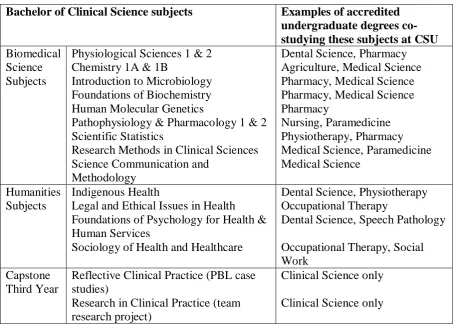
Clinical Science is a three-year, full time degree of 18 subjects that are usually taken across four semesters over the first two years, with four subjects each semester, and with a capstone final third year of two subjects, each of which are worth four times the credit points of each of the previous subjects. Table 1 shows the current (2016) complete program of 18 subjects, and indicates the variety of learning experiences given to students. The subjects include 12 from the biomedical and science disciplines, four from humanities and a Problem Based Learning (PBL) capstone third year of the two heavily weighted subjects, the first involving of a series of PBL case studies and the second comprising a team-based original research project.
Among many others, one particular purpose of the capstone year is to help applicants be successful once they are in their chosen school, for most medical and dental schools have PBL or a similar approach to curriculum structure, and several graduate schools have now included a research component. Furthermore, this degree design was developed in partnership with a major metropolitan medical school that suggested the advantages inherent in this particular program structure. As the degree was constructed to help rural students become competitive for admission into their choice of health degrees, as well as help them be successful once they were in the program, opportunities for additional voluntary trial selection tests and interview preparation are embedded within the degree program.
Table 1. The array of subjects in the Clinical Science Program at Charles Sturt University
Bachelor of Clinical Science subjects Examples of accredited
undergraduate degrees co-studying these subjects at CSU Biomedical
Science Subjects
Physiological Sciences 1 & 2 Chemistry 1A & 1B
Introduction to Microbiology Foundations of Biochemistry Human Molecular Genetics
Pathophysiology & Pharmacology 1 & 2 Scientific Statistics
Research Methods in Clinical Sciences Science Communication and
Methodology
Dental Science, Pharmacy Agriculture, Medical Science Pharmacy, Medical Science Pharmacy, Medical Science Pharmacy
Nursing, Paramedicine Physiotherapy, Pharmacy Medical Science, Paramedicine Medical Science
Humanities Subjects
Indigenous Health
Legal and Ethical Issues in Health Foundations of Psychology for Health & Human Services
Sociology of Health and Healthcare
Dental Science, Physiotherapy Occupational Therapy
Dental Science, Speech Pathology
Occupational Therapy, Social Work
Capstone Third Year
Reflective Clinical Practice (PBL case studies)
Research in Clinical Practice (team research project)
Clinical Science only
Clinical Science only
Graduate Outcomes from Clinical Science
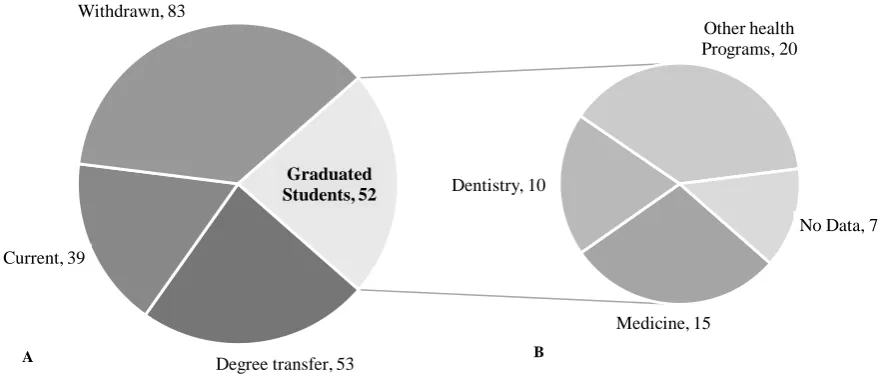
With regard to the success of many of the graduates of Clinical Science, Figure 1 demonstrates the degree of success of these students, with 48% of graduates gaining entry into medical and dental degrees. These were at a variety of institutions, namely, Charles Sturt University (undergraduate dentistry), University of Notre Dame (graduate medicine), University of Wollongong (graduate medicine), University of Sydney (graduate medicine and dentistry), and
the University of Newcastle/University of New England’s Joint Medical Program (undergraduate medicine). Five out of six from the first graduate cohort in 2009 and all 6 from the 2010 cohort who gained entry to a medical or dental school have now graduated with most practicing in a rural or remote area of NSW at time of writing, namely, Lithgow, Wagga Wagga, Dubbo and Albury as well as Far North Queensland (personal communications from former students by email, held by the authors).
Figure 1. Pie chart ‘A’ Clinical Science Outcomes of all enrolled students and ‘B’ Graduate Career Outcomes. Of the 227 ever-enrolled students (2007-2015), there have been 52 graduates, of which 48% (n = 25) have been successful in applying for Medical or Dental programs both at and outside CSU. Degree program transfers are CSU internal transfer only. Students transferring to other degrees outside CSU are considered ‘withdrawn’ on top of normal attrition.
Other outcomes for Clinical Science students have been to transfer to another degree either at CSU or to another institution at the end of first or second year, as indicated in Figure 1. Of these students, 29 have gained entry to CSU’s undergraduate Dentistry School, nine (9) into CSU Pharmacy, three (3) to CSU Physiotherapy, two (2) gained positions in the Joint Medical Program of the University of Newcastle and the University of New England. In addition, several have transferred to other health related degrees, such as Nursing, Paramedics and Oral Health.
To gain entry into a high demand Australian undergraduate health professions degree, an applicant usually needs an exceptional result after 12 years of high school. This is measured by the results of the Higher School Certificate and represented as an Australian Tertiary Admissions Rank (ATAR). The overall value of Clinical Science is demonstrated by the success of students who otherwise would not have gained entry to the high-demand health programs such as medicine or dentistry, even with the rural ‘bonus points’ that are typically given. Clinical Science students have traditionally had either relatively low ATAR results or, in a few cases, they did not complete high school.
Degree transfer, 53 Current, 39
Withdrawn, 83
Medicine, 15 Dentistry, 10
Other health Programs, 20
No Data, 7 Graduated
Students, 52
A B
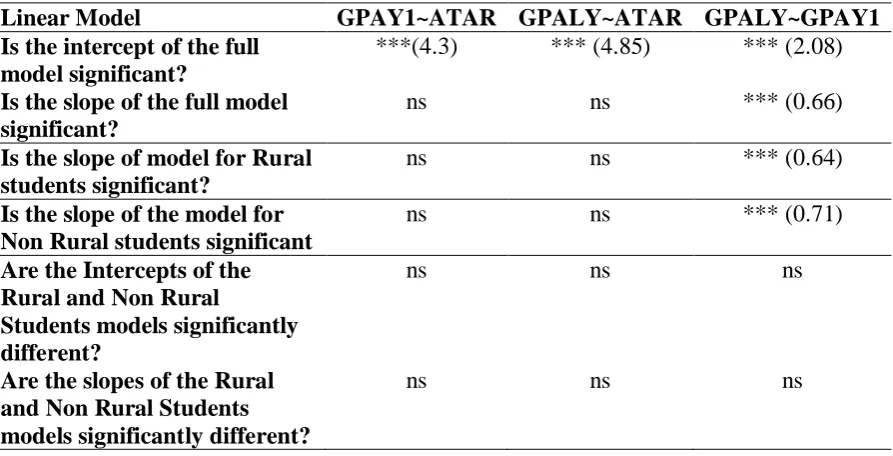
The relationship between ATAR and GPA is therefore important as ATAR is considered a suitable predictor of performance within a degree. Our analysis of the cohort of Clinical Science students who were successful in applying for Graduate Medicine and Dentistry Table 2), indicates that the relationship between ATAR and GPA in First Year (GPAY1) or between ATAR and GPA in the Last Year (GPALY) was not significant (p>0.1). The relationship between GPA in first and last year, however, was significant (p<0.001). These results demonstrate that students from varied education and geographic backgrounds, with academic and transitional support, can achieve at the highest levels within the tertiary system.
Table 2. The statistical significance of the relationships between ATAR and GPA in Year1 (GPAY1) and in the Last Year (GPALY), for the graduate cohort of the B.Clinical Science, Charles Sturt University, who gained entry to a Medical or Dental degree, 2009-2015. Values in brackets indicate the value of the statistic, and “***” indicates significance at p<0.001.
Linear Model GPAY1~ATAR GPALY~ATAR GPALY~GPAY1
Is the intercept of the full model significant?
***(4.3) *** (4.85) *** (2.08)
Is the slope of the full model significant?
ns ns *** (0.66)
Is the slope of model for Rural students significant?
ns ns *** (0.64)
Is the slope of the model for Non Rural students significant
ns ns *** (0.71)
Are the Intercepts of the Rural and Non Rural
Students models significantly different?
ns ns ns
Are the slopes of the Rural and Non Rural Students models significantly different?
ns ns ns
In addition, we compared the intercepts and slopes of the relationships between ATAR and GPA in Year 1, and GPA in the Last Year on the basis of regionality of students (rural or non-rural). Here again we found that only the relationship between GPA in Year 1 and the Last Year was significant (p<0.001). There was, however, no significant difference between the slopes and intercepts of the rural and non-rural groups. This means that the two lines were parallel and had the same intercept. As a result of these analyses, we suggest that a single model, describing the relationship between GPA in First and Last Year, for a combined group of rural and non-rural students is a suitable model to describe the Clinical Science student cohort (Figure 2).
One may question the lack of relationship between attained ATAR and GPA – it may suggest that the subjects are not of a sufficiently high academic standard. Table 1 shows, however, that the subjects delivered within the Clinical Science program’s first two years are taken by students from other programs (because the subjects meet the accreditation standards set by external professional boards for areas of practice including, but not limited to Nursing and Midwifery, Physiotherapy, Pharmacy and, Dentistry). In addition to this, in line with Charles Sturt University policy, all CSU subjects are submitted to a rigorous process of moderation of assessment tasks, specifically to identify bias or a lack of constructive alignment with subject learning objectives. This suggests that many students coming from a wide range of educational
backgrounds and experiences have the capacity to be successful within the tertiary sector with sufficient and appropriate scaffolding, even though they did not initially gain entry to high demand health degrees (Hyde & Southwell, 2011; Hyde, Southwell, & Read, 2011).
Figure 2. Trend line shows the relationship between GPA in Year 1 (GPAY1) and GPA in the Last Year (GPALY) for the graduate cohort of the B.Clinical Science, Charles Sturt University, who gained entry to a Medical or Dental degree, 2009-2015. NB: (i) GPA is on a seven point scale. (ii) Circles in the figure indicate both rural student and non-rural students. (iii) Two cases were removed from this data set because the students completed an Honours year degree after Clinical Science, and were subsequently admitted to a Medical or Dental School.
Of particular significance to the preparation of students for success in gaining entry to, and success in graduate health programs, is the 3rd year experience that involves intensive small group work and mentoring through PBL and a team-based original research project. It is in this year that many students articulate and demonstrate a personal and learning transformation (Hyde & Southwell, 2011; Hyde et al., 2011), which is mirrored not only in their personal reflections on their experience, but also in a jump in GPA across first year to the third and final year (Figure 2 and Table 2).
This result suggests that there is potential in the Clinical Science degree for an academic benefit to accrue to Indigenous students who undertake the course in order to gain entry to and pursue a health profession degree. The important consideration here is of the high proportion of Aboriginal and Torres Strait Indigenous people who live in rural and remote parts of Australia (Bradley et al, 2008). However, the situation for Indigenous students cannot be fully compared to other students due to their particular needs, as indicated in other sections of this paper, and thus why the various initiatives that are described in the next part of this paper were undertaken.
Towards an Indigenous Pathway Program
Given the significant success of Clinical Science to assist many aspiring non-Indigenous students into high demand health-profession degrees, a question remains, ‘What is needed to attract Indigenous students into the degree so that they have the same opportunities for success in these high level STEM programs?’ The following account will demonstrate the need for an Indigenous pathway as well as discuss the initiatives put into place at the Orange campus of CSU and more specifically within Clinical Science to begin to address these issues.
Consulting with Aboriginal colleagues within the university and with local Aboriginal groups was critically important in addressing these aforementioned issues. Developing a partnership with the Orange Local Aboriginal Land Council (OLALC) and, more specifically, its Landcare group, Gaambawananha Ngurambang, was instrumental in achieving the outcomes of this project. The process began with the submission of a needs analysis to the Head of School that proposed establishing a specific Aboriginal and Torres Strait Islander Pathways Program (ATSIPP) for students to prepare their entry into health-related degrees (Hyde & Parissi, 2013). The report was reviewed and accepted by Aboriginal colleagues within CSU. Meetings were subsequently held with members of the Wiradjuri Council of Elders, the Local Orange Council of Elders and the Orange Aboriginal Medical Service, over a period of 18 months. In total, approximately 45 hours of meetings and ceremonies with indigenous leaders were conducted. The relationships formed during these meetings developed into a more formal partnership when grants from CSU sources amounting to $55,000 were gained2. The grants allowed the practical application of the partnership, with the Gaambawananah Ngurambang group designing and implementing a series of activities on the Orange campus. An important stage of the project concluded with the official opening of an Aboriginal Nature and Bioscience Park on campus, by the Vice Chancellor of CSU and a ‘Welcome to Country ceremony’ by an Elder from the OLALC group in March 2016. This process is detailed below.
The (urgent) need for Indigenous students in STEM degrees
We begin our description of practice with a rationale for the ATSIPP project. The Aboriginal and Torres Strait Islander population is one of the three most disadvantaged groups within the higher education system, perpetuating a cycle of low socioeconomic status and poor health (Bradley et al., 2008). To help alleviate this, studies indicate that Aboriginal and Torres Strait Islander participation in higher education should be much higher than it currently is (Barney, 2013; Devlin & James, 2006; Sharrock & Lockyer, 2008). Increasing student participation rate in higher education is a crucial factor in helping to reduce this disadvantage overall (Devlin & James, 2006; Kippen, Ward, & Warren, 2006; Pechenkina, Kowal, & Paradies, 2011) and meet the continuing demand for Aboriginal and Torres Strait Islander higher education graduates (Bandias, Fuller, & Larkin, 2013). Research shows that attracting Aboriginal and Torres Strait Islander students does not mean they will stay to completion however (Pechenkina et al., 2011), with completion rates failing to mirror enrolment rates (Behrendt, Larkin, Griew, & Kelly, 2012). It is therefore imperative to develop support strategies alongside of recruitment strategies to ensure success for those Aboriginal and Torres Strait Islander students who enrol. To improve the success of Aboriginal and Torres Strait Islander students, a recent Australian Commonwealth government report (Behrendt et al., 2012) suggested that universities focus their efforts on supporting students in those disciplines which will contribute most to closing the gap in areas of need and in those degrees in which Aboriginal and Torres Strait Islander students are under-represented. The lack of participation by Aboriginal and Torres Strait
2 The partnership that developed the plans consisted of 10 academic, support and grounds staff, and 9 members
of OLALC, particularly from its Gaambawanahah Ngurambang landcare group.
37
Islander people in higher education results in a lack of these graduates and postgraduates across the spectrum of professions, limiting the professions’ access to alternative perspectives, knowledge and skills (Behrendt et al., 2012).
Studies suggest that increased enrolment in health science programs is essential to produce a future healthcare workforce equipped to meet the need of Aboriginal and Torres Strait Islander people (Kippen et al., 2006), and it is recognised that health, education, and economic status are interrelated (Rigby et al., 2011). The need for greater participation in health education and research by Aboriginal and Torres Strait Islander students is also supported by the fact that Aboriginal and Torres Strait Islander doctors are more likely than their non-Indigenous counterparts to have a higher proportion of Aboriginal and Torres Strait Islander patients, and possess greater understanding of the health needs of Aboriginal and Torres Strait Islander people (Garvey, Rolfe, Pearson, & Treloar, 2009). Health education is one of the fields of study with one of the highest attrition rates for Aboriginal and Torres Strait Islander students, alongside architecture and education (Bandias et al., 2013). Significantly, the Medical Deans of Australia and New Zealand (MDANZ) submission to the Review of Higher Education access and outcomes for Aboriginal and Torres Strait Islander people noted that, in 2011, just 11 Aboriginal and Torres Strait Islander medical students graduated, representing only 0.5% of all domestic medical graduates (Medical Deans of Australia and New Zealand, 2011).
Fostering success for Indigenous students
While CSU has performed well in establishing a strategic framework and with some successful health programs already in operation, there is much work to be done. Some of the successes include the development of an Indigenous Education Strategy (IES) (Williams, 2007), Reconciliation Action Plan, and Cultural Competence pedagogical framework alongside a suite of services dedicated to implementing the strategy and supporting Aboriginal and Torres Strait Islander staff and students (Tulloch, 2014). At a degree level, CSU has a record of achievement, with the Bachelor of Health Science (Mental Health), Djirruwang Program recognised as a best practice model within CSU, alongside of the CSU Pathways and Partnerships Program where a series of university study centres in rural locations provide assistance to Aboriginal and Torres Strait Islander people wanting to enter higher education (Behrendt, 2011).
CSU is built upon the lands of the Wiradjuri people, the largest Indigenous territory of Australia, and home to approximately 44,000 Indigenous Australians, representing 3.2% of the total population in the region, however Aboriginal and Torres Strait Islander students comprise only 2.2% of the CSU student population (Williams, 2007). There is a need for more dedicated strategies to recruit, support, retain, and graduate Aboriginal and Torres Strait Islander students. Important to consider is the attrition rate for Indigenous students, even though CSU is about on par with the sector. Nevertheless, Indigenous attrition of 20% for internal students and 48% for distance students is a major concern (information from the CSU Office of Planning and Audit, 2012, data held by the authors). Given these data, the government strategies, the CSU strategic framework, and the positive examples of practice in CSU, the need to develop suitable initiatives on the Orange campus was apparent, and has been taken up by staff. These initiatives are described here.
Developing Cultural Competence at CSU
Implementing a system of cultural competence among staff and students is crucial for attracting Aboriginal students and helping them to succeed. One of the key factors repeated in the literature is that students need to feel ‘culturally safe’ – partially through the presence of Aboriginal and Torres Strait Islander staff, but also through an appropriate pedagogical
framework which is sensitive to the needs of Aboriginal and Torres Strait Islander learning styles, as well as physical expressions of Aboriginal culture on campus (Kippen et al., 2006). As described by Trudgett (2011), this idea of cultural responsibility and fear of cultural alienation is a significant feature which has the potential to impact on students’ success, and has already been shown to be perceived as a barrier to achievement in higher education (Regional Aboriginal Education Team, 2012; Rigby et al., 2011). In their qualitative study of the experiences of Aboriginal and Torres Strait Islander students in a public health degree in Victoria, for example, Kippen et al. (2006) found that the formal environment of the university was perceived by Aboriginal and Torres Strait Islander students as lacking in the flexibility they needed, and this contributed to poor learning.
Another critical issue was the lack of cultural sensitivity in students, staff, as well and other health care workers when students were on placement; this led many Aboriginal and Torres Strait Islander medical students enrolled at The University of Newcastle to experience alienation. Participants in one study, for example, reported having to continually justify why they were in the program, how they got in and how they passed (Garvey et al., 2009). A further report by the Australian Indigenous Doctors Association (AIDA) found that discrimination and racism are a part of the learning environment for many Aboriginal and Torres Strait Islander students in medical education (Ellender et al., 2008; Regional Aboriginal Education Team, 2012). It is important for any pathways program to therefore incorporate cultural competence into the mainstream, and in that way to educate all students and staff about the impact of such discrimination and ending stereotypical perceptions.
Drawing on a report from the Medical Deans of Australia, Ellender et al. (2008) explain the importance for Aboriginal and Torres Strait Islander health issues to be longitudinally integrated into the medical curriculum in addition to all staff and students becoming more skilled at cultural safety. The research conducted by this author into why Aboriginal and Torres Strait Islander medical students ‘drop out’ points to emotional homesickness issues as well as family and financial difficulties.
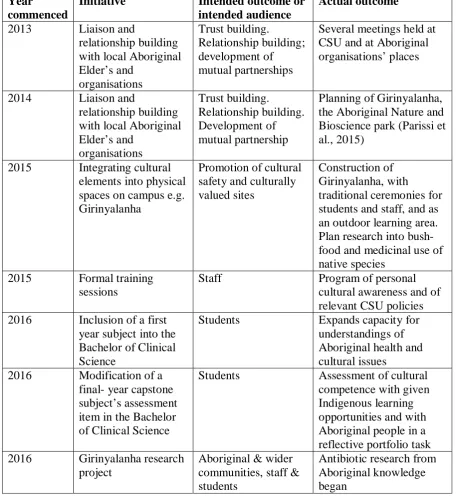
In view of this body of research, staff from Clinical Science initiated a program of developing cultural sensitivity and awareness among fellow academics and support staff on the Orange Campus between 2013 and 2016: these are outlined in Table 3. In 2013, contact was made with and meetings were held between CSU academic staff and the Local Orange Elders Council of the Wiradjuri; with that, an 18-month process of trust-building commenced. Sometimes this was not an easy journey, but certainly a highly rewarding one and one that led to several advantages for all concerned. Eventually, contact was made with the Orange Local Aboriginal Land Council (OLALC) to rehabilitate a weed-infested two hectare patch of remnant woodland that is situated near the teaching area of the campus. From this, a collaborative partnership arose with Aboriginal Elders holding several ceremonies that were open to the campus and local communities, including two where staff and students were involved in helping with the arrangements and participating in the ceremonies.
Another way to help make Indigenous students feel more culturally safe is to establish or re-establish Aboriginal cultural elements onto the physical space of the campus. Beginning in 2014, a collaborative effort with OLALC has established ‘Girinyalanha’, the Aboriginal Nature and Bioscience Park in an area of remnant woodland, which is adjacent to the teaching area of the Orange campus. Girinyalanha in the Wiradjuri language means to talk together, to communicate, to engage in thought and feeling, and to share knowledge and culture. The site was cleared of exotic weeds and new local species were planted by members of OLALC with
a grant from CSU that was gained by staff. In aiming to deepen understanding of Aboriginal cultural values in all education programs, and to boost support for Indigenous students, the Park was designed to create a new space for reflection, teaching and research. With this, a journey of mutual understanding, learning and cooperation has begun (Parissi, Rawson, Anderson, Kinross, & Raman, 2015).
Table 3. Program of cultural competence within the School of Biomedical Science at Orange campus.
Year
commenced
Initiative Intended outcome or
intended audience
Actual outcome
2013 Liaison and
relationship building with local Aboriginal Elder’s and organisations Trust building. Relationship building; development of mutual partnerships
Several meetings held at CSU and at Aboriginal organisations’ places
2014 Liaison and
relationship building with local Aboriginal Elder’s and organisations Trust building. Relationship building. Development of mutual partnership
Planning of Girinyalanha, the Aboriginal Nature and Bioscience park (Parissi et al., 2015)
2015 Integrating cultural elements into physical spaces on campus e.g. Girinyalanha
Promotion of cultural safety and culturally valued sites
Construction of Girinyalanha, with
traditional ceremonies for students and staff, and as an outdoor learning area. Plan research into bush- food and medicinal use of native species
2015 Formal training sessions
Staff Program of personal
cultural awareness and of relevant CSU policies 2016 Inclusion of a first
year subject into the Bachelor of Clinical Science
Students Expands capacity for
understandings of Aboriginal health and cultural issues
2016 Modification of a final- year capstone subject’s assessment item in the Bachelor of Clinical Science
Students Assessment of cultural
competence with given Indigenous learning opportunities and with Aboriginal people in a reflective portfolio task 2016 Girinyalanha research
project
Aboriginal & wider communities, staff & students
Antibiotic research from Aboriginal knowledge began
Within Girinyalanha, a traditional Aboriginal mosaic burn3 was used in March 2015 to both clear weeds and to expose any symbols of cultural significance, such as three identified Scarred Trees which were found. Scarred Trees are culturally significant but also clearly demonstrate that the site was an important place for past generations of Wiradjuri people. Within the site, a Yarning Circle with pathways designed by OLALC to be of symbolic importance to local Wiradjuri peoples was created, and re-planting of understorey vegetation contained plants of local cultural and conservation significance. It is hoped that the park will inspire research into medicinal and bush food potential of local vegetation species (which has begun), as well as a sought-after resource for teaching and reflection, and as a place of cultural significance for Aboriginal and non-Aboriginal staff, students and members of the local communities.
The physical and relationship-building components of the Clinical Science initiative have been consolidated by the incorporation of a series of formal training sessions and changes to subjects within the degree program, as described in Table 2. This component of the change process consists of three parts: three workshops, online cultural competence training, and changes to degrees and subjects. The first two workshops consisted of interactive discussions led by a Clinical Science staff member that had factual information as well as some cultural elements such as Aboriginal song. Since the workshops were for lecturers from the School of Biomedical Science, although with some non-academic staff, the primary theme was to demonstrate facts of Aboriginal science4 and the links with Western science (Regional Aboriginal Education Team, 2012). The third workshop was led by a senior Aboriginal member of the university and covered some similar themes, but was specifically targeted at outlining the requirements for implementing CSU’s policies in this area.
So far, the practical outcomes from these initiatives were put into practice in the following year, 2016, such as including a new subject into the Clinical Science degree in the first semester
3 A mosaic burn is a type of cool burning technique to aid biodiversity and traditionally used to bring on fresh
grass to attract game for hunting. “Essentially, the technique involves burning a small patch in mild conditions, such as cool mornings or late afternoons in late autumn and early winter, and when there is little breeze” http://www.abc.net.au/news/2016-05-24/monaro-farmers-use-aboriginal-cool-burn-fires-to-recover/7440824
4 Aboriginal science can be understood in a similar fashion to a common understanding of Western science,
namely, a way of perceiving and interpreting nature. In particular, for some, Western science is moving in the direction of an Indigenous ‘wholistic’ approach (George, 2011; Regional Aboriginal Education Team, 2012). Perhaps, and more specifically, this can be seen in the Western science of Systems Theory (Checkland & Scholes, 1990) and a range of other of the ‘new’ Western sciences, eg, Complexity Theory, Gaia Theory and Chaos Theory (Capra, 1996).
Figure 3. Culturally significant Mt Canobolas from Girinyalanha, the Aboriginal Nature and Bioscience Park at the Orange Campus of Charles Sturt University.
Figure 4. The established Yarning Circle at Girinyalanha, the Aboriginal Nature and Bioscience Park at the Orange Campus of Charles Sturt University.
41
of first year. The inclusion of this subject has facilitated a discussion of the notion of Aboriginal science as a way of understanding how science can work in different cultural contexts. Another subject in Clinical Science has added an assessment item, part of a third year reflective portfolio, that requires the students to consider, critically analyse and reflect on their experiences in Aboriginal focused case studies, field visits, meeting with Aboriginal Elders, films, lectures and other learning experiences.
Conclusion
The Orange campus cultural engagement project, although a work in progress, may serve as a model for encouraging the inclusion of Aboriginal and Torres Strait Islander, and of Indigenous people in general, into STEM tertiary studies, such as the Bachelor of Clinical Science. This can then help with the larger issue of improving the dire health outcomes of Indigenous Australians. However, without the appropriate acculturation and inclusive processes and programs, many Indigenous students have demonstrated their dissatisfaction with the process of tertiary education by the high attrition rates from these degrees. Initiatives at CSU have been helped by the natural advantage that the CSU Orange campus has in being in a rural area, with a space enough to create an Aboriginal Nature and Bioscience Park, Girinyalanha. This latter project has itself been key to establishing partnerships with local Aboriginal communities and then, as appropriate, allowed staff and students to listen to, observe and engage in Aboriginal cultural stories and ceremonies. The longer term aim is to also help to make our campus culturally safe for Indigenous students, as well as fostering research projects. Establishing these direct and mutually meaningful partnerships between the university and Aboriginal people is a vital lesson that we have learned. Future directions are aimed at developing an awareness of these initiatives among potential students and future applicants, and investigating strategies to provide further personalised support to Aboriginal and Torres Strait Islander students for the application and entry process through to study completion.
Acknowledgements
We acknowledge here that the campus and the Clinical Science degree are located on the land of the original inhabitants, the Wiradjuri people. We also wish to acknowledge the help and involvement of the staff at the Orange campus of Charles Sturt University, and especially our creative partnership with members of the Orange Local Aboriginal Land Council. We are grateful for the funds from a CSU Green Sustainability Grant, and the CSU Orange Campus Agricultural Education and Research Grant which allowed for the work to create Girinyalanha
to be accomplished. Particular thanks go to Dr Peter Anderson and Dr Yann Guisard who provided advice and help with the statistical analysis undertaken.
References
Aspin, C., Brown, N., Jowsey, T., Yen, L., & Leeder, S. (2012). Strategic approaches to enhanced health service delivery for Aboriginal and Torres Strait Islander people with chronic illness: a qualitative study. BMC Health Services Research, 12(1), 1-9. doi: 10.1186/1472-6963-12-143
Azer, S. A. (2007). Medical education at the crossroads: Which way forward? Annals of Saudi medicine, 27(3), 153.
Bandias, S., Fuller, D., & Larkin, S. (2013). Vocational Education, Indigenous Students and the Choice of Pathways. Research Report: ERIC.
Barney, K. (2013). ‘Taking your mob with you’: Giving voice to the experiences of Indigenous Australian postgraduate students. Higher Education Research & Development, 32(4), 515-528.
Behrendt, L. (2011). RE: Review of Higher Education Access and Outcomes for Aboriginal and Torres Strait Islander People.
Behrendt, L., Larkin, S., Griew, R., & Kelly, P. (2012). Review of higher education access and outcomes for Aboriginal and Torres Strait Islander people: Final report (A. Government Ed.). Canberra, ACT: Department of Industry. Innovation, Science, Research and Tertiary Education.
Bradley, D., Noonan, P., Nugent, H., & Scales, B. (2008). Review of Australian higher education: Final report [Bradley review].
Capra, F. (1996). The web of life: A new scientific understanding of living systems. New York: Anchor Books. Checkland, P. & Scholes, J. (1990). Soft systems methodology in action. Chichester: John Wiley & Sons. Devlin, M., & James, R. (2006). Partnerships, pathways and policies: improving indigenous education
outcomes: Dept. of Education, Science and Training.
Ellender, I., Drysdale, M., Chesters, J., Faulkner, S., Kelly, H., & Turnbull, L. (2008). When a dream becomes a nightmare: Why do Indigenous Australian medical students withdraw from their courses? The Australian Journal of Indigenous Education, 37(01), 40-47.
Garvey, G., Rolfe, I. E., Pearson, S. A., & Treloar, C. (2009). Indigenous Australian medical students’ perceptions of their medical school training. Medical education, 43(11), 1047-1055.
George, J, M. (2011). Indigenous knowledge as a component of the school curriculum. In L. M. Semali & J. L. Kincheloe (Eds.), What is Indigenous knowledge? Voices from the academy (pp. 79-94). New York: Routledge.
Griffin, B., Harding, D. W., Wilson, I. G., & Yeomans, N. D. (2008). Does practice make perfect? The effect of coaching and retesting on selection tests used for admission to an Australian medical school. Medical Journal of Australia, 189(5), 270.
Griffin, B., & Hu, W. (2015). The interaction of socio‐economic status and gender in widening participation in medicine. Medical education, 49(1), 103-113.
Hackling, M., Byrne, M., Gower, G., & Anderson, K. (2015). A pedagogical model for engaging Aboriginal children with science learning. Teaching Science: The Journal of the Australian Science Teachers Association, 61(1).
Hyde, S. J. & Parissi, C. (2013). Justification for an Aboriginal and Torres Strait Islander pathwaysprogram at CSU, Orange campus: Final report. School of Biomedical Sciences, Charles Sturt University: Wagga Wagga, Australia. (Report is available from the authors).
Hyde, S. J., & Southwell, P. J. (2011). The effect of PBL on students' personal and academic development. Paper presented at the CSUEd, Albury, NSW.
Hyde, S. J., Southwell, P. J., & Read, D. (2011). Trannsformation of student academic regulation over a PBL year. Paper presented at the Association for Health Professional Educators, Alice Springs, NT.
Keast, K., & Dragon, N. (2015). Indigenous health: Stepping into the gap. Australian Nursing and Midwifery Journal, 22(8), 18.
Kippen, S., Ward, B., & Warren, L. (2006). Enhancing Indigenous participation in higher education health courses in rural Victoria. The Australian Journal of Indigenous Education, 35, 1-10.
Medical Deans of Australia and New Zealand. (2011). Review of higher education access and outcomes for Aboriginal and Torres Strait Islander people. https://docs.education.gov.au/documents/medical-deans-australia-and-new-zealand-inc: Department of Education.
Parissi, C., Rawson, A., Anderson, P., Kinross, C., & Raman, A. (2015). Aboriginal Nature and Bioscience Park: A journey of research into Aboriginal cultural engagement and science. Poster presented at the Biodiversity Dreaming Conference, Bathurst NSW.
Pechenkina, E., Kowal, E., & Paradies, Y. (2011). Indigenous Australian students' participation rates in higher education: Exploring the role of universities. The Australian Journal of Indigenous Education, 40, 59-68. Regional Aboriginal Education Team. (2012). 8 ways: Aboriginal pedagogy from Western NSW. Dubbo: NSW
Department of Education and Communities.
Rigby, W., Duffy, E., Manners, J., Latham, H., Lyons, L., Crawford, L., & Eldridge, R. (2011). Closing the gap: Cultural safety in Indigenous health education. Contemporary Nurse, 37(1), 21-30.
Sharrock, P., & Lockyer, H. (2008). One to one and face to face: A community based higher education support strategy retaining Indigenous Australian university students. The Australian Journal of Indigenous
Education, 37(01), 28-39.
Smith, J. D. (2016). Defining rural and remote Australia. In J. D. Smith (Ed.), Australia's Rural, Remote and Indigenous Health (3 ed., pp. 23-44). Chatswood: Elsevier.
Springer, S., & Smith, J. D. (2016). Working with Indigenous People. In J. D. Smith (Ed.), Australia's Rural, Remote and Indigneous Health (3 ed., pp. 124-154). Chatswood: Elsevier.
Trudgett, M. (2011). Western places, academic spaces and Indigenous faces: Supervising Indigenous Australian postgraduate students. Teaching in Higher Education, 16(4), 389-399.
Tulloch, M. (2014). Indigenous Cultural Competence: A journey for staff and students. Bathurst: Charles Sturt University.
Williams, S. (2007). Indigenous Education Strategy (Centre for Indigenous Studies, Trans.). www.csu.edu.au: Charles Sturt University.