Issues
ISSN: 2146-4138
available at http: www.econjournals.com
International Journal of Economics and Financial Issues, 2016, 6(4), 1760-1767.
The Effectiveness of Catastrophe Bonds in Portfolio
Diversification
Massimo Mariani
1*, Paola Amoruso
21Department of Corporate Finance, LUM Jean Monnet University, Casamassima (Ba), Italy, 2LUM Jean Monnet University,
Casamassima (Ba), Italy. *Email: [email protected]
ABSTRACT
The rapid growth of catastrophe bonds in financial markets is due to increasing environmental disasters and consequent economic losses, barely covered by insurance and reinsurance companies. These securities represent an effective solution, allowing the risk transfer to the capital market. The objective of this paper is to prove real advantages of the investor who operates in this market segment, in terms of portfolio diversification. The present work indeed shows how investing in catastrophe instruments produces actual benefits for investors both in term of diversification and total return. In fact the final results of the quantitative analysis show how efficient cat-bonds are in terms of stability, being characterized by lesser volatility and fairly stable returns. Thus, the risk potentially connected to these bonds wouldn’t be a limiting factor for their development. Particularly the trend of catastrophe
bonds highlights how the possible implementation and spreading of these instruments could improve portfolio strategies. Keywords: Financial Markets, Catastrophe Bond, Portfolio Diversification
JEL Classifications: G1, G11
1. THE RECENT TREND OF THE MARKET
SEGMENT IN TERMS OF VOLUMES
The rapid growth of catastrophe bonds on the international stage ismainly due to deterioration of climatic conditions and consequently
of environmental disasters, which cause massive economic losses, which reinsurance and insurance companies are responding to
hardly. Catastrophe bonds are securities, which allow the risk transfer to the capital market, solving the problem on an efficient basis. The present work has the aim to prove benefits connected to
these bonds, from investor perspective. In this regard, the existing
literature of the last 10 years has been focused on the analysis of determinants which influence the pricing of cat bonds, particularly
dealing with price dynamics more than effective advantages for
investors, in terms of portfolio diversification and total return.
Aiming at developing the outlined investigation, describing at the
same time market segment’s dynamics and characteristics, it is necessary to refer to one of the indexes elaborated from 2002 by
Swiss Re, representative of the catastrophe bonds trend at a global level; among the aforementioned indices, the Swiss Re Cat Bond
Price Return selects, for the period 2002-2014, a yearly average
yield, including coupons, equal to 8.3% in line with the trend of the High Yield of Barclay’s (+8.2%) index and superior to that of the American share index Standard and Poor (S&P) 500 (+6.5%).
Generally, natural disasters can be seen as a function of specific
natural process as well as human activity and their impact on society can be investigated through a multitude of factors. The last decade
has been characterized by the sudden deterioration of the world
climatic situation which has determined an increase of natural disasters and of the ensuing caused damages. For example, it has
been estimated that a 10% increase of the wind speed corresponds to an increase of damages produced by the latter of 150%. Its main cause is to be attributed to the lack of environmental biodiversity preservation as well as to the rampant urbanization of high risk
areas (Canter and Cole, 1997). According to a report from the
world Meteorological Organisation (2014) the first decade of the
21st century was characterized by 3.496 natural disasters from
floods, storms, droughts and heat waves, of which approximately 80% were due to flooding and storms. It proves that natural disasters are occurring nearly five times as often as they were in the 1970s.
years proved the strong influence of nature to effect deaths and damages in both developed and developing countries alike. In fact
in existing literature many scholars have argued that the social and economic costs of natural disasters are disproportionately borne by
poor people in developing countries. For instance, between 1980 and 1999, India experienced fourteen earthquakes that killed a
total of 12,137 people while the United States experienced nine
earthquakes that killed only 137 people (Kahn, 2005). Infact the response of societies to natural hazards depends on both country-specific climatic and topographic factors and numerous socio-economic factors (Fuchs et al., 2007). Particularly, higher income
as well as educational achievement seemed to contribute towards
reduction of capital losses and human fatalities (Skidmore and Toya, 2007). The idea that economic development allows a country to better manage and mitigate the risk from disasters is intuitive, and
empirical evidence report, obtained by using cross-sectional or
panel macro data (e.g., UNDP, 2004; Anbarci et al., 2005; Kahn, 2005; Skidmore and Toya, 2007) showed results that are broadly
supportive of this logic. In this context an effective solution in
represented by catastrophe bonds; they are innovative financial instruments which propose an effective solution to the significant losses provoked by environmental disasters that, relatively to 2014, had a global value of 110 billion USD of which about 31 of ensured losses, registering a decrease compared to 140 billion USD of 2013 and overall, compared to the average relative to the past 10 years appropriate to inflation (Guy Carpenter, 2015). This was equal to about 190 billion USD of which 58 were ensured
(Insurance Information Institute). Specifically, cat bonds are constituted by bonds emissions covering a determined catastrophic
event (i.e., earthquake, seaquake, hurricane, fire, etc.) enabling the insurance and/or reinsurance companies to transfer the risk
and therefore the duties for the reimbursement of the damages connected to the aforementioned events by the insurer to the
capital market through a special purpose vehicle (SPV), namely a
third party company created ad hoc (Braun, 2011). Bonds return is correlated to the loss potential risk that can be referred to a
determined period of time, to a geographical area or to a particular
type of disaster; the paid interest is generally superior to the stock market indices as a prize for the extra risk (Cummins, 2008).
If the event, object of the bond, actually takes place, the interests
and/or the capital due to the investor who has undersigned the
former, are used to support compensation requests. In view of the clear advantage that the aforementioned financial product
represents for insurance companies, offering the effective
possibility of preventing illiquidity situations deriving from compensation requests following serious natural disasters, there is also an effective benefit that the investor can obtain from the trade off between risk and return, as well as a low correlation of the bond with the market risk. Typically this security has an average duration of 3 years and it refers to specific triggers according
to which contractual obligations start, that will be explained
in due course (Kenneth and Froot, 1999). Most of the previous authors who explored cat bond pricing in secondary market, have
evaluated the bond as a function of expected probability of loss;
in this regard, Cox and Pedersen (2000) developed a pricing approach based on the requirement of a term structure model and on a probability feature for the catastrophe risk exposure.
Nevertheless, other authors have developed analysis by using
Poisson distribution in order to model catastrophe probabilities, as for instance Baryshnikov et al. (2011), and Jin-Ping and Min-Teh (Lee and Yu, 2002). Loubergé proposed a valuation
methodology which interested exclusively cat bonds with an
Industry Loss Index (Loubergé et al., 1999). In more recent times, different valuation approaches have been developed; Gomez and Carcamo in 2014 proposed a multifactor pricing model for
cat bonds, including factors considered relevant for investors
such as interest rate, credit rating and expected losses (Gomez and Carcamo, 2014). During the same year, Braun presented an analysis based on a series of ordinary least squares regressions with heteroskedasticity and autocorrelation consistent standard
errors in order to identify the main determinants of the cat bond
spread at issuance, confirming the relevance of the expected loss.
Moreover additional determinants proved major impact such as covered territory, sponsor, reinsurance cycle, and the spreads
on comparably rated corporate bonds (Braun, 2014). In 2009 Dieckmann proposed an analysis based on a set of 61 bonds, referred to periods both before and after hurricane Katrina (2005), in order to evaluate significant spread drivers as well as the effect of catastrophic event on pricing relation (Dieckmann, 2009). The impact of hurricane Katrina on the pricing of cat bonds has been also investigated by Ahrens et al. (2013), by drawing a Bayesian estimation technique to test the Lance Financial model introduced by Lane (2000). Some of the above mentioned variables, such as
expected loss, covered territory and reference peril were included
in the analysis proposed by Bodoff and Gan (2009), which was conducted on a sample of 115 transactions issued before 2008, in
order to investigate cat bond pricing. Some of the major models
developed in literature were compared by Jaeger et al. (2010) and then by Galeotti et al. (2012). However, the most interesting
study developed in recent years has been conducted by Guertler
et al.; particularly it deals with secondary market trend and it concerns the impact of financial market volatility as well as of
relevant natural disasters on cat bond spreads, by using panel data
methodology (2014). In fact, the majority of existing literature has been focused on investigating the significance of various
potential spread determinants, typically characteristics which are
consistent with the specific structure of cat bond. Edwards et al. (2007) focused the analysis on the corporate debt market, finding
that larger issue volumes are associated with lower transaction
costs. Moreover, the influence of term structure on the interest rate was largely debated by Cox et al. (1985). Cummins and Weiss in 2009 stated that investors demand to be compensated with higher spreads in cat bonds market in of moral hazard by the sponsor (Cummins and Weiss, 2009). With reference to the
covered territory and the reference peril, possible effects of these
factors has already been investigated by Lei et al. (2008), Bodoff and Gan (2009) and Papachristou (2009), and were subsequently objects of following studies (e.g. Galeotti et al., 2012). Moreover, generally it’s common knowledge that yields for corporate and
government bonds are related to rating classes (e.g., Elton et al.,
2001). Consequently a similar relation can be associated with
the spread of cat bond and its rating. According to Guertler et al.
(2014) fixed-income investors usually look to securities with the same rating as characterized by same risks, and a similar effect
The positive trend of the analyzed market segment has characterized the course of the first semester of 2015. Indeed, on the 5th of April there were seven new simultaneous issuing on the
market. Consistently the events taking place at the beginning of the
year encouraged the returns of the whole year. In fact, according to Artemis database, the whole amount of the new catastrophe bonds
issuing, relative to the first semester of 2015, has been estimated equal to 4.2 billion dollars, a value which further increases taking into account the issuing in euro which amount to about 485 million.
However, if from the one hand the growth of volumes could be
considered a particularly positive factor, on the other a significant development of the market could not benefit the latter, with
particular reference to a lowering of the relative yield due to the progressive increase of the audience of investors, without an
effective decrease of the risk, thus producing non balanced risk-returns profiles for investors.
A clear signal of the ongoing growing importance that these
bonds have for the global insurance markets can be read through the acts of the UK government that has recently stated, within its own budget plans, the intention to modify the fiscal legislation in
order to enable the issuing and the domiciliation of cat bonds in the
domestic context. A similar intervention could lower the marketing cost of these products, speeding up the market growth and favoring
the creation of more supportive conditions for investors. Even
France and more recently Spain, have recognized the importance
of this sector, foreseeing state interventions in this sense; in fact, private subjects property owners who stipulate a policy against
fire are obliged to underwrite a guarantee clause against natural
catastrophes with the state, that, for this reason has created a public reinsurance company.
As detailed above, the current paper has the objective of
investigating the analyzed market segment trend. In this
perspective the selected sample was composed by the whole of catastrophe bonds issued from 1998 until today, chosen by Artemis
database from which insurance linked securities,not strictly related to natural catastrophe,were excluded. The idea was to highlight the variations recorded in the issuing volumes in the chosen time frame and later, it was shown the scarce dependency existing
between the segment that can be brought back to cat bonds and the traditional market. Finally, comparing the monthly and annual returns of the analyzed instruments, it was proven the effective
advantage that would follow inserting catastrophe bonds within
a traditional portfolio both in terms of diversification and in light
of a greater stability in the returns of the same.
2. ORIGIN AND DEVELOPMENT OF
CATASTROPHE BONDS
The increase of catastrophe dimensions, of their frequency and
their great costs of compensation has stressed the incapacity of the
reinsurance industry to effectively aggregate and diversify risk,
supplying the necessary capital to cover damages (Cummins et al., 1999). It is therefore clear that also the reinsurance traditional
institute isn’t sufficient to guarantee insurability of damages by
catastrophe. In this respect it has become necessary to research
alternative forms to ensure the catastrophic risk.
The first attempts of market segment development, attributable to cat bonds, took place at the beginning of the 90s in the USA,
probably because of the unfavorable geo-climatic and hydro-geologic conditions. In particular, after the hurricane Andrew
in 1992, the capital market was directly considered as a source of financing and participation in the risks, following possible catastrophic future events. The Property and Casualty bonds were developed in this difficult historical moment in order to
face the need stemming out from a limited and costly capacity of
catastrophes reinsurance. These first forms were based on a simple mechanism of catastrophe risk transfer to the capital market,
lessening in this way the branch limiting capacities.
The Chicago Board of Trade and the Bermuda Commodities
Exchange some years later, were forerunners in this market segment, introducing financial instruments in the shape of option contracts connected to the risk following a catastrophic event.
However these first attempts didn’t achieve the desired results and were withdrawn after some years because they lacked exchange
volumes. The little interest created by the aforementioned products in insurers is to be primarily investigated in different directions,
as for example the market lightness and the strong connotation basis-risk, which in the context of catastrophe bonds, reflects the
possibility that a catastrophe bond may not be partially or fully triggered even when the sponsor of the catastrophe bond has
suffered a loss. In fact the study conducted in 2004 by Cummins
et al. showed the relevance assumed by the above mentioned factors in such context.
In 2007, following a period characterized by constant hurricanes
in the USA, that stressed again the strong limits of insurance and
reinsurance markets, the Chicago Mercantile Exchange (CME) and the New York Mercantile Exchange (NYMEX) introduced futures and options connected to the hurricane risk in the USA, generating a peak in such market segment with the placement of 31 new operations during the whole year. Specifically, the CME is an American financial and commodity derivative exchange based in Chicago and founded in 1898, which in 2008 merged with the NYMEX and COMEX.
The first issuing of cat bonds, dates back to 1994, amounted to 85 million dollars and was realized by Hannover Re, which has become Swiss Re since 2001 (Ciani et al., 2014). In the following years, the first of the successive cat bonds issuing by a non-financial company took place in 1999; the same had as object the insurance cover of earthquakes in the Tokyo region for the Oriental Land Company owner of Tokyo Disneyland (Cummins, 2008).
Despite various structural characteristics being tested in the first cat bonds market phases, over the past years there has been a greater orientation towards the standardization of the financial instrument. In first instance, the main reason can be attributed to
the fact that these bonds must comply with the various typologies of
As highlighted during this paper the introduction of cat bonds
is due to an incapacity of the reinsuring market to guarantee an
offer suitable to cover the highest layers, namely those with a low possibility of happening but high severity as stressed by
Froot (2001).
In particular, such solution consists of the securitization of financial
or insurance instruments shaped as bonds based on catastrophic
risk. They operate as a collateral protection for the risk that can be assimilated to extreme events, cancelling the counterpart risk against the payment of a long-standing fixed price. Cat bonds offer a potential cover relating to infrequent events characterized by high severity, transferring the risk of the insurer/reinsurer to the capital market and therefore allowing insurance/reinsurance companies to transfer, part or the entirety of the insured risk to the aforementioned market. These instruments are issued in
favor of investors receiving interest commensurate to the partial
or total capital loss risk, if one or more predefined catastrophic events take place, in relation to particular indices named triggers
because in this circumstance, the bond capital is used to pay the sponsor (generally insurance or reinsurance company promoting the issuing, coinciding with the originator character), who has
benefited from the reinsurance in the transaction. In view of the high return probabilities, higher than the market ones, there is the risk of interests and capital loss against compensation requests
in the event of the activation of one or more triggers. The latter can be different: Indemnity triggers in relation to which payouts are determined in function of the sponsor effective losses; index triggers based on an index which is not directly tied to the aforementioned losses, but it is representative of the accidents relatively to the whole sector; it is therefore in function of the possible losses that the reinsurer could sustain, of the capital to be recovered from investments and of the portfolio losses distribution of the companies involved in the issuing. Hybrid triggers which blend more than one trigger in a single bond; parametric triggers
where the bond payoff is triggered by specified physical measures
of the catastrophic event such as the wind speed and location
of a hurricane or the magnitude and location of an earthquake;
industry loss triggers where the payoff on the bond is triggered when estimated industry-wide losses from an event exceed a
specified threshold. A modeled-loss trigger is calculated using a model provided by one of the major catastrophe modeling firms – Applied Insurance Research Worldwide, EQECAT, or Risk
Management Solutions. The index could be generated by running
the model on industry- wide exposures for a specified geographical area (Cummins, 2008). Alternatively, the model could be run on a representative sample of the sponsoring insurer’s own exposures.
The characteristics that exist among various types of triggers can be essentially attributed to the level of transparency of the same,
aiming at minimizing opportunist behaviors of the originator. On
the contrary, triggers only partially controlled by the originator, can
reduce the problems of moral hazard and guarantee transparency to investors (Lee and Yu, 2002). However it’s important to stress the existence of a trade-off between moral hazard and basis risk: In fact, the triggers guaranteeing a greater transparency minimizing moral hazard phenomena, involve a greater basis risk for the originator. Particularly, the current distribution of different triggers
is described in Figure 1.
The above mentioned securities, consist of an exchange between capital and coupons, in which the payment of the same, or
the capital reimbursement, are subject to the verification of
a predetermined catastrophic event. The sponsor stipulates a
financial reinsurance contract with the SPV aiming at securitizing the risk.
Cat bonds are generally sponsored by insurance and reinsurance companies and catastrophe exposed corporations, all of which
are susceptible to a wide range of risk. The issuance process for
catastrophe bonds is fairly standard, with some variations that
depend on the complexity of the structure and the bond’s trigger
type. Once the trigger type and level of protection has been
selected, the credit rating agencies evaluate the proposed bond’s quality, expressing their opinion as a letter rating from BBB to
A-. The whole amount of the capital destined to the cover of the
reinsured damage, merges ahead of time in the SPV and it can
only be used to cover losses deriving from this bond, therefore
rendering the instrument completely collateralized. What has
been just described, considerably reduces the counterpart where compared to the traditional reinsurance contracts. The mechanism at the basis of the issuance is structured as a reinsuring contract
between the sponsor and the SPV, who obtains the necessary capital to underwrite and fully collateralize the aforementioned
contract through the bond sale. Because this bond is issued directly
by the SPV, it is not affected by the sponsor’s credit rating, nor it is considered to be debt of the sponsor. The typical financial
structure for a catastrophe bond can be described as in Figure 2.
This is a valuable feature, as it eliminates the risk that the
reinsurance contract would not be honored by a reinsurer
bankrupted by other obligations in a truly catastrophic event.
The capital collected by the bond sale can be exclusively used for
the aims prefixed in the reinsurance contract and it merges into
funds created ad hoc that mostly invest in short-term titles, with
the objective of reducing to the minimum the credit risk. Investors are compensated for their risk by receiving a coupon, usually paid quarterly. The coupon is funded by a combination of reinsurance
premiums paid by the sponsor and the proceeds of investing the
bond’s principal. The coupon rate is typically set based in part
on the probability, as determined by AIR, that the bond will lose money due to a catastrophe event. The coupon rate is also based
on market factors such as the supply of similar insurance-linked
securities and investor demand.
Should a defined event occur (the so-called trigger event), the SPV will use part or all the funds lent to it by investors to pay
the appropriate recovery to the sponsor. If no loss-causing events
occur, the bond’s principal is returned to investors after the bond’s scheduled lifetime passes. Most bonds last from 1 to 5 years.
3. ANALYSIS OF THE MARKET SEGMENT
The most important insurance and reinsurance companies in theglobal overview, as for example Lloyd’s and Swiss Re, recognized
for the transfer of insurance risks. Regarding this in July 2015, Swiss Re published a report relative to the reinsurance market and
regarding the new issuances, the analysis focused in a particular way on the spread and development of the aforementioned
financial instruments aiming at obtaining the effective size of such market segment and prove empirically its potential overall returns
generated for the shareholders.
Consistently with what has been explained up to now, Lloyd’s in
collaboration with the University of Cambridge Judge Business School, elaborated a report referring to an interactive map concerning the danger of possible catastrophes and the forecast of damages following the latter, estimated referring to possible losses
in terms of gross domestic product for 301 cities in the world. Such
analysis enables to highlight the implications that would follow, directly conditioning the future scenarios of the whole insurance and reinsurance world. The above mentioned report stresses the possibility to reduce the economic and social costs of catastrophic
events through the insurance practice, quantifying a reduction of 13% of caused losses following an increase of 1% in the market insured share, apart from an increase of 22% of costsat the expense of contributors following a catastrophe.
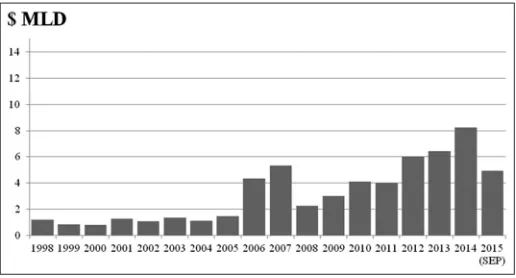
In order to analyze catastrophe bonds market trend in the past 20 years, it is useful to analyze at first the issuances in terms of volumes, assuming a reference period from 1998 to 2015 as
presented in Figure 3.
From an explorative analysis we understand that in the historical reference period, the greatest issuances, in terms of volumes, were
recorded in 2007 and then in 2014.
In 2007, as explained in this paper, following a period characterized by constant hurricanes in the USA, the CME and the NYMEX, to remedy the inadequate capacity of insurance companies to face
such catastrophic event, introduced futures and more generally,
options connected to the hurricane risks in the USA, generating a sudden growth of the market segment object of this analysis
following the placement of 31 new bonds during the whole year.
In 2014, after <10 years, it was carried out the most important cat bonds single transaction by Everglades Re Ltd. Thanks to
this issuance, that reached just before closing the record volume
of 1.5 billion dollars, Florida Citizens Property Insurance Corporation, created in 2002 to provide both windstorm coverage
and general property insurance,increased its own dependency on
market capitals as source of reinsurance cover; the size of this transaction, as its competitive price, allowed citizens to increase its own reinsurance cover up to 68% on the whole. The key factor of
this bond was selected in the structure able to offer an aggregated protection for a series of events in a pre-determined time span;
specifically they are hurricanes, whose repetition could bring to the achievement of the so called trigger point. The risk covered by the
current cat bond can therefore be attributed to an active hurricane
season and not specifically to a single event on a large scale.
Afterwards, aiming at testing the possible advantage that could
be obtained by the investment in the financial instruments object the observation of two indices, one considered as proxy of the market segment that can be referred to cat bonds and the other,
Figure 2: Financial flows for a catastrophe bond
Figure 1: Current trigger breakdown; sector data as of 31 December 2014
Source: Swiss Re Capital Markets
Table 1: Annual returns descriptive statistics
Benchmark Annual returns
Average Standard
deviation Min % Max % Swiss Re Global Cat
Bond Total Return Index 7.4 0.04 1.1% 13.2
S&P 500 Total Return 8.3 0.20 −33.0 38.1
S&P: Standard and Poor
Figure 3: Yearly cat bond trading volumes January 1998-September
Considering a sufficiently wide time span, it has been assumed a period between January 2002 and October 2015. The benchmark
considered aimed at tracing the trend of performance offered by
the traditional market in the last 5 years is the S&P 500 Total
Return Index; the Swiss Re Global Cat bond Total Return Index
has been instead assumed as indication of the cat bond market
return, whose issuance is carried out in dollars.
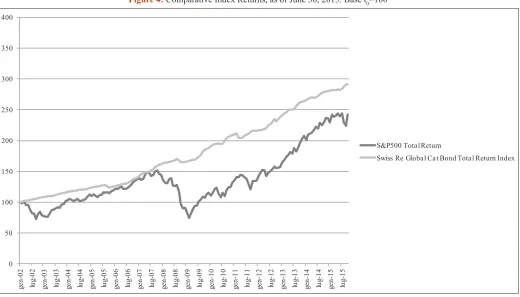
A first comparison reveals a possible independence of the market segment referring to cat bonds compared to the traditional market, offering an effective portfolio diversification to investors in such
instruments, as highlighted in Figure 4. In fact it was observed a correlation among the indices monthly deviations having a value
of around 0.17, namely a substantial incorrelation among the trends
object of this analysis that guarantees the possible advantage in
terms of diversification obtained from the insertion of catastrophe bonds in a stock portfolio.
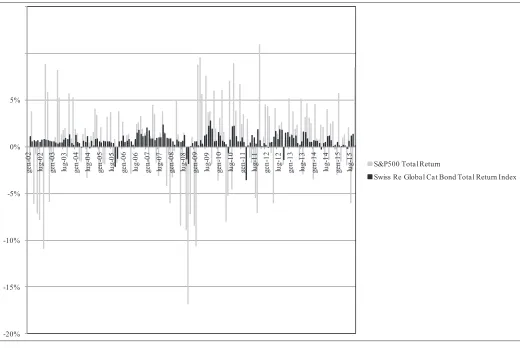
The comparison observed in Figure 5, carried out on the basis of
the two aforementioned indices monthly returns, appears to be
suggesting how the bonds analyzed have a stability which is far superior to the one possessed by stock instruments, and this is confirmed by descriptive statistics presented in Table 1.
Despite the advantages offered by cat bonds low correlation, by
the traditional market trend as well as by the low volatility of the same compared to the one typically characterizing the other asset classes, there still are problems connected to the high risk; in fact in the rare event of losses, the latter assume an important size.
However in light of the recorded results, it can be stated that
cat bonds seem to bring the investor to act in a diversification
framework, neglecting the level of risk connected to such
instruments, which can be mainly attributed to the high downside
risk due to the possibility of non-reimbursement of the initial
investment.
In any case, the analysis of the indices annual returns presented in Figure 6 shows a great difference in the performances, in fact, apart from a lesser volatility, Swiss Re Global Cat Bond Total Return Index obtained positive returns for the whole time span
taken into account, contrary to the benchmark which registered fluctuating results, sometimes even negative. This factor could be attributed to the index internal diversification and therefore, it can
be attributed to the different types of issued cat bonds.
4. CONCLUSION
The rapid growth of catastrophe bonds has been due to the rising number of natural disasters occurred in the last decades, which increased the number of institutions willing to mitigate the impact of catastrophes, and their economic and social costs. This paper
introduces a framework for understanding the potential risks and/ or benefits which can be obtained investing in cat-bonds.
In fact the last decade has seen catastrophic events increasing
in frequency and intensity, causing economic losses with an overall amount of 110 billion USD in 2014. With respect to the
above mentioned data, the share of economic damage covered by
insurance policies is limited and, specifically, it amounts to about 30%, with resulting costs of the residual 70% being charged mainly on taxpayers. In this sense, the analyzed financial instruments could
represent an effective solution, transferring reducing costs to the
financial market, since they are still charged on the public budget.
Figure 5: Monthly Index returns, as of July 2015
Figure 6: Annual Index returns 2002-2015
Moreover the last part of the paper is focused on a quantitative analysis of the cat-bond market both from an historical point of view, in order to highlight the market trend of these securities
since 1998, and from a strictly analytical point of view, comparing
returns of the cat-bond market with those of the equity market.
The analysis performed actually proved that the investment in
cat-bonds produced actual benefits for investors both in terms of diversification and total return. In fact the final results showed how
efficient cat bonds are in terms of stability, being characterized by
lesser volatility and fairly stable returns.
Cat bonds can be therefore seen as a valuable source of
diversification, other than a security which possibly delivers higher return than the traditional ones, also considering the risk-return
trade-off. However, as evidenced in this paper, even if the growth
particular reference to a lowering of the relative yield due to the progressive increase of investors audience, without an effective
decrease of the risk, thus producing non balanced risk-returns profiles for investors. It is therefore necessary to face a twofold issue, linked on the one hand to the need to respond to growing
natural disasters, on the other to guarantee positive returns, not compromised by the excessive increase of investors.
In conclusion, these securities should be the subject of further research, due to the progressive importance they assumed in
the international markets, for instance investigating variables that affect the trade off risk-return as well as exploring how the structure of the bond can influence the performance of the same.
REFERENCES
Ahrens, F., Fuess, R., Kestel, S. (2013), Econometric Pricing Model for Cat Bonds: Bayesian Approach, Handbook of Modelling, Optimization and Bioenergy. Ch. 4. Germany: Springer.
Anbarci, N., Escaleras, M., Register, C.A. (2005), Earthquake fatalities: The interaction of nature and political economy. Journal of Public Economics, 89(9), 1907-1933.
Baryshnikov, Y., Mayo, A., Taylor, D.R. (2011), Pricing of cat bonds.
Statistical Tools for Finance and Insurance, 1, 371-391.
Bodoff, N.M., Gan, Y. (2009), In: Alexander, B., editor. An Analysis of the Market Price of Cat Bonds, Casualty Actuarial Society E-Forum,
Spring.
Braun, A. (2011), Pricing catastrophe swaps: A contingent claims approach. Insurance: Mathematics and Economics, 49(3), 520-536. Braun, A. (2014), Pricing in the primary market for cat bonds: New
empirical evidence. Risk Management and Insurance, 116, 56-82. Cambridge Centre for Risk Studies, Lloyd’s City Risk Index 2015-2025.
Judge Business School, University of Cambridge.
Canter, M.S., Cole, J.B. (1997), The foundation and evolution of the
catastrophe bond market. Global Reinsurance,6, Hedge Financial
Products, Inc., September.
Chen, C. (2014), Buffett Warning Unheeded as Catastrophe Bond Sales
Climb. Bloomberg, 18th June 2014.
Ciani, S.M., Marcelli, A., Pinelli, P., Romani, S. (2014), Economia,
Ambiente e Sviluppo Sostenibile. Milano: Franco Angeli.
Cox, J.C., Ingersoll, Jr., J.E., Ross, S.A. (1985), A theory of the term structure of interest rates. Econometrica, 53(2), 385-407.
Cox, S.H., Pedersen, H.W. (2000), Catastrophe risk bonds. North American Actuarial Journal, 4(4), 56-82.
Cummins, J.D. (2008), CAT bonds and other risk-linked securities: State of the market and recent developments. Risk Management and
Insurance Review,11, 23-47.
Cummins, J.D., Lalonde, D., Phillips, R. (2004), The basis risk of
catastrophic-loss index securities. Journal of Financial Economics, 71(1), 77-111.
Cummins, J.D., Lewis, C., Phillips, R. (1999), Pricing excess-of-loss reinsurance contracts against catastrophic loss. In: Froot, K.A., editor. The Financing of Catastrophe Risk. Ch. 3. Chicago: University of Chicago Press. p93-148.
Cummins, J.D., Weiss, M.A. (2009), Convergence of insurance and financial markets: Hybrid and securitized risk-transfer solutions. Journal of Risk and Insurance, 76(3), 493-545.
Dieckmann, S. (2009), By Force of Nature: Explaining the Yield Spread on Catastrophe Bonds, Working Paper, University of Pennsylvania. Edwards, A.K., Harris, L.E., Piwowar, M.S. (2007), Corporate bond
market transaction costs and transparency. The Journal of Finance, 62(3), 1421-1454.
Elton, E.J., Gruber, M.J., Agrawal, D., Mann, C. (2001), explaining the rate spread on corporate bonds. The Journal of Finance, 56(1),
247-277.
Froot, K. (2001), The market for catastrophe risk: A clinical examination.
Journal of Financial Economics,60(2-3), 529-571.
Fuchs, S., Heiss, K., Huebl, J. (2007), Towards an empirical vulnerability function for use in debris flow risk assessment. Natural Hazards Earth System Science, 7(5), 495-506.
Galeotti, M., Guertler, M., Winkelvos, C. (2012), accuracy of premium
calculation models for cat bonds: An empirical analysis. Journal of
Risk and Insurance, 80, 401-421.
Gomez, L., Carcamo, U. (2014), A multifactor pricing model for cat bonds in the secondary market. Journal of Business, Economics and Finance, 3(2), 247-258.
Guertler, M., Hibbeln, M., Winkelvos, C. (2014), The impact of the financial crisis and natural catastrophes on cat bonds. Journal of Risk and Insurance, 82(3),579-612.
Guy Carpenter. (2015), Global Catastrophe Review - 2014, GC Briefing,
February.
Insurance Information Institute.(2016), Catastrophes: Global. World, Natural Catastrophes: 2015 Natural Catastrophes.
Jaeger, L., Mueller, S., Scherling, S. (2010), Insurance-linked securities:
What drives their returns? The Journal of Alternative Investments, 13(2), 9-34.
Kahn, M.E. (2005), The death toll from natural disasters: The role of
income, geography, and institution. The Review of Economics and Statistics, 87(2), 271-284.
Kenneth, A., Froot, K. (1999), The Financing of Catastrophe Risk.
Chicago: University of Chicago Press.
Lalonde, D.A., Karsenti, P. (2008), So you want to issue a cat bond, Air
Currents, Air Worldwide Corporation.
Lane, M.N. (2000), Pricing risk transfer transactions.ASTIN Bulletin,
30(2), 259-93.
Lee, J.P., Yu, M.T. (2002), Pricing default-risky cat bonds with moral hazard and basis risk. Journal of Risk and Insurance, 69(1), 25-44. Lei, D.T., Wang, J.H., Tzeng, L.Y. (2008), Explaining the Spread
Premiums on Catastrophe Bonds,Working Paper, NTU International
Conference on Finance, Taiwan.
Loubergé, H., Kellezi, E., Gilli, M. (1999), Using catastrophe-linked securities to diversify insurance risk: A financial analysis of cat bonds. Journal of Insurance Issues, 22(2), 125-146.
Papachristou, D. (2009), Statistical Analysis of the Spreads of Catastrophe
Bonds at the Time of Issue. Conference Paper,39th ASTIN
Colloquium.
Policy Issues in Insurance. (2011),Risk Awareness, Capital Markets and Catastrophic Risks. Paris: OECD. p14.
Skidmore, M., Toya, H. (2007), Economic development and the impacts of natural disasters. Economics Letters, 94(1), 20-25.
Swiss Re (2015),Insurance linked securities market update. Vol. XXIII,
January.
United Nations Development Programme. (2004), Reducing Disaster Risk: A Challenge for Development. New York: Bernan Association. World Meteorological Organization (2014), Climate Change 2014: