Original Article
EVALUATION OF CHANGE IN SALIVARY pH, FOLLOWING
CONSUMPTION OF DIFFERENT SNACKS AND BEVERAGES AND
ESTIMATION OF THEIR ORAL CLEARANCE TIME
Neha Gupta, * Shirazi Mutreja, **
Shivalingesh Kamate K, *** Bhuvandeep Gupta
†* Senior Lecturer, Department of Public Health Dentistry, ITS Dental College Hospital & Research Centre, Greater Noida, Uttar Pradesh India
** Senior Lecturer, Department of Pedodontics, DJ College of Dental Science and Research, Modinagar, Uttar Pradesh, India * Reader, Department of Public Health Dentistry, ITS Dental College, Greater Noida, Uttar Pradesh India
† Reader, Department of Public Health Dentistry, ITS Dental College, Greater Noida, Uttar Pradesh India
_________________________________________________________________________
ABSTRACTObjectives: To evaluate changes in salivary pH after consumption of 9 different snacks and beverages and to determine the time taken for their clearance from the oral cavity. Material
and Methods: 125 caries free subjects were selected and were given 9 different snacks and beverages (one item per day) for 9 consecutive days. For each study subject the unstimulated salivary samples were collected at following intervals – before the test food consumption (baseline), immediately after consumption, at 4 mins, 8 mins and 12 mins after consumption of test food. Salivary pH was estimated with the help of digital pH meter. Descriptive statistics were used to describe mean salivary pH and oral clearance time. One way ANOVA and post hoc Tukey’s test was used to compare mean salivary pH at different intervals of time for each test food. Results: It was found that all the food groups except one, caused statistically significant reduction in salivary pH in the following order: carbonated beverage > citrus fruit > apple > chocolate > biscuit > tea > milk > chewing gum containing sugar. Chewing gum containing sugar substitute led to significant increase in salivary pH immediately after consumption. Oral clearance time for the test foods varied widely with only tea and milk getting cleared from oral cavity within 9-12 mins and results were found to be statistically significant. The oral clearance for liquids was found to be faster than the solid foods.
Conclusion: All the test food items whether consumed in solid or liquid form caused a drop in salivary pH except chewing gum containing sugar substitute. The oral clearance was found
to be rapid in beverages compared to snack items.
KEYWORDS: Saliva; pH; oral clearance time; snacks; beverages
INTRODUCTION
Saliva is a complex secretion consisting of 99% of water and remaining 1% of organic and inorganic molecules. The diverse functions of the oral tissues such as mastication, deglutition, taste sensation, speech and initial digestion of the carbohydrates would be impossible without the salivary secretions. The interface between the saliva and oral tissue is the site of many dynamic reactions which affect both the soft tissues and hard tissues of the mouth. Saliva provides the physiologic environment in oral cavity where the complex interactions between the agent, host and the environment factor occur, to bring about demineralization of the tooth and subsequent development of caries. The salivary parameters which affect the enamel stability in the oral environment are pH of saliva, salivary flow rate, oral clearance, concentrations of calcium, phosphate and fluoride ions and salivary levels of
the oral microorganisms.[1] The microbial flora in
the oral cavity contains microorganisms that are
capable of metabolizing fermentable
carbohydrates, leading to the production of a variety of acidic by products. The production of acids by microorganisms within the dental plaque continues until the carbohydrate substrate is metabolized. Stephan et al., reported that within three to five minutes of exposure of these microorganisms to fermentable carbohydrates, the pH of plaque and saliva decrease below the critical pH value of 5.5.[2] This drop in salivary and plaque pH leads to demineralization of the
underlying tooth enamel. With time, the pH once again rises to a resting pH level as the acid is either neutralized or removed from the oral
cavity.[3] The foods which produce a pH drop
below pH 5.5, known as critical pH, are considered detrimental to teeth. The two most important factors that affect the drop in salivary pH after consumption of any food item are the physical properties of the food consumed and the
buffering capacity of the saliva. The
concentration of fermentable carbohydrate in a food does not directly affect the pH drop in the mouth, but it affects the period of time taken to
return to normal pH levels. Thus, the
retentiveness and oral clearance time of a food play an important role in the demineralization of tooth structure.[4,5] Oral clearance refers to the elapsed time between the introduction of a substrate to the oral cavity and the moment when its presence can no longer be detected. Oral clearance can be expressed as half life (50% of
the original concentration of fermentable
carbohydrate) or as detection threshold which is the time taken to reach a concentration at which
the substance is no longer detected.[5] The
clearance pattern of a specific food is very important to estimate its oral availability and can be determined both in vivo and in vitro.[3] Oral clearance properties vary according to individual person and depends upon metabolism of food by microorganisms, adsorption onto oral surfaces, degradation by plaque and salivary enzymes,
saliva flow and swallowing.[6] The foodstuffs vary
widely in their carbohydrate content, tendency to be retained on tooth surfaces, tendency to be broken down by salivary enzymes, and in their capacity to stimulate the flow of saliva. As a result, they have variable effect on salivary pH
and oral clearance time following their
consumption.[7] The food items such as cream
sandwich, cookies and potato chips are more likely to be retained on teeth in larger amounts than foods like milk chocolate, caramels, and jelly beans. These food particles retained on the tooth surface are further hydrolyzed by microorganisms which lead to further decrease in pH of saliva.[6] Keeping the above facts in view, a research was undertaken with the following aims and objectives:
• To evaluate the changes in salivary pH after the consumption of different snacks and beverages.
• To estimate the oral clearance time of different snacks and beverages after their consumption.
MATERIALS AND METHODS
The present study was a clinical study carried out to evaluate the changes in salivary pH, after consumption of different snacks and beverages and to estimate their oral clearance time.
Sampling
300 randomly selected undergraduate students from hostel inmates of K.D. Dental College and Hospital, Mathura were examined. Out of these, 125 subjects were selected on the basis of following inclusion and exclusion criterion:
Inclusion Criterion
Subjects who were caries free i.e. DMFT
score =0
Exclusion Criterion
Subjects who did not give informed consent.
Subjects who were using alcohol or tobacco in
any of the form.
Subjects who were using any medication at
the time of study or in period of last 15 days prior to the study.
Subjects who were suffering from any
systemic illness
All the study subjects were similar with respect to their age, dietary habits, oral hygiene measures and other lifestyle factors which could have significant effect on the study results.
Ethical Clearance
Before carrying out the present study the ethical clearance was obtained from the institutional ethical clearance committee.
Informed Consent
Before the start of the study, the purpose and methodology of the study was explained to each of the subject and informed consent was obtained.
Study Design
Snacks, beverages and oral clearance time Gupta N, Mutreja S, Kamate KS, Gupta B
were given one food item to eat and then unstimulated saliva samples were collected at the following fixed time intervals:
i. 1st follow up - immediately after test food consumption
ii. 2nd follow up - 4 mins after the test food consumption
iii. 3rd follow up - 8 mins after the test food consumption
iv. 4th follow up - 12 mins after the test food consumption
The same study subjects were given 9 different snacks and beverages to eat for 9 subsequent days and subsequent salivary samples were collected. Where appropriate, the foods were consumed as a single item or as a 10g portion, or as 50 mL of liquid drink. In all cases, subjects were requested to consume the food item in as normal a fashion
as possible, avoiding excessive and
unphysiological chewing or rinsing procedures.
Collection Of Salivary Samples
For the collection of unstimulated saliva, subjects were seated comfortably, with their eyes open in a standard dental chair. The subjects sat with their head bent forward and spat into a sterile test tube through a sterile funnel. 1 ml of unstimulated saliva was collected at baseline and at each time interval after test food consumption. For the laboratory analysis, the salivary samples were transported for the laboratory analysis on the same day immediately after the food consumption and salivary pH was estimated within 30 minutes after the collection of the samples.
Laboratory Analysis
The laboratory analysis was carried out in the Pharmaceutics Department of Rajeev Academy of Pharmacy which is located in the college campus only .The salivary pH was directly estimated using the digital pH meter calibrated using buffers of pH 4, 7 and 9. The accuracy of pH meter was checked at regular intervals to ensure that readings were correct. To measure the pH of the saliva, pH sensitive electrode was dipped into 1 ml of saliva. The digital reading was allowed to stabilize for a few seconds and the pH reading was recorded. In between the readings, the electrode was cleaned with a stream of distilled water and placed in a standard solution of pH 7. This ensured stable readings and provided a constant check on any drift. The pH of saliva was measured as soon as possible and not later than 30
minutes after the collection of the sample. The oral clearance time was estimated on the basis of time taken for the salivary ph to return to the baseline values.
Statistical Analysis
The collected data was entered in the Microsoft Excel Sheet and analyzed using the SPSS Ver 12.0 statistical package. The mean and the standard deviation was calculated for the salivary pH using descriptive statistics. One way ANOVA and Tukey’s test was used to compare the changes in the mean salivary pH at various intervals of time after consumption of different snacks and beverages. The p value equal to or less than 0.05 was fixed to be statistically significant.
RESULTS
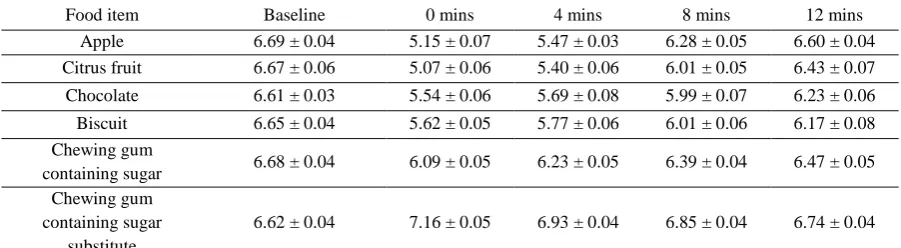
The present study was conducted to evaluate the changes in salivary pH, after consumption of different snacks and beverages and to estimate their oral clearance time. The study was carried out on 125 subjects with the mean age of 22.6 ± 0.5 years. It was found that in all the food groups except one there was reduction in salivary pH immediately after the test food consumption which began to rise 4 minutes after food consumption but did not return to baseline (lower than baseline) even after 12 minutes. The drop in salivary pH was observed in the following order: carbonated beverage > citrus fruit > apple > chocolate > biscuit > tea > milk > chewing gum containing sugar. Maximum and minimum pH drop observed immediately after test food consumption was seen for carbonated beverages (4.86) and chewing gum containing sugar (6.09) respectively. Table I shows the mean salivary pH, after the consumption of different snacks. All the snacks led to a fall in salivary pH immediately
after consumption except chewing gum
containing sugar substitute. Maximum drop in salivary pH was observed immediately after consumption of citrus fruit (5.07) whereas least salivary pH drop was observed in case of chewing gum containing sugar (6.09). The pH of saliva increased immediately after consumption of
chewing gum containing sugar substitute
Table I: Mean Salivary pH at different intervals of time after consumption of different snacks
Food item Baseline 0 mins 4 mins 8 mins 12 mins Apple 6.69 ± 0.04 5.15 ± 0.07 5.47 ± 0.03 6.28 ± 0.05 6.60 ± 0.04 Citrus fruit 6.67 ± 0.06 5.07 ± 0.06 5.40 ± 0.06 6.01 ± 0.05 6.43 ± 0.07 Chocolate 6.61 ± 0.03 5.54 ± 0.06 5.69 ± 0.08 5.99 ± 0.07 6.23 ± 0.06 Biscuit 6.65 ± 0.04 5.62 ± 0.05 5.77 ± 0.06 6.01 ± 0.06 6.17 ± 0.08 Chewing gum
containing sugar 6.68 ± 0.04 6.09 ± 0.05 6.23 ± 0.05 6.39 ± 0.04 6.47 ± 0.05 Chewing gum
containing sugar substitute
6.62 ± 0.04 7.16 ± 0.05 6.93 ± 0.04 6.85 ± 0.04 6.74 ± 0.04
Table II: Mean Salivary pH at different intervals of time after consumption of different beverages
Food item Baseline 0 mins 4 mins 8 mins 12 mins Tea 6.63 ± 0.04 5.88 ± 0.07 5.99 ± 0.02 6.24 ± 0.04 6.61 ± 0.04 Milk 6.62 ± 0.04 5.98 ± 0.04 6.08 ± 0.06 6.47 ± 0.05 6.59 ± 0.07 Carbonated beverage 6.64 ± 0.04 4.86 ± 0.07 5.28 ± 0.04 5.67 ± 0.04 6.20 ± 0.05
Table III: Oral Clearance Time of different snacks
Food group Baseline 12 mins p value
Apple 6.69 ± 0.04 6.60 ± 0.04 0.037 Citrus fruit 6.67 ± 0.06 6.43 ± 0.07 0.000 Chocolate 6.61 ± 0.03 6.23 ± 0.06 0.000 Biscuit 6.65 ± 0.04 6.17 ± 0.08 0.000 Chewing gum containing sugar 6.68 ± 0.04 6.47 ± 0.05 0.000 Chewing gum containing sugar substitute 6.62 ± 0.04 6.74 ± 0.04 0.002
Table IV: Oral Clearance Time of different beverages (Tukey’s Test)
Food group Baseline 12 mins p value
Tea 6.63 ± 0.04 6.61 ± 0.04 0.980
Milk 6.62 ± 0.04 6.59 ± 0.07 0.841
Carbonated beverage 6.64 ± 0.04 6.20 ± 0.05 0.000
carbonated beverage (4.86) which was lowest among all test food items (all snacks and beverages). After the consumption of tea and milk, the salivary pH reached pH values close to the baseline values within 9-12 mins. The oral clearance time for all the snacks was found to be more than 12 minutes as the difference in the salivary pH at baseline and at 12 minutes after the consumption of different snacks was significantly different (Table III). The difference in the salivary pH for tea and milk at twelve minutes and at baseline was not statistically significant implying the oral clearance of tea and milk was completed in 9-12 minutes (Table IV). Among the 9 different snacks and beverages, carbonated beverage caused maximum drop in salivary pH immediately after consumption whereas chewing gum containing sugar caused the least. Chewing gum containing sugar substitute increased the salivary pH after consumption. It was found that
the oral clearance of beverages was rapid as compared to that of solid snacks. Among all the snacks and beverages, only tea and milk had the oral clearance time within 9-12 mins.
DISCUSSION
Snacks, beverages and oral clearance time Gupta N, Mutreja S, Kamate KS, Gupta B
structure.[3] The present study was conducted to evaluate the change in salivary pH and oral clearance time of different snacks and beverages after their consumption. The study was carried out on 125 subjects with the mean age of 22.6 ± 0.5 year selected among the hostel inmates of K.D. Dental College and Hospital, Mathura. The study subjects were similar with respect to their age, dietary habits, oral hygiene measures and other lifestyle factors which could have significantly affected the study results. In the present study, all the food groups except one caused statistically significant reduction in salivary pH immediately after consumption in the following order : carbonated beverage (4.86) > citrus fruit (5.07) > apple (5.25) > chocolate (5.54) > biscuit (5.62) > tea (5.88) > milk (5.98) > chewing gum containing sugar (6.09). A variety of factors play a role in determining the change in salivary pH after the consumption of any food item. When a food is consumed, an admixture of saliva and food is formed. The increased flow rate of saliva, as a result of food consumption, leads to increase in pH of saliva but the overall change depends on the on the sugar content, intrinsic pH, buffering capacity and manner in which the food is consumed.[8] Similar findings were reported by Konig et al who observed that food consumption lowers salivary pH, and that this drop is followed
by a rise in pH.[7] The drop in salivary pH below
the critical pH level (5.5) immediately after consumption was found after the consumption of apple and citrus fruit. Oral clearance of apple was found to be slow and was not complete within 12
mins. Similar findings were reported by Imfeld et
al., who found dangerously low salivary pH after
the consumption of fresh fruits particularly apple which remained low for a considerable amount of time.[7] In the present study the salivary pH decreased considerably after the consumption of chocolate and biscuits but did not reach the critical salivary pH. There was gradual rise in salivary pH after the interval of 4 minutes, 8 minutes and 12 minutes for both the test foods. The rise in the salivary pH for the chocolate was slow for the initial period of 8 minutes but at the end of 12 minutes the salivary pH for the chocolate was found to be higher as compared to the biscuits. Chocolate is perceived to be ‘sticky’ but is not as retentive in nature as biscuit and tends to get cleared from oral cavity faster than
biscuit as reported in other studies.[7,9,10] Oral clearance time for both chocolate and biscuit was found to be more than 12 minutes. In the present study, it was found that chewing gum containing sugar led to a fall in salivary pH immediately after consumption. The probable reason for this finding might be that even though chewing gums stimulate salivary flow but sugar containing gums cause drop in salivary pH due to acid production in saliva through sustained release of sucrose.[11]
However, Dawes et al., reported increase in
salivary pH after the consumption of chewing
gum containing sugar.[4] It was found that though
there was a rise in salivary pH at 4 minutes, 8 minutes and 12 minutes interval but this difference was not statistically significant particularly at 8 and 12 mins intervals. This might be due to fact that chewing gum stimulated salivary flow, which augments rapid oral clearance of fermentable carbohydrates from oral cavity is at peak only within first few minutes of chewing.[12] In the present study chewing gums containing sugar substitute were found to increase the pH of saliva (immediately after consumption) and these results are in agreement with other studies which have reported that chewing gum containing sugar substitute increase buffering capacity of saliva, thereby increasing the salivary pH above the baseline salivary score[1,12] Xylitol, in particular, has antimicrobial action and causes stimulation of saliva leading to increased buffer
capacity and increase in pH.[12] There was drop in
the pH observed at 4 minutes, 8 minutes and 12 minutes interval however the difference was not statistically significant at 4 minutes and 8 minutes interval. The oral clearance of both the chewing gums were not complete in 9-12 mins. Tea and milk were found to lower the salivary pH but well above the level of critical pH. This might be due to the fact that milk has lactose which has low acidogenicity as found in another study.[4] Mor et al., reported an initial rise in pH of saliva after milk consumption.[5] Oral clearance of both tea and milk was found to be was within 9-12 mins which is in agreement with a study which confirmed rapid clearance of liquids from the oral
cavity.[9] The low pH achieved after the
consumption of carbonated beverage might be due to its intrinsic pH which has been reported to
be in the range of 2 – 3. Beverages are perceived
the contrary, beverages sustain a low pH level for a longer duration of time.[4,8,13,14] Among the 9 different snacks and beverages, the oral clearance was found to be rapid in beverages as compared to solid snacks. Similar findings have been reported by Ludwig and Bibby who found that clearance of sugar from the mouth was much
more rapid when it was consumed in
liquid(beverage) rather than in solid
form(snacks).[9]
CONCLUSION
The present study concluded that the consumption of different snacks and beverages cause an immediate drop in the salivary pH which begin to rise after 4 minutes of food consumption and the pH rise after sometime till it reaches the baseline salivary pH values. The drop in the salivary pH was found below the critical pH after the consumption of apple, citrus fruits and carbonated beverages. Chewing gum containing sugar substitute leads to a rise in salivary pH after consumption which can prove to be beneficial in maintaining oral health. The oral clearance time for most of the food groups was found to be more than 12 minutes. It was found that oral clearance was rapid when a food was consumed in liquid form (beverage) as compared to solid form (snacks).
LIMITATIONS & RECOMMENDATIONS
It is well said that no research is pure research and no study is without limitations. In the present study also certain inherent limitations which were identified. The limited size of 125 subjects included in the study might have influenced the study results. Further the changes in the salivary pH were observed only up to the 12 minutes interval. This limited the estimation of the oral clearance time for most of the food groups as the return of the salivary pH to baseline was not complete in 12 minutes. Therefore, a further study is recommended with larger sample size and the recording of the pH changes for a duration of 30 mins to 1 hour for more precise evaluation of the oral clearance time
CONFLICT OF INTEREST & SOURCE OF FUNDING
The author declares that there is no source of funding and there is no conflict of interest among all authors.
BIBLIOGRAPHY
1. Edgar M, Dawes C, O’Mullane D: Saliva
and Oral Health. 3rd ed. London: British Dental Association; 2004.
2. Stephan RM. Changes in hydrogen-ion
concentration on tooth surfaces and in carious lesions. JADA 1940;27(5):718-23.
3. Touger-Decker R, Loveren C. Sugars and
dental caries. Am J Clin Nutr 2003;78: 881-92.
4. Dawes C, Macpherson LM. Effects of nine
different chewing gums and lozenges on salivary flow rate and pH. Caries Res 1992;26(3):176-82.
5. Mor BM, McDougall WA. Effects of milk
on pH of plaque and salivary sediment and the oral clearance of milk. Caries Res 1977;11:223-30.
6. Imfeld T, Schimd R, Lutz F, Guggenheim B.
Cariogenicity of Milchschnitte (Ferrero GmbH) and apple in program-fed rats. Caries Res 1991;25:352-8.
7. Konig KG. Diet and oral health. Int Dent J
2000;50:162-74.
8. Ludwig TG, Bibby BG. Acid production
from different carbohydrate foods in plaque and saliva. J Dent Res 1957;36:56-60.
9. Dodds MWJ, Edgar WM. The Relationship
Between Plaque pH, Plaque Acid Anion Profiles, and Oral Carbohydrate Retention After Ingestion of Several 'Reference Foods'
by Human Subjects. J Dent Res
1988;67:861-5.
10. Thaweboon S, Suddhasthira T, Thaweboon B, Soo-Ampon S, Dechkunakorn S. Plaque pH response to snack foods in children with different levels of mutans streptococci. South East Asian. J Trop Med Public Health 2007;38(3):598-603.
11. Nogourani MK, Ghasemi HS, Nariman T, Pursina F. Chewing Gum: Effect on pH and Streptococcus Mutans of Saliva. In The Preliminary Program for First African and Middle-East IADR Federation Conference September 27-29, 2005.
12. Walsh JL. Clinical aspects of salivary biology for the dental clinician. Int Dent SA 2007;9(4):22-41.
Snacks, beverages and oral clearance time Gupta N, Mutreja S, Kamate KS, Gupta B