Vol. 14, No. 1, 2017, 9-15
ISSN: 2320 –3242 (P), 2320 –3250 (online) Published on 11 December 2017
www.researchmathsci.org
DOI: http://dx.doi.org/10.22457/ijfma.v14n1a2
9
International Journal of
A Study on Bidiagonal Type-2 Triangular Fuzzy Matrices
K.Latha1, K.Thiripurasundari2 and P.Sivasakthi3
1
PG and Research Department of Mathematics Poompuhar College, Melaiyur, India.
2
PG and Research Department of Mathematics Poompuhar College, Melaiyur, India.
3
PG and Research Department of Mathematics Poompuhar College, Melaiyur, India.
e-mail: [email protected]
Received 5 November 2017; accepted 4 December 2017
Abstract. The concept of a type-2 fuzzy set was introduced by Zadeh as an extension of
an ordinary fuzzy set. Type-2 fuzzy sets have grades of membership that are themselves fuzzy. Hence the membership function of a type-2 fuzzy set is three dimensional, and it is the new third dimension that provides new design degrees of freedom for handling uncertainties. Also fuzzy matrices play an important role in scientific developments. In this paper, the concept of bidiagonal type-2 triangular fuzzy matrices is proposed. Also some properties of bidiagonal type-2 triangular fuzzy matrices are presented.
Keywords: Type-2 fuzzy set, Type-2 triangular fuzzy number, Type-2 triangular fuzzy
matrices.
AMS Mathematics Subject Classification (2010): 15B15
1. Introduction
The concept of a type-2 fuzzy set, which is an extension of the concept of an ordinary fuzzy set, was introduced by Zadeh in 1975 [14]. A type-2 fuzzy set is characterized by a membership function, i.e., the membership value for each element of this set is a fuzzy set in [0,1], unlike an ordinary fuzzy set where the membership value is a crisp number in [0,1]. Hisdal [1] discussed the IF THEN ELSE statement and interval-valued fuzzy sets of higher type. Jhon [2] studied an appraisal of theory and applications on type-2 fuzzy sets. Stephen Dinagar and Anbalagan [8] presented new ranking function and arithmetic operations on generalized type-2 trapezoidal fuzzy numbers.
The fuzzy matrices introduced first time by Thomason [12], and discussed about the convergence of powers of fuzzy matrix. Kim [3] presented some important results on determinant of square fuzzy matrices. Ragab et al [6] presented some properties of the min-max composition of fuzzy matrices. Shyamal and Pal [7] first time introduced triangular fuzzy matrices. Dinagar and Latha [9] introduced type-2 triangular fuzzy matrices. Also they presented some types and properties of type-2 triangular fuzzy matrices.
K.Latha, K.Thiripurasundari and P.Sivasakthi
10
fuzzy numbers. In section-3, we review the definition of type-2 triangular fuzzy matrices (T2TFM) and some operations on T2TFMs. In section-4, we define bidiagonaltype-2 triangular fuzzy matrices. In section-5, we derive some properties of bidiagonal T2TFMs. Finally in section-6, conclusion is also included.
2. Preliminaries: type-2 triangular fuzzy numbers Definition 2.1. Fuzzy set
A fuzzy set is characterized by a membership function mapping the elements of a domain, space or universe of discourse X to the unit interval [0,1].
A fuzzy set A in a universe of discourse X is defined as the following set of pairs:
A = {(x, µA(x)); x є X}.
Here µA: X → [0,1] is a mapping called the degree of membership function of the
fuzzy set A and µA(x) is called the membership value of x є X in the fuzzy set A. These
membership grades are often represented by real numbers ranging from [0,1].
Definition 2.2. (Zadeh) Type-2 fuzzy set
A type-2 fuzzy set is a fuzzy set whose membership values are fuzzy sets on [0,1].
Definition 2.3.The type-2 fuzzy sets are defined by functions of the formA: x →χ ([0,1])
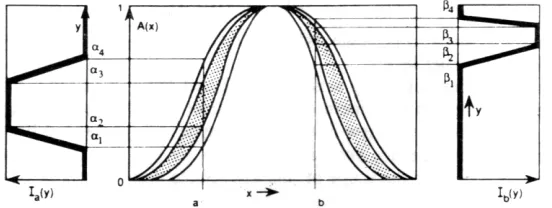
where χ ([0,1]) denotes the set of all ordinary fuzzy sets that can be defined within the universal set [0,1]. An example [4] of a membership function of this type is given in fig.1.
Figure 1: Illustration of the concept of a fuzzy set of type-2.
Definition 2.4. Type-2 fuzzy number [8]
Let be a type-2 fuzzy set defined in the universe of discourse R. If the following conditions are satisfied:
(i) is normal, (ii) is a convex set,
(iii) The support of is closed and bounded, then is called a type-2 fuzzy number.
11
A type-2 triangular fuzzy number on R is given by = {(x,(A1(x),A2(x),A3(x)); xєR}
and A 1
(x) ≤ A 2
(x)≤ A 3
(x), for all xє R. Denote = (,, ), where = (A1 L ,A1 N ,A1 U
), = (A2 L
,A2 N
,A2 U
) and = (A3 L
,A3 N
,A3 U
) are same type of fuzzy numbers.
2.6. Arithmetic operations on type-2 triangular fuzzy numbers [9]
Let = (, , ) = ((a1L,a1N,a1U),(a2L,a2N,a2U),(a3L,a3N,a3U)) and = (, , ) =
((b1 L ,b1 N ,b1 U ),(b2 L ,b2 N ,b2 U ),(b3 L ,b3 N ,b3 U
)) be two type-2 triangular fuzzy numbers. Then we define,
(i) Addition:
+ = ((a1
L+ b1 L ,a1 N+ b1 N ,a1 U+ b1 U ),(a2 L+ b2 L ,a2 N+ b2 N ,a2 U+ b2 U ),(a3 L+ b3 L ,a3 N+ b3 N , a3 U+ b3 U )) (ii) Subtraction:
− = ((a1
L− b3 U ,a1 N− b3 N ,a1 U− b3 L ),(a2 L− b2 U ,a2 N− b2 N ,a2 U− b2 L ),(a3 L− b1 U ,a3 N− b1 N , a3 U− b1 L ))
(iii) Scalar multiplication:
If k ≥ 0 and k є R then k = ((ka1L,ka1N,ka1U),(ka2L,ka2N,ka2U),(ka3L,ka3N,ka3U)) and
if k < 0 and k є R then k = ((ka3U,ka3N,ka3L),(ka2U,ka2N,ka2L),(ka1U,ka1N,ka1L)).
(iv) Multiplication: Define b = b1
L +b1 N +b1 U +b2 L +b2 N +b2 U +b3 L +b3 N +b3 U
.If ≥0, then
× = ( , , ), ( , , ), (!,!,!)".
If b<0, then
× = (! ,! ,! ), ( , , ), (,,)".
(v) Division:
Wheneverb ≠ 0 we define division as follows:Ifb>0, then
=( , , ), ( , , ), ( ! , ! , ! )" .
If b<0, then
=( ! , ! , ! ), ( , , ), ( , ,
)" .
2.7. The proposed ranking function [9]
Let F(R) be the set of all type-2 normal triangular fuzzy numbers. One convenient approach for solving numerical valued problem is based on the concept of comparison of fuzzy numbers by use of ranking function. An effective approach for ordering the elements of F(R) is to define a linear ranking function Ř:F(R) → Rwhich maps each fuzzy number into R.
Suppose if = (,, ), = ((A1 L ,A1 N ,A1 U ),(A2 L ,A2 N ,A2 U ),(A3 L ,A3 N ,A3 U
K.Latha, K.Thiripurasundari and P.Sivasakthi
12 Also we define orders on F(R) by
Ř() ≥Ř(%) if and only if Ř'%,
Ř() ≤Ř(%) if and only if Ř(%
and Ř() =Ř(%) if and only if Ř*%.
Definition 2.8. Type-2 zero triangular fuzzy number
If = ((0,0,0),(0,0,0),(0,0,0)) then is said to be a type-2 zero triangular fuzzy number. It is denoted by 0.
Definition 2.9. Type-2 zero-equivalent triangular fuzzy number
A type-2 triangular fuzzy number is said to be a type-2 zero-equivalent triangular fuzzy number if Ř () = 0. It is denoted by 0.
3. Type-2 triangular fuzzy matrices (T2TFMs) [9] Definition 3.1. Type-2 triangular fuzzy matrix (T2TFM)
A type-2 triangular fuzzy matrix (T2TFM) of order m×n is defined as A = (,-)mxn where
the ijth element ,- of A is the type-2 triangular fuzzy number.
3.2. Operations on T2TFMs
As for classical matrices we define the following operations on T2TFMs. Let A = (,-)
and B = (,-) be two T2TFMs of same order. Then we have the following:
(i) A+B = (,-+ ,-)
(ii) A−B = (,-− ,-)
(iii) For A = (,-)mxn and B = (,-)nxk then AB = (.̃,-)mxk where .̃,-= ∑21*,1 .1-,
i=1,2,…..,m and j=1,2,…..,k. (iv) AT or Aˊ= (-,)
(v) kA = (k,-) , where k is a scalar.
4. Bidiagonal type-2 triangular fuzzy matrices Definition 4.1. Diagonal T2TFM
A square T2TFM A= (,-) is said to be a diagonal T2TFM if all the elements outside the principal diagonal are 0.
Definition 4.2. Diagonal-equivalent T2TFM
A square T2TFM A= (,-) is said to be a diagonal - equivalent T2TFM if all the elements outside the principal diagonal are 0.
Definition 4.3. Upper bidiagonal T2TFM
13 For example A =
3 4
50
0 0
0
0 0
0 00 6667 8 9
Definition 4.4. Upper bidiagonal-equivalent T2TFM
A square T2TFM A= (,-) is called an upper bidiagonal - equivalent T2TFM if the diagonal and above the main diagonal has the non-zero entries and all the other entries are 0.
Definition 4.5. Lower bidiagonal T2TFM
A square T2TFM A= (,-) is called a lower bidiagonal T2TFM if the diagonal and below the main diagonal has the non-zero entries and all the other entries are 0.
For example A =
3 4
5 0
0 0 0 0 0
0 0 6 0667
8 9
Definition 4.6. Lower bidiagonal-equivalent T2TFM
A square T2TFM A= (,-) is called a lower bidiagonal-equivalent T2TFM if the diagonal and below the main diagonal has the non-zero entries and all the other entries are 0.
Definition 4.7. Bidiagonal T2TFM
A square T2TFM A = (,-) is called a bidiagonal T2TFM if it is either an upper bidiagonal T2TFM or a lower bidiagonal T2TFM.
Definition 4.8. Bidiagonal - equivalent T2TFM
A square T2TFM A = (,-) is called a bidiagonal-equivalent T2TFM if it is either an upper bidiagonal – equivalent T2TFM or a lower bidiagonal-equivalent T2TFM.
5. Properties of bidiagonal T2TFMs
Property 5.1. The sum of two upper bidiagonal T2TFMs of order n is also an upper bidiagonal T2TFM of order n.
Proof: Let A = (,-) and B = (,-) be two upper bidiagonal T2TFMs. Since A and B are
upper bidiagonalT2TFMs, ,- = 0 and ,- = 0 for all i > j and i+2 ≤ j; i, j = 1, 2, …, n.
LetA+B = C. Then (,-+ ,-) = (.̃,- ).
For all i> j and i+2 ≤ j; i, j = 1, 2, …, n, .̃,- = ,-+ ,- = 0 + 0 = 0. Hence C is also an upper bidiagonal T2TFM of order n.
K.Latha, K.Thiripurasundari and P.Sivasakthi
14
Proof: Let A = (,-) and B = (,-) be two lower bidiagonalT2TFMs. Since A and B are
lower bidiagonalT2TFMs, ,- = 0 and ,- = 0 for all i < j and i ≥ j+2; i, j = 1, 2, …, n.
LetA+B = C. Then (,-+ ,-) = (.̃,- ).
For all i< j and i ≥ j+2; i, j = 1, 2, …, n, .̃,- = ,-+ ,- = 0 + 0 = 0. Hence C is also a lower bidiagonalT2TFM of order n.
Property 5.3. The product of anupper bidiagonal T2TFM by a scalar is also an upper bidiagonal T2TFM.
Proof: Let A = (,-) be anupper bidiagonalT2TFM. Since A is an upper bidiagonal T2TFM, ,- = 0 for all i> j and i+2 ≤ j; i, j = 1, 2, …, n.
Let k be a scalar and kA = B. Then (k,-) = (,-).
For all i> j and i+2 ≤ j; i, j = 1, 2, …, n, ,-= k,- = k0 = 0. Hence B is also anupper bidiagonalT2TFM.
Property 5.4. The product of alower bidiagonalT2TFM by a scalar is also alower bidiagonal T2TFM.
Proof: Let A = (,-) be alower bidiagonalT2TFM. Since A is alower bidiagonal T2TFM,
,- = 0 for alli< j and i ≥ j+2; i, j = 1, 2, …, n.
Let k be a scalar and kA = B. Then (k,-) = (,-).
For alli< j and i ≥ j+2; i, j = 1, 2, …, n, ,-= k,- = k0 = 0. Hence B is also alower bidiagonalT2TFM.
Property 5.5. The transpose of an upper bidiagonalT2TFM is a lower bidiagonalT2TFM and vice versa.
Proof: Let A = (,-) be an upper bidiagonalT2TFM. Since A is an upper bidiagonal T2TFM, ,- = 0 for alli> j and i+2 ≤ j; i, j = 1, 2, …, n.
Let B be the transpose of A. Then Aˊ = B. i.e, (-,) = (,-).
For alli> j and i+2 ≤ j; i, j = 1, 2, …, n, ,- = 0 = -,.
That is for all i< j and i ≥ j+2; i, j = 1, 2, …, n, ,- = 0. Hence B is a lower bidiagonalT2TFM.
Remark: However, operations mixing upper bidiagonaland lower bidiagonal T2TFMs do not produce bidiagonal T2TFMs. For instance, the sum of upper bidiagonal and lower bidiagonal T2TFM can be any T2TFM (In particular tridiagonal T2TFM).
6. Conclusion
15 REFERENCES
1. E.Hisdal, The IF THEN ELSE Statement and Interval-valued Fuzzy sets of Higher type, International Journal of Man-Machine Studies, 15 (1981) 385-455.
2. R.I.Jhon, Type-2 fuzzy sets; an appraisal of theory and applications, International
Journal of Fuzziness Knowledge-Based Systems, 6(6) (1998) 563- 576.
3. J.B.Kim, Determinant theory for fuzzy and boolean matrices, Congressus
Numerantium, (1988) 273-276.
4. G.J.Klir and B.Yuan, Fuzzy sets and Fuzzy Logic: Theory and Applications, Prentice - Hall, Englewood cliffs, NJ, 1995.
5. M.Manvizhi, K.Latha and K.Thiripurasundari, Rank of a type-2 triangular fuzzy matrix, Imperial Journal of Interdisciplinary Research, 3(2) (2017) 538-545. 6. M.Z.Ragab and E.G.Emam, On the min-max composition of fuzzy matrices, Fuzzy
sets and Systems, 75 (1995) 83-92.
7. A.K.Shyamal and M.Pal, triangular fuzzy matrices, Iranian Journal of Fuzzy
Systems, 4(1) (2007) 75-87.
8. D.S.Dinagar and A.Anbalagan, Fuzzy programming based on type-2 generalized fuzzy numbers, International Journal of Mathematical Science & Engineering
Applications, 5(IV) (2011) 317-329.
9. D.S.Dinagar and K.Latha, A note on type-2 triangular fuzzy matrices, International
Journal of Mathematical Science & Engineering Applications, 6(I) (2012) 207-216.
10. D.S.Dinagar and K.Latha, Some types of type-2 triangular fuzzy matrices,
International Journal of Pure and Applied Mathematics, 82(1) (2013) 21-32.
11. D.S.Dinagar and K.Latha, A study on determinant of type-2 triangular fuzzy matrices, The Journal of Fuzzy Mathematics, 23(4) (2015) 895-906.
12. M.G.Thomason, Convergence of powers of a fuzzy matrix, J. Math Anal. Appl., 57 (1977) 476-480.
13. L.A.Zadeh, Fuzzy sets, Information and Control, 8 (1965) 338-353.