A Method for Automated Test Cases Generation
from Sequence Diagrams and Object Constraint Language
for Concurrent Programs
Thi-Dao Vu
1,∗, Pham Ngoc Hung
2, Nguyen Viet Ha
2 1Academy of Cryptography of Techniques,141 Chien Thang street, Tan Trieu, Thanh Tri, Hanoi, Vietnam
2Faculty of Information Technology, VNU University of Engineering and Technology,
E3 Building, 144 Xuan Thuy Street, Cau Giay, Hanoi, Vietnam
Abstract
This paper proposes an automated test cases generation method from sequence diagrams, class diagrams, and object constraint language in order to solve several steps of the model-based testing process. The method supports UML 2.0 sequence diagrams including eight kinds of combined fragments. Test cases are generated with respect to the given concurrency coverage criteria. With strong concurrency coverage, generating exhaustive test cases for all concurrent interleaving sequences is exponential in size. The key idea of this method is to create selections of possible test scenarios in special case of exploring the message sequences with their possible interleaving in parallel fragments or weak sequencing fragments. Test data for testing loop fragments are also generated. A tool supporting the proposed method is implemented and tested with several case studies. The obtained results show the feasibility and effectiveness of the method.
Received 10 June 2016, Revised 27 October 2016, Accepted 31 October 2016
Keywords: Model based Testing, Test Scenario, Test Data, Test Case, Sequence Diagram, Class Diagram, Object Constraint Language.
1. Introduction
Model- based testing plays a significant role in practice and a lot of researches on it has been investigated in recent years due to great benefits. There are some approaches for model-based testing such as test data
generation, test cases generation from
behavior models, and test scripts generation
from abstract tests [1]. Generation of
∗Corresponding author. Email.: [email protected]
executable test cases from Unified Modeling Language (UML) sequence diagrams and Object Constraint Language (OCL) is one of major approaches. By this approach, it is easier to obtain accurate behavior models in order to apply in the software companies. The translation of a sequence diagram into an intermediate graph [2, 3] is mandatory for generating all possible scenarios. These test scenarios denote abstract test cases that will help to find errors during implementation of software systems.
There are many proposed works in order
to show that approach. Some methods
of test cases generation from models did
not address different types of combined
fragments and in case nested combined
fragments [4, 5]. An approach in [2]
dealt with five combined fragments such as repetition (loop), selection (alt/opt/break), and concurrencies (par) in UML 2.0 [6]. However, it only executed one iteration
in loop fragments. Therefore, the loops
need to be generated more test scenarios. Moreover, this approach did not generate all possible test scenarios (in special case of parallel fragments). Some problems such as deadlocks and synchronization in concurrent systems are solved in [7, 3], but this method did not handle test data generation.
When generating test cases from UML sequence diagrams and OCL, we first need to construct a set of test scenarios which represents a sequence of performed
operations in a software system. One
challenging task is how to derive a
comprehensive test scenarios when the
system under testing is complex and the number of test scenarios may be huge.
Therefore, there are the following difficulties
facing in the automatic test cases generation.
• Concurrency in a sequence diagram
is attributed by weak sequencing
(seq) or parallel (par) fragments.
Concurrent programs may behave
nondeterministically. It may result
in different outputs when repeated
with the same inputs in different runs.
Therefore, test cases generation in
concurrent programs have a degree
of nondeterminism that sequential
programs do not support.
• Coverage of concurrency and branch
features could lead to a huge number
of test scenarios. However, some
test scenarios could not be tested because some infeasible test scenarios correspond to unreachable paths.
• Generating test data for testing loop
fragments solves the problem that the body of the loops is only executed once in [2, 5].
This paper proposes a method in order
to deal with the above issues. The
method generates test scenarios from UML 2.0 sequence diagrams and OCL (in class diagram) according to a given coverage criterion for concurrent flows. The key idea of this method is to select the possible test scenarios in order to avoid the test scenarios explosion. Next, test data are created from the constraints by using one predicate at a time and reducing domains of variables
step by step. For each test scenario, test
data generation procedure specially solves the problems of testing loops. Therefore, test scenarios help to detect errors in testing loops and concurrency errors such as safety and liveness property of the systems.
The rest of this paper is organized as follows. Section 2 introduces some of the basic concepts that used in this research. A brief control-flow graph generation from UML 2.0 sequence diagrams and class
diagrams is given in Sect. 3. Section 4
describes the improved method to generate test scenarios with respect to concurrency
coverage criteria. Section 5 describes the
proposed test data generation. Section 6
presents a tool to implement the proposed method and a case study to validate the
Finally, we conclude the paper and discuss future works in Sect. 7.
2. Background
In this section, we introduce some concepts related to model- based testing, concurrency coverage criterion, and mutation analysis.
2.1. Model–based testing
Model–based testing (MBT) automates the detailed design of the test cases and the generation of the traceability matrix
[1]. More precisely, instead of manually
writing hundreds of test cases (sequences of operations), the test designer specifies an abstract model of the system under test (SUT), and then the MBT generates a set of test cases from that model. By using MBT, the test design time is reduced. Moreover, an advantage of this approach can generate a variety of test suites from the same
model simply by using different test selection
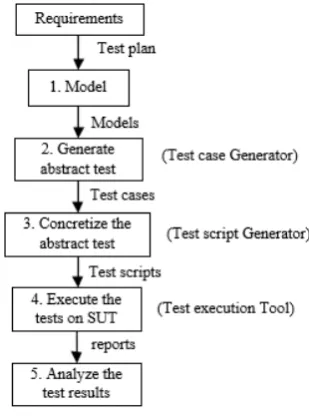
criteria. The MBT process can be divided into the following five main steps shown in Figure 1.
The first step of MBT is to specify an abstract model of the SUT. The second step of MBT is to generate set of abstract tests, which are sequences of operations from the model. The coverage reports some indications of how well the generated test set exercises all
the behaviors of the model. The first two
steps distinguish MBT from other kinds of
testing. In online MBT tools, steps two
through four are usually merged into one step
whereas in offline MBT, they are separate.
The third step of MBT is to transform the abstract tests into executable concrete tests. This may be done by a transformation tool, which uses various templates and mappings
Fig. 1. The model-based testing process.
to translate each abstract test case into an
executable test scripts. The fourth step is
to execute the concrete tests on the SUT. With online MBT, the tests will be executed as they are produced, so the MBT tool will manage the test execution process and record
the results. The fifth step is to analyze
the results of the test executions and take corrective action that means comparing the actual results with expected ones. By making the model explicit, in a notation that can be used by MBT tools, we are able to generate tests automatically (which decreases the cost of testing), generate an arbitrary number of tests, as well as obtain more systematic coverage of the model. These changes can increase both the quality and quantity of test suites.
2.2. Concurrency coverage criteria
Generating test scenarios is a key step
in the generation of test cases. Because
all possible paths (due to limited testing resources), three coverage criteria have been proposed in [8, 9] as follows.
(i) Weak concurrency coverage: test
scenarios are derived to cover only one feasible sequence of parallel processes, without considering the interleaving of messages between parallel processes.
(ii) Moderate concurrency coverage: test scenarios are derived to cover all feasible sequences of parallel processes without considering the interleaving of messages between parallel processes.
(iii) Strong concurrency coverage: test
scenarios are derived to cover feasible sequences of messages and parrallel processes having the interleaving of messages between parallel processes.
These concurrency coverage criteria require the derived test scenarios covering each
parallel process at least once. Both
weak concurrency coverage and moderate concurrency coverage test the messages and control flows within a parallel process in a sequence way. Strong concurrency coverage considers the crossing of messages and control flows from parallel processes, which may result in a huge number of test scenarios, and thus may be impractical. We propose an algorithm for generating test scenarios to satisfy possible interleaving of messages in parrallel processes, and it also avoids messages sequence exploration.
2.3. Mutation analysis
Mutation analysis has been widely
employed to evaluate the effectiveness of
various software testing techniques [10].
Mutation testing is a fault-based testing
technique which hypothesizes certain
types of faults that may be injected by programmers, and then designs test cases
targeted at uncovering such faults. Faults
are introduced into the program by creating a set of faulty versions, called mutants. These mutants are created from the original program by applying mutation operators, which describe syntactic changes to the programming language. Test cases are used to execute these mutants with the goal of causing each mutant to produce incorrect
output. The mutation score (MS) measures
the adequacy of a set of test cases that is defined as follows:
MS(p,t)= Nk Nm−Ne
where, p refers to the program being
mutated, t is the test suite, Nk is the
number of killed mutants, Nm is the total
number of mutants, and Ne is the number
of equivalent mutants. An equivalent mutant is one behavior that is the same as that of
p, for all test cases. The automatically
generated mutants can be very similar to
real-life faults [11]. Making a good MSindicates
the effectiveness of a testing technique [10].
There fore, we use the MS to evaluate the
proposed method.
3. Control–Flow Graph Generation
Given UML 2.0 sequence diagrams
describing behaviors of SUT and class diagrams declaring all method signatures and class attributes, a proposed recursive
algorithm generates control-flow graph
(CFG) from sequence diagrams, and
constraints of variables are derived from
class diagram to generate test data. A
corresponding sequence diagram. Each node of this CFG is either a block node (BN), a decision node (DN), a merge node (MN), a fork node (FN) or a join node (JN). The edges represent control flows among nodes. Edges from DNs are labelled with predicates.
A BN represents a message mi or a
sequence of messages. Each message mi
contains type information of the receiver class from class diagram and is structured
as a tuyp (mi, parameterList, returnValue).
Each parameter of message mi may be
a class attribute involving constraints
(OCL expressions).
A DN represents a conditional expression such as boolean expression that needs to be satisfied for selection among operands
of a fragment. A MN represents an exit
from the selection behavior (for example, an
exit from an alt or an opt fragment). A
FN represents an entry into a par or a seq fragment. A JN represents an exit from a par or a seq fragment.
First of all, the generation of sequence diagram data structure creates a queue which includes messages, fragments and
operands. The queue is denoted queue.
The processElement describes the proposed
iterative process for generating different
kinds of nodes from the queue. At each
iteration, it analyzes each element ofqueueto
create corresponding exit node and connects edge from current node to exit node. Then exit node is considered current node. Because the parameters of a message in the sequence diagram lack of the constraints and type
information. The additional information
(constraints of variables) is derived from the class diagram and is appended to each message. The Algorithm 1 can analyze all of sequence diagrams where any combined
fragment can contain of the supporting
fragments in UML 2.0. The proposed
technique requires sequence diagrams in xmi file.
Algorithm 1Generating CFG
Input: D:Sequence diagram;CD:Class diagram
Output: Graph G: (A, E, in, F) where A is a set of nodes (consisting BN, DN, MN, FN, JN); in denotes the initial node and F denotes a set of all final nodes representing terminal nodes of the graph;
E is a set of control edges such that E=
{(x,y)|x,y∈A∪F}.
1: create initial nodein, nodex;
2: create emptyqueue;
3: create curPos point at start element of
sequence diagram D in xmi; 4: repeat
5: curPosread each element of D
to add to queue//used in [12]
6: curPosmove to next Element; 7: until curPos meets end element of xmi
file
8: x=processElement(queue,CD,in);
9: if x, f inalNodethen
10: create final Node f n∈F;
11: Connect edge from xto f n;
12: end if 13: return G;
We use the analysis of xmi sequence diagram to create a corresponding queue [12]. The data structure of sequence diagram is an array of elements including messages,
fragments and operands. All elements are
sorted by time taken in the diagram. In
the termination of loop (line 7) we have a data structure queue that is equivalent to the
correspoding exit node x (line 8). CFG is
generated by connecting the initial node in
to the order of exit nodes created by the
function, then the last edge is made from x
to the final nodefn(line 11).
Algorithm 2 analyzes each element of
queue to return different kinds of nodes.
Starting withinnode,inis considered current
node (curNode), each element of queue is
taken by (queue.pop()). The function is
iteratively called to be transformed. There are five kinds of corresponding nodes in the graph that are BN, DN, MN, FN, and JN. In addition, with each element of the sequence diagram, we distinguish two nodes between entry node and exit node.
The entry node is the current node which is connected to the outside by incoming edges and therefore supplied as input to
the function. The exit node is the node
which is connected to the outside by outgoing edges and hence returned as output of the function. When the element derived from the
sequence diagram that is messagem, then the
receiver class of the message is consulted. The method signature corresponding to the method call is then derived using the function
ReturnMessageStructure. For the OCL constraints, type and attribute (the structure
including (mi, parameterList, returnValue))
are appended to the messge mi, and the
code to perform it is the function call
AttachConstraintInfo(). After creating the corresponding node, the current node will be connected to the created node, and then this node is considered the current
node. In this way, CFG is generated
from the sequence diagram with any nested combination of fragments.
Comparing with [2], a sequence of
messages in operands of par fragments is
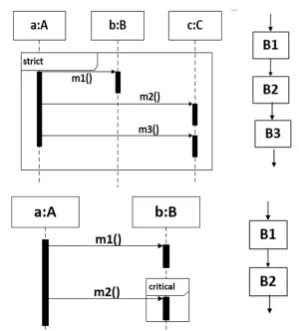
Fig. 2. General structure of CFG (for par, seq fragments).
Fig. 3. General structure of CFG (for strict and critical region fragments).
equivalent with a BN while in this technique each message corresponds to a BN. The
isAsyn property is attached to each BN if the corresponding messages of threads in seq or par fragment have sharing data or
lock mechanism (line 29). Therefore, a
Algorithm 2Analyzing elements of queue
Input: Class diagram CD,queue q,
curNode∈A
Output: exitNode∈AfunctionprocessElement (q: queue, CD: class diagram, curNode:A) :A 1:whilequeue !=emptydo
2: x=queue.pop();
3: if(x==fragment) and (x.type==’opt’ or ’alt’ or ’break’ or ’loop’)then
4: Create a DN ;
5: ConnectEdge(curNode,DN); 6: else if(x==message)then
7: begin
8: BN=CreateBlockNode()//BN is message 8: or a set of messages
9: foreach messagem∈B
10: get receiver class in r.clasName
11: msg=returnMsgStructure(CD,r.clasName,m) 12: attr=returnAttributeStructure(CD,r.clasName) 13: forall variables in m
14: attachAttributeInfor(attr,m); 14: //attach constraint c[i] to msg
15: end for
16: end for
17: ConnectEdge(curNode,DN); 18: exitNode=BN;
19: end;
20: else if(x==operand)and(x.guard!=null)then
21: attachGuardtoEdge() 22: curNode=DN;
23: else if(x==frag)and(x.type==’par’or’seq’)then
24: Create forkNode FN; 25: ConnectEdge(curNode,FN); 26: curNode=FN;
27: foreach operand
28: create BN to coressponding msg; 29: isAsynToBN()//attach isAsyn to BN
30: end for
31:else if(x==’EOF’andx.type==’alt’or’opt’)then
31: //termination condition of frag alt or opt 32: Create merge node MN
33: ConnectEdge(curNode,MN); 34: exitNode=MN;
35:else if(x==’EOF’andx.type==’par’or’seq’)then
36: Create join node JN 37: ConnectEdge(curNode,JN); 38: exitNode=JN;
39:else if(x==’EOF’ and x.type==’loop’)then
40: attachLoopstoEdge()
40: //attach number of loops to Edge 41: ConnectEdge(curNode,DN); 42: curNode=DN;
43:end if
44:returnexitNode; 45:end while;
4. Test Scenarios Generation
Given a CFG, an Algorithm is proposed
for generating test scenarios. The test
scenarios denote abstract test cases which represent possible traces of executions. The output from the scenario generation is a finite set of scenarios which are complete paths starting from the initial node to the final
node. Because it is usually impossible or
infeasible to test all possible paths (due to limited testing resources), three concurrency coverage criteria are given above to choose that depending on the characteristics of each
project software. Both weak concurrency
coverage and moderate concurrency coverage test the messages and control flows within
a parallel process in a sequence way. If
the systems do not address the issues of the synchronization and sharing data, we can select the weak coverage criterion or
moderate coverage criterion. The weak
concurrency coverage is one case of the moderate coverage, so we propose Algorithm 3 to generate test scenarios following the
moderate coverage. Basic paths generated
Algorithm 3 Generating the test scenarios following the moderate concurrency coverage Input: Control-flow Graph G with initial
nodeinand final nodes are f ni
Output: T is a collection of test scenarios, t is a test path
1: T =∅;t=∅;
2: curNode=in;//current node starts fromin
3: repeat
4: move to next node;
5: ifcurNode==BNthen
6: t.append(BN);
7: end if
8: ifcurNode==DNthen
9: Append true part of BN up to MN in t
10: Append false part of BN up toMN in t
11: end if
12: if(curNode==FN)then
13: create sub pathtifor each fork out flow;
14: append BN of each fork flow up to JN
15: in respective sub pathti; 16: end if
17: if(curNode== f ni)then 18: T=T+{t};
19: end if 20: untilGraph end
The proposed Algorithm 4 generates test scenarios to improve the strong concurrency coverage from CFG to solve that problem. The algorithm constructs a path for each thread of execution. At each step it appends
BN to the path t if curNode is BN. When
a DN is reached then on the basis of result of decision guard condition, the path t is
appended respective true/false part up to MN.
IfcurNodeis FN then sub paths representing each thread of execution for that fork are activated. The messages of operands in seq or par fragment (having isAsyn property is
true) is a switch point of sub paths. The
point changes for the sub paths when BNs
are appended to the path t. That addition will stop until all active sub paths for a given FN
are empty. When curNodeis reached a final
node (f ni), the path t is updated collection of test scenarios T.
Comparing with depth first search (DFS) and breadth first search (BFS) algorithm, these new generated paths are given as test scenarios for testing concurrency errors
in sequence diagram. In par or seq
fragment, selection of adequate switch points for message interleaving of operands among
queues is more important. If there is no
switch point for each concurrent thread then messages will execute one after another in sequence.
This sequencing will lose concurrent
nature among messages. If there is a
switch point after each message in queue then number of concurrent paths will be exponential. In case of concurrent threads that neither share any common data nor need any casual order between messages of
different threads can be interleaved in any
sequence. Therefore, it will not lead to
any concurrency or synchronization error. But the messages of concurrent threads have the share common data or need any casual
order among them in different threads that
can be interleaved in restricted way. These types of threads are called synchronized
threads. The synchronized threads need
careful selection of switch point in queues to generate adequate test scenario. A proper selection of switch point will generate a feasible concurrent test sequence in presence of concurrency.
selected before a sharing data, after a sharing data, before locking and after locking (for example, bank transaction has two threads in par fragment: Lock1-withdraw1-Unlock1;
Lock2-deposit2-Unlock2). These switch
points try to capture casual ordering errors and data safety errors in the concurrent thread implementation. A test scenarios generated by algorithm 4 should be able to uncover data safety error, concurrent execution should able to detect inconsistent state of shared data due to specific interleaving of execution. A possible technique to generate such interleaving is to switch execution of thread inside critical section. A test sequence that provides such specific interleaving, which check for data inconsistency, is having data
safety error uncover capability. Therefore,
we could find the concurrency errors such as safety and liveness property of systems. The proposed method is applied to systems for test scenarios generation and found to be
very effective in controlling the test scenarios
explosion problem.
All variables in the block node are associated with constraint information which is taken in class diagram. One representative value for each variable on the test scenario is to be selected. Therefore, messages in block nodes along the test scenario correspond to a parameterized operation call. Each outgoing edge from a decision node contains one predicate. Each test scenario must satisfy all predicates along its path. Sect. 5 proposes a method to generate test data for each the scenario, special in case of loops.
5. Test Data Generation
The test scenarios obtained (as discussed in the Sect. 4) denote the sequence of messages.
The sequence is a feasible sequence of messages if we find test data (test input) to satisfy all the constraints along the scenario. Many current researches solve the equations to find values that satisfy these constraints.
However, it is difficult to generate test data
for testing loops. The proposed method
solves that problem by finding values in the test scenarios of CFG, using one predicate at a time and reducing domains of variables
step by step. We develop the dynamic
domain reduction procedure [2] in case of testing loops.
For each test scenario ti ( in set of test
scenarios T ) represents as a sequence of nodes < ni1,ni2, ...,nig > where ni1 denotes
the initial node andnigdenotes the final node,
we need to find sub domain of test input satisfying all the constraints along current
path ti such that the path reaches the final
node nig. ReduceDomainsof variables is the
key step in the procedure. The predicates
(on the branch edges) from DN are used to
form new constraints. The pathtiis traversed,
a search process is used to split the domain of some variables in an attempt to find a set of values that allow the constraints to be
satisfied. GetSplit modifies the domains for
variables in a constraint so that (1) the new domains satisfy the constraint and (2) the size of the two domains is balanced. For example,
predicate is x > y with domains for x,y are
(0..50), the first attempt would be to make
the domain for x to be (26..50) and for y
is (0..25).
Given the initial domains of two variables known as left and right variables that are combined by a relational expression, if these domains are non-intersecting, the predicate
may be either satisfied or is infeasible. If
the two domains define sets of values that
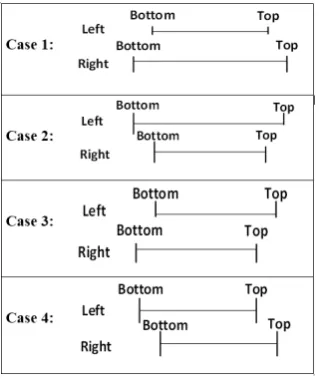
Fig. 4. ComputesplitPtdepending on domains of variables.
domains such that the constraint is satisfied for all pairs of values from the two domains. The split point is found based on top and bottom values of left and right domains. There are the following four cases to consider in Fig. 4.
Case 1:splitPt=(le f t.top−le f t.bot)∗pt+le f t.bot Case 2:splitPt=(right.top−right.bot)∗pt+right.bot Case 3:splitPt=(le f t.top−right.bot)∗pt+right.bot Case 4:splitPt=(right.top−le f t.bot)∗pt+le f t.bot
The inputs to getSplit are domains
for two expressions (left and right
domains) and integer that indicates what iteration of the search is being performed
(Indx = 1, 2, 3, 4,...) with exp satisfies:
2exp ≤ Indx≤2exp+1
Therefore, pt= (2exp−(2∗2(2expexp−1)−1)) Result, pt =(12, 14,34,18,38,...)
The synthesis test data generation
procedure includes the following steps:
Choose test scenario ti, a sequence of
nodes < ni1,ni2, ...,nig >. If node ni is a
DN, it is marked and encountered. Later,
the procedure uses reading predicate on
the branch edge and reducing domains of
variables by using above getSplit. If node
ni is not a DN, the procedure moves to
next node. When using getSplit, the value
of pt is initially got to 12 and depending
domains of left and right variables to get
the new domains for variables. A split
point is returned, the domains of left and
right variables are adjusted. If the new
domain values satisfy the predicate then the procedure continues with the next node of the
scenario ti until the final node is reached. If
the new domains do not satisfy the constraint the value of ptis changed to 14 and a different split is found. If there have been too many attempts to find a feasible split point (more than k split points), the procedure goes to the
previous DN in the scenario ti. If there are
no previous decision nodes to evaluate, the procedure gives up on this path and goes to
the next path in T. Normally when we test
loops, test scenarios will be tested in some cases with 1, 2, random n, max, min times
of specified loops. If the test scenario is
traversed, the DN is marked and encountered and then variables are checked dynamically (the maximum or minimum numbers of loops which are parameters of loop fragments are attached in edges of graph). If the variable does not satisfy the constraint, the procedure exits the loop and continues traversing the test scenario on the node after the loop. The reduced domain at the end of the procedure denotes a feasible domain of values for a test scenario.
In the test data generation procedure, loops
are handled dynamically. The procedure
finds all the scenarios that contain at most one loop structure. It then marks those DNs
that affect whether another iteration of the
traversed, when the DN is encountered, the loop constraint and variables are checked dynamically to decide whether to continue with another iteration. Comparing with [2], if variables always satisfy in next iteration, our procedure exits the loops to generate test data when the DN is encountered in case of 1, 2,
random n, max and min loops. In [2, 5] for
loop fragment, the coverage criterion satisfies at least one scenario reaching the loop and the body of the loop is only executed once. Our method is that test scenario containing test data are generated if satisfying the constraints along the scenario in case number
of loops 0, 1, 2, random n and max, min
of loops.
Execution time: Algorithmic analysis
of algorithms are complicated that is
exceedingly difficult. The excecution time of
the procedure depends upon the number of
decision nodes (D), the number of paths (T),
and the constant k (split points). Moreover,
if the procedure has to go throughkattempts
at each decision node, then that is k split
attempts at the first decision, then k splits at
the second decision for every attempt at the
second decision, and so on, for a total of kD
split attemps. So the running time isT ∗kD.
Although the worst–case running time is exponential, the worst case can seldom be expected to be achieved in practice. Moving through the control fow graph dynamically allows path constraints to be
resolved immediately, which is more efficient
both in space and time, and more often successful than constraint-based testing. The dynamic nature of this procedure also allows certain improvements to be made in the handling of arrays, loops, and expressions.
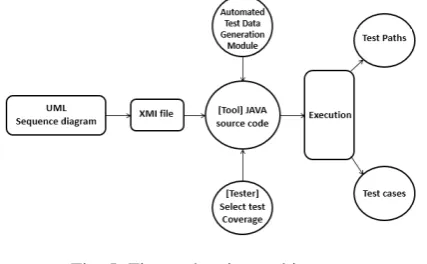
Fig. 5. Figure showing architecture of SequenceCocur.
This procedure incorporates elements
from the constraint–based testing domain reduction procedure, symbolic evaluation,
and the dynamic test data generation
approach. It integrates constraint satisfaction, symbolic evaluation, and a novel search
process into one dynamic process. As
compared with previous automatic test data generation procedures, we believe that the dynamic domain reduction procedure can be expected to be more likely to find a test case when a test case exists, and that
implementations can be more effective
and efficient.
6. Experiments
A tool named SequenceConcur to support the proposed method has been implemented. We report on a case study conducted to examine the method, and mutation analysis
was used to evaluate its effetiveness.
6.1. Tool Support
In this section we discuss the results obtained by implementing the proposed
method. The method is implemeted using
JAVA and JDK version 1.8. We have
developed the method for generating test cases automatically from UML sequence diagrams and OCL in a tool. The architecture of SequenceConcur is shown in Fig. 5.
The Tool consists of 1936 lines of code and has the following functionality:
(i) Preprocessing: It imports the UML
sequence diagrams and OCL in class
diagrams (in XMI format). We
used Enterprise Achitect version 11 to produce the UML design artefact. The tool was developed using the proposed recursive algorithm (in Sect. 3) for generating CFG.
(ii) Generating test senarios: It generates test scenarios from CFG with respect to
different concurrency coverage criteria
and presents the generated scenarios for further analysis.
(iii) Generating test data: It creates test data for each test scenario by improving dynamic domain reduction procedure [4]. The proposed procedure solves this test data for testing loops.
The weak concurrency coverage is one case of the moderate coverage, so the tool
only presents moderate coverage. The
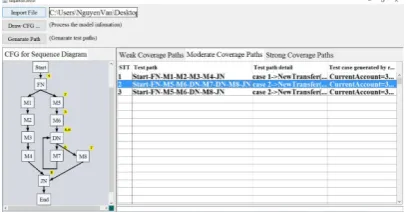
moderate coverage path tab (as shown in Fig. 6) presents the generated test scenarios satisfying the moderate coverage criterion and the strong coverage path tab shows the generated test scenarios satisfying the improved strong coverage criterion (as shown in Fig. 7).
Fig. 6. Generated test paths for moderate coverage criterion.
Fig. 7. Generated test paths for strong coverage criterion.
6.2. Case study
In this section, we illustrate our test case generation from UML sequence diagram 2.0 and class diagram using an example of a bank transaction. A bank object is a main thread of the application that creates two additional threads such as thread1, thread2. These two threads handle the money transfer between two accounts, saving account (accSaving)
and current account (accCurrent). The
Fig. 8. The sequence diagram for Account Transfer in Bank system.
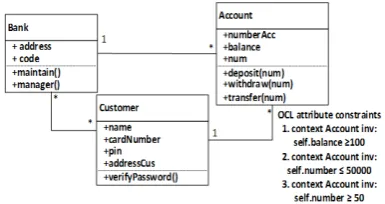
diagram for account transfer functionality. For the sake of brevity, the class diagram (as shown in Fig. 9) shows only the specific classes that are involved in that function.
Test scenarios generation: The proposed algorithm traverses the CFG to generate test scenarios (in Sect. 4). For concurrent system, by using Algorithm 4 test scenarios would be able to uncover some of the concurrency
issues. The account transfer functionality
identifies the quality of the test scenarios generated by DFS, BFS and our method to uncover the concurrency errors (Table 1).
Working of the test data generation algorithm: consider the test scenario
described by T3= (Start
-FN-M5-M6-M1-M2-DN-M7-DN-M8-M3-M4-JN-End),
we illustrate test data generation for the scenario T3. The predicates are shown on their associated edges, and the constraints and data type of variable are attached in
block node. The variables amount of money
being withdrawn of two account type are x,y and the balance of account is balance. All variables from class diagram are set
with integer domain. The initial domains
of input variables x,y and balance are:
Fig. 9. The class diagram and constraint OCL for Account Transfer.
x,y:[50,50000] and balance:[100,65535]
(because balance ≥ 100 and balance is
integer variable).
Assume that the test path T3 with 2 loops, our algorithm marks and encounters decision
node DN that traversed. If DN is 2, the
test path is: Start
-M5-M6-M1-M2-DN-M7-DN-M7-DN-M8-M3-M4-End The sub path
of M5-M6-M1-M2 introduces no change to
the input variables. To take the branch
from node DN to M7, the predicate y <
balance and y: [50,50000] and balance :
[100,65535]. Therefore, domain of variables
indicate split point in the fourth case, and
splitPt = (right.top − le f t.bot) ∗ pt + le f t.bot = (65535 − 50) ∗ 1/2 + 50 =
32792, so y : [50,32792]; balance :
[32793,65535]. Traverse block node M7,
withdraw(y) because the smallest amount of
money withdrawn is 50, so balance reduces
50, thus balance: [32743,65485].
The next time through the loop, we have the same predicate, domain of variables is
in the fourth case splitPt = (65485 −
50) ∗ 1/2 + 50 = 32767, thus y :
[50,32767] and balance : [32768,65535].
Get on traversing M7, withdraw(y) because the smallest amount of money withdrawn is
50, so balance reduces 50, thus balance :
The final time through the loop, the branch from DN to M8, that domains of variables are
in the fourth case andsplitPt= (65485−50)∗
1/2+50= 32767, because the predicate y≥
balance, thus value ofyis 32767 and domain of balanceis [32718,32766]. Therefore, for test scenario T3 reduced domain of test data
are: y= 32767;balance: [32718,32766] and
x: [50,50000].
6.3. Evaluation
In this section, we attempt to prove the fault- detection capability of the test suite generated using the proposed method.
6.3.1.Metrics
By using the mutation score (MS), we
measure the effectiveness of the proposed
method. The MS indicates the adequacy of a test suite for the system under testing.
6.3.2.Experimental procedure
We used SequenceConcur tool to parse the UML sequence diagram (in an XMI file) and OCL for bank transaction. During the transformation, all branches and concurrent flows were represented as CFG. The tool generated a set of test scenarios from the graphs based on a given coverage criterion.
Test data are generated by using the Algorithm in Sect. 5 (special in case of testing loops), from which we selected only those satisfying the generated test scenarios to be
in the test suite. As a result, we selected
20 test cases for each test scenario when the improved strong coverage criterion was used, four test scenarios were created in our experiments.
Seeding faults: muJava [14] was used to randomly seed faults into the Java program
for bank transaction. Using the muJava
system, 9 method-level and 5 class-level operators were applicable for our study. In these applicable operators, a total of 351 method-level and 26 class-level mutants were generated.
Executing tests and collecting the results: we next applied each test in the test suite to both the original program and the mutants,
comparing with the outputs. If the output
was the same, then the current test passed; otherwise, a fault was detected.
6.3.3.Results and analysis
Data safety error uncover capability: in
our case study, the messages m2 and m6 in
par fragment have shared data, and safety of data is more important. Test scenarios are generated by the algorithm that should be able to uncover data safety errors. We use and compare DFS, BFS and our algorithm in generating the test scenarios (in Table 1) from CFG.
DFS algorithm generates test scenarios including test sequences that are not capable of finding data safety errors because it does not allow interleaving between the messages
of two operands in par fragments. The
test scenarios are generated by BFS and our algorithm that are capable of finding data safety errors. However, BFS algorithm does
not generate the test sequences in case ofzero
iteration loop while our method uses with two
parts, false part and true part that meanszero
and more thanoneiteration. Test data are also
considered to get on with 2, random n and
max,minloops.
Fault– detection capability: In order to study the impact of the test suite size on
the effectiveness of the proposed method,
Table 1. Test scenarios generated by DFS, BFS and our algorithm and last column indicates data safety error uncover capability
Algorithm Test scenarios Error
uncover capability
DFS Start-FN-M1-M2-M3-M4-M5-M6-DN-M7-DN-M8-JN-End No
Start-FN-M5-M6-DN-M7-DN-M8-M1-M2-M3-M4-JN-End No
BFS Start-FN-M1-M5-M2-M6-M3-DN-M7-DN-M4-M8-JN-End Yes
Start-FN-M5-M1-M6-M2-DN-M7-DN-M3-M8-M4-JN-End Yes
Our algorithm
Start
-FN-M1-M5-M2-M3-M4-M6-DN-M7-DN-M8-JN-End(T1)
Yes
Start-FN-M1-M5-M2-M3-M4-M6-DN-M8-JN-End(T2) Yes
Start
-FN-M5-M6-M1-M2-DN-M7-DN-M8-M3-M4-JN-End(T3)
Yes
Start-FN-M5-M6-M1-M2-DN-M8-M3-M4-JN-End(T4) Yes
Table 2. The MS results using the strong concurrency coverage criterion for each test scenario
Level Number of test
cases
Test scenario 1
Test scenario 2
Test scenario 3
Test scenario 4
Method-level size= 2 51.2% 40.5% 45.7% 50.2%
size= 10/20/30 56.5% 55.7% 47.7% 60.4%
Class-level size= 2/10/20/30 74.5% 74.5% 81.5% 81.5%
30 test cases per scenario. We further
compare the fault- detection effectiveness of
the proposed method with that of random testing, comparing their MS scores for the same numbers of test cases.
Table 2 presents the MS results for each test scenario, displayed according to ’Method-level’ and ’Class-level’. From the table, we can observe the following:
(i) For both method-level and class-level faults, the generated test scenarios show
a good fault-detection effectiveness. The
generated test case were able to detect more
than 40.5% of method-level faults and were
able to detect more than 74.5% of the
class-level faults.
(ii) the test suites are derived for different
test scenarios which have a different
fault-detection capability. Because the evaluation
results for different test suite sizes are the
same in case of 10, 20, 30 test cases per each scenario for both method-level faults and class-level faults, our method does not need a large number of test cases for each scenario.
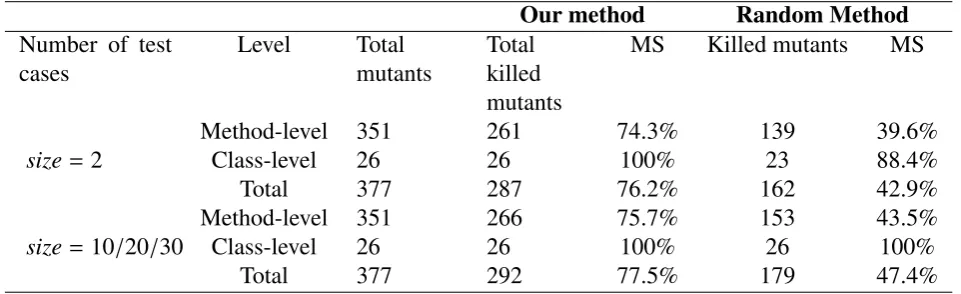
Table 3 presents the MS results of both our method and the random method. From the table, we can observe the following:
(i) for the same sizes, test suites generated by our method achieve higher mutation scores than those achieved by the random method,
with the differences being more prominent
Table 3. The mutation score MS results of our method and the random method
Our method Random Method
Number of test cases
Level Total
mutants
Total killed mutants
MS Killed mutants MS
size=2
Method-level 351 261 74.3% 139 39.6%
Class-level 26 26 100% 23 88.4%
Total 377 287 76.2% 162 42.9%
size=10/20/30
Method-level 351 266 75.7% 153 43.5%
Class-level 26 26 100% 26 100%
Total 377 292 77.5% 179 47.4%
their MS are 76.2% and 42.9%, respectively).
(ii) regardless of test suite size, the test suites generated by our method can detect 100% class-level faults while it can detect only
88.4% by the random method.
The experimental results show that, the test suite generated using our method can detect more than 76% of seed faults with a very small size of test suite (one test case per scenario). Furthermore, more than 74% of method-level faults and 100% of class-level faults can be detected by the generated
test cases. For the same situations, our
method achieved a higher mutation score than random testing. These results indicate
that the proposed method is both effective
and efficient.
7. Conclusions
The paper presented the automated
test data generation method based UML sequence diagrams, class diagrams and OCL. The method supports UML 2.0 sequence diagrams including eight kinds of combined fragments. The key idea of this method is to generate all possible test scenarios in case of exploring the message sequence with their
possible interleaving in par or seq fragments. The test scenarios are generated to avoid test explosion by selecting switch points. Therefore, concurrency errors of systems can be found. In addition, test data generation for testing loop fragments in case of iterations 0,
1, 2, randomnandmax,minloops.
In some current approaches, test data are generated in case of body of loop that is
only executed once. The method supports
different coverage criteria and can therefore
test concurrent processes effectively. Finally,
we have implemented the tool to support the proposed method and conducted the case study (bank transaction) to validate its feasibility and effectiveness.
We are investigating to determine
infeasible or feasible test scenarios when there have no input data for them to be
executed. We also are going to extend
the proposed method for other UML
diagrams (e.g., state-chart diagrams, activity
diagrams). Moreover, we would like to
further investigate and evaluate the
fault-detection effectiveness, and costs, of the
Algorithm 4Generating the test scenarios to improve the strong concurrency coverage Input: Control-flow Graph G with initial
nodeinand final nodes are f ni
Output: T is a collection of test scenarios, t is a test path
1: T =∅;t=∅;
2: curNode=in;//current node starts fromin
3: repeat
4: move to next node;
5: if(curNode==BN)then
6: t.append(BN);
7: end if
8: if (curNode==DN and Branch is TRUE)
then
9: Append t with true part BN to MN;
10: else
11: Append t with false part BN to MN;
12: end if
13: if(curNode==FN)then 14: active all sub paths of FN;
15: repeat
16: Select random sub path;
17: Append t with node up to before or
after node having isAsyn //message having isAsyn (true) is a switch point
18: untilall sub paths are empty
19: end if
20: if(curNode== f ni)then 21: T=T+{t};
22: end if 23: untilGraph end
Acknowledgments
This work is supported by the project no. QG.16.31 granted by Vietnam National University, Hanoi (VNU).
References
[1] M. Utting, B. Legeard, Practical Model-Based Testing: A Tools Approach, Morgan Kaufmann Publishers Inc., San Francisco, CA, USA, 2006.
[2] A. Nayak, D. Samanta, Automatic test data synthesis using uml sequence diagrams, Journal of Object Technology 9 (2) (2010) 115–144. [3] M. Shirole, R. Kumar, Testing for concurrency
in uml diagrams, SIGSOFT Softw. Eng. Notes 37 (5) (2012) 1–8.
[4] M. Dhineshkumar, Galeebathullah, An approach to generate test cases from sequence diagram, in: Proceedings of the 2014 International Conference on Intelligent Computing Applications, ICICA ’14, IEEE Computer Society, Washington, DC, USA, 2014, pp. 345–349.
[5] B.-L. Li, Z.-s. Li, L. Qing, Y.-H. Chen, Test case automate generation from uml sequence diagram and ocl expression, in: Proceedings of the 2007 International Conference on Computational Intelligence and Security, CIS ’07, IEEE Computer Society, Washington, DC, USA, 2007, pp. 1048–1052.
[6] O. M. Group, The Unified Modeling Language UML 2.0 Technical Report formal/06-04-04, The Object Management Group (OMG), 2006. [7] M. Khandai, A. Acharya, D. Mohapatra, A
novel approach of test case generation for concurrent systems using uml sequence diagram, in: Electronics Computer Technology (ICECT), 3rd International Conference, Vol. 1, 2011, pp. 157–161.
[8] C. ai Sun, Y. Zhao, L. Pan, X. He, D. Towey, A transformation-based approach to testing concurrent programs using uml activity diagrams, Software: Practice and Experience. [9] C. ai Sun, A transformation-based approach
to generating scenario-oriented test cases from uml activity diagrams for concurrent applications (2008) 160–167.
[10] S. C-A, W. G, C. K-Y, C. TY, Distribution-aware mutation analysis, in: Proceedings of 9th IEEE International Workshop on Software Cybernetics (IWSC 2012), IEEE Computer Society, Izmir, Turkey, 2012, pp. 170–175.
component-based systems, in: The 10th IEEE-RIVF International Conference on Computing and Communication Technologies, 2013, pp. 22– 26.
[13] T. D. Vu, P. N. Hung, V. H. Nguyen, A Method for Automated Test Data Generation from Sequence Diagrams and Object Constraint
Language, in: Proceedings of the Sixth International Symposium on Information and Communication Technology, ACM, Hue City, Viet Nam, 2015, pp. 335–341.