Journal of Patient-Centered
Journal of Patient-Centered
Research and Reviews
Research and Reviews
Volume 5
Issue 4 -- Patient Self-Management Article 4
10-29-2018
How to Translate Self-Management Support Tools Into Clinical
How to Translate Self-Management Support Tools Into Clinical
Practice
Practice
Matthew J. Simpson Jeanette M. Daly Douglas H. Fernald John M. Westfall LeAnn C. Michaels Barcey T. Levy David L. Hahn Lyle J. Fagnan Donald E. Nease Jr.
Follow this and additional works at: https://aurora.org/jpcrr
Part of the Community Health and Preventive Medicine Commons, Diseases Commons, Health and Medical Administration Commons, Health Services Research Commons, Primary Care Commons, and the Therapeutics Commons
Recommended Citation Recommended Citation
Simpson MJ, Daly JM, Fernald DH, Westfall JM, Michaels LC, Levy BT, Hahn DL, Fagnan LJ, Nease DE Jr. How to translate self-management support tools into clinical practice. J Patient Cent Res Rev.
2018;5:276-86. doi: 10.17294/2330-0698.1636
276 JPCRR • Volume 5, Issue 4 • Fall 2018 Original Research Matthew J. Simpson, MD,1 Jeanette M. Daly, PhD, RN,2 Douglas H. Fernald, MA,1 John M. Westfall, MD,1 LeAnn C. Michaels, BS,3 Barcey T. Levy, MD, PhD,2 David L. Hahn, MD,4 Lyle J. Fagnan, MD,3 Donald E. Nease, Jr., MD1
1Department of Family Medicine, University of Colorado School of Medicine, Aurora, CO; 2Department of Family Medicine, University of Iowa, Iowa City, IA; 3Department of Family Medicine, Oregon Health & Science University, Portland, OR; 4Department of Family Medicine and Community Health, University of Wisconsin School of Medicine and Public Health, Madison, WI
ORIGINAL RESEARCH
How to Translate Self-Management Support Tools Into
Clinical Practice
A Report From the INSTTEPP* Trial and Meta-LARC
†Consortium
P
atient self-management is an inevitable part of the work of being a patient.1 Self-management support (SMS) has been defined as the efforts of the health care team to promote patient engagement in behaviors that positively impact their illness.2 Improved patient self-management has the potential to improve health-related outcomes and decrease the cost of chronic care.2,3Purpose Patient self-management is an inevitable part of the work of being a patient, and self-management support (SMS) has become increasingly important in chronic disease management. However, the majority of SMS resources available in the Agency for Healthcare Research and Quality SMS Resource Library were developed without explicit collaboration between clinicians and patients.
Methods Translation of SMS tools derived from the library into primary care practices occurred utilizing boot camp translation in four different practice-based research networks (PBRNs). The typical model of boot camp translation was adapted for the purpose of the Implementing Networks’ Self-management Tools Through Engaging Patients and Practices (INSTTEPP) study to develop SMS tools for implementation in the participating practices. Clinicians, clinic staff members, and patients were involved throughout the translation process. Existing resources from the SMS library were reviewed and adapted by each boot camp translation group to create tools unique to the patients in each network.
Results There was no preexisting resource within the library that was deemed suitable for implementation
without modification. Each network adapted tools from the SMS library to create different products.
Common themes emerged from each network’s translation process that highlighted the importance of patient engagement in the translation process. Boot camp translation, in conjunction with PBRNs, can be implemented to adapt SMS tools for implementation in member practices.
Conclusions Boot camp translation with a combination of practices and patients can be implemented to facilitate a
Keywords
process of local adaptation that improves the local applicability of SMS tools in primary care clinics. (J Patient Cent Res Rev. 2018;5:276-286.)
self-management support; practice-based research network; boot camp translation
*Implementing Networks Self-management Tools Through Engaging Patients and Practices
†The Meta-Network Learning and Research Center is comprised of Duke
Primary Care Research Consortium, Iowa Research Network, Oregon Rural Practice-based Research Network, Quebec Practice-Based Research Network, State Networks of Colorado Ambulatory Practices and Partners, and Wisconsin Research and Education Network.
Correspondence: Donald E. Nease, Jr., MD,
www.aurora.org/jpcrr 277 Original Research
The development of materials and instruments to facilitate the delivery of SMS in the primary care setting has traditionally not engaged patients in the process. Within the Agency for Healthcare Research and Quality’s (AHRQ) SMS Resource Library,4 the majority of resources available came from health care organizations or academic medical centers without any collaboration with patients. Engaging patients as members of a practice’s quality improvement initiatives has been shown to improve the health care delivery process and quality of care.5,6 Thus, engaging patients in the development and dissemination of SMS tools has the potential to increase relevance, uptake, and ability to effectively deliver patient SMS.
Boot camp translation (BCT) is a process that has successfully engaged community members and health care professionals in the process of translating evidence-based medical practice into messages that resonate locally.7,8 By employing principles of community-based participatory research, BCT takes evidence-based guidelines and recommendations and communicates them in a format that is accessible, understandable, meaningful, and engaging to community members and patients.9
The Improving Networks’ Self-management Tools Through Engaging Patients and Practices (INSTTEPP) study sought to apply BCT to the topic of SMS to review and develop new SMS instruments for use with patients in small to medium-sized primary care clinics. The SMS library4 provided the evidence and guidelines for the BCT process, informing both the expert presentation and serving as a starting point for translation. This INSTTEPP paper reports on the process of using BCT to create and adapt SMS tools for subsequent implementation in primary care clinics.
METHODS
The primary methods and outcomes of the INSTTEPP trial are published elsewhere in this issue.10-12 Four practices were recruited for participation in the study from each of 4 practice-based research networks (PBRNs) in the Meta-LARC consortium (16 practices total): Oregon Rural Practice-based Research Network, Wisconsin Research and Education Network, Iowa Research Network, and State Networks of Colorado
Ambulatory Practices and Partners (SNOCAP). BCT was utilized across the 4 PBRNs to translate SMS tools for implementation in the practices participating in this study. The main aims were to evaluate the effect of these translated materials on measures of patient SMS, practice staff attitudes, degree of adoption within the clinics, and measures of patient activation. The institutional review boards of all 4 PBRN institutions approved the research protocol through a ceding process to the Colorado Multiple Institutional Review Board (COMIRB), as is documented in a companion paper within this issue.13
BCT originated in the High Plains Research Network, a PBRN in eastern Colorado and a member of the SNOCAP consortium. The full description of the BCT process has been previously described.9 For the purposes of INSTTEPP, the typical timeline for the BCT was shortened. Instead of occurring over a series of 9 months with several in-person meetings, there was only 1 7-hour in-person kickoff meeting followed by 3 to 4 30-minute phone calls occurring over a period of approximately 3 months. A stepped-wedge design14 was implemented to allow each PBRN to sequentially initiate the BCT in its network at 2-month intervals with the order determined by random assignment. Due to their experience and history with BCT, research team members from SNOCAP traveled to each state to facilitate the kickoff meeting, after which the facilitation responsibility was transferred to local network leadership with guidance and training from SNOCAP.
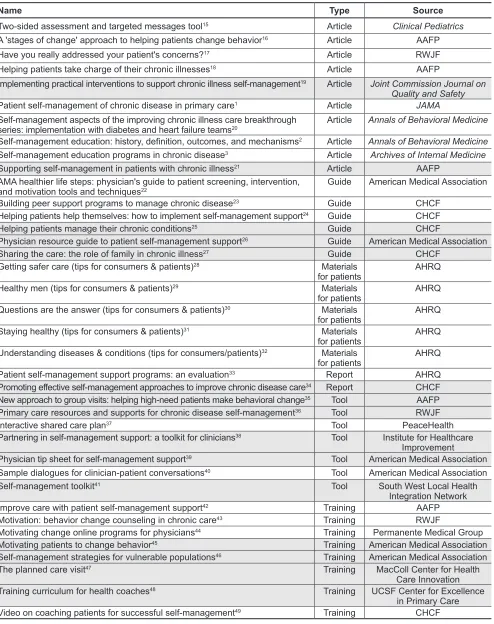
Each participating practice recruited 2 patients, 1 staff member in a care manager role, and 1 clinician for participation in each network’s BCT along with the research team. The full-day BCT kickoff retreat began with introductions, followed by an expert presentation on SMS. The articles and resources in AHRQ’s SMS library served as the basis for the expert presentation. The afternoon session was devoted to brainstorming ideas for messaging and implementation, during which 1 hour and 15 minutes were devoted to reviewing the existing tools in the SMS library. The kickoff retreat ended with discussions about key messages learned throughout the day.
278 JPCRR • Volume 5, Issue 4 • Fall 2018 Original Research
Name Type Source
Two-sided assessment and targeted messages tool15 Article Clinical Pediatrics A 'stages of change' approach to helping patients change behavior16 Article AAFP Have you really addressed your patient's concerns?17 Article RWJF Helping patients take charge of their chronic illnesses18 Article AAFP
Implementing practical interventions to support chronic illness self-management19 Article Joint Commission Journal on
Quality and Safety
Patient self-management of chronic disease in primary care1 Article JAMA Self-management aspects of the improving chronic illness care breakthrough
series: implementation with diabetes and heart failure teams20 Article Annals of Behavioral Medicine Self-management education: history, definition, outcomes, and mechanisms2 Article Annals of Behavioral Medicine Self-management education programs in chronic disease3 Article Archives of Internal Medicine Supporting self-management in patients with chronic illness21 Article AAFP
AMA healthier life steps: physician's guide to patient screening, intervention,
and motivation tools and techniques22 Guide American Medical Association Building peer support programs to manage chronic disease23 Guide CHCF
Helping patients help themselves: how to implement self-management support24 Guide CHCF Helping patients manage their chronic conditions25 Guide CHCF
Physician resource guide to patient self-management support26 Guide American Medical Association Sharing the care: the role of family in chronic illness27 Guide CHCF
Getting safer care (tips for consumers & patients)28 Materials
for patients AHRQ Healthy men (tips for consumers & patients)29 Materials
for patients AHRQ Questions are the answer (tips for consumers & patients)30 Materials
for patients AHRQ Staying healthy (tips for consumers & patients)31 Materials
for patients AHRQ Understanding diseases & conditions (tips for consumers/patients)32 Materials
for patients AHRQ Patient self-management support programs: an evaluation33 Report AHRQ Promoting effective self-management approaches to improve chronic disease care34 Report CHCF New approach to group visits: helping high-need patients make behavioral change35 Tool AAFP Primary care resources and supports for chronic disease self-management36 Tool RWJF
Interactive shared care plan37 Tool PeaceHealth
Partnering in self-management support: a toolkit for clinicians38 Tool Institute for Healthcare Improvement Physician tip sheet for self-management support39 Tool American Medical Association Sample dialogues for clinician-patient conversations40 Tool American Medical Association
Self-management toolkit41 Tool South West Local Health
Integration Network Improve care with patient self-management support42 Training AAFP Motivation: behavior change counseling in chronic care43 Training RWJF
Motivating change online programs for physicians44 Training Permanente Medical Group Motivating patients to change behavior45 Training American Medical Association Self-management strategies for vulnerable populations46 Training American Medical Association The planned care visit47 Training MacColl Center for Health
Care Innovation Training curriculum for health coaches48 Training UCSF Center for Excellence
in Primary Care Video on coaching patients for successful self-management49 Training CHCF
Table 1. Resources* Contained in the AHRQ Self-Management Support Resource Library4
*Shaded rows indicate materials utilized during the boot camp translation kickoff meeting.
www.aurora.org/jpcrr 279 Original Research
the study start date, the entire library was reviewed to select resources for the BCT kickoff retreat. The expert presentation was created exclusively from and reviewed these resources. Specific resources from each of the 6 categories of materials were selected for the afternoon portion of the kickoff retreat. The selected tools were then divided into 5 stations, and BCT participants spent 15 minutes reviewing the resources at each station. The SMS library webpage was displayed at one station to give participants familiarity with the website navigation and to show participants all available resources. Furthermore, a complete list of the resources with links to the materials was provided to all BCT participants. A research team member was located at each station to record feedback from all BCT participants.
After the conclusion of BCT in each network (the day-long retreat and subsequent conference calls), the materials and messages developed by the translation process were implemented in the participating practices. Researchers reviewed the notes from the kickoff meeting and phone calls to understand the themes from each discussion as well as the decisions made during the translation process, including a review of the original and final SMS tools from each PBRN.
RESULTS
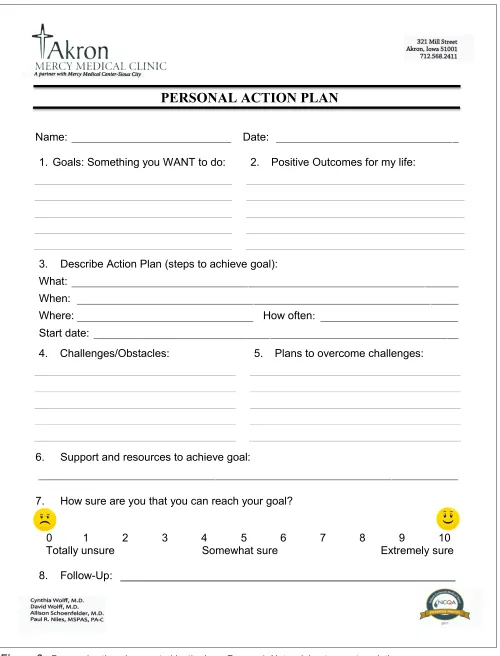
A total of 32 patients and 32 practice team members were engaged in the BCT process, with 45% of individuals attending all meetings and phone calls throughout the BCT process.10 Each BCT group informed the development of SMS tools for subsequent implementation in each of the participating practices. The BCT process resulted in the creation of unique tools in each network (Figures 1–4).
No individual tool from the SMS library was chosen for clinic use without modification. Each network selected one or more tools as starting points for the translation process. Similar themes emerged from the translation process within each PBRN. First, the subject of accountability arose in each PBRN, with emphasis on the idea that patients and practices had to share accountability for self-management. Patients expressed an interest to having practices hold them accountable for accomplishing self-management goals and advised practices to have active follow-up
to achieve this accountability. Furthermore, each BCT group recognized that the burden of SMS extends beyond clinic walls, and because of this the subject of peer support groups arose in each network’s group.
Each network made substantive changes to the language included in their SMS tools for them to be more motivating and engaging for their own practice’s patient populations. With the Wisconsin Research and Education Network BCT, the patient participants preferred the word “convinced” instead of “conviction” on the visual analog scale, as conviction was deemed to have negative connotations. Similarly, in the Iowa Research Network, the world “problem” was removed and focus centered on the creation of a personal action plan. The word “barriers” was felt to be insurmountable and this was replaced with “challenges.”
DISCUSSION
Even though each BCT occurred independently, similar themes emerged from the translation process in each network. The participants valued the idea of accountability from both the patients and the practices, even going so far as to suggest the term “contract” as opposed to a “shared goals/care plan” in the Oregon Rural Practice-based Research Network.
Additionally, the subject of peer support groups arose in each PBRN. The BCT groups in each state suggested language changes to reflect verbiage that is more relevant to the lived experiences and preferences of the participants. These themes highlight the importance of engaging patients, clinicians, and clinic staff in the translation process.
280 JPCRR • Volume 5, Issue 4 • Fall 2018 Original Research Figure 1. Diabetes self-management support tool created by the Oregon Rural Practice-based Research Network’s boot camp translation group.
APPENDI
CES
Appendix A.
Diabetes self-management support tool created by the Ore
gon Rural Practice-
camp translation group.
based Research Network’s boot
Bl
ood
Pr
es
su
re
Las t v isit : _ ___/__ __ To da y: ____ /_ __ _ Goa l: 14 0/ 90 mm HgEye
Exam
(Yea
rly)
Du
e:
yes/
no
To
tal
Cholest
erol
(Yea
rly)
Due : yes/noMi
cr
oa
lb
umi
n/
Cr
ea
tini
ne
(Y
ea
rly
)
Cu rr en t result:___ ___ __ _ Du e: yes/no Go al : Le ss th an 30 mg /d lWe
ig
ht
Ch
ec
k
Last Visit :_ ____ ___ Toda y: _ __ __ ___ __HgA
1c
(E
ve
ry
3
mon
ths)
Prior Re sult :_ __ ____Curr ent re sult:_ __ ___ N ext Due:____ ____ __G
oa
l:
<7%
Your
Diabetes
Health
Guide
Blo od Su gar Medi cation M etf ormi n_ ____ __ __ ____ __ Glipiz id e__ __ __ __ __ __ ____ I ns ulin Lantus/L
ev emir_________ __ H umalo g/ No volog_ ___ __ ___
Vaccines
____Y ea rly flu v ac ci ne ? __ __ Pn eumonia v ac ci ne ? Pr ev na r 13 __ _ Pn eu m ov ax 2 3_ __ __ __ Hep B (19 ‐59 yrs) #1 ___ #2_ __ #3_ __ To ta l Tr iglyceride s HD L LDL Resu lt G ui de lin es <1 75 <1 50 >5 0/ >4 0 wo men/ m en <70 R ec om m end ed that al l peopl e w ith d ia bet es age 4 0-7 5 year s ol d
be on a
www.aurora.org/jpcrr 281 Original Research
Figure 2. Problem-solving worksheet created by the Wisconsin Research and Education Network boot camp translation group.
Appendix B.
Problem solving worksheet created by the Wisconsin Research and Education
282 JPCRR • Volume 5, Issue 4 • Fall 2018 Original Research Figure 3. Personal action plan created by the Iowa Research Network boot camp translation group.
Appendix C.
Personal action plan created by the Iowa Research Network boot camp translation
group.
PERSONAL ACTION PLAN
Name: _____________________________ Date: _________________________________
1. Goals: Something you WANT to do: 2. Positive Outcomes for my life:
3. Describe Action Plan (steps to achieve goal):
What: ______________________________________________________________________
When: _____________________________________________________________________
Where: ________________________________ How often: _________________________
Start date: __________________________________________________________________
4. Challenges/Obstacles: 5. Plans to overcome challenges:
6. Support and resources to achieve goal:
____________________________________________________________________________
7. How sure are you that you can reach your goal?
0 1 2 3 4 5 6 7 8 9 10
Totally unsure Somewhat sure Extremely sure
www.aurora.org/jpcrr 283 Original Research
Figure 4 (continues on next page). The two-page self-management support tool created by the State
www.aurora.org/jpcrr 285 Original Research
CONCLUSIONS
This study illustrates the importance of the translation process, as no instrument was implemented directly from the library and each network created unique tools. SMS instruments require a process of local adaptation that serves to increase the relevance and meaning to both patients and practices. BCT is a process that can be implemented to engage these key stakeholders in the successful development of SMS tools. In turn, the delivery of SMS in primary care clinics could be improved from this process of translation. Given these findings, focus ought to shift toward enabling practices to facilitate collaboration with patients in the development of SMS tools instead of the current focus on the development of more instruments or clinical workflows.
Patient-Friendly Recap
• Patient self-management is an important part of managing chronic disease, and primary care practices are well equipped to support self-management efforts.
• Despite access to a wealth of
self-management resources, the authors found no individual tool studied could be adequately implemented in clinical practice without some
modification for local patients.
• Engaging patients in the creation of materials
and workflows for self-management support
can lead to richer materials that resonate more with patients.
Acknowledgments
Iowa Research Network: Akron Mercy Medical Clinic (Akron, IA); Red Haw Family Medical Center, P.C. (Chariton, IA); Family Medicine Clinic, University of Iowa Hospitals and Clinics (Iowa City, IA).
Author Contributions
Study design: Westfall, Fagnan, Nease. Data acquisition or analysis: Simpson, Daly, Fernald, Michaels, Levy, Hahn, Fagnan, Nease. Manuscript drafting: Simpson, Nease. Critical revision: Daly, Fernald, Westfall, Michaels, Levy, Hahn, Fagnan.
Conflicts of Interest
None.
Funding Sources
This research was funded by Agency for Healthcare Research and Quality (AHRQ) grant 1R18HS022491-01. Infrastructure support (ie, Meta-LARC) was funded by AHRQ grant IP30HS021639-01.
References
1. Bodenheimer T, Lorig K, Holman H, Grumbach K. Patient self-management of chronic disease in primary care. JAMA. 2002;288:2469-75. CrossRef
2. Lorig KR, Holman H. Self-management education: history,
definition, outcomes, and mechanisms. Ann Behav Med.
2003;26:1-7. CrossRef
3. Warsi A, Wang PS, LaValley MP, Avorn J, Solomon DH. Self-management education programs in chronic disease: a systematic review and methodological critique of the literature. Arch Intern Med. 2004;164:1641-9. CrossRef
4. Agency for Healthcare Research and Quality. Self-Management Support Resource Library. Page originally created 2016 Feb. http:// www.ahrq.gov/professionals/prevention-chronic-care/improve/ self-mgmt/self/sms_browse.html. Accessed March 24, 2016. 5. Han E, Hudson Scholle S, Morton S, Bechtel C, Kessler R.
Survey shows that fewer than a third of patient-centered medical home practices engage patients in quality improvement. Health Aff (Millwood). 2013;32:368-75. CrossRef
6. Nilsen ES, Myrhaug HT, Johansen M, Oliver S, Oxman AD. Methods of consumer involvement in developing healthcare policy and research, clinical practice guidelines and patient information material. Cochrane Database Syst Rev. 2006;(3):CD004563. CrossRef
7. Zittleman L, Emsermann C, Dickinson M, et al. Increasing colon cancer testing in rural Colorado: evaluation of the exposure to a community-based awareness campaign. BMC Public Health. 2009;9:288. CrossRef
8. Westfall JM, Zittleman L, Felzien M, et al. Reinventing the wheel of medical evidence: how the boot camp translation process is making gains. Health Aff (Millwood). 2016;35:613-8. CrossRef
9. Norman N, Bennett C, Cowart S, et al. Boot camp translation: a method for building a community of solution. J Am Board Fam Med. 2013;26:254-63. CrossRef
10. Fagnan LJ, Simpson MJ, Daly JM, et al. Adapting boot camp translation methods to engage clinician/patient research teams within practice-based research networks. J Patient Cent Res Rev. 2018;5:298-303.
11. Nease DE Jr, Daly JM, Dickinson LM, et al. Impact of a boot camp translation intervention on self-management support in primary care. J Patient Cent Res Rev. 2018;5:256-66. 12. Fernald DH, Simpson MJ, Nease DE Jr, et al. Implementing
community-created self-management support tools in primary care practices: multimethod analysis from the INSTTEPP study. J Patient Cent Res Rev. 2018;5:267-75. 13. Daly JM, Weiner Harrod T, Judge K, et al. Practice-based
research networks ceding to a single institutional review board. J Patient Cent Res Rev. 2018;5:304-10.
14. Brown CA, Lilford RJ. The stepped wedge trial design: a systematic review. BMC Med Res Methodol. 2006;6:54. CrossRef
15. Woolford SJ, Clark SJ, Ahmed S, Davis MM. Feasibility and acceptability of a 1-page tool to help physicians assess and discuss obesity with parents of preschoolers. Clin Pediatr (Phila). 2009;48:954-9. CrossRef
16. Zimmerman GL, Olsen CG, Bosworth MF. A 'stages of change' approach to helping patients change behavior. Am Fam Physician. 2000;61:1409-16.
17. Epstein RM, Mauksch L, Carroll J, Jaén CR. Have you really addressed your patient’s concerns? Fam Pract Manag. 2008;15:35-40.
286 JPCRR • Volume 5, Issue 4 • Fall 2018 Original Research
19. Glasgow RE, Davis CL, Funnell MM, Beck A. Implementing practical interventions to support chronic illness self-management. Jt Comm J Qual Saf. 2003;29:563-74. CrossRef
20. Glasgow RE, Funnell MM, Bonomi AE, Davis C, Beckham V, Wagner EH. Self-management aspects of the improving chronic illness care breakthrough series: implementation with diabetes and heart failure teams. Ann Behav Med. 2002;24:80-7. CrossRef
21. Coleman MT, Newton KS. Supporting self-management in patients with chronic illness. Am Fam Physician. 2005;72:1503-10.
22. American Medical Association. Physicians’ guide: patient screening, intervention and motivation tools and techniques. Released 2008 Mar 31. http://www.tcyh.org/physicians/ downloads/behavior/healthier-lifesteps-physician-guide.pdf. Accessed May 13, 2016.
23. Heisler M. Building peer support programs to manage chronic disease: seven models for success. Published 2006 Dec 12. http://www.chcf.org/publications/2006/12/building- peer-support-programs-to-manage-chronic-disease-seven-models-for-success. Accessed May 13, 2016.
24. Bodenheimer T, Abramowitz S. Helping patients help themselves: how to implement self-management support. Published 2010 Dec 13. http://www.chcf.org/ publications/2010/12/helping-patients-help-themselves. Accessed May 13, 2016.
25. Bodenheimer T, MacGregor K. Helping patients manage their chronic conditions. Published 2005 Jun 6. http://www. chcf.org/publications/2005/06/helping-patients-manage-their-chronic-conditions. Accessed May 13, 2016.
26. American Medical Association. Physician resource guide to patient self-management support. Released 2012. http:// selfmanagementalliance.org/wp-content/uploads/2013/09/ phys-resource-guide.pdf. Accessed May 13, 2016.
27. Rosland AM. Sharing the care: the role of family in chronic illness. Published 2009 Aug 12. http://www.chcf.org/ publications/2009/08/sharing-the-care-the-role-of-family-in-chronic-illness. Accessed May 13, 2016.
28. Agency for Healthcare Research and Quality. Getting safer care. Page last reviewed 2014 Dec. http://www.ahrq. gov/patients-consumers/care-planning/errors/safety.html. Accessed May 13, 2016.
29. Agency for Healthcare Research and Quality. Healthy men. Page last reviewed 2012 Dec. http://www.ahrq.gov/patients-consumers/patient-involvement/healthy-men/index.html. Accessed May 13, 2016.
30. Agency for Healthcare Research and Quality. Questions are the answer. Page originally created 2011 Aug. https://www.ahrq. gov/topics/questions-are-answer.html. Accessed May 13, 2016. 31. Agency for Healthcare Research and Quality. Stay healthy.
Page last reviewed 2012 Dec. http://www.ahrq.gov/patients-consumers/patient-involvement/healthy-men/healthy/index. html. Accessed May 13, 2016.
32. Agency for Healthcare Research and Quality. Understanding diseases & conditions. Page originally created 2013 Feb. http://www.ahrq.gov/consumer/diseases.html. Accessed May 13, 2016.
33. Pearson ML, Mattke S, Shaw R, Ridgely MS, Wiseman SH. Patient Self-Management Support Programs: An Evaluation. AHRQ Publication No. 08-0011. Rockville, MD: Agency for Healthcare Research and Quality, November 2007.
34. Kanaan SB. Promoting effective self-management approaches to improve chronic disease care: lessons learned. Published 2008 Apr 3. http://www.chcf.org/publications/2008/04/ promoting-effective-selfmanagement-approaches-to-improve-chronic-disease-care-lessons-learned. Accessed May 13, 2016. 35. Antonucci J. A new approach to group visits: helping high-need patients make behavioral change. Fam Pract Manag. 2008;15(4):A6-8.
36. Diabetes Initiative. Assessment of primary care resources and supports for chronic disease self management (PCRS). Last revised 2008 Dec. http://www.diabetesinitiative.org/ support/documents/PCRSwithBackgroundandUserGuide. Rev12.08.FINAL.pdf. Accessed May 13, 2016.
37. PeaceHealth. Interactive shared care plan. Released 2006. https://www.sharedcareplan.org/. Accessed May 13, 2016. 38. Institute for Healthcare Improvement. Partnering in
self-management support: a toolkit for clinicians. http://www.ihi. org/resources/pages/tools/selfmanagementtoolkitforclinicians. aspx. Accessed May 13, 2016.
39. American Medical Association. Physician tip sheet for
self-management support. Last modified 2011 May 23. http://
www.healthcarecommunities.org/SearchResults/ViewDocument. aspx?EntryId=50916&CategoryID=8257. Accessed May 13, 2016. 40. American Medical Association. Sample dialogues for
clinician-patient conversations. http://developmentalmedicine.ucsf. edu/pdf/actionPlan/SelfMgmtTrainingMay06.pdf. Accessed May 13, 2016.
41. South West Self Management Program. Self-management toolkit: a resource for health care providers. http://www. swselfmanagement.ca/smtoolkit/. Accessed May 13, 2016. 42. American Academy of Family Physicians. Improve care with
patient self-management support. Released 2016 Jun. http:// www.aafp.org/pcmh/videos. Accessed May 13, 2016. 43. Huntington J, Ward D, Lessler D, et al. Motivation: behavior
change counseling in chronic care. Prepared 2010. http:// www.son.washington.edu/pqe/patient-centered-video.asp. Accessed May 13, 2016.
44. The Permanente Medical Group. Motivating change online programs. http://www.kphealtheducation.org/. Accessed May 13, 2016.
45. American Medical Association. Motivating patients to change behavior. http://www.bigshouldersdubs.com/clients/ AMA/22-AMA-Motivating.htm. Accessed May 13, 2016. 46. American Medical Association, Portal of Geriatric
Online Education. Self-management strategies for vulnerable populations. Released 2012 Jun. http:// www.bigshouldersdubs.com/clients/AMA/18-AMA-SelfManagement.htm. Accessed May 13, 2016.
47. Improving Chronic Illness Care. Watch a planned care visit. http://www.improvingchroniccare.org/index.php?p=Planned_ Care_Videos&s=225. Accessed May 13, 2016.
48. University of California, San Francisco Center for Excellence in Primary Care. Health coaching. http://cepc.ucsf.edu/ health-coaching. Accessed May 13, 2016.
49. California Health Care Foundation. Video on coaching patients for successful self-management. Published 2008 Aug 15. http://www.chcf.org/publications/2008/08/video-on-coaching-patients-for-successful-selfmanagement. Accessed May 13, 2016.