Volume 9
Issue 1 Fall/Winter 2010 Article 13
November 2010
Background Checks and Social Effects: Contemporary Residential
Background Checks and Social Effects: Contemporary Residential
Tenant-Screening Problems in Washington State
Tenant-Screening Problems in Washington State
Eric Dunn
Marina Grabchuk
Follow this and additional works at: https://digitalcommons.law.seattleu.edu/sjsj
Recommended Citation Recommended Citation
Dunn, Eric and Grabchuk, Marina (2010) "Background Checks and Social Effects: Contemporary Residential Tenant-Screening Problems in Washington State," Seattle Journal for Social Justice: Vol. 9 : Iss. 1 , Article 13.
Available at: https://digitalcommons.law.seattleu.edu/sjsj/vol9/iss1/13
Background Checks and Social Effects:
Contemporary Residential Tenant-Screening
Problems in Washington State
Eric Dunn & Marina Grabchuk
INTRODUCTION
In October 2007, the website FreeCreditReport.com—not to be confused
with the publicly mandated annualcreditreport.com1—launched a series of
television commercials featuring a young singer who laments having neglected to watch over his credit report. He is turned down for jobs, loans, and in one spot, housing:
Well I married my dream girl, I married my dream girl But she didn’t tell me her credit was bad
So now instead of living in a pleasant suburb We’re living in the basement at her mom and dad’s Now we can’t get a loan for a respectable home Just because my girl defaulted on some old credit card If we’d gone to free credit report dot com
I’d be a happy bachelor with a dog and a yard.2
Some might agree with the singer—that he should have run his fiancée’s credit report before saying “I do.” Others might find the thought revolting. But there is no denying the jingle’s underlying premise: poor credit absolutely can doom a young couple’s dreams of moving into their own home. And though most families who cannot qualify for a home loan would probably sooner rent an apartment than live in their parents’ basement, unfavorable credit reports are no less a barrier to obtaining rental housing.
are approved or denied almost exclusively on the basis of financial criteria. Rental applicants, however, must usually also satisfy a series of inquiries into matters of character, lifestyle, and personal history. This has long been the case, but modern information systems have vastly expanded the amount of information available to landlords about prospective tenants and the warped speeds at which that information can be obtained,. In today’s age of online public records and digital transmission, a rental applicant’s complete residential history, credit report, criminal record, civil litigation background, and other information are available within hours or even minutes, and in Washington, all at the prospective tenant’s expense.3 Some
landlords access this information directly from public websites and databases; however, most contract with tenant-screening services (a subset of the consumer-reporting industry) to cull records from various sources and prepare custom “tenant-screening reports.”
These technologies have revolutionized the processes by which rental housing providers choose tenants, supplementing or even replacing traditional tenant-screening tools like written applications, personal interviews, or phone calls to past landlords. Today’s residential landlords are able to choose their tenants much more selectively than in the past, and do so in hopes of reducing the risk of leasing to a tenant who will default in rent, damage the premises, or be otherwise problematic. As is common with technological advances, however, these benefits have come at significant, though largely overlooked, social costs.
In Washington, individuals and families are frequently denied housing due to inaccurate or misleading background reports that they have no
practical way of correcting.4 Other potential tenants are deterred by or
unable to afford screening fees, which, if they pay and are rejected at one property, they must pay again to apply elsewhere.5 Still others find they are
domestic violence protection order cases, poor consumer credit, or other disfavored characteristics.6
In Washington, unfavorable tenant-screening reports probably do not deter too many marriages among perfectly matched mates, but they do keep plenty of people living in their parents’ basements. Contemporary tenant-screening practices (and the exclusionary policies they support) also swell
the ranks of the homeless,7 frustrate offender reentry programs, deter
domestic violence survivors from leaving abusive partners, chill existing tenants from asserting basic legal rights, and cause other significant public policy effects Washington can scarcely afford to ignore.
This article will take a deeper look at these problems, how they arose, and possible methods to address them. Part One looks at current residential screening industry practices, including common tenant-selection criteria, and the procedures and information sources that landlords use to evaluate applicants. Part Two will detail how these practices lead to social problems, such as unfair rejections for rental housing or the collective effects of disqualifying people categorically from broad sections of the rental market due to criminal records, eviction cases, or poor credit. Part Three examines the limited strengths and numerous drawbacks to the few potential legal remedies for frustrated rental applicants under existing U.S. and Washington law, including theories under the Fair Credit Reporting Act, Washington’s Residential-Landlord Tenant Act and Consumer Protection Act, fair housing statutes, and privacy claims. Finally, Part Four discusses possible legislative solutions that, if enacted, could mitigate abusive tenant-screening practices in Washington, such as proposals for “portable screening reports,” enhanced procedures for sealing judicial records, and expanded protection for tenants under the Fair Credit Reporting Act.
I.CURRENT INDUSTRY NORMS
particular applicant meets those criteria. Both aspects profoundly affect how rental housing opportunities are distributed in Washington.
A. Tenant-Selection Criteria
The purpose of tenant screening is to predict the likelihood that a particular rental applicant will make (what the landlord considers) a “good tenant.” To this end, the criteria landlords use for selecting tenants can range from amorphous judgments about an applicant’s desirability to formal admission policies that evaluate applicants across a wide spectrum of factors. But most of the time, rental criteria relate to the essential requirements of residential tenancies like paying rent and complying with basic rules. Despite variations from one housing provider to the next, basic criteria usually fall along the twin axes of financial suitability and behavioral suitability.8
Financial suitability means being able to meet the anticipated pecuniary obligations of the tenancy.9 This most obviously includes rent, as well as
other expected expenses such as utility bills, security deposits, renter’s insurance (if required), and so on. Some landlords may also consider whether the applicant would be likely to pay a claim or judgment in the event of damage to the premises, early lease termination, or other breach.10
Many housing providers assess financial suitability using mathematical formulas or thresholds (e.g., monthly gross income of two-and-a-half to
three times the rent is common).11 An applicant may also need to
demonstrate that the income is reliable, such as through a minimum
duration of employment.12 Some landlords may require a cosigner or extra
security deposit for applicants whose financial qualifications are
marginal.13 Notably, many housing providers refuse to accept tenants who
rely on child support, government housing subsidies, welfare benefits, or certain other often-stigmatized income sources.14 Even assuming the tenant
payments, debts—especially to former landlords—or other adverse credit history can disqualify a rental applicant.15
Behavioral suitability means satisfying the housing provider that the applicant will follow the rules, fulfill other nonfinancial obligations of the
tenancy, and live harmoniously in the community.16 This determination is
typically based on an applicant’s history at previous residences, as shown by interviews with the applicant, with prior landlords and other references, and, especially, with various background reports such as civil litigation records, criminal histories, and credit scores. Applicants who receive critical reports from past housing providers or who cannot demonstrate a stable residential history are generally treated less favorably.17 Applicants with
acute blemishes such as bankruptcies, foreclosures, eviction records, or felony convictions are often categorically excluded.18
B. Screening Methods and Information Sources
Today’s landlords commonly obtain the reports that facilitate the use of both financial and behavioral tenant-selection criteria from background-check providers,19 many of whom specialize in so-called “tenant screening”
and others who also conduct pre-employment screening and other types of
consumer reports.20 Tenant-screening companies can provide residential
landlords almost-instant access to extensive background information about practically any rental applicant. Tenant-screening reports, which typically
cost between $35 and $75 per adult occupant21—with the entire cost
generally passed along to the applicant22—commonly include four main
components concerning an applicant: (1) a residential history; (2) a credit report; (3) a criminal background check; and (4) civil litigation records (especially eviction reports).23 In addition, many tenant-screening services
also market analysis or evaluation of this raw information, usually in the form of “scores” or “recommendations” concerning the applicant’s fitness
for tenancy.24 The methods and practices by which this information is
present new challenges for contemporary consumer advocates as well as the judicial system itself. We begin with a closer look at the reports.
1. Residential History
Housing providers routinely require applicants to disclose their prior
residences for the preceding period, often about three to seven years into the
past, usually on a written rental application. This residential history
provides names and contact information for past housing providers, and indicates the proper states and localities to search for criminal records, civil litigation records, or other public records. Most housing providers and screening services will cross-check past addresses that an applicant supplies against a credit report or other external sources. The failure to fully and accurately disclose past housing providers or places of residence may alone be sufficient grounds for rejection.25 Some screening services, usually for
higher fees, will interview past housing providers and include the resulting
information in the screening report,26 whether verbatim, in a summary or
abbreviated form, or by incorporation into a recommendation or other evaluation of the applicant’s desirability.
2. Credit Reports
Another regular feature of a tenant-screening report is a credit report, that is, a “consumer report,”27 about the applicant from a credit bureau, often
(but not always) from one of the so-called “big three” credit bureaus:28
Equifax, Experian, and Trans Union.29 Although “credit bureau” has no
official meaning in U.S. law,30 the term is popularly understood to mean “a
company that collects information from various sources and provides consumer credit information on individual consumers for a variety of uses.”31 A credit report will generally list an applicant’s prior addresses,
report should also identify anyone who has requested the report and the purpose of such inquiries.33
3. Criminal Background Checks
A criminal background check is a consumer report containing information related to arrests, criminal charges, or convictions pertaining to the applicant.34 Some screening services search for criminal records only in
local jurisdictions; others search across the country for records or in any jurisdiction where the applicant has reported living.35 Though there is no
nationwide database or other central repository of criminal records, some tenant-screening companies offer a fifty-state search for criminal records, which may include jurisdictions where the applicant has never lived or even visited.36
In Washington, criminal records are available through the WATCH (Washington Access To Criminal History) database, which is maintained by
the Washington State Patrol.37 WATCH contains records produced by
courts and criminal justice agencies throughout the state and include conviction records, records of arrests within one year if pending disposition,
and records of registered sex offenders and kidnappers.38 WATCH matches
records to the name, date of birth, or other identifiers used in the search
inquiry.39 Any member of the public can access WATCH online and obtain
an immediate criminal record for a $10 fee per search.40
Like with credit reports, some tenant screeners—particularly those that market nationwide history reports—purchase private
criminal-background reports for resale as part of the tenant-screening package.41
Hundreds of private vendors assemble and resell criminal records as part of
background checks for pre-employment and tenant screening.42 The largest
companies.43 Many private vendors maintain their own “shadow databases,”
which may contain criminal records that have been expunged or vacated, or otherwise restricted or sealed to public access.44
4. Civil Litigation Records
Tenant-screening reports also usually contain records concerning various forms of civil litigation, most of which are obtained directly from courts or
court-maintained indices.45 Money judgments usually appear on credit
reports, such as in collections cases for consumer or medical debt.46 Judicial
foreclosure actions are rare in Washington, but may also appear in screening reports.47 Other civil litigation records common in tenant-screening reports
include rental collections,48 tenant-initiated landlord-tenant suits,49
antiharassment or domestic violence protection order proceedings,50 and
civil commitment proceedings.51
Most important are unlawful detainer (i.e., eviction) lawsuits52 which
tenant-screening firms report when the applicant is named as a defendant. In Washington, unlawful detainer cases are heard in county-level superior courts.53 Civil case records for superior courts, including unlawful detainer
actions (UDs) are indexed in the Superior Court Management Information
System (SCOMIS), a statewide electronic case management database.54
SCOMIS data is free and instantly accessible by anyone via internet.55
Whenever a new civil action is filed in any of Washington’s thirty-nine superior courts, the clerk enters the parties’ names, case number, and “case type” into SCOMIS; for an eviction lawsuit, the case type will appear as “unlawful detainer.” In addition to the public site, the Washington Administrative Office of the Courts provides a subscription service whereby subscribers may periodically download SCOMIS data into private computer systems.56
information downloaded from SCOMIS). A person who has such a record is deemed by the tenant-screening industry to have an “eviction history.”57
Detecting an eviction history may be fast and free to anyone with internet access, but more detailed and trustworthy information about civil actions is comparatively difficult, expensive, and time-consuming to obtain. SCOMIS does allow access to cryptic docket entries in pending or recently closed cases, but it does not include or link to any additional records or documents containing the claims, defenses, findings, evidence, or other details about cases being searched.58 Some superior courts, such as King County’s, make
scanned case documents available on-line—but for a fee, and access
requires a special account.59 Few housing providers choose to incur such
expenses and delays to obtain more detailed records.
II.CURRENT PROBLEMS IN TENANT-SCREENING
Contemporary tenant-screening practices raise two types of problems for residential tenants in Washington. First, tenant-screening reports that contain inaccurate or misleading information impair many tenants’ housing prospects undeservedly. Second, exclusionary policies deprive many individuals and families of access to housing for reasons that, while based on true information, are objectively unfair or conflict with other significant public policy goals.
A. Inaccurate or Misleading Information in Tenant-Screening Reports
Studies assessing the accuracy of consumer reports show alarming rates of factual errors. A 2004 study based on 197 interviews across thirty U.S. states found errors in 79 percent of respondents’ “big three” consumer reports.60 One in four of those errors were significant enough to cause a
consumer’s wrongful denial of credit.61 An ABC News investigation in
criminal convictions.”62 Public records databases can be compromised by
similar errors. For instance, state sex offender registries, which often rely on offenders to update their own listings, are notorious for reporting outdated or inaccurate information.63
Tenant-screening reports typically incorporate several components into a single report.64 This suggests that the chance of finding significant errors in
a tenant-screening report is at least as high as the combined likelihood of finding errors in each particular component,65 and additional opportunities
for clerical errors and other mistakes tend to arise any time a screening agency interprets, repackages, abridges, or otherwise modifies information in a component part. This is especially true of scores or recommendations based on criminal and civil litigation records, which may require substantial skill to properly interpret.66
Types of errors common in background checks include overreporting (i.e.., when a record about a different person with the same name as the applicant is reported as being a potential match for the applicant),67 records
based on criminal identity theft (i.e., where an actual arrestee gives a false name or claims to be another actual person), reports containing expunged
records, and mundane clerical errors.68 Washington’s public records
systems are susceptible to all of these problems.
WATCH reports records based on replicable identifiers such as names and birth dates, which can lead to a high incidence of potential matches and,
thus, overreporting of criminal records.69 The possibility for potential
matches is even higher with SCOMIS, which narrows name searches only by county.70 Inevitable clerical errors occur, whether by court clerks, law
enforcement personnel, or others inputting information or making changes in the database.71 Safeguards against identity theft—criminal or otherwise—
do not exist. For these reasons, WATCH warns users that it “cannot guarantee the records you obtain through this site relate to the person on
whom you are seeking information,”72 while SCOMIS makes “no
these pages,” and warns that data may not be “accurate or complete [or] in its most current form.”73
A related problem is the presentation of true information in misleading ways, resulting in harm to prospective tenants. For instance, criminal history reports often make “several criminal charges connected with one arrest look like they involve multiple incidents.”74 A report showing that a
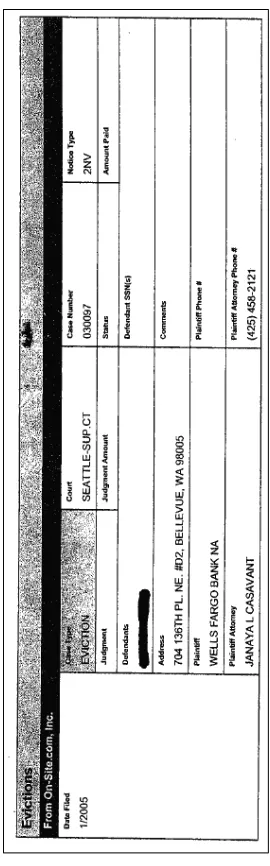
rental applicant was sued for unlawful detainer often creates an impression that the person was evicted, even though she may have been improperly sued or prevailed in the case.75 In fact, eviction reports seldom contain more
than the most basic information about unlawful detainer suits: the names of the parties, the court where the action was filed, and a filing date.76 Further
details—such as the grounds for suit, any defenses raised, or the outcome— are typically omitted or, if included at all, reported in a perfunctory, incomplete, or even incoherent manner.
Erroneously attributed criminal records or eviction cases can obviously cause applicants to be denied housing, for such records make applicants appear as less desirable tenants than they truly are. Inaccurate or misleading screening reports also cause applicants to be rejected for nondisclosure or misrepresentation, as housing providers almost always ask potential tenants to disclose any criminal convictions or eviction suits on their applications, and false or incomplete information is usually an independent basis for rejection.77 Despite the serious consequences of such errors and misleading
information, correcting inaccurate tenant-screening reports is seldom practical or beneficial to rental applicants.
B. Monitoring or Correcting Inaccurate Tenant-Screening Reports
Both the federal and Washington Fair Credit Reporting Acts provide dispute and reinvestigation mechanisms that enable consumers to rectify
inaccurate or misleading credit records.78 These statutory procedures
obligate a consumer reporting agency79 (“CRA”) that receives a dispute
concerning the accuracy or completeness of information on a “consumer report” to “reinvestigate” the item, at no charge to the consumer, within thirty days.80 Unless the CRA verifies the disputed entry, the information
must be “promptly delete[d] from the file of the consumer, or modif[ied] as appropriate, based on the results of the reinvestigation.”81 If reinvestigation
does not resolve the dispute, the CRA must permit the consumer to file a “brief statement setting forth the nature of the dispute” along with the adverse item.82
Albeit imperfect, this process at least enables consumers who anticipate applying for credit to take proactive steps that can prevent them from being turned down or charged higher rates due to inaccurate information. But a vital component in this scheme is an automated updating system, “e-Oscar”
(for Online Solution for Complete and Accurate Reporting),83 through
on a periodic basis.84 Because of e-Oscar, a consumer only needs to dispute
an item with one national credit bureau to correct the same information with all of them.85
In stark contrast, rental applicants have no practical method to check their tenant-screening reports or to dispute inaccurate or misleading information in advance of a housing search. Only CRAs that “regularly engage in the practice of assembling or evaluating, and maintaining . . . [c]redit account information from persons who furnish that information regularly and in the ordinary course of business” are required to participate in e-Oscar or a
comparable automated reinvestigation or updating service.86
Tenant-screening agencies tend to avoid this requirement because they do not ordinarily receive regular credit account updates from banks, credit card
companies, or other “furnishers.”87 Because there are dozens of
tenant-screening services operating in Washington,88 obtaining and reviewing
tenant-screening reports from so many companies, as well as disputing any inaccuracies found in the reports, is not feasible.89
Also, unlike the big three and other CRAs that maintain running files on all consumers, a tenant-screening firm customarily compiles a report on a specific rental applicant only when requested by a housing provider.90 Upon
transmitting that report to a landlord, the screening service ordinarily will not continue to collect or update information about that applicant, and may even delete the file altogether.91 When a screening company has no report to
obtain and review ahead of time,92 it is nearly impossible for a consumer to
preemptively assure his report is accurate, even if he knows which screening service the prospective landlord will use.
Housing providers typically order tenant-screening reports only upon receiving rental applications for then-available dwelling units and usually make prompt use of such reports.93 If a report contributes to an applicant’s
rejection, the landlord must so inform the applicant and provide the name, address, and telephone number of the screening service that supplied it.94
firm) within the next sixty days, which the consumer may use to detect and dispute any inaccuracies that may have led to the denial.95 But submitting
such a dispute is seldom worthwhile.
Disputing an inaccurate or misleading tenant-screening report after a denial is often futile because the desired rental unit will likely be leased to another person well before a rejected applicant can obtain the report, lodge a dispute, wait up to thirty days for the reinvestigation, and (if successful) secure a corrected report, which may or may not cause the housing provider to reconsider the application.96 Because there are so many tenant-screening
firms operating in Washington, the next housing provider to whom the applicant applies is unlikely to request a screening report from the same
source.97 Furthermore, if the disputed information is derived from an
erroneous or misleading public record, the CRA may not even owe a duty to correct its report unless (and until) the public record itself is corrected.98
C. Multiple Screening Fees for the Same Information
Another problem associated with incorrect records is multiple screening fees. A person who applies for housing at successive providers must ordinarily pay a separate screening fee each time, even though the reports purchased with those fees usually contain substantially identical
information.99 Applicants with blemished credit or adverse background
information often face a substantial risk of rental rejections and the associated prospect of paying multiple screening fees any time they search for rental housing.100 For these individuals, screening fees can easily extend
into the hundreds of dollars,101 sometimes consuming funds that might be
needed for security deposits, moving expenses, or other housing-related costs.102 Social service agencies that offer financial assistance with such
expenses are similarly affected.103
screening reports on to applicants.104 Borderline applicants, faced with the
prospect of paying such fees repeatedly, may limit their housing searches to inferior properties and less desirable neighborhoods rather than risk money on application fees at high-quality rental properties they perceive as more likely to deny them.105 On a collective level, this phenomenon may foster
the concentration of poverty and frustrate efforts to promote diverse and economically integrated communities.
D. Social Consequences of Outsourcing to Tenant-Screening Services
A rental decision theoretically entails a unique evaluation of whether the applicant’s household appears consistent with the nature of the housing and whether the applicant is likely to comply with the relevant rules and policies, coexist peaceably with the neighbors, and fulfill the financial obligations of the tenancy. Yet in practice, this analysis is typically reduced to a purely mechanical comparison of rigid suitability criteria against individual applicants’ background reports. Tenant-screening services often facilitate such decision making by marketing scores, recommendations, or other opinions concerning prospective tenants, purportedly based on the raw reports.106 Some invite landlords to outsource rental decisions entirely by
selling only the opinion (e.g., “accept” or “reject”) and withholding the data upon which it is predicated.
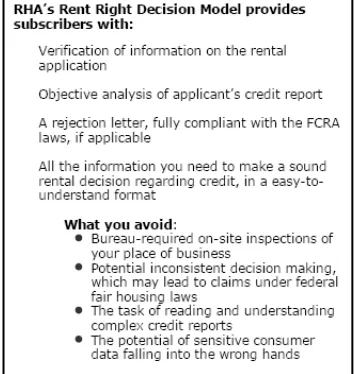
For example, the Rental Housing Association of Puget Sound (RHA) offers a product it calls “Rent Right,” in which the landlord is provided only a decision (either “Approved,” “Approved with Conditions,” or “Declined”) and is not given any reason for the decision or permitted to view any of the applicant’s credit details.107 RHA extols this method as sparing landlords
“[t]he task of reading and understanding complex credit reports.”108 Unlike
if making rental decisions themselves—though, under tighter rental market conditions, even landlords themselves tend to be extremely selective.109
Rental recommendations, and the ultimate approvals or rejections, are typically predicated on the broadly accepted assumption that a person’s past is the best predictor of future performance—in this case, as a tenant. But its strict application tends to produce controversial consequences that threaten numerous public policy concerns. Rental policies excluding applicants who lack a “stable housing history,” for instance, inhibit public efforts to combat homelessness. Overly restrictive rules against applicants with criminal records frustrate offender-reentry initiatives. Excluding applicants with certain disfavored income sources (like housing vouchers, welfare benefits, or child support) undermines the efficacy of poverty relief and welfare programs. Rules which disqualify applicants with records of home foreclosures tend to multiply, often arbitrarily, the economic and social ills of the recent national foreclosure crisis. Then, probably the most significant tenant-screening abuse is the widespread practice of automatically rejecting applicants with “eviction” records.
In much of Washington, residential landlords commonly reject any applicant who has been involved in an unlawful detainer litigation against a prior landlord, period—regardless of whether the case resulted in a judgment for the landlord and physical “eviction” of the tenant, a complete dismissal and exoneration of the tenant on all claims, or anywhere in between.110 It may be only natural that landlords seek to avoid leasing to
tenants they perceive as “high risk,” but the practice dramatically impairs the rental housing opportunities of a significant number of Washington families.111 On a widespread basis, this exclusionary practice erodes access
to our courts, weakens the due process rights of all residential tenants, and relegates some to an intractable condition of homelessness.112
Rental policies which automatically disqualify applicants because of unlawful detainer suits undermine access to justice by chilling tenants from
even appearing in landlord-tenant court.113 Tenants who have meritorious
defenses and compelling evidence often decide that preserving a particular tenancy is not worth the damage that an unlawful detainer record will inflict upon their future rental prospects—especially when that damage is not
ameliorated by a favorable outcome in the case.114 Consequently, rather
than assert defenses, tenants often decide simply to move out after being
served eviction notices or unfiled legal pleadings.115 Housing providers
justify these exclusions on grounds of efficiency and economy (since obtaining and evaluating additional information about an unlawful detainer action can impose significant costs, delays, and other difficulties), but cynically, many landlords are equally or even more strongly averse to having tenants who have successfully defended against eviction lawsuits by prior housing providers.116
tenant’s future housing opportunities merely by filing suit—a measure solely within the landlord’s control—tenants are deterred from doing anything they predict might invite litigation.118 Of course, not all tenants
avoid being sued for unlawful detainer or incurring other irreparable injuries to their rent-worthiness.
E. The Result: “Unhouseables”
The process of screening prospective residential tenants naturally implies that some will be accepted as tenants by particular landlords and others will not. Though rental rejections may often be attributed to errors and false impressions, plenty of rental applicants do have damaged credit, lack bank accounts or other established credit, have been arrested or convicted of criminal offenses, have been asked to leave previous rental properties, sued for unlawful detainer, or evicted by a court, or have recently been homeless or without verifiable “residential history.” Many of these would-be tenants encounter great difficulty nowadays in locating willing landlords, often on the basis of information that few landlords would have discovered before the age of digitized records and free online databases.119 Indeed, as the
information available to landlords has increased, so too have the grounds for rejecting applicants, especially in tight market conditions when overly selective criteria are not punished.120
To many such applicants, the cost of these difficulties is measurable in hours wasted in futile apartment searches and hundreds of dollars in
application fees.121 Yet many such applicants secure housing eventually—
even if in substandard facilities or less-than-desirable locations. Increasingly, however, tarnished rental applicants are finding they are
unable to secure any housing at all.122 As a 2004 study observed in
backgrounds.”123 More locally, housing counselors and advocates from
major social services agencies, such as Seattle’s Solid Ground, have cited tenant-screening as an issue of top priority to their clients and a first-rank barrier to reducing homelessness in Washington.124
III.POTENTIAL REMEDIES UNDER EXISTING LAW
Though Washington has made no effort to comprehensively regulate the tenant-screening industry, a handful of laws bearing more broadly on subjects like fair housing, landlord-tenant, and credit reporting do reach certain tenant-screening practices, sometimes substantially.
A. Tenant-Selection Criteria
Perhaps the most straightforward legal theory for challenging unfair tenant-screening practices is a simple breach of contract claim. A person who applies for rental housing presumably contracts with the landlord for a good-faith consideration of her application (especially if a fee is paid), so a landlord’s unreasonable rejection of the application could sustain an actionable claim.125 An unreasonable or bad-faith basis for rejection might
be a ground contrary to the landlord’s established rental criteria,126 a reason
unrelated to predicting future performance in a tenancy, or some socially malevolent basis that conflicts with public policy.127 Also, since a rental
application involves an interest in land, the unjust denial of a leasing application constitutes an irreparable injury for which a court could order
specific performance.128 But, while appealing in the abstract, numerous
practical considerations undermine breach of contract as a viable legal theory for addressing tenant-screening problems.
if the criteria are known, a rental applicant may be unable to prove a deviation from those criteria because Washington law permits a landlord to deny a rental application without disclosing the reasons for rejection.129 All
that Washington law does require is that the landlord inform the rental applicant (either orally or in writing) of the denial, and if a tenant-screening
service was used the landlord must provide its name and address.130 This
lack of transparency may prevent a rental applicant from detecting that his rental application was denied unfairly, let alone prove such a claim.
The lack of viable remedies is another significant obstacle. Since an offending landlord will typically rent vacant premises to another tenant well before a rejected applicant could bring a lawsuit or obtain relief, gaining access to the desired premises is often not feasible.131 Even if the rental unit
is still available, many prospective tenants would probably prefer not to start new tenancies with landlords embittered by litigation. Courts may also be reluctant to issue injunctions likely to require extensive subsequent oversight.132 This means damages, though inadequate as a matter of law,133
may be the only realistic remedy for a wrongful denial of rental housing claim. Such damages, which might include the application fee, related incidental costs, and possibly compensation for loss of expectation (e.g., if the tenant had to pay more in rent or settle for inferior housing elsewhere), would often appear inadequate to make bringing a lawsuit for damages worthwhile, particularly given the absence of a fee-shifting statute.134
1. Residential Landlord-Tenant Act
An applicant who feels he was wrongfully denied rental housing may also consider bringing an action under Washington’s Residential Landlord Tenant Act (RLTA), a 1973 statute that governs most residential tenancies
in Washington.135 With one exception, the RLTA does not regulate the
rejects an applicant for an untenable reason (such as those discussed above) theoretically violates this duty of good faith.
The RLTA, however, provides no specific remedy for a breach of the duty of good faith, and in the only reported case discussing the provision, the Washington Court of Appeals, Division I, openly questioned whether the duty actually affords tenants “a substantive right to good faith treatment by the landlord.”137 Basic principles of statutory construction suggest that
the RLTA duty of good faith is substantively enforceable,138 but without
specific remedies for a violation, the good faith provision appears scarcely more helpful to rental applicants than the analogous breach of contract theory.
2. Consumer Protection Act
Another statute that provides mistreated rental applicants with a potential avenue for legal redress is the Consumer Protection Act (CPA), which prohibits “[u]nfair methods of competition and unfair or deceptive acts or
practices in the conduct of any trade or commerce.”139 Unlike the RLTA,
common law, or good faith theories discussed above, the CPA provides distinct and potent remedies for persons injured by unfair or deceptive practices, including actual damages, costs and attorney fees, injunctions
against “further violations,” and even exemplary damages.140 The
Washington Supreme Court has also authorized other types of equitable relief in association with CPA claims on the basis of “[t]he superior court’s inherent authority to enforce orders and fashion judgments.”141
To establish a CPA claim, a plaintiff must prove that the defendant committed an unfair or deceptive act or practice in the scope of trade or commerce, that the act or practice affects the public interest, and that the act or practice injured the plaintiff.142 A rental applicant who is rejected for an
enable a CPA unfair practice claim—indeed, “unfair” probably covers a broader range of practices than “bad faith.”143 The leasing of residential
homes is commerce, and tenant-selection practices affect the public, because landlords regularly advertise vacancies, solicit applications, and make leasing decisions in the course of their business.144 But while the CPA
appears to be a promising tool for challenging unfair rental housing rejections, appearances can sometimes be deceiving.
In 1985, the Washington Supreme Court ruled in State v. Schwab that
residential tenants may not sue landlords for unfair or deceptive practices under the CPA.145 It is unclear whether (and to what extent) Schwab reaches
transactions between landlords and rental applicants (i.e., persons who have applied for rental housing but have not yet been accepted as tenants).146 The
RLTA sets forth the rights and duties belonging to persons defined as “landlords” and “tenants,” rental applicants are not mentioned, and the definition of “tenant,” though broad (“any person who is entitled to occupy a dwelling unit primarily for living or dwelling purposes under a rental
agreement”), does not embrace applicants.147 The original RLTA did not
feature any provisions governing transactions between landlords and applicants, and no such components had been inserted by the time of
Schwab in 1985. Thus, it is reasonably clear the legislature did not originally intend the RLTA, rather than the CPA, to govern transactions between landlords and rental applicants.
However, in 1991 and 2004, two provisions governing transactions
between landlords and applicants were added to the RLTA.148 One of the
1991 amendments (now codified at RCW 59.18.253 and 257) limited the fees landlords can charge for the cost of obtaining tenant-screening reports
and background information.149 The other provision imposed rules on
deposits to secure occupancy of rental units.150 These regulations benefit
prospective “tenants,” rather than the actual tenants to whom the RLTA traditionally applied.151 Both provisions contain specific, self-contained
The 1991 amendments are capable of two basic interpretations. One view is that by extending the RLTA to some transactions between landlords and “prospective tenants,” the legislature intended to bring all such relationships
under the RLTA and, thus, exempt them from the CPA (per Schwab).153
The other, more likely view, is that the legislature intended only to create a remedy for people charged excessive application fees or unfair rental deposits, and did not intend to fully determine which transactions between residential landlords and nontenants belonged within the RLTA. Whereas the RLTA had been a comprehensive statute governing practically all aspects of the landlord-tenant relationship, the 1991 amendments were directed at two specific problems: application fees and deposits. Also, the 1991 limits on fees and deposits were designed to make rental housing more affordable to low-income people, not to counteract charges the legislature
had found unfair or deceptive.154 The CPA may, therefore, not have
appeared to be the appropriate enforcement tool. The findings did not
indicate any intention for the 1991 amendments to extend Schwab to all
transactions between residential landlords and rental applicants, or even any explicit consideration that the amendments could have such an effect.155
In 2004, however, the RLTA acquired (for the first time) a provision that actually regulates a ground upon which landlords may select tenants: the
Victim Protection Act (VPA).156 Among other things, the VPA prohibits a
residential landlord from denying a rental application because of the person’s status as a victim of domestic violence or certain other crimes.157
Like the 1991 RLTA amendments, the VPA is codified under the RLTA and provides specific, self-contained remedies for violations.158 The VPA
did not comprehensively regulate the field of possible transactions between landlords and rental applicants; instead, it addresses a narrow set of specific evils—housing discrimination against domestic violence victims and the
economic barriers to leaving abusive partners.159 Nevertheless, this
It is highly doubtful that, in prohibiting landlords from rejecting tenants on such an egregiously unfair and socially obnoxious basis as in the VPA,
the legislature truly intended to extend the RLTA—and with it Schwab—to
the full spectrum of residential tenant-selection decisions. But it can no longer be denied that the RLTA reaches tenant-selection practices, and some may interpret the VPA as evidence that the legislature assumed the RLTA applied to tenant selection all along (and, thus, that claims based on
unfair tenant-screening practices are exempt from the CPA per Schwab).
Followed to its logical conclusion, this argument assumes, probably unrealistically, that the legislature could not pass a law to protect domestic violence victims from housing discrimination without also revisiting
Schwab. On the other hand, placing the VPA antidiscrimination provision under the RLTA makes it consistent with the Law Against Discrimination, under which housing discrimination claims are also specifically exempt
from CPA enforcement.160
It is likely only a matter of time before a Washington appellate court will have to decide squarely whether or not Schwab extends to rental applicants; in fact, several cases have come close. In the unpublished 2002 decision of
Collard v. Reagan, the Court of Appeals, Division II, upheld an award of CPA damages to a group of rental applicants who had been scammed out of
application fees and deposits by a residential landlord.161 The landlord
argued on appeal that the CPA claim was barred by Schwab, but the Court
of Appeals did not consider the defense because the landlord had not presented it to the trial court.162
More promising for rental applicants is the 2001 case of Ethridge v.
Hwang, in which the Washington Court of Appeals, Division I, declined to extend Schwab to mobile home park tenancies.163 In Ethridge, a mobile
and brought several claims, including one under the CPA. The park challenged the CPA claim, reasoning that relationships between mobile home parks and their tenants are exclusively governed by the Mobile Home
Landlord-Tenant Act (MHLTA), and thus, by analogy to Schwab, the park
could not be held liable under the CPA.
The Court of Appeals rejected the park’s argument, finding that “[t]he Legislature, in enacting the MHLTA to govern the unique case of mobile home tenancies, implicitly rejected the idea that the MHLTA and RLTA are substantially similar.”164 Because of a lack of detail in the Ethridge opinion,
it is not clear what points of dissimilarity the court found relevant between the RLTA and MHLTA. But as none are immediately apparent, what
Ethridge and Collard, together with Eifler v. Shurgard Capital Management165—a 1993 Court of Appeals, Division Two, decision holding
the CPA applicable to a claim by the tenant of a self-storage unit against the storage company—may truly signal is a mounting discomfort with the far reaches of Schwab among Washington’s appellate courts.
3. Antidiscrimination Laws
The clearest limitations on the criteria by which residential landlords may select tenants arise under classic fair housing laws, such as the federal Fair
Housing Act166 and Washington’s Law Against Discrimination.167 Some
Washington cities and counties have enacted significant local fair housing policies as well, such as Seattle’s Open Housing Ordinance168 or Tacoma’s
Law Against Discrimination,169 which extend antidiscrimination protections
a) Disparate Treatment Theories
The most basic form of discrimination, “disparate treatment,” occurs where a landlord “expressly treats members of a protected group differently than others who are similarly situated.”171 Contemporary housing providers
rarely employ criteria that overtly exclude members of statutorily protected classes or openly admit having rejected an applicant on a basis such as race, ethnicity, or another protected status.172 However, many landlords do not
provide, and Washington law does not ordinarily require, any reason for
rejecting a rental application.173 A landlord who rejects an application
without explanation may, in fact, have denied the applicant for an unlawful, discriminatory reason. Therefore, a rejected applicant who belongs to a protected class can raise a prima facie case of disparate treatment through circumstantial evidence by showing that he met the minimum qualifications for the rental, and the property remained available for rent after he was
denied.174 Confronted with such a claim, a landlord acquires a burden to
“produce evidence that the refusal to rent or negotiate for a rental was
motivated by legitimate, nondiscriminatory considerations.”175 A housing
provider who cannot so justify a prospective tenant’s rejection may be liable for housing discrimination.176
A landlord will ordinarily articulate at least a superficially legitimate reason for rejecting a rental applicant. If nothing else, the classic disparate treatment analysis can be useful for extracting such reasons. If the explanation given is insincere or pretextual, the applicant may yet prevail on the disparate treatment claim by refuting the justification.177 Often,
rejections on fair housing grounds usually entails application of the more sophisticated “disparate impact” theory.
b) Disparate Impact Claims
A rental applicant may establish a prima facie case of disparate impact discrimination by demonstrating that her application was denied pursuant to an “outwardly neutral practice” that causes “a significantly adverse or disproportionate impact on persons of a particular type produced by the defendant’s facially neutral acts or practices.”179 Statistical evidence is
appropriate and often essential to prove disparate impact claims, and only the effects of the challenged practices are relevant—a plaintiff need not show that the landlord harbored any intent to discriminate unlawfully.180 If a
rental applicant establishes a prima facie case of disparate impact, the challenged tenant-selection rule is presumed unlawful; only by demonstrating a “compelling business necessity” for the challenged practice can a landlord overcome the presumption of discrimination.181
An example of a rental admissions policy that is “outwardly neutral” and well-suited to a disparate impact challenge is one that automatically
excludes applicants with criminal records.182 Such a policy makes no
explicit distinction between applicants based on race, national origin, gender, or any other protected status. Yet, a blanket exclusion of applicants with criminal records has a substantial adverse and disproportionate impact on African Americans who, as a group, are much more likely to be arrested,
charged with crimes, and imprisoned.183 A policy of this kind is, thus,
unlawful unless justified by a compelling business necessity.184 Such a
Countless other tenant-selection criteria are potentially assailable on disparate impact grounds. Landlords who refuse certain forms of income, such as welfare benefits, child support, or government housing subsidies, disproportionately harm members of groups more heavily represented
among recipients of such income.186 Rigid minimum income rules (e.g.,
requiring applicants to have monthly income of three times the rent) can unlawfully exclude members of groups more highly represented among the local poverty population or exclude persons with disabilities, which preclude them from earning wages or otherwise increasing their financial resources.187 Requiring applicants to display a stable housing history may
have discriminatory results on those who are or have recently endured homelessness, a group widely believed to consist disproportionately of persons with mental illness or other disabling conditions.188 Similar claims
are possible on behalf of applicants who, despite having a background that raises legitimate cause for concern (e.g., serious criminal offenses, misconduct in past tenancies, a history of delinquency in the payment of rent or household utilities, etc.), face exclusion even despite proof of rehabilitation or changed circumstances.189
Ironically, many landlords who adhere to formulaic admissions policies defend the practice as a means of avoiding unlawful discrimination in the selection of tenants. The RHA, for instance, claims its “Rent-Right Decision Model” saves landlords from “[p]otential inconsistent decision making, which may lead to claims under federal fair housing laws.”190 Even if, as
harm than good, much to the chagrin of supposedly unwittingly discriminating landlords.
c) Impediments to Disparate Impact Claims
While intuition and anecdotal evidence suggest that members of certain protected classes are more deeply disadvantaged by particular tenant-screening methods, reliable statistical evidence with which to investigate, confirm, and ultimately prove such disparate impact claims is often unavailable and cost-prohibitive to obtain.191 For instance, a significant
empirical question in this regard is whether, and to what extent, unlawful detainer defendants are more highly represented among certain racial and ethnic groups or people with disabilities in Washington. The same factors that lead to higher rates of poverty, welfare use, incarceration, and other adverse economic statistics among people of color and people with disabilities seem likely to contribute to higher rates of eviction and
nonjudicial displacement from housing.192 Some research shows that
low-income African-American women, especially those who are single mothers, tend to face eviction at disproportionately higher rates.193
If members of one or more protected classes are significantly more likely to be sued for unlawful detainer, then the categorical exclusion of rental applicants with unlawful detainer records tends to cause a disparate impact
on such groups.194 But mounting a viable fair housing challenge to such
policies would require that the statistical evidence be assembled. Washington courts do not keep demographic data on unlawful detainer defendants, and no other reliable source from which such statistics might be derived is readily apparent. Some out-of-state sources exist, but data that is not specific to Washington or does not correlate directly to unlawful detainer case filings, may not be adequate to support a viable claim.195
Common tenant-screening practices may also contribute to de facto
housing segregation in Washington communities.196 People seeking rental
when a screening fee is required.197 Whether or not the criteria by which
such rejections may occur are lawful, a rental applicant—particularly one with limited funds—may rationally forego attempts to obtain rental housing in preferred areas, and instead target less-desirable rental opportunities on the calculation that the tenant-selection criteria will be less stringent. Intuition suggests this process of self-screening, closely tied to the anticipated use of customary-screening criteria, may result in an unequal distribution of rental housing across racial, ethnic, and other lines. If so, fair housing laws may again provide a legal remedy. Yet, the practical impediments to establishing (or confirming the absence of) any such correlations, a likely prerequisite to any effective judicial challenge, could be even more intractable.198
Apart from the ever-present challenge of obtaining demographic statistics and other costly empirical data to prove antidiscrimination laws, these laws ultimately cannot do all the work of a comprehensive tenant-screening regime. Abusive tenant-screening practices inflict negative social consequences along an axis different from—if sometimes overlapping with—that with which fair housing laws are concerned. Rental criteria that disqualify applicants with poor overall credit, unstable housing history, old or minor criminal records, undesirable income sources, or even some evictions, tend to most heavily affect those who have experienced poverty or homelessness—conditions that often correlate to race, gender, ethnicity, or disability.
B. Challenging Inaccurate or Unfair Tenant-Screening Reports
1. RCW 59.18.257
by a screening service in the general area.”199 The payment of a
tenant-screening fee is conditioned upon the landlord’s disclosure “in writing of what a tenant screening entails [and] the prospective tenant’s rights to dispute the accuracy of information provided by the [entities] who will be contacted for information concerning the tenant[.]”200 Liability for violating
this provision is limited to “an amount not to exceed one hundred dollars.” However, an applicant’s incentive to enforce this right is further lessened in that the statute authorizes an award of court costs and attorney fees to the prevailing party—not necessarily a successful plaintiff.201
Although this provision appears to offer little practical value to rental applicants, a few points are intriguing from a regulatory standpoint. First, the applicant’s “right to dispute the accuracy of information provided,” whether by a tenant-screening service or by “entities listed on the tenant application who will be contacted,” undoubtedly references the applicant’s right to lodge a Fair Credit Reporting Act (FCRA) dispute with the
tenant-screening service202 and possibly a “furnisher” (that is, an entity that
provided information to the screening service).203 It is plausible that this
right to dispute inaccurate information may also guarantee an applicant the opportunity to present that dispute to the prospective new landlord.204
The other logical interpretation of the “right to dispute the accuracy of information provided by the . . . entities listed on the tenant application”205
would be recognition of a right to present the dispute directly to a past landlord, personal reference, or other person who supplied adverse information directly to the new landlord (but not via a tenant-screening service).206 But this interpretation would render the statutorily-referenced
“right” superfluous, because no duties are imposed on such sources to reinvestigate, reconsider, or correct any inaccurate information they may have supplied or to inform the prospective landlord of any such errors or
corrections.207 Recognizing a right to contest information with the
prospective tenants to be informed of their rights to dispute information they feel is inaccurate in order to help prevent denials of housing based upon incorrect information.”208
If RCW 59.18.257 does establish a right to dispute inaccurate information with the prospective landlord, the statute is silent regarding the extent of consideration that landlords must afford to such disputes.209 But in
view of the RLTA’s universal duty of good faith, it is not unreasonable to expect that a landlord must evaluate the dispute with at least some degree of substantive fairness, and perhaps more controversially, that the dispute must be considered before the premises are leased to another person.210
Several other ambiguous terms in RCW 59.18.257 are also worth closer examination. For instance, the RLTA contains no definition for
“tenant-screening service.”211 The term probably refers to a consumer-reporting
agency212 that makes consumer reports for use in approving or rejecting
rental applications. But with no statutory definition, it is possible that “tenant-screening service” could be interpreted more broadly, and may draw in entities not included within the federal or state FCRA definitions of a “consumer reporting agency.”
Also, the landlord’s duty to “notif[y] the prospective tenant in writing of what a tenant screening entails” is nowhere further clarified.213 This could
mean that the landlord is required to inform the applicant of the type of background information the landlord will obtain, or it may require more details about the sources that will be contacted or specific questions asked. “[W]hat a tenant screening entails” could also include information about the landlord’s tenant-selection criteria, again in more or less detail—arguably, a housing provider that rejects a rental application based on criteria that were not disclosed to the tenant in writing before accepting a screening fee violates this section.214
with virtually identical contents) is available to the landlord free of charge. Even if most screening services will not prepare a report at the request of a consumer,215 once a report has been prepared, the FCRA requires a
tenant-screening company to disclose that report to the applicant on request,216 and
for free if requested within sixty days of an adverse action.217 No law
prevents unsuccessful rental applicants from obtaining a copy of their screening report and then presenting that same report to other prospective landlords in subsequent applications.
It is plausible that RCW 59.18.257 could preclude a landlord who is offered such a “recycled” report from charging the applicant for the costs of
obtaining another largely duplicative screening report.218 The statute
authorizes a landlord to charge only “his or her actual costs in obtaining the background information,” and when the background information is available to the landlord free of charge, arguably the landlord’s “actual cost” for that information is $0.219 This would mean that a housing provider
who insists on ordering a new tenant-screening report, rather than accept a substantially similar applicant-supplied report, could not lawfully charge the applicant for the cost of the additional report. The legislature does not appear to have anticipated that applicants would attempt to reuse tenant-screening reports, but this construction is consistent with the spirit and purpose of RCW 59.18.257, making rental housing more accessible and affordable to low-income renters.220
2. Disputes with Tenant-Screening Services
No federal or Washington statute at present defines “tenant-screening service” or any equivalent,221 but usage suggests that it refers to a person or
business that compiles and transmits consumer reports bearing on a person’s fitness for leasing and occupying rental property.222 Such entities
are a type of CRA subject to the state and federal Fair Credit Reporting
Acts (FRCAs),223 which prohibit CRAs from negligently reporting
tenants.224 Rental applicants certainly enjoy all of the same FCRA rights
and protections pertinent to other consumer-reporting agencies.225 An
exhaustive exploration of possible FCRA violations is beyond the scope of this article, but several distinct practices inconsistent with FCRA duties are common among, or unique to, tenant-screening agencies.
At the heart of the FCRA is a requirement that “[w]henever a consumer reporting agency prepares a consumer report, it shall follow reasonable procedures to assure maximum possible accuracy of the information concerning the individual about whom the report relates.”226 “Preparing” a
consumer report is distinguished in the same FCRA provision from “reselling” a report obtained from another CRA, such as a credit report or private criminal background check.227 Hence, the duty to follow reasonable
procedures to assure maximum possible accuracy applies to tenant-screening agencies, most heavily with respect to eviction records, criminal background checks based on public record searches, recommendations or other evaluations of rent-worthiness, and other original content generated by screening services.
In requiring “reasonable procedures” (for assuring the maximum accuracy of information in a consumer report), the FCRA does not impose strict liability for making a false consumer report.228 Rather, the statute
applies a negligence standard under which the reasonableness of a consumer reporting procedure depends generally on “what a reasonably prudent person would do under the circumstances.”229 This is ordinarily a question
of fact.230 The main factors in this analysis are the degree of harm a
particular inaccuracy may potentially cause the consumer, the availability of procedures for improving accuracy, and the costs and burdens those additional procedures would impose.231 A fourth relevant factor may be the
resources (or lack thereof) available to the particular screener.232
claims and defenses, or final disposition.233 Of course, a more effective way
to guarantee accuracy of eviction reports would be to access and review the complete court records from unlawful detainer suits, rather than relying on
the SCOMIS entries only.234 Typical documents in an unlawful detainer
case file will include a complaint, an answer, motions, exhibits, declarations, court orders, and other materials setting forth the specific facts, arguments, findings, and particular circumstances of the suit.235 Thus,
tenant-screening companies that report eviction suits without reviewing court files or taking other precautions probably do not follow reasonable procedures to ensure the maximum possible accuracy of their reports and would likely be found liable under the FCRA if a resulting report is inaccurate or casts the rental applicant in a false light.236 The Ninth Circuit
has held that a CRA must consult and properly interpret court records when reinvestigating a consumer dispute,237 and the California Court of Appeals
has held that a tenant-screening agency may not follow reasonable procedures if it makes an initial report based solely on a register of actions (comparable to Washington’s SCOMIS) without further review of the court file.238
Nonetheless, current tenant-screening industry practices appear predicated on the assumption that the costs and burdens of reviewing and interpreting complete unlawful detainer case files before making tenant-screening reports would be found to exceed the FCRA reasonableness test.239 This precaution would entail both the logistical burden of obtaining
the relevant documents and require the expertise to properly interpret and report the contents.240 Yet, because the potential harm to a rental applicant
from an incorrect, incomplete, or misleading eviction report is so substantial,241 screening services can be expected to incur significant costs
and burdens to ensure the maximum possible accuracy of those reports.242
Given the particular need for tenant-screening reports to be accurate the first time around, rather than on reinvestigation,243 Washington tenant-screening
before reporting them to prospective landlords, and any such reports should include information favorable to the tenants (such as a positive outcome, meritorious defenses, or mitigating facts and circumstances apparent from the court documents).
The omission of case outcomes, mitigating circumstances, and other key facts concerning unlawful detainer suits is most defensible in counties that do not make superior court documents available online, as the costs and delays of obtaining the necessary information are likely greatest where access to the relevant records entails a physical visit to a (potentially distant) courthouse either by the screening agency itself or through a subcontractor.244 But in jurisdictions like King County, where superior court
records are accessible online at a low cost, the assumption that ascertaining and disclosing case dispositions or other details of UD suits (in initial tenant-screening reports) would be found to impose an unreasonable burden on consumer reporting agencies is highly suspect.245 Also undermining the
contention that such completeness not feasible in unlawful detainer reports is Washington’s Criminal Records Privacy Act, which requires law enforcement agencies to report the disposition of an offense whenever a nonconviction record of the offense is reported.246
A less-effective precaution for ensuring the accuracy of eviction records would be to cross-reference unlawful detainer records with other materials available to the screening service, especially the applicant’s credit report. For instance, if the credit report reveals a judgment in favor of the landlord, the screening service might justifiably presume the action was resolved adversely to the applicant (although this is not always true, as the contents of a court order often reflect different results than the title may suggest).247
an applicant’s credit report anyway (usually for resale as part of the screening package), these procedures—albeit imperfect—entail minimal cost and effort.
3. Public Records
Regardless of the measures tenant-screening services take to ensure the accuracy of their reports, true fairness in the rental application process will remain elusive absent tighter controls on the creation, storage, and dissemination of the public records upon which those screening reports are largely based. Much of the information in tenant-screening reports consists of repackaged data mined from various public databases, many of which were never intended as sources for consumer reports. Once information contained in public records—especially judicial records—reaches the public domain, there are few effective limits on either a tenant-screening firm’s further dissemination or a landlord’s use of that information in choosing tenants. Thus, keeping harmful information from reaching the public records in the first place or limiting the distribution of such records may be the most practical avenue for preserving tenants’ rental-housing prospects.
a) Nonconviction Criminal Records
Washington has extensively regulated the dissemination of nonconviction
criminal records (most notably arrests).249 Generally, a nonconviction
record may be disseminated only if it “states the disposition of such charge
to the extent dispositions have been made at the time of the request.”250
Inaccurate nonconviction records are subject to dispute and correction procedures,251 and all such records are deleted after two years.252 Only
records of convictions “may be disseminated without restriction.”253 These