journal homepage: http://jac.ut.ac.ir
A Review of Replica Replacement Techniques in Grid
Computing and Cloud Computing
Najme Mansouri
∗1and Mohammad Masoud Javidi
†21,2
Department of Computer science, Shahid Bahonar University of Kerman, Kerman, Iran.
ABSTRACT ARTICLE INFO
A data-intensive computing platform, encountered in some grid and cloud computing applications, includes numerous tasks that process, transfer or analysis large data files. In such environments, there are large and geographically distributed users that need these huge data. Data management is one of the main challenges of distributed computing environment since data plays on devoted role. Dynamic data replication techniques have been widely applied to improve data access and availability. In order to introduce an appropriate data replication algorithm, there are four important problems that must be solved. 1) Which file should be replicated; 2) How many suitable new replicas should be stored; 3) Where the new replicas should be placed; 4) Which replica should be deleted to make room for new copies. In this paper, we focus particularly on replica replace-ment issue which makes a significant difference in the efficiency of replication algorithm. We survey
Article history:
Received 18, February 2019 Received in revised form 25, oc-tober 2019
Accepted 17 November 2019 Available online 31, December 2019
Keyword: Cloud computing, Grid, Replica replacement, File popularity, Simulation
AMS subject Classification: 68.
∗Corresponding author: N. Mansouri. Email: [email protected] †[email protected]
1
Abstract continued
replica replacement approaches (from 2004 to 2018) that are developed for both grid and cloud environments. The presented review illustrates the replica replacement problem from a technological and it differs significantly from previous reviews in terms of com-prehensiveness and integrated discussion. In this paper, we present different parameters involved in replacement process and show the key points of the recent algorithms with a tabular representation of all those factors. We also report open issues and new challenges in the area.
2
Introduction
2.1
Distributed Systems
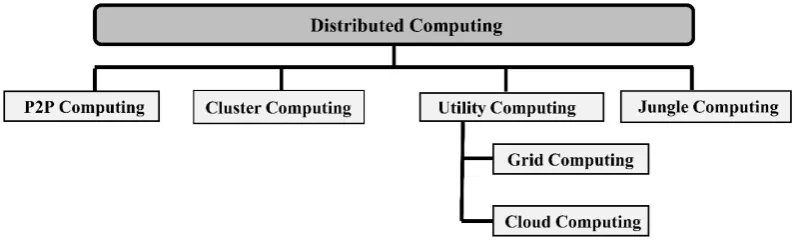
The way we do computing are changed due to rapid growth of the Internet and the availability of powerful computers. In recent decades, distributed computing plays a main role to solve a large scale problem. The classification of distributed computing is presented in Fig. [1]. The trend of systems is toward the use of Peer-to-Peer, utility, cluster, and jungle computing [10].
Figure 1: Distributed computing classification.
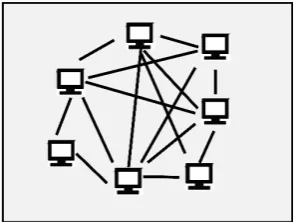
In a Peer-to-Peer system, every node performs as both a client and a server and presents part of the system resources. Figure [2] indicates that Peer-to-Peer system is self-organizing with distributed management.
Cluster computing is a type of computing that connects several nodes through fast local area networks. Performance and fault tolerance are two main reasons for providing a cluster instead of a single computer [24]. Figure [3] indicates the architecture of cluster computing.
Figure 2: Peer-to-Peer system.
Figure 3: Cluster computing.
Grid computing refers to cooperation of multiple clusters that are loosely coupled and are geographically distributed [3]. Figure 4 shows an overview of grid environment.
Figure 4: Grid computing.
refers to concurrent use of heterogeneous and distributed computing such as clusters, grids, clouds, independent computers, and more [10]. Figure 6 shows the jungle computing. Cluster computing, grid computing and cloud computing are similar in some aspects,
Figure 5: Cloud computing. Figure 6: Jungle computing.
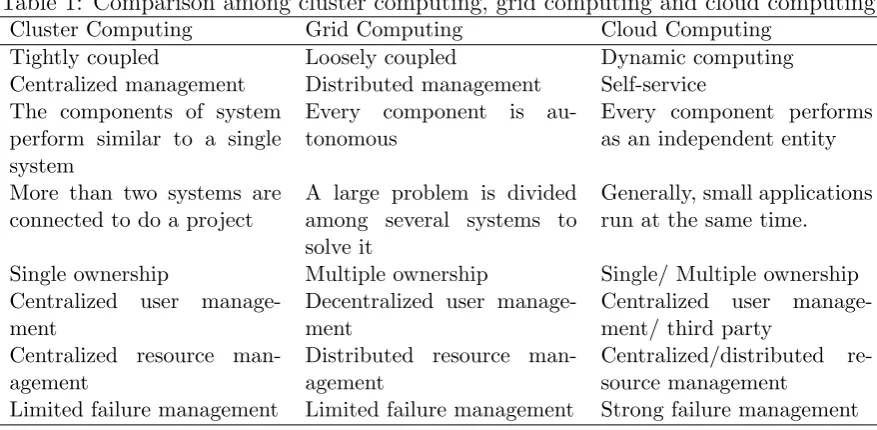
while there are some differences among these three technologies that shown in Table 1, [24].
Table 1: Comparison among cluster computing, grid computing and cloud computing.
Cluster Computing Grid Computing Cloud Computing
Tightly coupled Loosely coupled Dynamic computing
Centralized management Distributed management Self-service The components of system
perform similar to a single system
Every component is au-tonomous
Every component performs as an independent entity
More than two systems are connected to do a project
A large problem is divided among several systems to solve it
Generally, small applications run at the same time.
Single ownership Multiple ownership Single/ Multiple ownership Centralized user
manage-ment
Decentralized user manage-ment
Centralized user manage-ment/ third party
Centralized resource man-agement
Distributed resource man-agement
Centralized/distributed re-source management
Limited failure management Limited failure management Strong failure management
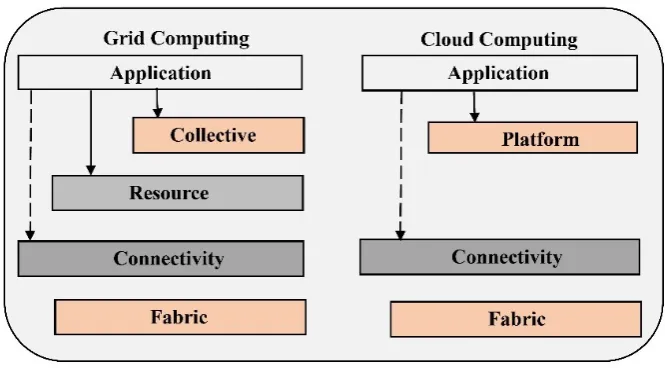
In this work, we focus on cloud and grid computing and so these environment have been described in detail. Figure 7 indicates the architecture of grid computing and cloud com-puting. Fabric layer contains different resources such as storage, network, and processors. Connectivity layer provides necessary security and communications. Collective layer in grid coordinating various resources. Application layer includes applications of user which execute in virtual organization environments [21].
Figure 7: Architectures of cloud and grid computing.
• IaaS (Infrastructure as a Service): Cloud providers provide various infrastructures for processing, storing, and networking such as virtual servers and storages. There-fore, users don’t need to handle these facilities except setting of some components such as host firewalls.
• PaaS (Platform as a Service): Cloud providers present a development environment based on the requirement of users. Therefore, users don’t need to install necessary software and worry about updating and purchasing the required software such as database.
• SaaS (Software as a Service): Cloud provider presents different types of applications and software for users. Therefore, user can pay some amount to the providers and use these software and applications with interfaces such as web browsers.
Generally cloud infrastructures are classified into four categories according to their scope of usage and methods of deployment [26].
• Private cloud: It refers to the he clouds that infrastructures are operated exclusively for an organization and hence gives high security compared to the other types of clouds. Three main features of private clouds are: (i) high security; (ii) Dedicated resources; and (iii) better customization.
• Public cloud: In public cloud, multiple users can use the cloud resources and services on the common environment. Some benefits of public cloud are: (i) high scalability; (ii) Easy and flexible setup; (iii) Pay-Per-Use.
• Community Cloud: It provides exclusive use for the organizations that have common objectives and security requirements. Therefore, establishing cost of community cloud is lower than personal private cloud.
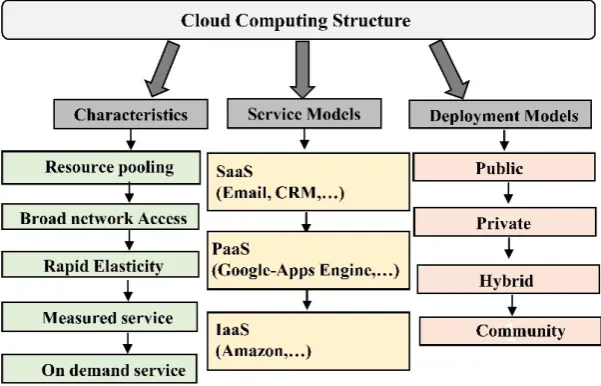
In Fig. 8, we can see five fundamental characteristics of cloud environment as rapid elasticity, measured services, on-demand self-service, resource pooling, and board network access.
Figure 8: Cloud computing structure.
To the best of our knowledge, this is the first review focusing on replica replacement algorithms for grid and cloud environments. The rest of the review is structured as follows. We start in section 3 by a brief description of the data replication. In section 4, we survey the replica replacement techniques. In addition, we use a tabular representation of all reviewed algorithms based on several main features to facilitate the comparison. Finally, section 5 presents the open research issues of replica replacement.
3
Data Replication
Nowadays, many scientific and applications like High Energy Physics process huge volume of data [15]. In this environment, effective data management is one important challenges. One common solution to effectively solve this issue is to rely on the data replication technique. Data replication can improve response time, throughput, and data availability with storing multiple replicas. Data replication is a hot topic for researchers in the distributed systems such as grid and cloud computing [16,20]. There are four important questions in data replication as follows.
• How many new replicas should be stored to make balance between performance and resource usage?
• Where new replica should be placed to improve network latency and response time?
• Which replicas should be deleted to provide enough space for storing new replica?
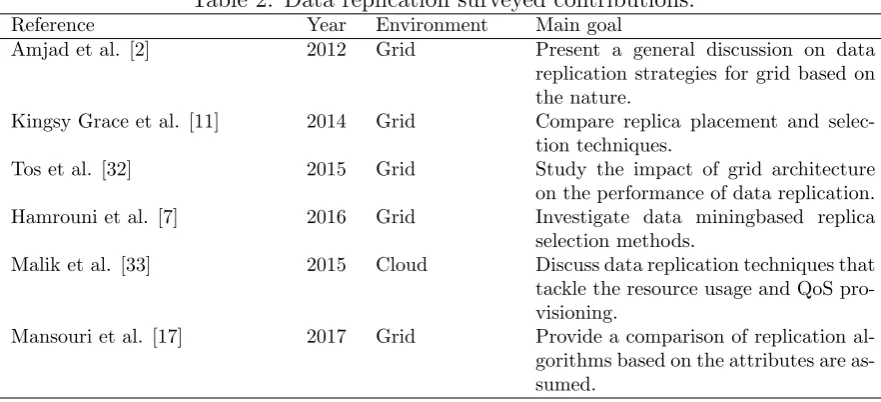
Table 2: Data replication surveyed contributions.
Reference Year Environment Main goal
Amjad et al. [2] 2012 Grid Present a general discussion on data replication strategies for grid based on the nature.
Kingsy Grace et al. [11] 2014 Grid Compare replica placement and selec-tion techniques.
Tos et al. [32] 2015 Grid Study the impact of grid architecture on the performance of data replication. Hamrouni et al. [7] 2016 Grid Investigate data miningbased replica
selection methods.
Malik et al. [33] 2015 Cloud Discuss data replication techniques that tackle the resource usage and QoS pro-visioning.
Mansouri et al. [17] 2017 Grid Provide a comparison of replication al-gorithms based on the attributes are as-sumed.
Generally, data replication is classified into two types. Static replication algorithm stores static number of replicas in predefined locations until users delete them. While dynamic replication approach adapts with the change in access pattern of users and status of system during replication process [17,18]. There are several review articles about data replication as listed in Table 2. The novelty of the work we present here, in relation to other surveys, is to focus on a study on replica replacement approaches for both data grid and cloud commuting environments.
4
Replica Replacement Algorithms
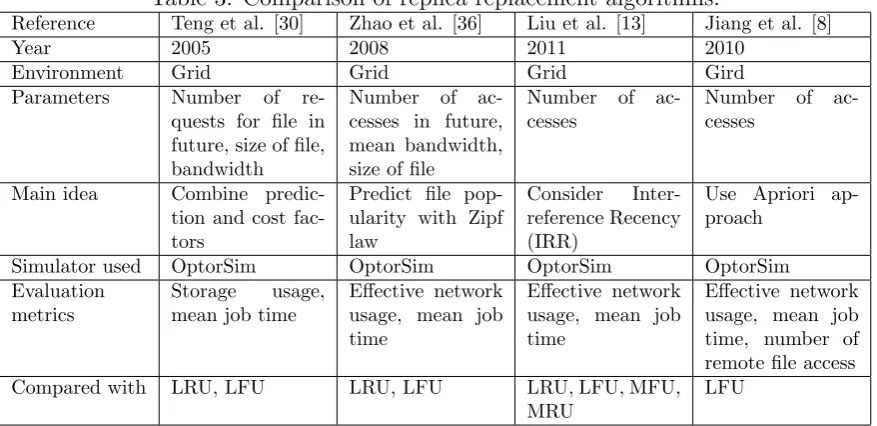
algorithm uses a Zipf-like distribution for predicting file popularity in next time interval. In addition, it considers bandwidth as main factor in replacement process since too much bandwidth usage may block the network. Therefore, the proposed strategy calculates the weight of each replica based on Eq. (1).
w(f) = N(f, t, T)× S(f)
B(f) (1)
Where N(f, t, T) indicates the prediction of number of accesses for file f based on Zipf distribution. S(f) is size of file andB(f) shows the mean of bandwidth of all the replicas in system. If the weight of new replica is higher than the replica in the local storage, that replica will be removed and the new replica will be stored into the local site. If enough storage is not available yet, the replacement process will continue. Experiment results demonstrated that the proposed strategy could perform better than Least Recently Used (LRU) and Least Frequency Used (LFU). Liu et al. [13] proposed a replacement
Table 3: Comparison of replica replacement algorithms.
Reference Teng et al. [30] Zhao et al. [36] Liu et al. [13] Jiang et al. [8]
Year 2005 2008 2011 2010
Environment Grid Grid Grid Gird Parameters Number of
re-quests for file in future, size of file, bandwidth
Number of ac-cesses in future, mean bandwidth, size of file
Number of ac-cesses
Number of ac-cesses
Main idea Combine predic-tion and cost fac-tors
Predict file pop-ularity with Zipf law
Consider Inter-reference Recency (IRR)
Use Apriori ap-proach
Simulator used OptorSim OptorSim OptorSim OptorSim Evaluation
metrics
Storage usage, mean job time
Effective network usage, mean job time
Effective network usage, mean job time
Effective network usage, mean job time, number of remote file access Compared with LRU, LFU LRU, LFU LRU, LFU, MFU,
MRU
LFU
Jiang et al. [8] designed a novel replica replacement strategy based on the Apriori approach for grid environment. The proposed method studies the associated access behaviors of each data intensive job. It considers the accessed files as items in grid environment. It defines the following rules for replacement process.
• When the frequency of set of files is lower than the minimum support then all files in that set should be deleted.
• It replaces itemset that has the least frequency with high priority one.
• If some itemsets have the same frequency then itemset with the smallest size will be selected for replacement.
• The data file that has the lowest value of confidence will be removed in that itemset.
Simulation results indicated that the proposed strategy could reduce number of remote file accesses.
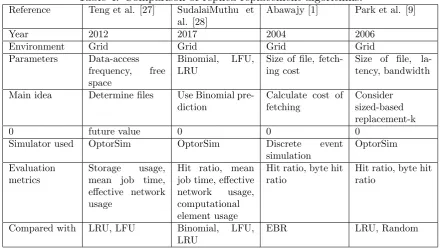
Table 4: Comparison of replica replacement algorithms.
Reference Teng et al. [27] SudalaiMuthu et al. [28]
Abawajy [1] Park et al. [9]
Year 2012 2017 2004 2006
Environment Grid Grid Grid Grid Parameters Data-access
frequency, free space
Binomial, LFU, LRU
Size of file, fetch-ing cost
Size of file, la-tency, bandwidth Main idea Determine files Use Binomial
pre-diction
Calculate cost of fetching
Consider sized-based replacement-k
0 future value 0 0 0
Simulator used OptorSim OptorSim Discrete event simulation
OptorSim Evaluation
metrics
Storage usage, mean job time, effective network usage
Hit ratio, mean job time, effective network usage, computational element usage
Hit ratio, byte hit ratio
Hit ratio, byte hit ratio
Compared with LRU, LFU Binomial, LFU, LRU
EBR LRU, Random
Soosai et al. [27] proposed a new replacement method named the Least Value Replacement (LVR). LVR strategy uses the following function for predicting the number of times a file will be accessed in the nextnrequests according to the past mrequests of the history [4]. The compared experiment results demonstrated that LVR strategy could execute jobs in lower time compared with LRU and LFU methods.
of the replica. Therefore, it assigns one of number range from 1 to 7 to each replica. For example, if replicar is chosen to be removed based on the only binomial prediction, then the vector is (1,0,0) and so the value of replicar is 4. If replicaris chosen to be removed based on only LFU, then the vector is (0,1,0) and so the value of replica r is 2. If it is determined by LRU and LFU then (0,1,1) gives 3. The low value of a replica means that it has low preference to replace.
Abawajy [1] proposed replica replacement algorithm based on locality, size and cost of files to achieve the best performance possible of grid environment. The proposed strategy keeps size of each file and the cost for fetching each file from remote site. The fetching cost is determined based on Eq. (2).
Cost(f, v, u) =Tprocess(v) +Latency+
size(f)
bandwidth(v, u) (2)
Where Tprocess indicates the processing time, Latency shows the latency for transferring
file f, size(f) is size of file, and bandwidth(v, u) shows the bandwidth between node v
and node u. The proposed algorithm considers local information to find the file that has size equals to or greater than the new replica to be replaced. In other words, it doesn’t remove small files that are least recently used and hence it saves many misses. The results of experiments indicated that the proposed algorithm substantially increases hit ratio compared to the economic-based cache replacement (EBR) strategy [6].
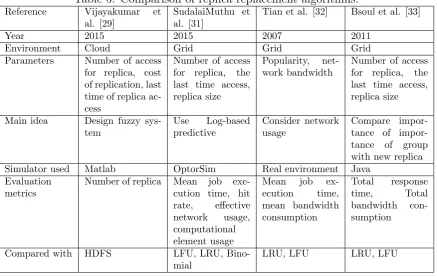
Park et al. [9] introduced a new replacement strategy, called SRB-k(size-based replacement-k). The proposed strategy does not use additional resources such as stacks. It replaces replicas without forecasting future requests, it chooses only a minimum number of files to be replaced in the future. If size of new replica is s then SRB-k strategy finds a file in the local site that its size is r. If there is a file with size s then the file is deleted for providing enough space for new replica. Otherwise, SRB-k strategy applies the replica replacement method considering the k value, which is proportional to the size of the new replica. For instance, if the size of new replica is 1000MB and k is 0.1 (or 10%), then the size of k is 100MB. In other words, 10% of the size of the new replica. If there is no file of that size in the local site and k is 0.1. Then q is obtained by summing the size of new replica and k value. So in this example q equals to 1100MB.p is set of files in local site that their size larger than r and smaller than q. Now, SRB-k strategy deletes a file from p set for replacing based on LRU. The results of simulation demonstrated that the proposed algorithm outperforms than LRU and Random when the storage size was large. Vijayakumar et al. [34] presented a replica replacement for cloud environment based on fuzzy inference system. The designed fuzzy system has three inputs as number of access for replica, cost of replication, last time of replica access. It is obvious that the replica with high number of access and high cost is not suitable for replacement. So fuzzy system assigns a value to each replica and the replica with the lowest value is candidate for deletion. According to the results of performance evaluation, the proposed algorithm provides better fault tolerance than HDFS [37].
Table 5: Comparison of replica replacement algorithms.
Reference Vijayakumar et al. [29]
SudalaiMuthu et al. [31]
Tian et al. [32] Bsoul et al. [33]
Year 2015 2015 2007 2011
Environment Cloud Grid Grid Grid Parameters Number of access
for replica, cost of replication, last time of replica ac-cess
Number of access for replica, the last time access, replica size
Popularity, net-work bandwidth
Number of access for replica, the last time access, replica size Main idea Design fuzzy
sys-tem Use Log-based predictive Consider network usage Compare tance of impor-tance of group with new replica Simulator used Matlab OptorSim Real environment Java
Evaluation metrics
Number of replica Mean job exe-cution time, hit rate, effective network usage, computational element usage
Mean job ex-ecution time, mean bandwidth consumption Total response time, Total bandwidth con-sumption
Compared with HDFS LFU, LRU, Bino-mial
LRU, LFU LRU, LFU
of accesses, the last time access, and replica size. Since the number of access in previous time gives an indication of future requests in the system. In addition, the file size has a main role on network bandwidth and storage usage and hence file size is considered as well. Simulation results demonstrated that the log based predictive replacement strategy performs better about 30% than Binomial based replica replacement algorithm in mean job execution time.
the new replica. It calculates the value of group based on Eq. (3).
GV =
n
P
i=1
N ORi
n P i=1 Sizei + n P i=1
N ORF ST Ii
F ST I +
1 CuT − n P i=1 LTi n (3)
Where n indicates number of files in the group and Sizei shows the size of file i in the
group. N ORi and F ST I show the number of accesses of file i and the frequency specific
time slide, respectively. CuT and LTi indicate the current time and the last request time
of file i, respectively. The simulation results presented that the improved Fast Spread algorithm outperforms than Fast Spread with LRU and Fast Spread with LFU.
Table 6: Comparison of replica replacement algorithms.
Reference Sun et al. [35] Sashi et al. [23] Mehraban et al. [19]
Madi et al. [14]
Year 2012 2013 2013 2011
Environment Cloud Grid Grid Grid Parameters System
availabil-ity, time of access, failure probabil-ity, replica size
Number of access for replica, replica size, bandwidth
Popularity, net-work bandwidth, size of replica
Number of access for replica, time of access
Main idea Consider failure probability
Assume a region based network Apply Half-life concept Use exponential growth/decay concept Simulator used CloudSim OptorSim OptorSim OptorSim Evaluation
metrics
System byte ef-fective rate, re-sponse time, suc-cessful execution rate
Mean job execu-tion time, stor-age usstor-age, effec-tive network us-age, number of replication
Mean job execu-tion time, stor-age usstor-age, effec-tive network us-age, number of replication
Mean job execu-tion time, hit ra-tio, effective net-work usage
Compared with - LFU LRU, LFU LRU, LFU
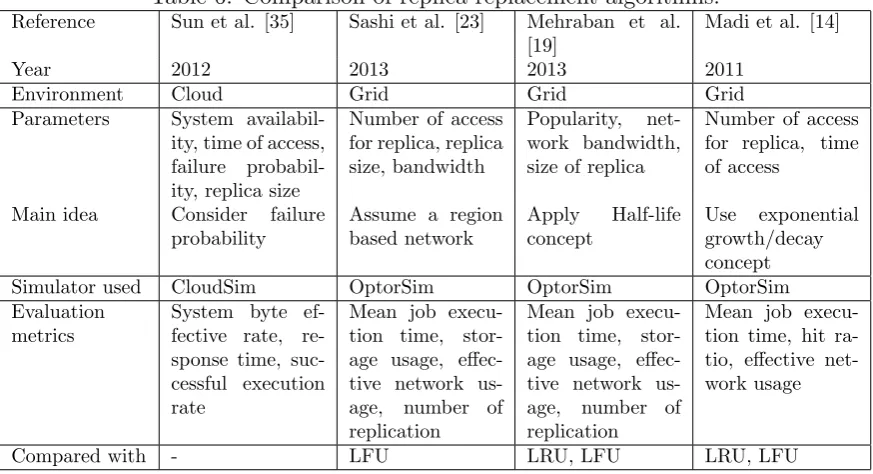
Sun et al. [35] proposed a new replication algorithm to improve data availability in cloud environment. The proposed strategy presents a mathematical model to describe the relationship between the number of replicas, system availability, time of access and failure probability of file. It determines the popularity of files based on the history of access and then if the popularity of a file exceeds from a dynamic threshold then replication is triggered. If the storage of selected node is not enough for new replica then it sorts all files in descending order by Replica Factor (RF) and removes the file with the lowestRF.
RF is obtained based on Eq. (4).
RFi =
P opFi N Ri×SFi
(4)
of file i. Simulation results proved that the proposed strategy improves task successful execution rate.
Sashi et al. [23] presented a replica replacement algorithm for a region based network. The proposed algorithm predicts the popularity of the file and also takes into account the size of the replica with its bandwidth cost. Popularity of file is defined as access frequency. The cost of replica is obtained as Eq. (5).
Cost(f) = AccF requency(f)× Size(f)
Bandwidth(f) (5)
Where Bandwidth(f) is given by Eq. (6).
Bandwidth(f) =
n
P
i=1
Bi
n (6)
Where n is number of replicas for file f. Finally, the proposed strategy deletes replicas that have low popularity and cost. Results of simulation indicated that the proposed strategy improves the network usage and job execution time.
Mehraban et al. [19] introduced a replica replacement algorithm that automatically de-termines which replica to be removed whenever the storage space of the grid node is full. The presented algorithm enhances the property of the temporal locality by considering frequency of file access, priority file, age, free storage space to find the victim file. It uses the Half-life concept to calculate the popularity of file. Therefore, popularity is obtained as Eq. (7).
AF(f) =
NT
X
t=1
(acctf ×2−(NT−t)) (7)
WhereN T indicates the number of time intervals that are passed and acct
f is the number
of accesses for the file f in time interval t. In addition the proposed strategy computes transfer cost based on the size of replica and bandwidth. Now priority replica is deter-mined as Eq. (8).
P riority(f) =α×AF(f) +β×T ransf er Cost (8)
Where α and β are coefficients of the formulas. The proposed strategy deletes replica that has the lowest priority in replacement process. Results of experimental indicated that the proposed replacement algorithm reduces execution time since it deletes victim replicas that have less valuable in the future.
Madi et al. [14] proposed a replica replacement strategy to provide a better grid perfor-mance. The proposed strategy assigns a value to each replica based on the exponential growth/decay concept. Value of file can be given as Eq. (9).
WhereNt
f indicates the number of access for filef at timetandris obtained as Eq. (10).
r = (N
t+1 f
Nt f
)−1 (10)
WhereNft+1 indicates the number of access for filef at timet+1. The proposed algorithm deletes less valuable file to provide sufficient space for storing new replica. Simulation results demonstrated that the proposed strategy could increase hit ratio in grid system.
5
Conclusion
References
[1] Abawajy, J.H., File replacement algorithm for storage resource managers in data grids, Lecture notes in computer science, 3038 (2004) 339-346.
[2] Amjad, T., Sher, M., Daud, A., A survey of dynamic replication strategies for im-proving data availability in data grids, Future Generation Computer Systems, 28 (2012) 337-349.
[3] Azari, L., Rahmani, A. M., Daniel, H.A. Nasih Qader, N. A data replication algo-rithm for groups of files in data grids, Journal of Parallel and Distributed Computing, 113 (2018) 115-126.
[4] Bell, W.H., Cameron, D.G., Carvajal-Schiaffino, R., Millar, A. P., Stockinger, K., Zini, F., Evaluation of an economy- based file replication strategy for a data grid, In: 3rd IEEE/ACM International Symposium on Cluster Computing and the Grid, (2003).
[5] Bsoul, M., Al-Khasawneh, A., Eddien Abdallah, E., Kilani, Y., Enhanced fast spread replication strategy for data grid, Journal of Network and Computer Applications, 34 (2011) 575-580.
[6] Carman, M., Zini, F., Serafini, L. K., Stockinger, K., Towards an economy-based optimization of file access and replication on a data grid, In: Proceedings of 2nd CCGRID (2002) 120-126.
[7] Hamrouni, T., Slimani, S., Ben Charrada, F., A survey of dynamic replication and replica selection strategies based on data mining techniques in data grids, Engineering Applications of Artificial Intelligence, 48 (2016) 140-158.
[8] Jiang, J., Ji, H., Xu, G., Wei, X., ARRA: an associated replica replacement algorithm based on Apriori approach for data intensive jobs in data grid, Key Engineering Materials, 439 (2010) 1409-1414.
[9] Jin Park, H., Hoon Lee, C., Sized-based replacement-k replacement policy in data grid environments, In: International Symposium on Parallel and Distributed Pro-cessing and Applications, (2006) 353-361.
[10] Kahanwal, B. Pal Singh, T., The distributed computing paradigms: P2P, Grid, Clus-ter, Cloud, and Jungle, International Journal of Latest Research in Science and Tech-nology, 1 (2) (2012) 183-187.
[12] Kumari, P., Kaur, P., A survey of fault tolerance in cloud computing, Journal of King Saud University Computer and Information Sciences, (2018).
[13] Liu, W., Shi, F. Du, W., An LIRS-based replica replacement strategy for data-intensive applications, in: 10th International Conference on Trust, Security and Pri-vacy in Computing and Communications, (2011) 1381-1386.
[14] Madi, M., Yusof, Y., Hassan, S. Almomani, O., A novel replica replacement strategy for data grid environment, In: International Conference on Software Engineering and Computer Systems, (2011) 717-727.
[15] Mansouri, N., QDR: a QoS-aware data replication algorithm for Data Grids consid-ering security factors, Cluster Computing, 19 (3) 1071-1087.
[16] Mansouri, N., Javidi, M.M., A new prefetching-aware data replication to decrease access latency in cloud environment, Journal of Systems and Software, 144 (2018) 197-215.
[17] Mansouri, N., Javidi, M.M. A Survey Of Dynamic Replication Strategies For Im-proving Response Time In Data Grid Environment, AUT Journal of Modeling and Simulation, 49 (2) (2017) 239-264.
[18] Mansouri, N. Adaptive data replication strategy in cloud computing for performance improvement, Frontiers of Computer Science, 10 (5) (2016) 925-935.
[19] Mehraban, M., Khademzadeh, A., Salehnamadi, M.R., A prediction-based replica replacement strategy in data grid, Journal of Basic and Applied Scientific Research, 3(4) (2013) 928-939.
[20] Omer, K., Abdalla, G.M.T., Dynamic Algorithms Replication Using Grid Comput-ing, In: International Conference on Computer, Control, Electrical, and Electronics Engineering, (2018) 1-6.
[21] Samimi, P., Patel, A., Review of pricing models for grid and cloud computing, In: IEEE Symposium on Computers and Informatics, (2011).
[22] Salehnamadi, M. R., Ghaheri, B., New replication method in data grids based on weighted files, Journal of Basic and Applied Scientific Research, 3(7) (2013) 546-553.
[23] Sashi, K., Santhanam, T., Replica replacement algorithm for data grid environment, ARPN Journal of Engineering and Applied Sciences, 8 (2) (2013) 86-90.
[25] Shuai Zhang, Shufen Zhang, The comparison between cloud computing and grid com-puting, In: International Conference on Computer Application and System Modeling, (2010) 72-75.
[26] Singh, S., Jeong, Y.S., Park, J.H., A survey on cloud computing security: Issues, threats, and solutions, Journal of Network and Computer Applications,75 (2016) 200-222.
[27] Soosai, A.M., Abdullah, A., Othman, M., Latip, R., Nasir Sulaiman, M., Ibrahim, H., Dynamic replica replacement strategy in data grid, In : 8th International Conference on Computing Technology and Information Management, 2 (2012) 578-584.
[28] SudalaiMuthu, T., RameshKumar, K., Hybrid predictive approach for replica re-placement in data grid, In: International Conference on Computer Communication and Informatics, (2017).
[29] SudalaiMuthu, T., RameshKumar, K., a log-based predictive approach for replica replacement in data grid, In: International Conference on Advanced Computing and Communication Systems, (2017).
[30] Teng, M., Junzhou, L., A prediction-based and cost-based replica replacement algo-rithm research and simulation, In: Proceedings of the 19th International Conference on Advanced Information Networking and Applications, (2005).
[31] Tian, T., Lu, J., A VO-based two-stage replica replacement algorithm, In: Interna-tional Conference on Network and Parallel Computing, (2007) 41-50.
[32] Tos, U., Mokadem, R., Hameurlain, A., T. Ayav, S. Bora, Dynamic replication strate-gies in data grid systems: a survey, The Journal of Supercomputing, 71 (11) (2015) 4116-4140.
[33] Tziritas, N., Kolodziej, J., Zomaya, A.Y., Madani, S.A., Min-Allah, N., Wang, L., Xu, C.Z., Marwan Malluhi, Q., Pecero, J.E., Balaji, P., Vishnu, A., Ranjan, R., Zeadally , S., Li, H., Performance analysis of data intensive cloud systems based on data management and replication: a survey, Distributed and Parallel Databases, 34 (2) (2015) 179-215.
[34] Vijayakumar, D., Srinivasagan, K. G., Sabarimuthukumar, R., FIR3: a fuzzy infer-ence based reliable replica replacement strategy for cloud data center, Conferinfer-ence on Computing and Network Communications, (2015) 473- 479.
[36] Zhao, W., Xu, X., Xiong, N., Wang, Z., A weight-based dynamic replica replacement strategy in data grids, In: IEEE Asia-Pacific Services Computing Conference, (2008) 1544-1549.